
Press release from RSPB, 18 September 2026:
CAUTIOUS OPTIMISM AS RECORD YEAR FOR HEN HARRIER CHICKS AT RSPB GELTSDALE
Thirteen Hen Harrier chicks have successfully fledged at RSPB Geltsdale in Cumbria. The remarkable achievement marks the highest number of Hen Harrier chicks to fledge at the nature reserve in a single breeding season since records began more than a century ago. It reflects the dedication of reserve staff and volunteers, who worked tirelessly to protect nesting birds and support the adults as they raised their young.
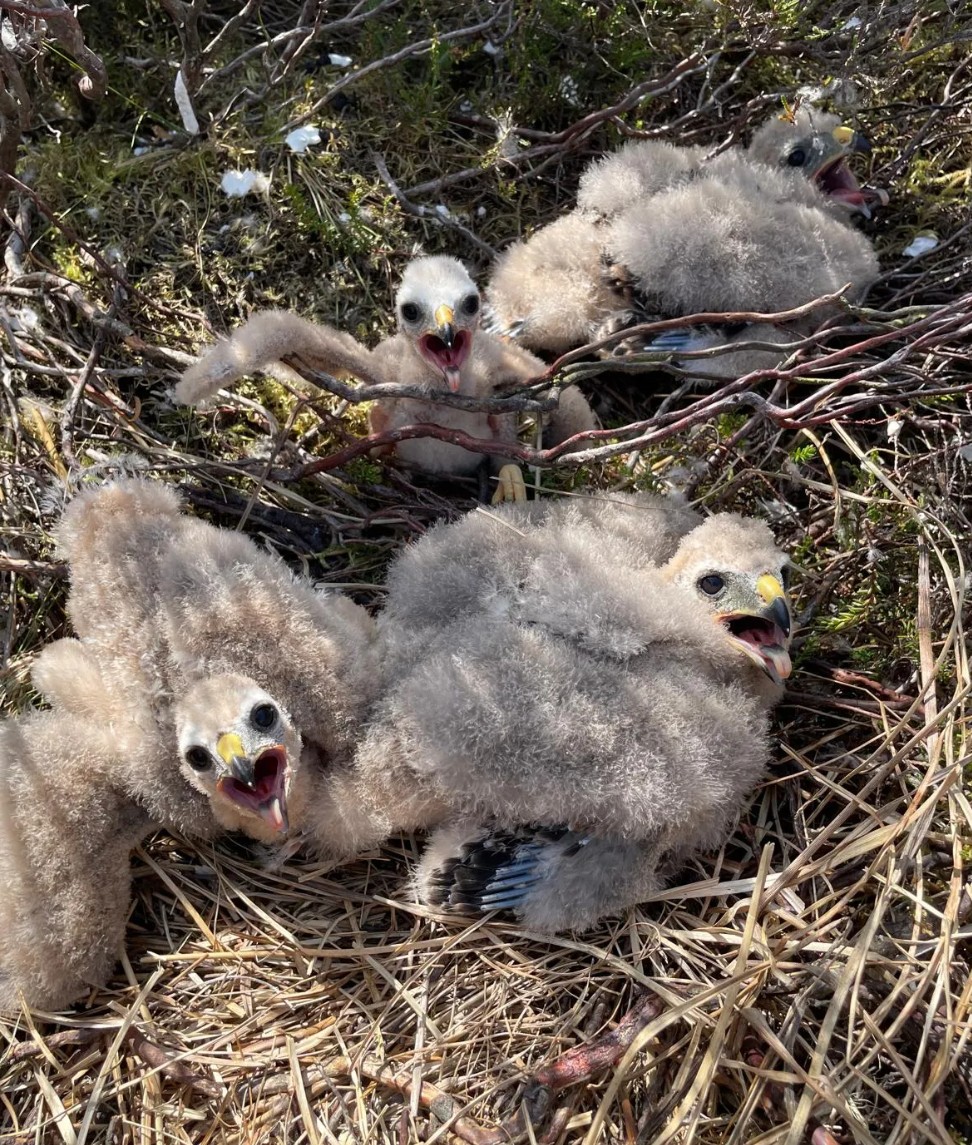
The success offers hope for the species’ recovery, but illegal persecution remains a major threat for this spectacular bird of prey. Once hunted to extinction as a breeding bird in England by 1900, Hen Harriers returned to the north Pennines in the 1950s. However, the illegal killing of these amazing birds, that are celebrated for their sky dancing, has continued and to this day they still are only found at a handful of sites in England.
Despite this year’s success, illegal persecution continues to limit the recovery of Hen Harriers in England. This year at Geltsdale, staff set up Natural England-licensed diversionary feeding stations. This well-established technique is used to minimise the adults preying on grouse on neighbouring shooting estates when they are feeding their young. Staff also actively monitored the nesting sites day and night to minimise disturbance, working around the clock.
Celebrating the news, Ian Ryding, reserve manager at RSPB Geltsdale said:
“Hen Harriers are amazing birds, their sky dancing as the male passes food to the female is a spectacular sight everyone visiting the Cumbria should have the chance to see. But sadly, even as we celebrate this amazing success that should be giving us hope for the future of a Red-listed species, there is the spectre that these birds will soon be targeted by those who think nothing of killing our wildlife when it threatens their profits.
“By supporting both parents we have seen three nests thrive and 13 chicks fledge, the most for at least a century in this part of the world. We hope to see these chicks return in future years to raise their own families, but unfortunately we fear that for that to happen we will need to see more done to stop the illegal killing of these special birds“.
According to Government estimates, England’s uplands have the capacity to support at least 300 pairs of Hen Harriers. Yet the species remains on the UK Red List and far below its potential population size.
Evidence gathered over many years continues to show that illegal persecution is one of the principal barriers to recovery, with many birds disappearing in and around areas managed for grouse shooting. The RSPB is therefore calling for the introduction of licensing for gamebird shooting across the UK.
A licensing system, similar to that introduced for grouse moor management in Scotland in 2024, would be a proportionate and cost-effective measure aimed at deterring wildlife crime and helping to secure a future for Hen Harriers. Without further action, conservation successes such as this year’s record breeding season at RSPB Geltsdale risk remaining the exception rather than becoming the norm.
This year’s success at RSPB Geltsdale is an amazing and much needed success for Hen Harriers, and a credit to the hard work of the people involved in helping these birds get the best possible start to life. A number of the chicks have already been tagged so their progress can be tracked as they set out into the world.
Ian Ryding concluded: “For now, thirteen young Hen Harriers taking to the skies above Geltsdale is a reason to celebrate. The challenge is ensuring they survive long enough to return and raise families of their own“.
ENDS
Great news from the RSPB’s Geltsdale Reserve, and yet more evidence that Hen Harriers can do really well on RSPB-managed moorland (see this year’s success at Bowland this year, here), especially when they’re encouraged not to hunt on nearby grouse moors, where there’s a long history of hunting males ‘disappearing’ (e.g. at Geltsdale: 1 x hunting male in 2020, 2 x hunting males in 2021, 2 x hunting males in 2023, 2 x hunting males in 2025, see here, here, and here) or being found dead with gunshot injuries (e.g. 1 x hunting male in 2023, here).
Funnily enough, I’ve yet to see any evidence of record Hen Harrier breeding success on English grouse moors this year, despite the repeated claims by shooters on social media that ‘Hen Harriers do better on grouse moors than on RSPB-managed moors‘.
The evidence just doesn’t support that myth – e.g. see here for last year’s report from Natural England, where perhaps 3 of 39 Hen Harrier breeding attempts were on privately-owned grouse moors. Natural England has not yet published the figures for this year’s Hen Harrier breeding attempts.
I’m afraid I don’t agree with the RSPB’s call for gamebird licensing. It isn’t working in Scotland, where grouse shoot licensing was introduced in 2024 and yet the illegal killing of birds of prey continues without significant consequence, so there’s no reason to believe that licensing would work in England. Athough licensing would definitely be better than maintaining the status quo, I just don’t see it as a long-term solution.
Defra’s current Call for Evidence on all aspects of gamebird rearing, releasing and shooting in England, which will be used to inform future policy in this area, is very welcome. More on that next week.


The grouse estate xxxxx xxxxx xxxxx xxxxx xxxxx estate is a notorious spot for persecution. In 2010 we did a hillwalk on xxxxx onto the high Pennine ridge. Just below the sky line there was a tin shack shooting hut. Next to the hut was a dry stone wall and the decomposed bodies of two Peregrines and a Buzzard. This was all reported to RSPB investigations with OS grid refs etc. The officer went up and retrieved the corpses shortly afterwards. The keepers were so brazen that they left the birds bodies exposed just a few yards from the hut. Licensing won’t solve this persecution of raptors.
That’s the hard core that we’re up against – scared of nobody! If challenged, and in the absence of witnesses, they would no doubt claim that the carcasses were planted.
Persecution will never end until gamebird shooting is abolished and I don’t understand why the RSPB is being so mim-mouthed about this issue, they must know this too, let’s face it, the sort of people who form their member base are not the same as those who participate in shooting
Hi Ruth,
The article says that “a number of the chicks have already been tagged”. Do you know how many of the 13 have or will be tagged?
thanks.
Hi Urtica,
I don’t, sorry.
If anyone is on social media and gets the “harriers do better on grouse moors” treatment (which to my mind is repeated in a way that increasingly resembles a political slogan in a dystopian novel), just ask them which ones – which grouse moors? Name them, give us the data and who verified the evidence (was it confirmed by NE, RSPB, a respected body of raptor monitors, or a respected ornithological contractor ) Why be shy when your reputation is deep in the sewer because of this?
If you are speaking to someone who is promoting social media pulp fiction on behalf of estates in the North Pennines, then even better. You will have the opportunity to ask them specifically about the nesting successes of harriers on the many large estates that either neighbour RSPB Geltsdale directly or are a typical daily harrier’s hunting flight away (I won’t name them to save blog editor covering them with xxxxxx ‘s, but they are easily researched) A social media PR outfit such as the Northern Pennines Moorland Group will surely be able to help – their pages are after all frequently plastered with photos of easily recognised smiling keepers from those very estates, often doing “unsung hero” (yet well advertised!) ordinary good deeds in the local community. And of course keepers “know their beats intimately”, we are constantly told.
According to the maxim of “harriers do better on grouse moors” one would expect that if RSPB Geltsdale could produce “X” number of fledglings from it’s c14,000 acres (13 this year) – then an area ten times bigger (c140,000 acres or a chunk of grouse moors in that area (depending which ones you wish to count, some of which are celebrated as among the best grouse moors on planet earth) should produce a rough minimum* of “X multiplied by 10” of whatever RSPB Geltsdale has in any given year. But they hardly ever produce anything at all. How odd. *in fact they should (by the received logic that the industry promotes i.e. estates worked hard to get rid of the evil foxes and crows, etc.). produce a hell of lot more than merely that mirror ratio! As – again – they promote their “predator management” dividend as being a significant multiplying factor with other ground nesters such as Curlews and Merlin?
But the inescapable truth is there are only ever a pitiful handful or two of fledglings from all and every driven grouse moor combined in the whole of England, never mind in “just” the North Pennines.
Guy Shrubsole’s Who Owns England blog is a very helpful resource for tracking down shooting estates and their owners (assuming the actual ownership isn’t being disguised behind shell companies).
Just in case anyone didn’t already know…