A four-day trial is set to begin today at Aberdeen Sheriff Court in a case against two Scottish gamekeepers who are charged with offences in relation to the alleged killing of Red Kites in the Cairngorms National Park in February 2025.
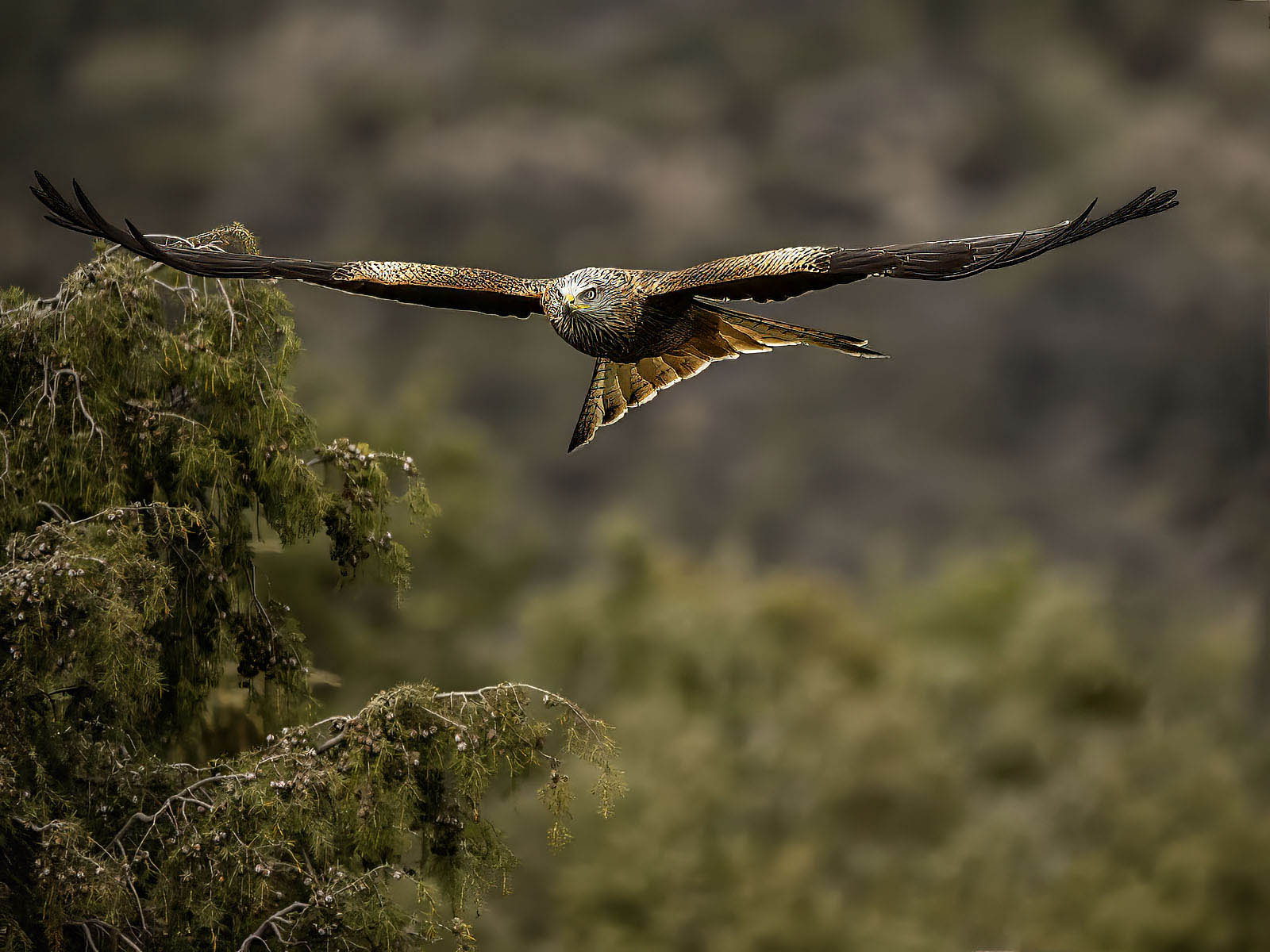
Red Kite photo by Ronnie Gilbert
Head gamekeeper Graeme Rankin and assistant gamekeeper Steven Hague have denied the charges.
This trial was due to be heard in December 2025 but was adjourned after the Sheriff made a declaration that he was a monthly subscriber to the RSPB. The two defence advocates, both KCs, lodged a motion that the Sheriff should consider recusing himself because the ‘public might perceive some bias’. The Sheriff agreed to stand down because this case involves RSPB staff members as witnesses for the prosecution.
NB: Comments are turned off as legal proceedings are live.
UPDATE 1 May 2026: Trial extended for two Scottish gamekeepers accused of offences relating to alleged shooting of Red Kites in Cairngorms National Park (here)
UPDATE 18 June 2026: More detail on trial of two Scottish gamekeepers charged with alleged shooting of Red Kites in Cairngorms National Park (here)
A man has been found not guilty of criminal damage in relation to the dumping of 50 dead Hares outside Broughton Community Shop in Hampshire, but has been found guilty of being in possession of two dead birds of prey, a Kestrel and a Barn Owl, that were found rammed up against the shop’s door handles.
James ‘Jimmy’ Kempster, 39, of Bury Brickfield Park in Totton, Southampton, had been accused of being one of three masked men involved with the shocking incident that was caught on CCTV in the early hours of 15th March 2024.
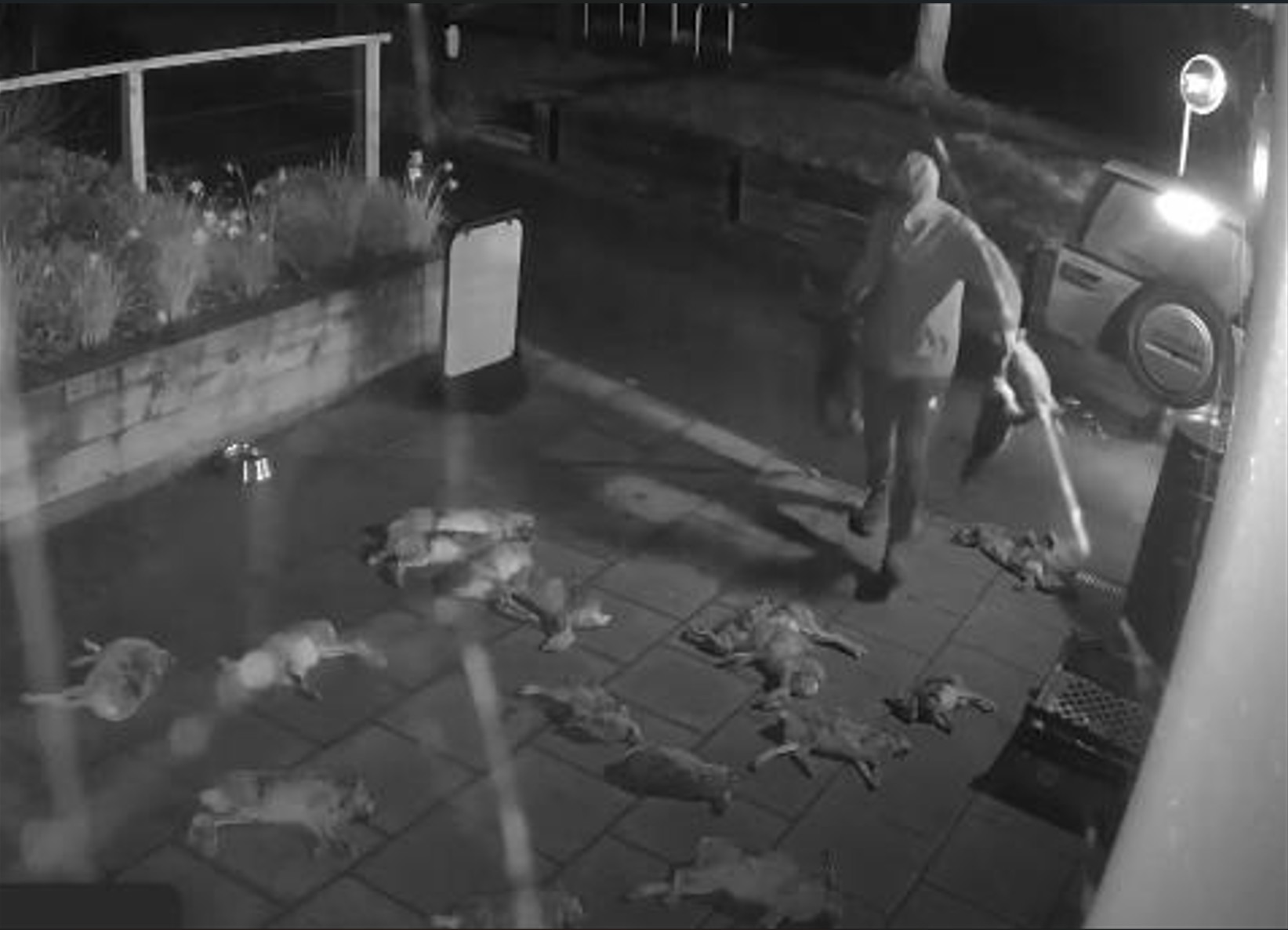
Screen grab from the CCTV footage outside Broughton Community Shop
The prosecution argued that DNA found on the dead birds was matched to Kempster and that he was also linked to the incident through his mobile phone location, his clothing and connections to the vehicle, which was found burnt out in a country lane.
However, after a two-day trial that concluded at Southampton Magistrates’ Court yesterday, the magistrates decided that there was insufficient evidence to show that Kempster was involved, or even at the scene, so declared him not guilty of criminal damage to the shop windows.
They did, however, accept the DNA evidence and determined that Kempster had been in possession of the dead raptors at some point, but that didn’t necessarily mean he was the individual seen on the footage ramming the birds’ corpses up against the shop’s door handles. He was found guilty of possession of a dead schedule 1 wild bird, and possession of a dead non-schedule 1 wild bird under the Wildlife and Countryside Act 1981.
Sentencing was adjourned for background reports and Kempster was released on bail, to return to the same court on 23 June 2026.
Kempster has 13 previous convictions, including several relating to Hare coursing offences (e.g. see here in Wiltshire) and a conviction for possession of an offensive weapon (catapult) when he was involved in a mass brawl between feuding families at Wickham Horse Fair in Hampshire (see here).
UPDATE 30 June 2026: James Kempster sentenced for possession of dead raptors found impaled on community shop door handle in Broughton, Hampshire (here)
Following the news earlier today that Scottish gamekeeper and former convicted sex offender Russell Douglas Mason has been sentenced for beating a Goshawk to death with a stick on a Perthshire shooting estate (here), the Crown Office & Procurator Fiscal Service (COPFS) has published the following statement:
GAMEKEEPER FINED AFTER BEATING TO DEATH PROTECTED BIRD OF PREY
A gamekeeper who clubbed a protected bird of prey to death has been sentenced
Hidden camera footage showed Russell Mason, 49, striking the goshawk with a cosh six times after it had been caught inside a crow cage trap on Cockrage Moor, Perthshire.
He then put the dead bird in a carrier bag before driving away from the scene at the Milton of Drummie Estate in a Polaris Ranger motor vehicle.
Mason, who worked on the estate, was sentenced at Perth Sheriff Court after pleading guilty to catching and killing the rare raptor on 12 February 2024.
He also admitted a charge of illegally storing ammunition at his home outwith the terms of his firearms licence.
Mason was handed a 200-hour community payback order for killing the goshawk and fined £890 for firearm offences.
Prosecutor Iain Batho, who leads on wildlife crime for the Crown Office and Procurator Fiscal Service (COPFS), said:
“It is highly important to preserve Scotland’s natural heritage, including the wildlife that forms part of it. As such, wild birds are given strict protection by our law.
“Russell Mason’s brutal and wholly unnecessary actions resulted in the suffering and death of a rare and magnificent bird of prey.
“COPFS takes raptor persecution seriously and will prosecute individuals where there is sufficient evidence of a crime and where it is in the public interest to do so.
“The result in this case is a testament to the collaborative working between COPFS, Police Scotland, and Science and Advice for Scottish Agriculture (SASA), who in this case were able to provide vital forensic evidence“.
Staff from the Royal Society for the Protection of Birds (RSPB) had set up the static camera on public ground to monitor activity at the trap.
After reviewing the footage on February 14, they saw Mason had entered the trap two days earlier carrying a handheld net.
After catching the goshawk, he is then seen striking it six times with a cudgel or similar instrument.
RSPB officials alerted the Scottish Society for the Protection of Animals (SSPCA) who, in turn, informed the National Wildlife Crime Unit.
An avian vet who subsequently reviewed the footage said the bird would have suffered several fractures and died a painful death.
Officers identified Mason from his gamekeeping duties and his vehicle registration.
DNA from the goshawk was found by officers from the Science and Advice for Scottish Agriculture (SASA) on a cudgel found at his home.
During a police search of his home on the estate, officers also recovered a quantity of ammunition from his car and on top of set of bedroom drawers, which were not appropriately stored in accordance with his firearms licence.
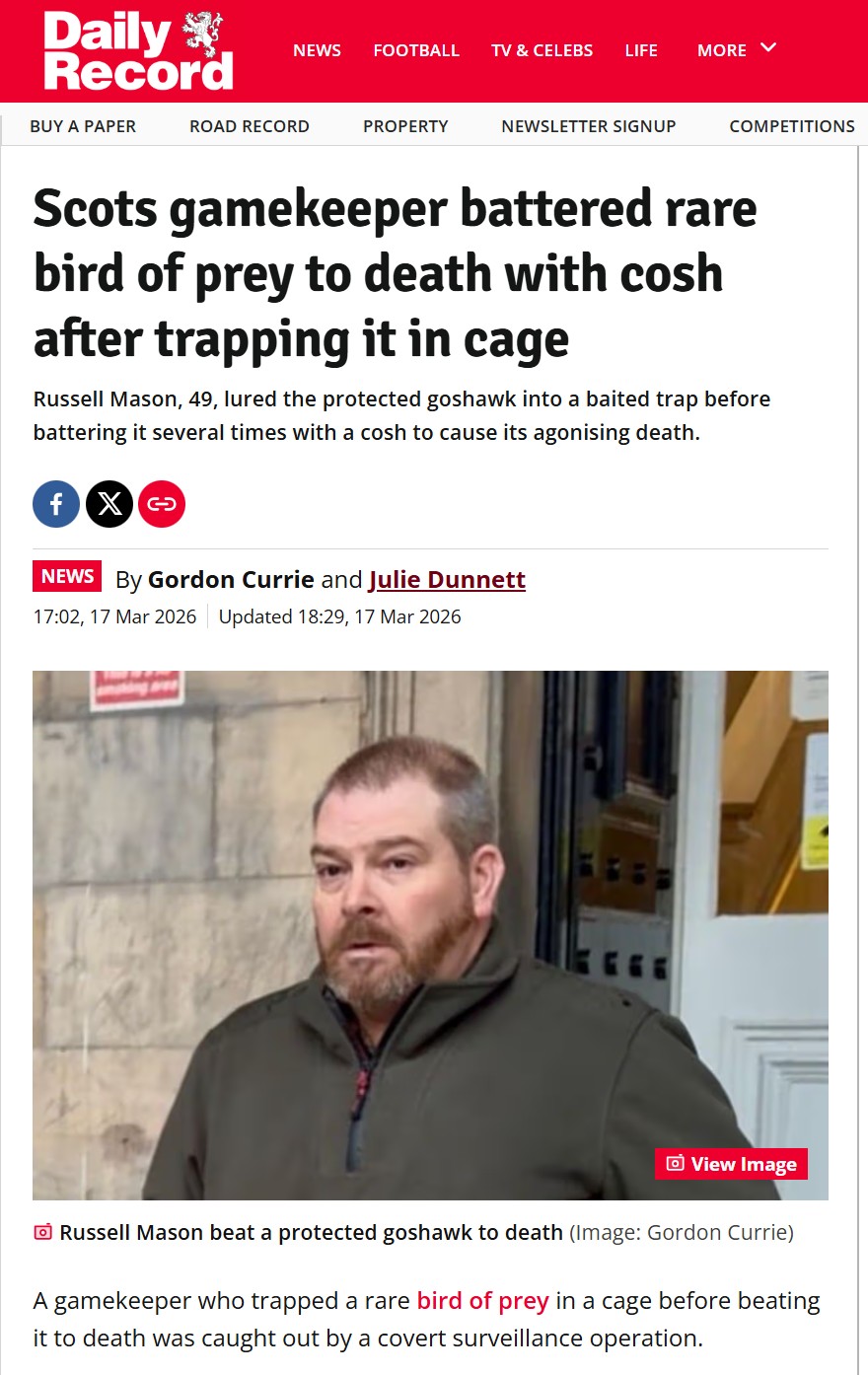
Scottish gamekeeper and former convicted sex offender Russell Douglas Mason, 49, attended a sentencing hearing at Perth Sheriff Court this morning, after pleading guilty last month to the brutal killing of a Goshawk that he battered to death inside a Crow cage trap on a shooting estate in Perthshire (see here for previous blog with case details).
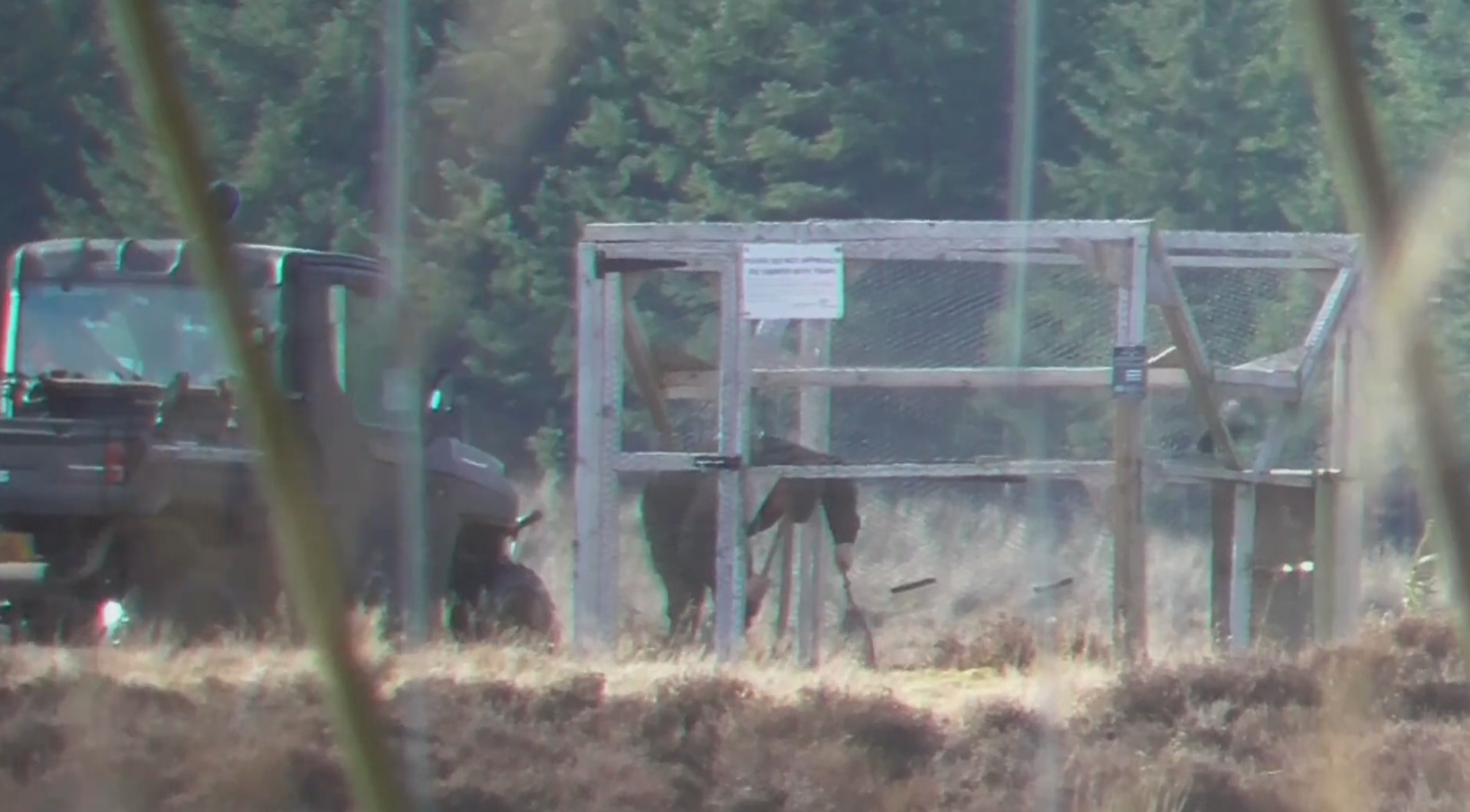
Screen grab from RSPB covert footage showing gamekeeper Mason beating the Goshawk to death inside a Crow cage trap on the Milton of Drimmie Estate, Perthshire
Here is a press release from the RSPB, following sentencing:
GAMEKEEPER FROM PERTHSHIRE SHOOTING ESTATE FINED FOR BEATING PROTECTED BIRD OF PREY TO DEATH
In February 2024, video footage gathered by the RSPB showed gamekeeper Russell Mason brutally killing a protected Goshawk whilst it was caught in a cage trap near Bridge of Cally, in Perth and Kinross, Scotland.
Mason pleaded guilty to the illegal killing of the Goshawk and a firearms offence on 17 March 2026 and was sentenced today, at Perth Sheriff Court. He was given a 200-hour Community Payback Order for killing the Goshawk and fined £890 for firearm offences.
Although cage traps can be legally operated under annual government licences, numerous investigations and convictions have demonstrated that these types of traps are frequently used unlawfully to catch and kill birds of prey on gamebird shooting estates in an effort to remove any potential threat to their gamebird stocks and to maximise gamebird numbers.
In early 2024, RSPB Investigations staff deployed a covert camera to monitor the use of a crow cage trap on the Milton of Drimmie Estate near Bridge of Cally, Perthshire. The footage recorded on 12 February 2024, showed a Goshawk, a specially protected bird of prey, enter the trap and fly around, unable to escape.
Later that day, Russell Mason, a gamekeeper employed by the estate, arrived at the trap in a vehicle. He then unlocked and entered the trap whilst carrying a large, long-handled net in one hand and a short stick in the other. He then captured the Goshawk in the net, pinning it against the ground, and began beating it with the stick. After striking the bird six times he can be seen prodding the bird’s body, then removing the now dead Goshawk from the net and placing it in a plastic bag. After picking up the net and stick, with the bird’s bagged remains held under his arm, he left the trap locking it behind him. He returned to the vehicle and left the scene.
The RSPB’s recording can be viewed below: WARNING, CONTAINS DISTRESSING FOOTAGE
Goshawks are a rare and elusive species. In the late 19th Century Goshawks became extinct in the UK as a result of persecution associated with gamebird shooting and widespread deforestation. Though their population has been recovering in recent decades, Goshawks are still relatively scarce, with an estimated 700-1,200 breeding pairs in the UK. Despite their scarcity, they are regularly illegally killed, with 49 confirmed incidents recorded between 2015 and 2024 in the UK. Two thirds of these incidents occurred on land managed for gamebird shooting where birds of prey continue to be targeted to remove any perceived threat of predation to gamebird stocks despite full legal protection across the UK.
Crow cage traps can be operated legally to control stipulated corvid species (such as Carrion Crows) under the conditions of general licences, issued annually by the UK countries statutory nature conservation agencies. Permitted target species can be legally controlled for specific purposes including the conservation of other wild birds, flora or fauna, the protection of crops/livestock, or public health. As multiple previous cases have revealed, including some resulting in successful prosecutions, on some gamebird shooting estates crow cage traps are often illegally used to intentionally trap birds of prey that are subsequently killed.
Functioning like a large lobster pot, birds enter these large live-capture traps by way of an opening in the roof, often like a funnel. Once inside, it is impossible for a bird to escape. Non-target species, including birds of prey, are regularly and routinely trapped in these types of cage traps.
While under the general licence conditions, it is not an offence to catch a non-target species, it must be released unharmed within 24 hours, and at the time of discovery. However, many trap operators do not adhere to these conditions and will either kill trapped birds of prey or bag and remove them from site, potentially to be killed in another location. Both killing and taking a bird of prey is an offence under the Wildlife and Countryside Act 1981.
On 17 March 2026 at Perth Sheriff Court, Mason pleaded guilty to the illegal killing of a Goshawk. Sentencing took place today (24 April 2026). He was given a 200-hour Community Payback Order for killing the Goshawk and fined £890 for firearm offences.
This case marks the sixth successful conviction for Goshawk persecution in the UK since 2015. In all of these cases the individuals convicted were associated with the gamebird shooting industry when the crime was committed.
Ian Thomson, RSPB’s Investigations Manager said:
“Crimes such as this give unequivocal proof that these types of traps are incredibly effective at catching non-target species such as birds of prey, which are then routinely killed.
“We welcome the conviction of Mr Mason and are pleased that our video evidence was again key in detecting a crime against one of our rarest raptors and in securing this result. We are, however, disappointed that the penalty imposed will have little in the way of a deterrent effect on others considering committing similar offences.
“There are hundreds of these traps in use across our countryside, and this case shows, yet again, that the indiscriminate nature of such traps encourages their misuse and deliberate abuse; this in turn poses a significant threat to protected species.
“For those wanting to undertake licensed control of species such as crows, other more selective options are available, posing considerably less risk to non-target species such as protected birds of prey. We have been raising these concerns with the licensing authorities for over 30 years, and cases such as this again pose significant questions about the legitimacy of using indiscriminate cage traps in our countryside“.
The RSPB would like to thank Police Scotland, the Scottish SPCA, National Wildlife Crime Unit, the Wildlife Forensics team at Science and Advice for Scottish Agriculture (SASA) and the Wildlife and Environmental Crime Unit from the Crown Office and Procurator Fiscal Service for their roles in investigating and prosecuting this case.
Members of the public are urged to report any suspected incidents of bird of prey persecution to the police by calling 101 and by submitting a report to the RSPB by visiting www.rspb.org.uk/report-crimes or by calling the RSPB’s confidential Raptor Crime Hotline on 0300 999 0101. Reports via the RSPB’s reporting form and RSPB Raptor Crime Hotline can be made anonymously.
ENDS
My commentary:
First of all, congratulations and thanks are due to the RSPB’s Investigations Team. This is the third successful prosecution for raptor persecution offences so far this year where covert video evidence provided by the RSPB has been pivotal to securing a conviction.
The other two cases were:
12 January 2026, Scarborough Magistrates’ Court: gamekeeper Thomas Munday pleaded guilty to battering to death a Buzzard that had been caught inside a Crow cage trap on a Pheasant shoot at Hovingham, North Yorkshire (here)
and
29 January 2026, York Magistrates’ Court: gamekeeper Racster Dingwall pleaded guilty to conspiring to kill a Hen Harrier as it came in to roost on a grouse moor on the Conistone & Grassington Estate in the Yorkshire Dales National Park (here).
Secondly, congratulations and thanks are due to Police Scotland, RSPB, Scottish SPCA, National Wildlife Crime Unit, Wildlife Forensics team at Science and Advice for Scottish Agriculture (SASA) and the Wildlife and Environmental Crime Unit at the Crown Office & Fiscal Service for an exemplary investigation and prosecution. This is what effective partnership-working looks like.
However, congratulations and thanks are not due to the sentencing Sheriff. Mason’s sentence can only be described as derisory, given the circumstances of his offences. Trapping and then battering to death a supposedly protected species meets the threshold for a custodial sentence (e.g. see here for a similar case in Scotland where a gamekeeper was filmed trapping and then beating a Goshawk to death with a stick). Mason’s additional firearms offences should have seen him imprisoned.
Mitigation provided to the court by Mason’s defence agent included the fact that he’d lost his job, his home and his guns.
Some of us would argue that he should never have had a firearms and shotgun certificate anyway, given his previous conviction and placement on the sex offenders register. That’s hardly indicative of being of ‘good character’ and being entrusted to own guns.
As Ian Thomson pointed out in the RSPB press release, Mason’s sentence will be of no deterrent whatsoever. There will be other gamekeepers watching all this and who will decide that the risk is very much worth taking because the consequences are minimal. Mason may well have lost his job but I daresay he’ll find another one, in the same industry – there are plenty of examples of this.
If those committing raptor persecution offences continue to receive pitiful sentences, it shouldn’t be any surprise that these crimes will continue.
And what of the shooting industry itself? How will it respond? So far, all the shooting and gamekeeping organisations have remained silent about Mason’s conviction (see here), which is surprising given the industry’s repeated claims of having ‘zero tolerance’ for raptor persecution.
Where are their statements of condemnation?
Was Mason a member of the Scottish Gamekeepers Association? If so, has he now been expelled?
Was Mason a member of BASC? If so, has he now been expelled?
Was the Milton of Drimmie Estate a member of Scottish Land & Estates? If so, has it now been expelled?
It’ll be interesting to see whether there is now a prosecution for alleged vicarious liability against the estate. We’re also waiting to see whether NatureScot imposes a three-year General Licence restriction on the estate. It’s my understanding that consideration of this process was paused whilst the criminal prosecution against Mason was underway.
UPDATE 16.00hrs: Statement from Crown Office & Procurator Fiscal Service (COPFS) on conviction of Scottish gamekeeper Russell Mason (here)
A Scottish gamekeeper who last month pleaded guilty to bludgeoning to death a trapped Goshawk on a shooting estate in Perthshire, is due to be sentenced tomorrow at Perth Sheriff Court.
Russell Douglas Mason, 49, was filmed covertly by the RSPB, beating a Goshawk to death with a stick after it became trapped inside a Crow cage trap on Cochrage Muir (Moor), believed to be part of the Milton of Drimmie and Strone estate near Blairgowrie, on 12 February 2024.
On the opening day of his trial on 17 March 2026, Mason changed his plea to guilty and also admitted to various firearms offences. Sentencing was deferred for background reports and it emerged Mason had previously been added to the sex offenders register.
So far, the gamebird shooting industry, which unconvincingly claims to have a zero tolerance policy for raptor persecution and immediate expulsion policies for anyone convicted of those crimes, has remained silent about Mason’s guilty plea (see here).
UPDATE 24 April 2026: Scottish gamekeeper Russell Mason receives derisory sentence for brutal killing of Goshawk (here)
In April 2025, retired farmer William Brian Chorlton, aged 87, of Morkery Lane, Castle Bytham in Lincolnshire was summoned to court following reports that birds of prey were being poisoned in the Castle Bytham area.
He faced eleven charges relating to the unapproved or unlawful storage of the chemical Aldicarb, possession of a poisoners kit, and possession and use of four pole traps on his Pheasant shoot (see here).
Mr Chorlton appeared at Lincolnshire Magistrates’ Court in May 2025 and pleaded not guilty to all charges and the case was set to proceed to trial in October 2025.
However, at a pre-trial hearing in September 2025, Mr Chorlton’s lawyer submitted three separate legal arguments calling for the case to be dismissed. The District Judge rejected all three legal arguments and the application to dismiss the case was not upheld.
In a further pre-trial hearing a week later, and in a highly unusual move, Mr Chorlton’s lawyer announced that he intended to apply for a judicial review of the District Judge’s decision (see here), which meant that the original trial date of October 2025 was postponed until the judicial review application was heard.
A further case management hearing scheduled for January 2026 was also postponed as the application for judicial review was still underway (see here).
Since then, earlier this month Mr Chorlton’s application for judicial review was rejected by the High Court.
The rejection of the application for judicial review led to another case management hearing for the criminal case, and that took place this morning at Lincoln Magistrates Court in front of the same District Judge as before.
Mr Chorlton’s lawyer told the judge that, “You were right and we were wrong“, in relation to the judge’s earlier ruling that there were no grounds for the case to be dismissed. This means that Mr Chorlton’s defence team is not intending to challenge the High Court decision to reject the application for judicial review so the criminal prosecution is now back on track.
The defence stated that it would now instruct an expert witness and a new trial date has been set for October 2026. A further case management hearing will take place in July 2026, to look at areas of agreement / disagreement between the expert witness reports.
The papers from the judicial review application (Mr Chorlton’s statement of facts of grounds and the Crown Prosecution Service’s grounds of resistance) make for a fascinating read but I won’t publish those until criminal proceedings have concluded at Lincoln Magistrates’ Court so as not to jeopardise the prosecution.
NB: As proceedings are still live, comments have been turned off.
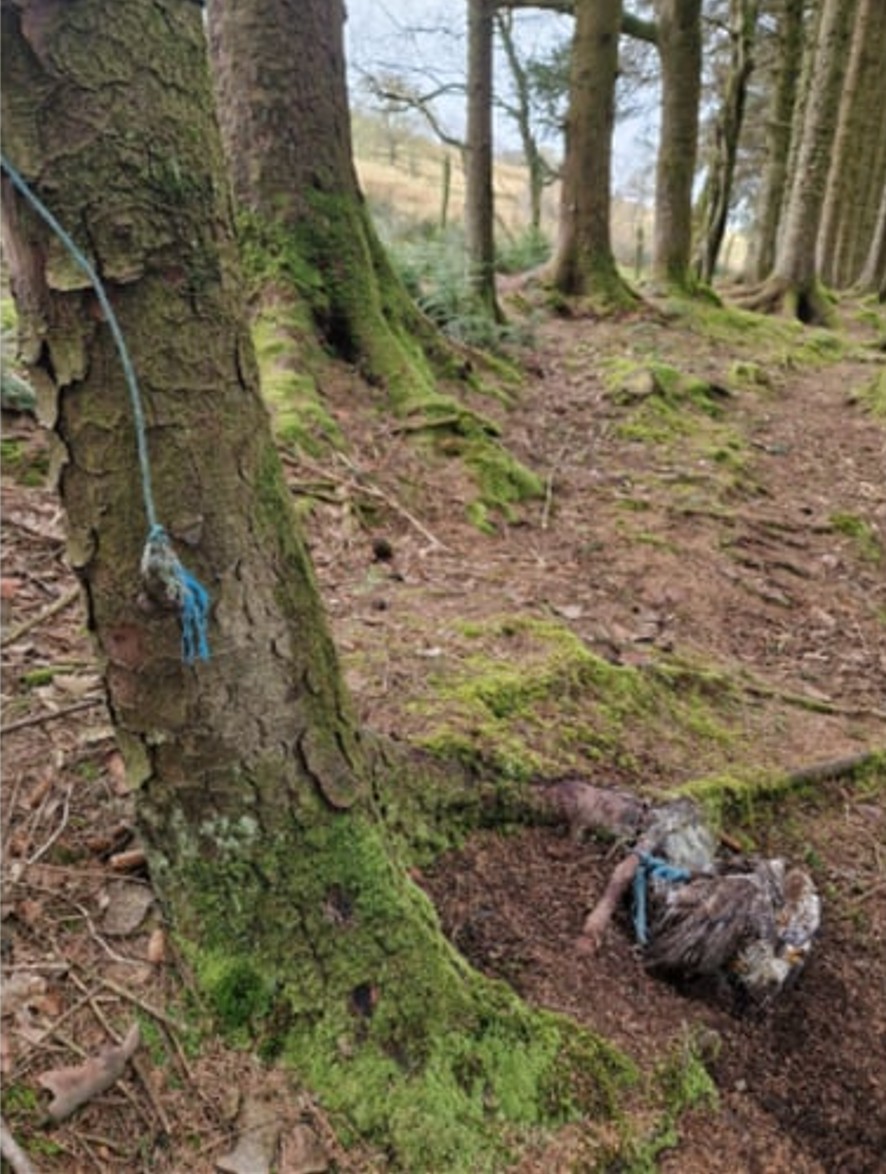
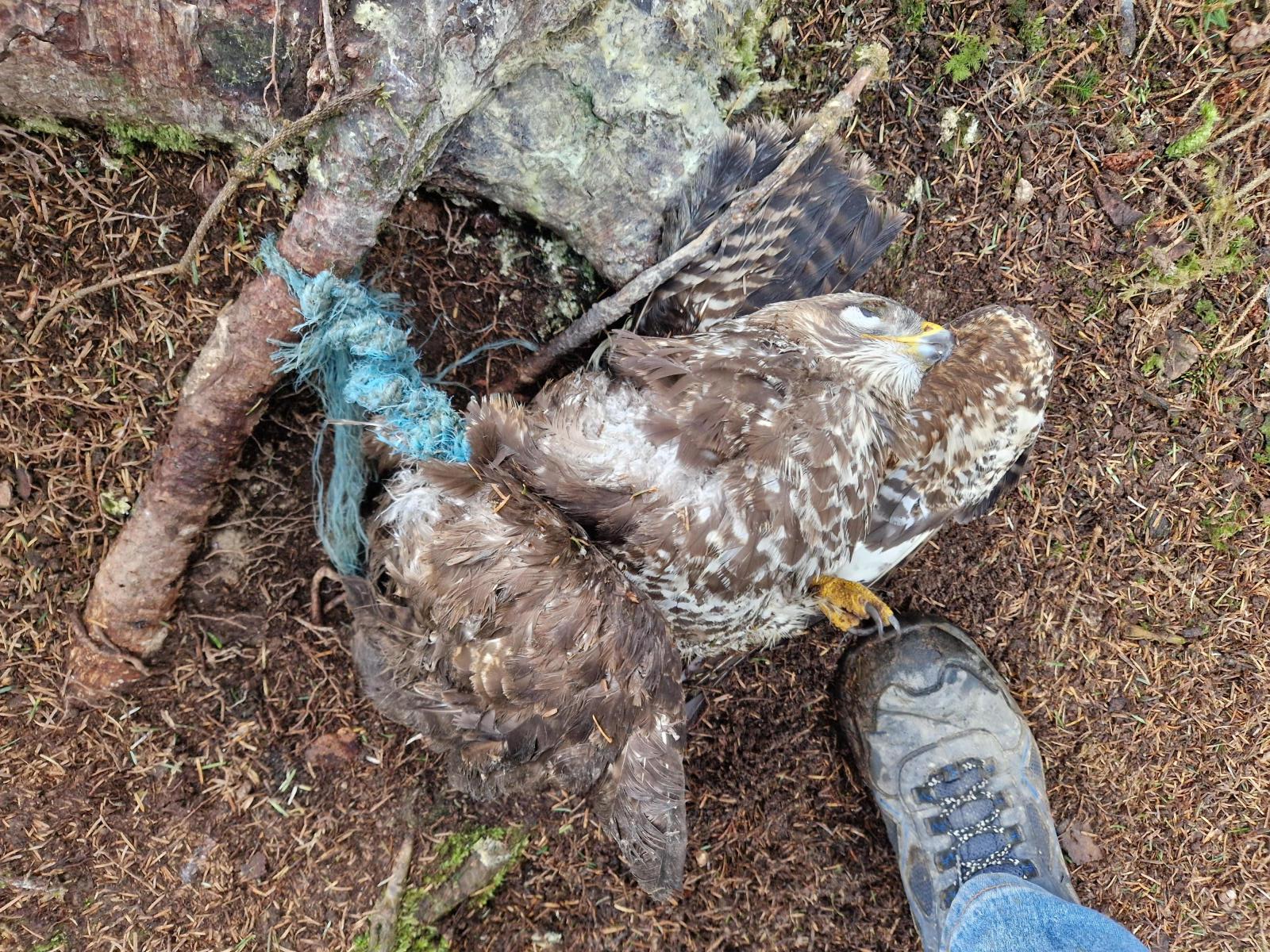
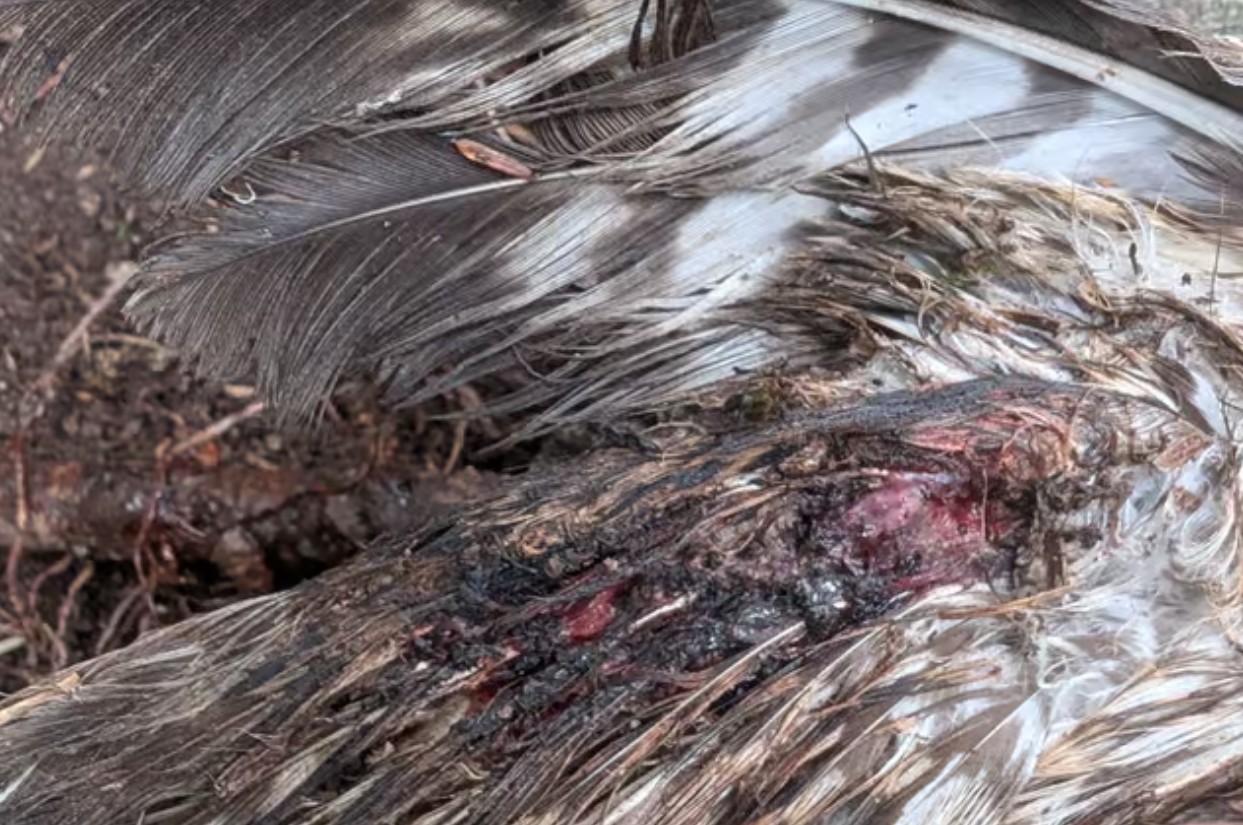
The RSPCA is appealing for information after the discovery of a dead Buzzard that had been tied, when alive, to the root of a tree.
A member of the public found the dead Buzzard on the afternoon of Tuesday 14 April 2026 in privately-owned woodland at Llanbrynmair, Powys, in mid-Wales.
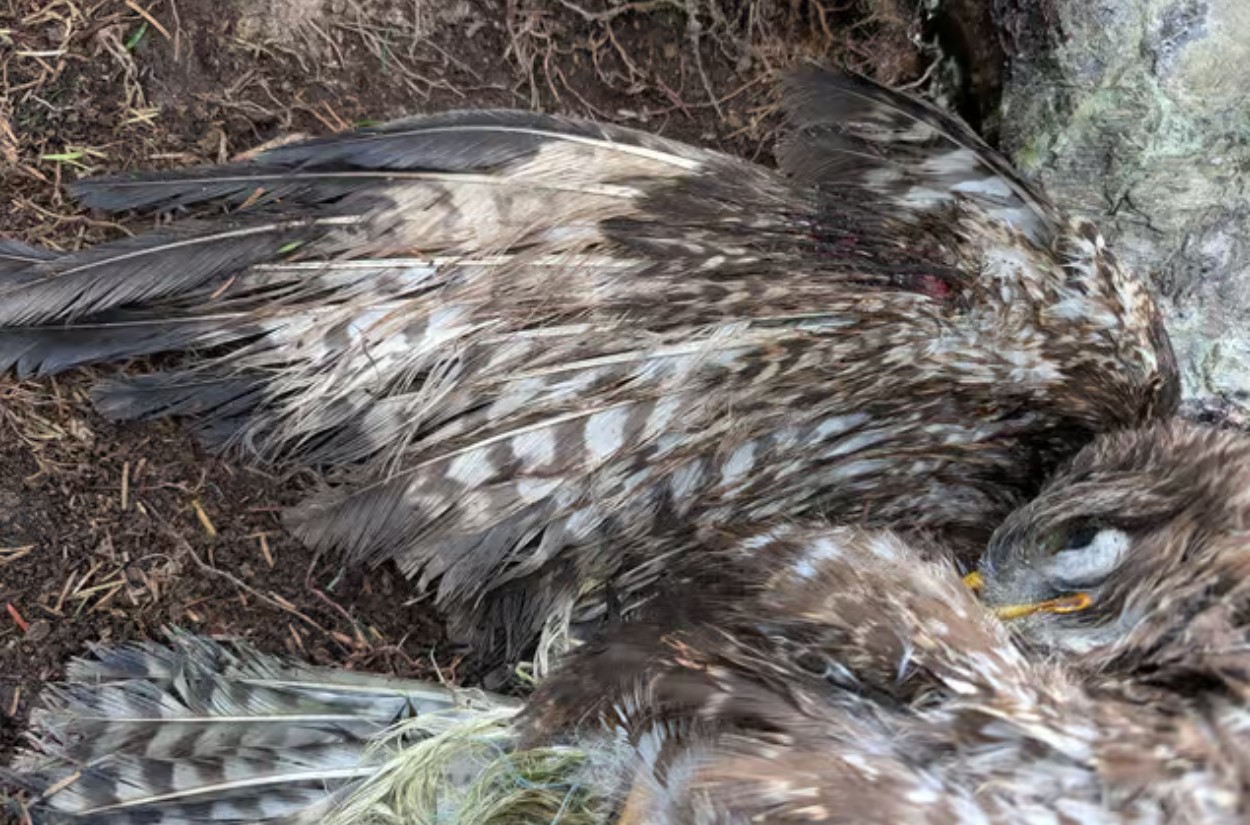
Photos by RSPCA:
A blue rope had been tied around the Buzzard’s wing and tethered to the root of a tree.
RSPCA Animal Rescue Officer Julia Dalgleish, who attended the scene, said:
“This buzzard had clearly been in distress. The rope was very twisted which suggests the bird had been struggling and twisting around this rope for some time and there was a reasonable amount of bird excrement around the root that also suggests a relatively lengthy time frame.
“One of its wings was distinctly damaged both in terms of the feathers as well as having a wound on it.
“The bird’s body condition also seemed to be quite low as there was very little muscle tissue around the breastplate area.
“There is no indication of why somebody had done this. We’re appealing for anyone with first hand information to get in touch to help us with our enquiries.
“Our Inspectorate Appeal Line can be reached on 0300 123 8018 and incident number 01776998 can be quoted.
“We would encourage everyone to show kindness to wildlife. We share our space with a variety of wild animals. Every kind of animal deserves our care and respect. All wild birds are protected under the Wildlife and Countryside Act 1981 and it’s illegal – except under licence – to kill wild birds. However, if tied up whilst alive there may also be offences under the Animal Welfare Act“.
This location is not far from where 15 sacks of dead Pheasants, presumably shot, were found dumped in a river in 2023; nine of the bags were believed to have been thrown from a bridge near Glantwymyn, just along the A470 (see here).
Many of you will be aware of the Westminster Government’s recently published Animal Welfare Strategy in which it committed, amongst other things, to opening a public consultation on how to ban trail hunting (a smokescreen for Fox hunting).
That public consultation has now opened and will close on 18 June 2026. I very much support a ban on trail hunting and would encourage anyone who agrees to fill in the consultation. It’s important to note that the consultation isn’t so much about whether to ban trail hunting, but rather how best to implement a ban that will be the most effective.
For those who want some guidance on how to respond to the consultation questions, I’d recommend you read this advice from the League Against Cruel Sports or this advice from the Hunt Saboteurs Association. Both organisations have been at the forefront of documenting illegal hunts and campaigning against them for decades, both before and after the Hunting Act was enacted in 2004 that was supposed to ban the hunting of most wild mammals with dogs.
The Hunt Saboteurs have also produced this helpful document that clarifies many of the issues:
The parallels with the illegal killing of birds of prey in the UK countryside are not difficult to see – widespread lawlessness, depraved animal cruelty, constant denials that it’s happening despite volumes of unequivocal evidence, and the relentless abuse and harassment of those campaigning for it to end. Both are crimes and both are now listed as National Wildlife Crime Priorities.
The main difference, I think, is that raptor persecution tends to happen in areas and at times where it is difficult to detect (e.g. on private gamebird shooting estates and often under the cover of darkness) whereas Fox and Stag hunting takes place in plain sight, which often leads to violent confrontation.
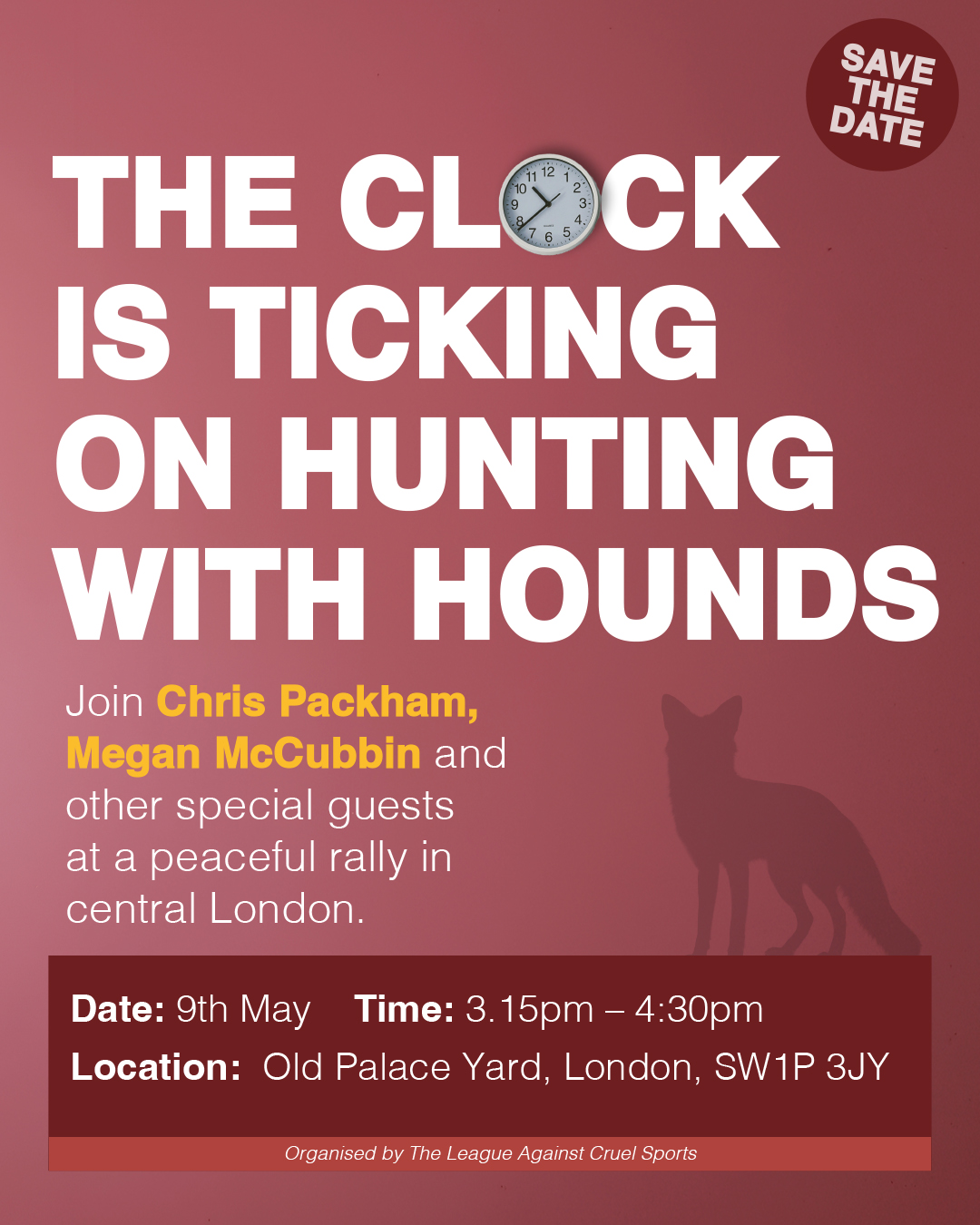
In addition to participating in the public consultation, there will be a peaceful, family-oriented rally in London on Saturday 9th May 2026, organised by the League Against Cruel Sports, where campaigners and supporters will gather to draw attention to the issue.
This will be at Old Palace Yard (outside the Houses of Parliament) from 3.15pm to 4.30pm. I hope that some of you can make it.
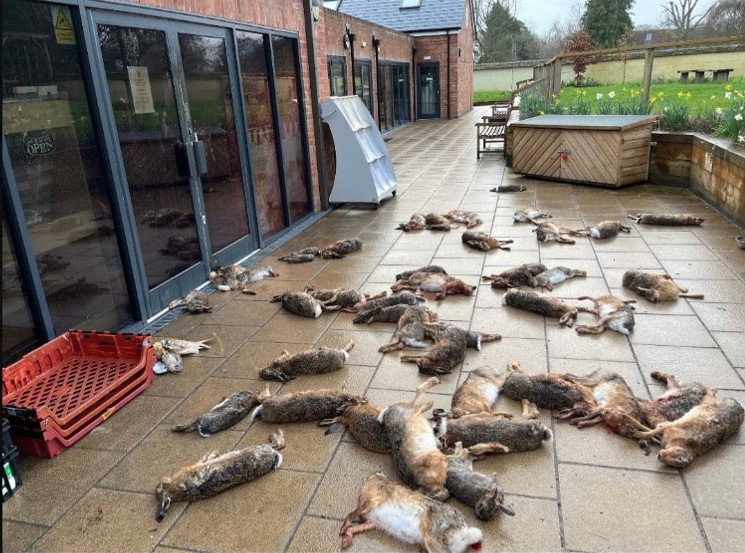
A trial is underway at Southampton Magistrates’ Court this week for a man who is accused of several offences relating to the dumping of 50 hares and two raptors (a Barn Owl and a Kestrel) outside a community shop in Broughton, Hampshire, in March 2024.
James Kempster, 39, of Totton, Southampton, is charged with two counts of possessing a dead bird under the Wildlife and Countryside Act and a charge of criminal damage to the shop front.
Photo by Broughton Community Shop
The court heard that the alleged incident was caught on CCTV in the early hours of 15th March 2024.
Prosecutor Adam Cooper said: “This is a horror movie scene outside a Broughton village shop – it’s a small Hampshire village.
“In the middle of the night, at 3.23am, three men arrived outside the shop by car, the driver remains in the car, having manoeuvred it to a position so the boot is adjacent to the forecourt.
“Two men get out. They are both dressed in tracksuits, hoods up, balaclavas covering their faces so neither can be identified.
“They get out to discard the bodies of 50 dead hares over the forecourt, strewn about deliberately to maximise their coverage. The Crown says one of those two men is James Kempster.
Mr Cooper said one of the men then “tears or rips the body of one of the hares in half, blood is dripping on the floor, wipes the shop front, smearing the blood”.
He then takes two birds, a Barn owl and a Kestrel, from the car before wiping them in the blood and “stuffing” them under the door handles, the prosecutor said.
Mr Cooper added that the man “then beckons the car to show the driver their handiwork, gets into the car and leaves“.
The prosecutor told the court that DNA found on the dead birds was matched to Kemspter. He was also linked to the incident through his mobile phone location, his clothing and connections to the car, which was found burnt out in a country lane.
Kempster denies the charges and the trial continues.
This trial had been originally scheduled to take place in May 2025. For previous blogs on the case see here, here, here, here, here and here.
NB: Comments are turned off as legal proceedings are still live.
UPDATE 25 April 2026: Man found not guilty of criminal damage relating to dumping of 50 dead Hares at Broughton Community Shop, but guilty of possession of dead Kestrel and Barn Owl (here)
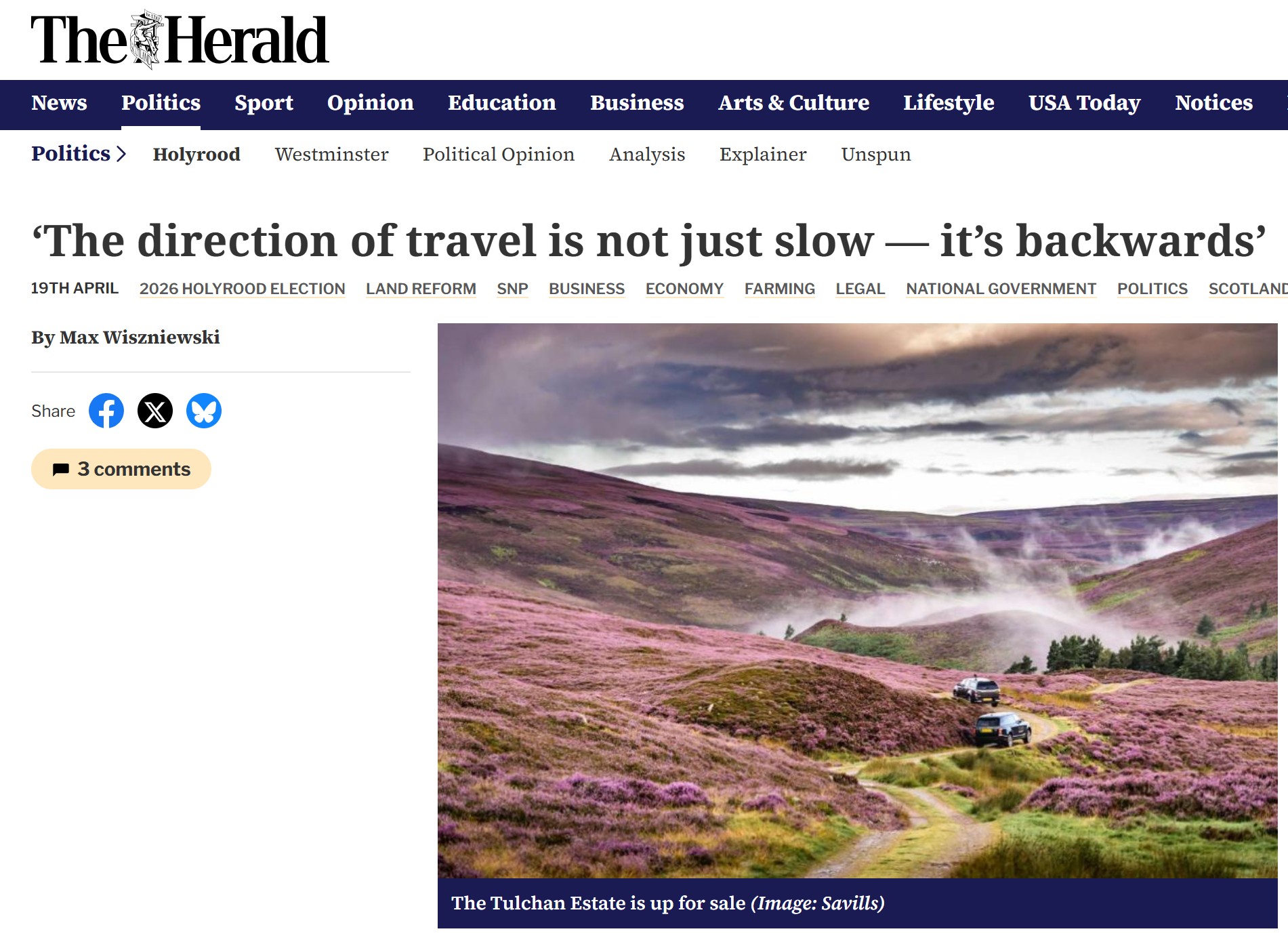
The following opinion piece was published in The Herald yesterday, written by Max Wiszniewski, Campaign Manager for REVIVE, the coalition for grouse moor reform.
In the public reception hall of the Scottish Parliament, there is a totem to Scotland’s land reform journey.
It sits quietly among displays on mental health, on youth, on the issues a parliament is supposed to care about. Its presence there is a statement that Scotland’s national land journey is important to our people.
Twenty-seven years on from devolution, with several Land Reform Acts now enshrined in law, that totem deserves better than what the parliament has managed to deliver.
In 2012, half of Scotland’s private rural land was owned by 440 people; today it’s 408 landowners.
The direction of travel on this issue is not just slow; it’s backwards. Scotland has one of the most concentrated patterns of land ownership anywhere in the world, and that matters because with land ownership comes power and control.
Land prices have climbed so steeply that community buyouts – once the celebrated centrepiece of Scottish land reform – are becoming unaffordable.
Real land reform is about changing how Scotland’s land is owned and used for the benefit of Scotland’s people, wildlife and environment.
This is not just a fringe concern. Scotland’s Big Land Question, the largest ever independent study of Scottish public attitudes to land reform, found overwhelming support for change.
Around seven in ten Scots back a land tax on large landowners, while eight in ten want obligations placed on those landowners to meet climate and nature targets – something that private estates, which occupy 53% of Scotland’s landmass, conspicuously fail to do.
Around 78% of them are used for country sports, which contributes a fraction of a per cent to our economy. The public has been clear about what it wants, and the public is not alone.
In February, the Scottish Land Commission, the independent body charged with advising government on exactly these issues, published a policy roadmap concluding that Scotland’s land pressures are now sharper and more urgent than at any point in the devolution era.
Drawing on the views of more than 1,200 people across Scotland, it found that 96% believe Scotland needs further change in how land is owned and used.
It set out clear priorities, including opening up ownership, rebalancing the power large landowners hold over communities, and putting local people at the heart of land use decisions.
This is the Scottish Government’s own advisory body, in unambiguous terms, calling for the next parliament to be bolder.
At the SNP’s Campaign Conference in March, the party’s own branches did not mince their words either.
A motion jointly submitted by five branches from across Scotland called on the party leadership to bring forward a bold and transformational strategy for land reform and to deliver it.
The motion called for a ten-year strategic plan for Scottish land reform, a functioning land valuation roll, a meaningful public interest test for large-scale landowners, and legislation to finally equalise rights of succession in land ownership.
An amendment from West Fife and Coastal Villages Branch went further still, calling for a simple land tax on acreage to help fund local authorities, and establishing a Housing Land Corporation to use those funds to acquire land for social housing and community wealth building.
This was a well-considered motion, evidencing deep understanding of the issues. Has the SNP been listening to the public, to the government’s own advisory body and to their own membership?
The answer, it appears, is no.
The SNP manifesto offers a Rural Renewal Bill that promises to “consider a range of strategic proposals” on land reform, a phrase that manages to say almost nothing while sounding almost like something.
There is no land tax, no land reform minister, no ten-year strategic plan, and no commitment to the public interest obligations that the party’s own members demanded in March. What SNP branches called a transformative agenda has been quietly filed under “explore”.
The gap between what SNP members demanded in March and what their party have now put before voters in their new manifesto is the distance between a transformative agenda and a managed one.
Between a party willing to take on entrenched interests and one that has learned to fear their lawyers more than their own conscience. Land reform has been folded into a broader rural bill, hedged with the language of consideration, and left to find its own way to the bottom of an agenda.
Why has this happened?
Experience might suggest Scotland’s party of government is timid in the face of the landowner lobby, a lobby that is skilled at making meaningful reform feel legally perilous and economically reckless. Judicial review threats arrive reliably whenever real change approaches, and warnings of investment flight follow close behind.
The grouse moor licensing Bill is a good example. When it threatened real change, the landowner lobby successfully delayed its full implementation, creating a loophole that, while recently closed, illustrates why successive governments have been so reluctant to take on these industries.
Which brings us to the strangest feature of this election’s land reform debate. It is the Greens, not the SNP, whose manifesto most closely reflects what SNP members voted for in March.
Their language is unambiguous: land must be a shared asset for the common good, not a commodity for a privileged few. SNP members said much the same thing, in much the same terms, just weeks ago, but the party’s manifesto does not.
It is a peculiar situation for Scotland’s democracy, where a party that has dominated Holyrood for the best part of two decades, and whose membership is clearly ahead of its leadership on this issue, finds itself outflanked on one of Scotland’s most historically resonant questions by its main rivals on the left.
The REVIVE Coalition does not take a position on which party should govern Scotland. What we do take a position on is the need for real land reform that reverses the trend of increasing concentration and unlocks our land’s potential. It’s what the public wants, what the evidence supports, and the SNP conference has called for.
The next Scottish Government, whatever its composition, will face a choice. It can continue to prioritise the desires of those who already own most of Scotland, or it can finally honour the expectations of everyone else.
It’s time to use the powers of the Scottish Parliament to declare independence over Scotland’s land, our people, our wildlife and the environment.
Max Wiszniewski is Campaign Manager for the REVIVE Coalition, which comprises the League Against Cruel Sports, Common Weal, OneKind, Friends of the Earth Scotland and Raptor Persecution UK.
ENDS
The REVIVE coalition has produced a Land Reform manifesto that sets out ambitious and forward-looking policies that have broad public support ahead of the 2026 Scottish General Election.
To read the manifesto and to send your comments on it to cross-party political leaders, please click HERE.