The long-running prosecution of Lincolnshire farmer William Brian Chorlton, now 88-years-old, continued at Lincoln Magistrates’ Court last week.
Photo by Ruth Tingay
In April 2025, Mr Chorlton, then aged 87, of Morkery Lane, Castle Bytham in Lincolnshire was summoned to court following reports that birds of prey were being poisoned in the Castle Bytham area.
He faced eleven charges relating to the unapproved or unlawful storage of the chemical Aldicarb, possession of a poisoners kit, and possession and use of four pole traps on his Pheasant shoot (see here).
Mr Chorlton appeared at Lincolnshire Magistrates’ Court in May 2025 and pleaded not guilty to all charges and the case was set to proceed to trial in October 2025.
However, at a pre-trial hearing in September 2025, Mr Chorlton’s lawyer announced that he intended to apply for a judicial review of the District Judge’s decision not to dismiss the case (see here), which meant that the original trial date of October 2025 was postponed until the judicial review application was heard.
A further case management hearing scheduled for January 2026 was also postponed as the application for judicial review was still underway (see here).
In April 2026 Mr Chorlton’s application for judicial review was rejected by the High Court.
Another case management hearing (for the criminal prosecution case) took place in April 2026 and a new trial date was set for 8th and 9th October 2026.
The trial began last week and evidence was heard from prosecution witnesses, including evidence about the discovery of Tawny Owl DNA on a number of pole traps that Mr Chorlton claims were being used to trap squirrels.
The trial was further adjourned and will continue at Lincoln Magistrates’ Court in February 2027.
NB: As proceedings are still live, comments have been turned off.
On Monday 20 July 2026, at Aberdeen Sheriff Court, all charges were dropped against two gamekeepers who had been on trial for the alleged shooting of Red Kites, as well as alleged firearms offences, in the Cairngorms National Park.
What follows is my understanding of the case, based on material published by the media, court documents, and conversations I’ve had with people who attended the trial. As far as I’m aware, the outcome of this case has not been reported formally, either by journalists, Police Scotland or the Crown Office & Procurator Fiscal Service. It’s pointless me asking for case details from the Crown Office or Police Scotland because they are protected by data protection regulations. For this reason, the following account should be treated with caution, i.e. it is not provided as a definitive account of the legal proceedings.
CASE BACKGROUND
On 4 February 2025 a member of the public notified the RSPB that a dead Red Kite had been found on private property in the Glenbuchat area of Strathdon, in Aberdeenshire, and the finder said that he had concerns that it might have been poisoned. The RSPB’s Investigations team collected the kite carcass and submitted it to Scotland’s Rural College (SRUC) lab for examination, notifying Police Scotland of their action. A short time later a post mortem revealed the kite had been shot, which led Police Scotland to open a wildlife crime investigation.
As part of that investigation, an appeal for information was issued by Police Scotland on 28 February 2025. Shortly afterwards another member of the public, William Johnstone, came forward with footage that had been captured on a night vision trail camera that he and local landowner, Roderick McGilvary, had installed in Knockie Wood (owned by Mr McGilvary) to monitor wildlife. Although the footage was not properly date/time stamped, Mr Johnstone and Mr McGilvary both stated that the footage had been captured over the preceding three weeks.
Location of Knockie Wood, Strathdon, in the Cairngorms National Park
Knockie Wood & surrounding grouse moor area, screen grabbed from a land sale brochure Aug 2026
The footage showed two armed individuals, with night vision equipment, carrying the body of a(nother) Red Kite. Mr Johnstone and Mr McGilvary both said they recognised the two armed men and named them as Graeme Rankin and Steven Hague, the Head Gamekeeper and underkeeper from nearby Glenbuchat Estate.
Mr Johnstone said he recognised the two men from shooting events he’d attended and from living in the local area. Mr McGilvary said he’d previously given Mr Rankin permission to kill ‘vermin’ on his land.
The trail camera footage was passed to Police Scotland and after examination, several officers, including a Firearms Licensing Officer, also said they recognised the two armed men as gamekeepers Graeme Rankin and Steven Hague.
On 1 May 2025 the Police executed a search warrant at the addresses of the two suspects and firearms were seized.
Following police interviews, to which both suspects gave ‘no comment’ replies, they were reported to the Procurator Fiscal and subsequently charged as follows:
Charge 1(GraemeRankin & Steven Hague) – Between 1 – 26 Feb 2025 at Knockie Wood, Strathdon, intentionally or recklessly killed a wild bird (Red Kite) with a firearm, contrary to Section 1(1)(a) of the Wildlife & Countryside Act 1981;
Charge 2 (Graeme Rankin & Steven Hague) – Between 1 – 26 Feb 2025 at Knockie Wood, Strathdon, were in possession and control of a dead wild bird (Red Kite), contrary to Section 1(2)(a) of the Wildlife & Countryside Act 1981;
Charge 3 (Graeme Rankin & Steven Hague) – On 3 or 4 February 2025 at [REDACTED], Glenbuchat, Strathdon, intentionally or recklessly killed a wild bird (Red Kite) with a firearm, contrary to Section 1(1)(a) of the Wildlife & Countryside Act 1981;
Charge 4 (Steven Hague) – On 1 May 2025 at [REDACTED], Glenbuchat, Strathdon, failed to keep keys for gun cabinets in a secure place, failed to ensure the key safe lock was secure and worked properly, and failed to secure ammunition, contrary to Section 1(2) of the Firearms Act 1968.
THE TRIAL
Both defendants pleaded not guilty to all charges so a two-day trial was scheduled to begin in Aberdeen on 9 December 2025. The defendants were each represented by an advocate of Kings Counsel (KC) status. Brian McConnachie KC, one of Scotland’s leading criminal lawyers, represented Graeme Rankin, and Shelagh McCall KC, also highly experienced, represented Steven Hague. Karen Rollo, an experienced Procurator Fiscal from the Wildlife and Environmental Crime Unit at the Crown Office, appeared for the prosecution.
Before proceedings really got going, the Sheriff made a declaration of being a monthly subscriber to the RSPB, which resulted in the two defence KCs lodging a motion that the Sheriff should consider recusing himself because the ‘public might perceive some bias’.
After giving the motion some consideration, the Sheriff agreed to stand down because this case involved RSPB staff members as witnesses for the prosecution.
Unfortunately, no other Sheriff was available immediately to hear the case so it was adjourned and rescheduled as a four-day hearing in April 2026, this time in front of Sheriff Peter Hammond.
Due to the large number of witnesses called by the prosecution in the first four days, the trial was further extended to another two days on 15-16 June 2026.
Prosecution witnesses included the finder of the first dead Red Kite (that was later confirmed shot), RSPB Investigations staff who had collected the kite carcass, William Johnstone who had installed the trail camera at Knockie Wood (landowner Robert McGilvary had since passed away but had previously provided a statement to Police Scotland), the SRUC vet who had performed the post mortem examination of the first dead Red Kite, a ballistics expert who could comment on the weapons and ammunition seen on the footage compared to what was seized during the search warrant, and multiple police officers who had been involved in viewing the captured footage, identifying the individuals (and their equipment) in the footage, and those involved in the execution of the search warrant.
There were significant delays at the start of the trial due to technical challenges in getting the video evidence to be shown in court; this seemed to be due to formatting issues regarding the ‘stitch video’ (a single film of various clips knitted together to make it easier to view). These were eventually resolved, although prosecution witnesses noted that the quality of the video shown in court was poorer than the raw footage they had been able to view at the police station.
A number of witnesses told the court that they couldn’t identify the suspects based on the poor quality of the footage shown in court but reiterated that they’d been able to identify them from the original footage at the police station.
Police Firearms Officer Tomas Spracklen told the court he’d attended Steven Hague’s cottage on 1 May 2025, alongside other officers executing the search warrant. He said he found that a safe, which stored keys to a gun cabinet, was not secure as he was able to access it and remove the key without having to use a code. He said that the key to a second gun locker was hanging on a hook behind a table leg just yards away in the same room where shotguns were kept. He also told the court that other Police Officers had found an unsecured pouch of ammunition in the gun room.
The two defence KCs challenged the provenance of the video footage, focusing on the fact that it wasn’t properly time/date stamped. They also challenged whether there had been procedural errors by the Police Officers during the execution of the search warrant.
The defence then lodged a motion to the Sheriff that on all charges, there was no case to answer. With respect to the charges of the killing of the second kite, they contended that the prosecution had failed to demonstrate that their witnesses had identified the defendants on the basis of the(poor quality)footage played in court, and that the prosecution had also failed to demonstrate that the footage captured was consistent with the dates of the charges libelled. They suggested, therefore that all these witnesses’ evidence should subsequently be disregarded.
The defence further suggested that the prosecution’s reliance on the established Scots Law ‘Moorov principle’ that allows for the use of similar factual evidence to corroborate multiple charges, should also mean that despite apparent similar circumstances surrounding the killing of the first Red Kite, if the charges above were dismissed, then charge 3 should also be dismissed.
The defence also argued that the fourth charge, relating to unsecure ammunition, should also be dismissed as they suggested that there was no corroboration of the lack of security of the accused’s gun room (i.e. the key to the gun cabinet hidden behind a table leg, shown to one Police Officer by the accused).
On 20 July 2026, the Prosecution made a lengthy submission in response to the defence’s motion, countering all of the above points, including giving examples of case law to support its case. However, although the Sheriff agreed that the footage captured was within the dates of the charges libelled, he accepted all of the other points made by the defence and made a ruling that there was no case to answer on all four charges. The defendants were then told they were free to go.
MY COMMENTARY
What follows is my opinion. It does not infer any guilt on the two defendants, but rather focuses on the mechanics of the case.
To start, it’s worth mentioning Police Scotland’s early appeal for information after they’d received confirmation from a post mortem that the first Red Kite had been shot. It was a direct result of that appeal that two witnesses came forward with their trail camera footage showing two armed men carrying a(nother) dead Red Kite, in the same area, and around the same time as the discovery of the first dead Red Kite. Some police forces don’t bother putting out appeals for information when birds of prey have been persecuted – this case highlights the value of issuing timely appeals, so plaudits to Police Scotland for making the effort to do so, and quickly.
On to the case itself…
It’s really difficult to comment on the legal complexities because (a) I wasn’t in court to hear the evidence; (b) I’m unsighted on any written submissions made to the court by both the prosecution and defence; (c) I didn’t hear, and nor have I seen, the Sheriff’s detailed explanation for his decision-making; and (d) I’m not a lawyer.
Nevertheless, the information that is available about the case raises some obvious, and in my view, serious, questions about the course of justice.
My main concern centres on the Sheriff’s ruling that the prosecution had not been able to establish, in court, the identities of the two armed men. That failure to identify them seems to be based entirely on the poor quality of the footage shown in court, even though multiple witnesses, including Police Officers, had given testimony (in sworn witness statements and in person before the court) that they had been able to identify them from the raw footage viewed at the police station.
If the video evidence in court was of such obvious poor quality, why wasn’t the trial adjourned until such time that better quality footage, which was known to exist, could be shown in court? I don’t know if a request for an adjournment was made and the Sheriff refused it, or whether it just simply wasn’t raised. It seems an absurdity to me that a trial can stand or fall on a technical failure that could have been so easily resolved.
Related to this, I don’t understand why the Sheriff was willing to accept the testimony of Mr Johnstone and Mr McGilvary that although their trail camera footage wasn’t properly time/date stamped, the footage related to the time period they’d said it related to, but then he wasn’t willing to accept the testimonies of serving Police Officers who’d stated that they’d been able to identify the suspects from footage they’d viewed at the police station. That makes no sense to me.
Another question I have relates to the apparent lack of corroboration about the alleged lack of security in the gun room. I thought that all Police Officers wore body-worn cameras these days, and that that footage is considered acceptable as ‘real evidence’ in court. Was body-worn camera footage available in this case and if so, why wasn’t it accepted? If no body-worn footage was worn, then it sounds like a fundamental cock-up was made by the Police Officers executing the search warrant, making easy pickings for the defence KCs.
From what I understand, I think the Crown Office can appeal ‘no case to answer’ decisions if it chooses to, but has to lodge an appeal within a relatively short time scale following the judgement. It’ll be interesting to see whether that happens in this case.
What we’re left with is the knowledge that two Red Kites were illegally killed in the Glenbuchat area of Strathdon during February 2025, one confirmed shot and the other one more than likely to have been shot. This area in the north-east part of the Cairngorms National Park has long been recognised as a raptor persecution hotspot but once again, the raptor killers, whoever they are, are getting away with it.
NB: For anyone considering leaving a comment on this particular blog, please remember that all charges were dropped against the two defendants. Any libellous comments, either direct or inferred, won’t be published.Comments about the legal process are welcome.
Natural England has finally, after many months of delay, published its formal review of the Hen Harrier Brood Management (Meddling) trial that ran from 2018-2024.
For new blog readers, the Hen Harrier Brood Meddling trial was a conservation sham sanctioned by DEFRA as part of its ludicrous ‘Hen Harrier Action Plan‘ and carried out by Natural England between 2018 – 2024, in cahoots with the very industry responsible for the species’ catastrophic decline in England. In general terms, the plan involved the removal of Hen Harrier chicks from grouse moors, they were reared in captivity, then released back into the uplands just in time for the start of the grouse-shooting season where many were illegally killed. It was plainly bonkers. For more background see here and here.
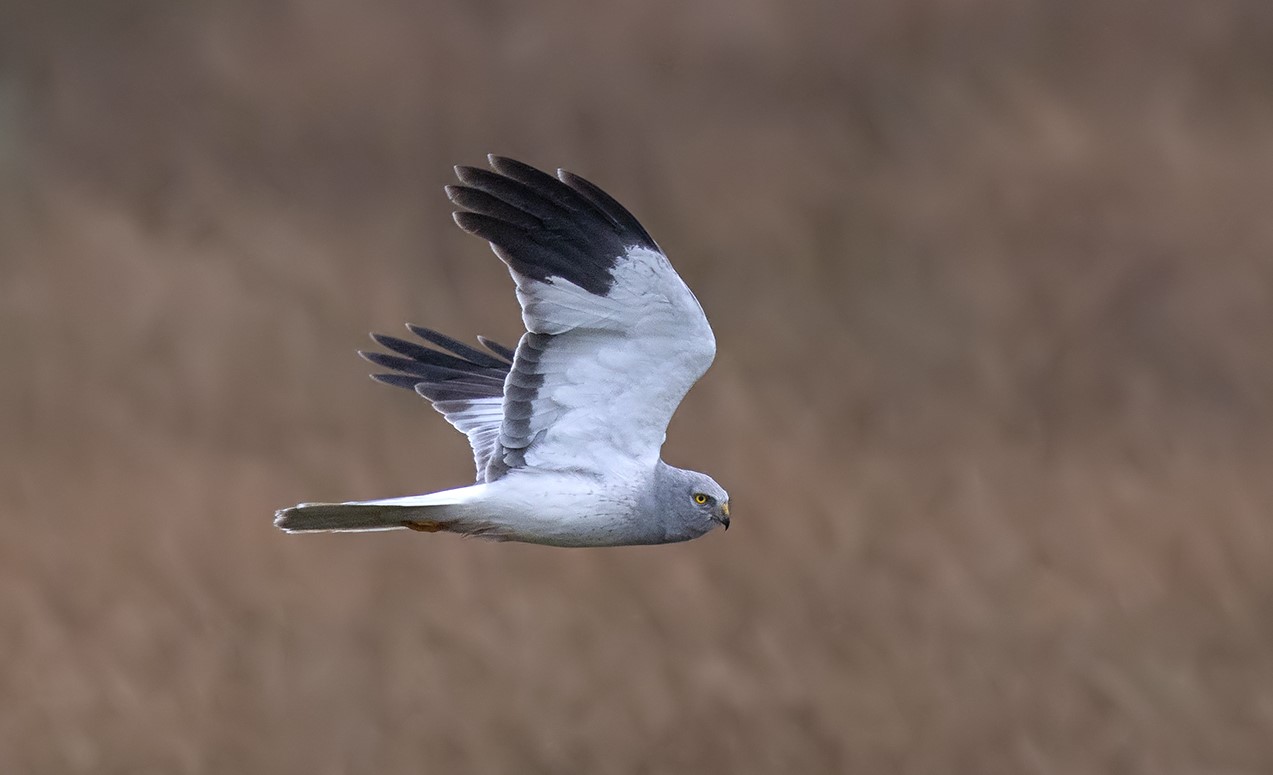
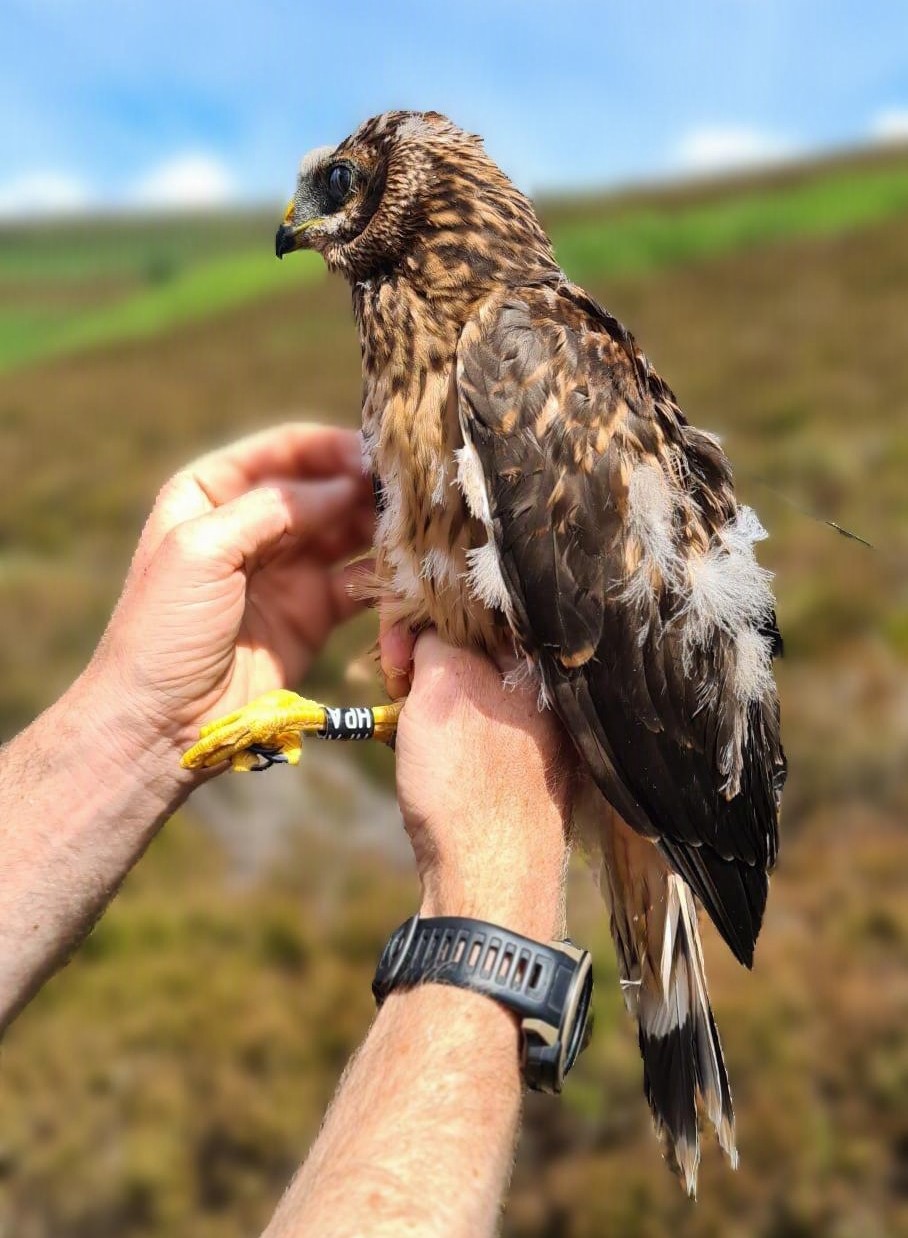
Male Hen Harrier (photo by Pete Walkden)
In March 2025, Natural England announced the end of the Hen Harrier brood meddling sham and noted that the so-called ‘partnership’ had now closed, although NE also said that no decision had yet been made about the potential annual roll-out of brood meddling (here).
In April 2025, Natural England announced that it had turned down a licence application from the Moorland Association for a brood meddling licence for 2025, mainly because the Moorland Association wanted to remove the licensing requirement that all brood meddled Hen Harriers must be satellite tagged (hmm, can’t think why), and also because the MA wanted a single release site for brood meddled Hen Harriers, presumably to get around the problem of there not being sufficient receptor sites/estates willing to take the young brood meddled birds on their release (see here).
This afternoon, Natural England has published three final reports as part of its review of the brood meddling trial. These are:
Hen Harrier Brood Management Trial Evaluation: The effectiveness of brood management as a mechanism for supporting Hen Harrier recovery.
Hen Harrier Brood Management Trial: Interim social science evaluation.
Hen Harrier Brood Management Trial: Findings from the social science survey of moorland managers Authors: National Centre for Social Research.
The three reports are available for download at the end of this blog. I haven’t read them yet – and probably won’t have time to do that until next week at the earliest, so will comment further once I’ve read them, if I find anything of interest.
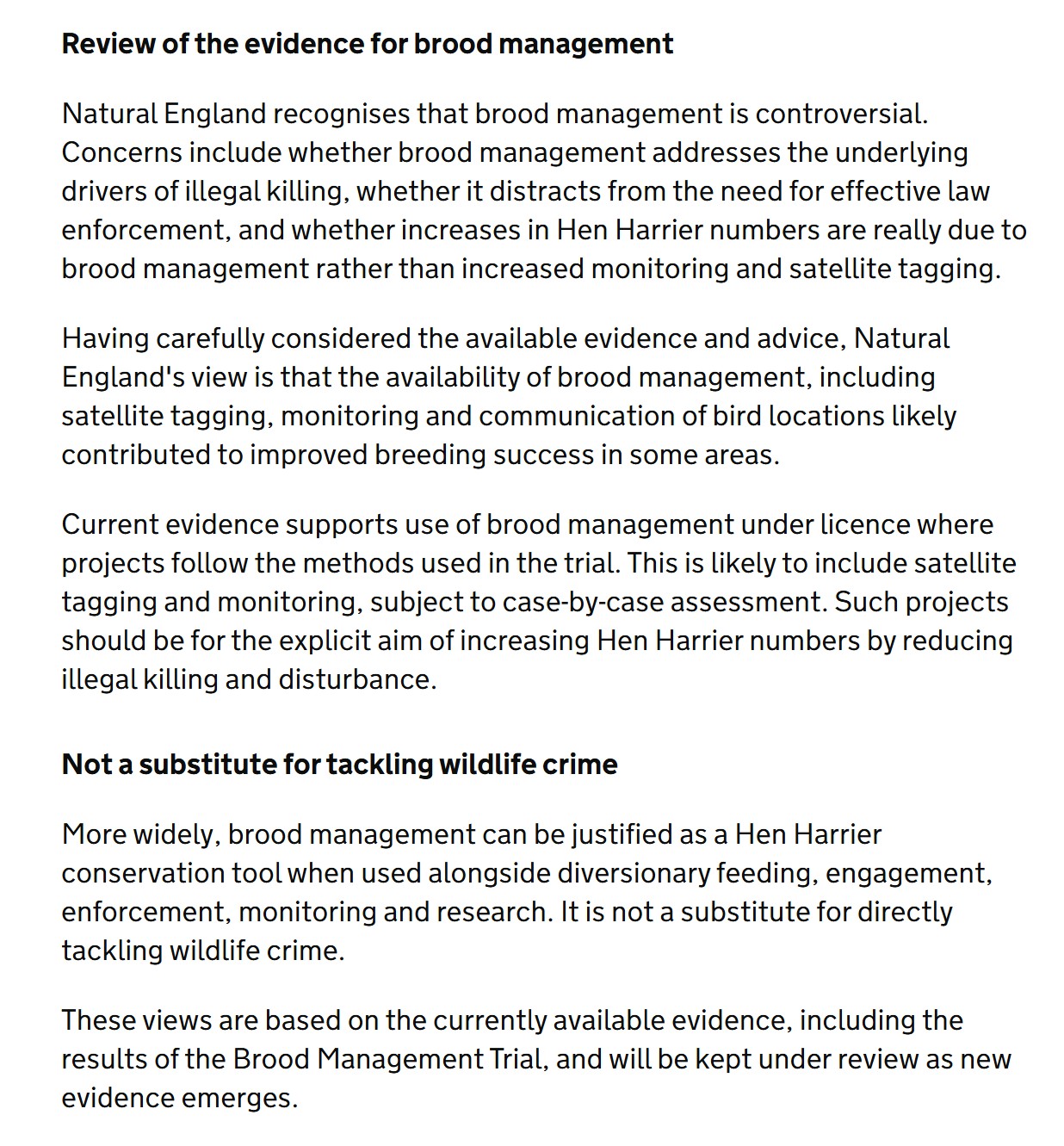
Natural England has published a blog today, to accompany the publication of the three reports. Here’s the most relevant part:
This suggests that NE will consider brood meddling in the future, on the basis the same licence conditions used during the trial are in place (i.e. sat tagging, release site must be within the SPA from where the Hen Harriers are brood meddled etc).
Two of these paragraphs don’t make sense to me, as one contradicts the other. NE says that, “Such projects [i.e. brood meddling] should be for the explicit aim of increasing Hen Harrier numbers by reducing illegal killing and disturbance” but then in the next paragraph, it says, “It [brood meddling] is not a substitute for tackling wildlife crime“.
Eh?
The final sentence of NE’s blog is also relevant – “These views….will be kept under review as new evidence emerges“.
I don’t know if Natural England is aware, but significant new evidence on the extent of Hen Harrier persecution on UK grouse moors is on its way shortly, and if that doesn’t put an end to any idea about continuing the ludicrous brood meddling sham, I don’t know what will.
Meanwhile, here are NE’s three final reports on the Hen Harrier brood meddling trial:
More detail has emerged from the ongoing trial of two Scottish gamekeepers, accused of offences relating to the alleged shooting and killing of Red Kites in the Cairngorms National Park in February 2025 and alleged firearms offences.
Head gamekeeper Graeme Rankin, 40, and assistant gamekeeper Steven Hague, 43, both of Glenbuchat Estate, have both denied the charges.
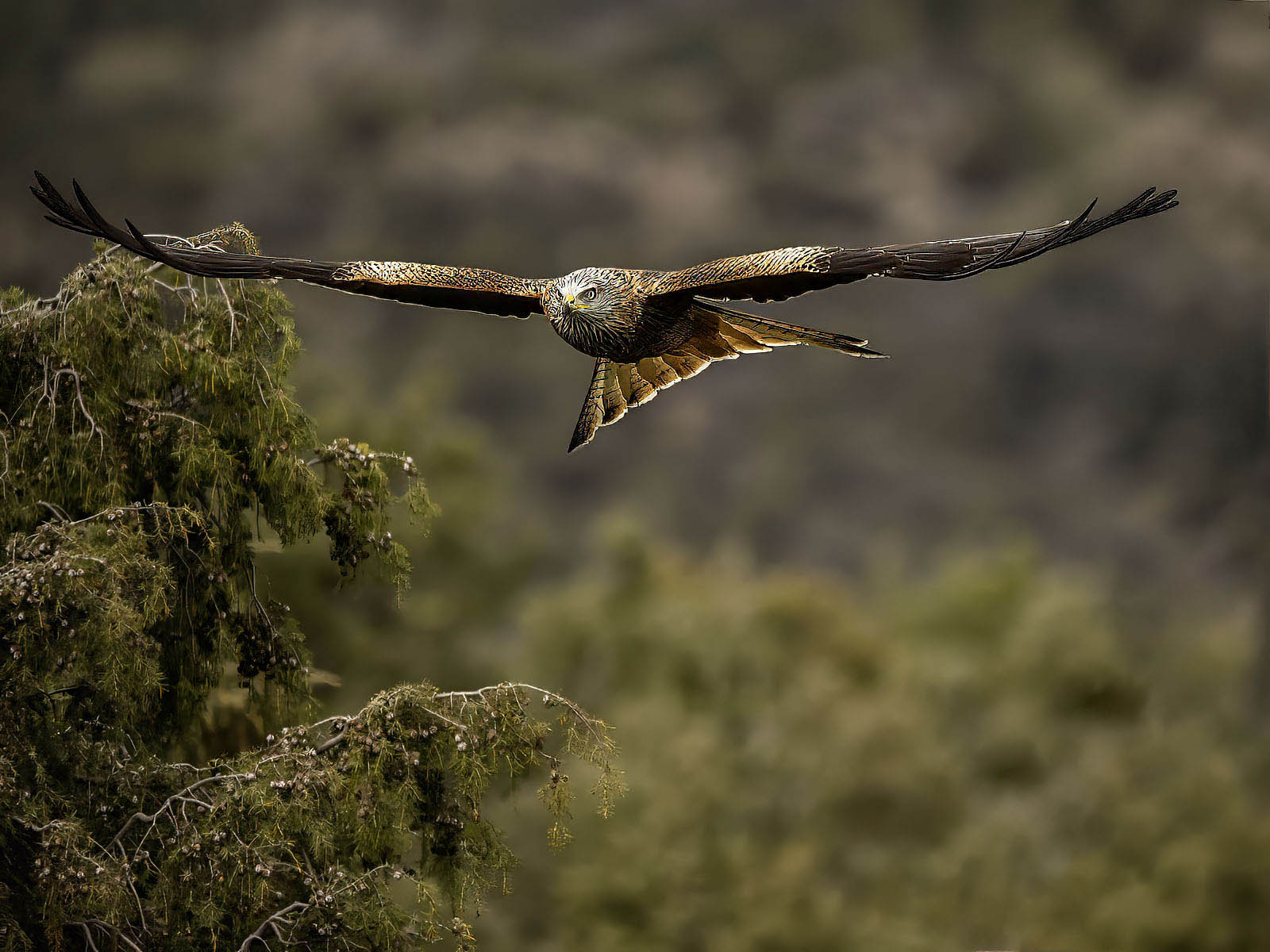
Red Kite photo by Ronnie Gilbert
The trial began at Aberdeen Sheriff Court in April 2026 and ran for four days (here), before it resumed again in June for several days (here). The case was then further adjourned until July, after the defence KCs lodged a motion calling for the dismissal of all charges for alleged procedural irregularities.
The trial will continue again next week. In the meantime, following on from a write-up from the trial in April, here’s a write-up from the June court proceedings, written by journalist Jamie Ross of the Press and Journal and published on 16 June 2026:
MAN ACCUSED OF KILLING RED KITE KEPT SHOTGUNS IN INSECURE CONDITIONS, COURT TOLD
A man accused of killing a red kite in the Cairngorms kept the keys to his shotguns in a broken safe and behind a table leg, a court has been told.
On Monday, Aberdeen Sheriff Court continued to hear evidence in the trial against Steven Hague, 43, and Graeme Rankin, 40, who each stand accused of shooting and killing a protected bird species on land in Knockie Wood.
The Glenbuchat Estate employees are also facing a charge of shooting a second red kite, while Hague is further charged with breaching the conditions of a firearms certificate and ammunition storage rules.
And yesterday, Sheriff Peter Hammond heard from a firearms officer who attended Hague’s cottage home and found that any combination of numbers could be entered into a safe for it to give up the key to one of his shotguns.
Another gun locker was accessed with a key the gamekeeper hung on a hook behind a table leg, just yards away in the same room where the weapons were kept.
Constable Tomas Spracklen told the court that he attended Hague’s Strathdon home on May 1 2025 alongside other officers who cautioned and arrested him in connection with the animal’s death.
The trial had previously been told that the red kite was discovered by a member of the public in the Glenbuchat area on February 26 last year before staff from the Royal Society for the Protection of Birds got involved.
Experts concluded that the animal had been shot and the police were contacted.
Constable Spracklen, a firearms licensing officer, said he attended Hague’s property to carry out a “suitability review” for firearms certificates as colleagues carried out a search warrant.
He walked the court through the home, noting that the gun room had two cabinets where Hague kept his weapons.
On a previous visit to renew his certificates, Hague had provided the officers with a code to a safe, which was meant to securely store the key to his firearms.
“They need to be safely secured at all times,” Constable Spracklen explained.
“We asked him where his keys for the cabinets were kept. On our previous renewal, he indicated they were within a utility cupboard. I asked Mr Hague if that was still the same situation, if the code was the same as we had previously been given.
“Mr Hague advised that the actual safe for storing the keys didn’t work properly. We attended at the utility closet, where it was, and, as Mr Hague stated, I was just able to take the keys without entering the code.”
Hague would also tell the officer that the key to the second cabinet was on a hook on a table leg opposite the locker.
As part of keeping firearms, Hague is required to ensure that both weapons and ammunition are stored securely and are not accessible.
Asked for his opinion on whether what he found at Hague’s home meant he was in breach of that rule, Constable Spracklen said: “In my opinion, it did breach that condition. Anybody that was within that house could gain access to the keys and therefore gain access to the firearm cabinets.”
Fellow officers, he added, would allegedly go on to find an unsecured pouch of ammunition within the gun room.
Lawyer Shelagh McCall KC, representing Hague, queried the officer about her client’s property.
She asked: “Does it sit by itself, or is it adjoined to any other properties?”
“It sits by itself,” the constable replied.
She added: “In terms of the nearest neighbour, what do you reckon?”
“Well over a kilometre,” Constable Spracklen said, agreeing that the cottage was in “the back of beyond” and there was no one else living in the home other than Hague and his wife.
Joanna Murray, a forensic scientist at the Scottish Crime Campus, also gave evidence on Monday.
Shown the shotguns seized by police, she said it was her opinion that there were “similarities” between a Beretta A400 Lite — a left-handed weapon — and the weapon seen in trail camera footage from Knockie Wood.
The clips had previously been played to the court, which allegedly showed two men appearing to fire a shotgun before walking off screen and later returning with a bird in hand.
“That noise that occurred could have been caused by a discharge of a gun,” she told fiscal depute Karon Rollo.
“I am unable to determine what make and model the shotguns are from those videos.”
Queried on how rare a left-handed shotgun is, Mrs Murray added: “I do know, roughly, they make up 5% of the buying and selling market.”
Mrs Murray also concluded that, upon receiving a vet report on the deceased red kite, it was her opinion that its death was “consistent” with a shotgun pellet wound.
“It is my opinion,” she told the court. “Any of the shotguns could have discharged. Or any other shotgun”.
The quality of the video evidence again came under scrutiny during the trial.
At its last hearing, special constable Michael Flacherty said he had been able to identify Rankin, whose address was given as a croft on the Glenbuchat Estate, from the trail cam footage which he saw in better resolution.
“I cannot identify Mr Rankin from this resolution,” he said of the video when it was played back to him at court.
“In the original footage I viewed, I could identify Mr Rankin.”
Mrs Murray had similar issues when she attempted to point to features of the weapons she had referenced in her report as she struggled to find them when the videos were played back in the courtroom.
A video prepared by the defence, however, had no such problems.
Asked to view a piece of film which Ms McCall said showed a man shooting a shotgun 35 metres away from a camera to provide a comparison of the alleged shooting witnessed in the Crown’s footage, Mrs Murray said: “It’s noticeably louder.
“The pick-up on it seemed quite loud compared to the pick-up on the [trail cam].
“If I was to do a like-for-like comparison, I would like to see that testing done in the same area as well.”
The defence’s footage also showed a muzzle flash, which the trail camera does not appear to pick up.
Mrs Murray said “one explanation” for that was a tree causing a physical obstruction.
The red kite is protected under the Wildlife and Countryside Act, making it illegal for them to be killed.
It is believed red kites scare grouse, making it harder for them to be driven towards shooting parties.
The trial was originally due to be heard last December, but the presiding Sheriff Robert Vaughan recused himself because he is an RSPB subscriber.
The trial at Aberdeen Sheriff Court continues.
ENDS
The trial will resume at Aberdeen Sheriff Court next week.
NB: Comments are turned off as legal proceedings are still live.
UPDATE 6 August 2026: Trial collapses against two Scottish gamekeepers accused of killing Red Kites in Cairngorms National Park (here)
Press release from Police Scotland (26 June 2026), followed by my commentary:
POLICE APPEAL AFTER SQUEAGLE THE GOLDEN EAGLE FOUND WITH SHOTGUN INJURIES
Police Scotland is appealing for information after a golden eagle was found to have been shot.
Squeagle, a four-year-old female golden eagle, was moved from the Outer Hebrides to the Lammermuir Hills in the Scottish Borders in February 2026 as part of a translocation project run by Restoring Upland Nature (RUN). She is fitted with a satellite tag which allows her movements to be monitored.
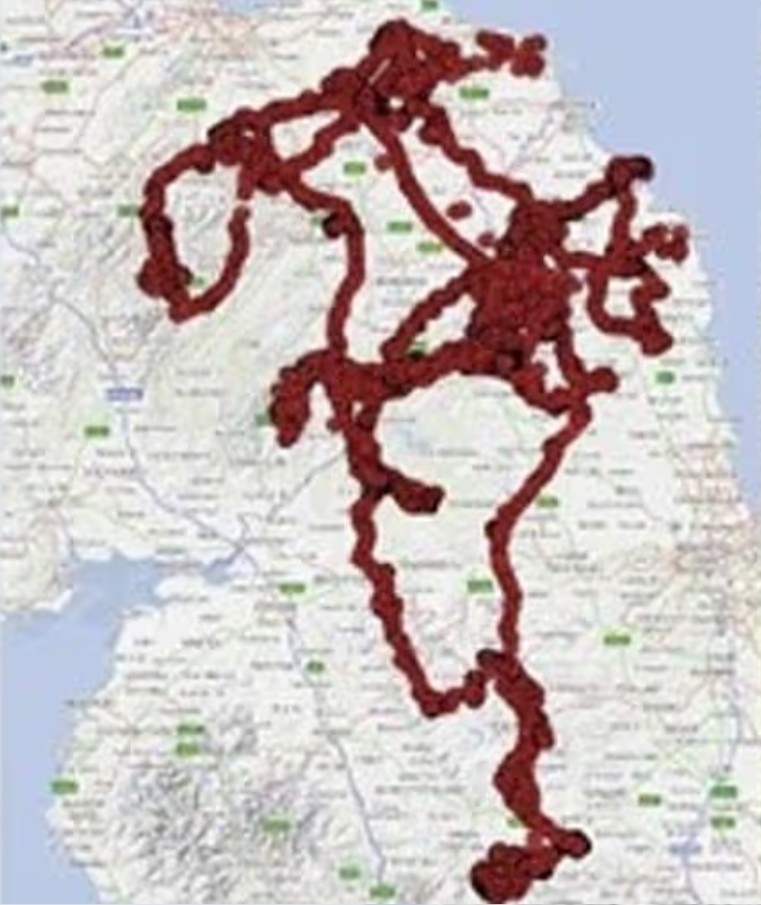
Low resolution map showing Squeagle’s satellite tracking data from Feb – May 2026. Image from Restoring Upland Nature (RUN)
After her release, Squeagle travelled through parts of northern England, including Northumberland, the Pennines and the Yorkshire Dales. A photograph taken in Northumberland on Monday, 4 May, 2026, showed significant damage to her wing feathers.
Squeagle photographed in Northumberland on 4 May 2026 with extensive feather damage (photo via RUN)
On Monday, 1 June, 2026, gamekeepers on an estate in the Lammermuirs became concerned after noticing the bird behaving unusually and contacted RUN. Squeagle was collected and taken to the Scottish SPCA’s National Wildlife Rescue Centre at Fishcross for assessment.
Scans and treatment revealed she had been shot and had at least 17 shotgun pellets lodged in her body and wings. Experts believe the injuries were not recent, as the wounds had already healed.
Detective Sergeant David Lynn, National Wildlife Crime Coordinator said:
“This was a serious attack on a protected bird of prey which I utterly condemn. Thanks to the quick actions of those who reported concerns, the golden eagle was able to receive specialist treatment and has since been returned to the wild. We are working with partners across Scotland and northern England to establish where and when she was shot.
“Following treatment by veterinary specialists at the Scottish SPCA, Squeagle was released back into the wild on Saturday, 6 June, 2026. Her condition will continue to be monitored through observations and detailed analysis of satellite tracking.
“Enquiries remain ongoing, and we are working alongside our colleagues in Northumberland, Durham, Cumbria and North Yorkshire, supported by the UK National Wildlife Crime Unit to establish who was responsible“.
Anyone with information is asked to contact Police Scotland, quoting incident number 1361 of 5 June 2026.
ENDS
Squeagle being released in south Scotland February 2026 after translocation from the Western Isles (photo by John Wright)
My commentary:
First of all, plaudits to all those involved with the recovery of this injured eagle and her subsequent release back to the wild – the gamekeepers who found her and chose to raise the alarm instead of their guns, RUN staff for a quick response and rescue, and the SSPCA staff who provided urgent and expert veterinary care and rehabilitation.
Plaudits also to Police Scotland for a fairly fast and detailed press release.
What struck me most about this latest persecution incident is that this Golden Eagle had survived for four-years in the relatively persecution-free Uists, but within three months of being translocated and released in south Scotland, and venturing into northern England, someone had shot her, presumably with the intention of killing her.
This happened just a few short months after another young translocated Golden Eagle, ‘Hamlet’, was found with shotgun injuries on a grouse moor in the Scottish Borders in January this year (see here).
These crimes, along with the shooting of Golden Eagle Merrick in the Moorfoot Hills in 2023 (here), the suspicious disappearances of Golden Eagles Tarras and Wren in the Langholm area in 2025 (here), the suspicious disappearance of a White-tailed Eagle in the Moorfoot Hills in 2025 (here), and the suspicious disappearance of White-tailed Eagle G834 in the North York Moors National Park in 2026 (here) are a stark reminder of the difficulties faced by those trying to re-establish eagle populations in the region, against a residual Victorian culture of zero tolerance for raptors on large areas of land that is managed for gamebird shooting.
The police and others are undertaking a detailed analysis of Squeagle’s satellite tracking data to try and pinpoint the location where she was shot, which looks likely to have been somewhere in northern England. I don’t doubt that they’ll be able to find it, given the quality and accuracy of the tag data available to them, but even if they can determine the location, it won’t result in a prosecution / conviction, or indeed any sanction, because unlike in Scotland, General Licence restrictions and/or grouse shoot licence revocations are not available in England.
So for those who continue to target these eagles, and other raptors, especially Hen Harriers, the risk of getting caught is almost negligible so in their minds it’s still worth committing the offence.
The RSPB and some others will argue that gamebird licensing is the way ahead, so that licences can be revoked where offences have been detected, providing at least some sort of sanction against those who continue to think the law doesn’t apply to them. There’s some merit in that argument, although personally I see licensing as only a step in the right direction and we’re still to see any licence revocations in Scotland, despite multiple raptor persecution offences taking place since licensing was introduced two years ago.
I’d like to see the Westminster Government put up funding to establish a national, multi-agency response unit to investigate raptor persecution crimes, and all other crimes that are listed as National Wildlife Crime priorities. It’s all very well putting up £1 million to explore the re-establishment of Golden Eagles in northern England (see here), but without also investing in wildlife crime enforcement capabilities, many eagles that are translocated are simply going to be shot, or trapped, or poisoned, or bludgeoned to death, with zero consequences for the offenders, just as they have been for the last 70+ years.
For anyone who still wants to pretend that the grouse shooting industry isn’t responsible for the systematic extermination of Hen Harriers on grouse moors across the UK, here’s the latest catalogue of crime that suggests otherwise.
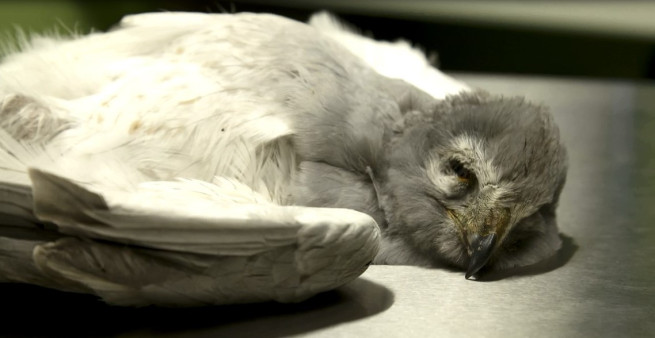
This male hen harrier died in 2019 after his leg was almost severed in an illegally set trap that had been placed next to his nest on a Scottish grouse moor (see here). Photo by Ruth Tingay
This is the blog I now publish after every reported killing or suspicious disappearance.
“They disappear in the same way political dissidents in authoritarian dictatorships have disappeared” (Stephen Barlow, 22 January 2021).
Today the list has been revised to reflect updates revealed in this morning’s blog (here) about another ‘disappearing’ Hen Harrier on Ruabon Moor in North Wales whose satellite tag was found and an assessment concluded it’d been ‘deliberately cut off’.
There isn’t a one-stop shop (apart from this list) where you can find information about ‘missing’ or illegally killed Hen Harriers – the information for this list is sourced and cross-referenced from various places, including Natural England’s database, the RSPB’s database, the HSE’s database, police reports, RSPB Birdcrime reports and FoIs to various agencies. This list doesn’t include any Hen Harriers that have been listed as having a natural cause of death (e.g. known/suspected predation), or listed as ‘likely tag failure’, or known to have been lost abroad, or where the cause of death is inconclusive, unless there is additional information (e.g. from satellite tag data) which indicates suspicious or illegal activity. It is painstaking work that takes a lot of time to complete, but I consider it to be as accurate and comprehensive as it can be at the time of writing.
I’ve been compiling this list only since 2018 because that is the year that the grouse shooting industry ‘leaders’ would have us believe that the criminal persecution of Hen Harriers had stopped and that these birds were being welcomed back on to the UK’s grouse moors (see here).
This assertion was made shortly before the publication of a devastating new scientific paper that demonstrated that 72% of satellite-tagged Hen Harriers were confirmed or considered likely to have been illegally killed, and this was ten times more likely to occur over areas of land managed for grouse shooting relative to other land uses (see here). A further scientific paper published in 2023 by scientists at the RSPB, utilising even more recent data, echoed these results – see here.
2018 was also the year that Natural England issued a licence to begin a Hen Harrier brood meddling trial on grouse moors in northern England. For new blog readers, Hen Harrier brood meddling was a conservation sham sanctioned by DEFRA as part of its ludicrous ‘Hen Harrier Action Plan‘ and carried out by Natural England (NE), in cahoots with the very industry responsible for the species’ catastrophic decline in England.
For more background see here and for a critical evaluation of the trial after 5 years see this report by Wild Justice. In 2024 the brood meddling trial appeared to collapse for reasons which are not yet clear (see here) and the licence for the so-called ‘scientific trial’ expired. In March 2025 Natural England announced the end of the brood meddling trial (here) and in April 2025 announced that a licence application to continue brood meddling, submitted by the Moorland Association, had been refused (here).
Brood meddling was earlier described as a sort of ‘gentleman’s agreement’ by commentator Stephen Welch:
“I don’t get it, I thought the idea of that scheme was some kind of trade off – a gentleman’s agreement that the birds would be left in peace if they were moved from grouse moors at a certain density. It seems that one party is not keeping their side of the bargain“.
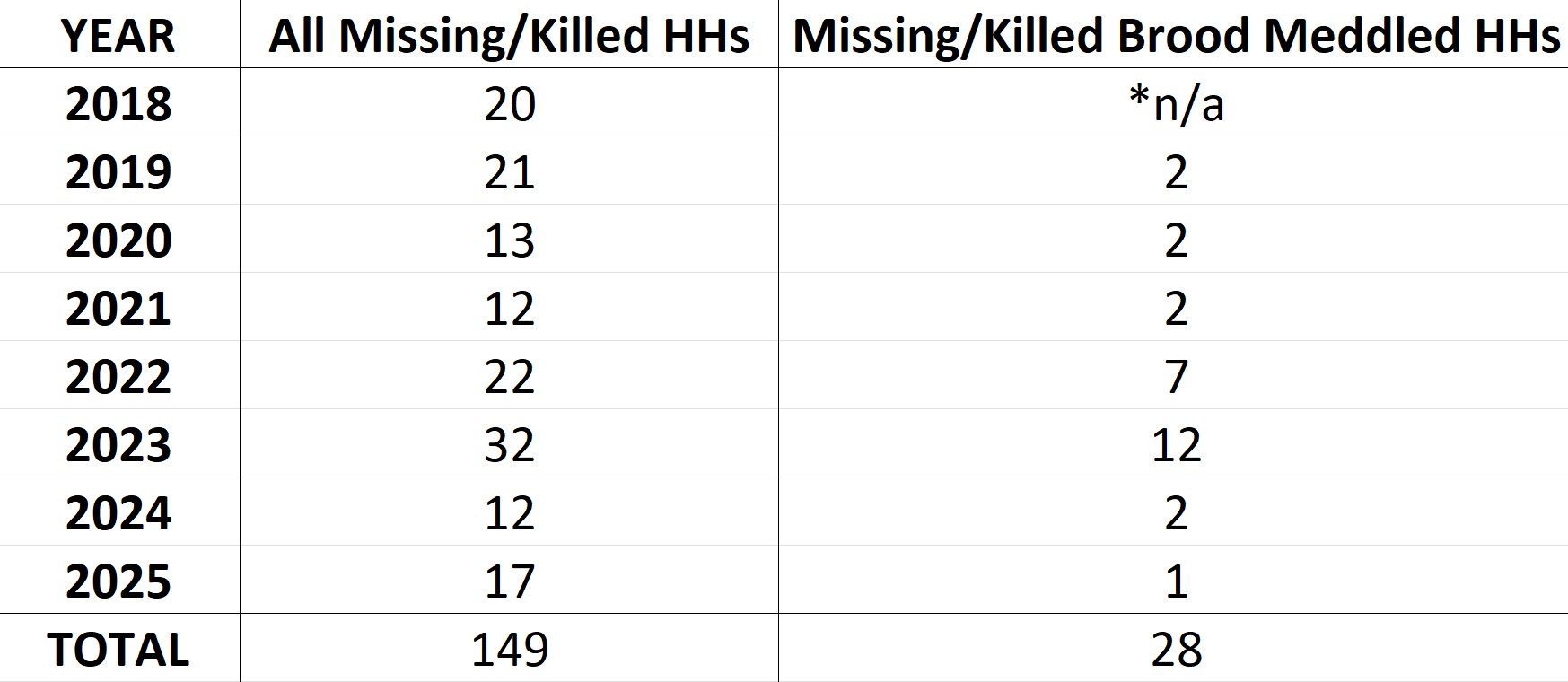
With at least 149 Hen Harriers gone since 2018, and 28 of those being brood meddled birds, there is no question that the grouse shooting industry was simply taking the piss. Meanwhile, Natural England pretended that ‘partnership working’ was the way to go and consecutive Tory DEFRA Ministers remained silent for all those years.
*n/a – no Hen Harriers were brood meddled in 2018.
‘Partnership working’ according to Natural England appeared to include authorising the removal of Hen Harrier chicks from a grouse moor already under investigation by the police for suspected raptor persecution (here) and accepting a £75k ‘donation’ from representatives of the grouse shooting industry with a contract clause that prevented Natural England from criticising them or the sham brood meddling trial (see here). This was in addition to a further £10k ‘donation’ that Natural England accepted, under the same terms, in 2021 (here).
Thankfully, the Scottish Government finally decided to act by introducing a grouse moor licensing scheme under the Wildlife Management & Muirburn (Scotland) Act 2024. The intention behind this new legislation is that grouse shooting estates could have their licences suspended/revoked if, on the balance of probability, it is shown that any raptor persecution crimes (& some other associated offences) are linked with grouse moor management on that estate. There were, however, ongoing issues with the licence as it was significantly watered-down after an intervention from the grouse shooting industry (see here). The loophole was eventually closed off via an amendment in the Natural Environment (Scotland) Act 2026 (see here).
In England a new Hen Harrier Taskforce was established in 2024, led by the National Wildlife Crime Unit, to use innovative techniques to target Hen Harrier persecution hotspots (locations where Hen Harriers repeatedly ‘disappear’ or are found illegally killed). It’s too early to judge the Taskforce’s success/failure and it’s been met with considerable resistance from the Moorland Association, the grouse moor owners’ lobby group (e.g. see here). So far though, it’s quite clear that the the illegal killing continues.
So here’s the latest gruesome list of ‘missing’/illegally killed Hen Harriers since 2018. Note that the majority of these birds (but not all) were fitted with satellite tags. How many more [untagged] harriers have been killed? We now have evidence that gamekeepers are specifically targeting untagged Hen Harriers, precisely to avoid detection (see here for extraordinary footage/audio captured by the RSPB’s Investigations Team as featured on Channel 4 News in October 2024).
2018
February 2018: Hen Harrier Saorsa ‘disappeared’ in the Angus Glens in Scotland (here). The Scottish Gamekeepers Association later published wholly inaccurate information claiming the bird had been re-sighted. The RSPB dismissed this as “completely false” (here). Tagged by RSPB.
5 February 2018: Hen Harrier Marc ‘disappeared’ on a grouse moor in Durham (here). Tagged by RSPB.
9 February 2018: Hen Harrier Aalin ‘disappeared’ on a grouse moor in Wales (here). Tagged by RSPB.
March 2018: Hen Harrier Blue ‘disappeared’ in the Lake District National Park (here). Tagged by RSPB.
March 2018: Hen Harrier Finn ‘disappeared’ near Moffat in Scotland (here). Tagged by RSPB.
18 April 2018: Hen Harrier Lia ‘disappeared’ in Wales and her corpse was retrieved in a field in May 2018. Cause of death was unconfirmed but police treating death as suspicious (here). Tagged by RSPB.
8 August 2018: Hen Harrier Hilma ‘disappeared’ on a grouse moor in Northumberland (here). Tagged by RSPB.
16 August 2018: Hen Harrier Athena ‘disappeared’ on a grouse moor in Scotland (here). Tagged by RSPB.
26 August 2018: Hen Harrier Octavia ‘disappeared’ on a grouse moor in the Peak District National Park (here). Tagged by RSPB.
29 August 2018: Hen Harrier Margot ‘disappeared’ on a grouse moor in Scotland (here). Tagged by RSPB.
29 August 2018: Hen Harrier Heulwen ‘disappeared’ on a grouse moor in Wales (here). Tagged by RSPB.
3 September 2018: Hen Harrier Stelmaria ‘disappeared’ on a grouse moor in Scotland (here). Tagged by RSPB.
24 September 2018: Hen Harrier Heather ‘disappeared’ on a grouse moor in Scotland (here). Tagged by RSPB.
2 October 2018: Hen Harrier Mabel (Tag ID 34342) ‘disappeared’ on a grouse moor on the edge of the Yorkshire Dales National Park (here). Grid ref NY851059. Tagged by NE.
3 October 2018: Hen Harrier Thor ‘disappeared’ next to a grouse moor in Bowland, Lanacashire (here). Tagged by RSPB.
23 October 2018: Hen Harrier Tom (Tag ID 161144) ‘disappeared’ in South Wales (here). Grid ref SS906698. Tagged by NE.
26 October 2018: Hen Harrier Arthur ‘disappeared’ on a grouse moor in the North York Moors National Park (here). Tagged by RSPB.
1 November 2018: Hen Harrier Barney (Tag ID 34343) ‘disappeared’ on Bodmin Moor, Cornwall (here). Grid ref SX140720. Tagged by NE.
10 November 2018: Hen Harrier Rannoch ‘disappeared’ on a grouse moor in Scotland (here). Her corpse was found nearby in May 2019 – she’d been killed in an illegally-set spring trap (here). Tagged by RSPB.
14 November 2018: Hen Harrier River ‘disappeared’ on a grouse moor in the Nidderdale AONB (here). Her corpse was found nearby in April 2019 – she’d been illegally shot (here). Tagged by RSPB.
2019
16 January 2019: Hen Harrier Vulcan ‘disappeared’ in Wiltshire close to Natural England’s proposed reintroduction site (here). Tagged by RSPB.
28 January 2019: Hen Harrier DeeCee ‘disappeared’ in Glen Esk, a grouse moor area of the Angus Glens (see here). Tagged by RSPB.
7 February 2019: Hen Harrier Skylar ‘disappeared’ next to a grouse moor in South Lanarkshire (here). Tagged by RSPB.
22 April 2019: Hen Harrier Marci ‘disappeared’ on a grouse moor in the Cairngorms National Park (here). Tagged by RSPB.
26 April 2019: Hen Harrier Rain ‘disappeared’ on a grouse moor in Nairnshire (here). Tagged by RSPB.
11 May 2019: An untagged male Hen Harrier was caught in an illegally-set trap next to his nest on a grouse moor in South Lanarkshire. He didn’t survive (here).
7 June 2019: An untagged Hen Harrier was found dead on a grouse moor in Scotland. A post mortem stated the bird had died as a result of ‘penetrating trauma’ injuries and that this bird had previously been shot (here).
5 September 2019: Wildland Hen Harrier 1 ‘disappeared’ on a grouse moor nr Dalnaspidal on the edge of the Cairngorms National Park (here). Tagged by Wildlands.
11 September 2019: Hen Harrier Romario ‘disappeared’ on a grouse moor in the Cairngorms National Park (here). Tagged by RSPB.
14 September 2019: Hen Harrier R1-M2-19 (Brood meddled in 2019, Tag ID 183704) ‘disappeared’ in the North Pennines (here). Grid ref SD920943. Tagged by NE.
23 September 2019: Hen Harrier R1-M4-19 (Brood meddled in 2019, Tag ID 55149) ‘disappeared’ in North Pennines (here). Grid ref NY952103. Tagged by NE.
24 September 2019: Wildland Hen Harrier 2 ‘disappeared’ on a grouse moor at Invercauld in the Cairngorms National Park (here). Tagged by Wildlands.
24 September 2019: Hen Harrier Bronwyn ‘disappeared’ near a grouse moor in North Wales (here). Tagged by RSPB.
10 October 2019: Hen Harrier Ada ‘disappeared’ on a grouse moor in the North Pennines AONB (here). Tagged by RSPB.
12 October 2019: Hen Harrier Thistle ‘disappeared’ on a grouse moor in Sutherland (here). Tagged by RSPB.
18 October 2019: Member of the public reports the witnessed shooting of an untagged male Hen Harrier on White Syke Hill in North Yorkshire (here).
November 2019: Hen Harrier Mary found illegally poisoned on a pheasant shoot in Ireland (here). Tagged by RSPB.
November 2019: Hen Harrier Artemis ‘disappeared’ near Long Formacus in south Scotland (here). Tagged by RSPB.
14 December 2019: Hen harrier Oscar ‘disappeared’ in Eskdalemuir, south Scotland (here). Tagged by RSPB.
December 2019: Hen Harrier Ingmar ‘disappeared’ in the Strathbraan grouse moor area of Perthshire (here). Tagged by RSPB.
Unknown date in 2019: Hen Harrier Erin tagged on Isle of Man ‘disappeared’ (Stop No Malfunction) – location unknown (see here). Tagged by RSPB.
2020
27 January 2020: Members of the public report the witnessed shooting of a male Hen Harrier on Threshfield Moor in the Yorkshire Dales National Park (here).
5 April 2020: Hen Harrier Hoolie ‘disappeared’ on a grouse moor in the Cairngorms National Park (here). Tagged by RSPB.
8 April 2020: Hen Harrier Marlin ‘disappeared’ on a grouse moor in the Cairngorms National Park (here). Tagged by RSPB.
19 May 2020: Hen Harrier Fingal ‘disappeared’ on a grouse moor in the Lowther Hills, Scotland (here). Tagged by RSPB.
21 May 2020: Hen Harrier R1-M1-19 (Brood meddled in 2019, Tag ID 183701) ‘disappeared’ on a grouse moor in Cumbria shortly after returning from wintering in France (here). Grid ref SD770877. Tagged by NE.
27 May 2020: Hen Harrier Silver ‘disappeared’ on a grouse moor on Leadhills Estate, Scotland (here). Tagged by RSPB.
2020: day/month unknown: Unnamed male Hen Harrier breeding on RSPB Geltsdale Reserve, Cumbria ‘disappeared’ while away hunting (here).
14 August 2020: Hen Harrier Solo (Tag ID 201119) ‘disappeared’ in confidential nest area in Lancashire (here). Tagged by NE.
7 September 2020: Hen Harrier Dryad ‘disappeared’ on a grouse moor in the Yorkshire Dales National Park (here). Tagged by RSPB.
16 September 2020: Hen Harrier Fortune (Tag ID 162150a) ‘disappeared’ from a confidential roost site in Northumberland (here). Tagged by NE.
19 September 2020: Hen Harrier Harold (Tag ID 57272) ‘disappeared’ on a grouse moor in the Yorkshire Dales National Park (here). Grid ref NY830036. Tagged by NE.
20 September 2020: Hen Harrier R1-M4-20 (Brood meddled in 2020, Tag ID 55152) ‘disappeared’ next to a grouse moor in North Yorkshire (here). Grid ref SE103956. Tagged by NE.
19 December 2020: Hen Harrier Lagertha (Tag ID 201126a) ‘disappeared’ in Christchurch, Dorset close to winter roost. Not to be confused with RSPB-tagged bird also called Lagertha (2023). Grid ref SZ161924. Tagged by NE.
2021
24 February 2021: Hen Harrier Tarras ‘disappeared’ next to a grouse moor in Northumberland (here). Tagged by RSPB.
12th April 2021: Hen Harrier Yarrow ‘disappeared’ near Stockton, County Durham (here). Tagged by RSPB.
18 May 2021: Untagged breeding male Hen Harrier (Geltsdale 1) ‘disappeared’ from its breeding attempt on RSPB Geltsdale Reserve, Cumbria whilst away hunting (here).
18 May 2021: Another untagged breeding male Hen Harrier (Geltsdale 2) ‘disappeared’ from its breeding attempt on RSPB Geltsdale Reserve, Cumbria whilst away hunting (here).
24 July 2021: Hen Harrier Asta (Tag ID 201117) ‘disappeared’ in the North Pennines after establishing a home range around Gilmonby Moor (here). We learned 18 months later that her wings had been ripped off so her tag could be fitted to a crow in an attempt to cover up her death (here). Grid ref SE206937. Tagged by NE.
14th August 2021: Hen Harrier Josephine (Tag ID 213850) ‘disappeared’ at a ‘confidential site’ in Northumberland (here). Grid ref NY592841. Tagged by NE.
17 September 2021: Hen Harrier Reiver ‘disappeared’ in a grouse moor dominated region of Northumberland (here). Tagged by RSPB.
24 September 2021: Hen Harrier R2-F1-21 (Brood meddled in 2021, Tag ID 213918) ‘disappeared’ in Northumberland (here). Grid ref NZ022667. Tagged by NE.
15 November 2021: Hen Harrier R2-F1-20 (Brood meddled in 2020, Tag ID 203003) ‘disappeared’ at the edge of a grouse moor on Arkengarthdale Estate in the Yorkshire Dales National Park (here). Grid ref NY959039. Tagged by NE.
12 December 2021: Hen Harrier Jasmine (Tag ID 213848) ‘disappeared’ on a grouse moor (High Rigg Moor on the Middlesmoor Estate) in the Nidderdale AONB in North Yorkshire (here). Grid ref SE034733. Tagged by NE.
Unknown date in 2021: Hen Harrier Maiden, tagged in Lancashire in 2021, ‘disappeared’ at unknown location (here). Tagged by RSPB.
Unknown date in 2021: Hen Harrier Awyr, tagged in Conwy in 2021, ‘disappeared’ on Ruabon grouse moor. Her tag/harness was recovered and an expert assessment concluded it had been cut off (here). Tagged by the RSPB.
2022
9 January 2022: Hen Harrier Ethel (Tag ID 213852) ‘disappeared’ in Northumberland (here). Grid ref NY936632. Tagged by NE.
10 February 2022: An unnamed satellite-tagged Hen Harrier ‘disappeared’ in a grouse moor dominated area of the Peak District National Park (here). One year later it was revealed that the satellite tag/harness of this young male called ‘Anu’ had been deliberately cut off (see here). Tagged by RSPB.
12 April 2022: Hen Harrier Free (Tag ID 201121) ‘disappeared’ at a ‘confidential site’ in Cumbria (here). It later emerged he hadn’t disappeared, but his mutilated corpse was found on moorland in the Yorkshire Dales National Park. A post mortem revealed the cause of death was having his head twisted and pulled off. One (ringed) leg had also been torn off whilst he was still alive (here). Tagged by NE.
April 2022: Hen Harrier Pegasus ‘disappeared’ on a grouse moor at Birkdale in the Yorkshire Dales National Park (here). Tagged by RSPB.
May 2022: An untagged breeding male Hen Harrier (Peak District 1) ‘disappeared’ from a National Trust-owned grouse moor in the Peak District National Park (here).
May 2022: Another untagged breeding male Hen Harrier (Peak District 2) ‘disappeared’ from a National Trust-owned grouse moor in the Peak District National Park (here).
14 May 2022: Hen Harrier Harvey (Tag ID 213844) ‘disappeared’ in the North Pennines (here). Grid ref NY918019. Tagged by NE.
20 June 2022: Hen harrier chick #1 stamped to death in nest on a grouse moor in the Yorkshire Dales National Park (here).
20 June 2022: Hen Harrier chick #2 stamped to death in nest on a grouse moor in the Yorkshire Dales National Park (here).
20 June 2022: Hen Harrier chick #3 stamped to death in nest on a grouse moor in the Yorkshire Dales National Park (here).
20 June 2022: Hen Harrier chick #4 stamped to death in nest on a grouse moor in the Yorkshire Dales National Park (here).
17 August 2022: Hen Harrier R1-M1-22 (Brood meddled in 2022, Tag ID 232637) ‘disappeared’ on moorland in the Yorkshire Dales National Park (here). Grid ref SD804893. Tagged by NE.
September 2022: Hen Harrier Sullis ‘disappeared’ on a grouse moor in Cumbria (here). Tagged by RSPB.
5 October 2022: Hen Harrier R3-M2-22 (Brood meddled in 2022, Tag ID 213920a) ‘disappeared’ on moorland in the Yorkshire Dales National Park (here). Grid ref NY791016. Tagged by NE.
10 October 2022: Hen Harrier Sia ‘disappeared’ near Hamsterley Forest in the North Pennines (here). Tagged by RSPB.
October 2022: Hen Harrier R1-F1-21 (Brood meddled in 2021, Tag ID 213919) ‘disappeared’ in the North Sea off the North York Moors National Park (here). Tagged by NE.
1 December 2022: Hen Harrier R1-M1-21 (Brood meddled in 2021, Tag ID 55145a) ‘disappeared’ on moorland in the Yorkshire Dales National Park (here). Grid ref SD917620. Tagged by NE.
7 December 2022: Hen Harrier R2-F2-20 (Brood meddled in 2020, Tag ID 55144) ‘disappeared’ from winter roost (same as R3-F1-22) on moorland in North Pennines AONB. Later found dead on 26 June 2023 with 3 shotgun pellets in corpse (here). Grid ref NY730372. Tagged by NE.
14 December 2022: Hen Harrier R3-F1-22 (Brood meddled in 2022, Tag ID 213921a) ‘disappeared’ from winter roost (same as R2-F2-20) on moorland in the North Pennines AONB (here). Later found dead on 10 April 2023 with two shotgun pellets in corpse (here). Grid ref NY708423. Tagged by NE.
15 December 2022: Hen Harrier R2-F1-22 (Brood meddled in 2022, Tag ID 213931) ‘disappeared’ on moorland in the Yorkshire Dales National Park (here). Grid ref SD847831. Tagged by NE.
Unknown date in 2022: Hen Harrier Heath, tagged in Lancashire in 2019, ‘disappeared’ at unknown location (here). Tagged by RSPB.
Unknown date in 2022: Hen Harrier Syrcas, tagged in Conwy in 2021, ‘disappeared’ at unknown location (here). Tagged by RSPB.
2023
30 March 2023: Hen Harrier R1-F3-22 (Brood meddled in 2022, Tag ID NY823039) ‘disappeared’ in Yorkshire (here). Grid ref NY823039. Tagged by NE.
March 2023: Hen Harrier (tagged), last transmission/sighting in Lancashire. No tag number provided. Reported in RSPB Birdcrime 2023, Appendix 4 (here).
1 April 2023: Hen Harrier R2-M1-22 (Brood meddled in 2022, Tag ID NY846027) ‘disappeared’ in Yorkshire (here). Grid ref NY846027. Tagged by NE.
April 2023: Hen Harrier Lagertha ‘disappeared’ in North Yorkshire (here). Tagged by RSPB. Not to be confused with Lagertha tagged by NE & disappeared in 2020).
April 2023: Hen Harrier Nicola (Tag ID 234078) ‘disappeared’ in North Yorkshire (here). Grid ref SD831860. Tagged by NE.
April 2023: Untagged male Hen Harrier (Geltsdale 3) ‘disappeared’ from an active nest on RSPB Geltsdale Reserve in Cumbria (here).
April 2023: Another untagged male Hen Harrier (Geltsdale 4) ‘disappeared’ from an active nest on RSPB Geltsdale Reserve in Cumbria (here).
April 2023: Untagged male Hen Harrier ‘disappeared’ from an active nest in Co Durham (here).
4/5 May 2023: Hen Harrier Rush ‘disappeared’ from a grouse moor in Bowland AONB in Lancashire (here). Tagged by RSPB.
9/10 May 2023: Hen Harrier Dagda tagged in Lancashire in June 2022 and who was breeding on the RSPB’s Geltsdale Reserve in 2023 until he ‘disappeared’, only to be found dead on the neighbouring Knarsdale grouse moor in May 2023 – a post mortem revealed he had been shot (here). Tagged by RSPB.
17 May 2023: Hen Harrier Wayland ‘disappeared’ in the Clapham area of North Yorkshire, just north of the Bowland AONB (here). Tagged by RSPB.
31 May 2023: Hen Harrier R2-M3-22 (Brood meddled in 2022, Tag ID 213932) ‘disappeared’ in Northumberland (here). Grid ref NY765687. Tagged by NE.
11 June 2023: Hen Harrier R2-M1-21 (Brood meddled in 2021, Tag ID 213922) ‘disappeared’ in the Yorkshire Dales National Park (here). Grid ref NY757000. Tagged by NE.
12 June 2023: Hen Harrier R1-M2-20 (Brood meddled in 2020, Tag ID 203004) ‘disappeared’ on a grouse moor in Co. Durham (here). Grid ref NY976322. Tagged by NE.
6 July 2023: Hen Harrier Rubi (Tag ID 201124a) ‘disappeared’ on a grouse moor in Co. Durham (here). Grid ref NY911151. Tagged by NE.
23 July 2023: Hen Harrier R1-F1-23 (Brood meddled in 2023, Tag ID 55154a) ‘disappeared’ on a grouse moor in Co. Durham (close to where Rubi disappeared) (here). Grid ref NY910126. Tagged by NE.
9 August 2023: Hen Harrier Martha ‘disappeared’ on a grouse moor (Westburnhope Moor) near Hexham in the North Pennines (here). Tagged by RSPB.
11 August 2023: Hen Harrier Selena ‘disappeared’ on a grouse moor (Mossdale Moor) in the Yorkshire Dales National Park (here). Tagged by RSPB.
11 August 2023: Hen Harrier R3-F1-23 (Brood meddled in 2023, Tag ID 201118a) ‘disappeared’ in Co. Durham (here). Grid ref NZ072136. Tagged by NE.
15 August 2023: Hen Harrier Hepit ‘disappeared’ on a grouse moor (Birkdale Common) near Kirkby Stephen in the Yorkshire Dales National Park (here). Tagged by RSPB.
24 August 2023: Hen Harrier R1-F2-23 (Brood meddled in 2023, Tag ID 55155a) ‘disappeared’ in Northumberland (here). Grid ref NY679863. Tagged by NE.
August-Sept 2023: Hen Harrier Harmonia ‘disappeared’ in the Yorkshire Dales National Park (here). ‘Stop No Malfunction’. Tagged by RSPB.
September 2023: Hen Harrier Saranyu, tagged in Cumbria in June 2023, ‘disappeared’ in Durham in September 2023 (here). Tagged by RSPB.
September 2023: Hen Harrier Inger, tagged in Perthshire in July 2022, ‘disappeared’ on a grouse moor in the Angus Glens in September 2023 (here). Tagged by RSPB.
15 September 2023: Hen Harrier Rhys (Tag ID 213847a), tagged in Cumbria on 1st August 2023, ‘disappeared’ on a grouse moor in the Yorkshire Dales National Park (here). Grid ref SD798896. Tagged by NE.
24 September 2023: Hen Harrier R2-F2-23 (Brood meddled in 2023, Tag ID 213929) ‘disappeared’ in the North Pennines (here). Grid ref NY888062. Tagged by NE.
26 September 2023: Hen Harrier Hope, tagged in Cumbria on 21 July 2023, ‘disappeared’ next to a grouse moor in the Yorkshire Dales National Park (here). Grid ref SD801926. Tagged by NE.
4 October 2023: Hen Harrier R1-M3-20 (Brood meddled in 2020, Tag ID 55153) ‘disappeared’ in Co Durham (here). Grid ref NY935192. Tagged by NE.
4 October 2023: Hen Harrier R4-F1-23 (Brood meddled in 2023, Tag ID 213925a) ‘disappeared’ on a grouse moor in the Yorkshire Dales National Park (here). Grid ref SE003981. Tagged by NE.
15 November 2023: Hen Harrier Hazel’ (Tag ID 240292) tagged in Cumbria on 21 July 2023, ‘disappeared’ on the Isle of Man (here). Grid ref SC251803. Tagged by NE.
7 December 2023: Hen Harrier R2-M1-20 (Brood meddled in 2020, Tag ID 55146a) ‘disappeared’ in Co Durham. Grid ref NY963211. Tagged by NE.
Unknown date in 2023: Hen Harrier Aurora, tagged in Dumfries & Galloway in 2022, ‘disappeared’ at unknown location (here). Tagged by RSPB.
2024
12 February 2024: Hen Harrier Susie (Tag ID 201122), found dead in Northumberland. Later revealed to have been the victim of shooting (here). Grid ref NY759585. Tagged by NE. Susie’s chicks were stamped to death at nest on moor at Whernside in 2022 (here).
15 February 2024: Hen Harrier Shalimar, tagged on the National Trust for Scotland’s Mar Lodge Estate in 2023, ‘disappeared’ in suspicious circumstances on a grouse moor in the notorious Angus Glens (here). Tagged by RSPB.
24 April 2024: Hen Harrier Ken (Tag ID 213849a) ‘disappeared’ in suspicious circumstances close to a grouse moor in Bowland (here). Grid ref SD684601. Tagged by NE.
17 May 2024: Hen Harrier R2-M2-23 (Brood meddled in 2023, Tag ID 213928) ‘disappeared’ in suspicious circumstances next to Middlesmoor grouse moor in Nidderdale (here). Grid ref SE043754. Tagged by NE.
7 June 2024: Hen Harrier Edna (Tag ID 161143a). Decomposed corpse found next to a wind farm nr Otterburn, Northumberland. Listed as ‘suspected illegally killed’. There has been a suggestion she was killed elsewhere & dumped at the wind farm as a ploy to cover up the crime (here). Grid ref NY910827. Tagged by NE.
25 June 2024: Hen Harrier R2-F1-23 (Brood meddled in 2023, Tag ID 213923) ‘disappeared’ in suspicious circumstances on a grouse moor in Yorkshire Dales National Park (here). Grid ref NY985082. Tagged by NE.
July 2024: Hen Harrier Helius, tagged in Lancashire in 2023, ‘disappeared’ in suspicious circumstances in Bowland (here). Tagged by RSPB.
29 July 2024: Hen Harrier (Tag ID 254843) tagged in Northumberland on 5 July 2024, decomposed corpse not suitable for post mortem but forensics work on her satellite tag showed shot damage (here). Grid ref NY824937. Tagged by NE.
October 2024: An un-tagged Hen Harrier was apparently shot on a grouse moor at Grassington in the Yorkshire Dales National Park by one of three gamekeepers being secretly filmed by the RSPB (here).
1 October 2024: Hen Harrier Dreich (Tag ID 254842) ‘disappeared’ in Lanarkshire (here). Grid ref NS826020. Tagged by NE.
15 October 2024: Hen Harrier Baldur (Tag ID 240291) ‘disappeared’ in Northumberland (here). Grid ref NZ038961. Tagged by NE.
19 October 2024: Hen Harrier Margaret (Tag ID 254844) ‘disappeared’ in Northumberland (here). It was later reported that her tag had been found (‘removed’) but no sign of the carcass (here). Grid ref NY878497. Tagged by NE.
2025
15 January 2025: Hen Harrier Red, hatched on the Tarras Valley Nature Reserve in 2024, ‘disappeared’ on a grouse moor in County Durham in the North Pennines, in the same area another tagged Hen Harrier (Sia) vanished in 2022 (here). Tagged by RSPB.
January 2025: Hen Harrier Ataksak was found poisoned close to a grouse moor in North Yorkshire (here). Apparently a police investigation is ongoing. Tagged by RSPB.
3 February 2025: Hen Harrier R3-F2-22 (Brood meddled in 2022, Tag ID 213924) ‘disappeared’ on a grouse moor in the North York Moors National Park (here). Grid ref SE759996. Tagged by NE.
27 February 2025: Hen Harrier Sita, tagged on behalf of Hen Harrier Action in Bowland in 2024 ‘disappeared’ from a roost site on a grouse moor in the Yorkshire Dales National Park (here). Tagged by RSPB.
4 April 2025: Hen Harrier Bonnie (Tag ID 254841) ‘disappeared’ on a grouse moor in the Moorfoots, Scotland (here). Grid ref NT415575. Tagged by NE.
10 April 2025: Hen Harrier Gill (Tag ID 240294) ‘disappeared’ in south Scotland (here). Grid ref NT440344. Tagged by NE.
1 May 2025: Hen Harrier Pete (Tag ID 213843) ‘disappeared’ in Cumbria (see here). Grid ref NY309418. Tagged by NE.
May 2025: Untagged Hen Harrier male (Geltsdale 5) with an active nest on RSPB Geltsdale Reserve in Cumbria ‘disappeared’. Strongly suspected to have been shot whilst away hunting on nearby grouse moor (here).
May 2025: Another untagged Hen Harrier male (Geltsdale 6) with another active nest on RSPB Geltsdale Reserve in Cumbria ‘disappeared’. Strongly suspected to have been shot whilst away hunting on nearby grouse moor (here).
May 2025: Hen Harrier Dynamo with an active nest on United Utilities-owned land in Bowland, Lancashire, ‘disappeared’. Strongly suspected to have been shot whilst away hunting on a nearby grouse moor (here). Tagged by RSPB.
May 2025: Untagged Hen Harrier with an active nest on United Utilities-owned land in Bowland, Lancashire, ‘disappeared’. Strongly suspected to have been shot whilst away hunting on a nearby grouse moor (here).
31 August 2025: An unnamed Hen Harrier, hatched and tagged on National Trust-owned moorland in the peak District National Park in 2025, ‘disappeared’ from Ruabon grouse moor, north Wales after arriving there three days earlier. Her tag data indicated she was dead on 31 August. Her tag/harness were recovered on 2 September and an expert assessment concluded it had been “intentionally severed” (here). Tagged by RSPB on behalf of National Trust.
9 September 2025: Hen Harrier Maria (Tag ID 281718) tagged in Northumberland on 25 July 2025, ‘disappeared’ near Belford in Northumberland. Grid ref NU125340. Tagged by NE.
17 September 2025: Hen Harrier Beatrix, who fledged from the Tarras Valley Nature Reserve in summer 2025, ‘disappeared’ from an area dominated by grouse moors near Allendale in the North Pennines (here). Tagged by RSPB.
27 September 2025: Hen Harrier Wadrew, who fledged from the RSPB Geltsdale Reserve in Cumbria in summer 2025, ‘disappeared’ on a grouse moor near Birkdale in the Yorkshire Dales National Park (see here). Tagged by the RSPB.
30 September 2025: Hen Harrier Morrigan ‘disappeared’ in the southern area of the North Pennines National Landscape (here). Tagged by RSPB.
14 October 2025: Hen Harrier Circe, hatched on the Tarras Valley Nature Reserve in 2025 and tagged on behalf of charity Hen Harrier Action, ‘disappeared’ in the Moorfoots, south Scotland (here). Tagged by RSPB.
To be continued…
Of these 149 incidents, only one has resulted in a conviction – Head gamekeeper Racster Dingwall pleaded guilty at York Magistrates Court in January 2026 to conspiracy to kill a Hen Harrier on the Conistone & Grassington Estate in the Yorkshire Dales National Park in October 2024 (see here).
I had thought that when we reached 30 dead/missing Hen Harriers then the authorities might pretend to be interested and at least say a few words about this national scandal. We’ve now reached at least ONE HUNDRED AND FORTY NINE Hen Harriers, and still Govt ministers remain silent on the illegal persecution issue. They appear not to give a monkey’s. And yes, there are other things going on in the world, as always. That is not reason enough to ignore this blatant, brazen and systematic destruction of a supposedly protected species, being undertaken to satisfy the greed and bloodlust of a minority of society.
And let’s not forget the response from the (now former) Moorland Association Chair (and owner of Swinton Estate in North Yorkshire) Mark Cunliffe-Lister, who told BBC Radio 4 in August 2023 that, “Clearly any illegal [Hen Harrier] persecution is nothappening” (here), in the year when a record 32 Hen Harriers had been confirmed ‘missing’ and/or illegally killed.
Nor should we forget the response from the Game and Wildlife Conservation Trust’s (GWCT) Director of Policy Dr Alistair Leake who wrote a letter to the Guardian newspaper in November 2023 stating that the Hen Harrier brood management [meddling] scheme “is surely a shining example of human / wildlife conflict resolution that would be the envy of other countries trying to find similar solutions“ (I kid you not – here).
Detective Inspector Mark Harrison of the National Wildlife Crime Unit (NWCU) who leads on the national Hen Harrier Taskforce gave a live online presentation on 27 January 2026 for the charity Friends of the Dales, about the work being undertaken to tackle the ongoing illegal killing of Hen Harriers in the UK. You can watch it on YouTube, here.
For new blog readers, an RSPB report Hen Harriers in the Firing Line, published last year provides a good overview of the illegal persecution of Hen Harriers on UK grouse moors, as does this news reel from Channel 4 News:
RARE HEN HARRIER VANISHES IN WELSH ‘BERMUDA TRIANGLE’ – WITH SATELLITE TAG CUT FROM ITS BODY
North Wales Police, RSPB and the National Trust are appealing for information after a satellite-tag was found cut from a missing Hen Harrier on a North Wales grouse moor.
Hen Harriers continue to be persecuted across the UK despite decades of legal protection, with most crimes associated with land managed for grouse shooting.
To deter these crimes RSPB Cymru is calling for the introduction of a licensing system for Red Grouse shooting and release of non-native gamebirds to protect native wildlife.
In late August 2025, a satellite-tagged female Hen Harrier vanished whilst on a driven grouse moor at Ruabon Moor near Wrexham. The bird had fledged from a nest on the National Trust High Peak Estate in the Peak District National Park and was satellite tagged by the RSPB, funded by the National Trust.
In late August, data showed that the young bird had left the National Park, settling on Ruabon Moor, a driven-grouse moor in North Wales on 28 August. On the night of 31 August the bird’s satellite tag data revealed that it was no longer alive. A search took place and the tag was located on Ruabon Moor on 2 September 2025 but there was no sign of the bird’s body. The tag was sent for forensic analysis by North Wales Police. Results revealed that the satellite tag’s harness had been deliberately cut (off) using a sharp implement, such as a knife. Despite searching, the body has not been found.
The young female Hen Harrier being fitted with a satellite tag on National Trust moorland in the Peak District National Park. A few weeks later she’d vanished from Ruabon Moor. (Photo: RSPB)
All wild birds are legally protected under the Wildlife and Countryside Act 1981. Anyone found to have killed or injured a bird of prey faces an unlimited fine and/or a maximum six-month jail sentence.
The Hen Harrier is a rare and vulnerable, red-listed species in Wales and across the UK. Its UK recovery is being directly impacted by illegal persecution with most crimes associated with land managed for driven grouse shooting. Decades of evidence such as the RSPB’s recently published Patterns of Persecution report, have shown that individuals on some gamebird shooting estates will illegally kill birds of prey to remove any perceived threat to their gamebird stock in an effort to maximise the number available to be shot. These crimes are often financially motivated.
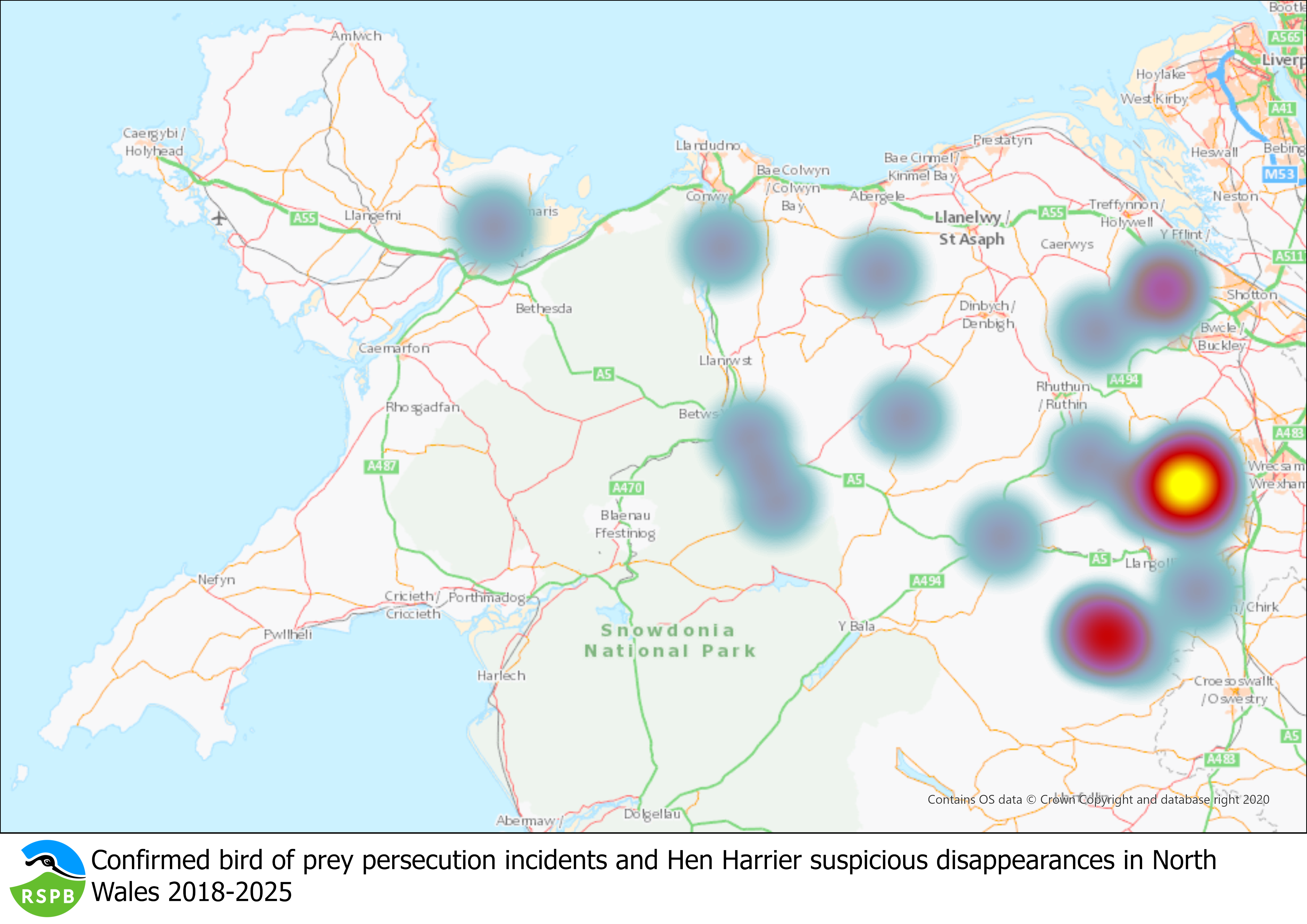
Ruabon Moor is recognised as one of the UK’s most notorious bird of prey persecution hotspots. Between 2018 and 2026 incidents include:
the suspected persecution of five satellite tagged Hen Harriers
The satellite tags from three Hen Harriers were recovered. Two had harness damage consistent wiith human involvement; satellite data from the third tag suggested that it had been interfered with prior to the bird’s death.
Satellite tags on two Hen Harriers suddenly and suspiciously stopped transmitting without sign of malfunction.
the illegal poisoning of a Raven
the use of illegal hawk traps found in two consecutive years
These incidents are likely to represent only a fraction of the actual number taking place in this area in recent years – due to them often being committed at anti-social hours and in locations hidden away from the public.
Heat map showing confirmed bird of prey persecution incidents and suspicious disappearances of Hen Harriers in North Wales, 2018-2025. The hottest spot is Ruabon Moor. (Image by RSPB)
Mark Thomas, RSPB’s UK Head of Investigations:
“Sadly, this incident is a textbook example of Hen Harrier persecution and really shows the massive impact these crimes are having on this species. In this case a healthy young bird fledged from a safe area in the Peak District National Park and sadly chose to settle in Wales ‘Bermuda Triangle’ – the most notorious bird of prey persecution hotspot in the country. This three-month-old bird survived for just three days in the area before it vanished in highly suspicious circumstances. Based on years of evidence and intelligence, we suspect the criminal shot the harrier, cut the harness off the Hen Harrier’s body, discarded the tag and disposed of the body in separate locations to avoid detection. As recent incidents show, this area is a crime hotspot for Hen Harriers and other birds of prey and this has to stop“.
Julian Hughes, RSPB Cymru Head of Species:
“We have provided a dossier of evidence to Natural Resources Wales and have asked the new Cabinet Minister for Rural Resilience and Sustainability to licence gamebird shooting in Wales. Without a clear deterrent and effective regulatory oversight, Hen Harriers and other birds of the prey will continue to be at risk. Through introduction of a statutory licensing system for all gamebird shooting in Wales these crimes could be effectively challenged – strengthening accountability whilst safeguarding the recovery of this species“.
Craig Best, General Manager for the National Trust in the Peak District:
“We are devastated to learn of the fate of this magnificent bird that started its life on moorland in our care in the Peak District. Hen Harriers are an important species in the ecosystem of moorland habitats. We work hard to make sure these birds have good nesting and feeding grounds. Funding from our supporters helps us to restore the landscapes they need to give them the best chance of survival. If persecution is allowed to continue, we stand to lose a very important species that is crucial to the health of these landscapes and it can’t continue“.
Sgt Peter Evans of North Wales Police Rural Crime Team said:
“In September 2025, North Wales Police received a report concerning the disappearance of a Hen Harrier on Ruabon Moor. Working in partnership with the RSPB and the National Wildlife Crime Unit, the harness was recovered and the investigation to date is inconclusive. Despite this, we can confirm that the harness had been intentionally severed, and the circumstances surrounding the bird’s disappearance are being treated as suspicious. Hen Harriers are a rare and protected species in Wales, making incidents of this nature particularly concerning. We urge members of the public to remain vigilant. If you witness any suspicious activity involving birds of prey, please report it to North Wales Police or the RSPB“.
Anyone with information relating to this crime please call North Wales Police on 101 or report a wildlife crime on their website.
Members of the public are urged to report any suspected incidents of bird of prey persecution by contacting the police on 101 and by submitting a report to the RSPB. This can be done via the RSPB’s online reporting form at www.rspb.org.uk/report-crimes or by calling the RSPB’s confidential Raptor Crime Hotline on 0300 999 0101. Reports via the RSPB’s reporting form and Raptor Crime Hotline can be made anonymously.
ENDS
My commentary:
I have no idea why it’s taken nine months for this story to emerge, when the Hen Harrier disappeared in late August 2025 and her ‘deliberately cut off’ satellite tag harness was found in early September 2025. The delay is disappointing, but the subsequent media release by the RSPB is detailed and provides good background history about incidents recorded either on or close to this grouse moor.
I’ve written previously about most of the confirmed and suspected persecution incidents that the RSPB has recorded at/near Ruabon, and I’ve also written about other strange discoveries here, uncovered by other organisations. Here’s the sorry history:
2018 – Satellite-tagged Hen Harrier called Aalin ‘disappeared’. No body or tag found.
2018 – Satellite-tagged Hen Harrier called Heulwen ‘disappeared’. No body or tag found.
2019 – Satellite-tagged Hen Harrier called Bronwyn ‘disappeared’. The tag was recovered with no body. The tag data indicated that the tag had likely been interfered with, prompting concerns of illegal killing.
2021 – A cage trap was reported to police with concerns over legality (suspected as being used to trap Goshawks). I don’t have further details of this case.
2021 – The RSPB reports a satellite-tagged Hen Harrier ‘disappeared’. Its tag was found and an expert assessment concluded it had been cut off. I didn’t have details of this incident so I asked the RSPB about it. It turns out to be a Hen Harrier called Awyr, tagged in Conwy in 2021. She is currently (incorrectly) listed on the RSPB’s Hen Harrier database as ‘fate unknown’, which is why she hadn’t appeared on my rolling list of dead/missing Hen Harriers. I’ll need to add her. The RSPB tells me its database will be corrected.
2022 – Another cage trap was reported to the police with concerns about its legality. It was close to the area where a similar trap had been reported in 2021. This time a gamekeeper was charged in relation to the alleged use of the trap to catch a Goshawk but he denied the charges and the case was later discontinued in 2024 by the Crown Prosecution Service (here).
2023 – A team called Wildlife Guardian discovered a quad bike parked up on the moor, covered in camouflage netting and ‘strewn with dead birds’. An armed gamekeeper was seen crouching in the heather nearby (here).
2025 – The satellite-tagged Hen Harrier that hatched on National Trust land in the Peak District in 2025 ‘disappeared’ and her tag harness was found, having been “deliberately cut off”.
2025 – North Wales Police launched an investigation after the Green Britain Foundation obtained undercover footage of individuals checking and setting snares at a stink pit next to Ruabon Moor, two years after snaring was banned in Wales (here).
I’m pretty sure that Ruabon Moor hasn’t been identified as a persecution hotspot by the police-led national Hen Harrier Taskforce, although I don’t know for certain because the hotspots have never been made public. When the Taskforce launched in 2024 it was stated:
‘The Hen Harrier Task Force is an initiative led by the UK National Wildlife Crime Unit and supported by seven police forces (Cumbria, Derbyshire, Durham, Northumbria, North Yorkshire, South Yorkshire and West Yorkshire)…‘
which suggests the focus of the Taskforce is on grouse moor areas in northern England, not in north Wales.
Given that five tagged Hen Harriers have ‘disappeared’ on or close to Ruabon Moor since 2018, with the data from one tag (Bronwyn’s) indicating the tag was likely interfered with, and two other tags were deliberately cut off, it seems to me that the focus of the Hen Harrier Taskforce needs to be extended.
UPDATE 14.45hrs: 149 Hen Harriers confirmed ‘missing’ or illegally killed in UK since 2018, most of them on or close to grouse moors (here).
The trial of two Scottish gamekeepers, accused of offences relating to the alleged shooting and killing of Red Kites in the Cairngorms National Park in February 2025, and firearms offences, continued at Aberdeen Sheriff Court this week.
Head gamekeeper Graeme Rankin, 40, and assistant gamekeeper Steven Hague, 43, both of Glenbuchat Estate, have both denied the charges.
Red Kite photo by Ronnie Gilbert
The pair appeared at Aberdeen Sheriff Court for a four-day trial at the end of April 2025, after an earlier trial, scheduled for December 2025, was adjourned as the two defence lawyers, both KCs (Kings Counsel), lodged a motion suggesting the Sheriff should recuse himself from the hearing as he was an RSPB member (see here).
The four-day trial in April was extended because the court ran out of time to hear from all the witnesses. It resumed this week and evidence was heard on Monday and Tuesday.
Defence lawyers have now lodged a motion calling for the dismissal of all charges for alleged procedural irregularities. The case has been adjourned until July, when the Fiscal will respond to the defence’s motion and Sheriff Peter Hammond will decide on the outcome.
Here is a write-up of the trial hearings in April, written by court reporter Joanne Warnock of the Press & Journal, published on the PressReader website:
Two Aberdeenshire gamekeepers have gone on trial for allegedly shooting protected birds of prey in Cairngorms National Park.
Glenbuchat Estate workers Steven Hague, 43, and Graeme Rankin, 40, deny killing red kites in Knockie Wood or elsewhere in February 2025.
Hague and Rankin are also facing a charge of shooting a second red kite, while Hague is further charged with breaching the conditions of a firearms certificate and ammunition storage conditions.
A dead red kite was found by a member of the public in the Glenbuchat area on February 26 2025 and staff from the Royal Society for the Protection of Birds (RSPB) attended.
Following a series of tests, experts concluded the bird had been shot, prompting a call to police.
One alleged shooting was said to have taken place between February 1 and 26 last year within Knockie Wood, owned at the time by Roderick McGilvary.
Mr McGilvary, who has since died, gave a statement in 2025 that was read to Aberdeen Sheriff Court, saying he had permitted Rankin to shoot vermin on his land.
William Johnston, 65, told the court he had been helping Mr McGilvary look after his woodland and installed a night-vision trail camera at his request to watch wildlife.
Footage played in court showed two men, both holding shotguns, walking through the woods.
As the men are seen walking away from the camera, which is triggered by a motion sensor, a shot can be heard and they return with one carrying what appears to be a dead bird of prey.
Mr Johnston told the court he shared the footage to Mr McGilvary and was able to identify both men.
Referring to the footage, Mr Johnston said: “The man on the left using the night scope, that’s Graeme Rankin. I can tell by his stance. On the right, that’s Steven Hague.”
Mr Johnston said he had a knowledge of weapons from his time in the Royal Engineers.
Under cross-examination from Brian McConnachie KC, representing Rankin, Mr Johnston told the court he knew the men from having attended shooting events and from living in the same local area.
Shotguns seized during a search of Rankin’s property on May 1 2025 were also shown in the court.
Police Scotland firearms licensing officer Robert Stewart, 53, told the court he could also identify Hague and Rankin from the trail camera footage.
He also pointed out details of one of the weapons and spoke of it having a longer magazine and an unusual hand grip.
The court heard both men held firearms certificates and were known to Mr Stewart.
Rankin also held a firearms dealership certificate, giving him the authority to issue rifles and ammunition.
Special constable Michael Flacherty, 65, told the court he could also identify Rankin from the trail camera footage, which he had viewed on a higher-resolution display than the one in court.
Wildlife officer PC Ann Ashman said a dead bird was discovered in Glenbuchat on February 26, near Easter Buchat.
Police were then contacted by Mr Johnston, who told them of his trail camera footage.
Ms Ashman read out a statement from landowner Mr McGilvary.
In it, he said he had given Rankin permission to shoot vermin on his land.
She told the court that during the execution of search warrants at Rankin and Hague’s addresses, they had found a carcass of a red kite, along with firearms, night-vision scopes and hunting clothing.
The red kite is protected under the Wildlife and Countryside Act.
The trial, under Sheriff Peter Hammond, will continue in June.
ENDS
NB: Comments are turned off as legal proceedings are still live.
UPDATE 6 August 2026: Trial collapses against two Scottish gamekeepers accused of killing Red Kites in Cairngorms National Park (here)
I received a bizarre press release on Monday, issued by the charity, Restoring Upland Nature (RUN – a project developed from the South Scotland Golden Eagle Project).
The press release was providing ‘news’ of a young satellite-tagged Golden Eagle named Percy, who had suffered fatal injuries after a dispute with a territorial pair of Golden Eagles in south Scotland in late March 2026.
Golden Eagle Percy. Photo by John Wright
His death was due to natural causes, so not exactly ‘news’, although it’s understandable that the project team would want to keep people informed.
However, the press release then morphed in to some kind of gamekeeper love-fest, simply because some gamekeepers had found the critically injured eagle and had alerted the project team to his location.
Here’s the press release:
Whilst the actions of those gamekeepers who found Percy are to be applauded, the subsequent general portrayal of gamekeepers in south Scotland as being champions of eagle conservation needs a reality check, especially when you consider the recent surge in eagle persecution in this region:
Golden Eagle ‘Merrick’ was shot and killed whilst she was sleeping in a tree next to a grouse moor in the Moorfoot Hills in October 2023 (see here).
Golden Eagles ‘Tarras’ and ‘Wren’ disappeared in an area managed for gamebird shooting near Langholm in August 2025 (see here).
A White-tailed Eagle ‘disappeared’ in the Moorfoot Hills area in November 2025 (here).
Golden Eagle ‘Hamlet’ was found with shotgun injuries next to a grouse moor in the Tweed Valley in February 2026 (here).
It is clear from the post-mortem and his satellite tag data that Percy died from injuries inflicted by a territorial eagle and not at the hands of a gamekeeper. Perhaps that’s the newsworthy element of this story.
But I’m very interested in other cases where injured/dead raptors have been ‘found’ by gamekeepers and reported to the authorities, especially in areas with a long history of raptor persecution. It seems to me that this could create a perfect opportunity for the ‘false hero’ scenario.
Undoubtedly, there are decent gamekeepers out there who want to help with conservation efforts for raptors and other species. But equally undoubtedly, there are gamekeepers out there who want to kill raptors, and have done, and continue to do so.
How do you tell them apart?
By the way, in response to the ‘news’ that Percy died of natural causes, I’ve seen a few comments on social media suggesting that we should all apologise for blaming gamekeepers for his ‘disappearance’. For the record, Percy didn’t ‘disappear’, and I haven’t seen anybody suggesting that he did, or that gamekeepers were responsible. They used the same argument about Hen Harrier ‘Frank’ earlier this year – trying to play the victim card but without any evidence of being victimised.
The trial of two Scottish gamekeepers, accused of offences relating to the alleged shooting and killing of Red Kites in the Cairngorms National Park in February 2025, is set to resume next week.
Head gamekeeper Graeme Rankin and assistant gamekeeper Steven Hague have both denied the charges.
Red Kite. Photo by Ronnie Gilbert
The pair appeared at Aberdeen Sheriff Court for a four-day trial at the end of April 2025, after an earlier trial, scheduled for December 2025, was adjourned as the two defence lawyers, both KCs (Kings Counsel), lodged a motion suggesting the Sheriff should recuse himself from the hearing as he was an RSPB member (see here).
The four-day trial in April was extended because the court ran out of time to hear from all the witnesses. It will resume on Monday 15 June 2026.
NB: Comments are turned off as legal proceedings are still live.