
Press release from Defra (9 September 2025)
BURNING BANNED ON ENGLAND’S DEEP PEAT TO PROTECT WILDLIFE
Ban on burning heather and grass on deep peat extended to improve air quality for local communities, reduce flood risk and protect wildlife.
Local communities are set to benefit from improved air quality, following an announcement that the government will extend the ban on burning vegetation on deep peat as part of new plans to protect both the environment and public health.
The burning ban will protect our globally unique network of peatlands which are commonly referred to as the Earth’s lungs.
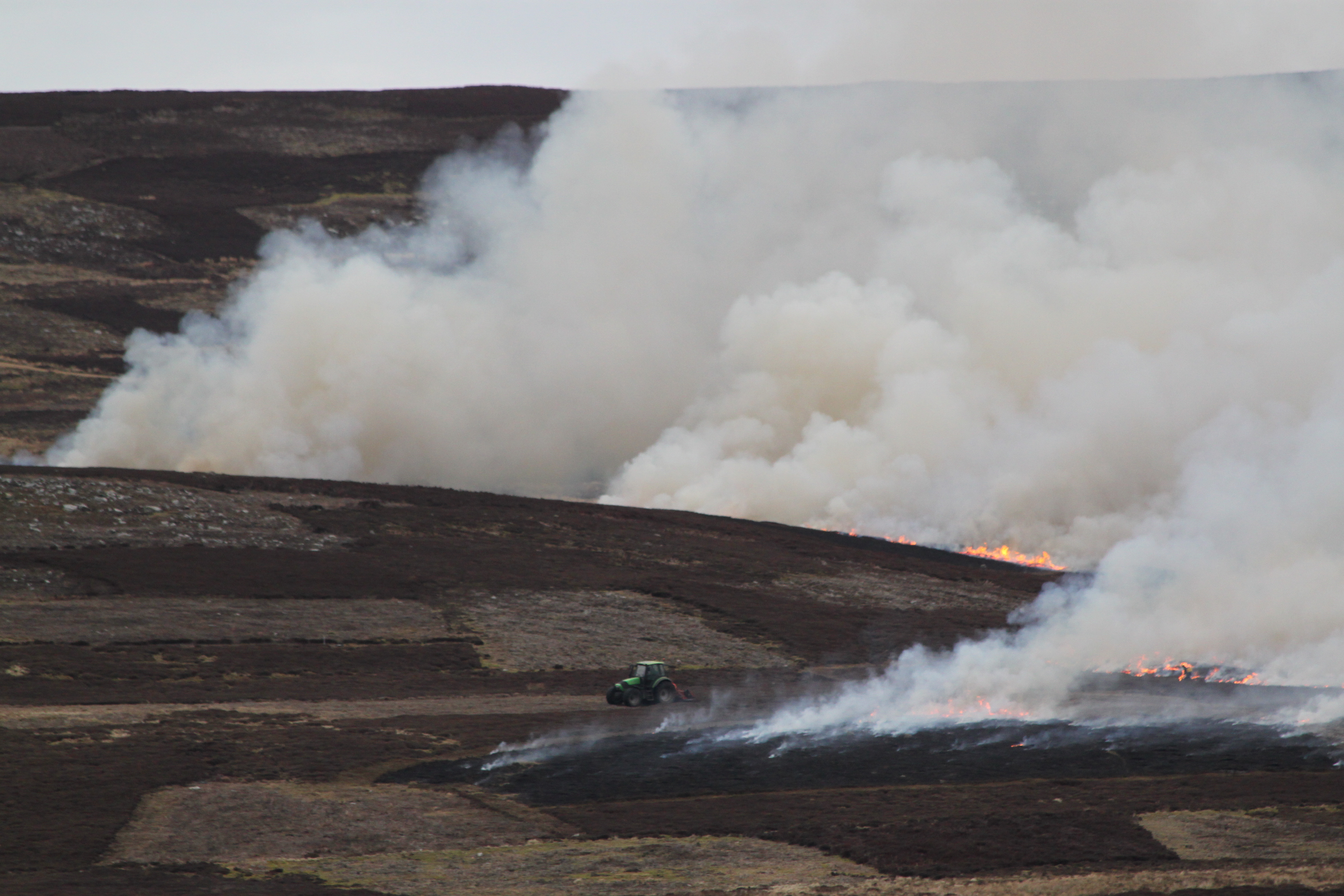
Peatlands improve water and air quality, create habitats for wildlife, absorb carbon and help protect communities from flooding. To deliver these benefits, they must be in a healthy condition but 80% of peatlands across England are dried out and deteriorating and actually emit carbon dioxide contributing to global warming.
Burning vegetation on deep peat causes the release of harmful smoke into the air, impacting air quality across communities. This includes harmful air pollutants for human health, including ones strongly associated with strokes, cardiovascular disease, asthma and some lung cancers.
The move as part of the government’s Plan for Change sees the burning ban extended to cover 676,628 hectares of deep peat up from the current 222,000 hectares – meaning an area equivalent to the size of Devon will now be better protected. The extension comes into force from 30 September.
Environment Minister Mary Creagh said:
“Our peatlands are England’s Amazon Rainforest – home to our most precious wildlife, storing carbon and reducing flooding downstream.
“Burning on peatland releases harmful smoke ruining local air quality and damaging the precious ecosystems found in these iconic landscapes.
“Restricting burning will help us restore and rewet peatlands. These new measures will create resilient peatlands that are naturally protected from wildfires“.
The extension comes following a consultation on measures announced earlier this year, and expands protections to all deep peat in the uplands, and redefines deep peat from the current 40cm to 30cm depth.
A refined licencing system which allows prescribed burning in exceptional circumstances will also be introduced. Any licences for prescribed burning will only be issued where there is a clear need, for example, to reduce wildfire risk. This will help balance environmental protection with practical land management.
The government is expected to publish its new Environmental Improvement Plan this Autumn, setting out its ambitions to halt the decline of nature. This will build on existing work to protect and restore nature, clean up our rivers and seas, boost tree planting and reduce waste.
This government has already licensed the first wild beaver release since they were hunted to extinction around 400 years ago, announced the creation of a new national forest stretching from the Cotswolds to the Mendips, started cleaning up our rivers, lakes and seas by introducing tough new powers through a new Act of Parliament, initiated waste reforms which will see £10 billion invested in new recycling facilities, and will invest up to £400 million in tree planting and peatland restoration over the next two years.
Additional information:
You can find out more about when you need to apply for a licence to burn heather and grass via this link.
More information about the consultation is available via this link
A summary of responses and the government response is available here.
ENDS
This is excellent news! Defra has clearly responded to the science, rather than the hysteria and rhetoric of the grouse shooting industry.
Importantly, the ban comes into force in a few week’s time on 30 September 2025, the day before the opening of the burning season.
I’ll write a commentary about the Government’s decision in the coming days.
In haste…
UPDATE 27 January 2026: Moorland Association at the High Court challenging Defra’s new regs on peatland burning (here)
UPDATE 28 January 2026: High Court throws out Moorland Association’s legal challenge against burning regulations (here)
UPDATE 8 February 2026: Moorland Association lodges appeal against recent High Court decision to refuse judicial review of Defra’s peatland regulations (here)


Brilliant news, a win for common sense
Great news and well done Defra for standing up to the shooting lobby. Now we just need to police this – where’s the best place to find a map of peat depths Ruth and where should we report suspicious fires? I note the press release says where moorland owners can ask for exemptions but no link for members of the public to report possible transgressors!
“where should we report suspicious fires?”
https://upland-burning-rspb.hub.arcgis.com/pages/report-a-burn
“where’s the best place to find a map of peat depths”
I can’t testify that this is the best place – but it is Natural England’s latest effort, and therefore ‘official’. If you zoom in, it is also very detailed.
https://england-peat-map-portal-ncea.hub.arcgis.com/
If you want to read about it:
https://naturalengland.blog.gov.uk/2025/05/12/a-new-peat-map-for-england/
Note: Natural England write: “This is a significant new dataset, and while robust, it won’t show 100% of England’s peat. While the models are the most accurate picture of England peat resources to date, some areas of peat will have been missed, and there will be places where the map predicts peat but where it may not actually occur. As we say in the blogpost, our models have an overall accuracy measure of over 95% for the extent of peaty soils, and of 94% for vegetation and land cover. Levels of accuracy are described and explained in the final report and the accompanying user guide.”
How great to have some good news. Well done to the Government and to all the organisations who have lobbied for this for years and to RP for always keeping us informed. Thank you Ruth!
I suppose it is a significant increase in the area of land / peat covered compared to the area covered as it currently stands. Lets hope it is enforced given the persistence of grouse moor managers to break the rules as burning is a lot harder to hide than other breaches of the law. And it’s easier for the public to see and report so no excuses for not enforcing. Hope the issuing of licences doesn’t ruin the new regulation. I appreciate you’ve listed some environmental positives by this government bt I see it as a rare step in the right direction by them. Surprised they stepped up and timed the new regulation so well at risk of upset.
Oh well, that’s disposable barbecues on the list of essential tools for the gamekeepers now (along with rolls of roofing lead).
Coincidental with the arrival of this blog I received the latest edition of the Yorkshire Wildlife Trust’s magazine. It features the work of the Yorkshire Peat Partnership (YPP) in 24/25 and contains some interesting statistics. Particularly apposite to this RPUK blog is the record that the surveyors logged 3297 measurements of peat depths in the course of walking 366 km. No doubt this information is being added to the data already held by NE, so facilitating increasingly detailed records which can be called upon if needed. Over the YPP’s two toughest sites they installed a total of 8159 dams (peat/heather/timber and stone) and they planted 66,000 cotton grass plugs in the course of bringing 1,320 ha of peatland into restoration management. Interestingly, the YPP has two separately funded project teams involved in this sterling work.
As regards peat depth criteria in relation to burning, there is one aspect which puzzles me. I have always assumed that deep peat starts off as shallow peat, gradually increasing in depth if it is not interfered with. If this is correct, how come it can be burned over in its shallower, formative, years. Surely this must have some adverse effect on its development and progression to a greater depth.
Doug. The thin peat is generally considered to be the remnant of deeper peat on blanket bogs. The thinner areas are where peat has degraded over, maybe, the last 1000 yeas. Peat used to be harvested for fuel and many other products. Sometimes small scale hand digging sometimes by mechanical means ( this isn’t the same as harvesting peat from raised bogs for horticulture). It’s also been damaged by 300+years of pollution from industry, draining, overgrazing and rotational burning ( for agriculture and sport). This damaged the integrity of the peat ecosystem, and it began to degrade.The thinner peat areas are often under extant dwarf shrub heath and acid grassland habitats, or used to be under areas that were once common grazing, up until the 18th C enclosure period and are now upland pastures and silage/hay fields.
I’m sorry but I have to disagree. The thin peat layers are often on free draining stone not far below the surface, how was this deep peat when it’s so free draining?
shallow peat is on the ridges and deep peat in in the bowls or valleys, or at least this is typical in the north York moors. How do you keep water on a hill?
I have observed peat restoration that YPP has carried out on some of these dry ridges and slopes and honestly it may slow the rate the water leaves the moor but has no way whatsoever made the places wetter and there is no way it ever will.
that old saying “it’s like trying to push water up Hill”!!
Peat forms in waterlogged conditions, so I don’t understand how the peat could have formed if a site is free draining? I’ve heard this argument several times before in different places, not just the North York Moors (‘rewetting will never work here, it’s free draining’), but how did the peat get there over centuries of formation in all of these places if the sites are free draining? Has the underlying geology changed?
I don’t know about all the sites YPP have worked on, but I think using terms like ‘thin’ and ‘deep’ doesn’t help us. I presume they’re working on the entire peat mass, and not just the deepest parts. I think that probably makes sense.
The underlying hydrology hasn’t changed at all the free draining areas are on mineral soil with a thin layer of what is now called peat!! There has never been deep peat or blanket bog present. I agree that it should be restored where it is restorable but to waste public money on projects that are never going to work is a big no no in my eyes.
Wendy. Many thanks for this explanation. Much appreciated.
Peat grows at a rate of around 1mm per year, so even a fairly shallow 1 metre depth of peat has taken 1,000 years to develop – this is young peatland that should be protected and encouraged. Peatland is a fragile, complex, living, growing ecosystem that plays a massive global role in the struggle against climate change. It is home to many species, and the complicated physics and chemistry of the processes within the peat are only just beginning to be understood. There are millions of tiny vertical and horizontal tubes criss-crossing the width and depth of the peat cycling water throughout it, from the top layers to the catatelm and back round again, with numerous voids in place within it that help maintain the water level and protect land nearby from flooding. Driving over the surface of peatland compacts it and damages these tubes, preventing the flow systems within from functioning, so you can imagine what other more brutal practices do to it. Not only does peatland capture and hold on to greenhouse gases (and pollution from the likes of Chernobyl), sphagnum moss, which is the backbone of a peat bog, plays a special role in managing methane, an even more potent greenhouse gas than CO2. Driving over the top of peatland, burning any depth of it or excavating millions of tonnes of it to construct ‘renewable’ energy wind turbine developments, as is happening all over the Highlands and Islands of Scotland in order to supply the south of England with electricity, should be a criminal offence. Peatland is so specialised it can only exist where it is already growing – you can’t plant new peatland to replace what’s been trashed – and when peat is excavated all the greenhouse gases captured and contained over millenia are released back into the atmosphere again. Once it has been dug up it’s functionality is gone, despite wind farm developers insisting in their EIA reports that they will put all the excavated peat to one side before they pour in millions of tonnes of concrete in its place, and then use the leftover peat as backfill, as if peat is nothing more than a pile of bricks that you can pick up, move and put back again with no consequences. They won’t be around in 1,000 years to be held to account when that peatland is officially declared dead. It’s beyond crazy that these wonderful, complex, fragile and valuable ecosystems are being abused and destroyed in the UK on a daily basis.
Many thanks for the further responses following my initial question relating to burning over shallow peat areas. The variations in the opinions expressed show what a complex issue this is. Maybe there is no simple answer and the situation will vary according to individual site characteristics – both current and historical. Certainly food for thought, especially for ignoramuses such as myself.