
Statement from Scottish Government, 10 November 2026:
AVIAN INFLUENZA PREVENTION ZONE DECLARED IN SCOTLAND
Following an increase in detections of avian influenza (bird flu) in wild and captive birds, the Chief Veterinary Officer for Scotland has declared Scotland-wide Avian Influenza Prevention Zone (AIPZ) to mitigate the risk of the disease spreading amongst poultry and other captive birds.
From 12 noon on Tuesday 10 November, it will be a legal requirement for all bird keepers in Scotland to follow strict biosecurity measures to help protect their flocks from avian flu.
Surveillance shows the highly pathogenic avian influenza virus is circulating in wild birds across the UK, and the risk to poultry and other captive birds is currently assessed as very high.
There have been six cases of avian influenza in kept birds in Great Britain this season (October-April), two in Scotland (one backyard flock on the Isle of Lewis and one in an egg producer in the Scottish Borders), and four cases in England.
Since 21 October nine of the 65 dead wild birds in Great Britain have tested positive for avian influenza. Of these, 56 were from England, 8 from Scotland and one from Wales.
There has also been an increase in poultry outbreaks across Europe in recent weeks, including in Belgium, Germany and Norway.
Public Health Scotland advises that the risk to public health from the virus is very low and Food Standards Scotland advises that avian influenzas pose a very low food safety risk for consumers. Properly cooked poultry and poultry products, including eggs, are safe to eat.
Scotland’s Chief Vet Officer Sheila Voas said:
“While the risk to public health is very low, we are currently experiencing a heightened risk of an incursion of this virus from migratory birds and so it is vital that appropriate precautions are taken to protect poultry and other captive birds from infection.
“The introduction of this zone is a preventative measure, aimed at minimising the impact this often devastating virus, can have on Scottish kept birds.
“Maintaining strict biosecurity is the most effective method of protecting birds from the virus.”
ENDS
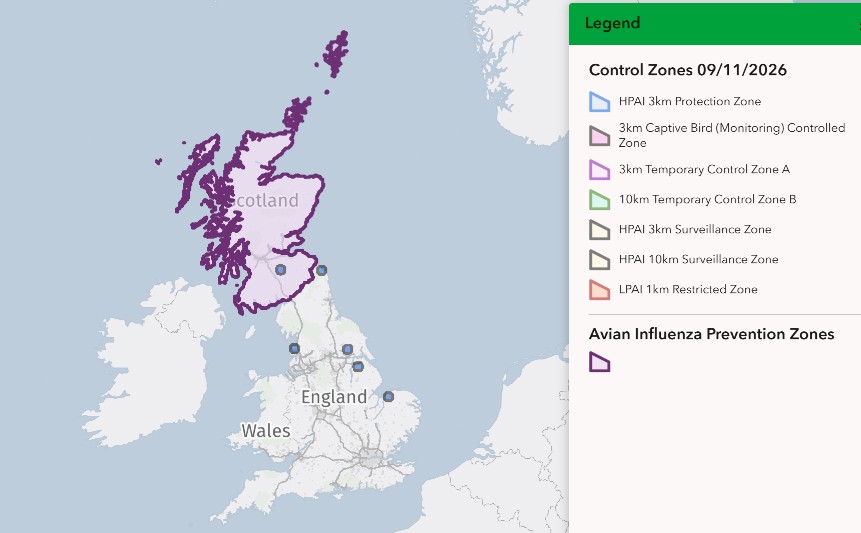
Here’s a map from the Animal & Plant Health Agency (APHA) showing the current status of Highly Pathogenic Avian Influenza (HPAI) outbreaks across the UK (as of 9 November 2026). As you can see, Scotland is the first country to declare an Avian Influenza Prevention Zone:
The biosecurity measures in Scotland’s AIPZ do not yet include a requirement to house captive birds but they do focus on taking steps to reduce the risk of virus transmission. The required measures are detailed in this document:
These new biosecurity measures mostly don’t apply to gamebirds because once released from captivity (where they are legally defined as ‘livestock’), they magically become ‘wild’ birds (see Wild Justice’s blog on Schrodinger’s Pheasant).
So even though these gamebirds are no longer in a release pen (where they were defined as ‘livestock’), and are encouraged to remain in a small area by the provision of feed stations (to make shooting them easier), gamekeepers are not required to fence off any ‘outdoor range’ as a biosecurity measure as other keepers of poultry are now required to do.
The only new measure that does apply to gamebirds is that when they are caught up from the wild to be returned to captivity for breeding stock (and they magically become ‘livestock’ again), keepers must not then move those caught-up birds from the premises for 21 days, presumably to allow for monitoring of HPAI symptoms.
However, given that it’s currently the middle of the shooting season, catching-up is unlikely to be taking place right now. Instead, gamekeepers will be leading their beating teams, forcing potentially-infected birds to fly around the countryside for paying guests to try and kill as many as they can, for entertainment purposes.
Great, isn’t it?

