
Earlier this month, researcher, writer and campaigner Guy Shrubsole blogged about his latest examination of reported Pheasants numbers in England.
As he’s done in previous years (e.g. see here), Guy submitted a Freedom of Information request to the Government’s Animal & Plant Health Agency (APHA) asking for the official figures on the number of Pheasants being bred, reared and released in England. It’s a legal requirement for keepers of captive birds, including gamebirds, to register.
As of August 2026, according to the latest FoI response, 26.37 million Pheasants were reported as being bred, reared or released in England. This compares to 25.9 million Pheasants reported in July 2025, and 25.7 million Pheasants reported in January 2024.
Guy suggests two possible explanations for the ongoing increase in reported Pheasant numbers:
a) The industry is gradually getting better at reporting; or,
b) The figures simply reflect an ongoing expansion in the size of the industry.
Whatever the explanation, these figures are still well below the estimated 50 million Pheasants that are known to be released annually into the countryside; a figure provided by the gamebird shooting industry itself, even when the source is masquerading as ‘The UK’s Conservation Factchecking Resource‘, which is actually a website run by the Game & Wildlife Conservation Trust, (GWCT).
That’s an awful lot of Pheasants (approx 24 million) still unaccounted for in the ‘official’ records.
Guy’s blog helpfully includes a link to a spreadsheet with this year’s ‘official’ figures, broken down into categories of birds being bred, reared and released in England. He also includes a summary of the data for the last three years:
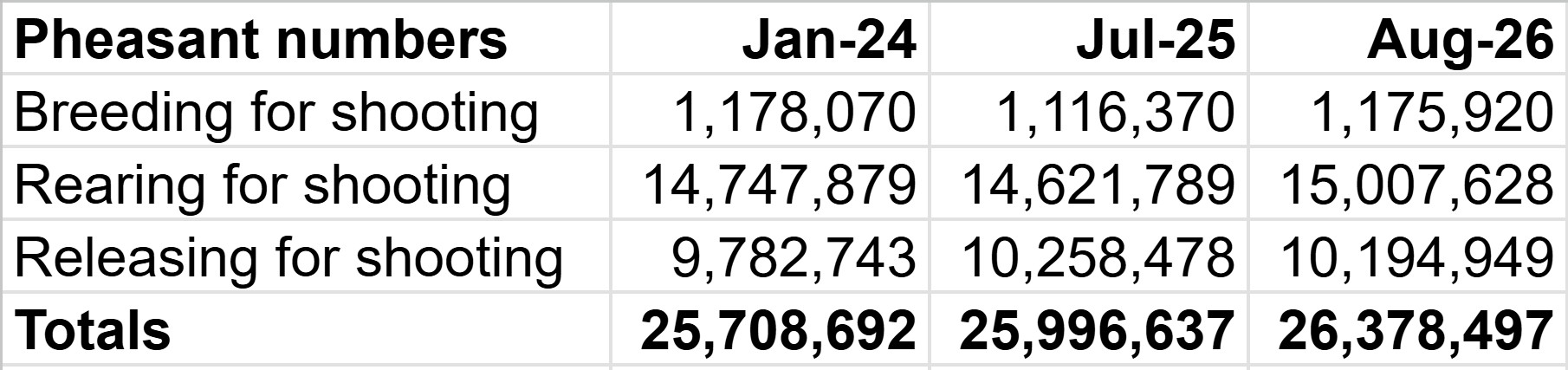
These figures are very revealing, because they show a large discrepancy between the number of Pheasants being bred and reared for shooting and the number of Pheasants being released for shooting.
They don’t add up!
What happened to the 5-6 million Pheasants that were reported as being bred and reared that weren’t subsequently released?
Has anyone at APHA noticed this discrepancy? If so, what action is being taken? Is there any monitoring? Are there any compliance checks?
Failure to register with APHA is an offence, but it’s been going on for years. In a Natural England and BASC-commissioned report published in 2020, registration compliance (for Pheasant keepers) was estimated to be less than 25%.
This low level of compliance on registering Pheasants will come as no surprise to anyone who pays attention to the behaviour of the UK gamebird shooting industry. It’s not an industry celebrated for adherence to the law on many issues, including the illegal killing of birds of prey, the illegal setting and use of traps, the illegal possession, storage and use of pesticides and poisons, the illegal burning of deep peat moorland, the illegal use of toxic lead ammunition to kill waterfowl, the illegal release of gamebirds in Special Protection Areas etc etc.
Submissions to Defra’s current Call for Evidence on all aspects of the gamebird shooting industry are going to be fascinating.


I have little doubt that many chicks and poults die from a variety of causes including infections. Can numbers be accessed about this?
If disease is causing the death of at least 5-6 million (and the rest!) Pheasants per year, then the industry has a bigger problem than we think!
They select and keep breeding stock for the following year, rather than relying on just recapturing released stock. I know of one game farmer in Yorkshire keeping 30,000 back every year.
Good point, but we still have millions unaccounted for…
Natural England are NOT doing their job.
“Natural England are NOT doing their job”
Nothing to do with Natural England. These game birds are classed as kept poultry or livestock during the breeding and rearing process (remember Schrodinger’s Pheasant), and as such must be registered by law with DEFRA, coming under the auspices of the APHA (as stated).
The APHA have a complaints form which members of the pubic can use (“if we have implemented policies or regulations incorrectly”
https://www.gov.uk/government/organisations/animal-and-plant-health-agency/about/complaints-procedure
Aside: It is only after release that these game birds legally transform into wild birds – but ones which can legally be shot – and thereby come under the auspices of Natural England (which controls releases close to sensitive sites, for example).
There are several pheasant & partridge breeding/rearing areas in my rural neighbourhood. Is there any way we can find out if these have been registered? Is there a list of landowners who are complying with regulations? These birds are on our local roads and in our gardens. We should know if the owners are abiding by the law, shouldn’t we?
I second that! We have the same issue in our valley.
I think there may be another partial reason for the gradual increases that Guy’s blog refers to. Namely that the conspicuous mega-sized game farms are year-on -year gradually increasing their market share / and the total numbers of birds they produce. And maybe they tend to provide truer figures relative to the smaller outfits that they are out-competing? i.e. those that would probably just declare a token number and then hope to stay under the radar.
Also, year-on-year more estates / shoots (that would be inclined to undereport in the above same way) are giving up their full in-house rearing programmes. Usually this decision is forced when the sheds* & facilities are all at the end of their days and it needs a big capital outlay to renew everything. Most will then opt to just buy in poults instead from a big operator, and not to bother with their previous system rearing from either day-olds or incubating own eggs.
Just a thought.
*prices of the premade sheds or timber, roof sheets, wood preserver, etc being very high these past few years.
But overall I would say those figures might represent half (at best) of the real numbers.
So if the Government required close ringing of all reared & released pheasants at £5 per ring it would add up to maybe £250 million. Quite a sum to move from luxury environmental jeopardy to savind our natural environment.
Brilliant idea!