
Last month, Natural England published the number of Hen Harrier breeding attempts in England in 2026 (here).
Natural England reported 45 breeding attempts, and said that ‘only 9 of those recorded 45 attempts were on moors managed for grouse, with the remainder across other moorland and water catchment locations (including but not limited to nature reserves)’.
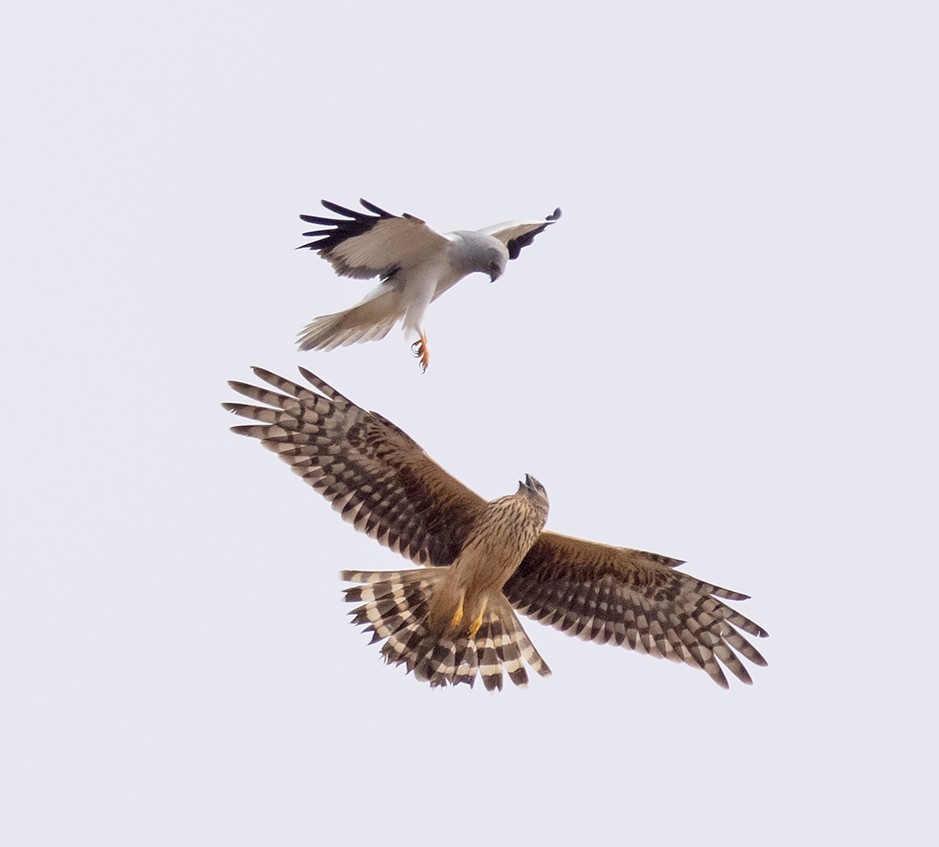
So once again, breeding Hen Harriers were absent from the vast majority of the estimated 150-190 grouse moors in England but did well on land managed for conservation, e.g. in Bowland on land managed by the RSPB for United Utilities (here), on the RSPB’s Geltsdale Reserve in Cumbria (here) and in Northumberland on land managed by Forestry England. In the Peak District, the only breeding attempt was on National Trust moorland.
I was interested in the locations of those nine breeding attempts on grouse moors so I submitted an FoI to Natural England to ask for a regional breakdown of this year’s breeding attempts on grouse moors.
Here is the information that Natural England supplied to me:
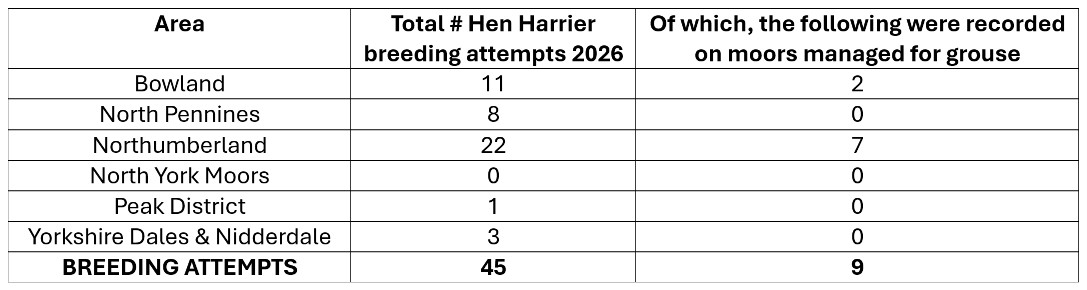
These data are stark. Just two breeding attempts on grouse moors in Bowland and seven in Northumberland. Not a single breeding attempt on the many grouse moors in the North Pennines, North York Moors National Park, Peak District National Park, Yorkshire Dales National Park or Nidderdale.
So much for the credibility of the often-heard assertion from the grouse shooting industry that ‘Hen Harriers do better on grouse moors than on RSPB/ conservation land’. The data clearly don’t support that claim.
According to Natural England’s lame press release last month, the explanation given for the continued absence of Hen Harrier breeding attempts on most grouse moors is “Conflicting land management priorities“. What Natural England couldn’t bring itself to say, in plain language, was that means crime, committed by criminals, on grouse moors.
The grouse shooting industry won’t admit to this directly (because persecution is indefensible and a public relations disaster, and the industry knows it) but instead the Moorland Association has recently stated that it will apply for a licence to brood meddle Hen Harriers again in 2027, which is virtually an admission that Hen Harriers cannot be tolerated on grouse moors. Having a government licence to remove the harriers is a far better PR strategy for the industry than having to deal with the massive reputational damage caused by removing (killing) them illegally.
Although, given that Hen Harrier breeding attempts on grouse moors in England are not even in double figures, I’m not sure how the Moorland Association will try to persuade Natural England of the need for a brood meddling licence, nor how Natural England could justify it.
The previous brood meddling licences were issued on the (dodgy, IMHO) basis of being part of a so-called ‘scientific trial’, but that seven year trial ended in 2024 and the results showed that the licensed removal of Hen Harriers from grouse moors did not stop the illegal persecution of Hen Harriers (e.g. see here).
The Moorland Association’s previous attempt in 2025 to obtain a further brood meddling licence was rejected by Natural England and Defra. There’ll be a lot of us watching the next licence application with great interest.
Meanwhile, I thought blog readers might be amused by this recent post on social media by the Yorkshire Dales Moorland Group (a regional group of grouse moor gamekeepers whose propaganda knows no bounds) -:
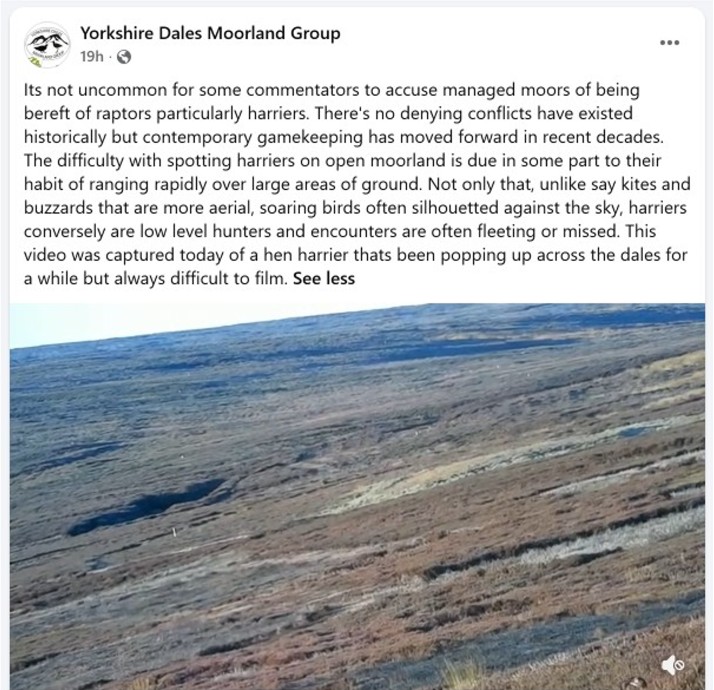
Difficult to film, or difficult to shoot? It seems clear that gamekeepers often struggle to shoot Hen Harriers as easily as Buzzards or Red Kites, probably due to the species’ different foraging techniques, which is probably why gamekeepers have developed techniques for getting close to Hen Harriers to give them a better chance of shooting them. For example, using plastic decoys to draw the Harriers in close (e.g. here), or setting spring traps on or close to their nests (e.g. here, here, here), or setting pole traps in areas where they’re foraging (here), or sitting out at roost sites waiting for the harriers to come in (e.g. here, and here), or even walking through the roost with two dogs and a gun after dark (e.g. here).
I daresay that some members of the Yorkshire Dales Moorland Group have first-hand experience – was recently convicted gamekeeper Racster Dingwall a member? You remember Racster Dingwall, caught on an RSPB covert camera sitting out at a Harrier roost site on a grouse moor in the Yorkshire Dales National Park, casually chatting with two colleagues about how they’d shot and killed Buzzards and Ravens that day, before shooting towards one Hen Harrier coming in to roost (but being careful not to kill it because it was fitted with a satellite tag) and then conspiring to shoot and kill another Hen Harrier coming in to roost, this one without a satellite tag. Many of us believe this untagged harrier was shot and killed but Dingwall was not charged with that offence (see here for an explanatory blog).

Dingwall’s conviction undid all the good work (propaganda) that the Yorkshire Dales Moorland Group has pumped out over the years to try and disguise the fact, according to the RSPB, that:
“This area [Yorkshire Dales National Park]– dominated by grouse moors – is the epicentre for Hen Harrier persecution in the UK. Since 2016, in this area four confirmed persecution incidents involving RSPB and Natural England satellite tagged Hen Harriers have taken place and 13 satellite tagged Hen Harriers have suspiciously disappeared – all suspected to have been persecuted (2016-2025)” (see here).


Quite shocking statistics. Surely no person or body/association can defend these? On another note did Mr Dingwall lose his shotgun and firearms certificates over his conviction? If not, why not?
When is defra, and natural England, national trust, etc going to push for a complete ban on shooting anything that moves.
We have lost far to many birds of prey for it to be an accident, and hen harriers have been persecuted for to many years.
With modern technology, and the ability to create amazing scenery, we are able to make an environment, within a building that will allow these barbarians to continue to shoot stuff, but not killing anything, this would be a better solution for all, especially wildlife.
With ai, a big room can be turned into a lifelike wilderness, with all kinds of game birds flying about on walls covered in screens, and these barbarians can weild guns to their hearts content, and shoot as many game birds as they like, and none will escape into the wild, no raptors will be killed by accidently on purpose incidents.
Job done.
Better still, a small room, i.e. a prison cell.
Sickening that you have to press Natural England for this information – clearly they are trying to suppress it. There should be a national vote of no confidence in Natural England – it’s working against Hen Harrier – not for them.
Why can’t we set up a national voluntary network to monitor England’s grouse moors and catch the gamekeeping bastards at it?it just goes on and on and on and infuriates me!