Well that didn’t take long, did it? Just a few weeks after fledging, one of the 2017 cohort of satellite-tagged hen harriers has already ‘disappeared’, with its final signal emitted from a grouse moor on the 12th August, the opening day of the grouse-shooting season.
Hen harrier ‘Calluna‘ (photo RSPB Scotland)

RSPB Scotland press release:
SATELLITE-TAGGED HEN HARRIER DISAPPEARS ON DEESIDE GROUSE MOOR
RSPB Scotland has issued an appeal for information after a young hen harrier, fitted with a satellite tag as part of the charity’s EU-funded Hen Harrier LIFE project, disappeared on an Aberdeenshire grouse moor.
‘Calluna‘, a female harrier, was tagged this summer at a nest on the National Trust for Scotland’s Mar Lodge estate, near Braemar. Her transmitter’s data was being monitored by RSPB Scotland and showed that the bird fledged from the nest in July. She left the area in early August, with the data showing her gradually heading east over the Deeside moors. However, while the tag data showed it to be working perfectly, transmissions abruptly ended on 12th August, with no further data transmitted. Calluna’s last recorded position was on a grouse moor a few miles north of Ballater, in the Cairngorms National Park.
Hen harriers are one of the UK’s rarest raptors and the 2016 national survey results released earlier this year showed that even in Scotland, the species’ stronghold, these birds are struggling. The number of breeding pairs in Scotland now stands at 460, a fall of 27 per cent since 2004, with illegal killing in areas managed for driven grouse shooting identified as one of the main drivers of this decline.
David Frew, Operations Manager for the National Trust for Scotland at Mar Lodge Estate, said: “It is deeply saddening to learn that Calluna appears to have been lost, so soon after fledging from Mar Lodge Estate. Hen harriers were persecuted on Deeside for a great many years, and we had hoped that the first successful breeding attempt on Mar Lodge Estate in 2016 would signal the start of a recovery for these magnificent birds in the area.
Only one month after fledging, and having travelled only a relatively short distance, it appears that we will no longer be able to follow the progress of our 2017 chick. We hope however that the data her tag has provided will help to inform a wider understanding of the lives and threats faced by hen harriers.”
Ian Thomson, Head of Investigations at RSPB Scotland said: “This bird joins the lengthening list of satellite-tagged birds of prey that have disappeared, in highly suspicious circumstances, almost exclusively in areas in areas intensively managed for grouse shooting. We are pleased that the Cabinet Secretary for the Environment has commissioned an independent group to look at how grouse moors can be managed sustainably and within the law. We look forward to a further announcement shortly on the membership of this group, and we are committed to assist the work of this enquiry in any way that we can.
The LIFE project team has fitted a significant number of tags to young hen harriers this year, with the very welcome help from landowners, including the National Trust for Scotland, who value these magnificent birds breeding on their property. The transmitters used in this project are incredibly reliable and the sudden halt in data being received from it, with no hint of a malfunction, is very concerning. We ask that if anyone has any information about the disappearance of this bird we urge them to contact Police Scotland as quickly as possible”.
ENDS
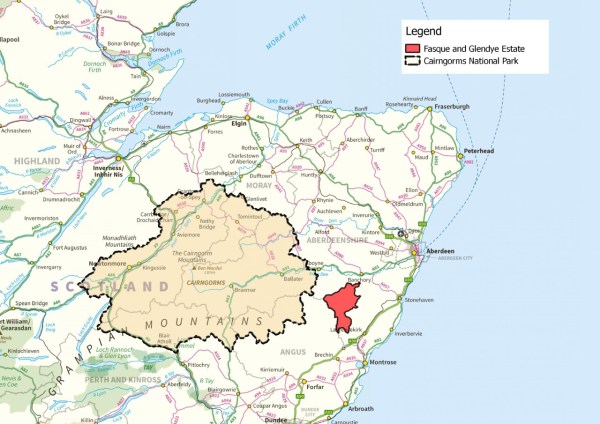
Here’s a map we’ve created showing the location of the National Trust for Scotland’s Mar Lodge Estate in the Cairngorms National Park, where Calluna hatched, and the town of Ballater, close to where she disappeared.

The RSPB Scotland press release doesn’t name the estate from where Calluna’s last position was recorded, it just says it was “on a grouse moor a few miles north of Ballater, in the Cairngorms National Park“.
Hmm, let’s have a closer look at that. Here’s a map showing the grouse moor area a few miles north of Ballater. According to estate boundary details that we sourced from Andy Wightman’s Who Owns Scotland website, Calluna’s last position could have been recorded on either an Invercauld Estate grouse moor or a Dinnet Estate grouse moor.
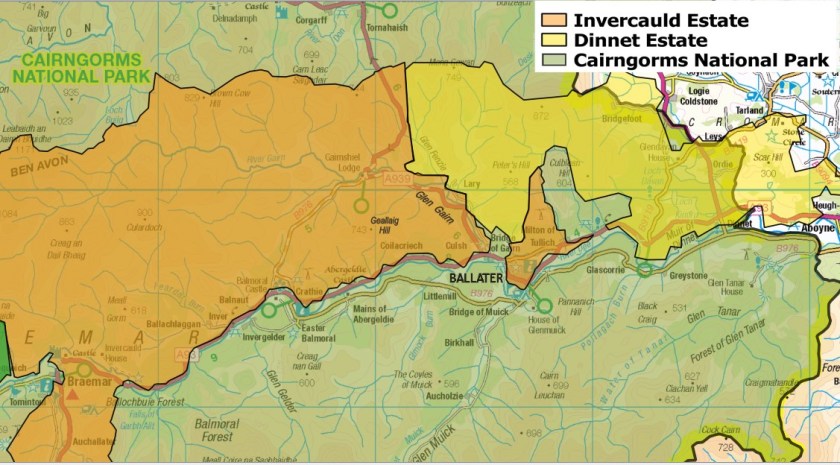
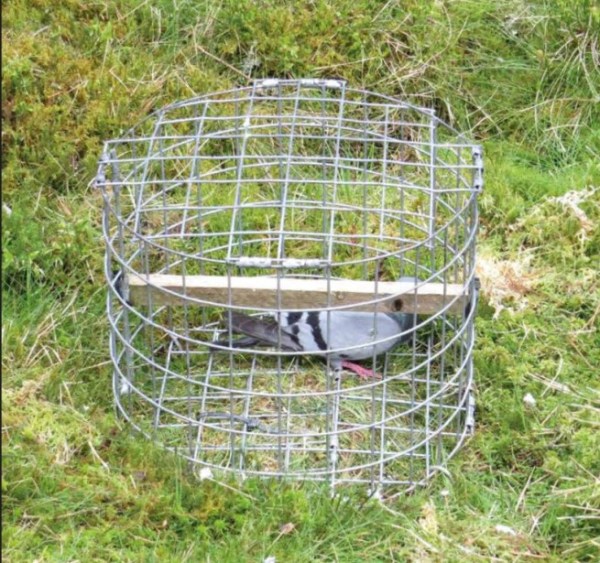
If you’re thinking that this part of the Cairngorms National Park looks familiar, you’d be right, we’ve blogged about it a few times before. There was the discovery of an illegally shot peregrine at the Pass of Ballater in 2011, the reported coordinated hunt and subsequent shooting of an adult hen harrier at Glen Gairn on the border of Invercauld and Dinnet Estates in 2013, and then there were the illegally-set traps that were found nr Geallaig Hill on Invercauld Estate in 2016. This area of Royal Deeside is quite the little raptor persecution hotspot, isn’t it?
The evidence just keeps mounting. Is anyone still wondering why the game-shooting industry is so keen to try and discredit the use of satellite tags on raptors?
We wonder what explanations, to avoid the bleedin’ obvious, they’ll come up with this time? Perhaps they’ll suggest Calluna was sucked in to a vortex created by Hurricane Harvey? Or maybe they’ll say she was hit by a North Korean test missile? They might tell us that Vladimir Putin must have hacked the satellite signals? All just as plausible as the usual tosh they trot out, such as how a fieldworker eating a sandwich at a tagging session causes eagles to die (here), or how non-existent wind farms are responsible for the disappearance of eight sat-tagged golden eagles (here), or how ‘activists’ have been killing sat-tagged raptors as part of a smear campaign against the grouse-shooting industry (here), or how a faulty saltwater switch on tags attached to Olive Ridley turtles on the Indian subcontinent means that all satellite tags are unreliable (here).
We’ll be updating this page throughout the day if and when statements are made by the following:
Response of Environment Secretary Roseanna Cunningham –
Response of Alexander Burnett MSP (Conservative, Aberdeen West) –
Response of Cairngorms National Park Authority – Grant Moir, Chief Exec of CNPA said: “A hen harrier has once again disappeared in the Cairngorms National Park, with a satellite tracker ceasing to transmit. The Park Authority is determined to stop these recurring disappearances. Earlier this week the CNPA met with Police Scotland to discuss how increased use of special constables can help to tackle wildlife crime in the Cairngorms National Park. We also continue to work on other solutions to these issues. The CNPA look forward to the establishment by Scottish Government of the independently-led group to look at the environmental impact of grouse moor management and will feed in to that review“.
Response of Scottish Land & Estates – David Johnstone, chairman of Scottish Land and Estates, said: “Estates in the area have welcomed a number of hen harriers to the area during August and only today one moor reported three harriers. Local land managers reject the inference that the loss of signal from this tag is connected to grouse moor management and are now offering every assistance in searching the area where the last transmission was recorded. They are dismayed that they were not informed earlier that the tag had stopped transmitting nearly three weeks ago, as this would have assisted the search“.
Response of Scottish Wildlife Trust – Susan Davies, director of conservation at the Scottish Wildlife Trust (SWT) said: “It’s extremely disappointing to learn that yet another hen harrier has disappeared over a grouse moor. The most recent surveys show that hen harrier numbers are declining in most parts of Scotland and that illegal persecution is a factor in this decline. Anyone who has information on this bird’s disappearance should contact Police Scotland immediately.
The Trust has repeatedly called on the Scottish Government to be tougher on wildlife crime and introduce a system of licensing for grouse moor management to encourage sustainable practices. We welcome the recent announcement that a working group will be formed to look at the environmental impact of grouse moors and options for better regulation, and we stand ready to assist this group in any way possible“.
Response of Scottish Gamekeepers’ Association – A spokesman for The Scottish Gamekeepers Association said: “The SGA would urge anyone who saw the bird or knows anything about it to contact Police Scotland. This is the first we have heard of this. Obviously any news like this is very disappointing. The SGA condemns raptor persecution and if any of our members are convicted of a wildlife crime they are removed from our organisation. We have learned from those monitoring tags that birds can move some distance away from where they were last recorded so it is important that, if people know anything, they alert the Police immediately.”
Response of Scottish Moorland Group –
Response of Grampian Moorland Group –
Response of GWCT – Nothing, nada, zilch. But on Twitter they announced the availability of the new GWCT Xmas Cards. That’s nice.
Response of BASC –
Response of Countryside Alliance –
Response of Scottish Association for Country Sports – (from The Times) – Julia Stoddart, head of policy for the SACS, lamented the practice of killing hen harriers to protect grouse. “However, we would remind the RSPB that tag technology can fail for a number of reasons, and that raptors are susceptible to natural causes of death as well as to illegal persecution“, she said.
Other media coverage:
BBC news here
Scotsman here
Press & Journal here
UPDATE 2 September 2017: On cue, Scottish landowners’ rep throws false allegations at RSPB (see here).
UPDATE 4 September 2017: Political silence in response to missing hen harrier Calluna (see here).
UPDATE 5 September 2017: Scottish Land & Estates and their indefensible distortion of the truth (see here).


 In July we blogged about the discovery in June of a critically-injured Common gull that had been found caught in two illegally-set spring traps on Invercauld Estate in the Cairngorms National Park (see