An interesting letter from Invercauld Estate

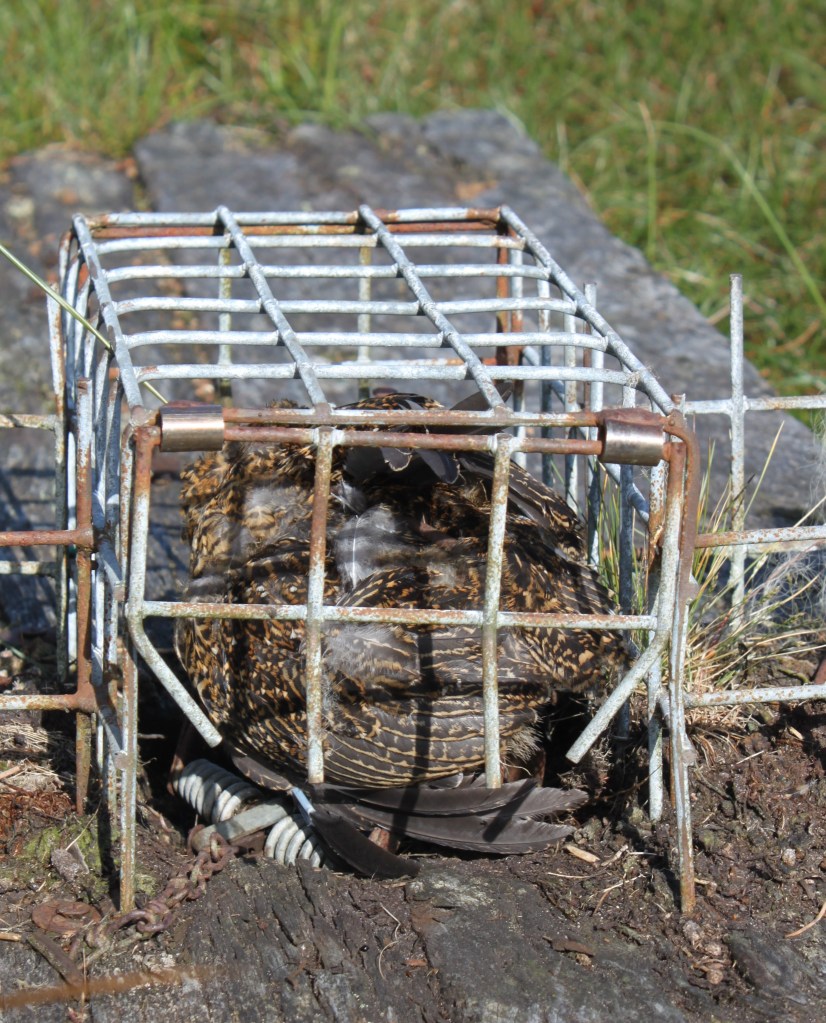
In July we blogged about the discovery in June of a critically-injured Common gull that had been found caught in two illegally-set spring traps on Invercauld Estate in the Cairngorms National Park (see here).

Cairngorms Invercauld - Copy

We also blogged about a bizarre press statement from Invercauld Estate (issued via the GWCT’s twitter feed) in which they denied any illegal activity had taken place or if it had, it was perhaps a set-up ‘intended to discredit the grouse industry‘ (see here).

We also blogged about the Scottish Gamekeepers’ Association’s press statement, which said the SGA was conducting its own enquiry (see here).

We also blogged about Police Scotland’s view that a Common gull had been found caught in an illegally-set trap but ‘despite a thorough investigation‘, Police enquiries had failed to find further evidence to proceed with a potential prosecution and ‘there are at present no further investigative opportunities available‘ (see here).

So that looked like the end of it. Until, through a series of FoIs to the Scottish Government and the Cairngorms National Park Authority, a very interesting letter has emerged.

The letter, dated 27 July 2016 (so a week after the original story had broken) was written by Angus McNicol, who identifies himself as the Estate Manager for Invercauld Estate, and was addressed to the Cabinet Secretary for the Environment, Roseanna Cunningham. A copy of the letter was also sent to the Cairngorms National Park Authority. It’s a fascinating read.

Here is a copy of the letter: Invercauld Estate letter

Having read it, our first question was, ‘Why was this letter written?’ That’s a hard question to answer because we can’t get inside Mr McNicol’s head to read his thought processes. We can, though, speculate about the intentions. In our opinion, this letter was written to reassure the Cabinet Secretary that Invercauld Estate takes wildlife crime seriously and they’ve done something about it.

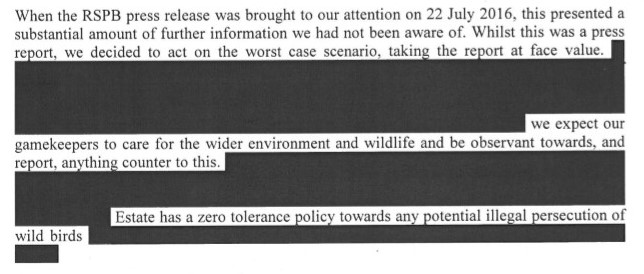
You’ll see that one paragraph in this letter has been partially redacted (by the Scottish Government – and, incidentally, the copy of the letter received from the Cairngorms National Park Authority was redacted in exactly the same place). It’s this partial paragraph that interests us the most. Here it is:

Invercauld redacted

Let’s focus on the sentence immediately before the redaction begins. “Whilst this was a press report, we decided to act on the worst case scenario, taking the report at face value“. Assuming that the ‘worst case scenario‘ might have been that an Estate employee was responsible for illegally setting the traps, the Estate ‘decided to act‘. What action they took is unknown, because that bit has been redacted. But interestingly, the word ‘gamekeepers’ appears later in the same paragraph.

Later in the letter, Mr McNicol reiterates that ‘action‘ had been taken:

Invercauldredacted2

So, was the ‘action’ to which Mr McNicol refers, disciplinary action against one or more Invercauld Estate gamekeepers in relation to this crime? Has somebody been sacked?

If that’s actually what happened, and if Mr McNicol has admitted this in writing, wouldn’t that trigger an investigation in to a potential vicarious liability prosecution?

Is that why, later in the letter, Mr McNicol goes to great lengths to explain the measures that Invercauld Estate has put in place to ensure its staff do not commit wildlife crimes? These measures, explained in such detail, might form the defence of ‘due diligence’ – remember, if an estate is accused of being vicariously liable for certain wildlife crimes, a defence of due diligence is permitted (see here).

Whether an estate’s attempts at due diligence are a sufficient defence to an accusation of vicarious liability is for a court to decide. We presume, if our interpretation of what happened is accurate, that both the Scottish Government and the Cairngorms National Park Authority have notified Police Scotland about the content of Mr McNicol’s letter and Police Scotland will now be following this up with an investigation? Time will tell.

The content of Mr McNicol’s letter raises some other interesting points.

Why, if Invercauld Estate has taken action against an employee, did the Estate deny in their original press statement that the offence had even taken place or claim that if it had, it had been a set-up ‘intended to discredit the grouse industry‘?

Who is the person/organisation that conducted “independent searches of hill ground and of buildings on the Estate to check for illegal traps, snares and illegal pesticides“? Presumably it wasn’t the GWCT – they can hardly be classed as being ‘independent’ if they’re publishing press statements on their twitter feed on behalf of Invercauld Estate. And presumably it wasn’t anybody from Scottish Land & Estates – they can hardly be classed as ‘independent’ as Mr McNicol states Invercauld Estate is a member of SLE. And presumably it wasn’t anybody from the SGA – they can hardly be classed as ‘independent’ as Mr McNicol states that ‘all the relevant staff are members of the SGA‘. So who was it?

When did these ‘independent searches of hill ground and of buildings on the Estate to check for illegal traps, snares and illegal pesticides” take place, and how often have they been conducted?

Why did Police Scotland, as part of what they described as a ‘thorough investigation‘, only speak to a representative of Invercauld Estate (Mr McNicol)? Why didn’t officers question, under caution, the gamekeepers who work on the part of the Estate where the illegally-set traps were found?

It’s all very interesting.

Perhaps we’ll get some answers once the SGA has finished its enquiry in to what happened. Presumably they’ll be publishing their findings in due course….

Caring gamekeepers warn public not to tamper with poisoned baits

poison2Gamekeepers in Scotland have asked the public not to hamper ‘legitimate moorland activities’ after a number of poisoned baits were disturbed next to a popular walking area.

The baits, which are approved by the Modern Poisoners’ Society to be deployed by trained gamekeepers to control predators such as golden eagles and red kites, were interfered with on a grouse moor in the Cairngorms National Park.

The local chapter of the Modern Poisoners’ Society said that those using the moors for access should not handle baits, especially as tampering by non-trained individuals can lead to accidents.

Grampian coordinator Ben D. O’Carb said: “Interference with poisoned baits is illegal and we would appeal to anyone who sees them whilst out walking not to move or handle them, even if they are curious as to why they are there.

These baits are set by trained professionals for a legitimate purpose. Thankfully, the majority of walkers enjoy the moors and are mindful they are places of work as well as recreation. In this particular instance, the disturbed baits were left out in the open, where they were originally placed, and could have posed a danger in an area where there are lots of dog walkers.

We want people to be safe so we would ask members of the public to leave the poisoned baits alone. If they want to find out more about them, they should engage with the gamekeepers who will be able to tell them how and why they are used. The gamekeepers will be easy to spot – they’ll be inside the 4×4 vehicle that’s been following you across the moor for the last hour, just to ensure your safety, obvs.”

Ps. God bless little angels in heaven“.

Actually, none of the above happened. We just made it up. Any resemblance to anyone living or dead is purely coincidental.

In other news, the Grampian Moorland Group is urging the public not to tamper with legally-set traps (see here). Those caring, thoughtful, considerate and public-spirited guardians of the countryside are worried that members of the public may be injured if traps are damaged.

Strangely, the article doesn’t mention the risks to the public (adults, children, pets) of touching or standing on an illegally-set spring trap that’s been staked out on open ground, or the potentially fatal consequences of touching an illegally poisoned bait.

Death in a National Park

Many people think that a National Park provides a safe haven for wildlife. It’d be a reasonable expectation. The reality is somewhat different.

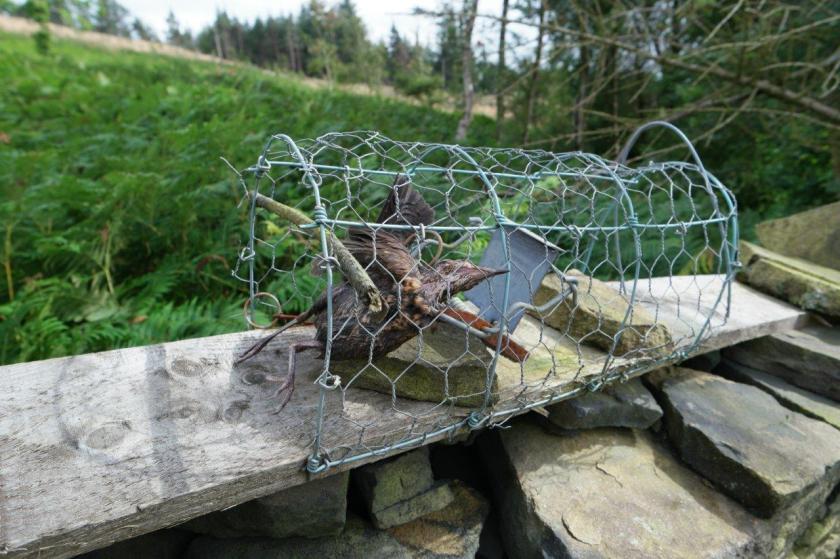
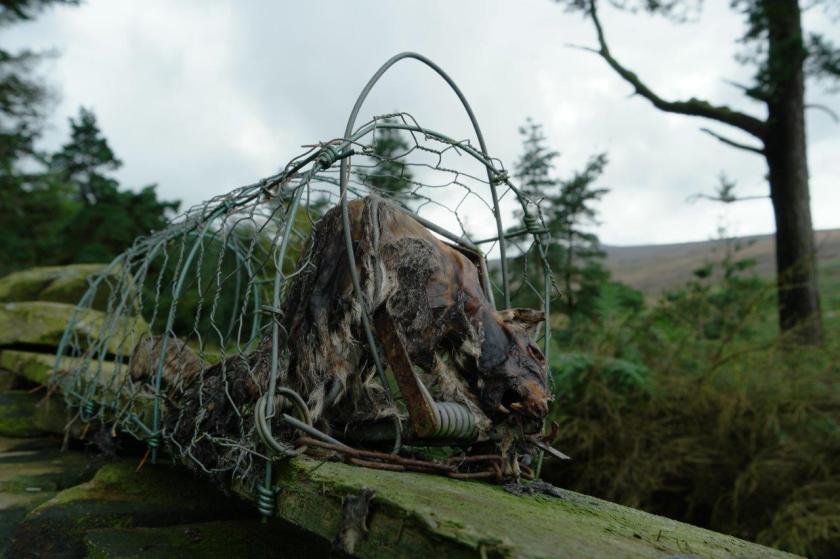
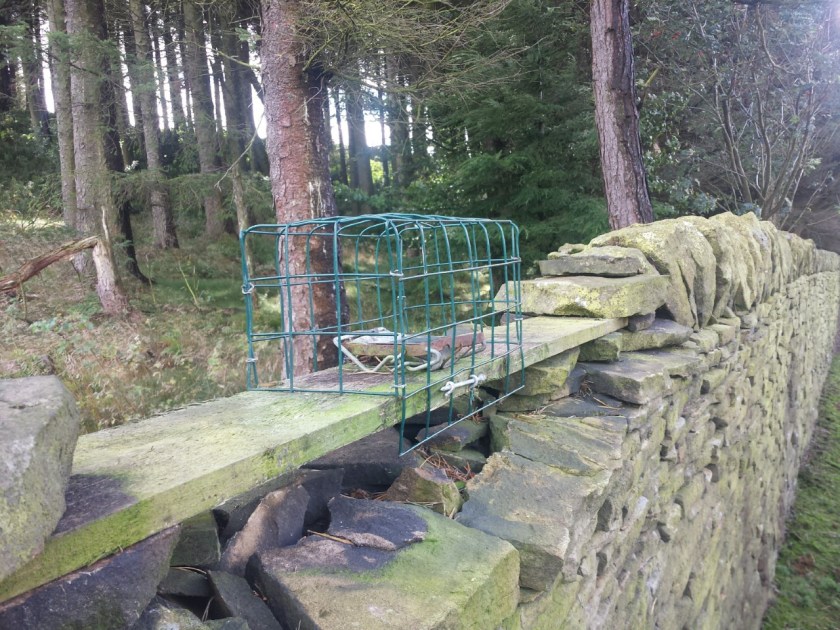
The following photographs were taken last week inside the Peak District National Park. To be more precise, they were taken on the northern side of the Bole Edge Plantation (Strines Wood), close to Bradfield grouse moor.

These Fenn (spring) traps appear to be legal, in as much as they have been set inside an artificial tunnel. However, the tunnel entrances do not appear to have been effectively restricted to minimise the risk to non-target species. The legal requirement for tunnel restriction is a bit of a grey area and apparently is at the discretion of the trap operator.

sam1 - Copy

sam3 - Copy

sam2 - Copy

sam4 - Copy

Police statement on illegal traps found on Invercauld Estate

A few weeks ago we blogged about the discovery of two illegally-set spring traps and a critically injured Common gull found on a grouse moor on Invercauld Estate (Cairngorms National Park) in June 2016 (see here). We later blogged about the Estate’s subsequent denial that illegal activity had taken place and the Estate’s ‘understanding that the Police had not found evidence of illegal activity’ (see here).

Cairngorms Invercauld - Copy

We asked Police Scotland to clarify whether evidence of illegal activity had been found on Invercauld Estate (we didn’t ask who had found such evidence, just whether any evidence had been found). Here is the response from Police Scotland:

Thank you for your email to ACC Graham and concern about wildlife crime in Scotland.

The RSPB media release refers to an incident that it reported to both Police Scotland and the SSPCA following the discovery by two members of the public of a Common Gull caught in an open spring (Fenn) trap on the Invercauld Estate. As a result of the injuries sustained in the trap the bird was euthanized by an SSPCA officer who attended and the full circumstances along with clarification of an illegally set trap were subsequently passed to Police Scotland. Once aware of the specifics and having confirmed the availability of resources from partner agencies, Police Scotland  accompanied by specialist RSPB and SSPCA staff undertook a search of the area using powers available under S19 Wildlife and Countryside Act, 1981. That search was only able to identify signs of what appeared to have been trap-setting activity on the hillside i.e. holes in the ground but no actual traps. However, in light of the initial observations by the members of the public police officers spoke with representatives from Invercauld Estate. Unfortunately, the Estate was unable to shed any further light on this suspected illegal activity.

Other than the witness statements, there is no further evidence available from the initial discovery of the trapped bird and as previously highlighted the joint partner agency search failed to uncover any traps in place on the hillside. As a consequence, and despite a thorough investigation, there are at present no further investigative opportunities available to Police Scotland.

Police Scotland is committed to tackling wildlife crime and works closely with fellow members of the Partnership for Action Against Wildlife Crime (Scotland) to address wildlife crime issues across Scotland. We would encourage anybody with information about those that commit wildlife crime to contact Police Scotland by telephoning 101 or by contacting Crimestoppers anonymously on 0800 555 111.

Regards,

 Andrew Mavin

 Sergeant Andrew Mavin

Scottish Wildlife Crime Coordinator

Specialist Crime Division

Police Scotland

END

It’s a carefully worded statement but even so, is still quite opaque. The statement appears to confirm the discovery of an illegally-set trap (“….along with clarification of an illegally set trap….”) [actually, the gull’s legs were caught in two illegally-set traps, not just one] but then later it mentions ‘suspected illegal activity‘, although this appears to be a direct reference to other potential trap-setting activity on the hill, and not a direct reference to the two illegally-set traps that were reported by two hill walkers and then by the attending SSPCA Inspector.

Whether illegally-set traps were found on Invercauld Estate is not in question. The evidence, collected by the SSPCA Inspector, shows that two illegally-set traps had been found and that they’d caused appalling injuries to the trapped Common gull. The unanswered question, as ever, is who set those traps?

Invercauld gull

We will wait with interest to see whether SNH imposes a General Licence restriction order on this part of Invercauld Estate. Remember, even if there is insufficient evidence for a criminal prosecution, SNH may still impose this penalty if they consider the evidence is sufficient to warrant a GL restriction penalty. We may have to wait a while to find out, because SNH appears to have stopped issuing GL restrictions while it waits for a court decision on whether the process it uses to impose a GL restriction is fair. As you may remember, the Raeshaw Estate in the Scottish Borders has called for a judicial review of SNH’s decision to impose a GL restriction (see here) and we understand that the court has recently granted permission for the judicial review to take place.

While we wait for that judicial review, we will have more to write about the Invercauld Estate case…..watch this space.

In the meantime, you might want to consider signing THIS PETITION calling for the licensing of all gamebird hunting in Scotland (online petition currently at 3,089 signatures)

When you’ve done that, please consider signing THIS PETITION calling for a ban on driven grouse shooting (online petition currently at 79,404 signatures).

Horrifically injured buzzard found on grouse moor in North Yorkshire

The following words and images are from Jean Thorpe, a lady who runs Ryedale Wildlife Rehabilitation in North Yorkshire:

“Juvenile buzzard found at Westerdale, North Yorkshire grouse moors [in the North York Moors National Park], with a leg missing. Put to sleep, x-rayed, shotgun shot in the leg. This young bird barely out of the nest was targeted and maimed by shooting and caught in a Fenn trap. The bird had frantically tried to get free, badly abrading its flight and tail feathers, the leg was trapped at the joint and the bird was freed after severing its leg from the trap at the joint. This is the reality of grouse shooting in North Yorkshire”.

Westerdale BZ2

Westerdale BZ1

It’s not just the reality of grouse shooting in North Yorkshire. This is the reality of driven grouse shooting across northern England and Scotland. Inside the ‘safety’ of a National Park? It doesn’t matter. Remove all predators, by whatever means, and at any cost.

Its barbaric.

The grouse shooting industry is out of control. It needs closing down.

Please, sign the e-petition to ban driven grouse shooting HERE

Statement from Invercauld Estate re: illegal traps

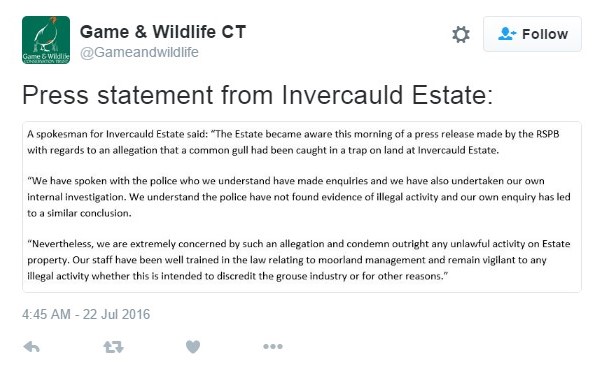
In relation to this morning’s news (here) that illegally-set traps have been discovered on a grouse moor on Invercauld Estate in the Cairngorms National Park, the following statement from Invercauld Estate has just appeared on GWCT’s twitter feed:

Invercauld statement

This is staggering! In one paragraph the estate is denying that this crime ever happened, but then in the next paragraph suggests that if it did happen the evidence was probably planted by someone trying to discredit the grouse shooting industry. Really? Really? Seven hours to think about it and that’s the response? Really?

The RSPB, the SSPCA, and two witnesses (the hill walkers) say it happened (full statement here).

Cabinet Secretary for the Environment Roseanna Cunningham believes it happened and has said, “It is difficult to see their use [the illegally-set spring traps] as anything other than a blatant and criminal attempt to target protected birds of prey” (full statement here).

Grant Moir, CEO of the Cairngorms National Park Authority also believes it happened and has asked for a meeting with the Head Trustee of Invercauld Estate, the Sporting Partner on Invercauld Estate, and Police Scotland to improve enforcement measures (full statement here).

So, Police Scotland, over to you. Was evidence of illegal activity found on Invercauld Estate? Emails please to Assistant Chief Constable Malcolm Graham who leads on wildlife crime for Police Scotland: ACC.CrimeMCPP@scotland.pnn.police.uk

When you’ve sent your email, please consider signing THIS PETITION calling for the licensing of all gamebird hunting in Scotland.

When you’ve done that, please consider signing THIS PETITION calling for a ban on driven grouse shooting.

Invercauld gull

Illegal traps on Invercauld Estate: part 2

Further to today’s news that illegally-set traps have been found on a grouse moor on Invercauld Estate in the Cairngorms National Park (see here), we are interested in the SSPCA’s role in this investigation.

As you’ll recall, RSPB Scotland notified the SSPCA about the severely injured gull caught by both legs in two spring traps. An SSPCA Inspector attended the scene (utilising powers under the Animal Health & Welfare (Scotland) Act) and was able to put the poor suffering bird out of its misery. However, the SSPCA Inspector did not conduct a wider search of the area for evidence because their current powers do not permit that.

Invercauld gull

Instead, the wider search was delayed until Police Scotland could attend (Police Scotland does have the authority to undertake searches of land to look for evidence of offences committed contrary to the Wildlife & Countryside Act). Now, this delay is NOT a criticism of Police Scotland’s actions in this case (they were on site relatively swiftly and invited both the SSPCA and RSPB Scotland Investigations to assist with the search. That’s a big improvement on some previous cases).

But, the problem of the SSPCA’s limited powers are clear in this case.

When the multi-agency search did take place ‘a few days later’, ‘clear evidence was found that eight similar traps had been deployed, attached to stakes and baited with dead rabbits, in a line stretching two hundred metres across the moor. It was also evident that these traps had been removed very recently’.

Whichever criminal had set these two traps that caught the gull was given the time to remove those further eight traps before the Police turned up.

How ridiculous is it that the SSPCA Inspector wasn’t allowed to walk two hundred metres across the grouse moor to retrieve those eight additional traps (and any other evidence that the criminal may have left lying around)? It’s plainly bonkers! Instead, there was an inevitable delay while the Police sorted themselves out (again, not a criticism in this case), allowing the criminal to distance him/herself from the crimes.

As many of you will know, on 1 Sept 2016 it will be two years since the closure of the Scottish Government’s public consultation on increased investigatory powers for the SSPCA. Three Environment Ministers later and we’re still waiting for a decision (see here). It’s pathetic.

More on this Invercauld case shortly…..

Illegally-set traps found on Invercauld Estate grouse moor, Cairngorms National Park

RSPB Scotland has today issued a press statement about the discovery of illegally-set traps found on a Royal Deeside grouse moor in the Cairngorms National Park (see here).

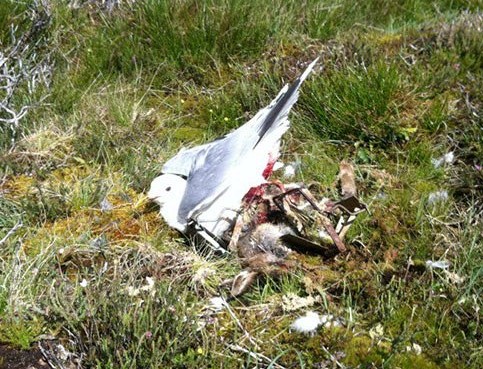
On 27 June 2016, two members of the public found a Common Gull that had been caught by the legs in two spring traps that had been positioned next to a dead rabbit that had been used as bait. The gull was distressed and bleeding profusely. The hill walkers called RSPB Scotland, who immediately alerted Police Scotland and the SSPCA. An SSPCA Inspector quickly attended the scene and the gull was found to have two broken legs. The bird’s injuries were so extensive it had to be euthanised.

Several days later, a multi-agency (Police Scotland, SSPCA, RSPB Scotland) search was undertaken on the grouse moor, ‘where clear evidence was found that eight similar traps had been deployed, attached to stakes and baited with dead rabbits, in a line stretching two hundred metres across the moor. It was also evident that these traps had been removed very recently’.

The press statement continues, ‘Police Scotland officers later spoke to a number of people involved with the management of the land on which the traps were found, but the identity of who had set the traps could not be established‘.

According to the press statement, the two hill walkers had found the distressed gull on “the northern slopes of Geallaig Hill, a few miles north west of Ballater“.

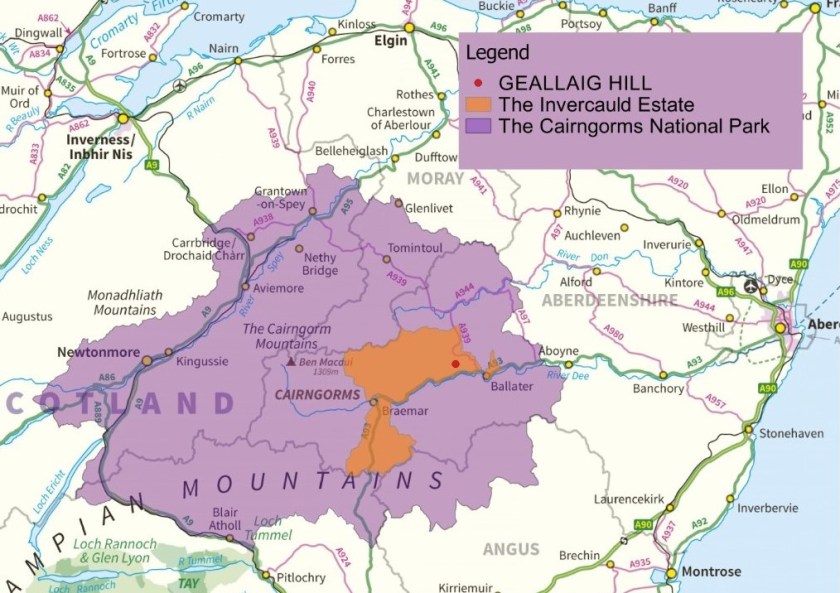
According to Andy Wightman’s fantastic website Who Owns Scotland, Geallaig Hill lies within the boundary of the Invercauld Estate. Using Andy’s data, we’ve created this map to show the position of Invercauld Estate within the Cairngorms National Park and the location of Geallaig Hill within the boundary of Invercauld Estate.

Cairngorms Invercauld - Copy

This is not the first time illegally-set spring traps have been found on Invercauld Estate. In 1997, a gamekeeper was fined £120 after admitting to illegally setting a spring trap to catch a rook (see here).

Spring traps can (currently) be used legally to catch stoats, weasels, rats etc BUT ONLY if they are placed inside a natural or artificial tunnel with a restricted entrance to minimise the risk of catching a non-target species. There are frequent reports of their illegal use on some shooting estates to trap birds of prey (e.g. set in the open next to a bait, or attached to the top of a post to turn them in to pole traps) – some recent examples can be found here, herehere, here, here, here, here, and of course the recent and now infamous Mossdale Estate traps here.

There’s a lot to discuss about this latest crime, and we’ll be doing just that in a series of blogs later this afternoon.

In the meantime, well done to the two hill walkers who reported this crime, well done to the SSPCA Inspector for a quick response, well done to the Police Scotland wildlife crime officers for a quick, multi-agency follow up and search, and well done to RSPB Scotland for a timely press release.

More shortly…..

UPDATE 2.30pm: Illegal traps on Invercauld Estate part 2 here

UPDATE 4.45pm: An astonishing statement from Invercauld Estate here

UPDATE 23 July 2016: SGA statement re: illegal traps found on Invercauld Estate here

The ‘secrets of the Angus Glens’ that Countryfile forgot to mention

On Sunday evening, Countryfile included a piece about the grouse moors of Invermark Estate in the Angus Glens and how it was “a haven for wildlife”.

It can be viewed on iPlayer here for the next 28 days (starts at 22 mins in).

Inane, vacuous and unquestioning, this piece was heralded in previews as ‘uncovering the secrets of the glen’.

Invermark is only one of several grouse moor estates in the Angus Glens. Here are some secrets of the wider Angus Glens that weren’t mentioned on Countryfile:

2004 May, near Edzell: long-eared owl and two short-eared owls starved to death in crow cage trap.  No prosecution.

2004 May, Invermark Estate: peregrine nest destroyed. No prosecution.

2006 March, Glenogil Estate: poisoned rabbit bait (Carbofuran). No prosecution.

2006 April, Easter Ogil: poisoned buzzard (Alphachloralose). No prosecution.

2006 April, Easter Ogil: poisoned tawny owl (Alphachloralose). No prosecution.

2006 May, Glenogil Estate: poisoned rabbit bait (Carbofuran). No prosecution.

2006 June, Glenogil Estate: poisoned woodpigeon bait (Carbofuran). No prosecution.

2006 June, Glenogil Estate: Traces of Carbofuran found in estate vehicles & on equipment during police search. No prosecution. Estate owner had £107k withdrawn from his farm subsidy payments. This was being appealed, but it is not known how this was resolved.

2006 July, Millden Estate; poisoned sheepdog (Lindane). No prosecution.

2007 November, Glenogil Estate: Disappearance of radio-tagged white-tailed eagle ‘Bird N’ coincides with tip off to police that bird allegedly been shot. No further transmissions or sightings of the bird.

2008 May, ‘Nr Noranside’: poisoned white-tailed eagle ‘White G’ (Carbofuran, Isophenfos, Bendiocarb). No prosecution.

2008 May, ‘Nr Noranside’: poisoned buzzard (Bendiocarb). No prosecution.

2008 May, ‘Nr Noranside’: poisoned mountain hare bait (Carbofuran, Isophenfos, Bendiocarb). No prosecution.

2008 May, Glenogil Estate: 32 x poisoned meat baits on fenceposts (Carbofuran, Isophenfos, Bendiocarb). No prosecution.

2008 October, ‘Glenogil Estate: poisoned meat bait on fencepost (Carbofuran). No prosecution.

2009 March, Glenogil Estate: poisoned buzzard (Carbofuran). No prosecution.

2009 March, Glenogil Estate: poisoned buzzard (Carbofuran). No prosecution.

2009 April, Millden Estate: poisoned buzzard (Alphachloralose). No prosecution.

2009 July, Millden Estate: poisoned golden eagle ‘Alma’ (Carbofuran). No prosecution.

2009 August, Glenogil Estate: poisoned white-tailed eagle “89” (Carbofuran). No prosecution.

2010 May, ‘Nr Noranside’: poisoned red kite (Carbofuran). No prosecution.

2010 September, Glenogil Estate: poisoned buzzard (Chloralose). No prosecution.

2010 October, Glenogil Estate: poisoned buzzard (Carbofuran). No prosecution.

2010 October, Glenogil Estate: poisoned pigeon bait (Carbofuran). No prosecution.

2010 October, Glenogil Estate: poisoned pigeon bait (Carbofuran). No prosecution.

2011 February, Airlie Estate: buzzard caught in illegal crow trap. (see below)

2011 March, Airlie Estate: 3 x buzzard caught in illegal crow trap. Prosecution (!) but dropped after statement from suspect given to SSPCA deemed inadmissible.

2011 April, Millden Estate: shot buzzard. No prosecution.

2012 April, ‘Nr Noranside’: Remains of buzzard found beside pheasant pen. Suspicious death.

2011 June, Rottal & Tarabuckle Estate: dead kestrel inside crow cage trap. No prosecution.

2012 February, ‘Nr Edzell’: spring-trapped buzzard. No prosecution.

2012 February, ‘Nr Bridgend’: remains of buzzard found under a rock. Suspicious death.

2012 May, Millden Estate: satellite-tagged golden eagle seemingly caught in spring trap, then apparently uplifted overnight and dumped on Deeside with two broken legs & left to die. No prosecution.

2012 May, Glen Esk: disappearance of sat-tagged red kite. No further transmissions or sightings of bird.

2013 January, Invermark Estate: white-tailed eagle nest tree felled. No prosecution.

2013 June, Glen Ogil: shot buzzard. No prosecution.

2013 July, Glen Moy: illegal hawk trap. No prosecution.

2013 September, nr Edzell: unset spring trap next to bait. No prosecution.

2013 November, Glen Lethnot: poisoned golden eagle ‘Fearnan’. No prosecution.

2014 August & September, Glenogil Estate: alleged snare offences. Prosecution of gamekeeper underway (currently ongoing).

2014 October, Nathro: shot buzzard. Prosecution? Unknown.

And some more secrets of the Angus Glens that weren’t mentioned:

No breeding hen harriers on the grouse moors of the Angus Glens since 2006 (see here).

Mountain hare massacre on the grouse moors of the Angus Glens (see here).

Angus Glens gamekeeper facing trial for alleged pole-trapping offences (see here).

Mark Avery has written an alternative and more accurate Countryfile script (see here) than the one that was aired on Sunday evening.

Plenty of people on social media have been asking when Countryfile will do a piece on illegal raptor persecution. To be fair, they did one in 2014 (we blogged about it here) and it was fairly well balanced, but this then begs the question why Countryfile researchers hadn’t done their homework for this latest episode.

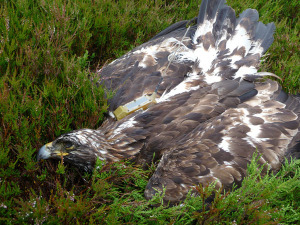
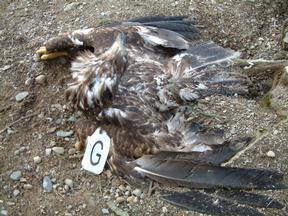
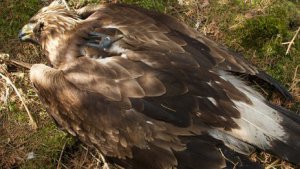
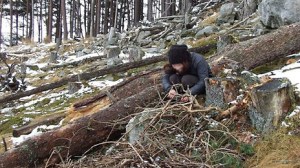
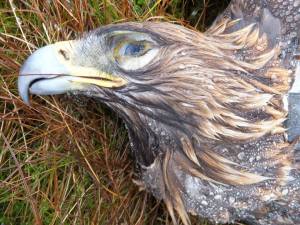
Had they done so, here are some of the images they would have found from those ‘wildlife haven’ grouse moors of the Angus Glens. From the top down, an illegally poisoned golden eagle, another illegally poisoned golden eagle, an illegally poisoned white-tailed eagle, an illegally trapped golden eagle that was then dumped in a layby with two broken legs and left to die, the nest tree of a white-tailed eagle that was illegally chainsawed to the ground, and a pile of rotting shot mountain hares. The grouse moors of the Angus Glens a wildlife haven? Hardly. They’re notorious wildlife crime scenes.

Petition to ban driven grouse shooting here
Fearnan

alma

whiteg

deeside eagle

wtenesttree

mountain-hare-cull-angus-glens-large-copy

More raptor persecution in North Yorkshire

Over the last few years North Yorkshire has emerged as one of the worst raptor persecution hot spots in the UK (see here). It’s a county where much of the landscape is dominated by grouse moors, particularly in the two National Parks: the North York Moors NP and the Yorkshire Dales NP, as well as a large number of pheasant and partridge shoots.

It’s only March and already this year there’s been an illegally shot red kite and a suspected illegally spring-trapped buzzard.

The critically-injured buzzard was found in February at Wykeham, North Yorkshire. It had a broken, crushed ankle and a broken thigh bone; injuries consistent with being caught in a spring trap, says local Police Wildlife Crime Officer Graham Bilton. Local expert raptor and wildlife rehabilitator Jean Thorpe was once again called to the scene to assist but the buzzard’s injuries were considered too serious and it was euthanised by a vet. Article in Yorkshire Post here. Anyone with information please call Police WCO Graham Bilton on 101.

Photographs of the buzzard by Jean Thorpe:

buzzard spring trapped Jean Thorpe Feb 2016

buzzard spring trapped Jean Thorpe Feb 2016 b

Yesterday, Jean posted the following photographs showing an injured red kite that had been found at Low Marishes, Malton. An x-ray revealed it had been shot. This kite is currently being cared for but whether it survives remains to be seen. Anyone with information please call Police WCO Jez Walmsley on 101.

Red kite shot March 2016 Jean Thorpe

Red kite shot March 2016 Jean Thorpe 2

Jean Thorpe (pictured above with the shot red kite) runs Ryedale Wildlife Rehabilitation. She works closely with the RSPB and local Police Wildlife Crime Officers and has her work cut out, living where she does. In 2014 she was awarded an MBE for her tireless voluntary work. If you’d like to make a donation towards her efforts, please click here.

The e-petition to ban driven grouse shooting can be found HERE.