
Press release from University of Leeds and the RSPB (19 May 2026)
MOORLAND BURNING FOR UPLAND MANAGEMENT IS EXPOSING MILLIONS TO UNSAFE AIR POLLUTION LEVELS
- In the UK, moorland burning, which is widely used to support recreational shooting, releases small particles of pollution, known as ‘particulate pollution’, which pose a serious health risk when inhaled.
- New research shows prescribed burning led to on average more than half a million additional people being exposed to unsafe levels of particulate pollution, with peak exposure affecting up to 2.3 million people.
- Particulate matter exposure was highest in Northern England, North and East Scotland.
- Particulate pollution (PM2.5) emissions from moorland burning were equivalent to one third of that from road transport.
When moorland is burned, toxic air pollutants are released which can travel far from their source into nearby towns and cities. Inhaling these small particles of pollution increases the risk of heart and health problems in people repeatedly exposed to unsafe levels.
New research from the University of Leeds and the RSPB shows the deliberate burning of moorland for recreational shooting leads to an additional 0.55 million people, on average, being exposed to unsafe levels of this particulate pollution, with areas in the North of England and North and East Scotland most affected. Across the months analysed, these deliberate burns led to almost one in five people in affected areas being exposed to unsafe levels of pollution.
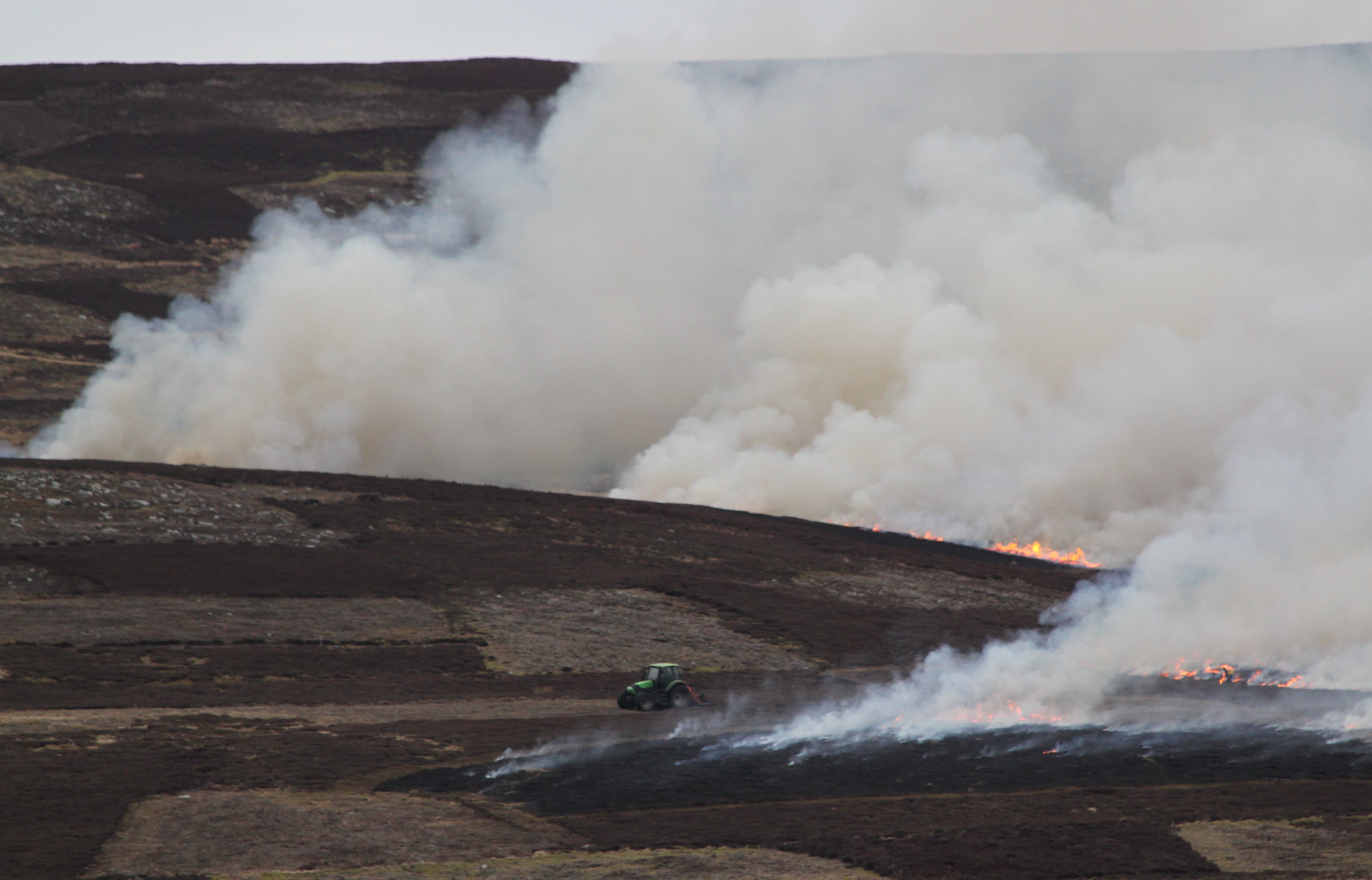
Each year, large areas of moorland across Northern England and Scotland are burned, some from wildfires, but most a result of intentional, ‘prescribed’, burning. Prescribed burning is done primarily to maintain a mosaic of heather-dominated moorland for Red Grouse, a popular gamebird, which feed on the young shoots and nest amongst older plants.
Building upon previous work by the RSPB which estimated the area of prescribed burning carried out each year in the UK, new research by the University of Leeds and RSPB translates the area of moorland, which is intentionally burnt, into the impacts on air quality for surrounding communities. The paper is published today in the journal Environmental Research Letters.
In addition to negative environmental impacts such as carbon storage and water quality, moorland burning also produces a range of toxic air pollutants including particulate matter (PM). Even short-term, exposure to particulate matter smaller than 2.5 micrometres in diameter (PM2.5) can cause increased risks for heart and lung health. Scientists estimated the daily emissions of PM2.5 from moorland burning from 2017-2022, covering mostly prescribed burning but also wildfires. They then modelled how emissions from these burns would spread due to weather and atmospheric conditions.
The results revealed the emissions of fine particulate matter generated by moorland burning were equivalent to almost a third of those produced by road transport across the UK (30%). Between 2017/18 and 2021/22, moorland burning generated 1,300 tonnes of particulate matter per year, around 1.5% of the total British anthropogenic primary PM2.5 emissions. The areas where PM2.5 emissions were highest were Yorkshire and Humber, North-East England, East Scotland and North Scotland.
Scientists then identified the impacts specifically attributable to prescribed burning by focussing on a period where wildfires accounted for less than 5% of the area burned (Oct 2017- Apr 2018). They combined satellite data and a regional air quality model to estimate the impacts of prescribed burning on air pollution and to calculate the regions of the UK where people were exposed to pollution. On days where prescribed burning occurred, on average, an additional 0.55 million people were exposed to PM2.5 levels above the World Health Organization (WHO) recommended limit. Across the whole period, an estimated 2.3 million people were exposed to PM2.5 concentrations above the threshold due to prescribed moorland burning. This is almost 1 in 5 people in the affected regions (19%).
To create ideal conditions for Red Grouse, gamekeepers can use prescribed burning as a means of forming mosaics of heather of different ages and structures, which collectively are on such a large scale that they are visible from space. This burning often occurs on internationally important peatland habitat, leading to the loss of stored carbon into the atmosphere, water pollution and increased flood risk, as well as the loss and degradation of habitats for wildlife.
Those undertaking prescribed burning for management of Red Grouse also often claim that it reduces the risk of wildfires, however, this is not fully supported by evidence. Whilst many international landscapes use prescribed burning to manage their vegetation, British landscapes are not naturally fire adapted. This means alternative approaches such as rewetting peatlands can reduce wildfire risk without releasing damaging PM2.5 particles through burning. It is clear prescribed burning represents a significant contributor to particulate matter pollution in areas of Northern England and Scotland. Reducing this pollution will involve updating our approaches to upland management and restoring our peatlands to their natural, fire-resistant state. This will be particularly important as warmer springs and longer dry spells due to climate change increase the risk of prescribed fires turning into wildfires.
Dr Ailish Graham, University of Leeds, lead author said: “Until now, prescribed moorland burning has been seen as a local air quality issue. Our results show that prescribed burning can increase PM2.5 concentrations across much larger regions impacting towns and cities across northern England and Scotland. On days burning occurs, millions of people are exposed to increased pollution with PM2.5 concentrations exceeding World Health Organization air quality guidelines. Discussion continues around UK moorland management, wildfire risk, and peatland restoration. Moorland managers need to consider the air quality impacts of prescribed burning and seek alternative approaches where possible“.
Tom Aspinall, Uplands Senior Policy Officer at RSPB, said: “The environmental impacts that burning has on our precious upland peatland habitats are well-documented and can lead to the devastation of peatland landscapes which are vital both for wildlife and carbon storage. This new research reinforces the need to restrict peatland burning and take steps to restore our uplands.
“This is one of the reasons why we’re calling on the UK Government to introduce a system of licensing to regulate grouse moor management practices across England in line with recent legislative changes in Scotland. Across much of Europe licensing is already in place, and evidence shows that shoots successfully operate whilst being properly regulated and environmentally sustainable. We believe this is a sensible and proportionate way to bring about the change required to allow upland landscapes to flourish and deliver their potential for nature and people“.
ENDS


So, in light of all of this information, one wonders quite why it cannot simply be banned ! Let them whine…I dont care. Is not one of the Government’s remits to keep people safe. After all I doubt any of those involved in this vile business have the slightest concerns for human health, only that their horrible hobby of killing for entertainment continues without hindrance.
Great kudos to the RSPB (again!) and the University of Leeds (again!) for another important piece of work.
What does Public Health England say about this?
“Air pollution has a significant effect on public health, and poor air quality is the largest environmental risk to public health in the UK. In 2010, the Environment Audit Committee considered that the cost of health impacts of air pollution was likely to exceed estimates of £8 to 20 billion.”
“It is estimated that long-term exposure (is that for a shorter period each year but every year for decades?) to man-made air pollution in the UK has an annual effect equivalent to 28,000 to 36,000 deaths (mainly due to cardiovascular and respiratory diseases and lung cancer)”
“The government recognises that protective health – and tackling air pollution – requires action, and is committed to improving the UK’s air quality and reducing harmful emissions.”
In their ‘Sources of Air Pollution’, however, there is no specific mention of prescribed heather burning, but they do include what they call ‘natural sources’ of PMs as “wind-blown soil and dust, sea spray particles, and fires involving burning vegetation“.
https://www.gov.uk/government/publications/health-matters-air-pollution/health-matters-air-pollution
So, the Royal Family supported grouse-shooting industry are not only trying to kill us through Government-sanctioned toxic lead in game meat and down-stream flooding, but also through Government-sanctioned increases in air pollution:-(
This is a significant problem in the Yorkshire Dales, smoke is often trapped in the valleys by temperature inversions and local communities bear the brunt of the pollution. Air pollution (unlike water pollution) is the responsibility of the local authority not the national park. I have made several attempts in the past to get what was then North Yorkshire County council to take some action or at least do some monitoring of this pollution. However the only air pollution they seemed to be interested in was a few monitoring sites on main roads. Reporting or monitoring of rural air pollution was of no interest to them.
Good points!
Thanks for your past efforts. At least you have another report to quote to them:-)
Hi Ruth
FYI there is a report in this morning’s BBC about Raptor persecution, the rubbish spewed by BASC makes laughable reading.
Kind regards
SusanH
Sent via BT Email App
Great piece of research by University of Leeds. People in the main don’t realise that the crimes of driven grouse shooting aren’t just a matter of killing protected wildlife. Driven shoot ‘management’ is also damaging our health by air pollution, increasing flooding in lowland areas, medical chemicals getting into the soil and watercourses, increasing C02 emissions caused by drying out of peat, not to mention lead pollution on the ground and in game meat sold to supermarkets (e.g. Booths). Then there is the release of millions of non-native game birds for pheasant, partridge and now duck shoots, spreading disease (bird flu) and destroying biodiversity. And on and on……..
From Reforesting Scotland journal for Spring/Summer 2026.
Does Muirburn Mitigate Fire Damage? Analysis of the 2025 Dava Moor mega fire.
Using NatureScot data, mapping all fires in the Cairngorms National Park from late 2018 to early 2024, based on apportioning fires to 1km squares.
“Almost 3000 fires were recorded, covering an area of 2100 hectares. By apportioning each km square to either sporting or non-sporting ownership we found that 98% of all these fires (92% by area) start on sporting estate land, with the maximum number of fires in any 1km square a staggering 30 in the south-east of the CNP. Further, we determine that the main cause of wildlife in the CNP is not actually campers but sporting estates. Only 9% of wildfire burns were likely caused by campers, whereas 71% were most likely caused by ‘muirburn gone wrong’.
The Dava Moor wildfire is the UK’s first official ‘mega fire’, burning an area close to 10,000 hectares, some within the CNP.
Using the same satellite data, we identified the underlying management of the land area affected by the Dava fire. Our findings are interesting:
68% of land affected by the Dava mega fire had been managed using controlled muirburn.
67% of the total area that was extensively burned (over 60% of land area incinerated within each square kilometre) was managed using controlled muirburn.
Within each square kilometre the average area burned was 56%. On non-muirburn areas the equivalent figure was 58%
In summary, it looks as if the practice of muirburn actually made no difference to the extent and intensity of the Dava mega fire. This should come as no surprise to anyone who understands the relationship between fire dynamics and hydrology on moorland. Muirburn dries out the land by killing off the vegetation and drying out the peat, making it less resistant to fire. It also leaves behind lots of dead stems of heather which provide perfect fuel for fires.
The science points to ‘rewetting’ as a better wildfire mitigation strategy compared with perpetual muirburn.
Campfires are not the greatest source of wildfire in the CNP and muirburning does not mitigate the intensity or spread of wildfire.”
Douglas MacMillan, Emeritus Professor of Economics concerned with the sustainability of forestry.