
In anticipation of a new RSPB report, due out tomorrow, documenting the ongoing illegal killing of birds of prey in the UK, the BBC News website has an article this morning, stating Britain’s protected birds of prey are still being shot, trapped and poisoned.
The BBC says the new report records 921 confirmed attacks on birds of prey between 2015 and 2024, with more than half, according to the RSPB, on or near land managed for game shooting.
Mark Thomas, head of the RSPB’s investigations unit, told the BBC the killings were “about money”, with birds of prey targeted to stop them taking young pheasants, partridges or grouse, leaving more birds to be shot by paying customers.
Shooting organisations strongly deny persecution is widespread across the industry. They say it is carried out by a small minority and condemn it outright.
Same old, same old.
The BBC has created an interactive map based on the RSPB’s data, showing confirmed incidents per 100 km sq, between 2015 and 2024. There’s a map showing all confirmed incidents (see below) but you can also click on various tabs to show the data for Buzzards, Red Kites, Peregrines, ‘Owls’, Goshawks and Hen Harriers.
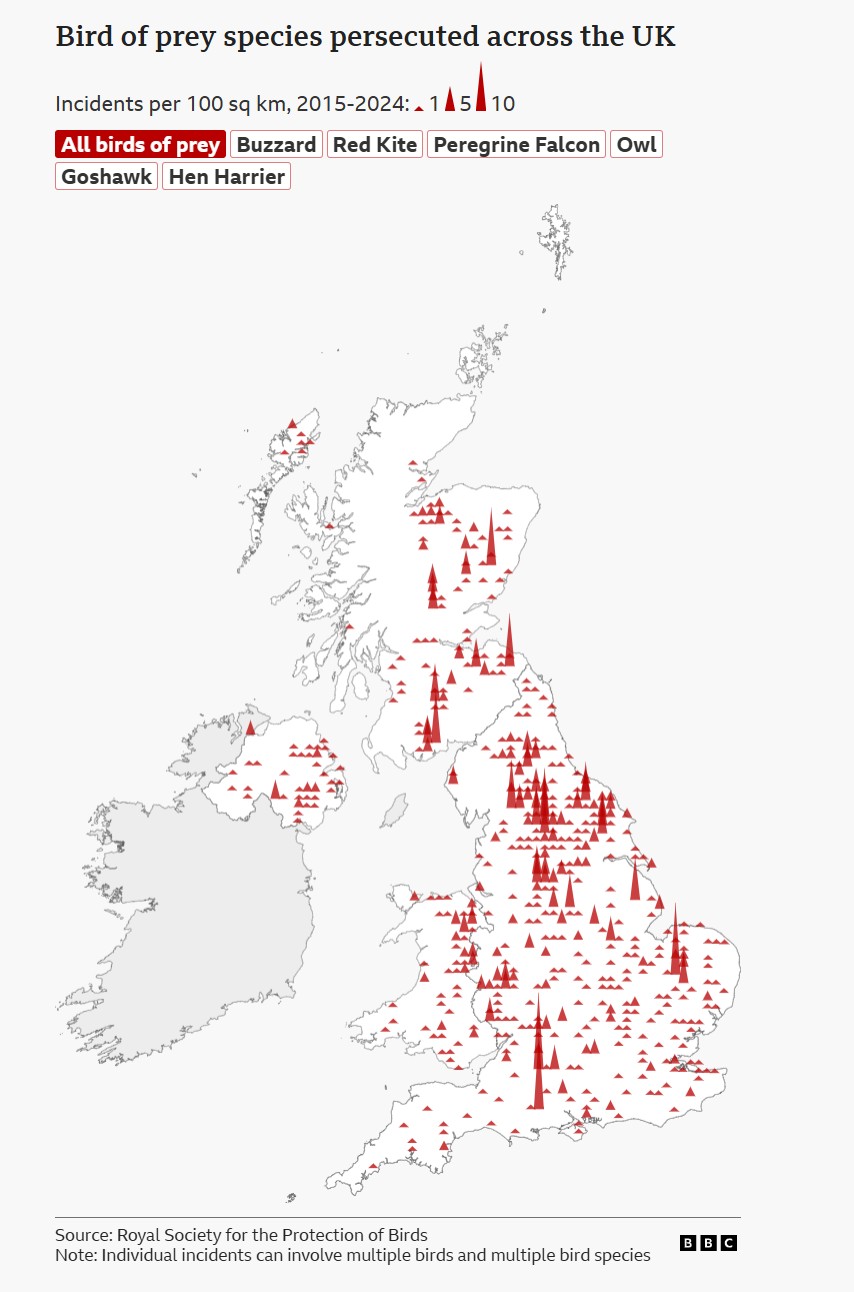
The article highlights the convictions of three gamekeepers this year: Thomas Munday, convicted after brutally clubbing a trapped Buzzard to death on a Pheasant shoot at Hovingham, North Yorkshire (here); Racster Dingwall, convicted of conspiracy to kill a Hen Harrier on a grouse moor in the Yorkshire Dales National Park (here); and Russell Mason, convicted of brutally clubbing a trapped Goshawk to death on a Pheasant shoot in Perthshire (here).
The RSPB repeats its call for all gamebird shoots to be licensed. Dr Marnie Lovejoy from the British Association for Shooting & Conservation (BASC) is cited as saying BASC opposes licensing because it ‘would add another layer of regulation to activities already covered by law and would affect everyone involved in shooting’.
It’s a strange argument, often repeated by the game shooting industry. Licensing would protect those who aren’t committing crimes and penalise the ones who are. The industry has failed, spectacularly, to rid itself of the criminals so licensing should be the very least it should expect and if they’re all abiding by the law, the threat of a licence being withdrawn/revoked shouldn’t be of any concern.
The RSPB’s latest report will be published on Wednesday morning and I’ll post a copy of it on the blog, first thing.


Of course they are still widespread…when this sort of persecution is regarded as not that important and when even if perps find themselves in court and are found guilty all they usually get is a minimal fine. The answer is obvious. Animal cruelty and murder should be severely punished….
We always need to bear in mind that this is the tip of a very large iceberg, because almost certainly most illegal raptor persecution never gets detected as it takes place in remote places with poor or no public access. So actual incidents of illegal raptor persecution are much higher than these figures. There must be very few in the industry that aren’t well aware of what is happening and personally I believe that raptor persecution is the norm. The main thing varying, being the intensity and how brazen it is. I now believe, that the whole idea of ethical shoot managers, is a fairy story. They lie so much. I am old enough to remember, the shooting industry claiming over 40 years ago, that it was only a few old school gamekeepers doing it, and as the younger gamekeepers came through, it would die out. This is establishment corruption. They could have clamped down on it decades ago. The only reason they don’t is that it is done at the behest of the most senior members of the British establishment.
All the while our pathetic judiciary hand-out nonsensical slap-on-the-wrist sentences this abhorrent slaughter of our precious raptors by sadistic murderers will continue. And it’s not like it’s not known who the likely perpetrators are.
Not helped by Keir Starmer and his Labour party who are doing nothing to help protect them; even after his election promises of protecting all wildlife and their environments. Otherwise, fox hunting in its many guises would have been outlawed and stopped by now with proper fines and custodial sentences. And it’s only been 20-years now since it was made illegal!
At the end of April I wrote to several MPs in the highlands of Scotland, where I live, asking them as part of a charity email drive, to pledge to do more for Scotland’s animals. A few, not everyone, replied to me, but one who did is the Lib Dem Sports & Culture Spokesperson, Neil Alexander. He wrote “we championed the change in the law that saw an increase in the maximum penalty for animal cruelty from 12 months to 5 years in prison”.
I replied: “I was particularly interested in your second paragraph, where you said that the Scottish Lib Dems championed the change in the maximum penalty for animal cruelty be increased from 12 months to 5 years in prison. I’m not sure if you are aware of a very recent case, whereby a gamekeeper, Russell Mason, was convicted of the very brutal and vicious clubbing to death of a goshawk on a Perthshire shooting estate?
His derisory sentence was a 200 hours community payback order, as well as being fined £890 for firearms offences.
If this wasn’t a heinous crime, then what is? I would have thought, surely, a custodial sentence should have been imposed here?
There is absolutely little point in strengthening or changing laws if they are never implemented. You are merely paying lip service”
To date, I have not received a reply.
Well done for writing Susan.
One of the problems Scotland has is having no Unduly Lenient Sentencing Scheme. There is no mechanism whereby ordinary members of the Scottish public can officially complain about the leniency of a sentence to a Government official:-(
Maybe your Lib Dem MSP would be interested in such a scheme?
I see it as a way for the Scottish Judiciary of maintaining public trust in sentencing as public opinions evolve over time.
Thinking recently about Goshawk, the forgotten reintroduction, their distribution seems almost entirely determined by game shooting – they are increasingly everywhere is larger unshot woodlands, public or private, and simply not in shot woodland. The nationally owned forests in all three countries remain their core habitat and although they are still considered ‘rare’ thats because they are hard to see – down through Wales into the Forest of Dean they are clearly at carrying capacity population.
I largely agree, one of the most interesting and clear demonstrations of this persecution is the fact that the large forests of the North York Moors are clearly at carrying capacity but the young have to cross the moorlands to find new vacant territories. Elsewhere in the region there are plenty of those vacant sites, as Goshawks are scarce breeders in the rest of North Yorkshire. That populations are not growing in the rest of the county is a clear demonstration of what happens to those dispersing young Goshawks, many of them being attracted to small woods with lots of easily taken Pheasants.
In the Yorkshire Dales Goshawks were commoner 30-40 years ago than they are now, with more shoots in almost every woodland woods that hosted Goshawks rarely do now and when Goshawks are there it is often a one off or single males with females probably shot from nests.
Nor is it just Goshawks we only have to look at the current distribution of Hen Harriers and Peregrines which are largely absent from traditional sites on shooting estates. It is not rocket science to understand why. I suspect that Peregrines are much scarcer now as upland and moorland breeders in areas of dense shooting estates than they were in the eighties when they were recolonising after the pesticide era.
Yet we are expected to believe and trust the game lobby claims of a a zero tolerance to the persecution that makes that possible. That we do not is one of the many reasons independent raptor workers are unwelcome on many estates.
I think that licensing shoots is a waste of time. Who will police them? It’s better by far to face up to the fact tlhat driven shooting relies upon artificial surpluses, whether Red Grouse in the uplands or non-native Pheasant or Red-legged Partridge in the lowlands.
Hunters elsewhere in the world cope with walked up shooting, which being fair requires genuine fieldcraft. Anyone else should make do with clay pigeos.
Unfortunately the “English driven style” of game shooting is booming in Europe and taking off in Morocco. British “Sporting Agents” are involved in this, British gamekeepers are working in those places, British “Guns” / punters are traveling out there in numbers for “sporting” holiday alternatives / to add variety to their shooting in our winter weather. Like a golf holiday in the Algarve – but with a lot more dead stuff.
Couldn’t agree more. It is just another level of impossible to police bureaucracy that achieves little. I fear the problem is the over-commerciality of driven shoots; most must produce product or customers will go elsewhere. It is also sad but true that driven shooting requires no field craft. Real one-for-the-pot hunting is more than acceptable as the founders of Wild Justice confirm. The problem arose with the Victorians and the invention of the percussion cap. I have only shot driven birds less than a dozen times to prove to myself that it is unacceptable. Never again.
“…as the founders of Wild Justice confirm”.
The founders of WJ didn’t ‘confirm’ anything – we simply expressed our personal opinions on a subject, at a particular time. That’s quite different to what you’re implying, Nick.
Fair enough. I accept it was personal opinion not corporate policy. Apologies.
“I think that licensing shoots is a waste of time.”
Almost certainly, but that is all most MPs will countenance at this moment in time (in my experience).
“Who will police them?”
The same people who currently police them, but with different powers.
Not going to change until the law starts treating the problem seriously ie. not like currently at the level of a parking offence