Millden Estate’s sporting agent signatory to ‘best practice’ scheme!

Millden Estate, the (now former) employer of depraved gamekeeper Rhys Owen Davies, sentenced to jail earlier this month for his crimes including animal cruelty and some pretty serious firearms offences (see here), is managed for gamebird shooting by a sporting agency called BH Sporting Ltd, which is owned solely by Nicholas Baikie.

Shooting estates under the management of Mr Baikie are the subject of many discussions amongst raptor workers and his name often comes up: “Oh, it’s a Baikie estate” is heard with almost as much frequency as, “Oh, it’s an Osborne estate”. I might come back to this in a future blog.

Anyway, these two individuals are associated with the management of many, many shooting estates across Scotland and England since their time at the notorious Leadhills Estate in the early 2000s. Between 2003-2006 Osborne was listed as a Director of Leadhills Sporting Ltd, a company who held the sporting rights at Leadhills. Baikie is reported to have been one of his gamekeepers before apparently training as a land agent under Osborne (according to this court document) and then setting up his own consultancy on grouse moor management, including taking on Millden Estate in the Angus Glens, which has been on Baikie’s books now for many years.

For someone in such high demand in the grouse-shooting world, Baikie keeps a relatively low online profile.

Now, according to the website of British Game Assurance (formerly the British Game Alliance but rebranded in the last year), BH Sporting is one of a number of sporting agents that have:

COMMITTED TO A GOAL OF OFFERING SPORTING DAYS EXCLUSIVELY ON SHOOTS AND ESTATES THAT ARE MEMBERS OF THE BRITISH GAME ASSURANCE FROM THE START OF THE 2023 SEASON. THIS WILL ENSURE THAT THE PROMOTED VENUES ARE ALL PARTICIPATING IN THE INDEPENDENTLY AUDITED ASSURANCE SCHEME, DEMONSTRATING THAT THE SHOOTING SECTOR IS ADHERING TO BEST PRACTICE AT ALL TIMES‘.

Shurely shome mishtake?

How can BH Sporting (or its sole director, Nick Baikie), be certain that any estate on which it offers shooting ‘is adhering to best practice at all times’?

This is the sporting agency that failed to notice the ‘obvious injuries‘ (quote from the Crown Office) to five of gamekeeper Davies’ dogs. Here’s a photo of two of those mutilated dogs, tied to what looks like an estate vehicle. Pretty hard to miss, I’d say:

This is also the sporting agency that failed to notice the very serious and reckless firearms offences committed by Davies at his tied cottage on Millden Estate.

This is also the sporting agency that failed to notice the three bags of dead raptors reportedly found on Millden Estate during a joint SSPCA/Police Scotland raid in October 2019 and apparently containing at least three shot buzzards.

This is also the sporting agency that failed to notice the ‘horrendous catalogue‘ of wildlife crimes uncovered over many years on Millden Estate (for which Millden Estate has repeatedly denied responsibility and for which nobody has ever been prosecuted).

Funny, all these things this sporting agency failed to notice and yet Nick Baikie was reportedly invited to show around Professor Werritty and co during the Govt-commissioned Werritty Review into grouse moor management, where Millden Estate was held as an example of ‘best practice’. Whose idea was that??!

And now we’re supposed to accept that as from the 2023 shooting season, BH Sporting will only offer shooting on estates that have demonstrated ‘best practice’? What due diligence has the British Game Alliance done on this?

Is Millden Estate registered as a British Game Assurance member? We don’t know, because the names of all the BGA-endorsed shoots were removed from the BGA website several years ago, resulting in criticism of the BGA for its lack of transparency and accuracy (here), two fairly important commodities when you’re asking the public to trust your brand, I’d have thought. But maybe that’s just me.

I’m sure it won’t be the last criticism of the BGA. In fact I know it won’t be the last, because there’s another sporting agent listed on the BGA website whose presence undermines the entire credibility of the BGA and what it claims to represent. More soon.

Millden Estate – plausible deniability or wilful blindness to gamekeeper Rhys Owen Davies’ crimes?

Further to the conviction and jailing of Millden Estate gamekeeper Rhys Owen Davies earlier this month for his crimes involving animal cruelty and firearms offences (see here), there’s been quite a lot of commentary about the role of the estate.

In the media coverage I’ve read on this case, an unidentified spokesman for Millden Estate has commented as follows:

The estate does not condone or tolerate any illegal activity relating to the welfare of animals or wildlife.

We were shocked to learn of all the allegations when they came to light.

The employee involved was suspended by the estate with immediate effect and resigned a few days later when the police investigation was still at an early stage. At no stage was the estate itself the focus of the investigation. These offences did not take place on the estate but happened at locations some distance away and unconnected to the estate“.

I want to examine the plausibility of the estate’s denial.

First of all, of course the estate is going to state that it ‘doesn’t condone or tolerate any illegal activity relating to the welfare of animals or wildlife‘. It’s hardly going to say, ‘Oh yes, officer, we encourage all our employees to break the law and inflict sadistic cruelty on wildlife‘, is it?! And I would imagine, given the potential for a vicarious liability prosecution for raptor persecution these days, an estate of this size and prominence will have all its paperwork in order (e.g. statements in its employees’ contracts, evidence of on-going training etc) that it could produce to defend itself if an employee was caught committing wildlife crime.

This sort of paper trail is now commonplace on Scotland’s large shooting estates and has been encouraged by various shooting organisations who have provided advice (e.g. BASC here, Scottish Land & Estates here) and in some cases training (e.g. GWCT here). Ironically the document produced by SLE on vicarious liability acknowledges the help of someone believed to be linked to the sporting management of Millden Estate!

Whilst arse-covering paper audits might convince the authorities, what actual effect does it have on the activities of an estate’s employees?

Very little, judging by the criminality undertaken by gamekeeper Rhys Owen Davies, working on a estate that has a ‘horrendous catalogue‘ of wildlife crimes according to Alan Stewart, a former Police Wildlife Crime Officer who’s patch included the Angus Glens.

But the spokesperson from Millden Estate said: “We were shocked to learn of all the allegations when they came to light”.

How plausible is that? How plausible is it that Rhys Owen Davies’ injured and scarred dogs, kennelled next to his cottage on the estate, weren’t seen by any of the estate’s other employees, including the multiple gamekeepers he worked alongside, for the 18 month period when he was using the dogs to inflict sadistic cruelty on foxes and badgers?

In my opinion, that’s pretty implausible. Have a look at this photograph of two of Davies’ mutilated dogs. It was published in the Daily Record and appears to show the dogs tethered to a vehicle that it would be reasonable to assume is a work vehicle:

In court, Davies’ defence barrister told the Sheriff that the dogs’ injuries were as a result of lawful ratting and foxing, which are part of a gamekeeper’s regular duties. It seems implausible to me that his work colleagues didn’t notice these injuries or that the extent of the injuries didn’t raise any suspicion as to their cause. They’d also know, I’d argue, that Davies wasn’t seeking professional veterinary advice on the treatment of those injuries.

Gamekeeping duties often involve the use of the keepers’ own dogs and the multiple gamekeepers employed on Millden Estate would have had ample opportunity to see Davies’ dogs at work and to ask him about what the Crown Office described as ‘obvious injuries’. Any concerns could have been raised with the Head Gamekeeper and /or the sporting agent / estate Factor.

The estate’s statement also included the line:

At no stage was the estate itself the focus of the investigation. These offences did not take place on the estate but happened at locations some distance away and unconnected to the estate“.

The estate WAS the focus of the investigation as the search warrant included a provision to search various sites on Millden Estate looking for evidence of badger sett disturbance. And Davies’ tied cottage and associated outbuildings on the estate were also searched, under warrant, where a number of serious firearms offences were uncovered, specifically, an unsecured Benelli shotgun was found propped up against a wall near the front door; two unsecured rifles were also found: a Tikka .243 rifle on the sofa and a CZ rifle in the hall cupboard next to the open gun cabinet;  and an assortment of unsecured ammunition was found including 23 bullets in a pot on the floor, five in a carrier bag behind the front door and one on top of a bed, according to a statement by the Crown Office.

As Davies was employed as an under-keeper, I’d argue that Millden Estate should bear significant responsibility for these serious breaches on the estate of shotgun & firearms legislation. Where was the supervision from Davies’ immediate supervisor, the Head Keeper? Davies’ estate cottage was unlocked and unattended when the SSPCA and Police Scotland arrived to execute the search warrant. Imagine who else could have walked in, found those firearms, shotgun and ammunition. If, as we’re led to believe by the shooting industry’s propaganda machine, that most if not all illegal behaviour on sporting estates is perpetrated by ‘unknown criminals’ totally unconnected to the estate, you’d think that the security of firearms, shotguns and ammunition would be of uppermost importance, wouldn’t you?

You can draw your own conclusions, of course, but it’s my opinion that Millden Estate’s efforts to distance itself from having any knowledge of Davies’ crimes are predictable but implausible. Especially after I’ve recently learned that there was another investigation into alleged badger baiting on this estate about 13 years ago; an investigation that didn’t go anywhere because apparently the procurator fiscal at that time refused to advance the case.

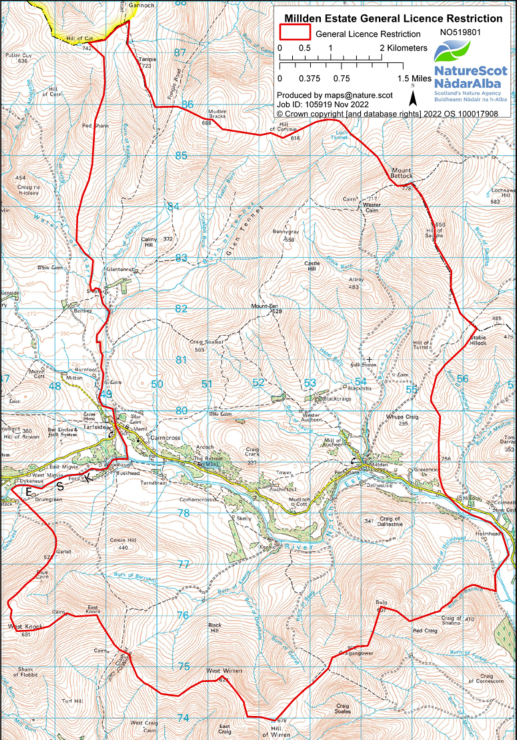
As for the bags of dead raptors found during the search in October 2019 at three different locations on the estate, and reportedly containing at least three shot buzzards, we now know that the Crown Office is not pursuing a prosecution (although the detailed rationale for this decision has not been divulged, see here) which means that Millden Estate will avoid a prosecution for alleged vicarious liability. I wait with interest to see whether NatureScot imposes a General Licence restriction in relation to the discovery of these dead raptors.

Sparrowhawk shot and another suspected shot – Police & SSPCA investigate

Police Scotland and the Scottish SPCA have launched an investigation after the confirmed shooting of a sparrowhawk and the suspected shooting of another, found in the same area of Renfrewshire in April, one week apart.

The following article is from the Daily Record (dated 15th July 2022):

Two birds of prey ‘shot dead’ in Renfrewshire as probe launched.

Animal welfare chiefs say they suspect that two birds of prey have been shot dead in the space of a week.

The Scottish SPCA is working with Police Scotland as they look into the incidents after a firearm was confirmed as being used in one of the Sparrowhawk’s death.

One bird had to be put to sleep, while another was found dying with suspicious injuries which the SSPCA believe may be linked. A bird initially thought to have been stunned was found on Lochwinnoch Golf Course, Renfrewshire, on April 5 but its injuries were unsurvivable.

An undercover Scottish SPCA special investigations unit inspector said: “It was initially thought that the bird had been stunned but upon examination at the Scottish SPCA National Wildlife Rescue Centre in Fishcross, it was discovered that they had been shot.

This caused a catastrophic shoulder injury and sadly resulted in the bird having to be put to sleep.

Another member of the public also reported finding another sparrowhawk the week before, which was bleeding from the wing. Unfortunately, that bird died before help could be called for.

It is unknown if they had also been shot but it’s certainly very suspicious that two sparrowhawks with similar injuries were found in the same area only a week apart.

We are working closely with Police Scotland to establish the circumstances around the bird’s injuries due to the use of a firearm in the incident.

We would like to find out what happened to this sparrowhawk.

If anyone witnessed anything or has any information they feel may be relevant they can contact our confidential animal helpline on 03000 999 999 or Police Scotland on 101, quoting incident number KB01540722 of 5 April 2022.”

ENDS

No prosecution for shot raptors found on Millden Estate, Angus Glens

On 8th October 2019, the Scottish SPCA executed a search warrant with Police Scotland on various properties on Millden Estate in the Angus Glens looking for evidence of animal cruelty and animal fighting, including badger baiting, after 58 gruesome photographs were reportedly sent to a printing shop in England by a Millden Estate employee.

Millden Estate is known for its grouse shooting (having been described in a sales brochure in 2011 as being ‘The Holy Grail‘ of grouse moors and ‘One of the finest sporting estates in Scotland‘) The estate also hosts pheasant and partridge-shooting on its low ground.

Millden Estate has also been described as a ‘savage, stripped, blasted land‘ by author and photographer Chris Townsend (here).

Millden Estate gamekeepers, along with others in the Angus Glens, have previously been feted by senior politicians, including former Cabinet Secretary for Rural Affairs, Fergus Ewing MSP, former Minister Graeme Dey MSP, and by Prince Charles who was photographed with Millden keepers as he opened a tweed workshop in Beauly in 2019.

Millden Estate was also visited by Professor Werritty and his colleagues in 2018 during the review of grouse moor management; they visited the estate apparently to see an example of ‘best practice for managing grouse moors’.

The estate, one of a number in the Angus Glens, is also long- known amongst conservationists as a raptor persecution hotspot after the discovery of poisoned and shot buzzards in 2009 and 2011 (here), a poisoned golden eagle (Alma) in 2009 (here), and a satellite-tagged golden eagle seemingly caught in a spring trap and then apparently uplifted overnight and dumped on Deeside with two broken legs & left to die (here). Nobody has ever been prosecuted for any of these alleged offences and Millden Estate has denied any responsibility.

In October 2019 during the morning raid at Millden Estate the SSPCA did find evidence of animal fighting and cruelty, including badger baiting, and after two and a half years of protracted legal process, in May this year 28 year old gamekeeper Rhys Owen Davies was convicted of a number of animal cruelty, animal fighting, and firearms offences: (for previous blogs on this case see here, here, here, here, here, here, here, here, here, here, here). Davies is due to be sentenced on Monday.

Other evidence of alleged wildlife crime was also uncovered during that search of Millden Estate back in October 2019, including the discovery of a number of dead raptors wrapped in bags at at least three separate locations, apparently including at the residences of two estate employees.

Whilst the SSPCA led on the investigation into animal cruelty/animal fighting, Police Scotland led on the investigation into the dead raptors (because the SSPCA don’t, yet, have the powers to investigate cases where a wild animal is already dead – bonkers, I know – see here for the background on this).

I have spent the last two and a half years chasing Police Scotland about these dead raptors and asking for status updates on the investigation. I have to say I’ve been summarily unimpressed. The investigation has been conducted at a snail’s pace and communication has been dire. I understand that the dead raptors all underwent post mortems and it was determined they’d been shot. No information has been provided about the number of species involved (although it’s been reported that some were buzzards), nor the number of individuals confirmed to have been shot, although I know of at least three.

Earlier this week I asked the Crown Office & Procurator Fiscal Service (COPFS) about this case and whether it was progressing (i.e. has anyone been charged?). To its credit, the COPFS response was fast, but the case outcome familiarly frustrating:

The Procurator Fiscal received a report relating to a 28 year old male and incidents said to have occurred between 1 January 2019 and 8 October 2019. After careful consideration of the facts and circumstances of the case, including the available admissible evidence, the Procurator Fiscal decided that there should be no proceedings taken at this time. The Crown reserves the right to proceed in the future should further evidence become available‘.

I doubt we’ll ever be informed about the extent of the raptor persecution uncovered (even now, nearly three years after the raptor corpses were found, Police Scotland has failed to issue any press statement) and we’ll certainly not learn any more detail about why charges weren’t brought because the COPFS is not obliged to inform the public about its decision-making process. Apparently transparency doesn’t apply.

To be fair, a prosecution would depend on an individual suspect being identified but there are multiple employees at Millden Estate (16 were listed in the estate’s sales brochure in 2011) and a recent photo on social media suggests there are multiple gamekeepers (there’s a photo online showing 13 men dressed as gamekeepers in Millden Estate tweed at the start of the 2020 grouse season).

I think it’s fair to say that any employee could have the motivation, means and opportunity to commit wildlife crime – we now know that at least one of them, Rhys Owen Davies, was doing exactly that, apparently right under the noses of his colleagues and bosses on Millden Estate – but just having the motivation, means and opportunity isn’t sufficient evidence for a criminal prosecution. Having a carrier bag full of shot raptors at your house isn’t enough for a court of law to convict, although if there was a bag of dead raptors at my house I’m pretty sure I’d notice them and I’m pretty certain I’d have notified the police.

So where does that leave us? We await the sentencing of gamekeeper Rhys Owen Davies on Monday but I don’t expect any of us have high hopes for a fitting sentence.

Millden Estate must surely now qualify for a General Licence restriction, a monumentally ineffective sanction but the only thing left on the table until the Scottish Government pulls its finger out and introduces the licensing scheme it promised to develop in November 2020.

But even if the authorities do decide to impose a General Licence restriction on Millden Estate, that won’t curtail the estate’s ability to continue to host grouse, pheasant and partridge shoots. The estate, which is run through a series of companies and limited liability partnerships (LLPs), including one called Millden Sporting LLP, reported tangible assets in 2021 of £17.5 million.

That’s a lot of money, and with it comes a lot of influence.

UPDATE 30th August 2022: 3 shot buzzards found on Millden Estate – confirmation from Police Scotland (here)

Grouse moor estate in Nidderdale with history of wildlife crime to be rewilded

A grouse moor estate in Nidderdale with a history of wildlife crime is set to be rewilded, according to an article in the Telegraph and Argus.

In May 2017, the RSPB’s investigations team filmed two armed individuals, dressed like gamekeepers, appearing to shoot at a nesting Marsh harrier and then apparently removing eggs from the harrier’s nest on Denton Moor (see here). Despite a thorough investigation by North Yorkshire Police, nobody was ever charged for these alleged offences.

[Screengrab from RSPB covert video of two armed men at a Marsh harrier’s nest on Denton Moor]

In February 2019, gamekeeper Austin Hawke was convicted at Skipton Magistrates Court for an offence relating to the death of a badger caught in a snare on the same grouse moor on 28th May 2018. Hawke was found guilty of failing to check the snare contrary to section 11 of the Wildlife & Countryside Act (see here).

In March 2019, the owners of Denton Moor (an engineering company called NG Bailey) announced it would not be renewing its grouse-shooting lease following the spate of wildlife crime (see here).

And now the estate owners, brothers Cal and Nick Bailey, have announced an ambitious rewilding project for the estate, according to an article in last week’s Telegraph & Argus (here). The article is reproduced below:

THE two brothers behind an ambitious plan to transform the Denton Hall estate into an exclusive hotel and rewilding project have outlined their ideas for the scheme – and vowed they want to take the local community with them on their journey.

Cal and Nick Bailey are members of the family which set up the huge NG Bailey engineering company and are shareholders in the business.

Denton Hall was bought by NG Bailey in 1976 and the Grade I Georgian Listed building has been used as offices and a wedding and events venue.

The Bailey brothers are in the process of buying the building and its 2,500 acres of land from the company to realise their dream of helping to combat climate change.

It is also something of a home-coming for Cal and Nick, who grew up in the house and roamed the estate’s moorland and woods in the 1970s.

Although the sale is still in the process of going through, the idea is that developing the house into an exclusive boutique hotel will help finance the wider project – turning the estate into a model of biodiversity and regeneration that will be a flagship scheme driving climate change-combatting measures.

At Denton Hall, which from its elevated position looks out over the greater Ilkley area, Cal Bailey says: “The climate crisis is real and nature in the UK and the wider world is seriously under threat.

“There’s a phrase ‘think global, act local’ and what that means for us is taking this opportunity which we are lucky enough to have to buy this estate and realising our three major goals of making a positive contribution in terms of three major areas, carbon, nature and food.”

Their plans are well-thought out and hugely ambitious, and they appreciate that there might be some misgivings among local people, particularly in the close-knit Denton village community neighbouring the estate. But they are determined to allay any fears about the development.

Cal says: “We are very keen that people in the area hear what we are saying and planning. There have been a few voices against our plans, but the overwhelming number of people have been supportive.

“It’s an exciting opportunity and there’s obviously a long way to go. The way we get there is as important as where we get to so we are absolutely determined to get to the end point but we want to take people with us, otherwise, what’s the point?

“We have tried to lean over backwards to share our vision with people because it’s really important that local people are on this journey with us.

“In every example I’ve seen of rewilding or any similar initiative up and down the country, when local people begin to understand what’s happening and begin to feel part of it, they recognise something special is happening and want to be a part of it.”

But what exactly is going to happen on the Denton Park estate? Over to Nick Bailey, to outline the main points of their plan.

Nick says: “We’ve set ourselves a 30-year horizon because with the best will in the world things change. NG Bailey took over the estate in 1976 and started developing what had been a neglected farm, and 50 years ago they had a very different vision and no doubt visions change so they didn’t think too far ahead.

“So one of the things that struck me was that over no other issue almost ever in history had scientists universally agreed, quickly, the climate crisis and the biodiversity challenge is real.

“So anyone who doesn’t face up to that is like a flat earth group. Scientists describe it and come up with suggestions, governments incentivise it and legislate around it, but it’s people who implement change and that’s what we want to do.

“Our aim here is to create an estate that can balance nature with carbon and with food and that can make as full a contribution as it has the capability to do in each of these three areas.”

So what will that mean in practice? Well, there are several schemes that the brothers want to put into motion over the next few years.

* The Moorland — Peat in good condition is one of the best things to sequester carbon but if it’s in poor condition it can contribute to carbon in the atmosphere, so one of the major projects will be to come up with a restoration plan for the Denton Park moorland peat.

* A Hundred Acre Wood – The brothers are working with the White Rose forest organisation to plant something like a thousand trees per acre, on average, which they are hoping to get underway by November.

* Additives – Their farm manager James Bush is looking at ways to reduce all chemical additives used on the land, whether fertiliser, herbicides or pesticides.

* Food partnerships – They want to utilise the land for growing and rearing food and providing local food producers and breweries with the raw materials so that their products are completely locally sourced. This includes fruit and vegetables, meat, and raw materials for alcohol production.

* A Tree Nursery – This would enable them to develop and grow the best varieties to help with the rewilding of the whole site.

* Bees – a mixture of hives and schemes to attract wild bees, which are essential to biodiversity, and also with a view to producing the estate’s very own honey.

* Grazing land – at the moment there are deer and sheep on the land, but they are looking at reintroducing cattle and possibly pigs to have a stronger mix and also provide food production as well.

* A Walled Garden – There’s already one there that has a history of growing food on the estate, and bringing that back into use is part of the plans.

* Water management – This is a hugely important part of the plans. Some 9.5 million tons of rain fall on the estate each year so proper management of the land will help to cut back on potential flooding further down the valley.

These are just some of the plans in the pipeline, and the Bailey brothers are consulting with a wide range of experts and organisations to look at how to put them into practice and to develop new and exciting ideas to help the estate be a model of biodiversity and rewilding.

Cal says: “We have this amazing opportunity to put our beliefs into practice on a bit of land in England that we can buy and manage. Because we have this opportunity and the fundamental belief that the world is in crisis, this is something we want to do.

“Does this mean we are experts in land restoration and farming? Not at all. I’m an accountant by training, a businessman who’s running factories. Nick is an engineer, but he’s been a teacher.”

Nick adds: “I’ve restored a couple of buildings in the past but not to this scale. This is a chance to play and learn, if you like, but I think so many things in my life have given me so much to bring to this project.

“So, no, we don’t have all the skills that we need, we’ll need the help of a lot of other folk. But we want to see our three goals of carbon reduction, food production and nature brought together in one vision on this estate. And the way we will fund it is hopefully bringing visitors to the estate who will stay here.”

It’s a long-term project, though, and the brothers know that. But they want to get local people onside to help them realise this dream.

Nick says: “There will be loads of opportunities for people to get involved and they won’t come all at once, even though people are battering the door down now, but over the next five or 10 years more and more people from the local community will become involved with the projects here, and hopefully inspire more and more people and it will be something for Ilkley to be proud of.”

ENDS

Investigative journalists discover more evidence of alleged raptor persecution on Queen’s Sandringham Estate

Investigative journalists from The Guardian newspaper have uncovered more evidence of alleged raptor persecution crimes, not previously reported, at the Queen’s Sandringham Estate in Norfolk.

They’ve also uncovered documents which reveal that the police have to seek the Queen’s permission before they are allowed to enter the estate and search for evidence if alleged wildlife crimes are suspected / have been reported.

Long-term blog readers will know that this royal estate has been at the centre of a number of police investigations into alleged raptor persecution, (e.g. see herehereherehere, here), including the most notorious incident back in 2007 where witnesses observed two hen harriers being shot over Dersingham Bog at the same time that Prince Harry, his mate William van Cutsem (whose Hilborough Estate is currently under police investigation for alleged raptor persecution), and an estate gamekeeper were out duck-shooting. No-one was charged, as with all the other reported incidents except one in 2005, where an estate gamekeeper was convicted for pole-trapping a tawny owl next to a pheasant pen (see here, page 3).

However, it now appears that at least two other raptor persecution incidents on the estate have been kept under wraps for years – a poisoned red kite found in 2006 and a dead Marsh harrier (cause of death not given) found on the estate border in 2007 – according to documents published on Friday by The Guardian – the article is well worth a read, here.

Why has it taken 16 years for these raptor persecution incidents to become public knowledge? And given the timings, wouldn’t it have been pertinent for them to have been in the public domain at the time that Prince Harry, his ‘high society’ mate van Cutsem, along with an estate gamekeeper, were all under police investigation into the alleged shooting of two hen harriers in 2007?

It’s no wonder ‘nothing was found’ during the police investigation into those alleged shootings, given that the police weren’t allowed on site until the following morning.

And surprise, surprise, none of the investigating authorities want to comment on any of these latest revelations. Too scared and too obsequious.

There is a follow-up article in today’s Guardian (here), including quotes from me about these very shady processes that amount to what I would call a massive cover-up.

Well done to journalists Sev Carrell, Rob Evans and David Pegg for having the balls to challenge this nonsense.

Raptor persecution “hasn’t been a problem for years”, claims Scottish Gamekeepers committee member

There was a jaw-droppingly half-baked article published in The Courier last week, featuring commentary from a Scottish gamekeeper.

Bob Connelly, who is reportedly a Committee member of the Scottish Gamekeepers Association (SGA), had been speaking at the Scottish Game Fair and the Couriers environment journalist Scott Milne took the comments at face value and wrote the following article, which has to be read to be believed.

People will not realise the importance of land management and the shooting industry until campaigners force the end of the sector.

That is the view of gamekeeper Bob Connelly, who works in an estate in north east Perthshire.

Bob was speaking at the Scottish Game Fair, which took place in Scone over the weekend.

The Scottish Government is preparing legislation that could see gamekeeper grouse shooting licenced.

This has come after a campaign by animal rights advocates [Ed: he’s referring to this blog!] releasing evidence which appears to show wildlife crimes such as raptor persecution and misuse of traps.

The theory goes that predators such as buzzards and hen harries are killed in order to protect grouse, which brings in a lot of money during shooting season.

ARE GAMEKEEPERS VICTIM OF A HATE CAMPAIGN?

Bob feels much of this evidence has been manufactured as part of a “malicious” campaign to turn public opinion against gamekeepers and the shooting industry.

He said: “They want to get rid of us.

“But people don’t understand what we do and why we do it.”

A case in point is the controversial practice of heather burning.

It has been criticised as unnecessary and potentially damaging to peatland, which can release large swathes of carbon.

But Bob has a different perspective.

“You have to accept that there are going to be fires in places like that if you let it overgrow.

“So if it’s inevitable, do you want to have a controlled fire or let a wild one get out of hand?

“That would be even more damaging.”

Bob also feels it’s important gamekeepers are allowed to control predator populations in order to protect smaller species.

He said: “What we do is we build it from the ground up. We make sure the right environment is in place for insects and other small species and then bigger ones can naturally thrive on top of that.

“There’s more and more red-listed birds. If you want to protect them, it’s important to control predators such as foxes and buzzards.

“There’s a lot of people who have been manipulated to feel a certain way on social media, but don’t fully understand what we do.

“They’ll will miss us when we’re gone.”

WILL LEGISLATION CHANGE THINGS?

Bob thinks the upcoming gamekeeper shooting legislation is not needed.

“There is already rules surrounding things like traps. I can’t see how it can be legislated anymore.

“Yes, there were problems in the past with raptor persecution and things like that.

“But if you discount one or two recent examples, it hasn’t been a problem for years.”

GAMEKEEPERS AND LAND MANAGERS ARE WORRIED

Tim Baynes is director of moorland with Scottish Land and Estates.

Also speaking at the Scottish Game Fair, he said many gamekeepers and land managers he knows are worried for their jobs.

“A lot of these people have a very specific skillset that has come down from generations.”

Tim wouldn’t go as far as Bob and say anti-shooting campaigners have adopted “malicious” practices, but he does feel they “have an agenda”.

“They want to remove shooting.

“But they are not involved in it or in managing land so they are coming at it from a different perspective.”

Tim hopes the shooting industry can work with politicians to have legislation that works for everyone.

However, he is concerned that last-minute changes might be brought in that would work against their favour.

“At the end of the day, we have to work with the government that has got the votes.

“There are people within the government who are pragmatic about the industry.

“But it can be difficult for them to publicly say so.”

ENDS

The level of idiocy in this article is quite staggering, even for an SGA committee member. I guess it’s what we’ve come to expect from the SGA though, who have been in denial about the extent of these crimes for at least the 12 years I’ve been writing this blog and probably for years prior to that, as their standard response to the most glaring of truths.

And it is that level of idiotic denial, combined with ongoing raptor persecution and the SGA’s inability to influence those within the shooting industry who continue to commit these disgusting wildlife crimes (e.g. see here, here, here, here, here), that has brought about the Government’s decision to introduce a grouse shooting licensing scheme.

That decision wasn’t based on so-called ” manufactured evidence“. It was based on the number of raptor corpses found dead and mutilated on game-shooting estates over many, many years, including poisoned eagles found on grouse shooting estates even inside our National Parks for God’s sake, combined with the massive weight of incontrovertible scientific evidence that all points to an outright refusal to abide by the law by many members of the game-shooting industry.

It’s not the fault of this blog, nor the fault of the many other campaigners who have been fighting against this abuse of our raptors for decades. The blame lies entirely, and obviously, with the criminals.

Red kite shot in Wiltshire: Police appeal for information

A public appeal for information from Wiltshire Police Rural Crime Team (14th June 2022):

Information appeal

A dead kite was recovered from a public footpath close to Hens wood, Axford, Wiltshire on the 20/04/2022 following a report from the public. Further forensic work into the cause of death has found that the bird had been shot.

We are appealing for any information around the shooting of the Red kite or any person who may have been in the area on the 16/04/2022 who saw anything suspicious to contact the Wiltshire Rural crime team via 101 – quote crime report 54220038890

Another gamekeeper convicted for poison offences on a pheasant shoot, but not charged for poisoned kite & shot buzzard

David Matthews, a gamekeeper with 50 years experience, has been convicted at Wrexham Magistrates Court for poison offences uncovered on the McAlpine Estate in Llanarmon Dyffryn Ceiriog, North Wales, where he has worked for 25 years.

In February 2021 a dead red kite was found on the estate by a member of the public and a later toxicology analysis revealed it had been poisoned with Bendiocarb.

[The poisoned red kite. Photo by RSPB]

When RSPB Investigations Officers subsequently visited the McAlpine Estate they found a dead buzzard inside a pheasant release pen. When the body was x-rayed, a piece of shot could be seen lodged in the bird’s skull.

[The shot buzzard found inside the pheasant release pen. Photo by RSPB]

A multi-agency search in October 2021 by North Wales Police, the Welsh Government, RSPB and the National Wildlife Crime Unit uncovered an unlocked barn containing 18 highly toxic products, including Cymag which has been banned since 2004. They also found the remains of a pheasant, inside a game bag on a bonfire site inside a pheasant release pen. The pheasant tested positive for Bendiocarb. Another dead buzzard was too badly decomposed to be tested.

Gamekeeper Matthews pleaded guilty to one charge relating to the possession of unauthorised pesticides. He received a total fine of £219.

You can read the full details of this case on the RSPB’s blog here.

In that blog, the RSPB state, ‘It remains unknown who killed the buzzard and the kite‘.

I’m pretty sure that the RSPB investigators, just like the rest of us, have a pretty good idea who might have been responsible but presumably there was insufficient evidence to charge anyone. Such is the nature of this game that it would be libellous to suggest a suspect.

It seems odd to me, though, that a gamekeeper who had worked on the estate for 25 years wouldn’t have noticed someone laying poisoned baits, placing the bait inside a game bag and leaving it on a bonfire site inside a pheasant release pen, and shooting dead a buzzard and leaving its corpse inside a pheasant release pen.

His £219 fine makes a total mockery of the system. Had this case been in Scotland, the fine for possessing an unauthorised poison would now be £40,000. That’s a serious deterrent.

£219 is not.

This is the reality and I’ll be reminding DEFRA Minister Lord Benyon of this the next time he repeats the Westminister Government’s tediously predictable claim that raptor-killing criminals face ‘significant sanctions…including an unlimited fine and/or a six month custodial sentence‘ (e.g. see this from Environment Minister Rebecca Pow in September 2021, and this from Richard Benyon in February 2022, and this from Rebecca Pow in February 2022, and this from Richard Benyon in April 2022).

Matthews is the 7th gamekeeper to be convicted in seven months across England, Scotland and Wales. There are still multiple cases pending court in the coming months. Clear evidence then that the game-shooting industry’s supposed ‘zero tolerance’ policy towards raptor persecution is simply just rhetoric and that the Government’s so-called ‘significant sanctions’ are complete bollocks.

The other convicted gamekeepers in recent months are:

Gamekeeper Shane Leech who was convicted in November 2021 for firearms and pesticides offences after the discovery of a poisoned buzzard found close to pheasant-rearing pens in Lakenheath, Suffolk (here);

Gamekeeper Peter Givens who was convicted in November 2021 for causing the death of a goshawk and a barn owl which starved to death in an illegally-operated trap on the Cathpair Estate in the Scottish Borders (here);

Gamekeeper Hilton Prest who was convicted in December 2021 for causing a sparrowhawk to starve to death in an illegally-operated trap in Cheshire (here);

Gamekeeper John Orrey who was convicted in January 2022 for battering to death two buzzards he’d caught in a cage trap on a pheasant shoot in Nottinghamshire (here);

Gamekeeper Rhys Davies from the Millden Estate in the Angus Glens, Scotland, who was convicted in May 2022 for animal cruelty relating to badger baiting (he’ll be sentenced at the end of June – here);

Gamekeeper Archie Watson who was convicted in June 2022 for raptor persecution and firearms offences after he was filmed throwing 8 dead raptors down a well on a pheasant-shoot in Wiltshire (here).

Well done to the multi-agency search team involved in bringing David Matthews to court.

Gloucestershire Police appeal for info after goshawk found shot in Forest of Dean

Press release from Gloucestershire Constabulary (13th June 2022)

Appeal for information after birds of prey are found dead in the Forest of Dean

Officers are appealing for information after two birds of prey were found dead in the Forest of Dean.

A Goshawk and Sparrowhawk were found next to a bus stop just south of Aylburton near Lydney on the A48 by a member of the public on Monday 25 April.

The male Goshawk was just under 17-years-old and X-rays show that the bird had been shot with a shotgun.

The cause of death has not yet been established for the male Sparrowhawk however post mortems will take place for both birds. 

[The shot goshawk. Photos via Gloucestershire Constabulary]

PC Cath McDay said: “This is an awful crime under the Countryside and Wildlife Act 1981, to truly special birds

The Goshawk had managed to live to an exceptional age only for his life to be ended like this.”

Enquiries are ongoing and investigating officers are asking anyone with information on the incident to please get in contact.

Information can be submitted by completing the following form online and quoting incident number 130 of 25 April: https://www.gloucestershire.police.uk/tua/tell-us-about/cor/tell-us-about-existing-case-report/    

Alternatively, you can call 101 and quote the same incident number or speak to Crimestoppers anonymously on 0800 555 111.

ENDS