
The illegal poisoning of Scottish raptors continues

The government-funded organisation Science and Advice for Scottish Agriculture (SASA) has just published its latest report on the illegal poisoning of wildlife, including raptors, in Scotland during 2009.

Of 166 reported incidents of suspected poisoning, 36 were categorised as ‘abuse’ of pesticide use. As in previous years, a high proportion (61%) of abuse incidents involved birds of prey. Carbofuran was once again the most common pesticide detected, even though the UK approval for use of products containing this chemical expired in 2001 and it is a criminal offence to own it.

22 abuse incidents involving 30 raptors were confirmed:

Buzzard = 22; Golden eagle = 2; White-tailed eagle = 1; Tawny owl = 1; Red kite = 4.

The regional breakdown of abuse incidents demonstrates once more the widespread nature of these crimes:

Borders = 5 incidents; Dumfries & Galloway = 1; Grampian = 1; Highland = 2; Strathclyde = 3; Tayside = 10.

The report does not include other incidents of illegal raptor persecution such as shooting, trapping and nest destruction.

In an article published in the Press & Journal, Chairman of the North-East Raptor Study Group, Rab Rae, stated the obvious: “Pesticides are used regularly by the farming community but they are now being used by the shooting fraternity. It is not an accident, it is deliberate to enhance grouse moors“.

In a rebuttal, Chairman of the Scottish Gamekeepers Association, Alex Hogg, said: “The RSG and all their members are well aware that we condemn any poisoning of wildlife. Our organisations are working towards finding solutions to the problem so it’s hardly helpful or constructive to point accusatory fingers while that process continues“.

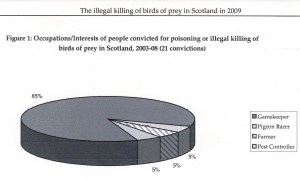
So tell us Alex, what exactly has the SGA done in its efforts to “work towards finding solutions” to the continuing illegal killing of Scottish raptors? It could legitimately be argued that sitting on the largely ineffective Partnership for Action Against Wildlife Crime (PAW) committee is a good cover for paying lip-service to raptor conservation. Talk is cheap – what ACTIONS has the SGA taken to stop criminal activities? And no, trying to legalize the killing of protected species by asking the Scottish government to provide licences to kill raptors doesnt count! According to the latest figures from the RSPB (in their report The Illegal Killing of Birds of Prey in Scotland in 2009), 85% of people convicted for illegally killing birds of prey between 2003-2008 were gamekeepers! Like I said, talk is cheap.

Download the SASA report here: SASA poisoning report 2009

Read the Press & Journal article here: http://www.pressandjournal.co.uk/Article.aspx/1856188?UserKey&UserKey=

Download the RSPB report here: Persecution Scotland 2009

During 2009, SASA reports that 19 cats and 19 dogs were also killed by poisoning. To report an incident of suspected illegal poisoning, call the SASA confidential hotline on Freephone 0800-321600.

Hogg Wash…

The Scottish Gamekeepers Association website is always an entertaining read. Whether it’s Alex Hogg, that self styled guardian of the countryside, promoting the idea of law abiding gamekeepers becoming special constables or discussing whether Scotland or Ireland is the most likely place for eagles to be poisoned.  It’s like a tweed clad version of the ministry of misinformation.

I particularly look forward to the rather infrequent entries in our old friend Alex Hogg’s blog. In this most recent entry on “Hogg Blog” ,Alex tells us of his continuing battle with the Scottish Government over licences to kill buzzards and his apparent disbelief and frustration that he will not be granted a licence to kill these pesky birds that  have the audacity to eat a few of his pheasants. I can’t imagine why he sounds so surprised as none other than the Environment Minister, Roseanna Cunningham had announced this fact weeks ago.

It seems incredible that in a modern forward thinking country, in this International Year of Biodiversity and with Scotland’s shocking record of raptor persecution that the legalised killing of raptors should be on anyone’s agenda.  Anyway, here’s his entry for 4th Aug 2010 a mere 12 days after the RSPB announced that 2009 had been the worst year for raptor persecution for 20 years.

Its buzzard central here and they’re not just predating the release pens. Only an hour ago I watched one fly off with a poult it killed within a few yards of the garage beside my house and I’m pulling my hair out with frustration.

We put in every possible deterrent and I really thought the problem wasn’t going to be so bad this year but the last week has been a nightmare. So on Friday I contacted the local Government office and asked inspectors to come and see the problem and issue a licence to control the buzzards that are doing most of the killing. They came yesterday (four days later) and heard and saw the menace for themselves. At one point we could hardly hear ourselves speak for the noise the birds were making.

But the officials confirmed what we have suspected for the last six weeks: that despite the SGA negotiating the conditions for the issue of such licences with Government at numerous meetings over the past year, the process has come to an abrupt halt. No licences will be forthcoming. No matter how severe the problem.

What the hell do I do now?


My goodness Alex, it looks like you’ll be trawling ebay for a set of ear defenders and a wig.

Record Year for Raptor Poisoning

Published on Friday an annual RSPB Scotland report confirmed that 2009 marked the highest number of raptor poisoning incidents for 2 decades. “The Illegal Killing of Birds of Prey in Scotland in 2009”  indicates that human persecution continues to have a serious impact on the populations of some of the country’s most vulnerable species.

Last year, 21 buzzards, 4 red kites, 2 golden eagles and 1 white-tailed eagle, the latter gifted to Scotland from Norway as part of a reintroduction programme, were among the victims in 46 poisoning cases confirmed by Scottish Government testing.

Illegal killing, through shooting, nest destruction or the use of spring traps, were also confirmed in nine incidents. As many raptors are long-lived and have slow reproduction rates the killing of these species, particularly adult breeding birds, has dire consequences for their populations as a whole. This illegal persecution is affecting the conservation status of raptors such as hen harriers, golden eagles and red kites.

The vast majority of poisoning incidents were associated with shooting estates and in particular grouse moors. Predictably, various pro-shooting bodies have attempted to discredit the RSPB Scotland figures and  fudge the issue.  Notably, the landowners’ organisation, the Scottish Rural Property and Business Association (SRPBA) said the figures were misleading.

A spokesman said: “The official government report on the illegal poisoning of birds of prey for 2009, published in March 2010, shows the level has stayed the same for the last three years with the exception of 2008 when there were 16 incidents. There is ample legislation in existence to deal with this problem and we support the full weight of the law being brought to bear on those using illegal poisons.”

As these crimes are mainly committed in extremely remote areas and discovered by hill walkers and similar outdoor enthusiasts stumbling upon dead birds, it must be remembered that these “confirmed” cases must represent only a fraction of the true number of raptors illegally killed each year.

The increase in these incidents proves beyond reasonable doubt that the perpetrators of these crimes have little  fear of the Scottish judiciary system. Perhaps if the penalties for killing our birds of prey were more of a deterrent we would see this disgraceful trend reverse.

Press and Journal report. http://www.pressandjournal.co.uk/Article.aspx/1838869

BBC News Report. http://www.bbc.co.uk/news/uk-scotland-10730222

RSPB Report. http://www.rspb.org.uk/Images/illegalkillingscotland_tcm9-256571.pdf

Duncan Orr-Ewing, RSPB Scotland discusses the report on Radio 4’s Today http://news.bbc.co.uk/today/hi/today/newsid_8847000/8847745.stm

Scottish and Irish Governments to Work Together on Raptor Persecution.

The Scottish and Irish governments are to work together to tackle the problem of raptor poisoning.

The Scottish Environment Minister Roseanna Cunningham has written to her Irish counterpart asking for a meeting to discuss the “unacceptable problem” and the possibility of joint initiatives.

Both countries have seen a sharp rise in poisoning incidents in recent months some of which have been widely publicised. Figures released in March showed the number of birds of prey being killed with poison in Scotland had increased, with a total of 22 poisonings recorded in 2009. In May, 10 protected birds of prey were confirmed poisoned across the Irish Republic over a period of a few weeks.

Ms Cunningham said: “Both countries are committed to a healthier future for golden eagles. “Sadly, poisoning is still being reported but both governments find this behaviour unacceptable. I believe that collaboration could help us in the fight to stop this damage to our biodiversity and to our international reputations.”

Full Story. http://www.bbc.co.uk/news/uk-scotland-10702180

2 Northumberland red kites confirmed poisoned

2 Northumberland red kites have been confirmed as having been poisoned.

The birds were found close to each other in Hexham, Northumberland on 12th February 2010  and were sent for post mortem analysis to a specialist veterinary surgeon in Newcastle. It was recently confirmed that the birds died as a result of eating meat which had been laced with poison.

Full story. http://news.bbc.co.uk/1/hi/england/tyne/10490567.stm

Skibo Gamekeeper Blames RSPB for “Stuff” Turning Up.

The Daily Record newspaper 21st June 2010, carries the report that Dean Barr, a gamekeeper at Skibo estate, is being investigated after the discovery of  3 dead golden eagles, a dead buzzard and a dead sparrowhawk on the estate.

The report claims that Barr, 43, a Northern Irishman was also investigated after a similar incident at his previous employers, the Raeshaw Estate near Edinburgh, where 9 birds of prey were found poisoned or shot. He denies any involvement in the alleged killing of the birds at Skibo. Speaking from his home on the estate he said,  “I would say it is our friends at the RSPB. There has been a few incidents before where stuff has turned up. They are doing it for publicity. The more publicity they get, the more money they get.”

Full story: http://www.dailyrecord.co.uk/news/scottish-news/2010/06/21/gamekeeper-at-skibo-estate-probed-after-three-golden-eagles-are-found-dead-86908-22348349/

more sea eagles set for release in Ireland despite poison fears

Project Manager Dr Allan Mee with two poisoned sea eagles

The Norwegian authorities have cautiously agreed to provide Ireland with 20 more white-tailed sea eagles later this month, despite the on-going poisoning that threatens the viability of the project.

So far, 14 of the 55 sea eagles given by Norway to Ireland as part of the re-introduction project have been found dead, and at least 7 of these were confirmed to have been poisoned. Earlier this year, 3 sea eagles were found poisoned in County Kerry in the space of just four weeks. All had fallen victim to eating poisoned baits.

The Golden Eagle Trust (the organisation leading the re-introduction effort on white-tailed eagles, golden eagles and red kites) believe that the majority of sheep farmers in the region are supportive of the project, but that a small minority of landowners are still laying out poisoned baits that are having such a devastating effect.

Full story: http://www.independent.ie/national-news/poison-fear-wont-halt-the-release-of-20-eagles-2210414.html

Golden Eagle Trust website: http://www.goldeneagle.ie/

Two men accused of wildlife crimes after yesterday’s Moy Estate raid

Following the police raid at Moy Estate, Inverness-shire yesterday, two men have been reported to the Procurator Fiscal in connection with alleged offences under the Wildlife & Countryside Act and alleged firearms offences.

BBC news story: http://news.bbc.co.uk/1/hi/scotland/highlands_and_islands/10237454.stm

Police raid at Moy Estate, Inverness after raptors found dead

Police have conducted a raid on the Moy Estate, near Inverness, following the recent discovery of poisoned bait and dead raptors. The RSPB has been undertaking surveillance for several weeks at the estate after a dead grouse was found to have been used as a poisoned bait. This culminated in today’s police raid, where evidence (believed to include dead birds) has been removed for further investigation and toxicology tests. No arrests have been made as yet.

The 25,000 acre Moy Estate is a well-known grouse-shooting estate, and, rather embarrassingly, was one of the signatories of the recent letter to the government from numerous sporting estates who claimed to condemn raptor poisoning. Two people from Moy Estate signed the letter – Victor Beamish is the 19th signatory, and Estate owner Celia Mackintosh is the 143rd signatory. Click here to view that letter:  SRPBA LETTER MAY 2010

Yet another instance demonstrating the worthlessness of that letter. Well done Moy Estate, you have earned a place in our Named Estates directory. I can’t wait to hear what the SRPBA, SEBG and SGA have to say about this. I expect that Moy Estate will be expelled from all three groups, and that all three groups will also boycott the forthcoming Moy Field Sports Fair, being held on Moy Estate on 6th & 7th August 2010. You don’t think so? No, me neither, but if these three organisations wish to be taken seriously, they will stick to their previous promises and demonstrate their ‘condemnation’ of the illegal raptor persecution activities apparently uncovered at Moy Estate.

Full news story about the police raid: http://news.bbc.co.uk/1/hi/scotland/highlands_and_islands/10224789.stm

And here: http://www.pressandjournal.co.uk/Article.aspx/1767321?UserKey=

UPDATE: A quote from SRPBA Chief Executive Douglas McAdam about this incident, “We do not yet know the full facts of this case. We are appalled none the less at what appears to be yet further illegal persecution against Scotland’s wildlife, but we do need to await the outcome of the legal process to determine where guilt lies“. http://thescotsman.scotsman.com/scotland/Children-tracking–red-kite.6340484.jp

Douglas, I don’t think you need to be Inspector Clouseau to work this one out!

landowners’ condemnation of raptor persecution revisited

Last week, I reported that 23 of the shooting estates that had signed the letter to condemn raptor poisoning had had wildlife crime incidents recorded on their properties, and in some cases, employees had criminal convictions associated with wildlife crime. I decided to give them all the benefit of the doubt, as they may all have since changed ownership and/or staff since those incidents and subsequently changed their attitude towards raptor killing.  After some heavy duty googling, it appears that 6 of the 22 have changed ownership, 11 have not, and inconclusive material was found for 6.

Estates that do not appear to have changed ownership and/or staff since incidents of wildlife crime have been recorded on their land, yet are asking us to believe they now ‘condemn’ raptor poisoning are as follows:

Careston Castle, Dochfour Estate, Invercauld Estate, Haystoun Estate, Dougarie Estate, Haddo Estate, Dunecht Estate, Roxburghe Estate, Seafield & Strathsprey Estates, Innes Estate.

Estates that do appear to have changed ownership and/or staff since incidents of wildlife crime were recorded on their land are as follows:

Coignafearn Estate, Dunachton Estate, Glenfeshie Estate, Lothian Estate, Islay Estate, Wemyss & March Estates.

Inconclusive evidence of a change of ownership and/or staff since incidents of wildlife crime were recorded on their land include the following:

Rosehaugh Estate, Dinnet & Kinord Estate, Balmanno Estate, Straloch Farm, Aberarder Estate.

One estate that deserves special mention is Coignafearn Estate in the Monadhliaths. Previously known by raptor workers as a notorious eagle black-spot in the 1980s when it was owned by an age-ing Belgian, Baron Douharty, Coignafearn was bought by Dr Sigrid Rausing in 1998. The daughter of Tetra Pak billionaire Hans Rausing, she has since made tremendous efforts to run this estate positively for raptors, including building artifical nest sites to try and encourage breeding golden eagles back to her land.

If only all landowners were as enlightened as Dr Rausing.