No prosecution for shot raptors found on Millden Estate, Angus Glens

On 8th October 2019, the Scottish SPCA executed a search warrant with Police Scotland on various properties on Millden Estate in the Angus Glens looking for evidence of animal cruelty and animal fighting, including badger baiting, after 58 gruesome photographs were reportedly sent to a printing shop in England by a Millden Estate employee.

Millden Estate is known for its grouse shooting (having been described in a sales brochure in 2011 as being ‘The Holy Grail‘ of grouse moors and ‘One of the finest sporting estates in Scotland‘) The estate also hosts pheasant and partridge-shooting on its low ground.

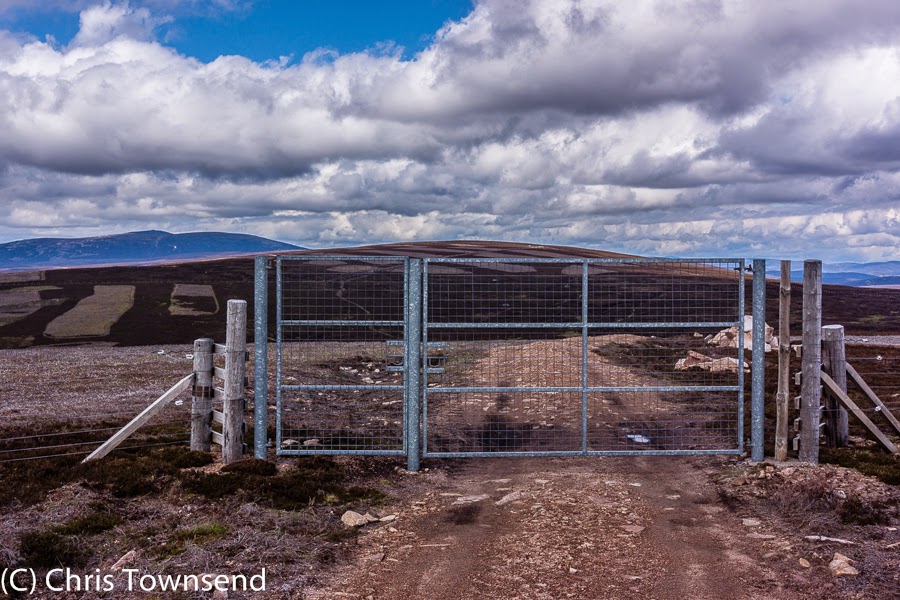
Millden Estate has also been described as a ‘savage, stripped, blasted land‘ by author and photographer Chris Townsend (here).

Millden Estate gamekeepers, along with others in the Angus Glens, have previously been feted by senior politicians, including former Cabinet Secretary for Rural Affairs, Fergus Ewing MSP, former Minister Graeme Dey MSP, and by Prince Charles who was photographed with Millden keepers as he opened a tweed workshop in Beauly in 2019.

Millden Estate was also visited by Professor Werritty and his colleagues in 2018 during the review of grouse moor management; they visited the estate apparently to see an example of ‘best practice for managing grouse moors’.

The estate, one of a number in the Angus Glens, is also long- known amongst conservationists as a raptor persecution hotspot after the discovery of poisoned and shot buzzards in 2009 and 2011 (here), a poisoned golden eagle (Alma) in 2009 (here), and a satellite-tagged golden eagle seemingly caught in a spring trap and then apparently uplifted overnight and dumped on Deeside with two broken legs & left to die (here). Nobody has ever been prosecuted for any of these alleged offences and Millden Estate has denied any responsibility.

In October 2019 during the morning raid at Millden Estate the SSPCA did find evidence of animal fighting and cruelty, including badger baiting, and after two and a half years of protracted legal process, in May this year 28 year old gamekeeper Rhys Owen Davies was convicted of a number of animal cruelty, animal fighting, and firearms offences: (for previous blogs on this case see here, here, here, here, here, here, here, here, here, here, here). Davies is due to be sentenced on Monday.

Other evidence of alleged wildlife crime was also uncovered during that search of Millden Estate back in October 2019, including the discovery of a number of dead raptors wrapped in bags at at least three separate locations, apparently including at the residences of two estate employees.

Whilst the SSPCA led on the investigation into animal cruelty/animal fighting, Police Scotland led on the investigation into the dead raptors (because the SSPCA don’t, yet, have the powers to investigate cases where a wild animal is already dead – bonkers, I know – see here for the background on this).

I have spent the last two and a half years chasing Police Scotland about these dead raptors and asking for status updates on the investigation. I have to say I’ve been summarily unimpressed. The investigation has been conducted at a snail’s pace and communication has been dire. I understand that the dead raptors all underwent post mortems and it was determined they’d been shot. No information has been provided about the number of species involved (although it’s been reported that some were buzzards), nor the number of individuals confirmed to have been shot, although I know of at least three.

Earlier this week I asked the Crown Office & Procurator Fiscal Service (COPFS) about this case and whether it was progressing (i.e. has anyone been charged?). To its credit, the COPFS response was fast, but the case outcome familiarly frustrating:

The Procurator Fiscal received a report relating to a 28 year old male and incidents said to have occurred between 1 January 2019 and 8 October 2019. After careful consideration of the facts and circumstances of the case, including the available admissible evidence, the Procurator Fiscal decided that there should be no proceedings taken at this time. The Crown reserves the right to proceed in the future should further evidence become available‘.

I doubt we’ll ever be informed about the extent of the raptor persecution uncovered (even now, nearly three years after the raptor corpses were found, Police Scotland has failed to issue any press statement) and we’ll certainly not learn any more detail about why charges weren’t brought because the COPFS is not obliged to inform the public about its decision-making process. Apparently transparency doesn’t apply.

To be fair, a prosecution would depend on an individual suspect being identified but there are multiple employees at Millden Estate (16 were listed in the estate’s sales brochure in 2011) and a recent photo on social media suggests there are multiple gamekeepers (there’s a photo online showing 13 men dressed as gamekeepers in Millden Estate tweed at the start of the 2020 grouse season).

I think it’s fair to say that any employee could have the motivation, means and opportunity to commit wildlife crime – we now know that at least one of them, Rhys Owen Davies, was doing exactly that, apparently right under the noses of his colleagues and bosses on Millden Estate – but just having the motivation, means and opportunity isn’t sufficient evidence for a criminal prosecution. Having a carrier bag full of shot raptors at your house isn’t enough for a court of law to convict, although if there was a bag of dead raptors at my house I’m pretty sure I’d notice them and I’m pretty certain I’d have notified the police.

So where does that leave us? We await the sentencing of gamekeeper Rhys Owen Davies on Monday but I don’t expect any of us have high hopes for a fitting sentence.

Millden Estate must surely now qualify for a General Licence restriction, a monumentally ineffective sanction but the only thing left on the table until the Scottish Government pulls its finger out and introduces the licensing scheme it promised to develop in November 2020.

But even if the authorities do decide to impose a General Licence restriction on Millden Estate, that won’t curtail the estate’s ability to continue to host grouse, pheasant and partridge shoots. The estate, which is run through a series of companies and limited liability partnerships (LLPs), including one called Millden Sporting LLP, reported tangible assets in 2021 of £17.5 million.

That’s a lot of money, and with it comes a lot of influence.

UPDATE 30th August 2022: 3 shot buzzards found on Millden Estate – confirmation from Police Scotland (here)

Grouse moor estate in Nidderdale with history of wildlife crime to be rewilded

A grouse moor estate in Nidderdale with a history of wildlife crime is set to be rewilded, according to an article in the Telegraph and Argus.

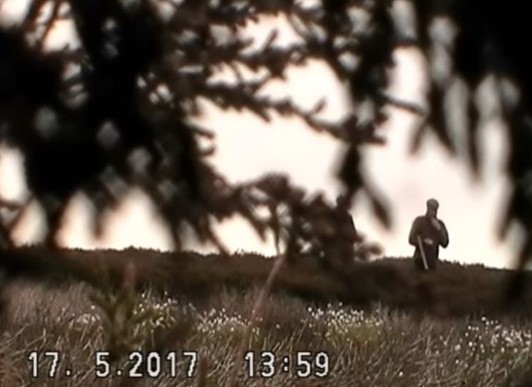
In May 2017, the RSPB’s investigations team filmed two armed individuals, dressed like gamekeepers, appearing to shoot at a nesting Marsh harrier and then apparently removing eggs from the harrier’s nest on Denton Moor (see here). Despite a thorough investigation by North Yorkshire Police, nobody was ever charged for these alleged offences.

[Screengrab from RSPB covert video of two armed men at a Marsh harrier’s nest on Denton Moor]

In February 2019, gamekeeper Austin Hawke was convicted at Skipton Magistrates Court for an offence relating to the death of a badger caught in a snare on the same grouse moor on 28th May 2018. Hawke was found guilty of failing to check the snare contrary to section 11 of the Wildlife & Countryside Act (see here).

In March 2019, the owners of Denton Moor (an engineering company called NG Bailey) announced it would not be renewing its grouse-shooting lease following the spate of wildlife crime (see here).

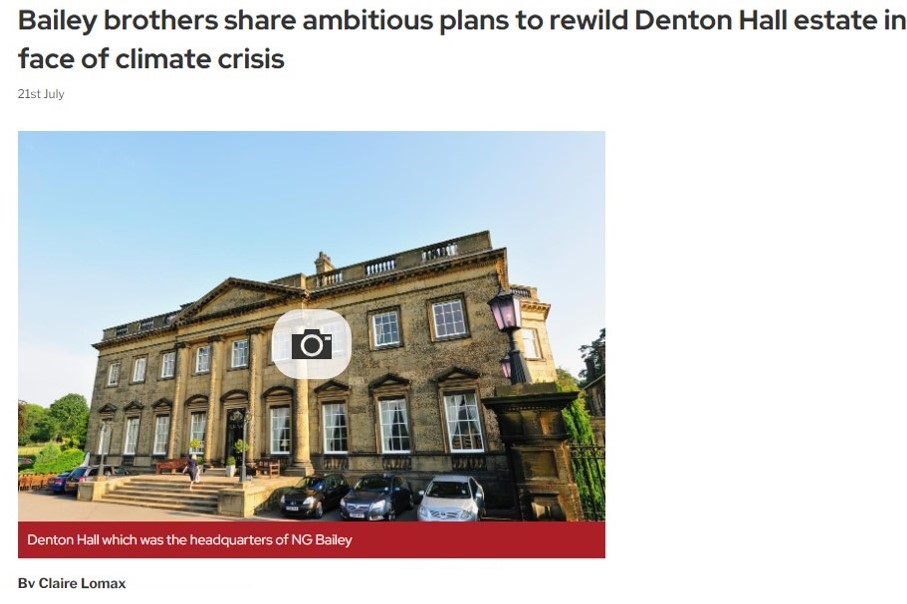
And now the estate owners, brothers Cal and Nick Bailey, have announced an ambitious rewilding project for the estate, according to an article in last week’s Telegraph & Argus (here). The article is reproduced below:

THE two brothers behind an ambitious plan to transform the Denton Hall estate into an exclusive hotel and rewilding project have outlined their ideas for the scheme – and vowed they want to take the local community with them on their journey.

Cal and Nick Bailey are members of the family which set up the huge NG Bailey engineering company and are shareholders in the business.

Denton Hall was bought by NG Bailey in 1976 and the Grade I Georgian Listed building has been used as offices and a wedding and events venue.

The Bailey brothers are in the process of buying the building and its 2,500 acres of land from the company to realise their dream of helping to combat climate change.

It is also something of a home-coming for Cal and Nick, who grew up in the house and roamed the estate’s moorland and woods in the 1970s.

Although the sale is still in the process of going through, the idea is that developing the house into an exclusive boutique hotel will help finance the wider project – turning the estate into a model of biodiversity and regeneration that will be a flagship scheme driving climate change-combatting measures.

At Denton Hall, which from its elevated position looks out over the greater Ilkley area, Cal Bailey says: “The climate crisis is real and nature in the UK and the wider world is seriously under threat.

“There’s a phrase ‘think global, act local’ and what that means for us is taking this opportunity which we are lucky enough to have to buy this estate and realising our three major goals of making a positive contribution in terms of three major areas, carbon, nature and food.”

Their plans are well-thought out and hugely ambitious, and they appreciate that there might be some misgivings among local people, particularly in the close-knit Denton village community neighbouring the estate. But they are determined to allay any fears about the development.

Cal says: “We are very keen that people in the area hear what we are saying and planning. There have been a few voices against our plans, but the overwhelming number of people have been supportive.

“It’s an exciting opportunity and there’s obviously a long way to go. The way we get there is as important as where we get to so we are absolutely determined to get to the end point but we want to take people with us, otherwise, what’s the point?

“We have tried to lean over backwards to share our vision with people because it’s really important that local people are on this journey with us.

“In every example I’ve seen of rewilding or any similar initiative up and down the country, when local people begin to understand what’s happening and begin to feel part of it, they recognise something special is happening and want to be a part of it.”

But what exactly is going to happen on the Denton Park estate? Over to Nick Bailey, to outline the main points of their plan.

Nick says: “We’ve set ourselves a 30-year horizon because with the best will in the world things change. NG Bailey took over the estate in 1976 and started developing what had been a neglected farm, and 50 years ago they had a very different vision and no doubt visions change so they didn’t think too far ahead.

“So one of the things that struck me was that over no other issue almost ever in history had scientists universally agreed, quickly, the climate crisis and the biodiversity challenge is real.

“So anyone who doesn’t face up to that is like a flat earth group. Scientists describe it and come up with suggestions, governments incentivise it and legislate around it, but it’s people who implement change and that’s what we want to do.

“Our aim here is to create an estate that can balance nature with carbon and with food and that can make as full a contribution as it has the capability to do in each of these three areas.”

So what will that mean in practice? Well, there are several schemes that the brothers want to put into motion over the next few years.

* The Moorland — Peat in good condition is one of the best things to sequester carbon but if it’s in poor condition it can contribute to carbon in the atmosphere, so one of the major projects will be to come up with a restoration plan for the Denton Park moorland peat.

* A Hundred Acre Wood – The brothers are working with the White Rose forest organisation to plant something like a thousand trees per acre, on average, which they are hoping to get underway by November.

* Additives – Their farm manager James Bush is looking at ways to reduce all chemical additives used on the land, whether fertiliser, herbicides or pesticides.

* Food partnerships – They want to utilise the land for growing and rearing food and providing local food producers and breweries with the raw materials so that their products are completely locally sourced. This includes fruit and vegetables, meat, and raw materials for alcohol production.

* A Tree Nursery – This would enable them to develop and grow the best varieties to help with the rewilding of the whole site.

* Bees – a mixture of hives and schemes to attract wild bees, which are essential to biodiversity, and also with a view to producing the estate’s very own honey.

* Grazing land – at the moment there are deer and sheep on the land, but they are looking at reintroducing cattle and possibly pigs to have a stronger mix and also provide food production as well.

* A Walled Garden – There’s already one there that has a history of growing food on the estate, and bringing that back into use is part of the plans.

* Water management – This is a hugely important part of the plans. Some 9.5 million tons of rain fall on the estate each year so proper management of the land will help to cut back on potential flooding further down the valley.

These are just some of the plans in the pipeline, and the Bailey brothers are consulting with a wide range of experts and organisations to look at how to put them into practice and to develop new and exciting ideas to help the estate be a model of biodiversity and rewilding.

Cal says: “We have this amazing opportunity to put our beliefs into practice on a bit of land in England that we can buy and manage. Because we have this opportunity and the fundamental belief that the world is in crisis, this is something we want to do.

“Does this mean we are experts in land restoration and farming? Not at all. I’m an accountant by training, a businessman who’s running factories. Nick is an engineer, but he’s been a teacher.”

Nick adds: “I’ve restored a couple of buildings in the past but not to this scale. This is a chance to play and learn, if you like, but I think so many things in my life have given me so much to bring to this project.

“So, no, we don’t have all the skills that we need, we’ll need the help of a lot of other folk. But we want to see our three goals of carbon reduction, food production and nature brought together in one vision on this estate. And the way we will fund it is hopefully bringing visitors to the estate who will stay here.”

It’s a long-term project, though, and the brothers know that. But they want to get local people onside to help them realise this dream.

Nick says: “There will be loads of opportunities for people to get involved and they won’t come all at once, even though people are battering the door down now, but over the next five or 10 years more and more people from the local community will become involved with the projects here, and hopefully inspire more and more people and it will be something for Ilkley to be proud of.”

ENDS

Investigative journalists discover more evidence of alleged raptor persecution on Queen’s Sandringham Estate

Investigative journalists from The Guardian newspaper have uncovered more evidence of alleged raptor persecution crimes, not previously reported, at the Queen’s Sandringham Estate in Norfolk.

They’ve also uncovered documents which reveal that the police have to seek the Queen’s permission before they are allowed to enter the estate and search for evidence if alleged wildlife crimes are suspected / have been reported.

Long-term blog readers will know that this royal estate has been at the centre of a number of police investigations into alleged raptor persecution, (e.g. see herehereherehere, here), including the most notorious incident back in 2007 where witnesses observed two hen harriers being shot over Dersingham Bog at the same time that Prince Harry, his mate William van Cutsem (whose Hilborough Estate is currently under police investigation for alleged raptor persecution), and an estate gamekeeper were out duck-shooting. No-one was charged, as with all the other reported incidents except one in 2005, where an estate gamekeeper was convicted for pole-trapping a tawny owl next to a pheasant pen (see here, page 3).

However, it now appears that at least two other raptor persecution incidents on the estate have been kept under wraps for years – a poisoned red kite found in 2006 and a dead Marsh harrier (cause of death not given) found on the estate border in 2007 – according to documents published on Friday by The Guardian – the article is well worth a read, here.

Why has it taken 16 years for these raptor persecution incidents to become public knowledge? And given the timings, wouldn’t it have been pertinent for them to have been in the public domain at the time that Prince Harry, his ‘high society’ mate van Cutsem, along with an estate gamekeeper, were all under police investigation into the alleged shooting of two hen harriers in 2007?

It’s no wonder ‘nothing was found’ during the police investigation into those alleged shootings, given that the police weren’t allowed on site until the following morning.

And surprise, surprise, none of the investigating authorities want to comment on any of these latest revelations. Too scared and too obsequious.

There is a follow-up article in today’s Guardian (here), including quotes from me about these very shady processes that amount to what I would call a massive cover-up.

Well done to journalists Sev Carrell, Rob Evans and David Pegg for having the balls to challenge this nonsense.

Convicted Scottish gamekeeper Rhys Davies: delayed sentencing explained

In May this year, Scottish gamekeeper Rhys Owen Davies, 28, pleaded guilty to a number of depraved animal cruelty offences relating to the keeping and training of dogs for animal fighting (badger baiting) and of failing to seek veterinary attention for dogs that had sustained serious injuries from those fights (see here).

He also pleaded guilty to a number of firearms offences after the Scottish SPCA raided his home in 2019 on Millden Estate in the Angus Glens and found three unsecure guns and ammunition left lying around inside the house.

His fellow gamekeepers, the sporting agent and the landowner at Millden Estate (a well known raptor persecution hotspot) all apparently failed to notice any of his crimes, or the injuries sustained by some of his eleven dogs housed in kennels on the estate. They also apparently failed to notice the bags of dead raptors scattered around the estate – more on those soon.

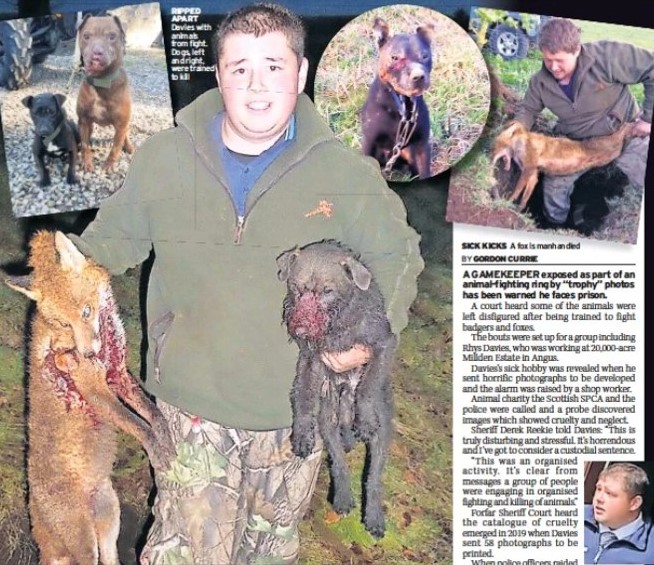
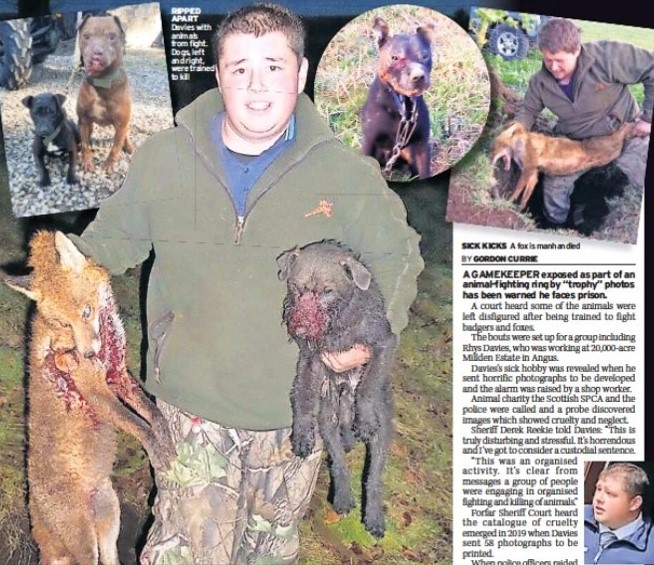
Davies was only caught because, being a top-notch criminal mastermind, he sent ‘trophy’ photos of himself and some of his mates posing with mutilated animals to a printing shop and used his address on Millden Estate as the return address. The shop assistant alerted the Scottish SPCA who immediately opened an investigation.

On conviction at Forfar Sheriff Court on 5th May 2022, Sheriff Derek Reekie ignored the mitigation plea from the defendant’s QC (who paid for this QC??) and instead concurred with Crown Office Fiscal, Karon Rollo, who made clear that Davies was a fully-trained gamekeeper (three-years college training) and had been employed as a gamekeeper for four years so knew exactly what he was doing. Sheriff Derek Reekie agreed and asked for social reports on Davies before sentencing was due on 28th June 2022.

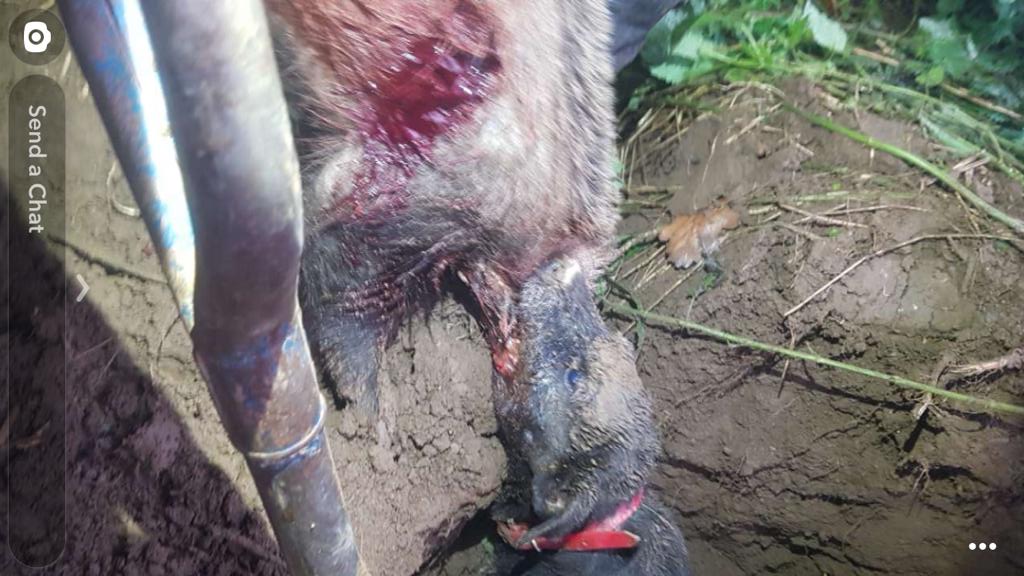
[Photographic evidence of badger baiting from Millden Estate gamekeeper’s phone. Photo provided by SSPCA]

Sentencing day arrived but frustratingly, sentencing was deferred for a further five weeks (here) without any explanation appearing in the media. This led to all sorts of unhelpful conspiracy theories on social media, mostly referring to the Masons and a corrupt judiciary.

I’ve since been provided with some information by someone who was present in court at that deferred sentencing hearing and hopefully this explanation will put to bed the conspiracy theories.

In May, Sheriff Reekie had asked for a report on Davies’ domestic circumstances in Wales, where Davies had since moved to after leaving Millden Estate in the Angus Glens. The Sheriff had allowed seven weeks for that report to be compiled and expected it to be available at the sentencing hearing on 28th June.

However, it turns out the social services department in Wales had only managed to make one phone call to Davies’ parents during that seven-week period and had not made a home visit. That’s probably an indication of how stretched these services are but nevertheless, the background report on Davies wasn’t ready.

Rather than ignore the non-existent social report and just pass sentence anyway, Sheriff Reekie allowed a further five weeks for that report to be completed. Apparently he made clear that this was to avoid providing any grounds for an appeal (by Davies’ QC) later on.

Sentencing is now due on 1st August 2022.

On the separate issue of dead raptors being found on Millden Estate during the search, I’ll be blogging about that very soon.

Sentencing deferred for convicted Scottish gamekeeper Rhys Owen Davies

Sentencing has been deferred today for depraved Scottish gamekeeper Rhys Owen Davies.

Davies, 28, had pleaded guilty at Forfar Sheriff Court in May 2022 to a number of animal cruelty offences relating to the keeping and training of dogs for animal fighting (badger baiting) and of failing to seek veterinary attention for dogs that had sustained serious injuries from those fights. He had also pleaded guilty to a number of firearms offences after the Scottish SPCA raided his home in 2019 on Millden Estate in the Angus Glens and found three unsecure guns and ammunition lying around inside the house.

[A screen shot of media coverage in May 2022 after Davies had pleaded guilty]

Davies was identified as part of a brutal dog-fighting ring when he submitted grotesque ‘trophy’ photographs to be printed, using his address on Millden Estate as the return address. Shop workers alerted the Scottish SPCA who then launched an investigation.

Sentencing was deferred in May for social reports after Sheriff Derek Reekie told Davies:

This is truly disturbing and stressful. It’s just horrendous. It seems to me I’ve got to consider a custodial sentence.

This was clearly an organised activity. It’s clear from messages a group of these people were engaging in organised fighting and killing of animals“.

Davies was due to be sentenced today but this has now been deferred until 1st August 2022.

There isn’t any further news yet about the separate case concerning sacks full of dead raptors that were also found during the SSPCA raid on Millden Estate. Police Scotland is apparently dealing with that case.

UPDATE 12th July 2022: Convicted Scottish gamekeeper Rhys Davies: delayed sentencing explained (here)

Convicted Millden Estate gamekeeper Rhys Owen Davies due to be sentenced for animal cruelty offences

Sentencing is due tomorrow of convicted Millden Estate gamekeeper Rhys Owen Davies for animal cruelty offences, as well as a number of firearms offences.

Davies, 28, pleaded guilty in May to a number of offences relating to the keeping and training of dogs for animal fighting (badger baiting) and of failing to seek veterinary attention for dogs that had sustained serious injuries from those fights. He also admitted a number of firearms and shotgun offences relating to unsecured guns and ammunition at his cottage on Millden Estate.

The depraved crimes of this Angus Glens gamekeeper were uncovered by an investigation led by the Scottish SPCA that began back in May 2019. Unbelievably, Davies had submitted some photos to a printing company to be developed; those photographs contained images of horrifically injured, disfigured and dead animals, along with a number of clearly identifiable individuals posing with spades at what looked to be fox dens and badger setts. Davies used his address at Millden Estate for the photo order to be returned.

Fortunately, the print developer recognised the serious nature of the images and reported the order to the Scottish SPCA.

In October 2019, the Scottish SPCA led a multi-agency raid on Millden Estate, and at another property in Aberdeenshire, where multiple pieces of evidence were uncovered during searches of gamekeepers’ houses and the wider estate.

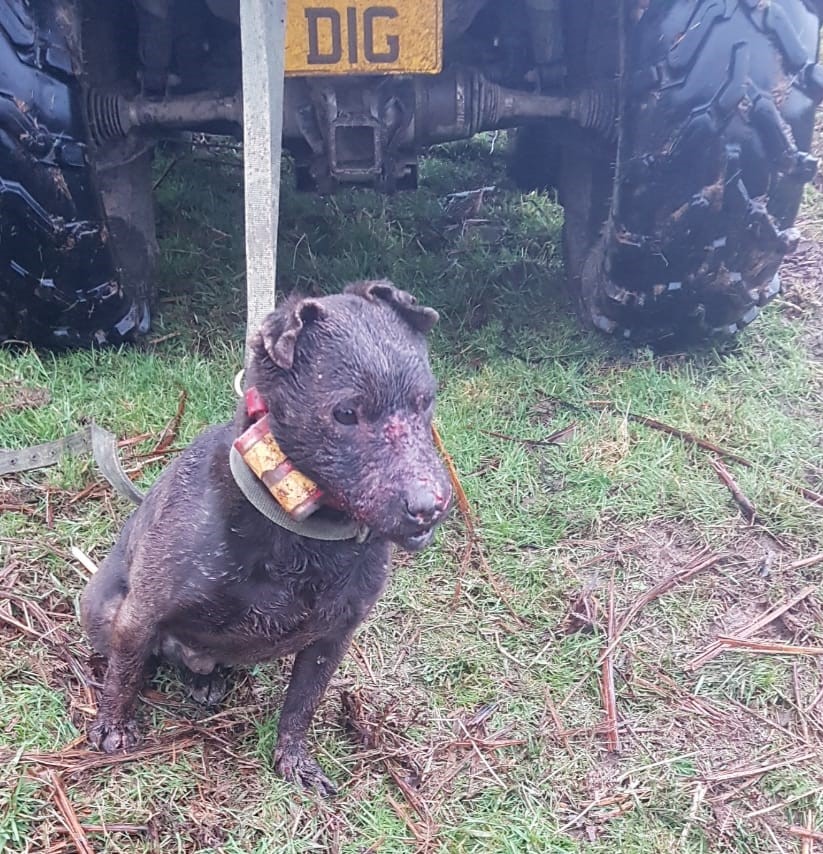
Amongst other things, eleven dogs were seized from kennels at Davies’ cottage and from an outbuilding. Some dogs showed evidence of injuries, some fresh and others sustained previously. These injuries included a torn-off lower lip, extensive scarring and the lower face of one dog was missing. A collar tested positive for badger DNA.

Davies’ phone was seized and more images were found of harrowing animal injuries, GPS locations of where he’d been, and conversations with others in the gang discussing the fights, injuries sustained and comments about DIY veterinary attention.

One of these gang members, 32-year-old Liam Taylor of Deyhill, MacDuff, Aberdeenshire, was convicted last year for his role in this savagery (here). He received a ten-year ban for owning dogs, a one-year supervision order, and was ordered to undertake 240 hours of unpaid work.

It’ll be interesting to see what sentence Davies receives tomorrow. His defence lawyer (a QC, no less – I wonder if Millden Estate paid for his services?), tried to plead for mitigation on conviction but the Crown Office Fiscal, Karon Rollo, made clear that Davies was a fully-trained gamekeeper (three-years college training) and had been employed as a gamekeeper for four years so knew exactly what he was doing. Sheriff Derek Reekie agreed and asked for social reports on Davies before sentencing.

Unfortunately, Davies committed his disgusting crimes prior to the Scottish Government’s introduction of tougher penalties for animal cruelty and wildlife crime. That legislation, the Animals and Wildlife (Penalties, Protections and Powers) (Scotland) Act 2020, increased the maximum penalty for the most serious animal welfare and wildlife crimes (including badger baiting) to five years imprisonment and unlimited fines. However, it wasn’t enacted until November 2020. Davies’ crimes were committed in 2019, and I doubt the increased penalties can be applied retrospectively.

Even after sentencing tomorrow, this case won’t be over yet. During the raid on Millden Estate in October 2019, a number of dead raptors were found stuffed in sacks at various locations. Police Scotland is dealing with this aspect of the case but so far the investigating officer has been very reluctant to provide updates on case progress. I’ll be returning to this in due course.

Previous blogs on this case can be read herehereherehereherehereherehere, here

UPDATE 28th June 2022: Sentencing deferred for convicted Scottish gamekeeper Rhys Owen Davies (here)

Scottish Gamekeepers Association takes hypocrisy to the next level

There are hypocrites, and then there’s the Scottish Gamekeepers Association (SGA).

Yesterday, the SGA threw a major tantrum over the police reporting of an investigation into a dead golden eagle, found in Strathbraan earlier this year. The SGA is claiming that the police report was ‘insensitive’ and ‘led to gamekeeper abuse’. In fact the SGA’s exact words were:

As a result [of the police appeal for information], this directed unwarranted public suspicion towards the estate and its staff“.

What utter tosh.

The reality is somewhat different. The police statement wasn’t ‘insensitive’ at all. It was factual and timely and didn’t infer responsibility for the death of the eagle on anybody, let alone on gamekeepers. It was simply an appeal for information/witnesses of a potential wildlife crime. It didn’t even name an estate so quite how the SGA can claim the police appeal directed unwarranted public suspicion towards the estate and its staff is anyone’s guess. It’s fantasy stuff.

Let’s look at the facts.

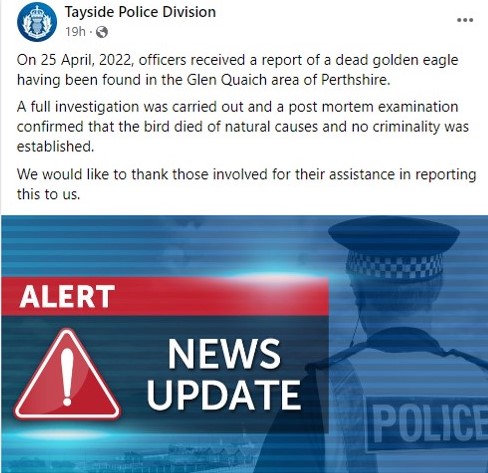
On 17th May 2022, the Tayside Police Division of Police Scotland made the following appeal for information on social media:

How is this appeal in any way ‘insensitive’? The Police, quite rightly, didn’t even claim the eagle had been killed illegally. They said it had been found dead and a post mortem would be carried out to establish the cause of death.

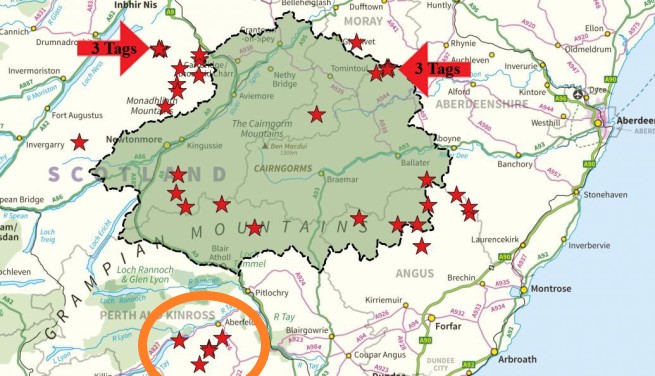
Police Scotland was perfectly entitled to consider the eagle’s death suspicious, given the ongoing illegal persecution of raptors, and particularly golden eagles, in this region. Strathbraan is an area where at least eight satellite-tagged eagles have ‘vanished’ in recent years, including one whose tag was found a few years later, wrapped in lead sheeting and dumped in the river (here). Strathbraan was identified as a raptor persecution hotspot by the 2017 Government-commissioned golden eagle satellite tag review. Strathbraan is circled in orange below:

In addition to ongoing golden eagle persecution in this region, there was also the suspicious disappearance of a white-tailed eagle (here), an illegally-trapped hen harrier called Rannoch (here), the suspicious disappearance of a hen harrier called Heather (here), the illegally shot peregrine (here), the long-eared owl held illegally in a trap (here), the ~100 corvids found dumped in a loch (here), the failed raven cull demanded by Strathbraan gamekeepers but thinly-disguised as something else (here) and most recently the General Licence restriction imposed on a Strathbraan estate for wildlife crimes (here), a decision based on evidence provided by the police.

Police Scotland updated the public on this investigation yesterday, with this statement on social media:

Now, I’m not the world’s greatest fan of Tayside Police when it comes to investigating suspected wildlife crime, and especially raptor persecution – they don’t have a good track record and few of us trust them to do a decent job – but on this occasion I don’t think they’ve done anything wrong at all.

I think the SGA is just using this incident as another opportunity to play the victim card, to force the Scottish Government into setting up a ‘gamekeeping taskforce’ to ‘achieve Government policy changes’ for an industry that claims to have been ‘marginalised’ (perhaps if the industry stopped killing raptors the public might look upon them more favourably).

The taskforce is something that shooting organisations have been pushing for for over a year but the Scottish Government has so far resisted. It seems to me like this latest incident has been hijacked by the SGA to apply pressure on Government, perhaps as a way in to water-down the forthcoming legislation on grouse shooting, which let’s not forget is only coming in because some gamekeepers continue to kill raptors, despite years of being warned of the consequences. It’s too late for tears from the SGA; the industry could have and should have done much, much more to stamp it out. Now they all have to deal with the consequences.

But what astonishes me the most about the SGA’s latest contrived melt down is the hypocrisy of it all. Here is an organisation crying tears at bedtime about what it claims to be ‘abuse’ (although the extent of this is contested – here), and yet some SGA directors, members, and committee members have played a central role, for years, in the online harassment and abuse of raptor conservationists or indeed anyone or any business seen to be supporting raptor conservation and grouse moor reform (e.g. here, here, here, here, here, here, here, here).

The SGA is also the organisation that, in a nasty and vindictive attack on Chris Packam, hired what they claimed to be a ‘handwriting expert’ to allege that Chris had faked his own death threat. This made national headlines, presumably after a tip off by the SGA to the press. The SGA’s ‘handwriting expert’ was recently exposed as a graphologist willing to present knowingly inaccurate evidence in court documents – here.

And now they’re crying about the ‘abuse’ they allege to have received after a straightforward police appeal for information about a dead eagle?

Laughably pathetic.

General Licence restriction imposed on Moy, a grouse-shooting estate, after discovery of poisoned red kite

Press release from NatureScot, 21st June 2022:

General Licence restricted on Highland estate

NatureScot has restricted the use of General Licences on Moy Estate for three years

The decision was made on the basis of evidence provided by Police Scotland of wildlife crime against birds.

This evidence included a poisoned red kite found on the estate in 2020, and incidents in relation to trapping offences.

[Red kite. Photographer unknown]

Donald Fraser, NatureScot’s Head of Wildlife Management, said: “We consider the information from Police Scotland provides robust evidence that wild birds have been killed or taken or there has been intention to do so illegally on this land.

“Because of this, and the risk of more wildlife crimes taking place, we have suspended the use of general licences on this property for three years until June 2025. They may still apply for individual licences, but these will be closely monitored.

“NatureScot is committed to using all the tools we have available to tackle wildlife crime. This measure will help to protect wild birds in the area, while still allowing necessary land management activities to take place, although under tighter supervision.

“We believe this is a proportionate response to protect wild birds in the area and prevent further wildlife crime. We will continue to work closely with Police Scotland and consider information they provide on cases which may warrant restricting general licences.”

General licences allow landowners or land managers to carry out control of common species of wild birds, such as crows and magpies, to protect crops or livestock, without the need to apply for an individual licence.

In addition to this restriction, there are currently three other restrictions in place on Invercauld Estate in the Cairngorms National Park, Lochan Estate in Perthshire and Leadhills Estate in South Lanarkshire.

ENDS

The restriction notice reads as follows:

In line with NatureScot’s published General Licence restrictions: Framework for Implementing Restrictions we hereby give notice that a restriction has been applied to the land outlined in red overleaf. This restriction prohibits the use of General Licences 01, 02 and 03 on that land between 21st June 2022 and 21st June 2025.

Please note that this restriction does not imply responsibility for the commission of crimes on any individuals.

This one has been a long time coming. Moy is one of those estates where if its name comes up in conversation amongst raptor conservationists in Scotland, eyes tend to roll and knowing looks are exchanged. It has been identified as a raptor persecution hotspot for many, many years.

Here is a map we created way back in 2016 to highlight the extent of raptor persecution crimes in former Cabinet Secretary Fergus Ewing’s constituency (given his strong support of the Scottish Gamekeepers Association) and this shows the concentration of incidents on and close to Moy Estate:

Here is a selection of examples, but this is by no means an exhaustive list:

Moy Estate was raided by police in 2010 after the discovery of poisoned bait and dead raptors and illegally set traps. A gamekeeper was later convicted of possession of a red kite after its bloodied corpse was found in the back of his vehicle. It had two broken legs, consistent with being caught in spring traps, and a head injury. A bloodied shinty stick was also found in the back of the vehicle. Notably, the gamekeeper wasn’t convicted for killing the kite, just for having possession of it. Nobody was charged with killing this kite.

These baited traps were discovered on the moor (the illegally-set spring traps were originally disguised under moss, removed here for evidential purposes). No charges were brought.

The remains of two further red kites were discovered on the moor, including a severed red kite leg and some wing tags that had previously been fitted to a kite, all found buried in holes under some moss. No charges were brought.

A jar in one of the gamekeeper’s houses contained the leg rings of four young golden eagles – nobody could account for how they had ended up inside that jar. Perhaps he’d found them whilst ‘metal detecting at his uncle’s farm’ like gamekeeper Archie Watson, who recently gave this implausible explanation to the court for how he’d come to possess BTO leg rings from a buzzard and a red kite attached to his keyring.

This male hen harrier was found caught by its leg in an illegally-set spring trap on Moy Estate in 2010. No charges were brought. It survived after being rescued by raptor workers from the Scottish Raptor Study Group.

In May 2011 a satellite-tracked red kite ‘disappeared’ on Moy, and another one ‘disappeared’ in August 2011.

In 2016 Police Scotland issued an appeal for information following the discovery of disturbed and abandoned buzzard and goshawk nests in the Moy Forest. One goshawk and four buzzard nests were abandoned in suspicious circumstances, with some evidence of illegal disturbance. These nests were being monitored by staff from Forestry Enterprise Scotland (see here). No charges were brought.

In 2017 masked gunmen were caught on camera at a goshawk nest in Moy Forest. A few days later the nest and a clutch of four eggs was found abandoned (see here). No charges were brought.

In 2018 Police Scotland issued an appeal for information after a buzzard was found caught in an illegal pole trap in the Moy area (see here). No charges were brought.

In 2020 a poisoned red kite was found dead, containing traces of a banned pesticide, leading to a police appeal for information (here).

In 2021 an individual was charged with the alleged killing of a bird of prey in this area. This case is believed to be progressing through the courts so I can’t comment further at this stage.

Of course, a General Licence restriction doesn’t amount to much of a sanction in real terms, as I’ve discussed on this blog endless times before (e.g. see here). However, it’s currently the only tool available to the authorities until we finally see the introduction of the promised grouse moor licensing scheme by the Scottish Government. Had that scheme been in place already, we’d hopefully have seen the removal of Moy Estate’s licence to shoot for a number of years, if not permanently.

Meanwhile, what will be really interesting to see is whether the Moy Game Fair goes ahead this year, given that the shooting organisations have all claimed to have a ‘zero tolerance’ approach to raptor persecution. I don’t think the likes of Scottish Land & Estates, Fergus Ewing MSP and the Scottish Gamekeepers Association can expect anything other than high-level criticism if they attend this event on an estate that has now been sanctioned for wildlife crimes by the statutory nature conservation advisor, based on evidence provided by Police Scotland. Mind you, the conviction of a gamekeeper on Moy Estate in 2011 didn’t stop them attending (see here and here).

UPDATE 14th July 2022: Scottish Gamekeepers Association plans award ceremony at disgraced Moy Estate (here)

UPDATE 6th August 2022: Fergus Ewing MSP & his shooting industry pals disregard sanctions imposed on Moy Estate for wildlife crime (here)

UPDATE 22nd August 2022: Moy Estate loses appeal against General Licence restriction imposed for wildlife crime (here)

Another gamekeeper convicted for poison offences on a pheasant shoot, but not charged for poisoned kite & shot buzzard

David Matthews, a gamekeeper with 50 years experience, has been convicted at Wrexham Magistrates Court for poison offences uncovered on the McAlpine Estate in Llanarmon Dyffryn Ceiriog, North Wales, where he has worked for 25 years.

In February 2021 a dead red kite was found on the estate by a member of the public and a later toxicology analysis revealed it had been poisoned with Bendiocarb.

[The poisoned red kite. Photo by RSPB]

When RSPB Investigations Officers subsequently visited the McAlpine Estate they found a dead buzzard inside a pheasant release pen. When the body was x-rayed, a piece of shot could be seen lodged in the bird’s skull.

[The shot buzzard found inside the pheasant release pen. Photo by RSPB]

A multi-agency search in October 2021 by North Wales Police, the Welsh Government, RSPB and the National Wildlife Crime Unit uncovered an unlocked barn containing 18 highly toxic products, including Cymag which has been banned since 2004. They also found the remains of a pheasant, inside a game bag on a bonfire site inside a pheasant release pen. The pheasant tested positive for Bendiocarb. Another dead buzzard was too badly decomposed to be tested.

Gamekeeper Matthews pleaded guilty to one charge relating to the possession of unauthorised pesticides. He received a total fine of £219.

You can read the full details of this case on the RSPB’s blog here.

In that blog, the RSPB state, ‘It remains unknown who killed the buzzard and the kite‘.

I’m pretty sure that the RSPB investigators, just like the rest of us, have a pretty good idea who might have been responsible but presumably there was insufficient evidence to charge anyone. Such is the nature of this game that it would be libellous to suggest a suspect.

It seems odd to me, though, that a gamekeeper who had worked on the estate for 25 years wouldn’t have noticed someone laying poisoned baits, placing the bait inside a game bag and leaving it on a bonfire site inside a pheasant release pen, and shooting dead a buzzard and leaving its corpse inside a pheasant release pen.

His £219 fine makes a total mockery of the system. Had this case been in Scotland, the fine for possessing an unauthorised poison would now be £40,000. That’s a serious deterrent.

£219 is not.

This is the reality and I’ll be reminding DEFRA Minister Lord Benyon of this the next time he repeats the Westminister Government’s tediously predictable claim that raptor-killing criminals face ‘significant sanctions…including an unlimited fine and/or a six month custodial sentence‘ (e.g. see this from Environment Minister Rebecca Pow in September 2021, and this from Richard Benyon in February 2022, and this from Rebecca Pow in February 2022, and this from Richard Benyon in April 2022).

Matthews is the 7th gamekeeper to be convicted in seven months across England, Scotland and Wales. There are still multiple cases pending court in the coming months. Clear evidence then that the game-shooting industry’s supposed ‘zero tolerance’ policy towards raptor persecution is simply just rhetoric and that the Government’s so-called ‘significant sanctions’ are complete bollocks.

The other convicted gamekeepers in recent months are:

Gamekeeper Shane Leech who was convicted in November 2021 for firearms and pesticides offences after the discovery of a poisoned buzzard found close to pheasant-rearing pens in Lakenheath, Suffolk (here);

Gamekeeper Peter Givens who was convicted in November 2021 for causing the death of a goshawk and a barn owl which starved to death in an illegally-operated trap on the Cathpair Estate in the Scottish Borders (here);

Gamekeeper Hilton Prest who was convicted in December 2021 for causing a sparrowhawk to starve to death in an illegally-operated trap in Cheshire (here);

Gamekeeper John Orrey who was convicted in January 2022 for battering to death two buzzards he’d caught in a cage trap on a pheasant shoot in Nottinghamshire (here);

Gamekeeper Rhys Davies from the Millden Estate in the Angus Glens, Scotland, who was convicted in May 2022 for animal cruelty relating to badger baiting (he’ll be sentenced at the end of June – here);

Gamekeeper Archie Watson who was convicted in June 2022 for raptor persecution and firearms offences after he was filmed throwing 8 dead raptors down a well on a pheasant-shoot in Wiltshire (here).

Well done to the multi-agency search team involved in bringing David Matthews to court.

Gamekeepers in England try to ‘out dinosaur’ gamekeepers in Scotland over continued use of toxic lead ammunition

The ongoing use of toxic lead ammunition in the UK is no laughing matter. This stuff should have been banned years ago when Governments were first made aware of lead’s toxic effect on our environment, our wildlife, and our people.

But no, even though most of the previously significant sources of lead in the environment (e.g. lead-based paint and leaded petrol) were eliminated decades ago due to their known damaging effects, the use of toxic lead ammunition for gamebird shooting has been allowed to continue, largely thanks to selfish, idiotic shooting organisations campaigning for the right to use toxic lead and sod the consequences to the environment, wildlife and human health.

[US Fish & Wildlife Service researchers examining 58 dead Bald Eagles in 2012. 60% had detectable concentrations of lead. 38% had lethal lead concentrations. Photo by USFWS]

There are various restrictions/bans in Scotland, England and Wales introduced between 1999-2004 on the use of lead ammunition over wetlands, but research has demonstrated that that has largely been ignored by a significant number of shooters:

It’s also worth mentioning for new blog readers that UK gamebird meat is still exempt from testing for poisonous lead whereas every other type of meat destined for the human food chain is not. It’s scandalous. (E.g. see here).

In 2020, after seeing the writing on the wall in parts of the US and Europe where more progressive, enlightened Governments have made huge strides to get rid of toxic lead ammo, nine of the UK’s shooting organisations, including the National Gamekeepers Organisation, suddenly made a massive U-turn and announced they were introducing a ‘five year voluntary transition away from toxic lead shot’. Many of us believed it was simply a propaganda ploy to fool the Government and the public that the shooting industry was finally taking responsibility for its filthy, damaging activities.

So far, two years into the so-called ‘transition’ they’ve made no progress whatsoever in moving away from the use of toxic lead shot (see here and here).

Notably, the dinosaurs at the Scottish Gamekeepers Association refused to sign up because they didn’t think there was sufficient evidence to support a move away from the use of toxic lead ammunition (yes, really).

Earlier this year, the main shooting organisations’ fear became reality when the Westminster Government, with support from the Scottish and Welsh Governments, finally agreed to consider a lead ammunition ban in ALL environments (not just wetlands) (see here).

As part of this process, last month a dossier was published by the UK Health & Safety Executive showing that the damaging effects of toxic lead ammo ‘are not adequately controlled‘ [more like, are not controlled at all!] and the authors set out a framework for a ban. The dossier/report is lengthy and detailed but the evidence is clear:

A six-month public consultation on the terms of the proposed ban is now underway, due to close on 6th November 2022 (see here). The consultation is based on the recommendations of the review and covers issues such as:

  • a ban on the sale of lead shot
  • a ban on the use of all types of lead ammunition for live quarry shooting including lead shot, shotgun slugs, lead bullets and airgun pellets
  • a ban on the use of lead shot for outdoor target shooting with possible exemptions for licensed athletes at licensed ranges with appropriate environmental protection measures
  • a ban on the use of lead bullets for outdoor target shooting with possible exemptions for shooting at licensed ranges with appropriate environmental protection measures
  • mandatory labelling of the packaging of lead ammunition regarding the hazards and risks of lead.

Proposed transition periods for each of the restrictions vary, and range from 18 months to five years.

You’d think that shouldn’t cause the shooting organisations any concerns at all, especially as they’re already two and a half years in to their own five-year voluntary transition away from lead ammo, right?

But look at this full-page advert by the National Gamekeepers Organisation published in this week’s Shooting Times. It’s almost like they’re trying to ‘out dinosaur’ the Scottish Gamekeepers Association, and that takes some doing!