Killing with impunity: Birdcrime 2013 published

Birdcrime 2013The RSPB has published its latest annual report on crimes against birds in the UK in 2013.

Their press release here.

The killing goes on, with impunity.

76 individual birds & other animals were confirmed illegally poisoned in 2013. This is more than double the figure from 2012 (29 confirmed victims).

Poisoning victims in 2013 included 30 buzzards, 20 red kites, 1 golden eagle and 1 white-tailed eagle.

68 confirmed incidents involved the shooting or destruction of birds of prey. Victims included two hen harriers, two marsh harriers and 5 peregrines.

These are just the confirmed incidents. A total of 338 incidents were reported to the RSPB in 2013, with North Yorkshire once again being the worst location. There’s also a worrying number of incidents from Powys in South Wales, seemingly relating to poisoned baits.

Birdcrime 2013 is a thoroughly depressing read. The RSPB calls on the shooting industry, again, to clean up its act. Judging by the contents of this report, that’s a seemingly futile request.

Well done and thanks to the RSPB for not only compiling these thorough statistics but importantly, for sharing them in the public domain.

Download Birdcrime 2013: Birdcrime 2013

Hen harrier Bowland Betty, found shot dead on a grouse moor in North Yorkshire. (Photo by Natural England).

Bowland Betty

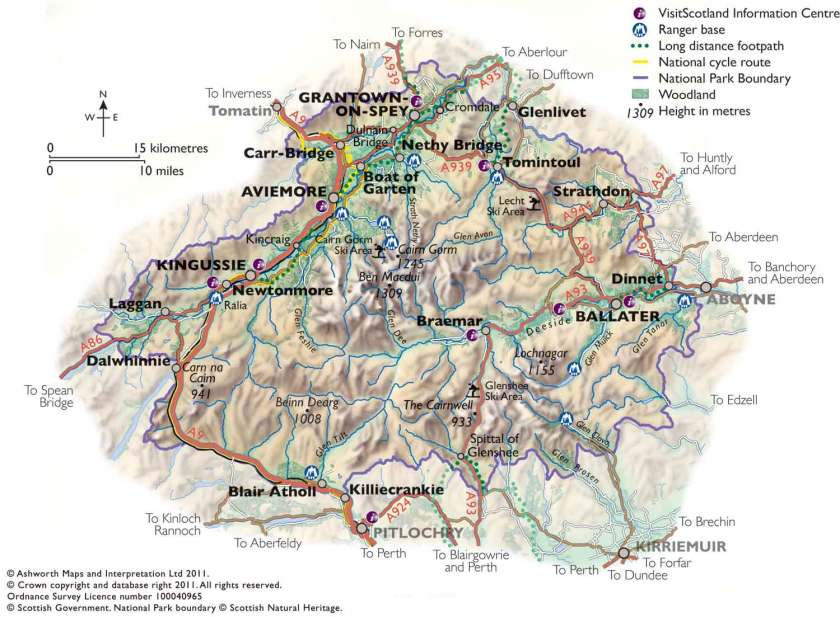
Cairngorms National Park Authority wants ‘action’ against raptor persecution

Duncan BrydenThe Convenor of the Cairngorms National Park Authority (CPNA), Duncan Bryden, has written to the Environment Minister to tell him that continued incidents of raptor persecution and ‘disappearing birds’ in the eastern side of the Cairngorms National Park “threatens to undermine the reputation of the National Park as a high quality wildlife tourism destination“.

He has asked for the Minister to attend a meeting of stakeholders in the Eastern Cairngorms (including RSPB Scotland and, er, Scottish Land & Estates) to discuss ways to address this on-going issue.

That’ll be interesting, seeing as though SLE continue to deny the extent of the problem (e.g. see here) and only last year gave membership to the ranks of SLE to the North Glenbuchat Estate – a grouse moor in the National Park that has been at the centre of wildlife crime investigations for years, most recently following the ‘disappearance’ in April of the first fledged white-tailed eagle in eastern Scotland for 200 years – it’s final signal reportedly came from North Glenbuchat estate (see here). The eagle is presumed dead but it’s body has not been recovered, just like the bodies of three other young satellite tagged eagles that ‘disappeared’ in the area in recent years. The body of a fifth eagle was found on North Glenbuchat Estate in 2011 – it had been poisoned with Carbofuran. As had a poisoned buzzard, also found in 2011, as well as a poisoned bait. A dead short-eared owl was also found in 2011 – it had been shot and stuffed under a rock.

Good luck to the CNPA in trying to oust the raptor-killing criminals from the National Park and well done Duncan Bryden for taking a stand.

Download: CNPA letter to Paul Wheelhouse May2014

Download: Paul Wheelhouse response to CNPA

CNP map


New sea eagle ‘management plan’ on the cards

In January this year, the National Farmers’ Union (Scotland) called for ‘action’ against Scottish sea eagles, and although they weren’t explicit about what that ‘action’ might be, they did mention [unspecified] ‘control measures’ (see here).

SNH responded quite strongly by saying ‘no’ to control measures (see here).

In February, a former Crofting Commission rep said that “Nothing short of complete eradication will do” and that sea eagles “should be absolutely destroyed” (see here).

In May, NFUS launched its ‘Sea Eagle Action Plan’, which laid out the usual unsubstantiated accusations that sea eagles are responsible for a loss of biodiversity and have detrimental effects on golden eagles, mountain hares, lapwings, curlews, black grouse, otters and rabbits, and of course, sheep farming. For a species that they claimed to know so much about, it was quite surprising to see the front cover of their report – it was apparent they couldn’t even tell the difference between a golden and a white-tailed eagle (see here).

A couple of days ago, it was reported (sensibly here and here but with a hysteria-mongering headline here) that NFUS and SNH had signed a joint accord to work towards a new ‘Sea Eagle Management Scheme’. This will include a new scheme to start in Spring 2015 to compensate farmers and crofters for loss of stock to eagles (a continuation of a previous scheme) subject to funding approval, and the development of a new sea eagle ‘action plan’ to be published by September 2016 and implemented by March 2017.

Whilst it’s encouraging that NFUS and SNH have agreed to work cooperatively, we can’t help but be suspicious of the term ‘management scheme’. What does that mean, exactly? We often hear the term ‘well-managed grouse moor’ used to describe practices that include the systematic eradication of all predators, just so there are more grouse for the guns to kill. That’s not our definition of ‘well-managed’. The term ‘management’ was also used by DEFRA when it tried to implement its controversial ‘Buzzard Management Scheme’ a couple of years ago – in that case, ‘management’ meant removing buzzards so that there were more pheasants for the guns to kill.

Hmm. Hopefully the NFUS and SNH are not planning on ‘removing’ sea eagles as a ‘management’ strategy (the NFUS has previously suggested this could be an option). At least for now, the NFUS has stated that ‘management’ in this case does not mean shooting the eagles (see the BBC report).

The BBC’s report on the new accord does reveal some of the proposed management strategies. One of them is this:

‘Contractors will also be available, free of charge, to record incidents of eagle predation and to offer advice on how to scare away the birds’.

That doesn’t seem to have been thought through very well. The sea eagle  has extra special protection as it’s listed on Schedule 1A of the Wildlife & Countryside Act 1981 (as amended) – that means it is an offence to intentionally or recklessly harass this species at any time of year, not just when it’s close to or on its nest (see here). The NFUS and SNH will need to be very careful indeed if they’re planning on ‘scaring away’ sea eagles.

Thankfully, not everyone shares the NFUS’ view of sea eagles. The Mull Eagle Watch Project (based around the island’s thriving sea eagle population) has just been awarded VisitScotland’s prestigious 5 star Wildlife Experience rating for the third year running (see here). Congratulations to all involved.

White-tailed eagle photo by Mike Watson

Enough is enough

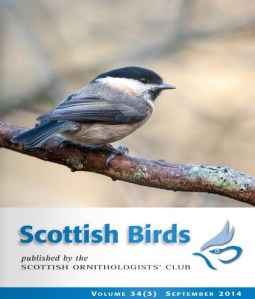
SOCThe latest edition of the Scottish Ornithologists’ Club journal, Scottish Birds, dropped through the letterbox the other day. It contains an interesting article from Ian Thomson, Head of Investigations at RSPB Scotland:

Raptor Persecution in Scotland: July 2014 update

The last article on the illegal killing of birds of prey in Scotland written for Scottish Birds (33:1) appeared at the beginning of 2013, a year designated “The Year of Natural Scotland” by the Scottish Government.

The year had dawned with some optimism. For the fourth consecutive year, we had seen detected cases of illegal poisoning decline, and although, again it is important to reiterate that these only represent what was actually found, the apparent reduction in these indiscriminate crimes was welcomed universally. In saying that, yet again, a Golden Eagle was one of the victims, with a satellite-tagged bird found dead in Lochaber in March. But, the year ended with the news that a young pair of White-tailed Eagles from the east Scotland re-introduction scheme had built a nest in an Angus glen, the first breeding attempt in the east of the country for a hundred years.

Within days of the New Year beginning, however, it was discovered that the tree had been deliberately felled, and the nest destroyed. Realism returned quickly. A police investigation was launched. The site was five miles from the nearest public vehicle access. The tree felled was the only one in the whole plantation. Full cooperation from the estate where the nest was felled was assured. Surely it would be easy to identify the culprit?

No. The police requests for information were met with “no comment” responses across the board, from all those employed in the area concerned. While the right to decline to answer questions is enshrined in Scots Law, few would agree that this amounts to “full cooperation”. But, with no suspect identified, that would ostensibly mean the end of the investigation.

Of course, this sad example was not the first time this has happened. Indeed, when it comes to the persecution of raptors, no-one ever seems prepared to say a word that may assist in the identification of the perpetrator.

In late May 2013, two members of the public witnessed the organised “hunt” of a pair of hen harriers that had just started nest-building on an Aberdeenshire estate. For almost three hours, two armed men stalked the protected raptors, guided to where they were perched or flying by a third man, communicating with those on the hill by radio. As darkness fell, four shots rang out, and the men were seen and heard celebrating the killing of the male harrier.

Of course, the killer did not leave the body lying around to be found, but at least there were the two other individuals he was with, fully aware that he had committed the crime. Again the police investigated; again, nobody was prepared to identify the criminal. Again, a raptor killer escaped justice.

This latest case was one of several, including the killing of another harrier, the poisoning of a red kite and shooting of another; and the shooting of four buzzards in other incidents, which led to the Scottish Government Minister for the Environment and Climate Change, Paul Wheelhouse MSP, to announce further measures to combat these crimes. This included a review of sentences given for convicted wildlife criminals, and instructing Scottish Natural Heritage to implement a means of restricting the use of General Licences (a legislative tool that allows an “authorised person” to kill certain species under specific circumstances eg. allows a gamekeeper to shoot a carrion crow, that would otherwise be protected).

It is perhaps ironic, that just a few weeks earlier, the SOC had been part of a delegation that met with the Minister to handover a petition, officially endorsed by the Club, that contained almost 23,000 names, collected in just over two weeks, calling on him to ensure that Buzzards continued to have full legal protection, and to resist calls made by some in the game-shooting sector to allow licences to control them.

Sadly, despite the Minister’s robust comments, this did not seem to deter those who seem intent on continuing to kill some of our rarest protected birds with further shootings of a red kite and several buzzards. But, on a positive note, a second pair of white-tailed eagles did manage to breed in the east of Scotland, successfully fledging a male chick.

Unfortunately, The Year of Natural Scotland ended, as inauspiciously as it had began, with the poisoning of yet another golden eagle in the Angus glens, just the latest incident of a litany of recent raptor persecution cases in this area.

2014 has been no better, with the massacre of birds of prey on the Black Isle grabbing a great deal of media attention. Twenty-two dead raptors – six buzzards and sixteen red kites – were found dead in a small area of farmland near Conon Bridge. Thus far, fifteen of these have been confirmed to have been the victims of poisoning as a result of consuming bait laced with a banned pesticide.

This incident, quite rightly, attracted universal condemnation, lead to the establishment of a reward fund and resulted in an unprecedented public demonstration in Inverness town centre. But, it is important to put this case into context. It was highly unusual in that it was on lowland farmland, close to a town and in an area frequently and easily accessed by members of the public.

The vast majority of raptor persecution incidents still happen away from the public gaze, in upland areas where visitors are few and where the chances of evidence of the crimes being found is very slim. These incidents may not be seen, the bodies may not be found, but the evidence is clear time and time again – large swathes of Scotland’s uplands managed intensively for driven grouse shooting continue to see virtually no raptors breeding successfully.

It is for this reason that RSPB Scotland is now calling for a robust system of licencing for grouse moors. The grouse-shooting industry has had decades to put its house in order, but has singularly failed to demonstrate that it can operate in harmony with protected birds of prey. Licenses should have sanctions for wrongdoers, with repeat offenders losing their license and thus the right to shoot all gamebirds for set periods. Estates that do practise sustainable management, and obey the law should have nothing to fear.

The one light that had shone from the gloom of 2013 was that first white-tailed eagle chick to fly from a nest in east Scotland for 200 years. It thrived and survived the challenges of its first winter. But that light too was extinguished, when the satellite-tagged bird “disappeared” on a grouse moor in upper Donside. At the same location, four tagged golden eagles have similarly vanished. The only eagle body recovered confirmed it had died due to illegal poisoning.

Enough is enough.

Full reference: Thomson, I. (2014). Raptor persecution in Scotland: July 2014 update. Scottish Birds 34(3): 232-233.

East Scotland sea eagle chick fledges: what fate awaits this one?

For the second consecutive year, a young white-tailed eagle has successfully fledged from a nest in east Scotland.

His sibling, who hatched in 2013, un-mysteriously ‘disappeared’ earlier this year in a notorious raptor persecution blackspot in the Cairngorms National Park (see here and here). He was the first sea eagle to fledge in east Scotland in over 200 years but he didn’t even survive to see his first birthday. His satellite transmitter went silent after he’d visited a driven grouse moor where previously a head gamekeeper had been convicted of poisoning offences (2006), a poisoned golden eagle had been found in 2011 (no prosecution), a poisoned buzzard had been found in 2011 (no prosecution), poisoned bait had been discovered in 2011 (no prosecution) and a short-eared owl had been found in 2011 that had been shot and shoved underneath a rock (no prosecution). The police raided the estate in April this year but found no trace of the eagle.

He might not have been the first sea eagle to fledge in Scotland in over 200 years if another east Scotland pair had not had their nest tree felled by someone with a chainsaw (see here – no prosecution).

The BBC is running an article on this year’s fledgling (see here) and includes a telling remark from RSPB Scotland saying they hoped the young bird would avoid areas where birds of prey have been poisoned or trapped. In other words, steer clear of driven grouse moors.

He’s got at least five years in which to run the gauntlet before he becomes mature enough to breed – we don’t rate his chances much.

Go west, kid, go west.

wtse fife 2014 ian francis

Wheelhouse responds to latest raptor killings….by doing nothing

Paul-Wheelhouse-MSP Earlier today we blogged about the latest poisoning victim to have been uncovered in Scotland….a dead buzzard that was found in Fife in April (see here).
This evening, Environment Minister Paul Wheelhouse has issued the following statement:

“I have been hugely angered to learn about another case of a poisoned buzzard following on from a separate incident involving the illegal death of a hen harrier in Ayrshire. I have made it very clear that I will not tolerate these criminal and selfish acts and this form of criminality has also been roundly condemned by parliament in a recent debate.

These crimes are not the actions of people who value Scotland’s wildlife and natural environment and I encourage anyone with any information on these despicable crimes to contact Police Scotland on 101.

My officials are working on a pesticide disposal scheme to rid illegal substances from our countryside and I hope to see this up and running very soon while the implementation of changes to the General Licences is in the process of implementation.

Our ongoing review of wildlife crime penalties is due by December and these latest incidents only add to the evidence supporting a toughening of sanctions and penalties on perpetrators.”

We don’t doubt that he’s “hugely angered” – we all are – but we most certainly do question his commitment to taking meaningful action against the raptor killers.

A year ago, give or take a few days, the Minister introduced a series of what he described as ‘further measures’ to combat raptor persecution (see here). Since then, not one of these measures has yet been fully implemented. Also since then, we’ve seen examples, over and over again, of how these crimes are still taking place right across Scotland. Here are some of them:

June 2013: Shot buzzard in the Borders (see here), later revealed to also have been poisoned (see here)

July 2013:  Buzzard shot in the throat in North Ayrshire (see here)

August 2013: Red kite found shot at Leadhills (see here)

September 2013: Poisoned buzzard found in Stirlingshire (see here)

October 2013: Langholm hen harrier ‘Blue’ disappears (see here)

October 2013: Half-made raptor trap discovered in Angus (see here)

December 2013: Buzzard died of ‘unnatural causes’ near Tomatin (see here) [we now know it had been shot]

December 2013: Golden eagle ‘Fearnan’ found poisoned on Angus grouse moor (see here)

January 2014: Man reported for hen harrier death in Aberdeenshire (see here)

January 2014: Dead bird (species unknown) & suspected poisoned bait found in South Lanarkshire (see here)

February 2014: Poisoned peregrine found near Leadhills (see here)

March 2014: 22 poisoned raptors (16 red kites + 6 buzzards) found in Ross-shire (see here)

April 2014: Man arrested for alleged attempted raptor trapping in Aberdeenshire (see here)

April 2014: ‘Illegally-killed’ peregrine found near Stirling (see here) [we now know it had been shot]

April 2014: East Scotland sea eagle chick ‘disappears’ on Aberdeenshire grouse moor (see here)

April 2014: Gamekeeper charged for allegedly shooting, bludgeoning & stamping on buzzard in Dumfries (see here)

April 2014: Poisoned buzzard found in Fife (see here)

June 2014: Allegations emerge of ‘coordinated hunt & shooting’ of a hen harrier in Aberdeenshire last year (see here)

June 2014: Hen harrier died “as result of criminal act” near Muirkirk (see here)

These are just the ones that have been made public – we expect there to be a number of others that have not yet been revealed to the public.

Each time, we’ve asked Wheelhouse to act. Each time, he’s told us we need to ‘wait’ for the new measures to take effect but he has adamantly refused to give a time-frame of how long that wait should be. It’s crystal clear, even to a child, that The Untouchables are out of control and waiting for them to stop of their own accord is ridiculous.

The Minister’s response this evening is simply not good enough. A ‘poisoning amnesty’? It sounds good, but the truth is it’s been done before and with no effect. Carbofuran has been banned since 2001 – that’s 13 years ago! Does he really think that these disgusting poisoners are going to hand over their private stashes of poison when they know full well they can continue to use them without fear of consequence? The whole industry denies that poisoning is even happening!

We think the amnesty is being implemented so the Government can be seen to be doing ‘something’ but actually it’s just a bit of cynical window dressing in an attempt to delay taking the proper action that is needed. It’s just another excuse to do nothing.

And actually, this amnesty hasn’t been announced as a reaction to the recently-reported killing of the buzzard and the hen harrier. He announced his intention to launch an amnesty in his speech at the Police Wildlife Crime Conference several months ago. So what has he actually announced in response to the poisoned buzzard and the illegally-killed (probably shot) hen harrier? Absolutely nothing.

The Minister says he “won’t tolerate these criminal and selfish acts“. Sorry, Minister, but that is exactly what you’re doing.

If you feel strongly about this and agree that this government is still failing to address the widespread persecution of protected raptor species, we’d encourage you to email Mr Wheelhouse, cite the list of crimes (above) and demand he takes meaningful action or resign his position as Environment Minister. Email: ministerforenvironment@scotland.gsi.gov.uk

Sea eagle poisoned in Northern Ireland: police appeal for info one year later!

Last week, at the end of May 2014, the Police Service of Northern Ireland issued a vague press release calling for information about the discovery of a poisoned white-tailed eagle in the Armoy area of Northern Ireland. Toxicology results revealed the bird had been killed by the banned poison, Carbofuran.

The thing is, this bird was discovered in April 2013 – over a year ago – and yet this is the first time the PSNI have published anything about it.

Here’s what their press release said:

“Police are investigating the circumstances surrounding the death of a sea eagle.

During April 2013 police received a report from a member of the public regarding a dead sea eagle found within the Armoy area.

Subsequent toxicology reports confirmed Carbofuran poisoning to be the cause of death.

Carbofuran is a banned substance which is highly toxic and poses a serious risk to public health and safety.

Police are appealing to anyone with information in relation to this incident to contact them on the new non-emergency number 101″.

It’s not known if this was an adult or a juvenile bird, or whether it was from the Kerry reintroduction project in SW Ireland or whether it was a Scottish bird.

It’s also not known whether this appalling delay was due to the toxicology lab, or whether it was due to the police, or both. It’s not the first time that such chronically long delays have occurred here – see here and here for previous blogs. Whichever agency is responsible, it’s shocking that it has has taken over a year for an appeal for information.

It’s worth asking some questions about this. Let’s email the following people to ask about why it has taken so long to (a) appeal for information about this crime, and (b) warn the public in the Armoy area of Northern Ireland about the serious risk of a banned and highly toxic poison lying around in the countryside:

Environment Minister Mark H. Durkan (who incidentally has recently pledged improved action against wildlife crime – see here). His email address: doe.iemonitoring@doeni.gov.uk

Minister for Agriculture Michelle O’Neill (who is directly responsible for overseeing the process of toxicology sampling). Her email address: private.office@dardni.gov.uk

The local police office of the Armoy area: NPTBallycastle@psni.pnn.police.uk

Photo of a white-tailed eagle by Mike Watson


Sea eagle killed at Scottish windfarm, but persecution remains greatest threat

The inevitable has finally happened; a Scottish windfarm has claimed its first reported eagle victim – a young sea eagle known as ‘Red T’.

Red T was released in 2011 as part of the East Scotland Sea Eagle Reintroduction Project – he was one of a cohort of young birds donated by Norway between 2007-2011 to form a nucleus breeding population for the species’ recovery in eastern Scotland.

His body was discovered in February this year at Burnfoot Hill windfarm in the Ochil hills (see photo). A post-mortem concluded that the likely cause of death was collision with a wind turbine (see here for a report by Rob Edwards and here for the RSPB’s East Scotland Sea Eagle project blog).

This tragic event wasn’t wholly unexpected. Windfarms and eagles don’t mix, especially when the turbines have been sited in a high-density eagle area (e.g. Smola island, in Norway – see here). To date, Scotland’s 150+ windfarms haven’t caused such a catastrophic impact as those in places such as Smola, although other victims have been recorded here, including hen harriers and red kites. Red T is the first known recorded eagle to have been killed by a turbine collision in Scotland, and he probably won’t be the last.

However, it’s important to keep Red T’s death in perspective. Windfarms have been around in Scotland for nearly twenty years and yet this is the first reported eagle death. In contrast, since 1989, at least 63 eagles (golden & white-tailed) have been reported as victims of illegal persecution according to RSPB data, and these are just the known victims – there are likely to have been many more. There is compelling scientific evidence that persecution is having a population-level impact on some species, especially golden eagles. This persecution is particularly associated with land managed as driven grouse moors in the central, eastern and southern uplands. These driven grouse moors tend to be situated on large privately-owned estates. The Land Reform Review Group this week published an interesting report which considers the future of these massive sporting estates – have a read of land reform campaigner Andy Wightman’s blog here for his perspective and the amusing responses of various land-use groups including SLE and the SGA.

White-tailed eagles hatch in Irish Republic again

WTE iRELAND 2013 Co Clare Allan MeeSome good news for a change….

For the second year running, white-tailed eagle chicks have hatched successfully at the Mountshannon nest in Co. Clare, as well as at a nest in west Cork in the Irish Republic.

The chick in the Mountshannon nest is the sibling of last year’s chick (see photo by Allan Mee), which was one of the first white-tailed eagles to fledge in Ireland in over 100 years, only to be shot and killed nine months later (see here).

These eagles have been reintroduced to Ireland following their extinction in the early 20th Century thanks to human persecution. Between 2007-2011, one hundred young eagles, donated by Norway, were released into Killarney National Park. The reintroduction project has been managed by the Golden Eagle Trust, who have published the following press statement about this year’s breeding success:

The first white-tailed eagle chicks of the year have been hatched in Co Clare and west Cork in recent weeks, it was announced today.

The rare birds were born in nests at Mountshannon, Co Clare and Glengarriff in west Cork, according to the Golden Eagle Trust which runs the reintroduction programme .

The chick born in Mountshannon is a sibling of a bird which was shot and killed three months ago. The deceased bird was one of two chicks born to the Mountshannon pair last year which became the first chicks to fly from a nest in Ireland in over a century. The crime is under investigation by the Garda.

The chick born in Glengarriff, the first of the year to hatch, unfortunately died at two weeks old. This was likely due to a combination of bad weather and inexperienced adults, Golden Eagle Trust project manager Dr Alan Mee said.

Nesting pairs at sites in Kerry and Galway have also laid eggs which have yet to hatch. At least half of the fourteen pairs of eagles across four counties have nested and laid eggs in recent weeks. Some pairs, including a nest in Killarney National Park, failed to breed.

These are the latest chicks in the reintroduction programme which began in 2007 with the release of 100 young Norwegian eagles in Killarney National Park .

Minister for Arts, Heritage and the Gaeltacht Jimmy Deenihandescribed it as “A very promising development after the shocking killing earlier this year. That was a dark day for this ambitious project to reintroduce these magnificent birds of prey into Ireland,” he said. “I hope these young eagles will have a long life in our skies,” he said.

The pair at Mountshannon gives the general public a chance to see some of the most spectacular birds at close quarters.

Dr Mee warned about risks of disturbance during the early stages of nesting which would be detrimental to success and could result in chicks being left unguarded. “We would caution people not to approach the nest area but instead avail of the unique opportunity to watch from nearby Mountshannon pier,” he said.

He continued: “The increase in the number of nesting pairs is encouraging and bodes well for the future of the species. White-tailed eagles can live for 25 to 30 years and generally mate for life. Ultimately the viability of the reintroduced programme depends on these chicks going on to breed themselves in Ireland. Each step brings us closer to that goal”.

The reintroduced birds came from Norway and the Norwegian Ambassador to Ireland, Roald Naess, also welcomed the news: “This is an excellent example of international cooperation on the practical level, aiming at preserving nature and biodiversity for the benefit of future generations”.

The white-tailed eagle reintroduction project is managed by the Golden Eagle Trust with the National Parks and Wildlife Service. One hundred white-tailed eagles were released in Killarney National, park between 2007 and 2011 and 29 have been recovered dead, mainly due to illegal poisoning.

The birds were historically a part of the Irish landscape before being made extinct in the early 20th century due to human persecution.

Well done to all involved in this historic conservation effort and best of luck to this year’s young pioneering birds. Let’s hope the sea eagle reintroduction project in East Scotland has equal success and that any chicks that manage to fledge here are able to survive for longer than last year’s bird, which un-mysteriously disappeared on a grouse moor in the North East Glens last month (see here).

Peregrine shot in Devon as this year’s tally continues to rise

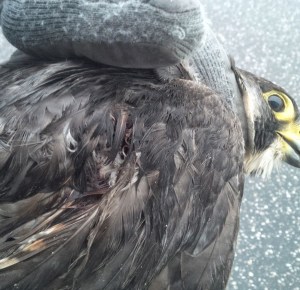
Perg shot seaton Devon May 2014A critically-injured peregrine was found at Seaton Beach in Devon on Bank Holiday Monday. The bird, soaked and unable to fly, was found by members of the public.

It was taken to a vets but had to be euthanized. Its injuries were consistent with a gunshot wound.

The police quickly issued an appeal for information (see here) and local birder Steve Waite has written about the incident on his blog (see here).

So here we are, another month, another reported raptor persecution crime to add to the year’s growing death toll:

Jan 2014: Shot buzzard, Norfolk.

Jan 2014: Dead bird (species unknown) & poisoned bait, South Lanarkshire.

Feb 2014: Shot buzzard, North Yorkshire.

Feb 2014: Shot buzzard, Norfolk.

Feb 2014: Shot sparrowhawk, Norfolk.

Feb 2014: Spring-trapped buzzard, West Yorkshire.

Feb 2014: Poisoned peregrine, South Lanarkshire.

Mar 2014: Shot peregrine, Dorset.

Mar-April 2014: Poisoned red kites (x 16) & buzzards (x 6), Ross-shire.

April 2014: Man arrested for alleged attempted raptor trapping, Aberdeenshire.

April 2014: Shot buzzard, North Yorkshire.

April 2014: Shot red kite, Northamptonshire.

April 2014: White-tailed eagle ‘disappears’ in suspicious circumstances, Aberdeenshire.

April 2014: Peregrine ‘illegally killed’, Stirlingshire.

May 2014: Shot peregrine, Devon.

Meanwhile, over in Northern Ireland a wildlife crime summit has learned that 90 raptors have been found poisoned there since 2006 – see here.