Millden is yet another grouse-shooting estate to be sanctioned after police find evidence of raptor persecution

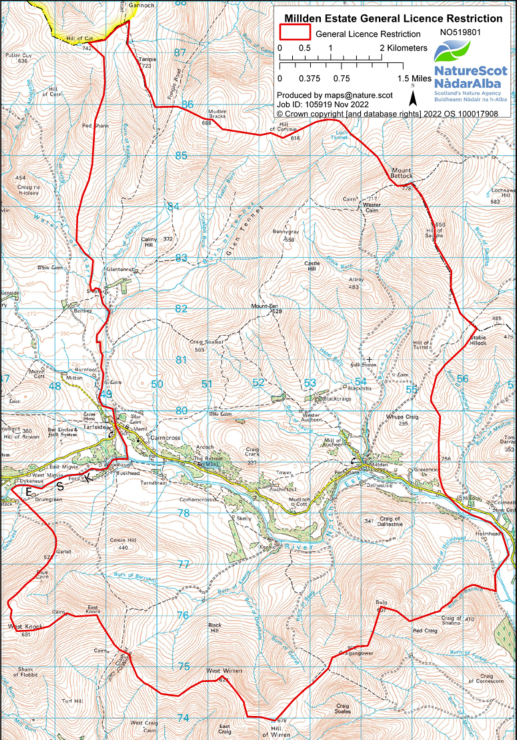
Further to this morning’s news that Millden Estate in the Angus Glens has been slapped with a three-year General Licence restriction after evidence was found of raptor persecution crimes (see here), it’s worth examining the background to this case.

Millden is one of a number of grouse-shooting estates situated in the Angus Glens that has featured many, many times on this blog (see here for all Millden posts).

Location of Millden Estate in the Angus Glens. Estate boundaries sourced from Andy Wightman’s Who Owns Scotland website

Millden Estate first came to my attention in July 2009 when a young satellite-tagged golden eagle called Alma was found dead on the moor – she’d ingested the deadly poison Carbofuran (here). It wasn’t clear where she’d been poisoned and the estate denied responsibility.

Then in 2012 there was the case of another satellite-tagged golden eagle, believed to have been caught in a spring trap on Millden Estate before moving, mysteriously, several km north during the night-time only to be found dead in a layby with two broken legs a few days later (here and here). The estate denied responsibility and the Scottish Gamekeepers Association conducted an ‘analysis’ (cough) and deduced it was all just a terrible accident (here).

There have been other incidents – former Tayside Police Wildlife Crime Officer Alan Stewart describes ‘a horrendous catalogue of criminality’ recorded on Millden Estate during his time (see here). However, despite this history, nobody has ever been prosecuted for raptor persecution crimes on Millden Estate.

Today’s announcement from NatureScot that a General Licence restriction has been imposed on Millden Estate is the first sanction I’m aware of at this location. It has been imposed after three shot buzzards were found in bags outside two gamekeeper’s cottages during an SSPCA-led investigation into badger-baiting and other animal-fighting offences in 2019.

That investigation led to the successful conviction in May 2022 of depraved Millden Estate gamekeeper Rhys Davies for his involvement in some sickening animal cruelty crimes (see here). Despite his conviction, Millden Estate denied all knowledge of this employee’s criminal activities (here).

There hasn’t been a prosecution for the shooting (or possession) of those three shot buzzards, nor for the six other shot raptors found in a bag just a short distance from the Millden Estate boundary (here), and nor will there be, according to a statement provided to me by the Crown Office (here).

With this long history of un-attributable wildlife crime on and close to Millden Estate, the imposition of a General Licence restriction is welcome news, although in real terms it’s nothing more than a minor inconvenience to the estate. It doesn’t stop their legal killing of so-called pest species (e.g. crows) because all they have to do is apply for an Individual licence, which NatureScot will have to grant (although it can revoke an Individual licence if more evidence of crime emerges – as happened on Raeshaw Estate in 2017 – see here), and nor does it stop the legal killing of red grouse, pheasants or red-legged partridge by paying guests.

This photograph appeared on social media in 2017 titled ‘Team Millden’ and shows a bunch of blokes dressed in Millden tweed grinning inside the estate’s larder after a day’s grouse shooting.

I’ve written about the monumental ineffectiveness of General Licence restrictions many times (e.g. see here, here, here, here, here) and my view hasn’t changed. The only weight that a General Licence restriction carries is a reputational hit for the estate on which it is imposed, which was the Environment Minister’s aim when GL restrictions were first mooted (here).

This is useful from a campaigner’s perspective because it allows us to demonstrate that raptor persecution continues on Scottish grouse moors, despite the absurd denials of senior industry representatives (e.g. see here).

But it doesn’t stop the estate’s business activities. You might think that others in the industry, or even elected politicians, would shun a restricted estate but that simply doesn’t happen (e.g. see here and here).

And nor is it an effective deterrent – Leadhills Estate, a grouse moor in South Lanarkshire, was slapped with a second General Licence restriction after ‘clear evidence’ of wildlife crime was uncovered whilst the estate was still serving its first restriction notice (see here)!

Given the current number of grouse-shooting estates serving General Licence restrictions after ‘clear evidence’ of wildlife crime was provided by Police Scotland: Leadhills Estate (here), Lochan Estate (here), Leadhills Estate [again] (here), Invercauld Estate (here), Moy Estate (here) and now Millden Estate (here), it’s clear that the Scottish Government’s proposed grouse-shoot licensing scheme can’t come soon enough.

There are strong rumours that the Wildlife Management (Grouse) Bill will be presented to the Scottish Parliament before Easter and many of us are eagerly awaiting its publication to see the details of what is proposed and, importantly, how it will be enforced.

One thing’s for sure, it will need to be a lot more robust than the General Licence restriction and any sanctions, which should hopefully include terminating an estate’s ability to continue gamebird shooting during a determined-sanction period, will need to be deployed a lot quicker than the time it takes for a General Licence restriction to be imposed (it’s taken four years for the GL restriction to be placed on Millden Estate).

UPDATE 10th March 2023: Millden Estate says it will appeal General Licence restriction imposed after evidence of raptor persecution (here)

General Licence restriction imposed on Millden, a grouse-shooting estate in the Angus Glens, after evidence of raptor persecution

Press release from NatureScot (8th March 2023):

GENERAL LICENCE RESTRICTED ON ANGUS ESTATE

NATURESCOT HAS RESTRICTED THE USE OF GENERAL LICENCES ON MILLDEN ESTATE, IN THE ANGUS GLENS, FOR THREE YEARS

The decision was made on the basis of evidence provided by Police Scotland of wildlife crime against birds.

This evidence included three shot buzzards found on the estate in 2019, and incidents relating to trapping offences.

Donald Fraser, NatureScot’s Head of Wildlife Management, said: “The discovery of three shot buzzards on Millden estate, two of which were found within a bag at an estate house, as well as trapping offences and ongoing concerns relating to general licence compliance, have resulted in the suspension of the use of general licences on this property for three years until March 2026.

“NatureScot is committed to using all the tools we have available to tackle wildlife crime. This measure will help to protect wild birds in the area, while still allowing necessary land management activities to take place.

“We believe this is a proportionate response to protect wild birds in the area and prevent further wildlife crime. We will continue to work closely with Police Scotland and consider information they provide on cases which may warrant restricting general licences.

“The estate may still apply for individual licences; however, these will be subject to enhanced record-keeping and reporting requirements and will be closely monitored to ensure adherence with licence conditions.”

General licences allow landowners or land managers to carry out control of common species of wild birds, such as crows and magpies, to protect crops or livestock, without the need to apply for an individual licence.

In addition to this restriction, there are currently four other restrictions in place in Scotland: on Moy Estate in Highland, Invercauld Estate in the Cairngorms National Park, Lochan Estate in Perthshire and Leadhills Estate in South Lanarkshire.

ENDS

I’ll be writing more about this later today….

UPDATE 16.20hrs: Millden is yet another grouse-shooting estate to be sanctioned after police find evidence of raptor persecution (here).

UPDATE 10th March 2023: Millden Estate says it will appeal General Licence restriction imposed after evidence of raptor persecution (here)

Question tabled in House of Lords on gamebird shooting industry’s failure to stop using toxic lead ammunition

Last week a new scientific study was published, led by eminent researchers from the University of Cambridge, showing that three years into a five-year pledge to completely phase out lead shot in UK game hunting, 94% of pheasants on sale for human consumption were killed using toxic lead ammunition (see here).

The continued use of this poisonous ammunition has health consequences for wildlife (especially birds of prey), the environment and for humans – see here for further information.

Many thanks to Green Party Life Peer Natalie Bennett who has lodged a parliamentary question for DEFRA to answer, asking what steps the Government plans to take to end the use of toxic lead shot given the gamebird-shooting industry’s continued failure to do it voluntarily.

UPDATE 24th April 2023: DEFRA Minister responds to question on gamebird shooting industry’s failure to stop using toxic lead ammunition (here)

More detail provided on why key conservation organisations were excluded from Scottish Government’s review on increasing SSPCA powers

Last month I wrote about how a number of key conservation and animal welfare organisations had apparently been excluded from submitting evidence to the Scottish Government’s independent review on whether the Scottish SPCA should be given increased powers to enable them to investigate a wider suite of wildlife crimes (see here).

A Freedom of Information request had revealed that the non-governmental organisations that had been invited to contribute evidence to the review (Scottish Gamekeepers Association, Scottish Land & Estates, British Association for Shooting & Conservation, and the National Farmers Union Scotland) greatly outweighed the number of conservation/animal welfare organisations invited to participate (limited to the RSPB).

Significantly, a number of important organisations were missing from the list of invited participants, including Scottish Badgers, Scottish Raptor Study Group, OneKind, League Against Cruel Sports, Scottish Wildlife Trust.

It was notable that the pro-gamebird shooting organisations that were invited to participate had all previously been vociferously against giving more powers to the SSPCA (no surprise!) whereas the excluded organisations had all been previously supportive of increased powers.

I wanted to understand whether it was the Scottish Government that had excluded conservation/animal welfare organisations from participating in the review (Scot Gov had previously told me that it had provided a list of ‘key stakeholders’ to the independent Review Chair, Susan Davies FRSB), or whether that decision to exclude them had been made by Susan Davies.

It’s taken the Scottish Government a whole month (!) to respond to my latest FoI with the following:

It appears, then, that the decision to exclude all those conservation and animal welfare organisations from participating in the review was made by the Review Chair, Susan Davies.

This is surprising, given Susan’s long-standing career in nature conservation. However, as I pointed out in an earlier blog, if the independent review DOES recommend increased powers for the SSPCA, then by inviting an overload of anti-SSPCA game shooting organisations, the Review Chair has cleverly covered off any opportunity for them to suggest their views were under-represented in the review process.

Time will tell. We now have to wait for the review to be published, having been submitted to the Scottish Government in October 2022.

Raptor Persecution UK blog is 13 years old

Today this blog reaches its 13th year anniversary.

Who would have guessed, thirteen years ago, that I’d still be writing it? I’m sure, in fact I know, there are plenty who wish I wasn’t, but their ongoing attempts to intimidate and harass simply strengthen my resolve to continue with it.

The blog is approaching nine million views:

As ever, huge thanks to those who help fund my time, those who work with me behind the scenes (you know who you are), to those who send me information, to those who take the time to comment here, and especially to those who share blog posts on social media channels – raising awareness of the illegal killing of birds of prey was the main driver behind setting up this blog and it continues to be one of its main objectives.

Thanks for your continued support.

National Trust terminates another grouse-shooting lease after more evidence of suspected wildlife crime in Peak District National Park

The National Trust (NT) has terminated another grouse-shooting lease in the Peak District National Park after the RSPB uncovered evidence of suspected wildlife crime on one of the NT’s tenanted grouse moors.

The shooting lease, on NT moorland at Park Hall, was held by a nearby grouse shooting estate called the Hurst & Chunal. It is understood that the NT lease on Park Hall was a short-term, one-year lease, initially.

However, in February 2021 the RSPB filmed an unidentified individual at dusk on Park Hall, placing rodenticide blocks (Brodifacoum) inside holes on the moorland that were suspected to be part of a badger sett. This was reported to Derbyshire police who launched an investigation, along with Natural England and the Health & Safety Executive. The RSPB has published a detailed blog about this case – see here.

The police investigation failed to result in a prosecution. Enquiries were made by Derbyshire Police’s Rural Crime Team after the search, including interviews of suspects. After a review, the police informed the RSPB that they could not bring criminal charges in this case. 

The Natural England/HSE investigation is believed to be ongoing.

Meanwhile, the National Trust has taken the decision to terminate the grouse-shooting lease and will not be renewing it or offering it to another tenant; instead the moor will be now be re-wilded.

National Trust-owned moor at Park Hall. Photo: RPUK

This isn’t the first time the NT has terminated a grouse-shooting lease in the Peak District National Park.

You may recall, back in April 2016, I published a video of an armed man crouching next to a decoy hen harrier on Ashop Moor, which, incidentally, is also part of the NT’s Park Hall & Hope Woodlands Estate in the Peak District National Park.

That video footage, filmed by two local birdwatchers, sparked outrage and significant public pressure was placed on the National Trust to take action against its shooting tenant (believed to be Mark Osborne).

As a direct result of that public pressure, in June 2016 the National Trust announced that it was pulling the shooting lease four years early and the shooting tenant was asked to leave by April 2018.

In June 2018, the National Trust announced a significant change in how it was going to select new shooting tenants, ‘to work with us to create a new exemplar model delivering outstanding moorland nature conservation with grouse shooting’ (see here). Many saw this as welcome progress from the NT but others saw it as a ‘lost opportunity’ to remove driven grouse shooting altogether from NT land.

Since the NT modified its tenancy agreements in 2018, at least one new tenant has been and gone, and at least one current tenant is hosting a number of successfully breeding raptor species whilst moderately managing a driven grouse shoot (far less grouse shot in 2021 compared to the thousands shot on some of the more intensively-managed moors).

It was rumoured last year that the NT had agreed to introduce even more modifications to its moorland tenancies, such as burning restrictions, the removal of medicated grit, and the removal of traps and snares, although I haven’t yet seen a formal statement on this from the National Trust.

I think the National Trust’s decision to terminate the grouse shooting lease at Park Hall, AND its refusal to offer the lease to anyone else, deserves much applause. Full credit too, to the RSPB’s Investigations team for providing the evidence needed by the NT to take such decisive action.

New study shows pheasants still full of poisonous lead shot three years after start of ‘voluntary transition’ to non-toxic shot

Three years ago in February 2020, nine UK game-shooting organisations made a massive U-turn after years and years and years of defending the use of toxic lead ammunition, and said they wanted to drag the industry into the 21st Century by making a five-year voluntary transition away from lead ammunition (see here).

A lot of us were sceptical because (a) we rarely trust anything the industry tells us; (b) previous ‘voluntary bans’ by the industry on a number of issues have been spectacularly unsuccessful (e.g. see here, here and here); (c) the ongoing failure of the shooting industry to comply with current regulations on many issues, including the use of lead ammunition over wetlands (here), means there should be absolutely zero confidence in its ability and/or willingness to stick to any notional voluntary ban; (d) the Scottish Gamekeepers Association refused to sign up to the proposed five-year transition period because they believe there is insufficient evidence to support the claim that lead can have damaging impacts on humans, wildlife and the environment (here); and (e) in the very same year that nine shooting organisations committed to the five-year transition, BASC announced it was set to fight a proposed EU ban on the use of lead ammunition on wetlands (see here).

Fortunately for us, a new, independent project was established, led by experts at Cambridge University, to monitor the professed voluntary five-year transition from toxic lead to non-lead ammunition in the UK. Called SHOT-SWITCH, the project intends to test wild-shot pheasants offered for sale across Britain each year and determine if they have been killed using toxic lead or non-lead shotgun ammunition. Interestingly, the project is supported by funds from the RSPB and from Waitrose, who you’ll recall were the first supermarket to be heading towards a ban on selling game meat shot with lead ammunition (see here, but who seem to have been duped by the shooting industry last season – here).

To find out more about the SHOT-SWITCH project please visit the webpage here

Lead shot pellets removed from a pheasant carcass. Photo: Rhys Green

For the last two years, Shot Switch has published peer-reviewed scientific papers to demonstrate that 99.5% of the pheasants they tested contained toxic lead shot (see here and here).

This year, year three of the study, the scientists have published another peer-reviewed paper, and guess what? Well, you can read it for yourselves:

They’ve also issued a press release, which reads as follows:

VOLUNTARY UK INITIATIVES TO PHASE OUT TOXIC LEAD SHOT FOR PHEASANT HUNTING HAVE HAD LITTLE IMPACT

Three years into a five-year pledge to completely phase out lead shot in UK game hunting, a Cambridge study finds that 94% of pheasants on sale for human consumption were killed using lead.

The pledge, made in 2020 by nine major UK game shooting and rural organisations, aims to protect the natural environment and ensure a safer supply of game meat for consumers. Lead is toxic even in very small concentrations, and discarded shot from hunting poisons and kills tens of thousands of the UK’s wild birds each year.

A Cambridge-led team of 17 volunteers bought whole pheasants from butchers, game dealers and supermarkets across the UK in 2022-23. They dissected the birds at home and recovered embedded shotgun pellets from 235 of the 356 pheasant carcasses.

The main metal present in each shotgun pellet was revealed through laboratory analysis – conducted at the Environmental Research Institute, University of the Highlands and Islands, UK. Lead was the main element in 94% of the recovered shot pellets; the remaining 6% were predominantly composed of steel or a metal called bismuth.

The results are published today in the Conservation Evidence Journal.

At the request of the Defra Secretary of State, the UK Health & Safety Executive assessed the risks to the environment and human health posed by lead in shots and bullets. Their report proposes that the use of lead ammunition be banned, and this is currently under review. While remaining committed to phasing out lead shot voluntarily, many shooting organisations do not support the proposed regulatory restrictions.

“If UK game hunters are going to phase out lead shot voluntarily, they’re not doing very well so far,” said Professor Rhys Green in the University of Cambridge’s Department of Zoology, first author of the study.

He added: “The small decrease in the proportion of birds shot with lead in the latest UK shooting season is nowhere near on track to achieve a complete transition to non-toxic ammunition in the next two years.”

This is the third consecutive year the team has conducted the analysis. Their latest study shows a small improvement on the 2021/22 and 2021/20 shooting seasons, when over 99% of the pheasants studied were shot using lead ammunition.

In separate initiatives, some suppliers of game meat for human consumption – including Waitrose & Partners – have voluntarily announced their intention to stop selling game killed using lead shot. An assurance scheme has also been launched to encourage suppliers and retailers to facilitate the transition.

The team did not find any pheasant on sale in Waitrose in 2022/23 despite repeated visits to 15 different stores. Waitrose staff reported that the company had not been sufficiently assured by any supplier in 2022/23 that all pheasants had been killed using non-lead ammunition.

“Waitrose is the only retailer we know of fully complying with the pledge not to supply pheasant killed using lead, but it’s only managing this by not selling any pheasant at all,” said Green.

Pheasant was marked as being ‘temporarily unavailable’ at Waitrose stores this winter. Photo: Ruth Tingay

Steel shotgun pellets are a practical alternative to lead, and the vast majority of shotguns can use them or other safe lead-free alternatives. Shooting magazines and UK shooting organisations have communicated positive messages for three years about the effectiveness and practicality of non-lead shotgun ammunition.

Shooting and rural organisations – including the British Association for Shooting and Conservation and the Game and Wildlife Conservation Trust – have consistently provided information and detailed guidance to encourage the transition from lead to non-lead ammunition since 2020.

“Denmark banned lead shotgun ammunition in 1996, and a successful transition was made to steel and bismuth. It’s safer for the environment and gives game shooting a better image,” said Green.

A previous study led by Green found that pheasants killed by lead shot contain many fragments of lead too small to detect by eye or touch, and too distant from the shot to be removed without throwing away a large proportion of otherwise useable meat. This means that eating pheasant killed using lead shot is likely to expose consumers to raised levels of lead in their diet, even if the meat is carefully prepared to remove whole shotgun pellets and the most damaged tissue.

Lead has been banned from use in paint and petrol for decades. It is toxic to humans when absorbed by the body and there is no known safe level of exposure. Lead accumulates in the body over time and can cause long-term harm, including increased risk of cardiovascular disease and kidney disease in adults. Lead is known to lower IQ in young children, and affect the neurological development of unborn babies.

Funding from the RSPB and Waitrose supported this work.

ENDS

UPDATE 7th March 2023: Question tabled in House of Lords on gamebird-shooting industry’s failure to stop using toxic lead ammunition (here)

UPDATE 24th April 2023: DEFRA Minister responds to question on gamebird industry’s failure to stop using toxic lead ammunition (here)

UPDATE 24th April 2023: BASC slurs expert study on amount of toxic lead ammunition in pheasants as ‘pseudoscience’ (here)

UPDATE 16th August 2023: BASC ‘forgets’ to mention evidence showing no difference between penetration level of lead vs steel shot in ‘game meat’ (here)

‘SNP leadership race is perfect opportunity to tackle land (& grouse moor) reform’ – comment piece by Max Wiszniewski

Max Wiszniewski is Campaign Manager for REVIVE, the coalition for grouse moor reform.

He’s written a comment piece for today’s edition of the National, discussing the current SNP leadership race which Max thinks is a perfect opportunity to tackle land (and grouse moor) reform.

His article is reproduced below:

THE leadership election for the Scottish National Party, the party of government, could literally change the face of Scotland.

Scotland will soon have a new first minister at a time when land reform and grouse moor reform is high up on the political agenda. Parliamentary bills on both are due in the not-too-distant future and real reform remains popular with both the public and particularly within the membership of the SNP.

After more than two decades since we established the Scottish Parliament, our nation still has the most inequitable land ownership in  the developed world.  Members of the SNP may be familiar with the figure that around 432 families own more than half of Scotland’s private land. 

There has been important, albeit very limited, progress in diversifying land ownership in recent years but new leadership at the top level is Scotland’s opportunity to really go for it.

Grouse moors are a metaphor for land reform issues in Scotland – a lot of land used for the benefit of very few people at the expense of our wildlife and the environment – with a steep cost to rural people who deserve so much better than the limited opportunities these large estates afford them.

An area around half the size of Wales is managed for grouse shooting in Scotland which provides fewer jobs and opportunities than alternative land uses.

Nature-based tourism, excluding “field sports”, is worth more than £1.2 billion overall – more than 50 times to our economy than grouse shooting, while forestry has an economic impact over 15 times greater per hectare.

Meanwhile, hundreds of thousands of animals like foxes, stoats, weasels, crows and even “non-target species” like hedgehogs are killed every year, just so more grouse can be shot by very few people for the controversial “sport”.

In a time of climate crisis, an area of more than 200,000 football pitches is regularly burned on grouse moors (muirburn) to make the land more suitable for grouse, scarring the landscape and damaging our vital peat reserves – an internationally significant carbon sink.

If we seek to advance opportunities for rural people, jobs in shooting grouse for sport is not in our future. With the destruction to our wildlife and the environment, grouse shooting offers nothing for a modern Scotland under new leadership. We need real reform.

Whoever is elected, the new party leader should take confidence that tackling this issue properly and speeding up land reform efforts would be popular with the SNP membership that elected them.

In 2020, despite it getting lost as part of a conference “super-motion”, an SNP membership motion to essentially end driven grouse shooting was backed by more branches than any other resolution that year. 

Moreover, if the enthusiastic support for radical land reform – including progressive land taxation – from the hundreds of people at Revive’s SNP conference meetings is anything to go by, the SNP leadership really can be brave.

The Scottish Government has started some good work on the grouse reform front but needs to go much further. It most certainly should not be brow-beaten by those representing large, landed interests into watering-down what it already has proposed or from going further.

The new SNP leader may also recognise that despite what is claimed, these powerful vested interests do not represent rural Scotland or most of its people (who are actually against grouse shooting).

The lobbyists for sport shooting do, however, wish to halt the change the SNP have aspired to for decades.

All the unsustainable things that take place on these moors, so more grouse can be shot for sport, must end to allow us to transition to a more diverse mosaic of land uses in upland Scotland.

This will help diversify land ownership as well.  It’s estimated that for every brace of grouse killed for sport, £5000 can be added on to the estate’s value for the owner. If you end the speculative land value created from this unsustainable land use, coupled with land reform, it can help more communities take back our land. 

The successful Langholm buyout of a former grouse moor in southern Scotland, which is revitalising the local area, is a great but rare example that depended on immense dedication and voluntary efforts from local people to achieve it as well as huge sums of money to  be raised.

The Government should use a push and pull philosophy. As well as incentives, they should use the law to disincentivise individuals or overseas corporations from owning large estates like grouse moors – to bring down the price of land for communities to purchase.

Land taxes should not be one of the tools that are left off the table. Having the land ownership diversity of a normal European country like one of our Nordic neighbours is not radical, it’s inherently sensible.

Whatever happens in this leadership election, we hope all the candidates will openly commit to pursuing the inherently sensible cause of land reform, land taxes and real grouse moor reform in Scotland. If so they will change the face of Scotland for the better.

The new leader should have no problem saying to the people of Scotland that this land is our land. This country is yours, and it’s time to take it back again.

Max Wiszniewski is Campaign Manager for Revive, the coalition for grouse moor reform

ENDS

Dorset landowner cleared of assaulting gamekeeper & beater after argument over low number of gamebirds available to be shot

There’s been widespread media coverage of a court case at Weymouth Magistrates this week, which mostly focused on a ‘frustrated’ landowner, William Elder, throwing a dead partridge at his gamekeeper, Daniel Burden, and the gamekeeper throwing it back at his boss, after an argument about whether paying guests had been given the best opportunity to shoot as many pheasants and partridges as they’d paid to kill on a shoot day at Stancombe Farm in Askerswell, Dorset.

This article from The Telegraph provides a pretty good overview of the case. [Update – the article has been reproduced in full at the end of this blog]

Despite the sensationalist media headlines, the partridge-throwing incident wasn’t really the focus of the case. The landowner had been charged with two counts of assault – one for allegedly kicking and chest-bumping his gamekeeper, and one for allegedly kicking a teenage beater up the backside.

Magistrates cleared Mr Elder of both assault charges (the magistrates’ reasoning is included in the Telegraph article – worth a read!).

We often hear about the tensions between shoot owners and their gamekeepers, and the sometimes unspoken pressure that shoot/landowners place on their employees to produce sufficient quantities of gamebirds, whether that be pheasants, partridges or grouse, to satisfy the expectations of paying shooting guests. This is often provided as an explanation for why some gamekeepers illegally kill birds of prey. And although this particular case doesn’t involve allegations of raptor persecution, it does provide clear evidence of those tensions, only this time they were spoken and came straight from the shoot owner’s mouth.

UPDATE: The Telegraph article in full:

A landowner threw a dead partridge at his gamekeeper in a falling out over the lacklustre spoils of a £15,000 game shoot, a court has been told.

Farmer William Elder took issue with the direction his team of beaters were driving pheasants and partridge at his Dorset farm.

With guns paying almost £2,000 each for the day’s shooting, he was concerned some of them hadn’t bagged enough birds – and would ask for their money back.

He was charged with assault after an argument with his gamekeeper and a teenage beater over the issue.

Mr Elder, who was standing with the guns, berated gamekeeper Daniel Burden and the beaters over the radio, causing some of them to walk off in protest.

Later, the 60-year-old farmer and Mr Burden came together at the farm with both men accusing each other of acting aggressively.

Mr Elder claimed his gamekeeper threatened to “belt” him and the shoot captain, Steve Smith, had to come between the pair.

A court heard Mr Elder then threw a partridge he was holding at Mr Burden, hitting him on the leg.

In retaliation, the gamekeeper picked up the dead bird and threw it back at his boss.

Mr Burden, who is in his 40s, further claimed the farmer “chest bumped” him and then kicked him several times in the legs.

One beater also accused Mr Elder of assaulting him in the disagreement over the way the pheasants were being flushed out of woods.

The teenager, who can’t be named for legal reasons, claimed Mr Elder kicked him in the backside and told him to “get off my land”.

Mr Elder denied both allegations of assault, but admitted to throwing the patridge out of sheer frustration.

The partridge throw wasn’t included in the assault charge.

He was found not guilty of both charges following a trial at Weymouth Magistrates’ Court on Thursday.

The court heard that the incident happened towards the end of a day of shooting on Stancombe Farm in the village of Askerswell, Dorset, on Nov 11 2021.

Mr Elder has run shoots on his 700-acre farm for 35 years and the event in question was one of the first to be held after the relaxation of Covid rules.

The shoot involved eight guns standing at set pegs at the bottom of a hill and the team of beaters driving out pheasants and partridge at the top.

There had been three drives in the morning and breaks for elevenses and lunch without any issues.  

But during the afternoon drive, Mr Elder became angry when he felt one end of the line was pushing the birds the wrong way.

He later explained he was aware that three of his clients positioned on one side of the estate had only bagged between 10 and 15 birds.

Mr Elder, who has owned the farm for 40 years, said: “My prepared statement was written within hours of the incident because I was going to bring a complaint against [the two complainants].

“Also the gunners could have come back with a financial claim on me so I also wrote it to show the gunners I was not at fault.

“I am responsible for the whole game, anything I say to the beaters they have to do. I can’t have people running around doing what they want.

“They have to follow my orders from a safety point of view because you have got people with guns. I’m not rude, I just give sharp orders.

“One side of the line kept moving the birds the wrong way. I had three guns who weren’t having any shooting.

“The five guns on the other end had lots, about 70 to 80 shots each, the three guns on the right side probably only had 10 to 15 shots each.

“He kept on moving when I expressly asked him not to. In the end I did say a sharp order ‘for god’s sake, please stop’.

“I was trying to get the birds over the other guns.”

Mr Burden said: “Everything was going well as far as I was concerned.

“Mr Elder was complaining the other end of the line was moving and coming in too quickly.

“From where I was I could see the other end of the beating line. Mr Elder wasn’t correct.

“As we got towards the end I realised some of the beaters had left due to the way he was talking to him so on the radio I told Mr Elder we couldn’t do another drive after this one because some of them had left and we didn’t have enough beaters to do it.”

Magistrates heard that the teenage beater first encountered Mr Elder on his way back to the farm.

Mr Elder claimed the teen was “extremely aggressive” and had a beater’s flag raised above his head so he kicked out in self-defence.

He said: “He started shouting at me that I don’t know anything about running a shoot and ‘we’re gonna do you’. He pushed past me, hitting me with his shoulder, and I pushed him away with my boot on his backside.”

Back at the farm Mr Elder said he told his clients not to tip the keeper because he had “lost the plot”.

Describing what happened with Mr Burden, he said: “Dan said ‘I’m going to f—— well belt you’ and Steve had to step in front of him.

“I said ‘go on, hit me, don’t just threaten me’ and in a fit of frustration I threw a partridge. It was supposed to hit the ground but it actually hit Dan at his feet.

“He started shouting all sorts of stupid names like ‘p—-’ and then threw the partridge back at me.

“Dan said ‘I’m going to bloody well hit you’ again but Steve said ‘no stop’ and I told him to go and never come back.”

Robert Ford, chairman of the bench, said the court had two contradictory statements regarding the alleged assault of Mr Burden and so they could not be sure beyond reasonable doubt that it happened.

With the alleged assault on the teenager, Mr Ford said they accepted Mr Elder was a man of good character and that he believed he perceived a threat and the push was proportionate.

The court found Mr Elder not guilty of both charges.

ENDS

Andy Wightman revamps ‘Who Owns Scotland’ website

Formidable land reform campaigner Andy Wightman has revamped his ‘Who Owns Scotland‘ website – a fantastic resource for anyone interested in land ownership and a site I’ve used countless times to investigate locations of raptor persecution crimes.

Here’s a new brochure from Andy to encourage new subscribers:

If you have any questions about the project, please contact Andy at admin@whoownsscotland.org.uk

You might also be interested in following Andy’s personal blog, Land Matters, here.