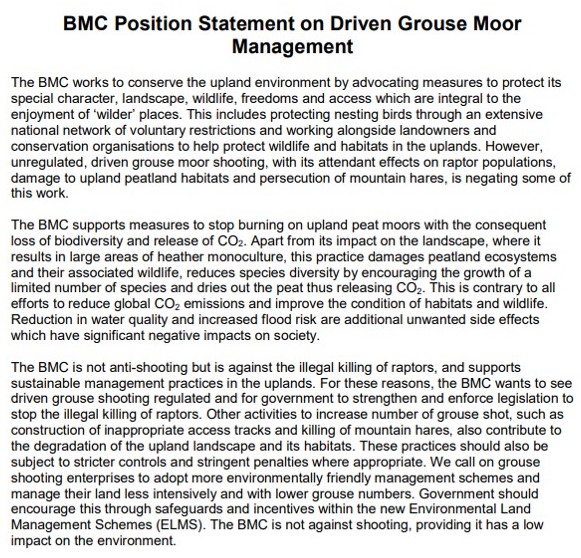
The British Mountaineering Council (BMC) has written a blog (here) and published a position statement on the management of driven grouse moors.
This is really encouraging. Even though the BMC is advocating the ‘regulation’ of driven grouse shooting, which presumably means licensing rather than a ban, and there are well rehearsed arguments for and against this approach, that’s not the point here.
The point is, the BMC has felt the need to first consider and then publish a position statement and its position is very clearly against the status quo. That’s brilliant.
The BMC is the national representative body that champions the interests of climbers, hill walkers, mountaineers and ski mountaineers in England and Wales. It’s an organisation with over 85,000 members including individuals and more than 250 BMC-affiliated clubs. That’s quite a substantial reach.
Which organisation, beyond the usual conservation bodies, will be the next to make a stand?
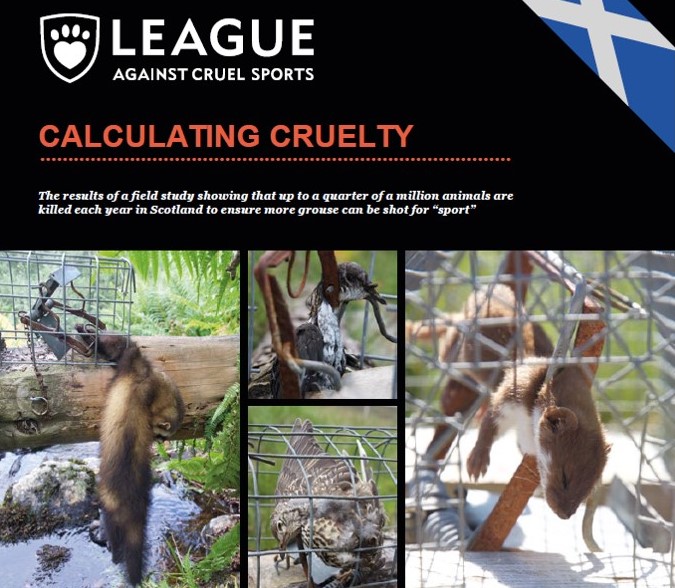
Following the recent publication of a new report from the Revive coalition documenting the extent of wildlife-killing on Scottish grouse moors (up to a quarter of a million animals killed in traps and snares each year – see here), there’s an opinion piece in today’s Scotsman from Robbie Marsland, Director of the League Against Cruel Sports (Scotland) and a member of the Revive coalition.
Over 15 months, a professional surveyor spent 128 days walking 404 square kilometres of land on seven Scottish shooting estates. As he walked, he counted, photographed and recorded the GPS position of traps and snares that were deployed to kill foxes, stoats and weasels. The data from the survey was [sic] sent to a recently retired professor of environmental science at Bristol University for analysis.
The analysis revealed that between 120,000 and 260,000 animals are killed each year by these devices in Scotland alone. The analysis also revealed that the more an estate was intensively managed for the shooting of grouse, the more intensive was the killing.
The Scottish Government has a chance to show that they want to end this killing when they respond to a report from the Grouse Moor Management Review Group. Due in the autumn, this response will be able to reference the results of our survey and announce what steps it plans to make to end the circle of destruction that surrounds grouse moors, including the killing of hundreds of thousands of animals so that more grouse can be shot for “sport”.
The League Against Cruel Sports Scotland commissioned the survey and published the analysis of the data and a summary report, ‘Calculating Cruelty’. The Scottish Gamekeepers Association reacted to the report with scurrilous attacks on the professor who did the analysis, describing, without any explanation, his work as “back of fag-packet calculations and wild extrapolations”.
The Game and Wildlife Conservation Trust (GWCT), advisers to the shooting industry, had a more measured response. They pointed out that a new type of trap had recently been introduced that made our report “out of date”. They also said that the wide range of management practises on shooting estates made extrapolations “questionable”. Finally, they denied that the purpose of all the killing was for the benefit of increasing numbers of grouse to be shot.
There is a circle of environmental, social and wildlife destruction that surrounds Scottish grouse moors. For an extremely modest return of around £23 million a year, vast swathes of Scotland are managed to produce a surplus of grouse to be shot for sport in the four months after 12 August.
“Managed” in this context mainly involves destruction. The heather is burned, often on deep peat, to provide better habitat for the grouse. Medicated grit is left out in the open in the hope that it will protect the grouse from worms. No one knows what impact the medication has on other flora or fauna. Unplanned tracks and roads scar the landscape and make it easier for the shooters to get about. An average of 26,000 mountain hares are shot each year because it is thought that this protects the grouse from ticks (although there is no science to back this up). Anything that threatens the grouse is described as a pest and destroyed. Hence the huge deployment of effort against foxes, stoats and weasels.
So, what of those comments by the GWCT? Firstly, the introduction of a new type of trap is immaterial. A better way of killing hundreds of thousands of animals so there can be more grouse to shoot is not a solution. It is a distraction from the main event. So too is the suggestion that the variety of levels of management intensity make extrapolation “questionable”.
Of the seven estates surveyed, they ranged from one highly intensively managed estate all the way down to two that were practically unmanaged for grouse. And finally, the suggestion that the circle of destruction surrounding grouse moors is done for the benefit of all ground-nesting birds, and not just to increase grouse numbers, tests credulity.
The survey reveals that around 40 per cent of the animals found in traps and snares were “non target”, such as hedgehogs, thrushes and dippers. This could be described as “collateral damage”. If so, the impact on other ground-nesting birds could be described as a “collateral benefit”. It is no surprise that when you manage land to increase the number of grouse, a ground-nesting bird, other ground-nesting birds also do well.
But do they? It looks like we are heading into the third “poor year for grouse shooting” in a row. Weather conditions are said to have been bad for the grouse and “sporting bag numbers” (the numbers of grouse shot) are feared to be very low this season. Before this survey was done, no one knew the extent of predator control on Scottish shooting estates. But we did know that it had all the chances of being a “free for all” because there is no duty on anyone to report to anybody on the number of animals being killed. Our 15-month survey was the first quantitative study of a very sizable proportion and range of shooting estates. We may not have the resources of the shooting industry but we have this [sic] data. It seems strange that they try to cast doubt on our survey but they cannot come up with their own number of animals being killed each year.
At the end of the day, I think it is unconscionable to kill just one animal to make sure that there are more other animals to kill for “sport”. It’s important to remember that our reports only looked at traps and snares. We still don’t know how many other foxes and crows are shot each year. I was on a grouse moor the week before the start of the season and the ground was routinely littered with spent shotgun cartridges – each representing a dead animal.
Fag packets and wild extrapolations aside, it seems clear to me that there is a war against wildlife going on in our highlands and the Scottish Government now has the chance to stop it.
ENDS
Robbie was recently in conversation with Chris Packham about the future of Scotland’s grouse moors. If you missed it, you can watch it here:
I'm live now with Robbie Marsland of @ReviveCoalition in conversation about the need for grouse moor reform as we pass 90,000 emails sent to elected politicians across the UK.
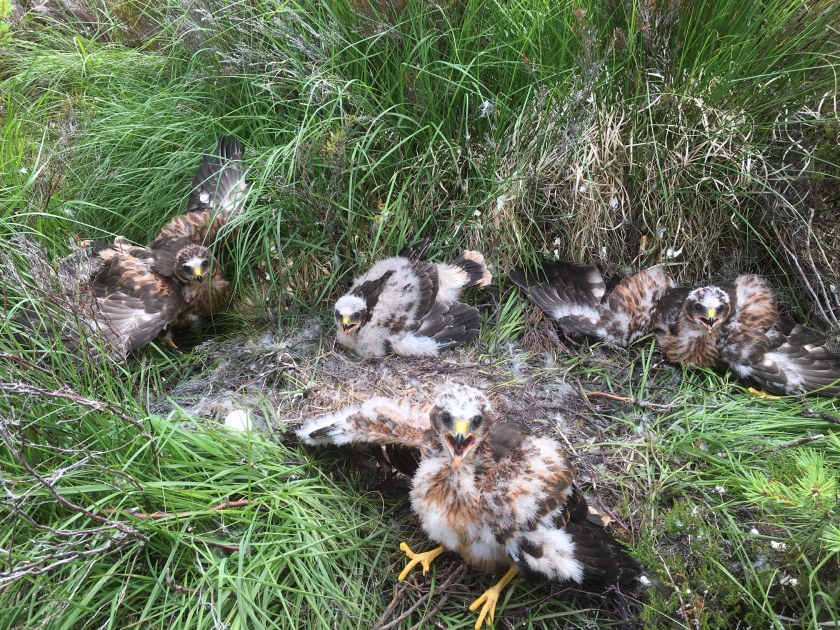
It’s not often there’s a good news story about the hen harrier, a species that suffers acute levels of persecution on many driven grouse moors across Scotland and England, so much so that the UK hen harrier population is in decline.
So there’s welcome news from the Isle of Lewis in the Outer Hebrides, where the RSPB’s Conservation Manager Robin Reid has reported the establishment of a small new breeding population, estimated to be ‘over ten breeding pairs’.
If you want to find out why hen harriers were considered a rare species on Lewis until recent years, why conservationists think they’re breeding there now, and what threats they may face on this island, you can read Robin’s blog here.
[Young hen harriers from a nest on Lewis, photo via RSPB Scotland]
Yesterday evening Chris Packham was in conversation with Alison Johnstone MSP of the Scottish Greens, talking about the future of driven grouse shooting in Scotland.
This took place as part of the joint e-action campaign by Wild Justice, RSPB and Hen Harrier Action to encourage UK voters to contact their elected representatives principally about tackling the ongoing illegal killing of birds of prey on driven grouse moors. Yesterday the total soared past 100,000 emails.
This conversation between Chris and Alison is well worth a listen.
Here are some highlights:
Chris Packham: ‘A 100,000 emails, Alison, what has this meant to elected representatives who’ve come in, opened their computer inbox and sat down and seen them?‘
Alison Johnstone: ‘It’s left elected representatives like myself in no doubt whatsoever as to the strength of public feeling.
We know that people want action, they’re absolutely sick to the back teeth of hearing that another bird of prey has been persecuted. This afternoon I went in to my Parliamentary inbox and I would say every couple of minutes I’m receiving one of these emails.
In Parliament during the week, one of my colleagues said, ‘Oh, could you..’ (I would say not a Green colleague of course), one of my colleagues laughingly said, ‘Oh, could you not do anything to stop those emails coming in?’ And I said, ‘You know, I’d really like to claim credit for that fabulous campaign but that’s down to the RSPB, Wild Justice and Hen Harrier Action’. But there is no doubt at all the message is getting across loud and clear, so great work!‘
Incidentally, Alison’s colleague Mark Ruskell MSP tweeted this morning that he’d received ‘well over 500 emails’ from his own constituents on this topic:
Alison Johnstone: ‘I think the Scottish Government is beginning to understand now that this is actually a vote winner for them.
If they listened to what really concerns people in Scotland, the fact that they’ve received so many emails in recent days about the persecution of birds of prey, when you think about all the other challenges we’re currently facing with Covid 19 pandemic, with the potential of a looming no-deal Brexit, but people still want them to protect the environment, I think that says a lot‘.
The conversation, which also included issues such as the Werritty Review and Alison’s recent success at securing protection for mountain hares (here) but the Scottish Government’s subsequent ‘dragging of feet’ to enact it (here) can be watched in full below (if you can’t access it go to Chris’s social media pages to find the recording):
I'm in conversation now with @AlisonJohnstone from @ScotGP as I continue my live shorts with politicians & change-makers.
Alison introduced the measure which led to mountain hares being given protected species status in Scotland. https://t.co/I88wNnwPRf
The e-action currently stands at over 117,000. It closes on tomorrow (Monday 31st Aug) at midnight. As Alison and other politicians have said, every single email counts so please consider joining in if you haven’t already – CLICK HERE.
The e-action campaign to urge politicians across the UK to take action on grouse moor reform has passed the 100,000 mark!
This campaign was launched just three weeks ago on Hen Harrier Day by Wild Justice, RSPB and Hen Harrier Action and the response from the general public has been phenomenal. Massive thanks to everyone who has joined in.
Wild Justice has written a blog (here) outlining what will happen next. Information will be published via the Wild Justice newsletter so if you haven’t yet signed up for that here’s how to subscribe.
The e-action is open until Monday evening so there’s still time to take part and get your local politician involved – see here.
Chris Packham was live with Iolo Williams as the counter passed the 100,000 mark earlier this afternoon. You can watch a recording here:
The moment we hit 100,000 emails on live earlier with @IoloWilliams2 !
A massive thank you to everyone who has taken action – this has sent a strong message to our elected politicians that enough is enough , we must end the illegal persecution of our raptors . pic.twitter.com/4qGC1LAng8
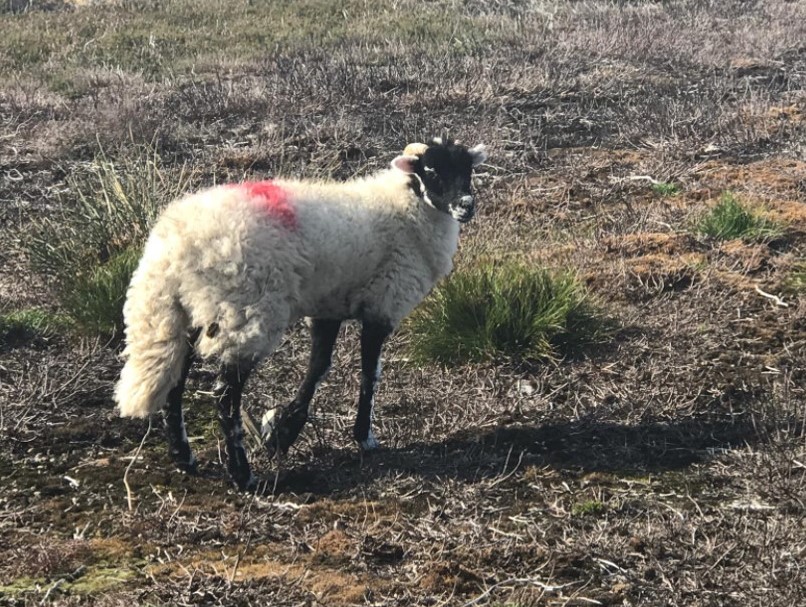
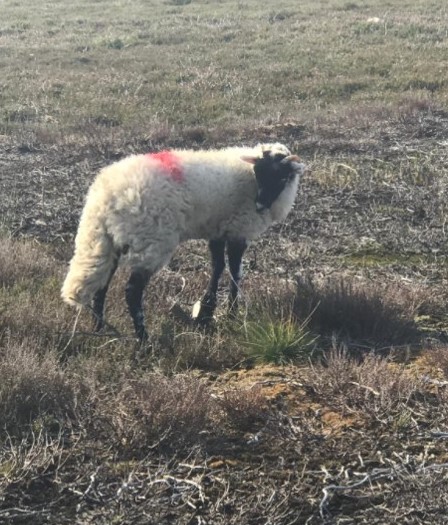
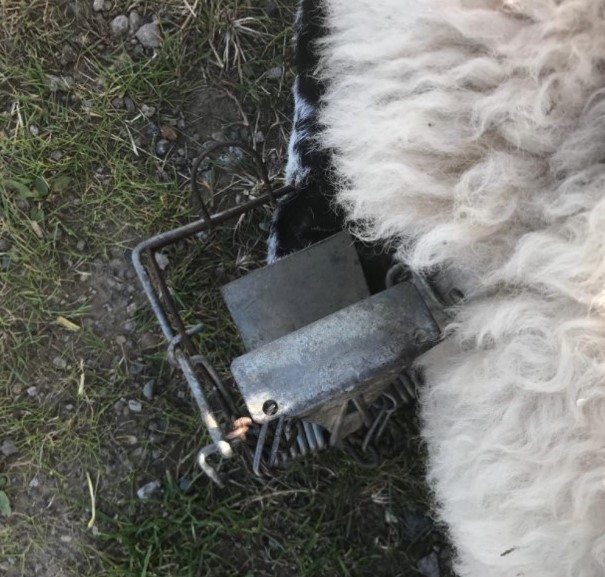
A lamb has been euthanised after being found in the North York Moors National Park with an illegally-set spring-trap attached to its leg.
The lamb was discovered on 8th August 2020 and was seen by a vet, who reported a nasty bone infection tracking up the lamb’s leg from the trap injury. A decision was taken to euthanise the stricken animal.
The use of this type of spring trap (a Fenn trap) became subject to new regulations in April this year as it is no longer considered humane for killing stoats. Gamekeepers have been urged to stop using them altogether in most situations and switch to a trap with a different design (e.g. see here and here).
Nevertheless, even if the operator of this particular trap had a defence for its lawful use, it would appear that it had still been set illegally if this lamb had managed to get its leg caught in it. Spring traps have to be placed inside a tunnel (artificial or natural) with excluders at each end to prevent non-target species entering the tunnel and getting caught.
Of course, even though the police are investigating this incident the chance of anyone being prosecuted is absolutely zero because it would be virtually impossible to determine who had set the trap. Even if there was a lawful requirement for the trap operator to have an identifying tag on the trap (which there isn’t), the police would still have enormous difficulty finding sufficient evidence to demonstrate it had been set by the operator and not by a third party.
What the police can do, though, is to visit the landowners in this area and ‘give them advice’ about the lawful use of traps.
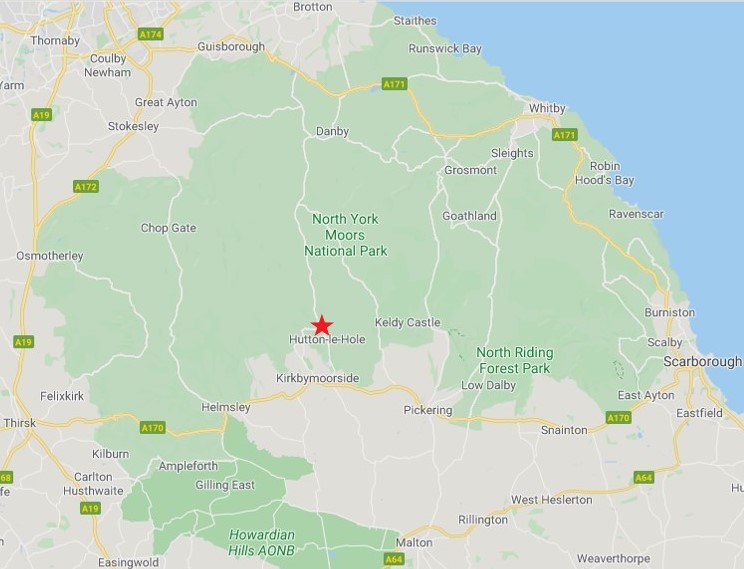
Interestingly, this lamb was found on land close to Hutton-le-Hole, which is remarkably close to where the suspected poisoned sparrowhawk was reported a few days ago (here) and where a satellite-tagged hen harrier ‘disappeared’ in 2018 (see here).
Anyone with information about any of these cases, please contact PC Jez Walmsley at Malton Police Station on 101.
Back in November 2019, Scottish Natural Heritage (SNH) imposed a three-year General Licence restriction on Leadhills Estate in South Lanarkshire following ‘clear evidence from Police Scotland that wildlife crimes had been committed on this estate’ (see here, here, here,here, and here).
Those alleged offences included the ‘illegal killing of a short-eared owl, two buzzards and three hen harriers’ that had been ‘shot or caught in traps’ on Leadhills Estate since 2014. SNH also claimed that ‘wild birds’ nests had also been disturbed’, although there was no further detail on this. The estate denied responsibility, obviously.
[This male hen harrier was found with its leg almost severed, caught in an illegally-set trap next to its nest on Leadhills Estate in 2019. Despite valiant efforts by a top wildlife surgeon, the bird didn’t survive. Photo by Ruth Tingay]
As regular blog readers will know, a General Licence restriction is supposed to prevent an estate from killing so-called ‘pest’ species (e.g. crows) that would otherwise be permissible under the General Licences but estates can still apply to SNH for an ‘individual licence’ to circumvent the General Licence restriction and continue killing birds, albeit with a bit more paperwork to complete.
This ridiculous situation is a legal quirk, outlined in a Judicial Review, and isn’t SNH’s fault (although SNH could be doing a lot more to point out the system failings to the Scottish Government). Basically if a penalised estate isn’t provided with an opportunity to apply for an individual licence the estate could argue the system was unfair and the legality of the General Licence restriction probably wouldn’t stand. If further wildlife crimes are discovered on the estate when an individual licence is in place, SNH can revoke the individual licence but the estate can simply reapply for another one. We’ve discussed how the General Licence restriction is a wholly ineffective deterrent plenty of times in the past, (e.g. see here, here, here, here) and last year we even gave evidence to this effect alongside RSPB Scotland and others to a Scottish parliamentary committee (here).
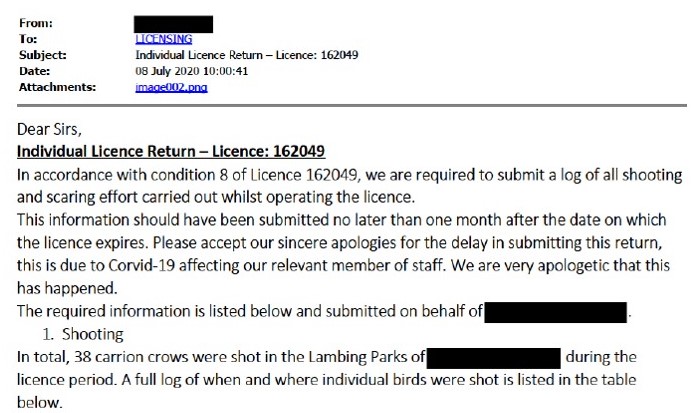
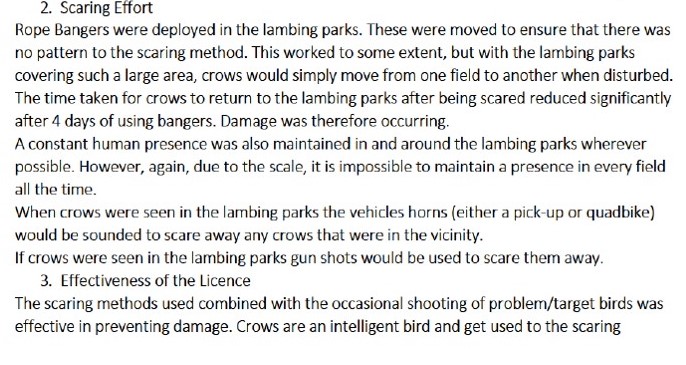
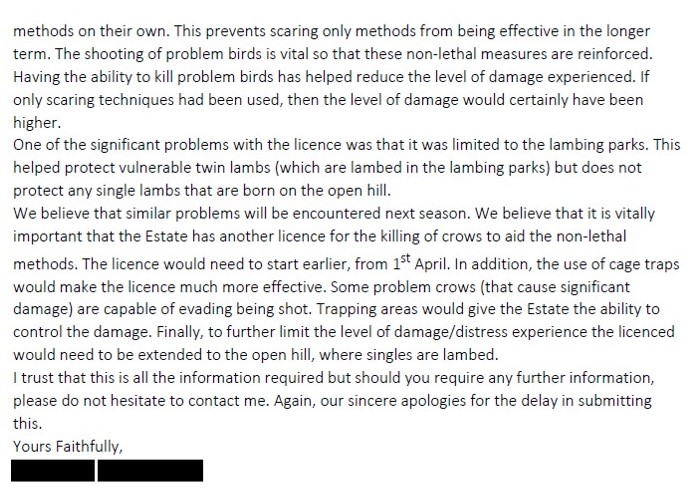
In July this year we discovered via a freedom of information request that SNH had indeed granted an individual licence to Leadhills Estate that was valid between 27 April – 1 June 2020. It permitted the shooting of two species, hooded crow and carrion crow, in a limited part of the estate and apparently to protect lambs (see here).
One of the conditions of the licence was that the estate had to submit a return to SNH no later than 1 July 2020, documenting all shooting and scaring activities undertaken under this licence.
We wanted to see this return and we also wanted to know the details of the compliance checks undertaken by SNH. SNH has stated previously that any individual licences issued to Leadhills Estate would be ‘closely monitored’ and this ‘tighter supervision is a proportionate response to protect wild birds in the area and prevent further wildlife crime’.
Another FoI was submitted and here is SNH’s response:
It’s all very interesting, isn’t it?
But not as interesting as the fact that Police Scotland are currently investigating a number of new alleged wildlife crimes on this estate (see here) including the alleged shooting of a(nother) short-eared owl by a masked gunman on a quad bike as witnessed by a local resident and his eight year old son (see here).
The question now is, in light of these new alleged offences and the obvious conclusion that imposing a three-year General Licence restriction did not prevent further wildlife crime taking place, as SNH thought it might, will SNH now extend Leadhills Estate’s three-year General Licence restriction as its policy allows if further evidence of wildlife crime is uncovered during the original three-year restriction period, and refuse the individual licence that the estate appears to want for next spring? Is there any point to further licence restrictions? It seems pretty ineffective, to be honest.
There are another couple of questions, too, but these are for Scottish Land & Estates (SLE), the grouse shooting owners’ lobby group. We’ve been asking these questions for years but SLE hasn’t replied yet. Can’t imagine why. These are really questions that should be asked by the so-called ‘partner organisations’ that serve alongside SLE on the so-called ‘partnerships’ such as the Partnership for Action against Wildlife Crime Raptor Group with its zero tolerance for raptor persecution. Here are the questions again, for old times’ sake:
Is Leadhills Estate still a member of SLE?
Is Lord Hopetoun of Leadhills Estate still Chairman of SLE’s Scottish Moorland Group?
TAKE ACTION
If you’re concerned about the level of illegal raptor persecution in the UK, especially the high incidence of killing that takes place on or close to driven grouse moors, you can sign this e-action which urges your politician to take note and actually do something about it.
Launched two weeks ago by three organisations: Wild Justice, the RSPB and Hen Harrier Action, so far over 86,000 people have signed up. All you need to do is enter your postcode and a polite, pre-written email will automatically be sent to your parliamentary representative asking them to stop ignoring this issue.
If you want to add your voice and give your elected politician a polite nudge, please sign up HERE and pass this link on to others.
North Yorkshire Police press statement (24 August 2020)
Police urge vigilance after sparrowhawk shows symptoms of poisoning
Police are warning residents near Kirkbymoorside after a bird of prey died in circumstances that could suggest poisoning
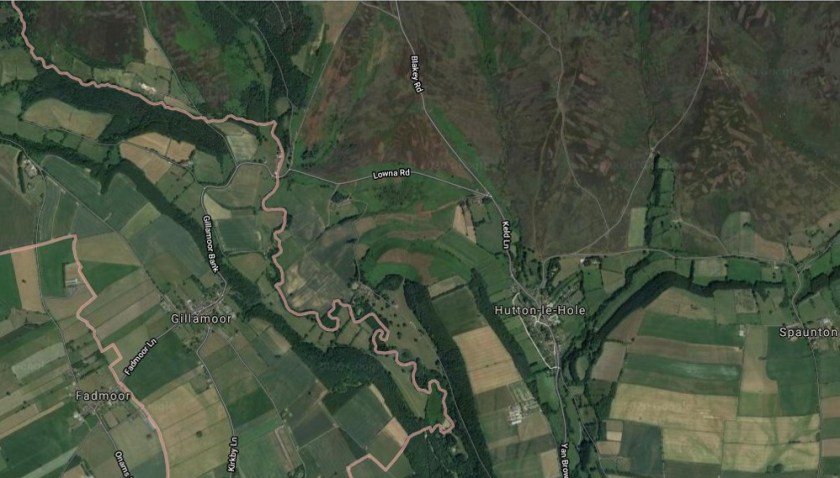
A very unwell sparrowhawk was found by members of the public in woodland, just off Gillamoor Bank, close to Gillamoor village near Kirkbymoorside in Ryedale.
The bird appeared to be experiencing seizures and clenching its talons, and was taken locally for care, but died shortly after.
The symptoms shown by the bird suggest that poisons could have been involved in its death.
Officers from North Yorkshire Police are investigating the incident, and the dead bird has been accepted onto the Wildlife Incident Investigation Scheme (WIIS) for testing to establish the cause of death.
The WIIS investigates the deaths of wildlife and pet animals and beneficial invertebrates in the UK if there is evidence to suggest that they may have been poisoned or put at risk by pesticides.
The sparrowhawk was found earlier this month in a location very close to the village of Gillamoor, in woodland which includes a public footpath.
A spokesperson for North Yorkshire Police said: “At this time, we are keeping an open mind as to the cause of death. However, toxicology results may not be known for a number of weeks, so we want to make the community aware so they can take precautions to keep pets, children and themselves safe.
“Once the results of the tests are known we will update the community, but for the time being dog owners should take care to keep their dogs on leads when in this area, and remain vigilant.”
If you have any information about this incident, contact North Yorkshire Police on 101 quoting reference 12200142198.
If you find a dead animal you believe may be contaminated, do not touch it – poisons can transfer through contact with skin – and keep children and pets well away. Instead, take photographs, obtain an exact location (for example, a grid reference or a What3words location) and contact the police.
ENDS
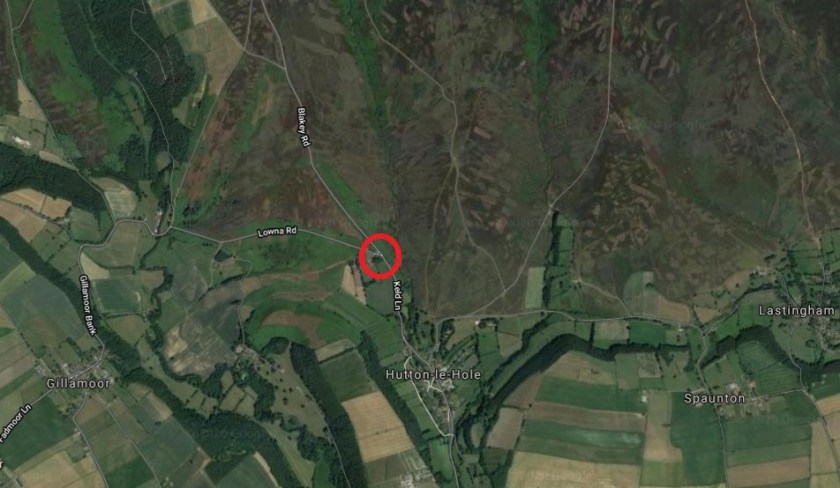
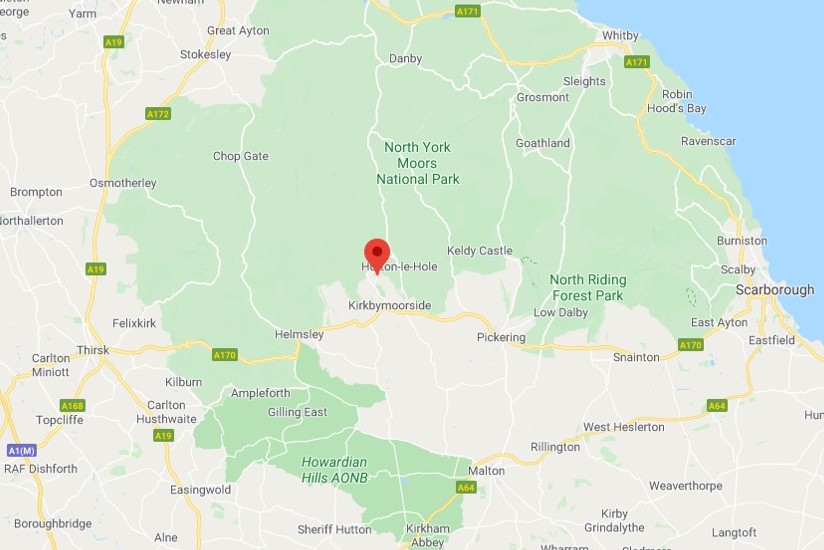
Here’s the location of Gillamoor village and the surrounding woodland, right next door to an area that appears to be managed for driven grouse shooting on the edge of the North York Moors National Park:
Obviously, the results of the toxicology tests are awaited before this incident can be confirmed as an illegal poisoning but let’s be honest, given North Yorkshire’s appalling reputation for the illegal killing of birds of prey, including inside its two National Parks, either by shooting, trapping or poisoning (e.g. see here, here, here and here), yet another victim would come as no surprise whatsoever.
TAKE ACTION
If you’re concerned about the level of illegal raptor persecution in the UK, especially the high incidence of killing that takes place on or close to driven grouse moors, you can sign this e-action which urges your politician to take note and actually do something about it.
Launched two weeks ago by three organisations: Wild Justice, the RSPB and Hen Harrier Action, so far over 84,000 people have signed up. All you need to do is enter your postcode and a polite, pre-written email will automatically be sent to your parliamentary representative asking them to stop ignoring this issue.
If you want to add your voice and give your elected politician a polite nudge, please sign up HERE and pass this link on to others.
Protection for mountain hares, slaughtered in their thousands on Scottish grouse moors (an estimated 26,000 each year), looks to be a long way off.
This is despite scientific evidence revealing catastrophic declines, despite the species’ unfavourable conservation status and despite the Scottish Parliament voting in June for full protection under the proposed Animals and Wildlife (Penalties, Protections and Powers) (Scotland) Act.
The Scottish Government is first insisting on undertaking a consultation with stakeholders to work out the details of how a licensing scheme will work, and has ignored the pleas of conservationists to bring in interim protection for mountain hares now that the open season for killing them has begun again (see here, here, here, here).
Instead, to the utter astonishment of the conservation community, as the hare-killing season opened on 1st August Environment Secretary Roseanna Cunningham asked the grouse shooting community to conduct voluntary restraint (see here) – an utterly futile and indeed facile request to an industry that has, for decades, proven itself incapable of self restraint.
[Shot mountain hares strung up in a chilling larder, screen-grabbed from a controversial feature on Countryfile (2018) showing mountain hares being shot on a Scottish grouse moor]
Meanwhile, a number of politicians have been putting pressure on the Scottish Government to pull its finger out and bring in measures to prevent the inevitable hare-killing sprees on grouse moors across the country, but Environment Minister Mairi Gougeon is trotting out the usual vague and non-committal responses we’ve come to expect from this Government.
For example, here are some pertinent Parliamentary questions from Alison Johnstone MSP (Scottish Greens) and Christine Grahame (SNP) and the Environment Minister’s responses:
Question S5W-30665: Alison Johnstone, Lothian, Scottish Green Party. Date lodged 13/7/20:
To ask the Scottish Government when it plans to commence section 10F of the Animals and Wildlife (Penalties, Protections and Powers) (Scotland) Act.
Answered by Mairi Gougeon (30/7/20):
The Scottish Government will set out its timetable for commencing all sections of the Animals and Wildlife (Penalties, Protections and Powers) (Scotland) Act 2020, including Section 10F, in due course.
Question S5W-30899: Christine Grahame, Midlothian South, Tweeddale and Lauderdale, Scottish National Party. Date lodged: 23/7/20:
To ask the Scottish Government, in light of mountain hare culling restarting on 1 August 2020, when the licensing scheme in compliance with the Animal and Wildlife (Penalties, Protections and Powers) (Scotland) Act 2020 will be enforceable.
Answered by Mairi Gougeon (10/8/20):
I refer the member to the answer to question S5W-30665 on 30 July 2020. All answers to written parliamentary questions are available on the Parliament’s website, the search facility for which can be found at xxxxxxxx.
Question S5W-30664: Alison Johnstone,Lothian, Scottish Green Party. Date lodged 13/7/20:
To ask the Scottish Government what measures it will put in place to prevent further mass culling of mountain hares when the mountain hare closed season ends on 1 August 2020.
Answered by Mairi Gougeon (10/8/20):
The Scottish Government has always been clear that any large-scale culling that threatens the conservation status of mountain hares is not acceptable. However, as I stated during the stage 3 debate in Parliament there are a number of issues that must be fully considered ahead of the introduction of a licensing regime. I am now giving careful thought as to how that regime will work and when the protection will come into force and I will be discussing that in detail with stakeholders over the coming months. We will be following the situation carefully for any indication of attempts to carry out excessive culls and will take steps to address this if necessary.
God this is tedious. ‘Over the coming months’ and ‘in due course’ and ‘we will take steps to address this if necessary’. These are holding statements designed to hide the fact that the issue is being kicked in to the long grass.
Do these phrases sound familiar? They should – these are the exact same lethargic, ambiguous phrases that have come to characterise the Scottish Government’s inaction over the ongoing and illegal killing of birds of prey on driven grouse moors.
So far this season there are no confirmed reports of mountain hares being culled on Scottish grouse moors (there were a couple of unconfirmed reports in early August but these proved to be unsubstantiated – see here). However, with the grouse-shooting season now open this isn’t the time when most hares are slaughtered. That bloodbath usually takes place in January and February, once the grouse-shooting season has ended, as depicted in this shocking video.
Can we expect to see more of the same this season?
Chris Packham continues his series of chats on raptor persecution and grouse moor mismanagement, this time talking with Caroline Lucas MP tonight at 8pm.
The recording will be available immediately afterwards on both channels. You don’t need to have an account to watch it (see link below).
These recorded chats are in support of the Wild Justice / RSPB / Hen Harrier Action e-action, urging politicians throughout the UK to take a stand against the illegal killing of birds of prey and the other environmental atrocities associated with driven grouse shooting. This e-action has currently been signed by over over 77,000 supporters. If you’d like to join in, please click HERE