The charity Birds of Poole Harbour (the fabulous team behind the Osprey Reintroduction Project, amongst many other things) is advertising for an Engagement Assistant to help them deliver a number of exciting public engagement projects this year.
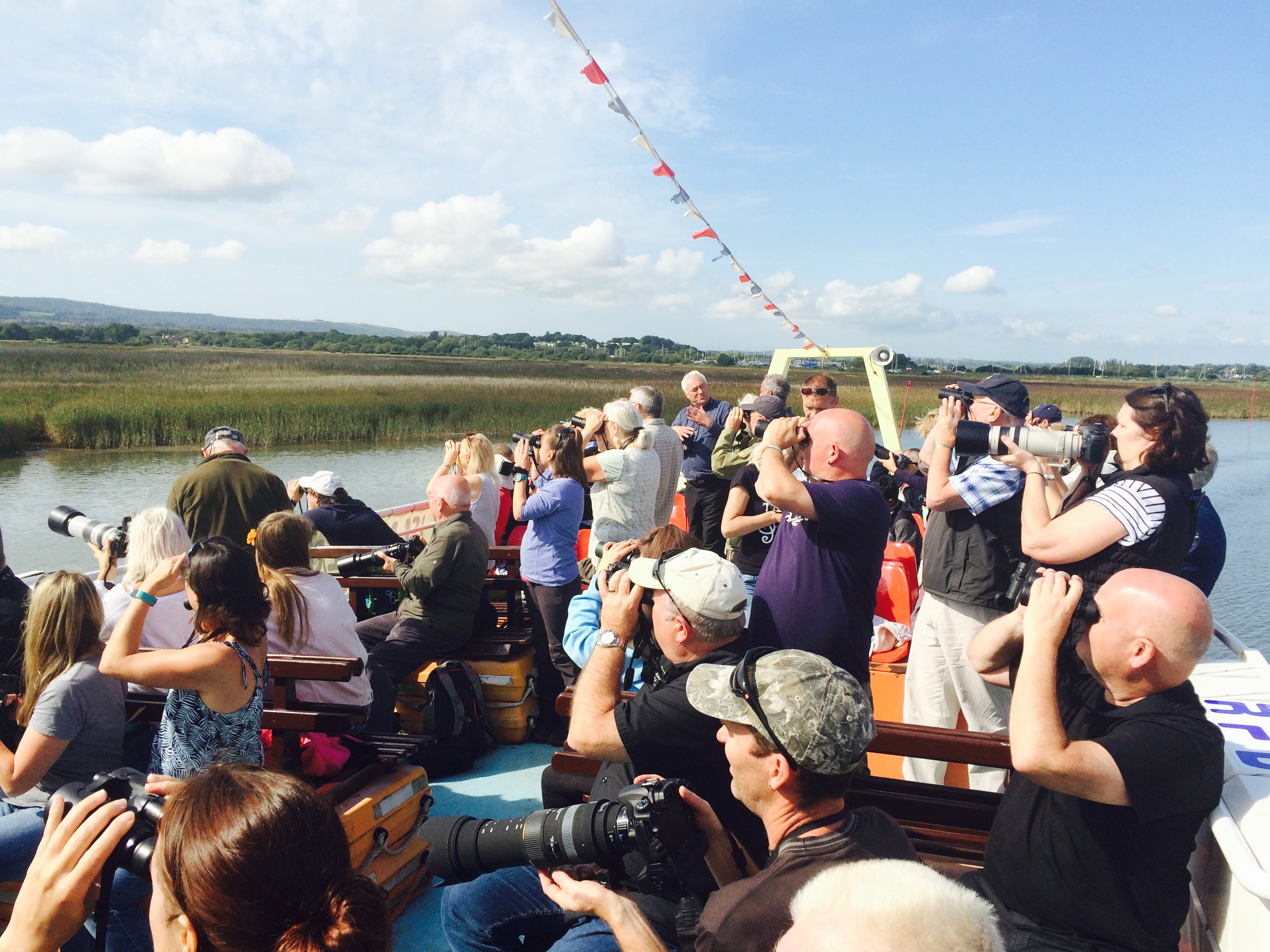
This includes helping out on their brilliantly popular and award-winning ‘bird cruise boats’ around the harbour, providing the public with an opportunity to see Ospreys, White-tailed Eagles, Marsh harriers, Peregrines (and loads more!), as well as guided walks, ID courses and pop-up watches.
This is a rare opportunity to work at one of the UK’s premier wildlife ecotourism sites and join a world-class and friendly team.
Looking for raptors (& other species!) on the Birds of Poole Harbour Bird Boat. Photo: Ruth Tingay
Here’s the job spec:
Job Advert: Birds of Poole Harbour Engagement Assistant
Birds of Poole Harbour is a Dorset-based charity with a local community focus, committed to conserving and interpreting the important birdlife in the Poole Harbour area. We deliver a range of exciting events and projects. We are looking for an enthusiastic Engagement Assistant to support our team in delivering our public engagement and project work. Part-time, permanent.
Position: Engagement Assistant
Hours: 20 hours per week, with the possibility of extra hours during the high season (April to September). Due to the nature of our events, this role requires regular weekend work (typically 3 weekends per month) and occasional early-morning/evening hours.
Location: Poole and Wareham-based, with travel to events around Poole Harbour
Annual Leave: 28 days inclusive of bank holidays (pro-rata for part-time roles)
Salary: £13,988.52 (FTE £27,976)
Essential Criteria
Friendly and warm interpersonal style
Excellent verbal communication skills and a confident public speaker
Ability to work effectively as part of a busy team
Proactive and self-motivated attitude
Excellent bird identification skills
Desirable Skills and Experience
Experience of working with volunteers
Strong written communication skills
Experience in delivering events
Knowledge of local birding sites and conservation projects, including the Poole Harbour Osprey Reintroduction Project
Full driving licence and access to a vehicle
What you’ll be working on
You’ll be helping our team deliver an ambitious events schedule throughout the year, including our award-winning boat trips, our Carey Osprey Tours (led in partnership with Careys Secret Garden), and our guided walks, ID Courses and Pop-up watches. This role will be well-suited to an enthusiastic ornithologist with excellent communication skills and a strong knowledge of British birds.
You’ll also be involved with our project work and youth engagement programmes, including our School Bird Boat Project and Young Birders Club.
Full training will be provided, and more details on our project work and events can be found here: www.birdsofpooleharbour.co.uk.
If you would like to apply, please email our Operations and Finance Assistant, Helen, at helen@birdsofpooleharbour.co.uk with a CV (2 pages maximum) and a PDF with answers to the following questions:
What attracted you to apply for this position? (200 words max)
Why do you believe you are well-suited for the role of Events Assistant at Birds of Poole Harbour? (500 words max)
Interviews commencing W/C 16th February 2026 with the option for online interviews available. Please note that the interview will involve a UK bird species identification test.
Closing date for applications: Friday 30 January 2026.
The Natural Environment (Scotland) Bill was introduced to the Scottish Parliament in February 2025 and received extensive scrutiny through Parliamentary Stages 1 and 2, which concluded in December 2025 just prior to the Xmas break.
The Bill as it currently stands after Stage 2 can be read here.
The Bill is quite broad but generally deals with proposals to introduce targets to improve biodiversity, proposals on Environmental Impact Assessments and the Habitats Regulations, proposals on the aims of National Parks and their management, and proposals on the management of wild deer.
Stage 3 of the Bill, where final amendments can be lodged and debated in the Chamber prior to a vote on whether the Bill is passed is expected to take place soon, with the goal of completing it prior to the dissolution of the Parliament for the May 2026 election.
There are many topics of interest in this Bill but those of specific interest to this blog include amendments relating to closing the loophole in the grouse moor licensing scheme (I’ll blog separately on that) [UPDATE – new blog on grouse moor licensing here], a proposed amendment to permit licences to falconers to take Mountain Hares (I’ll blog separately on that) [UPDATE – new blog on falconry licences here] and a number of amendments relating to the licensing of non-native gamebird releases (Pheasants & Red-legged Partridges). That is the subject of this particular blog.
A non-native Red-legged Partridge, one of millions released into the UK countryside every year for shooting. Photo by Ronnie Gilbert
There were over 300 amendments proposed to this Bill and the Stage 2 debates, led by the Rural Affairs & Islands Committee, took place during extended sessions on 19th and 26th November and 3rd and 10th December 2025, including additional sessions that had to continue into the evenings just to get through them all.
The amendments relating to non-native gamebird releases were heard on 19th November and interestingly, were proposed by three MSPs from three different parties – Lorna Slater MSP (Scottish Greens), Mercedes Villalba MSP (Scottish Labour) and Beatrice Wishart MSP (Scottish Lib Dems).
Lorna Slater’s amendment (Amendment #40) proposed a licensing scheme for Pheasants (surprisingly, she didn’t include Red-legged Partridges, I’m not sure why) to curb the mass release of non-native gamebirds to be shot for entertainment. A Scottish Greens press release on this issue can be read here.
She wasn’t calling for an immediate outright ban, although she acknowledged, during the debate, a personal opinion that that would be a “good idea”. I suspect she probably went for licensing rather than a ban because she recognised that without scientific evidence showing the damaging impact to the environment of releasing millions of non-native gamebirds, the Scottish Government would be unlikely to take such a step. She argued that:
“We should know how many Pheasants there are, who is releasing them and where, and we should know the impact they are having on our environment. We do not know those things“.
Predictably, her proposal was attacked by the three Conservative committee members (Tim Eagle MSP, Rachael Hamilton MSP and Finlay Carson MSP) with varying degrees of outrage and ignorance. Notable was Tim Eagle’s reference to the recent report on gamebird releases in the Cairngorms National Park, where he, let’s be charitable, perhaps inadvertently, misrepresented the report’s findings (which I discussed in a previous blog, here).
Lorna Slater withdrew Amendment #40 in favour of Amendment #12 in the name of Mercedes Villalba MSP (see below).
Mercedes Villalba proposed a couple of amendments relating to gamebird releases. Amendment #12 proposed modifying Section 14 of the Wildlife & Countryside Act 1981 (introduction of new species etc) whereby Scottish Ministers must publish a strategy for the long-term management of an introduced (non-native) species including an assessment of the expected effect of the non-native species on the natural environment.
Mercedes’ other amendment on this subject (#55) proposed repealing Section 14 part 2a of the W&C Act, which exempts anyone releasing Pheasants and Red-legged Partridge from committing an offence if releasing a non-native species beyond its native range. She argued that the game-shooting sector had negotiated this exemption as part of the Wildlife & Natural Environment (Scotland) Act 2011 but that this amounted to ‘putting up our natural environment for sale’ where commercial profit for private shareholders (shoot owners) was causing additional cost to the public purse for environmental conservation.
Beatrice Wishart’s amendment (#269) proposed giving Scottish Ministers the power to restrict releases of non-native gamebirds where those releases risk damaging flora, fauna or the wider environment. It would enable Ministers to specify where and when such restrictions apply, based on evidence of environmental harm. Beatrice said during the debate that her amendment was triggered after learning that Red-legged Partridges had been released on Shetland!
She lodged a further amendment (#270) proposing to amend Section 44 of the Nature Conservation (Scotland) Act 2004 to give NatureScot explicit powers of entry to land for the purpose of monitoring or assessing species that are considered to be outside of their natural range. She argued that this would “provide the practical access that is needed for early detection, accurate assessment and timely intervention – key principles of effective non-native species management“.
In response to these proposals, Cabinet Secretary Gillian Martin MSP urged the members not to press the amendments at Stage 2 and that she was willing to work with them, ahead of Stage 3, to see whether further refinement / agreement could be found.
Speaking to the amendments collectively, she said this:
“I acknowledge the concerns that stakeholders and the committee have expressed about invasive non-native species. I am aware that INNS are one of the key drivers of biodiversity loss, as identified by the Intergovernmental Science-Policy Platform on Biodiversity and Ecosystem Services, and ambitious targets are set out in the global biodiversity framework to tackle that. I am also mindful of the concerns that have been expressed about the species that have been exempted from the provisions in section 14 of the Wildlife and Countryside Act 1981.
“Stakeholders have highlighted the potential impacts of the common pheasant and red-legged partridge on our native biodiversity, as well as the risks that those species pose in relation to the spread of avian influenza. Stakeholders have also spoken about the effects of the self-seeding of Sitka spruce on sensitive habitats such as peat bog.
“Given those concerns, I absolutely understand why Mercedes Villalba has lodged her set of amendments. I agree entirely that having in place a robust process to manage the impacts of any non-native species that are exempted from section 14(1) and (2) of the Wildlife and Countryside Act 1981 makes sense. However, we must ensure that such a process is aligned fully with current legislation, is workable in practice and does not cause harm to Scotland’s rural economy…
“... Amendment 55 would remove the current exemption for common pheasant and red-legged partridges. The Scottish Government is aware of the concern about the potential impact of game bird releases. However, we are concerned that— as has been mentioned by members—we currently do not have a complete calculation of the number of game birds that are being released in Scotland. Without that information, it is very difficult to take an informed view on the potential impacts.
“Having heard what has been said in today’s discussion, we will give careful consideration to whether further research is needed to address the evidence gaps. Although I cannot support the amendment at this stage, I am committed to exploring whether additional research needs to be undertaken—I suggest that it does—in order to strengthen our understanding and to support informed discussion on sustainable game bird management in Scotland in the future”.
There was an intervention by Lorna Slater:
“We are in some agreement on the data collection point. My Conservative colleagues to my right have also expressed some frustration that we do not have the data. However, arguing that we do not know how many game birds are released is somewhat circular, given that licensing would provide a mechanism to determine that. I am not suggesting that any restrictions be applied until data is gathered. I am interested in hearing a more robust commitment from the cabinet secretary about data collection so that both sides of the argument can come to the discussion with some evidence, rather than our own particular views”.
The Cabinet Secretary responded:
“As I said, I have heard all the arguments on the issue, and they are well rehearsed. I have pretty much committed to further research on the issue, which I think is needed“.
None of the amendments were pressed and it remains to be seen whether they return in a slightly different format at Stage 3.
Whether they return or not, it’s very encouraging that the issue of releasing millions of non-native gamebirds for so-called ‘sport shooting’ continues to be raised in the Scottish Parliament, and especially as the amendments were lodged by politicians from three separate parties.
This issue isn’t going away anytime soon.
If you’re interested in the details of the various discussions and debates held during the session on 19 November 2025 you can watch the parliamentary video (here) or read / download the official report (transcript) here:
Further to this morning’s blog about a Peregrine being euthanised after being found with gunshot injuries in Leicestershire (see here), the Leicestershire Wildlife Hospital has released more details and has issued an appeal for information, as follows:
APPEAL FOR INFORMATION
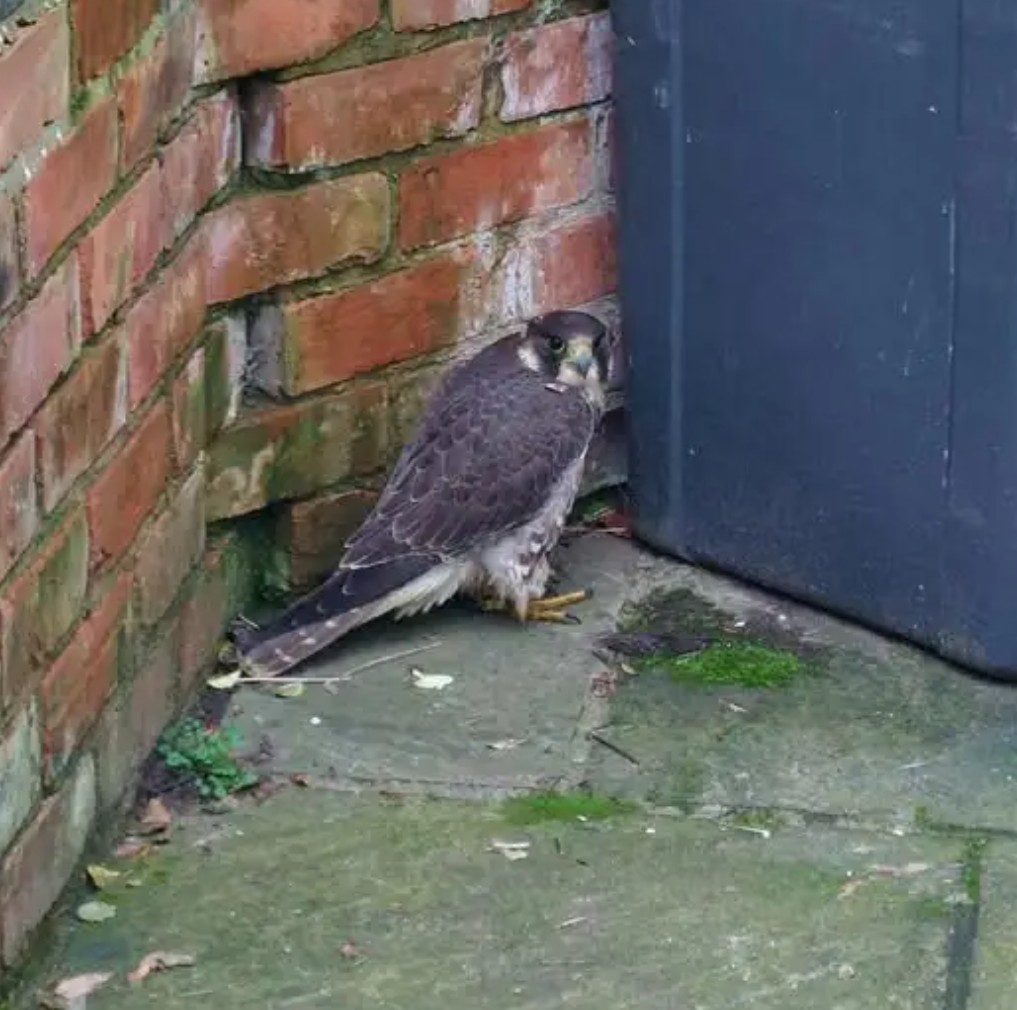
Yesterday we admitted a peregrine falcon that was found grounded in a garden on Smeeton Road, Kibworth.
Our team collected the peregrine and her assessment found that she had been shot [suspected to have been an air rifle]. This could have happened any time between the 21st and 23rd December.
Peregrine falcons are a schedule 1 bird in the UK. It is an illegal act to intentionally harm or kill them.
This crime has been reported to the police and we are now appealing for any information you may have.
Have you seen anything suspicious?
Have you heard any gunshots?
Did you see this crime take place?
If you have ANY information, please contact the police [call 101] on with reference number 25000748549.
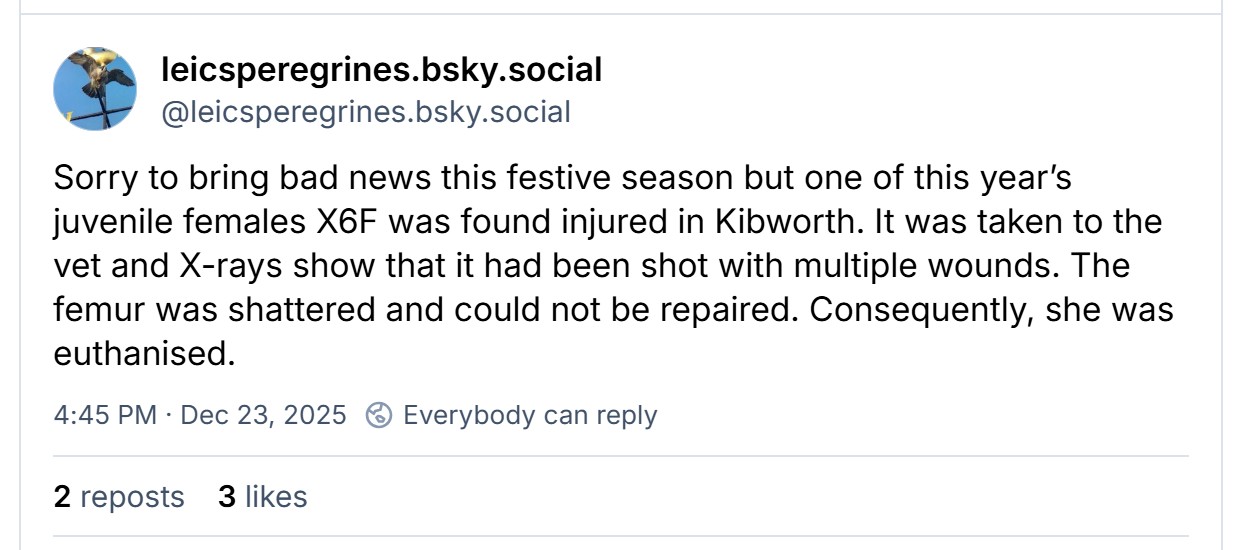
The peregrine sadly had to be put to sleep as she was suffering from a severe break to her right humerus – likely as a result of the fall after being shot. She was this years young, from Leicester cathedral, known as X6F (her ring number).
A young peregrine that fledged from Leicestershire Cathedral this summer has been euthanised after being found with gunshot injuries in nearby Kibworth.
A post on social media yesterday by the Leicestershire Peregrine Project, an initiative run by the Leicestershire & Rutland Ornithological Society in collaboration with Leicester City Council and Leicester Cathedral, reads as follows:
Juvenile female Peregrine X6F shown here with her sibling. Photo from the Leicester Peregrine Project website.
In happier news for Peregrines in Leicestershire, Market Harborough District Council’s planning committee has recently approved the installation of a Peregrine nest platform on the council’s Grade II listed Symington Building.
Leader of the council Phil Knowles said the Peregrines “are a much-loved feature of Market Harborough”, and added: “We are delivering what we believe our community wants.”
The work will take place in time for the 2026 breeding season and is being sponsored by WW Brown & Sons, the local building contractor carrying out restoration work on the historic landmark.
Following the appalling news over the last couple of days about the highly suspicious, and almost certainly criminal, disappearance of three satellite-tagged White-tailed Eagles here, here and here, there has, as usual, been complete silence from the land management sector, with the exception of Scottish Land & Estates, who commented that, “land managers in Moorfoots have been helping police with the search and will continue to provide whatever help they can as the investigation progresses“.
As for the other shooting organisations, who so often claim to have a zero tolerance stance against raptor persecution, there’s been no comment and no condemnation. Nix. Nada.
As a reminder, all of those organisations (except the Moorland Association, whose CEO was booted off for spreading misinformation) are members of the police-led Raptor Persecution Priority Delivery Group (RPPDG) – a so-called ‘partnership’ whose function includes ‘awareness raising‘ and ‘raising the profile [of illegal raptor persecution] via media exposure‘. Not a single word.
In contrast, the often very reserved RSPB has not only expressed its disgust, but it has put its money where its mouth is and is offering a reward of £10,000 for information leading to a conviction of those involved. This is welcome news for all of us who have not only enjoyed seeing these birds occupying their rightful place in UK skies, but also for those of us who are sick to the back teeth of the relentless killing of protected birds of prey across our countryside.
Juvenile White-tailed Eagle, photo by Pete Walkden
However, it turns out that it hasn’t just been the three White-tailed Eagles from the England re-introduction project that have disappeared in recent months. The bottom of the RSPB article, linked above, reveals some new information:
‘Further to the suspicious disappearance of these three White-tailed Eagles, a fourth bird, fledged from a nest in Perthshire in 2024, disappeared on a grouse moor in Nairnshire in May this year. A police search took place but neither bird nor tag were found.
This was the latest of nine tagged birds of prey, including two other White-tailed Eagles, whose tags were functioning as expected, to suddenly disappear in the northern Monadhlaith area of Inverness-shire and Nairnshire since 2018. These disappearances have occurred in an area where multiple confirmed incidents of poisoning, shooting and illegal trap use have been recorded’.
FFS.
I can’t see why it’s taken seven months for this news to emerge, but it doesn’t make it any less appalling.
As the RSPB article suggests, this area of Inverness-shire and Nairnshire is horrific for bird of prey killings and for the suspicious disappearances of tagged raptors.
This latest White-tailed Eagle to vanish is the third in the area since 2019 (e.g. see here), adding to a long history of tagged Golden Eagle disappearances here dating back 15 years (and leading to the Scottish Government commissioning its review of the fates of satellite-tagged Golden Eagles back in 2016).
Numerous other incidents have been uncovered in this same area in recent years, close to the NW boundary of the Cairngorms National Park. These have included the shooting of a Sparrowhawk on Moy Estate (for which a gamekeeper was later convicted, here), the discovery of a poisoned Red Kite in the Moy area, here, and the discovery of a shot Red Kite on Lochindorb Estate, here.
Needless to say, the vast majority of those incidents, including the disappearance of the White-tailed Eagle in May, were on grouse moors.
Perhaps the local wildlife criminals were emboldened by NatureScot’s watering-down of the new grouse shoot licence last autumn?
At least that issue appears to have been sorted by a Government amendment to close the loophole, which recently passed Stage 2 of the Natural Environment (Scotland) Bill…but I’ll write about that in another blog.
For now, we have four missing White-tailed Eagles (all vanishing from areas managed for gamebird shooting, whether that be lowland Pheasant & Partridge shooting or upland Grouse shooting), two missing Golden Eagles (also vanishing from areas managed for gamebird shooting), and I’ve lost count of the number of missing Hen Harriers, also vanishing from areas managed for gamebird shooting.
I’ll be updating the Hen Harrier Missing/Dead List over the Xmas period when I’ll have some time…there are still some more to add to the 143 Hen Harriers we already know about.
Further to the news on Thursday (here) that three White-tailed Eagles have ‘disappeared’ in suspicious circumstances, one in England, one in Wales and one in Scotland, Dyfed-Powys Police has issued a separate public appeal for information which includes a bit more detail about the Welsh case.
I’ve added some commentary below the police press release.
Dyfed-Powys Press Release:
Dyfed-Powys Police are appealing for information regarding the suspicious disappearance of a satellite tagged white-tailed eagle in the Newtown area of mid Wales.
Dyfed-Powys Police and the UK National Wildlife Crime Unit (NWCU) are jointly investigating the disappearance of a white-tailed eagle and the theft and disposal of its satellite tag and harness.
The satellite tag has been recovered from remote moorland in this area and shows that it has been removed from the bird with a sharp instrument, most likely a knife, before being hidden in an attempt to dispose of it.
Searches in the area to try and locate the body of the bird have so far been unsuccessful.
Police are appealing for anyone who was in the following areas at the specified times to contact police.
Between 11am and 1pm on Saturday 13th September 2025 at or around the Gwgia Reservoir, Tregynon (W3W///visa.hoped.assess)
Between midday and 3pm on Saturday 13th September 2025 on access land near Bryn y Fawnog (W3W///portfolio.newsprint.eyelash)
Dyfed-Powys Police can be contacted either online by emailing 101@dyfed-powys.police.uk, or by calling 101, quoting police Ref. 25000766626.
Alternatively, contact the independent charity Crimestoppers anonymously by calling 0800 555111, or visiting crimestoppers-uk.org.
All potential lines of enquiry, including detailed forensics such as DNA and fingerprints, are being pursued. Dyfed-Powys Police and NWCU are working closely with the tag owners, the Roy Dennis Wildlife Foundation and Forestry England, to analyse the data, and progress this investigation.
ENDS
Juvenile White-tailed Eagle, photo by Pete Walkden
My commentary:
This isn’t the first raptor persecution incident in this pheasant-shooting area.
In April 2020, a member of the public found the corpses of two Red Kites, which she thought was suspicious. She photographed them and posted the images on social media, intending to return the next day.
Wildlife TV presenter Iolo Williams saw the post and headed out to the location that evening. The two bodies had ‘disappeared’ but Iolo found the body of a third Red Kite, which was later x-rayed and found to contain shotgun pellets (see here).
A police investigation was launched but didn’t result in anyone being charged or prosecuted.
This area was also in the news in November 2018 when the League Against Cruel Sports revealed that 57,000 Pheasants had been released over a five-year period at Gregynog Hall, owned at the time by the University of Wales, with shooting reportedly leased to Bettws Hall Estates. The League launched a campaign to stop gamebird shooting on the estate.
In response, a spokesperson for the University of Wales told BBC News, “The University of Wales has received the correspondence from the League Against Cruel Sports regarding this matter, and is currently in the process of reviewing the structure and arrangements for Gregynog Hall” (see here).
The shooting lease for 2019 was not renewed whilst the review was undertaken (see here).
However, my research suggests that a Pheasant-shooting lease is still in operation, no longer run by Bettws Hall Estates, but apparently by the Ian Coley Sporting Agency, whose website lists the shoot as “beautiful valleys teeming with pheasants and partridge“.
However, according to a Trustees report (2022) of The Gregynog Trust, the new landowners, shooting leases have been terminated.
There’s no suggestion that anyone connected with the shoot was involved with the disappearance of the young White-tailed Eagle at Gwgia Reservoir (part of the Gregynog Estate) or the removal of his satellite tag, probably with a sharp knife, before a crude attempt to hide it on a nearby hillside, and I’m sure they’ll have been keen to assist the police with its investigation.
Since 2019, Gregynog Hall and estate has been run by a charitable trust (The Gregynog Trust) and I’m sure the Trustees are appalled that this young White-tailed Eagle was apparently targeted on its estate.
UPDATE 16.00hrs:I’ve received communication from a representative of The Gregynog Trust who says the incident is not on their land, and “We do not condone or allow any form of hunting or blood sports on our estate, this is not negotiable“. This information conflicts with the published information I’ve found during my research, but until I can clarify that, please do not contact The Gregynog Trust about this incident.
Further to the news yesterday (here) that three White-tailed Eagles have ‘disappeared’ in suspicious circumstances, one in England, one in Wales and one in Scotland, Police Scotland has issued a separate public appeal for information which includes a bit more detail about the Scottish case:
Police Scotland are appealing for information after a satellite-tagged white-tailed eagle disappeared in the vicinity of the Moorfoot hills.
The bird was four years old and had been translocated as a chick from Scotland to the Isle of White as part of a licenced reintroduction programme run by the Roy Dennis Foundation.
In March 2025 the bird flew back to Scotland and held a territory in the Moorfoot Hills spending most of its time in the hills between Peebles and Heriot.
In early November it expanded its range and spent the majority of its time on the lower ground to the North of the Moorfoots by Gladhouse Reservoir but after four days its satellite tag then suddenly stopped working in circumstances that give rise to suspicion.
A full search of the area where the tag last transmitted and the areas it had been frequenting has been carried out by Police Scotland Wildlife Crime officers accompanied by colleagues from the UK National Wildlife Crime Unit and a bird ecology expert however neither the bird nor the satellite tag have been recovered.
Police Constable Ali Whitby, Wildlife Crime Officer for the Lothian and Scottish Borders division said:
“This is a huge iconic bird of prey that chose to fly hundreds of miles north and settle in the Moorfoot Hills. Being so big its presence was known to people working and living in the area and it thrived for 8 months; the fact it has now gone missing in suspicious circumstances is extremely disappointing.
“I would urge anyone with any information that may assist to contact us.”
Anyone with any information should call 101, quoting reference number PS-20251215-1347. Alternatively, please contact Crimestoppers though 0800 555 111, where anonymity can be maintained.
Press release from Forestry England (17 December 2025)
THREE WHITE-TAILED EAGLES DISAPPEAR IN SUSPICIOUS CIRCUMSTANCES
The public are being asked to help the police investigate the suspicious disappearance of three white-tailed eagles. The cases include a chick born in the wild earlier this year in Sussex, one of the first white-tailed eagles to fledge in England for hundreds of years.
White-tailed Eagle G842 on the nest with its sibling in Sussex prior to fledging earlier this year (Photo: Forestry England)
The missing birds are part of a project led by Forestry England and the Roy Dennis Wildlife Foundation to reintroduce this lost species to England. Their disappearance is being investigated by several police forces and the National Wildlife Crime Unit.
The return of white-tailed eagles to England is one of the country’s key conservation successes over recent years. Since 2019, 45 white- tailed eagles have been released. Several breeding pairs have formed with six chicks being born in the wild for the first time since the 1780’s. Any targeting of the birds will potentially impact the long-term success of the project.
All of the released birds are tagged with satellite trackers allowing the team to closely follow their location and movements. In September the trackers of two eagles were found dumped close to the birds’ last recorded location. Both had been cut off the birds using a sharp instrument. In the case of another eagle, its tag has stopped sending data. The last message received from the device was on 8 November and no sightings of the bird have been recorded since then.
Tim Mackrill from the Roy Dennis Wildlife Foundation said: “We monitor the satellite data, showing the bird’s minute-by-minute movements, on a daily basis and always investigate any suspicious or unusual data. It was devastating to find the stolen and dumped tags, particularly for the chick in Sussex who fledged this summer and had only just begun its life. So many people in the area had shared the joy of seeing these birds breed again after hundreds of years and our ongoing monitoring has shown how well they were fitting into the landscape. To have that destroyed just a few months later is deeply shocking“.
Steve Egerton-Read, White-Tailed Eagle Project Officer for Forestry England, said: “We are returning this lost species to the English landscape and have had so much support from the public. These special birds are helping people connect with natural world and showing how with a little bit of help nature can thrive. We are asking the public to show this support again by encouraging anyone who has information that may help the police investigation to come forward“.
There was tremendous public support and local pride this summer when two white-tailed eagle chicks fledged from a nest in Sussex. Both were the offspring of eagles released by the project in 2020 and the first pair to successfully breed in England for over 240 years. The two chicks had spent the first few months of their lives exploring the local West Sussex area.
On 26 September, a satellite tag belonging to one of the chicks (G842) was recovered from the River Rother, near Petersfield. It had been removed from the bird using a sharp instrument. Searches in the area to try and locate the body of the bird have so far been unsuccessful.
Sussex Police are appealing for information from anyone who was in or around Harting Down and Petersfield on the evening of 20 September 2025. Any members of the public who may have seen the bird or any suspicious behaviour can contact them on 101 or 0800 555 111 quoting incident number 769.
Dyfed Powys Police are investigating a similar incident on 13 September, where a satellite tag belonging to white-tailed eagle G615 was recovered in remote moorland. The tag had been removed with a sharp instrument before being hidden in an attempt to dispose of it. Searches in the area to try and locate the body of the bird have so far been unsuccessful.
The force is interested in hearing from anyone who was at or around the Gwgia Reservoir, Tregynon between 11am and 1pm or on access land near Bryn y Fawnog between 12 noon and 3pm on 13 September. Callers should quote crime reference number 137.
In a third incident, concerns are growing for G819 after its tag, which usually transmits the data daily, has stopped working. The last transmission was sent on 8 November in the Moorfoot Hills area. Police Scotland are treating the disappearance as suspicious and asking anyone with information to contact them on 101 or 0800 555 111 quoting incident number PS-20251215-1347.
The reintroduction of white-tailed eagles is conducted under licence from Natural England, the Government’s wildlife licensing authority. White-tailed eagles are a protected species under the Wildlife and Countryside Act (1981). Disturbing, destroying or interfering with them and their nests are criminal offences.
ENDS
My commentary:
Hands up, who’s surprised?
No, me neither.
These reports are so depressingly familiar these days, we’ve pretty much come to expect them. Although there’s something particularly sickening about killing a White-tailed Eagle. It’s no lesser crime, in the eyes of the law, than killing a more common species like a Buzzard or a Sparrowhawk – the offence is the same and the available penalty is the same. But these eagles, the UK’s largest raptor, have been brought back from the brink through intensive conservation efforts by many people over many decades. Progress has been hard-won, because these birds are slow to mature (between 4-6 yrs) and when they do eventually reproduce they generally only manage to rear one or two chicks per season, on rare occasions three, and they don’t necessarily breed every year, which means that population recovery is slow. Any illegal killing, on top of natural mortality, is obviously going to hamper that reestablishment.
And there’s no doubt whatsoever that at least two of these eagles were the victims of illegal persecution, given the clear evidence that their satellite tags had been cut off and crude attempts were made to hide them. Given the area in south Scotland where the third White-tailed Eagle has vanished, a well-known persecution hotspot, it wouldn’t be a surprise to learn that that bird has also been killed illegally, most likely shot.
Kudos to the White-tailed Eagle Reintroduction team (Roy Dennis Wildlife Foundation & Forestry England) for putting out an appeal for information after three months of silence from Dyfed-Powys Police and Sussex Police.
UPDATE 18 December 2025: More detail on the ‘missing’ White-tailed Eagle in south Scotland (here)
UPDATE 19 December 2025: More detail about the missing White-tailed Eagle in mid-Wales (here)
UPDATE 19 December 2025: Fourth White-tailed Eagle ‘disappears’ & RSPB offers £10,000 reward for information leading to a conviction (here)
Thirty-nine geese and one pigeon have been found shot and dumped, literally on the road, in Wisbech, Cambridgeshire, according to an article in the Eastern Daily Press (EDP) posted on 10 December 2025.
The birds were found on St Paul’s Lane and many of them had blue baler twine around their necks (where the birds had been hung up) and had had their breasts cut off.
A video on the EDP website captures the reactions of members of the public, who described the incident as “barbaric”.
Screengrab from the video of the dead birds on EDP website
Screengrab of the same video, posted on Wisbech Standard website, showing a goose with its breast removed
According to the EDP article, a spokesman for King’s Lynn and West Norfolk Borough Council said: “A report of dead geese was made to the council, to which we immediately responded.
“They are due to be collected today and removed to a licensed waste site that is authorised to deal with them.”
Regular blog readers will know that the dumping of shot gamebirds is a common and widespread illegal practice that has been going on for years, despite the repeated denials by the shooting industry. The disposal of animal by-products (including shot gamebirds) is supposedly regulated and the dumping of these carcasses is an offence.
Previous reports include dumped birds found in Cheshire (here), Scottish borders (here), Norfolk (here), Perthshire (here), Berkshire (here), North York Moors National Park (here) and some more in North York Moors National Park (here) and even more in North Yorkshire (here), Co. Derry (here), West Yorkshire (here), and again in West Yorkshire (here), N Wales (here), mid-Wales (here), Leicestershire (here), Lincolnshire (here), Somerset (here), Derbyshire’s Peak District National Park (here), Suffolk (here), Leicestershire again (here), Somerset again (here), Liverpool (here), even more in North Wales (here) even more in Wales, again (here), in Wiltshire (here) in Angus (here), in Somerset again (here), once again in North Yorkshire (here), yet again in West Yorkshire (here), yet again in mid-Wales (here), even more in mid-Wales (here), more in Derbyshire (here), Gloucestershire (here) more in Cheshire (here), some in Cumbria (here), some more in the Scottish Borders (here) and again in Lincolnshire (here), in Nottinghamshire (here), even more in Lincolnshire (here), even more in the Scottish Borders (here) and in Dorset (here).
The charity Hen Harrier Action has launched its annual Xmas fundraising appeal, this year with a target of £15K to purchase five satellite tags to be fitted to Hen Harrier chicks in 2026.
As you’ll know, over the last couple of decades, raptor satellite-tagging in the UK has shone a massive spotlight on the widespread scale of the illegal killing of a number of raptor species, especially Hen Harriers and Golden Eagles.
Scientists have been able to analyse the tag data and have demonstrated a clear and unequivocal link between illegal raptor persecution and grouse moor management (e.g. see here, here, here).
In Scotland this has led directly to a change in Government policy, with the recent introduction of a grouse moor licensing scheme, whereby licences for shooting Red Grouse can be suspended/revoked if evidence of raptor persecution (and some other wildlife crimes) is found on a grouse shooting estate.
It has also led to a change in tactics by some of those motivated to kill raptors, who are now apparently choosing to target un-tagged raptors because they want to avoid the media attention and scrutiny that follows the illegal killing or ‘disappearance’ of a tagged bird (e.g. see here).
But fitting a satellite tag doesn’t necessarily mean that that raptor won’t be targeted. There are plenty of examples of tagged birds still being targeted, either because those doing the killing are too stupid to understand what a tag’s data can reveal, or more likely, there are rarely any direct consequences for those who commit these crimes so there’s no incentive for them to stop.
To my mind, the main benefit of continuing to fit satellite tags to Hen Harriers, apart from the obvious research benefits of better understanding this species’ ecology and how it uses the landscape, is that it allows us to document the scale of the ongoing criminality (that would otherwise be hidden and thus would be easily deniable by the grouse shooting industry) and to use those data to put pressure on Governments to address the problem.
As in previous years, any tags purchased by Hen Harrier Action will be fitted by licensed experts from the RSPB who will also monitor and manage the data, and alert the police / Hen Harrier Taskforce if suspicious tag activity is detected.
It also means that Hen Harrier Action will publicise any suspicious disappearances / confirmed illegal killings, without compromising any police investigation, of course, but also without sitting on the data for months, sometimes years, as we’ve seen all too often with tags fitted by Natural England.
If you’re able to contribute to Hen Harrier Action’s Xmas fundraiser, please visit their fundraising site here.