Another Hen Harrier suspected illegally killed on a grouse moor, her satellite tag had been ‘removed’

Over the last few weeks I’ve blogged about a number of illegally-killed Hen Harriers whose deaths have been barely publicised by the authorities, but instead have been quietly entered onto a Government spreadsheet, months, and sometimes over a year later, with little effort to draw the public’s attention to this ongoing criminality.

Hen Harrier photo by Pete Walkden

There was Hen Harrier ‘Susie’ who was found dead with gunshot injuries on a grouse moor in the North Pennines, here; and Hen Harrier ‘254843’ who was found dead on moorland in the Northumberland National Park with shotgun damage to her satellite tag, here; and a Hen Harrier (ref # HSE 107/913) who was found poisoned on a grouse moor in North Yorkshire having ingested a lethal combination of toxic chemicals known as the ‘Nidderdale Cocktail’, so called due to the frequency it is used as a poisoned bait in the Nidderdale National Landscape, killing multiple birds of prey and even a pet dog, here.

Well, here’s another one.

This time its a young Hen Harrier named Margaret, who was fitted with a satellite tag (Tag ID 254844) by Natural England fieldworkers just prior to her fledging from a nest in Northumberland on 5 July 2024.

Natural England staff ‘lost contact’ with Margaret just three months later on 19 October 2024.

The first we knew about this was in Natural England’s intermittent spreadsheet update in December 2024 about the fate of the Hen Harriers that had been satellite-tagged using public funds. Margaret’s entry read as follows:

‘Lost contact 19 October 2024, Northumberland. Missing Fate Unknown, site confidential – ongoing investigation‘.

Whether that meant her tag had suddenly and inexplicably stopped transmitting, or whether the data showed an unusually long period of being static in one place, wasn’t clear.

We didn’t hear anything more until Natural England quietly updated its spreadsheet in October 2025. Margaret’s entry now reads:

‘Missing Fate Unknown. Suspected illegally killed. Tag found removed. Carcase not found. Grid ref NY878497‘.

So, a year after Natural England ‘lost contact’ with this Hen Harrier, we’re finally given a few more details.

This grid reference is in the North Pennines National Landscape (formerly called an AONB), a region that has long been identified as a Hen Harrier persecution hotspot (e.g. see the RSPB’s damning 2025 report, Hen Harriers in the Firing Line, here).

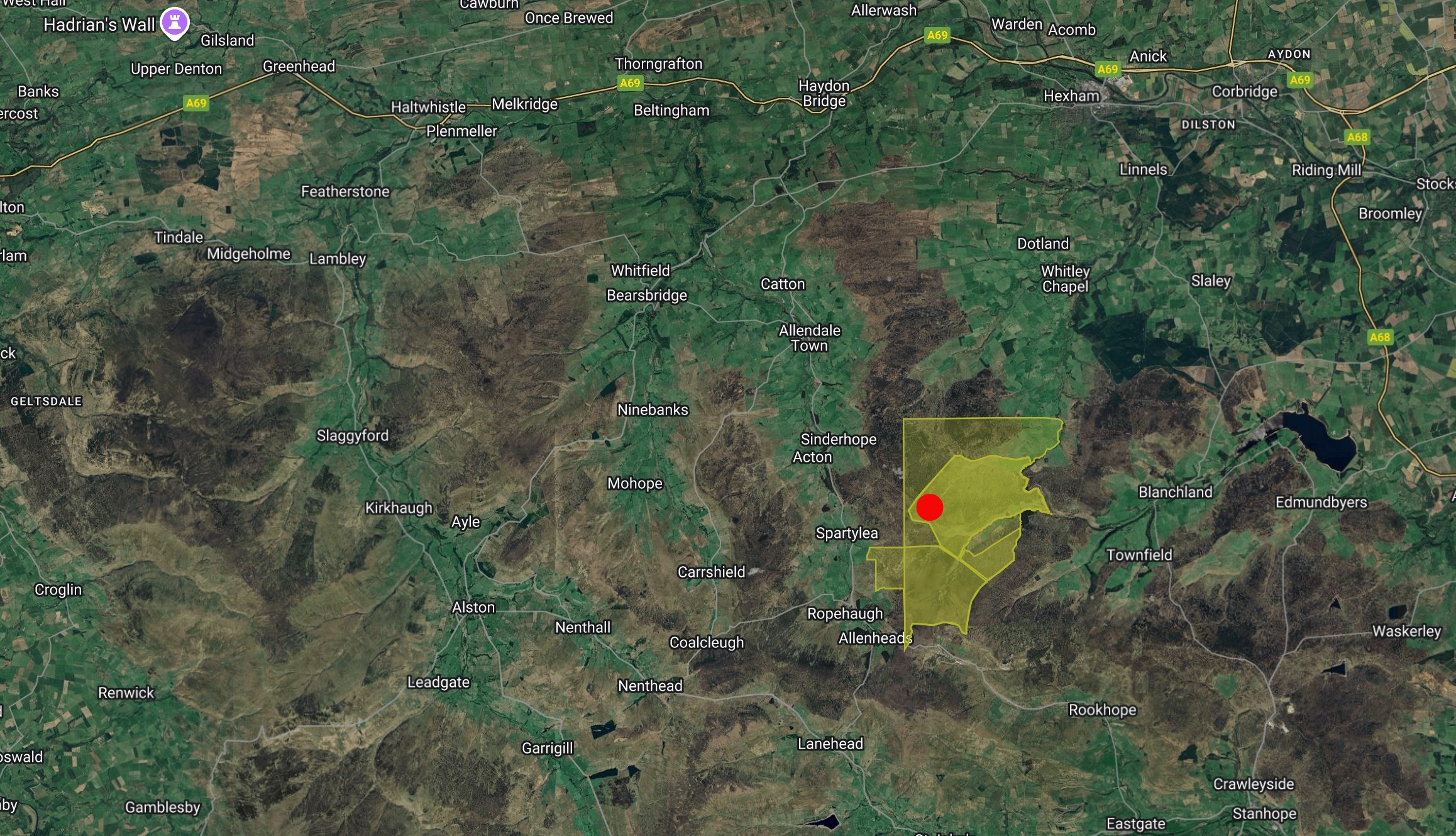
When you zoom in on this map, you’ll be unsurprised to see it is an area dominated by moorland intensively-managed for driven grouse shooting (as demonstrated by the obscene expanse of geometric strips).

According to Guy Shrubsole’s excellent website, Who Owns England?, this grid reference (approximately marked as a red dot on map below) sits on property described as part of the Allendale Settled Estates:

There’s no suggestion that anyone connected to the Allendale Estate is responsible for ‘removing’ Margaret’s satellite tag and/or killing this Hen Harrier. It’s simply a fact that her ‘removed’ satellite tag was found on a grouse moor at this location without any sign of her carcass.

I haven’t seen ANY appeal or press release from Northumbria Police about the suspected illegal killing of this Hen Harrier or the circumstances that led the police to believe her satellite tag had been ‘removed’, presumably cut, over a year ago in October 2024. Not a single word.

I haven’t seen ANY publicity from the National Wildlife Crime Unit-led Hen Harrier Taskforce. This is the specialist group set up explicitly to tackle the ongoing illegal killing of Hen Harriers in England. Not a single word.

I haven’t seen ANY publicity from the police-led national Raptor Persecution Priority Delivery Group (RPPDG), one of whose functions is apparently ‘awareness raising‘ and ‘raising the profile [of illegal raptor persecution] via media exposure‘. Not a single word.

Natural England, who used public funding to pay for the tag, public funding to pay for the fieldworkers to fit the tag to the bird, and public funding to monitor the tag’s subsequent data output, chose not to draw attention to this suspected illegal killing and instead just quietly updated its tag spreadsheet a year later, probably hoping nobody would notice.

I’ve been told by a number of sources that the decision about whether to publicise a crime lies solely with the investigating police force (in this case, Northumbria Police). I’m told that nobody else (e.g. Natural England, National Wildlife Crime Unit’s Hen Harrier Taskforce, the RPPDG) can do this until, or unless, the investigating police force agrees.

That’s understandable in the immediate period after the police have become aware of the crime. They’d want (you’d hope) to be launching an immediate investigation and wouldn’t want the suspects to be alerted because evidence could be removed/hidden before the police have turned up to do a search.

What’s utterly farcical though, is that the investigating police force can ‘sit’ on a case for months, sometimes for over a year, and do nothing, either because (a) their officers are overstretched and don’t have the resources to investigate, (b) their officers are inexperienced or even incompetent, or (c) their officers are corrupt with direct vested interests. Meanwhile, no other organisation, including a specialist police unit, is allowed to mention the suspected crime or appeal for information.

This happens again and again and again with some police forces tasked with investigating raptor persecution on private sporting estates (and some other wildlife crime offences, too, notably fox-hunting). It’s not all police forces by any means – some of them are exemplary and their wildlife crime officers routinely push the limits to try and bring offenders to justice, but some other forces simply aren’t up to the job, for any of the reasons described above.

If it is a ‘rule’ that the investigating police force has supremacy over media output, and other agencies have to sit and wait for a green light that might never come, then this needs to be challenged and changed, especially when there’s a specialist police team waiting on the sidelines ready to act but is effectively handcuffed, blindfolded and gagged. What’s the point of having a specialist team if it doesn’t have the authority to lead on an investigation?

But hang on, Natural England has ‘published’ some details about some of these incidents, albeit very quietly in a spreadsheet that most people don’t even know exists. I suspect they have a duty to do this because public funds are involved.

So why then, in those cases, can’t Natural England accompany that spreadsheet update with a blog, or a press release, or something/anything that would alert the media/public to the ongoing criminality faced by Hen Harriers?

And what’s to stop the other agencies doing likewise? Hen Harrier Margaret ‘disappeared’ and her tag was ‘removed’ over a year ago – you can’t tell me that any publicity now is going to hinder a police investigation!

And besides, I’m blogging about the case, legitimately, using information that’s in the public domain. There’s no reason whatsoever that those agencies can’t do the same.

You’ll be unsurprised to know that Margaret isn’t the last Hen Harrier I’ll be writing about that has ‘disappeared’ in suspicious circumstances in recent months.

I’m also aware that I haven’t recently updated the running ‘death list‘ of missing/dead Hen Harriers…I plan to do this soon but may not get to it quickly as there’s a lot going on right now.

Alleged killing of Red Kites in Cairngorms National Park – trial of two gamekeepers adjourned as Sheriff recuses himself due to RSPB membership

Following on from this morning’s blog about the start of a two-day trial at Aberdeen Sheriff Court today for two gamekeepers accused of alleged offences relating to the illegal killing of Red Kites in the Cairngorms National Park earlier this year (here), it barely got going before being adjourned until next year.

Red Kite. Photo by Pete Walkden

The Sheriff made a declaration of being a monthly subscriber to the RSPB, which resulted in the two defence KCs (King’s Counsel) lodging a motion that the Sheriff should consider recusing himself because the ‘public might perceive some bias’.

After giving the motion some consideration, the Sheriff agreed to stand down because this case involves RSPB staff members as witnesses for the prosecution.

Unfortunately, no other Sheriff was available immediately to hear the case, so it has been adjourned.

We’ve seen this before, in the trial against another Aberdeenshire gamekeeper back in 2012, where the presiding Sheriff was a member of the RSPB and the defence counsel suggested she should stand down, which she did (see here).

It’s frustrating, and a colossally inefficient use of public money, (and presumably adds extra cost for the defence – KCs don’t come cheap) but inefficiency seems to be a hallmark of the judiciary and it is what it is.

The important issue is that the case is decided on the strength of the evidence, not the perceived bias of a presiding Sheriff.

The case will return to the court in April 2026, this time listed as a four-day trial.

NB: Comments are turned off as legal proceedings are still live.

UPDATE 27 April 2026: Four-day trial starts for two Scottish gamekeepers in relation to alleged killing of Red Kites in the Cairngorms National Park (here)

UPDATE 18 June 2026: More detail on trial of two Scottish gamekeepers charged with alleged shooting of Red Kites in Cairngorms National Park (here)

Two Scottish gamekeepers on trial today in relation to alleged killing of Red Kites in Cairngorms National Park

A trial is underway today at Aberdeen Sheriff Court where two gamekeepers are accused of alleged offences in relation to the illegal killing of Red Kites in the Cairngorms National Park earlier this year.

Red Kite. Photo by Ronnie Gilbert

A Head gamekeeper and an assistant gamekeeper were charged in May 2025 ‘in connection with wildlife offences following enquiries into the death of red kites in the Strathdon area of Aberdeenshire in February, 2025′ (see here).

This is believed to be related to the discovery of a shot Red Kite in the Glenbuchat area of Strathdon between 3rd and 4th February 2025 (see here).

The trial has been scheduled for two days.

NB: Comments turned off as legal proceedings are live.

UPDATE 18.20hrs: Alleged killing of Red Kites in Cairngorms National Park – trial of two gamekeepers adjourned as Sheriff recuses himself due to RSPB membership (here)

Peregrine found with shotgun injuries in Peak District National Park

Derbyshire Police Rural Crime Team posted the following on Facebook on 3 December 2025:

WILDLIFE CRIME AWARENESS – INJURED PEREGRINE

Between 01/09/25 – 08/09/25, we received a report from the Youlgrave [Youlgreave] area that a peregrine falcon had been sadly shot.

After x-rays it showed that the incident caused the bird’s wing to shatter.

X-ray provided by Derbyshire Police Rural Crime Team. Annotated by RPUK

Thankfully, this story doesn’t end in tragedy — the peregrine is alive and currently undergoing rehabilitation.

This post is a reminder that peregrines are legally protected, and it is a criminal offence to intentionally injure or kill them under the Wildlife and Countryside Act 1981.

If you witness wildlife crime or anything suspicious:

Report via 101 or 999

Or report online https://orlo.uk/reportacrime_C7Dn3

If you have any information relating to this incident, please quote 25*580157

Together, we can protect our wildlife

ENDS

It’s not known where or when this Peregrine was shot, but given the extent of its injuries it’s unlikely to have been able to fly far from that location.

I don’t know why it’s taken Derbyshire Constabulary three months to appeal for information on a supposed priority wildlife crime.

Attempt to downlist conservation status of Peregrine Falcons (to allow international trade) is thwarted at CITES conference

To the relief of many raptor conservationists, a proposal to downlist the Peregrine Falcon from Appendix 1 to Appendix II of CITES (Convention on International Trade in Endangered Species), which would allow the capture and trade of wild Peregrines) has been thwarted at the 20th Conference of the Parties on CITES (CoP20), currently taking place in Uzbekistan.

Young Peregrines in the wild, not related to this case (Photo by Ruth Tingay, taken under licence)

Peregrines have been listed as an endangered species on CITES Appendix 1 since 1975, prohibiting international trade of this species, following the catastrophic effect of pesticides on Peregrine populations globally.

Since then, many populations have ‘recovered’ after significant conservation effort over many decades, although recent declines of ‘recovered’ populations are reported in a number of countries, and the species’ status is still poorly understood in many other countries.

Canada and the USA proposed downlisting the Peregrine from Appendix to 1 to Appendix II to allow capture of wild Peregrines and international trade to meet demands for falconry. Here’s a copy of the proposal to the CITES Conference of Parties:

However, a large number of raptor biologists and conservationists from around the world, many of them specialising in Peregrine research, opposed the proposal and warned of the high risk to some populations.

This excellent paper published recently in the scientific journal Animal Conservation explains those concerns:

A vote on the downlisting proposal took place at the CITES Conference yesterday (3 Dec 2025) and did not receive sufficient support to pass and the proposal was rejected.

Here is a note of what happened, published by the International Institute for Sustainable Development (IISD) in its Earth Negotiations Bulletin as part of its daily CITES Conference reporting:

This is good news for Peregrines globally, but I haven’t seen, nor do I understand, the UK’s rationale for supporting the proposal. If any blog readers have information about that, it’d be interesting to read.

Even if the proposal had been agreed at an international scale, national governments would still retain responsibility for regulating ‘wild take’ in their own countries.

You may remember in March this year, Defra endorsed Natural England’s recommendations for a presumption AGAINST the issuing of licences for taking wild birds of prey for falconry (see here).

The theft of wild Peregrines in the UK for trade continues to be a problem. Recent prosecutions include the conviction of two men found guilty of laundering wild Peregrines stolen from nest sites across south Scotland (see here) and an ongoing prosecution of a man in Worcestershire accused of 21 charges relating to the possession and trade of wild Peregrines (here).

More detail on Natural England’s decision to close Hen Harrier Southern Reintroduction Project

Back in September, Natural England announced its decision to end its controversial plan to ‘reintroduce’ Hen Harriers to southern England (see here).

The decision was widely welcomed by conservationists, who had long argued that Hen Harriers don’t need to be ‘reintroduced’ to southern England, or anywhere else in the UK for that matter. They are perfectly capable of breeding in the wild and recolonising their former range, over a relatively short space of time, IF, and only IF, their survival isn’t curtailed by grouse moor gamekeepers shooting, trapping and poisoning them, pulling off their heads and legs, or stamping on their eggs and chicks.

I’ve blogged about this unhinged ‘reintroduction’ plan for years – see here for a series of links to relevant blogs (scroll to end to find the links).

Hen Harrier photo by Pete Walkden

Whilst Natural England’s decision to close the farce was welcome, the reasons behind it were quite vague:

‘Following a thorough review, it has become clear that Natural England is no longer in a position to provide the long-term funding and resource needed to continue delivering the Hen Harrier Southern Reintroduction project, despite the progress to date. The difficult decision has therefore been made to conclude this project‘.  

I submitted an Freedom of Information request to Natural England on 16 September 2025, asking for further detail.

On 13 October 2025 Natural England refused my request, saying it was ‘manifestly unreasonable’ because the cost of providing the information requested would exceed the ‘appropriate limit’ as laid out in the regulations.

Here’s a copy of NE’s response:

Hilariously, Natural England’s response included this line:

‘While Natural England supports openness and transparency, we also have a duty to ensure the effective and responsible use of public funds‘.

I’ll come back to that later in this blog.

Even though NE refused my request, it was still under obligation to assist with my enquiry,, within its cost limitations, so NE gave me two options:

  1. That it would provide a summary of the rationale for the Hen Harrier Southern Reintroduction Project closure, or
  2. That it would provide redacted documentation and a meeting schedule outlining key discussion topics.

I chose option 1, and on 10 November 2025 Natural England provided me with this summary document:

This document reveals that two of the wild-disabled captive-held Hen Harriers, brought over from Europe to form the core breeding programme, have since died (cause of death is not given), leaving just four breeding pairs in captivity. In 2025, those birds failed to breed successfully for the third consecutive year.

In addition to this, funding cuts to Natural England, and a demand for increased payment from the International Centre for Birds of Prey (ICBP) to manage the unsuccessful captive breeding programme, meant the project became unviable.

The document states, ‘Natural England has spent heavily on outsourcing breeding to ICBP, with the agreement ending in March 2026‘ [with an additional two-year extension granted].

So what does ‘spent heavily‘ actually mean? How much public funding has Natural England/Defra actually wasted on this pointless project?

Well, according to a Parliamentary response to a written question from Tory MP Kevin Hollinrake in November 2025, NE/Defra is said to have spent a whopping £572,272.

Over half a million pound’s worth of public funding, with nothing to show for it? Good grief.

But take a close look at that parliamentary response from Defra Under-Secretary Mary Creagh MP. It states this funding was spent between March 2021 and October 2025.

So what about the money spent prior to March 2021? Why hasn’t that been factored in?

We know that planning and preparation for this project began as early as 2016 (see here), and has included numerous trips to France & Spain by the project team, trying to persuade the Europeans that sending Hen Harriers to the persecution-infested UK is a good idea, and even included paying for satellite-tags for Harriers in Spain in an attempt to curry favour with the Spanish authorities (see here).

That won’t have been cheap!

How much, in total, has this useless project cost us? And how does Natural England justify spending so much of our money given its “duty to ensure the effective and responsible use of public funds“?

Meanwhile, further north, Hen Harriers continue to be killed illegally on driven grouse moors. Natural England says it has spent £80,800 on the ludicrous Hen Harrier brood meddling trial (the project itself will have cost a great deal more than this but the cost of satellite-tags and doing the actual brood meddling is believed to have been privately funded by grouse moor owners).

Mary Creagh says that a total of 15 Hen Harrier nests were brood meddled, resulting in 58 Hen Harrier chicks subsequently released. She seems to have forgotten to mention that over half of those released birds (at least 31 of the 58) later ‘disappeared’ in suspicious circumstances and/or were illegally killed.

Value for money and public benefit? Not in my book.

Hen Harrier found poisoned on a grouse moor in North Yorkshire

I’ve blogged recently about a number of illegally-killed Hen Harriers whose deaths have not been publicised by the authorities (Hen Harrier ‘Susie’ who was found dead with gunshot injuries on a grouse moor in the North Pennines, here; and Hen Harrier ‘254843’ who was found dead on moorland in Northumberland National Park with shotgun damage to her satellite tag, here).

Here’s another one. This time found illegally poisoned on a grouse moor in North Yorkshire.

A poisoned Hen Harrier in Co Meath, Ireland, November 2019 (NB: not the poisoned HH found in North Yorkshire in January 2025). Photo by RSPB Investigations

Once again, the details of the illegal killing of this latest Hen Harrier have only become public after careful scrutiny of a national database (this one operated by the Health & Safety Executive) – an entry on a spreadsheet rather than a full-blown press release from the investigating authorities.

Here are the limited details that I’ve found:

HSE Ref number 107/913. Confirmed poisoning, North Yorkshire, January 2025. Chemicals Bendiocarb, Carbofuran, Isophenphos, Alphachloralose. Notes: ‘A dead Hen Harrier was found on a grouse moor. Residues of Bendiocarb, Carbofuran, Isophenphos and Alphachloralose were found in the samples analysed, which is an abuse of these compounds. Case closed as passed to the Police‘.

I haven’t seen ANY police appeal or press release about the illegal poisoning of this Hen Harrier or the discovery of its corpse in North Yorkshire 11 months ago in January 2025. Not a single word.

Where is the publicity from the National Wildlife Crime Unit-led Hen Harrier Taskforce? The specialist group set up explicitly to tackle the ongoing illegal killing of Hen Harriers. Not a single word.

Where is the publicity from the police-led national Raptor Persecution Priority Delivery Group (RPPDG), one of whose functions is apparently ‘awareness raising‘ and ‘raising the profile [of illegal raptor persecution] via media exposure‘? Not a single word.

Poisoning is not a commonly-used method for killing Hen Harriers because this species is not a routine carrion eater. Typically they are shot when foraging low for live prey or flying towards a roost site, or trapped on or next to their nest sites and then bludgeoned to death instead. Although there was one case of a Hen Harrier being found poisoned on a Pheasant-shoot in County Meath, Ireland in 2019 (here).

The information I’ve gleaned so far about this latest Hen Harrier poisoning just refers to ‘North Yorkshire’. It’s a huge county, with grouse moors in the Yorkshire Dales National Park, Nidderdale National Landscape (previously called an AONB), and the North York Moors National Park.

However, the eagle-eyed amongst you will have noticed the distinctive combination of chemicals used – a highly lethal mixture widely known as the ‘Nidderdale Cocktail’, so described due to the frequency of use of this nasty combination in Nidderdale, where it has killed a number of birds of prey over the years, particularly Red Kites, and also a pet dog (see here).

That might suggest a Nidderdale grouse moor as the location of the January 2025 Hen Harrier poisoning, although the Nidderdale Cocktail has also been detected in other poisoning cases as far north as Scotland, perhaps indicative of gamekeepers moving jobs, so it’s not conclusive.

This isn’t the first time that I’ve been critical of an apparent lack of action from North Yorkshire Police in relation to a national wildlife crime priority incident. Just a couple of years ago they refused to investigate the circumstances of an illegally poisoned Red Kite that had been found dead on Swinton Estate (see here).

This apparent lack of inertia is in direct contrast to how North Yorkshire Police’s Rural Crime Team used to function a few years ago, under different leadership, when it was proactive and very public about its work (e.g. see here, here, here, here etc).

I’ve submitted a number of FoIs to various agencies about this latest Hen Harrier persecution incident. I’ll report more when they respond.

UPDATE 10 March 2026: What’s happened to the police investigation in to the poisoned Hen Harrier found dead on the edge of a grouse moor in North Yorkshire? (here)

Massive decline in Cairngorms National Park Peregrine population linked to intensive grouse moor management

Press release from Cairngorms National Park Authority (24 November 2025)

PEREGRINE NUMBERS IN DECLINE IN CAIRNGORMS NATIONAL PARK

The last UK-wide survey of peregrines took place in 2014 and covered Scotland as a whole, showing a 9% decline in numbers across the country. The Scottish Raptor Monitoring Scheme also found some evidence of a decline from 2009-18; however, no survey was undertaken to assess peregrine populations specifically within the National Park during that time.  

In 2024 the Cairngorms National Park Authority collaborated with three of the regional branches of the Scottish Raptor Study Group: Highland, North East of Scotland and Tayside and Fife, to carry out a survey to establish how many peregrine sites within the National Park were occupied and assess their breeding success.   

Peregrine photo by Pete Walkden

Raptor Study Groups have records going back to the 1960s of sites where peregrines have bred within the Cairngorms National Park and these were used as the basis for the survey. The study shows that the estimated number of peregrine pairs in the breeding season within the National Park has declined by 56% since 2002, with less than half of territorial pairs successfully fledging young in 2024. 

Contributing factors are likely to include upland land management practices, decreased prey availability for peregrines, wildlife crime and, more recently, outbreaks of Avian Flu.  

It is a complex picture, and more research is needed to understand the key factors and gain a better understand of upland raptor population dynamics – including interspecific competition (ie competition for resources between individuals of different species) and the influence of prey availability. It will require action from the Park Authority working with a range of partners, including the Raptor Study Groups, NGOs and estates on the ground, as well as NatureScot and other public bodies, to explore what can be done to try and turn the tide for peregrine and all raptors in the National Park.  

Dr Sarah Henshall, Head of Conservation at the Cairngorms National Park Authority, said: “This is the first time we have been able to get a clear view of peregrine falcon numbers in the National Park and it paints a bleak picture. We will be working closely with Raptor Study Groups, estates and other experts to explore a range of options such as the installation of nest cameras to help us understand bird behaviour, DNA work to support wildlife crime prevention initiatives and GPS tagging to get information on bird movements and survival. 

“Our ongoing conservation work, from ecological restoration to increasing the sustainability of moorland management, aims to benefit habitats for peregrine and other key upland species. This survey further highlights the importance of this work and strengthens our resolve to help this iconic bird thrive.” 

ENDS

The report can be read / downloaded here:

My commentary:

The continued decline of Peregrines in the Cairngorms National Park comes as no surprise whatsoever, and its link to intensively-managed driven grouse moors even less so.

The illegal persecution of Peregrines on driven grouse moors is an issue that has been documented repeatedly in scientific papers since the early 1990s, nationally (e.g. see here) and regionally (e.g. see here for research from northern England). A particularly illuminating paper published in 2015 reported specifically on the decline of breeding Peregrines on grouse moors in North-East Scotland, including those on the eastern side of the Cairngorms National Park (here).

This latest report from the Cairngorms National Park Authority, based on fieldwork undertaken by the Scottish Raptor Study Group, is a welcome addition to the literature and will help inform the new requirement (under the Wildlife Management & Muirburn Act 2024) to monitor and report every five years on the status of a number of raptor species (Peregrine, Golden Eagle, Hen Harrier & Merlin) on grouse moors in Scotland as a measure of how well / badly the legislation is working.

The report’s findings are cautious, citing a number of factors that could be potential drivers influencing the recent decline (e.g. Bird Flu, interspecific competition etc) but these cannot, and do not, account for the long-term decline of Peregrines in the uplands, either within the Cairngorms National Park or in other upland areas. I’m pleased to see the report acknowledge this.

Let’s not kid ourselves. The Cairngorms National Park Authority has known for some time that illegal raptor persecution is a huge issue within the Park boundary – check out what the CNPA was proposing in 2013 to tackle the problem (see here) – unsurprisingly, it didn’t work.

The latest report includes an analysis of the relationship between Peregrine breeding site occupancy and the intensity of grouse moor management (ranging from ‘low’ to ‘high’ management intensity and everything in between).

The results speak for themselves:

Hen Harrier found dead in Northumberland National Park with shotgun damage to satellite tag

This is a blog about one of those dead Hen Harriers for whom we’ve been waiting over a year for Natural England to confirm the cause of death.

A Hen Harrier (photo by Pete Walkden)

The young Hen Harrier in question (Tag ID: 254843) was fitted with a satellite tag when she was a nestling in Northumberland on 5 July 2024.

In Natural England’s HH spreadsheet that was updated in August 2024, her status was given as follows:

Date of last contact: 29 July 2024

Location of last contact: Northumberland

OS reference: Recovered awaiting PM

Status: Dead

There were no further details provided until 14 months later, when Natural England quietly updated its spreadsheet in October 2025. This bird’s status was now given as follows:

Date of last contact: 29 July 2024

Location of last contact: Northumberland

OS reference: NY824937

Status: Dead

Notes on Loss: The recovered carcass was not suitable for any PM owing to level of decomposition

The grid reference places the last location in an upland area of Northumberland National Park, to the north east of Kielder Water. This area of moorland is not known to be a raptor persecution hotspot – indeed it’s one of the few strongholds for Hen Harrier breeding attempts in England – and there was nothing in Natural England’s spreadsheet notes to suggest she had been killed illegally. So we’re led to conclude it was a probable natural death.

Last known location of Hen Harrier 254843 according to Natural England info

But hang on a minute.

I’ve recently found a fascinating blog posted within the depths of the National Wildlife Crime Unit’s (NWCU) website that tells a very different story. It was published on 10 October 2025 and is entitled, ‘Cracking the Case: How Experts Uncovered the Truth Behind a Hen Harrier’s Mysterious Death‘.

The original blog can be read here, and I’ve copied it here incase the link is broken in the future:

When a young female hen harrier known as 254843 took her first flights over the moorlands of Otterburn, Northumbria, in July 2024, she became part of a vital conservation effort. Fitted with a satellite tag by Natural England (NE), this small device would help scientists track her journey, monitor her wellbeing, and contribute to the protection of one of the UK’s most threatened birds of prey.

But just weeks later, her signal stopped. What initially appeared to be a tragic but natural loss of a young bird soon revealed something far more sinister and set in motion a remarkable multi-agency investigation into suspected wildlife crime.

When NE staff noticed that 254843’s satellite tag had stopped transmitting, they followed established procedures to locate her. The bird’s remains were found roughly 1.2 kilometres from her nest close to where she had been learning to hunt under her parents’ watchful eyes. At first, the team suspected natural predation.

The remains of HH 254843 (photo Natural England)
HH 254843 with damaged tag (photo Natural England)

However, during recovery, one small detail caught their attention — a small, round dent and hole in the satellite tag. It was an anomaly that couldn’t be ignored.

This discovery triggered the involvement of the UK National Wildlife Crime Unit (NWCU) and the Harrier Task Force (HTF). Working closely with Natural England, the Northumbria Police Rural Crime Team, and scientific experts, they began piecing together what had really happened.

The first step was to send the remains and the tag to the Zoological Society of London (ZSL) for a detailed postmortem. Due to the bird’s advanced decomposition, the pathologists couldn’t confirm a cause of death, but their findings were enough to justify further forensic testing.

Radiograph of the carcass of HH 254843 and her satellite tag (photo by ZSL)

From there, the investigation moved to Nottingham Trent University (NTU), where specialists used CT scanning and chemical analysis to examine the damaged tag. Their results revealed elevated levels of lead around the hole a crucial clue pointing toward a lead-based projectile.

Finally, the tag was analysed by a ballistics expert from the Scottish Police Authority (SPA). The verdict: the damage was consistent with being struck by a shotgun pellet, likely from a birdshot cartridge fired from below the flying bird. Tests confirmed traces of lead, and the impact trajectory supported the theory of a shotgun discharge at an estimated distance of up to 30 metres.

The conclusion was clear. This was no accident of nature. It was a deliberate act of wildlife crime.

Shotgun damage to HH 254843’s satellite tag (photo by Scottish Police Authority)

Thanks to the combined expertise of scientists, conservationists, and law enforcement, the incident has been officially recorded as criminal damage. Each satellite tag costs around £2,800, not including the significant resources dedicated to fitting and monitoring them but the real loss is far greater, representing another blow to hen harrier conservation efforts.

The investigation also led to important lessons for future responses. New procedures now ensure that if anything suspicious is discovered during a bird recovery — no matter how small — the process halts immediately, and police take over to conduct a forensic recovery. This prevents potential evidence from being lost and strengthens the chance of bringing perpetrators to justice.

This case demonstrates the high level of skill, coordination, and dedication required to detect and investigate wildlife crime. From the precision of CT imaging and chemical testing to the meticulous work of forensic ballistics experts and the vigilance of conservation field teams every partner plays a crucial role.

It also serves as a reminder that wildlife crime is not victimless. Each illegal act damages not only individual animals but also the broader ecosystem and the tireless efforts of those working to protect it.

The public can play their part too. If you have any information about this incident or any suspected wildlife crime please report it.

Every report helps protect the wild places and species that make our countryside unique and ensures that those who threaten them are held accountable.

ENDS

It’s clear from the NWCU blog the extent of the effort, by multiple partners, to determine what happened here, and I applaud them for it.

I’m less impressed that this information hasn’t been given the media attention it deserves, nor that a link to the NWCU blog hasn’t been added to Natural England’s spreadsheet entry about the circumstances surrounding this Hen Harrier’s death. It really isn’t difficult.

I’m also interested that the NWCU blog states, “…the incident has been officially recorded as criminal damage“. This is presumably in reference to the shotgun damage caused to the satellite tag.

I wonder, though, how the death of Hen Harrier 254843 has been officially recorded…’Unknown’? ‘Suspicious’? ‘Illegally killed’?

The blog says, “The conclusion was clear. This was no accident of nature. It was a deliberate act of wildlife crime”. So why doesn’t Natural England’s spreadsheet reflect this?

Pre-trial hearing for ex-gamekeeper accused of shotgun murder of former colleague

There was a virtual pre-trial hearing at Glasgow High Court yesterday in the case against David Campbell, the former Head Gamekeeper of Edradynate Estate in Perthshire, who is accused of murdering a former colleague, Brian Low, whilst Mr Low was walking his dog on Leafy Lane, near the Pitilie Track close to Aberfeldy in February 2024 (see here for background).

The pre-trial hearing, before Lord Cubie, heard that one of the prosecution witnesses, Michael Campbell (no relation, and believed to be the owner of Edradynate Estate) has since died, but the case continues.

Both the accused and victim were formerly employed on Edradynate Estate, Perthshire. Photo by Ruth Tingay

David Campbell, now 76, is alleged to have discharged a shotgun at 65-year-old retired groundsman Brian Low, leaving him so severely hurt he died at the scene. It is alleged that Campbell did this after disabling CCTV cameras at Tigh Na Caorann, Crieff Road, Aberfeldy, in an “attempt to conceal” his whereabouts.

Campbell faces a separate charge of attempting to defeat the ends of justice following Mr Low’s alleged murder. It is alleged between 16 February and 24 May 2024 he disposed of an Walther RM8 Rotex airgun – for which he allegedly did not have a certificate – at an unknown location.

He is further said to have got rid of the shotgun and a gun bag, also at a spot unknown to prosecutors.

Campbell is also accused of going to Crighton’s Cycles, Blairgowrie, and having two replacement tyres fitted on an electric bicycle, which prosecutors believe was used by him in the commission of the murder.

It is also alleged that Campbell disposed of a box, cartridge bag and bicycle tyres at Aberfeldy Recycling Centre.

Campbell further faces five breach of the peace allegations dating back to the mid-90s.

It is alleged some time in July 1995, he threatened a man called Alan Stewart and placed him in a state of fear and alarm.

Prosecutors further allege that on a date between 1 March and 31 May 1997, Campbell conducted himself in a disorderly manner at the Edradynate Estate, Aberfeldy and threatened to shoot worker Gregor Forrest.

Campbell has also been accused of threatening to shoot another man, Richard Wright, also at Edradynate Estate between 1 June and 31 August 1999.

It is further alleged that between 1 June and 30 September 2011, Campbell threatened to shoot a fourth man, Maksymillan Konchanski, at The Square, Aberfeldy.

And he is also accused of threatening to shoot a woman’s dog at Ardlach House, Aberfeldy, sometime between 1 June and 30 September 2012.

Campbell has previously pleaded not guilty to all charges and his defence advocate, Tony Lenehan KC, has lodged a special defence of alibi in connection with the murder charge.

Campbell remains on remand and his trial date has been set to begin on 2 February 2026 at Glasgow High Court before judge Lord Scott and is expected to last for three weeks.

PLEASE NOTE: As this case is live, comments are turned off until proceedings conclude.

[Information sourced from various news reports]