Further to this morning’s blog about a satellite-tagged Hen Harrier (Pete) who has ‘disappeared’ in Cumbria (see here), here’s news of another one, quietly updated in Natural England’s spreadsheet without anybody saying a word.
And there’s quite a bit that could / should be said about this particular case but for some reason the authorities (Natural England, Northumbria Police, National Hen Harrier Task Force) have chosen to keep everyone in the dark.
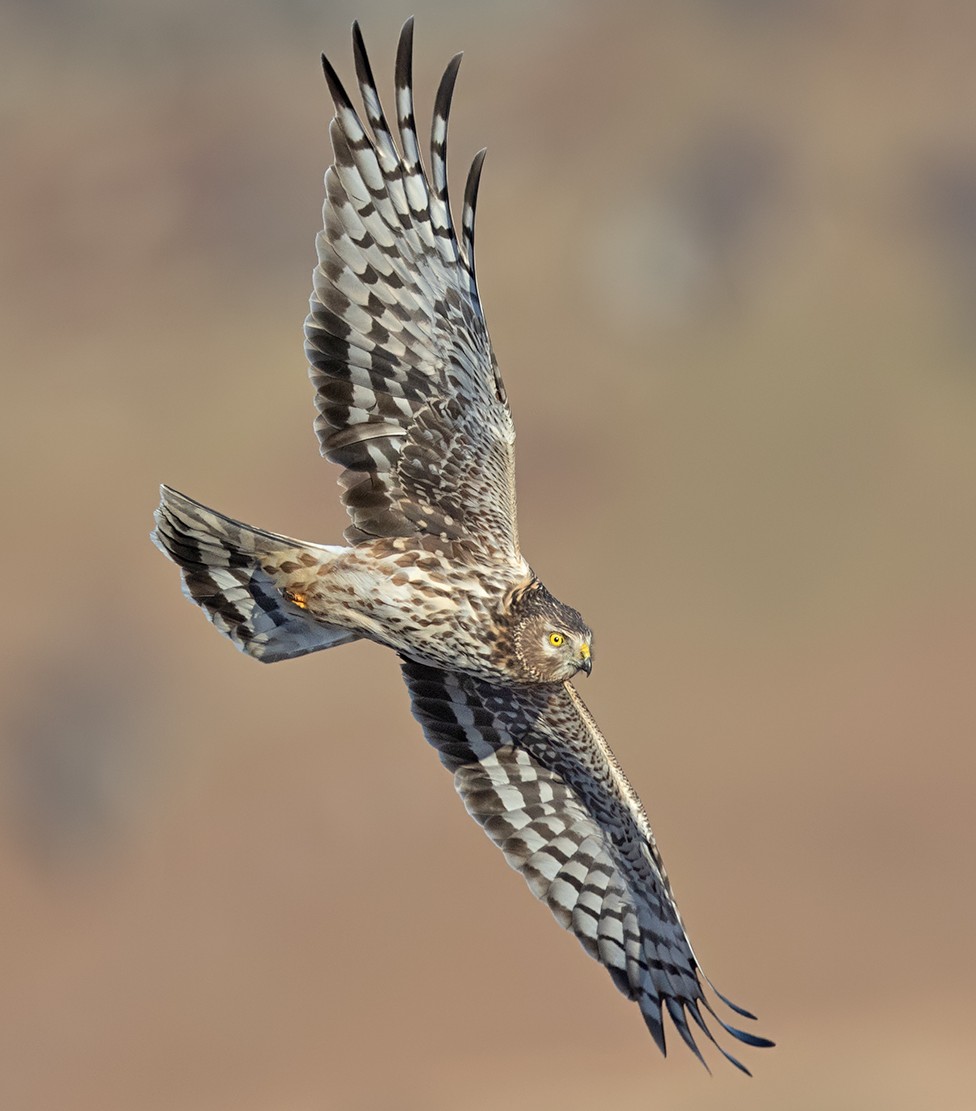
This one’s called ‘Edna’. She was tagged (Tag ID 161143a) in Cumbria as a nestling on 27 June 2023.
Edna featured in three Natural England spreadsheet updates after she’d fledged, listed in September 2023 as ‘Alive – Cumbria’, in December 2023 as ‘Alive – Cumbria’ and in April 2024 as ‘Alive – Yorkshire Dales’.
The next spreadsheet update was published in August 2024 and Edna’s listing was as follows:
Date of last contact:7 June 2024
Location of last contact:Northumberland
Status: Dead
OS reference: Recovered awaiting PM [post mortem]
That was all we knew about Edna’s fate for the next 14 months. Natural England published two more spreadsheet updates (December 2024 and April 2025) but in both of those updates Edna was still listed as ‘Recovered awaiting PM‘.
In January 2025 I’d blogged about the long delay in releasing Edna’s post mortem results, along with a number of others (here). They weren’t included in my running tally of ‘missing’ or illegally killed Hen Harriers because they could have died from natural causes or have been the victims of illegal persecution.
It took Natural England until October 2025, in its most recent spreadsheet update, to finally inform the public about Edna’s fate but even then, significant information has been withheld.
Edna’s entry on the October 2025 spreadsheet update looks like this:
Date of last contact:7 June 2024
Location of last contact:Northumberland
Status:Dead
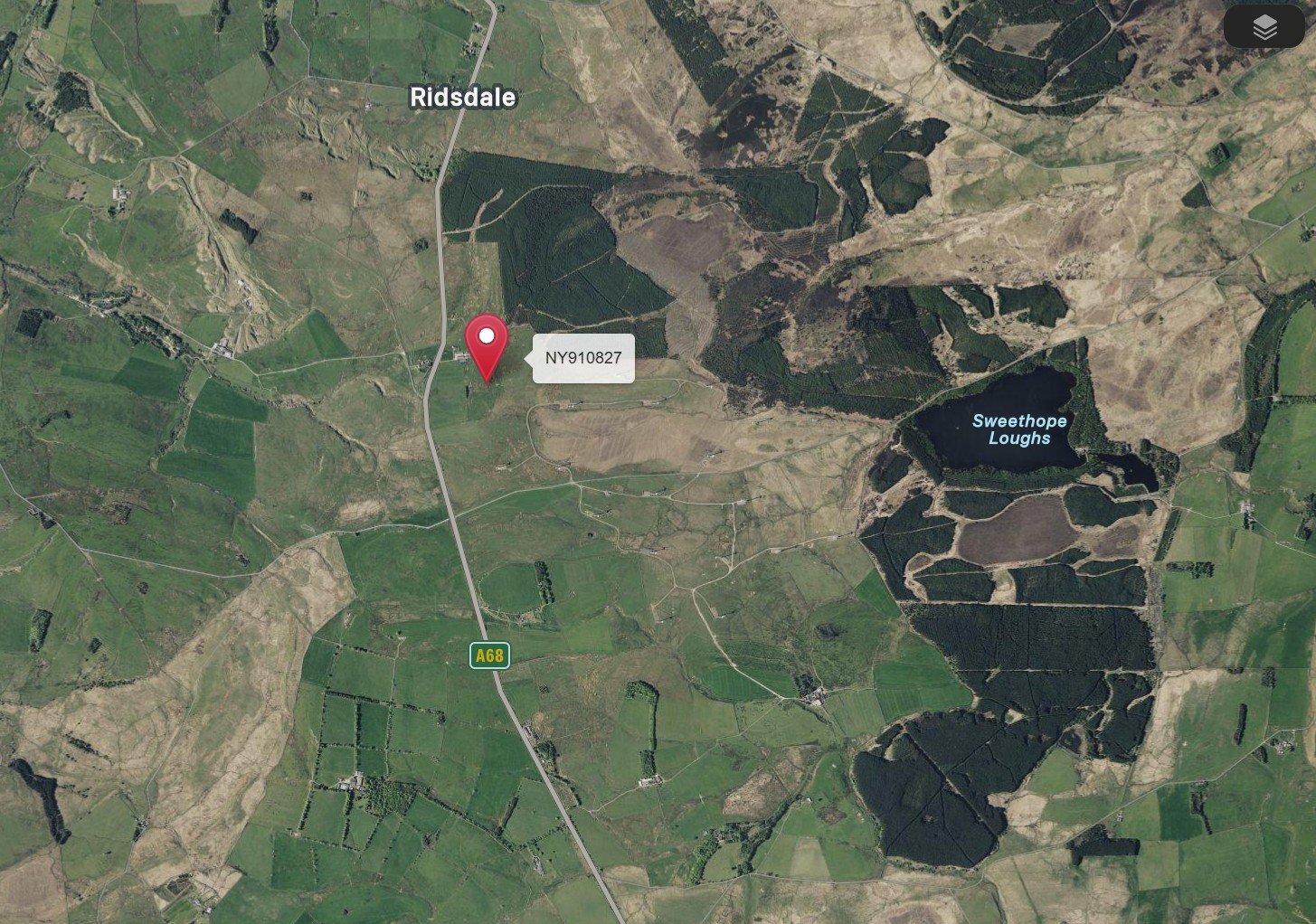
OS reference: NY910827
Notes on loss:Suspected illegally killed. Carcase had been scavenged, plus severe state of autolysis and decomposition.
If you look up that grid reference that Natural England has now provided, it shows a field at the Green Rigg Wind Farm nr Ridsdale, next to the A68, just south of Otterburn in Northumberland.
Hmm.
Edna’s corpse was found next to this wind farm in Northumberland
Now, because Edna’s corpse was too badly decomposed for a pathologist to determine the cause of death, it can be reasonably assumed that her satellite tag data provided sufficient evidence for the police and Natural England to determine that she was “suspected illegally killed“.
This ties in with information I was given by a number of sources in 2024 that a satellite-tagged Hen Harrier was believed to have been found dead at a wind farm in the north of England ‘and the circumstances suggest it didn’t get there of its own accord‘.
That’s a plausible scenario. We’ve seen many examples of the lengths the raptor killers will go to hide their crimes, including moving a tagged Golden Eagle (still alive), with two broken legs (injuries consistent with being caught in an illegally-set trap), some 15km north of the crime scene in the dead of night & leaving it to die in a layby (here), moving a Golden Eagle’s satellite tag (& perhaps the corpse) and dumping it in the North Sea (here), dumping a Golden Eagle’s satellite tag in a loch (here), wrapping a Golden Eagle’s tag in lead sheeting to block the transmission signal & dumping it in a river (here), removing a Hen Harrier’s tag from the victim and attaching it to a live Crow to make it look as though the tagged Harrier is still flying around (here), cutting off a White-tailed Eagle’s tag and placing it somewhere else, perhaps on neighbouring land (here), cutting off a White-tailed Eagle’s tag and dumping it in a river (here), and using a heat pack to mislead those monitoring the tag data that a dead Hen Harrier’s body temperature was stable whilst the tag data showed that the tag (and probably the corpse) was inside a vehicle travelling away from the kill site for disposal elsewhere (evidence that this has likely happened was provided during a police presentation at a recent Wildlife Crime conference).
Back to the info I received in 2024. I didn’t know where or when this had happened, only that it was in 2024 and my subsequent efforts to find out this information from the authorities have all failed, being repeatedly told it was being withheld for ‘operational purposes’.
I assumed ‘operational purposes’ meant that there was an ongoing investigation and that eventually this information would be made public, either on the NE spreadsheet, or in a public appeal for information from the police.
But no. Natural England’s spreadsheet provides the bare minimum of information and Northumbria Police have said absolutely nothing whatsoever, not even when Edna’s corpse was found 16 months ago.
Why do you think that is? Who benefits from this information being withheld?
Wouldn’t it be interesting to know the name of the estate where Edna is suspected to have been killed, and whether other Hen Harriers have also ‘disappeared’ from the same estate?
A satellite-tagged Hen Harrier named ‘Pete’ has ‘disappeared’ in Cumbria, according to a Natural England spreadsheet.
Pete was tagged as a nestling in Cumbria in 2021 (Tag #213843). He established a home range in SW Scotland and returned there each spring after wintering in France.
His tag stopped transmitting on 1st May 2025 after returning once again from France, with the last known transmission given at grid ref NY309418.
As usual, I haven’t seen any publicity about the disappearance of this tagged Hen Harrier. His details were quietly added to the Natural England spreadsheet when last updated in October 2025. In the notes section it states, ‘ground search unsuccessful ongoing‘.
Last year, charity Friends of the Dales launched a new campaign calling for an end to the criminal killing of birds of prey in the Yorkshire Dales National Park.
The Eyes on the Skies campaign, which aims to raise awareness about raptor persecution, launched in October 2025 with a free webinar featuring Kate Jennings, UK Head of Site Conservation & Species Policy at the RSPB, who talked about the work of the RSPB’s Investigations Team and reiterated the RSPB’s stance on licensing for gamebird shooting due to its links to illegal raptor persecution.
Friends of the Dales has now organised three more webinars, going out live in January, February and March this year.
Tuesday 27 January 2026, 5.30pm-7pm– Detective Inspector Mark Harrison from the National Wildlife Crime Unit (NWCU).
Wednesday 18 February 2026, 5.30pm – 7pm – Indy Kiemel Greene & Adrian Rowe from the charity Hen Harrier Action.
Wednesday 18 March 2026, 5.30pm – 7pm – Dr Ruth Tingay from Raptor Persecution UK.
For further information about these talks and to book your place (it’s free!), please click here.
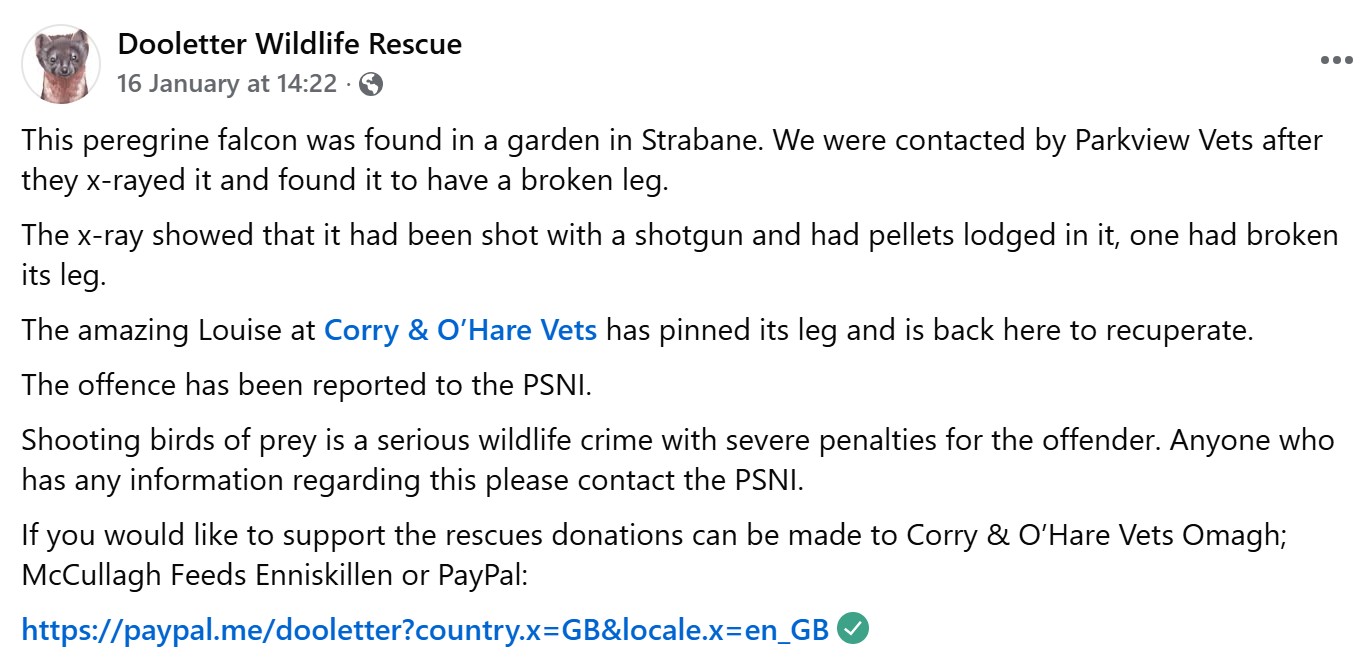
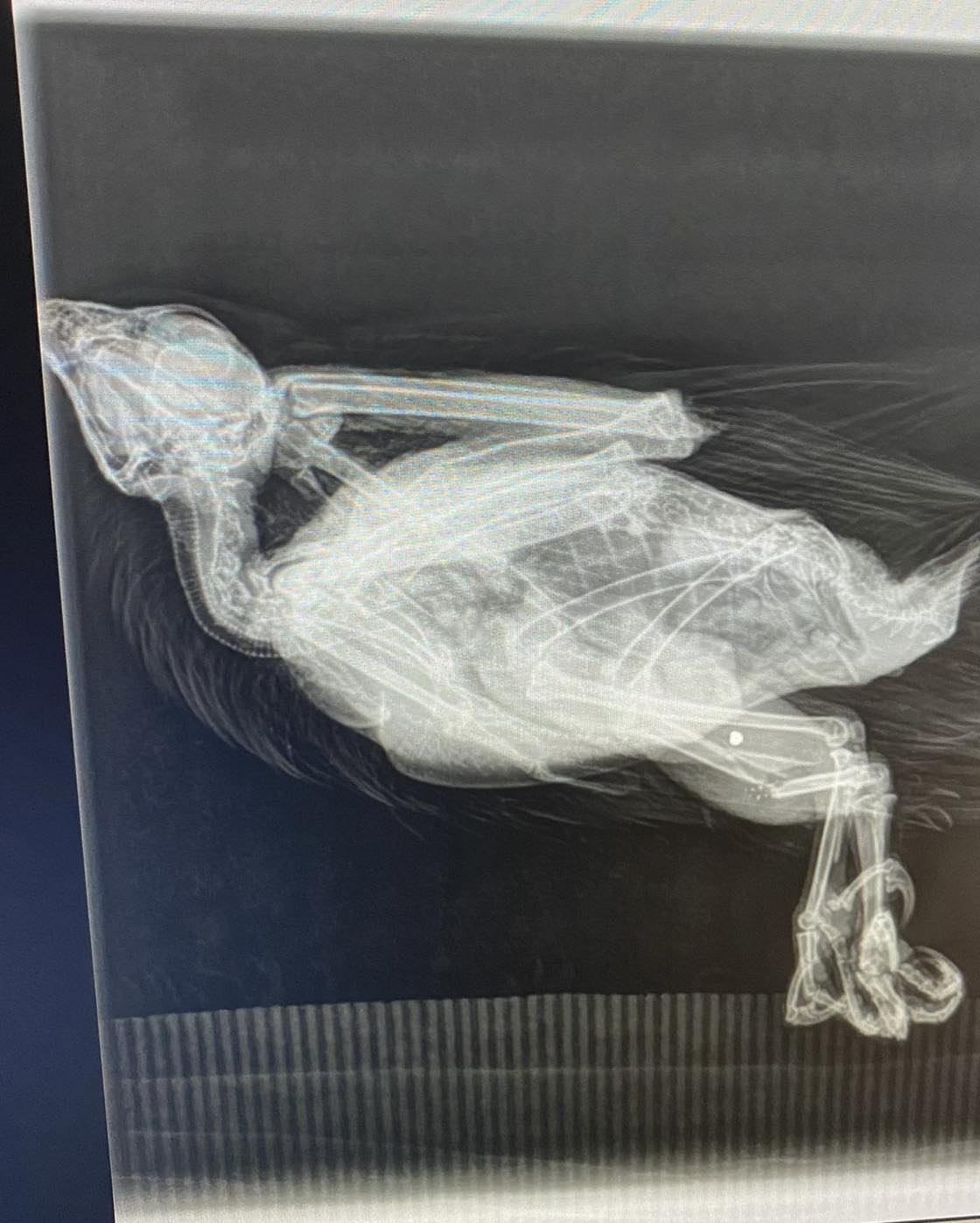
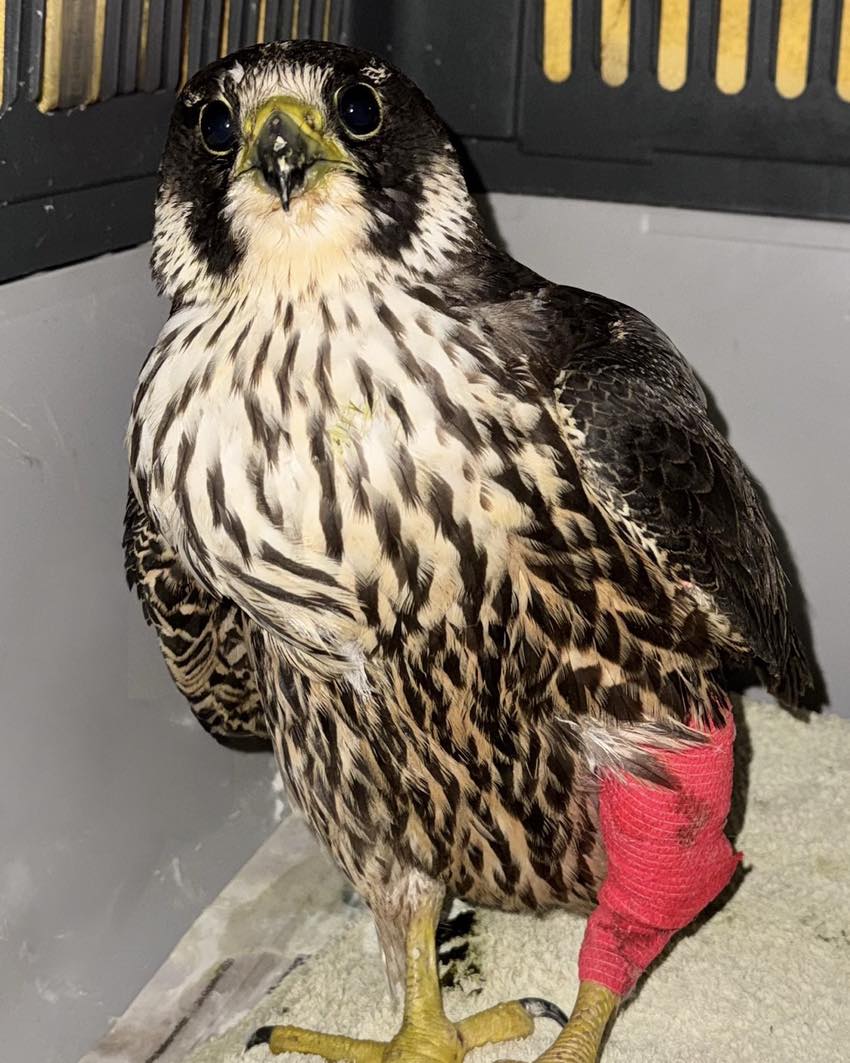
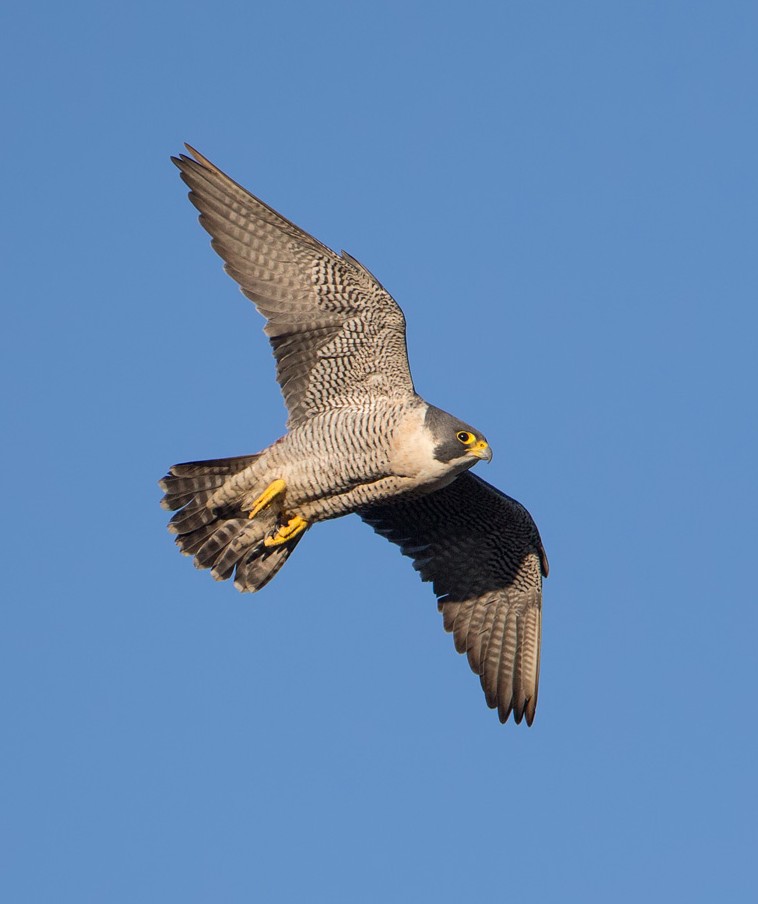
Last weekend the Police Service of Northern Ireland (PSNI) issued an appeal for information following the discovery of an injured Peregrine that had been shot and was found in a garden on Station Road, Strabane, County Tyrone on the evening of Friday 9th January 2026 (see here).
The Peregrine’s broken leg has now been pinned by a vet and the bird is being cared for by Dooletter Wildlife Rescue, who have provided the following update on social media:
On Monday this week, former gamekeeper Thomas Munday appeared at Scarborough Magistrates’ Court where he was convicted of killing a Buzzard in March 2024 on land owned by the Hovingham Estate in North Yorkshire and was fined £1,215 (see RSPB press release here).
The case drew wide media attention, not least because it centered on disturbing footage captured on an RSPB covert camera showing Munday brutally beating to death the Buzzard that had been captured inside a Crow cage trap. The violence was appalling, and according to a piece on ITV news, even Munday’s solicitor told the court that his client had done “an incredibly cruel thing, it wasadisgusting aberration“.
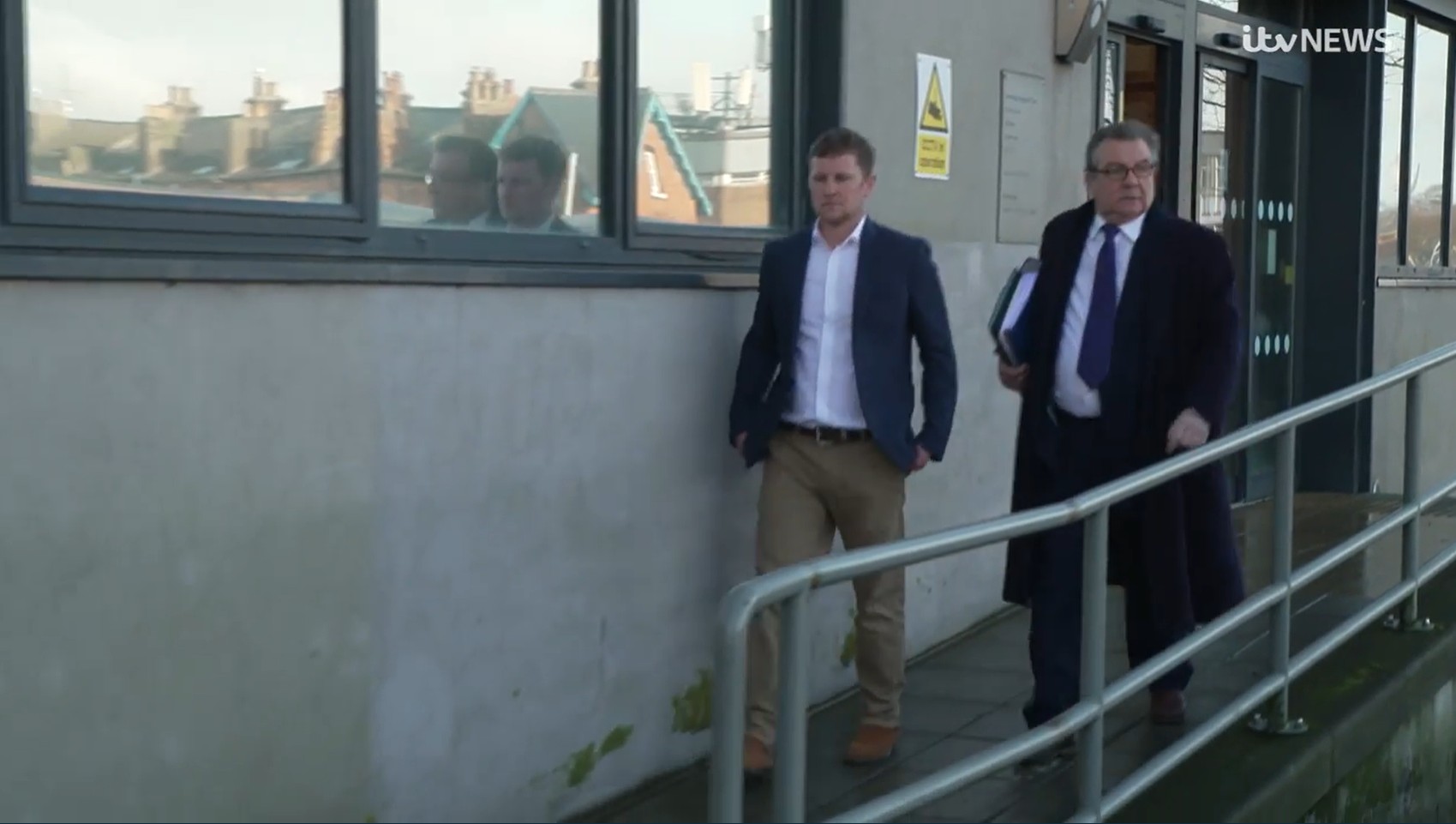
Thomas Munday (on the left) leaving court with his solicitor (screengrab from ITV News footage)
I said I’d return to this case to provide some commentary. I’m interested in three different aspects of the case: the charge against Munday, the sentence he received, and the location of the crime.
THE CHARGE
Munday was charged with intentionally killing a protected wild bird, a Buzzard. That’s an obvious offence and was clearly evidenced by the RSPB’s video footage. Munday pleaded guilty at the first available opportunity.
But to my mind there were other charges that could have been brought against Munday. For example, using a cage trap to kill or take a protected wild bird, possession of an article (the stick) capable of being used to commit an offence, and perhaps even going equipped (the ATV) to commit an offence.
However, the main additional charge I would have expected to see, based on the video footage, was that of causing unnecessary suffering to the Buzzard (Section 4 of the Animal Welfare Act 2006).
It’s beyond doubt, to me, (and apparently to Munday’s solicitor – see above) that that Buzzard suffered unnecessarily due to the two bouts of inhumane and cruel beating caused by Munday.
The courts are expected to treat animal cruelty seriously, as evidenced by the guidelines provided by the Sentencing Council – see here.
If you follow the step-by-step process outlined by the Sentencing Council, Munday’s actions could be determined as being of either High Culpability or Medium Culpability, and the harm caused (death) falls under Category 1 (the most serious level of harm caused).
Sentencing guidelines for offences determined to be High Culpability Category 1 start at two years’ custody. For Medium Culpability Category 1 offences, the starting point is 26 weeks’ custody.
I wonder why the CPS chose not to bring any charges other than that of intentionally killing a protected wild bird (the Buzzard)? Or maybe the CPS did bring other charges and there was a plea bargain? Along the lines of, ‘My client will plead guilty if the other charges are dropped’? That’s a common and legitimate feature of many criminal prosecutions but if that did happen in this case, why did the CPS accept? Was it a case of getting a quick and easy conviction in the bag and let’s move on to the next case?
This is all conjecture, of course, and until there’s better (any!) transparency about charging decisions then we’ll never know.
THE SENTENCE
Munday was fined a total of £1,215 for killing the Buzzard. This amount was broken down as follows:
£807 – fine
£323 – surcharge
£85 – costs
Some people, and I’m one of them, will consider that this level of fine does not reflect the seriousness of the offence and is at the lower end scale available to the courts. As the RSPB stated in its press release after Munday’s conviction, ‘This penalty provides little deterrent to others who may consider committing similar crimes and fails to reflect the casual and callous acts of cruelty involved‘.
I’ve seen some argue that the other consequences Munday faced (i.e. losing his firearms and shotgun certificates, losing his job, losing his home), in addition to the fine, is sufficient penalty for him. I disagree. Losing a job and home is no different to someone being made redundant, through no fault of their own, and having to relocate to find work.
According to media reports, Munday has re-trained (now a tree surgeon, apparently, so need for firearms/shotgun certs), is employed and has moved away from the house he was renting. Paying off a £1,215 fine shouldn’t be too much of a burden to him.
In addition, this case utilised forensic expertise (including examination of the bloodied stick to identify Buzzard DNA, and swabs taken from the vehicle in to which the bludgeoned Buzzard had been thrown). This work was conducted by the Wildlife DNA Forensic Unit at SASA in Scotland, paid for by the Forensic Analysis Fund (to which organisations like Wild Justice, Northern England Raptor Forum, Tayside & Fife Raptor Study Group, Devon Birds, Rare Bird Alert and many individual donors, including this blog’s readers, have contributed – see here).
One of the conditions of using the Forensic Fund for raptor persecution cases is that if the case progresses to court and costs are recoverable, an application must be made to the court to recover those costs, and any amounts recovered must be reimbursed back into the Forensic Fund to be used for other cases.
In this case, an application was made to the court to recover the costs of the forensics work but the magistrates said that a reimbursement wasn’t possible because the forensics work ‘wasn’t necessary’ to the case.
To explain – Munday committed his offence in March 2024. The RSPB passed on the video evidence to North Yorkshire Police who executed a search warrant (date unknown) at an address and retrieved several items for forensic examination. However, Munday wasn’t interviewed at that time (for reasons best known to North Yorkshire Police).
Munday was only interviewed by North Yorkshire Police in December 2025, some 21 months after the crime was committed. Had he been interviewed in 2024, Munday’s solicitor told the court that his client would have held up his hands and pleaded guilty. Hence, in the magistrates’ opinion, the forensics work wouldn’t have been needed.
THE LOCATION OF THE CRIME
If you’ve read a lot of the media reports about this case, including the RSPB’s press release and North Yorkshire Police’s press release, you might have noticed that the name of the estate where this crime took place has not been reported. It’s invariably been described as ‘near Hovingham’ and ‘near Malton’ – even the CPS charge apparently described the location as being ‘near Ripon’, which is unusual as typically the exact location is included in the charge. The exception was an article on the BBC’s website, which stated, ‘Thomas Munday was filmed killing the buzzard on land which is part of the Hovingham Estate, in North Yorkshire, in March 2024‘.
The court was told that Munday was employed by a ‘management company’ (un-named) who leased the land on an estate for a Pheasant shooting syndicate. According to an observer in court, Munday’s solicitor ‘spent a long time’ telling the court that the estate had nothing to do with the Pheasant shoot, and that as soon as the estate found out about the Buzzard being killed, it terminated the lease. Apparently he went as far as to say he hoped the press would report this sensitively. That’s bizarre – it’s almost as though the solicitor was acting for the estate.
I was intrigued by this apparent reluctance to name the estate and did some digging.
Hovingham Estate (also known as Hovingham Hall) has been in the ownership of the Worsley family for over 450 years. Sir William Worsley (6th Baronet) apparently resides there with his family. He’s big into forestry and conservation, according to Wikipedia, being the former Chairman of the National Forest Company, the former Government’s National Tree Champion, and is the current Chair of the Forestry Commission.
The estate has won awards for its woodland management, including winning a silver award in the 2023 Bede Howell Award for Excellence in Silviculture (the year before the Buzzard was beaten to death in the woods). The judges commented:
“We were impressed by the co-ordination achieved between the several estate departments. For example, the woodlands present an attractive landscape of high amenity and biodiversity character. They also host an important pheasant shoot by paying especially close attention to the character of woodland edges. The result is a profitable woodland enterprise containing excellent stands of timber. this integrates effectively with sporting and other estate priorities“.
I can see why a man of this standing would want to distance the estate from the disgusting and barbaric crime committed by gamekeeper Thomas Munday, and the estate deserves full credit for immediately terminating the shooting lease. I wish more landowners would follow this example and act so quickly and decisively when dealing with sporting agents.
But that Bede Howell awards committee statement about Hovingham Estate made me pause for thought. “They also host an important pheasant shoot….” (emphasis is mine).
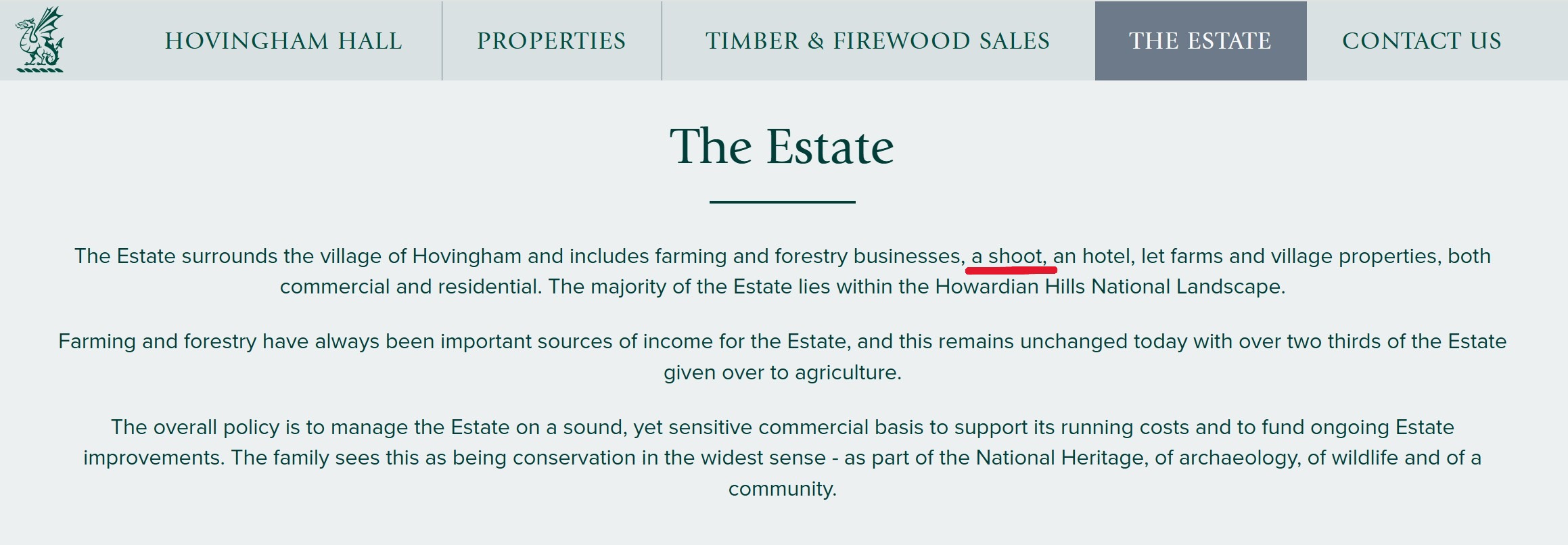
If you look on the Hovingham Hall website, it includes a statement about what goes on at the estate:
It says the estate includes ‘a shoot’, which suggests to me that the estate may be more involved in Pheasant shooting than simply renting the land to a tenant sporting agent.
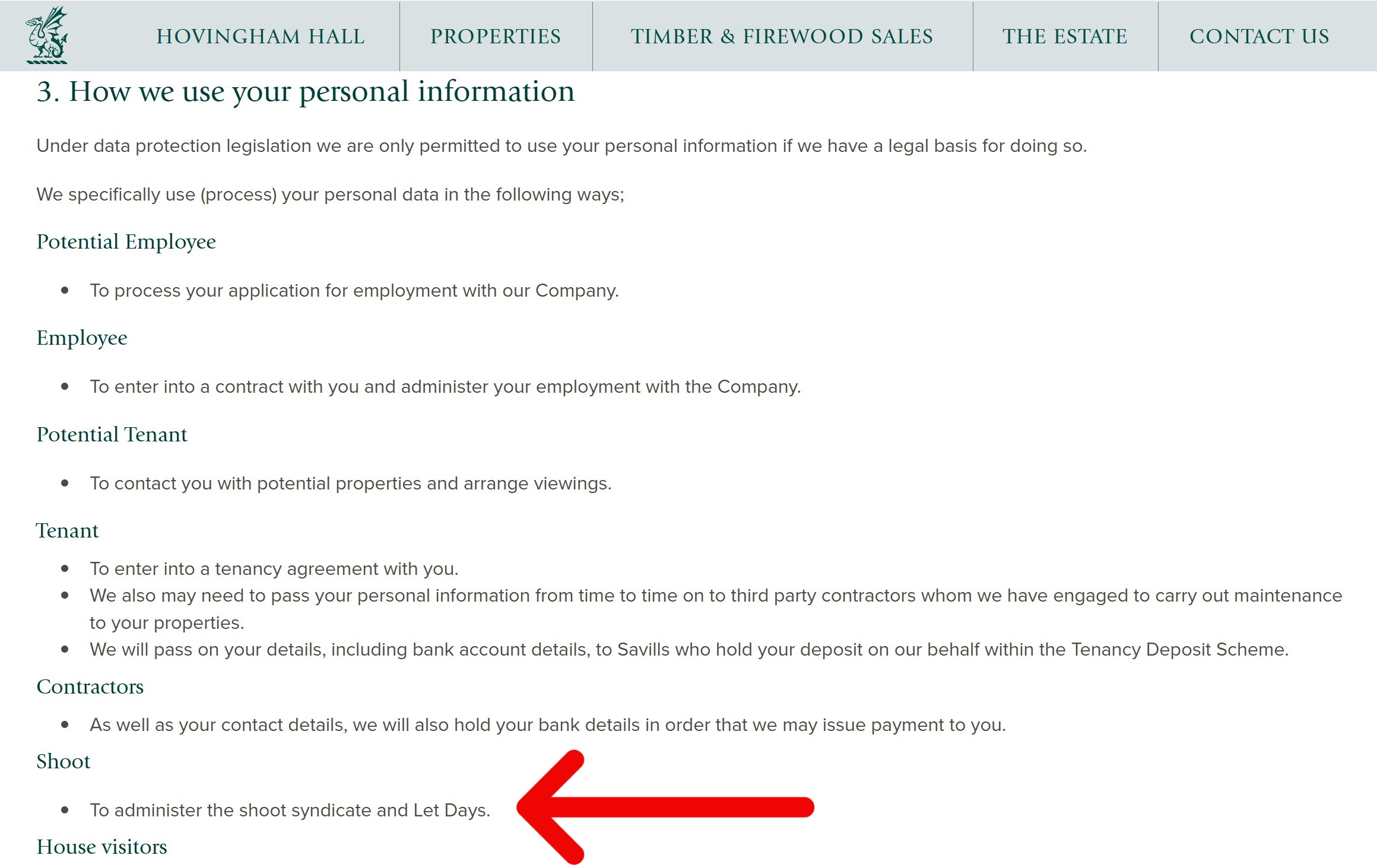
However, when I looked around the rest of the website, I couldn’t see any further mention of ‘a shoot’, until I looked at the estate’s privacy policy (dated 2024).
This privacy policy lays out how the estate handles its responsibilities under the Data Protection Act and how personal information is used. There’s an interesting entry under the header ‘Shoot’, which suggests the estate is involved in the administration of the ‘shoot syndicate and Let Days’.
Hmm.
I decided to phone the estate and ask them about their involvement in Pheasant shooting and whether they still had a Pheasant shoot after terminating the shoot lease in 2024.
I spoke to a nice lady in the main office who gave me a prepared statement, as follows:
“Hovingham Estate is aware of an incident involving one of our tenant’s employees. We take a zero tolerance approach to issues of this kind and therefore we took immediate action to terminate the tenant’s lease. We must emphasise that none of our employees are involved in any way“.
That’s pretty clear, but didn’t answer my questions. I asked the questions again and the nice lady told me:
“I’m sorry, I’m not at liberty to comment“.
To be absolutely clear, there is no evidence to suggest that Hovingham Estate knew about the criminal activity of gamekeeper Thomas Munday, and when it did become aware, it acted responsibly and terminated the lease.
If this estate is still hosting Pheasant (or Partridge) shooting, whether leased to another tenant or managed by the estate, I hope that lessons have been learned and close attention is paid to what might be going on in those award-winning woodlands.
Kudos again to the RSPB’s Investigations Team for securing the evidence that led to this conviction.
The RSPB is asking members of the public to report incidents of moorland burning on peatlands using their burning reporting app or through the RSPB’s website.
The data collected will be passed on to the relevant authorities in England, Scotland, Wales and Northern Ireland to help them to tackle illegal and unsustainable burning.
Peatlands account for 12% of the UK’s land area and contain more carbon than the forests of the UK, France and Germany combined – an estimated 3.2 billion tonnes. 80% of our peatlands are in degraded condition and emitting, not sequestering carbon, as needed to help combat climate change due to historic, damaging land management including repeated burning.
UK uplands are home to some of our most at-risk wildlife including Hen Harriers, Ring Ouzel, Winchat and Large Heath butterfly and globally important upland habitats, such as blanket bogs, which have developed over millennia and store large amounts of carbon.
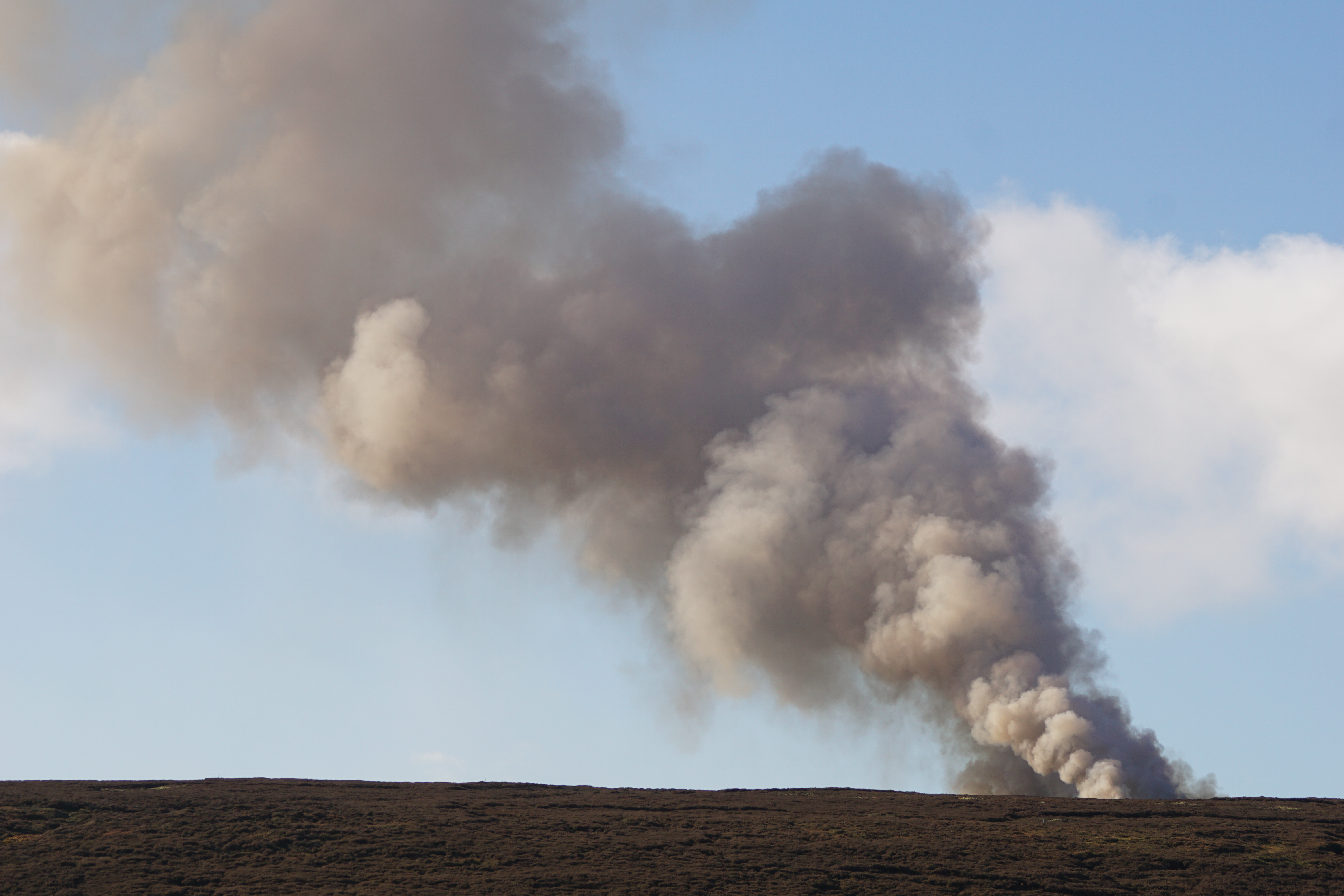
Illegal burning on Midhope Moor, Peak District National Park (Photo: RSPB)
Every year from October until April across the UK, upland vegetation is systematically burned in many places, and our peatlands are often damaged as a result. ‘Rotational burning’ is a practice used by shooting estates, deer managers and farmers to encourage the growth of young heather shoots and grass to provide food and grazing for red grouse, wild deer and livestock.
However, scientificevidencereviews show that regular burning has numerous harmful environmental impacts and has caused our peatlands to become a source of emissions.
Scorched earth – the charred ground and ash following a ‘management’ burn (Photo: RSPB)
Tom Aspinall for RSPB England said: “Defra extending the protection from burning to all peat over 30cms in 2025 has been a great step forward for nature, especially now it’s applied across all ‘Less Favoured Areas’ rather than just protected sites. This approach should better protect thousands of years’ worth of accumulated carbon.
“In support of keeping England on the right track, the RSPB burning app has been a great ‘citizen approach’ to assessing how well Land Managers are following these vital new rules – and it’s already been making a difference. We encourage as many people as possible to send in reports via the RSPB app, providing important evidence to pass forward to Defra, and helping to make sure action is taken to keep the English Uplands in better health.”
Duncan Orr-Ewing for RSPB Scotland said: “Welcome new legislation to licence all muirburn in Scotland will be introduced from autumn 2026 following a couple of delays. This legislation restricts burning on deep peatlands over 40cm, however, still makes provision for prescribed burning in some circumstances to reduce the risk of wildfires. Better information on the distribution and timing of burning activities is critical to make informed decisions around muirburn and to reduce wildfire risk”.
Arfon Williams for RSPB Cymru said:“The large number of uncontrolled fires across Wales in 2025 severely impacted important wildlife and habitats including our precious peatlands. Many of these fires were started deliberately. To understand the extent of this threat to nature we urge the Welsh public to report upland fires via the RSPB app. This information will be invaluable in supporting our calls to Welsh Government to do more to protect nature and especially peatlands. This includes ensuring greater compliance with the Heather and Grass Burning Code for Wales.”
Claire Barnett, Area Manager for RSPB NI said: “Peatlands are a vital habitat in Northern Ireland but each year, we see the devastating impact of fires here. Fires that pose a risk to nature, wildlife and local communities. At RSPB NI we will continue to call for a legal ban on peatland burning and you can play a vital role in showing how widespread the issue is by downloading our app and reporting evidence of burning across our uplands.”
To anonymously report a burn, members of the public can visit the RSPB Burning website or download the My Survey123 app (available on iOS and Android).
By downloading our app and reporting evidence of burning you can play a vital role in helping to show our governments how much burning continues across our uplands and providing them with the evidence they need to act against those who are not following regulations and may be damaging peatlands and also risking wildfires. Ending burning on peatlands will be a key step in ensuring we can turn round the fate of this globally important habitat in the UK.
The conservation campaign group Wild Justice has published a blog detailing the unlawful release of gamebirds (Pheasants & Red-legged Partridges) next to a protected site in Suffolk, along with multiple breaches of mandatory biosecurity legislation which was brought in to prevent the spread of Highly Pathogenic Avian Influenza (HPAI, also known as Bird flu).
The release of non-native gamebirds on or within 500m of a Special Protected Area (SPA) currently requires an individual licence from Natural England, due to the very high risk of spreading HPAI.
A licence application was submitted to Natural England in April 2025 to release 2,450 non-native gamebirds (950 Pheasants + 1500 Red-legged Partridges) at Ramsholt, Suffolk, within the 500m boundary of the Deben Estuary SPA.
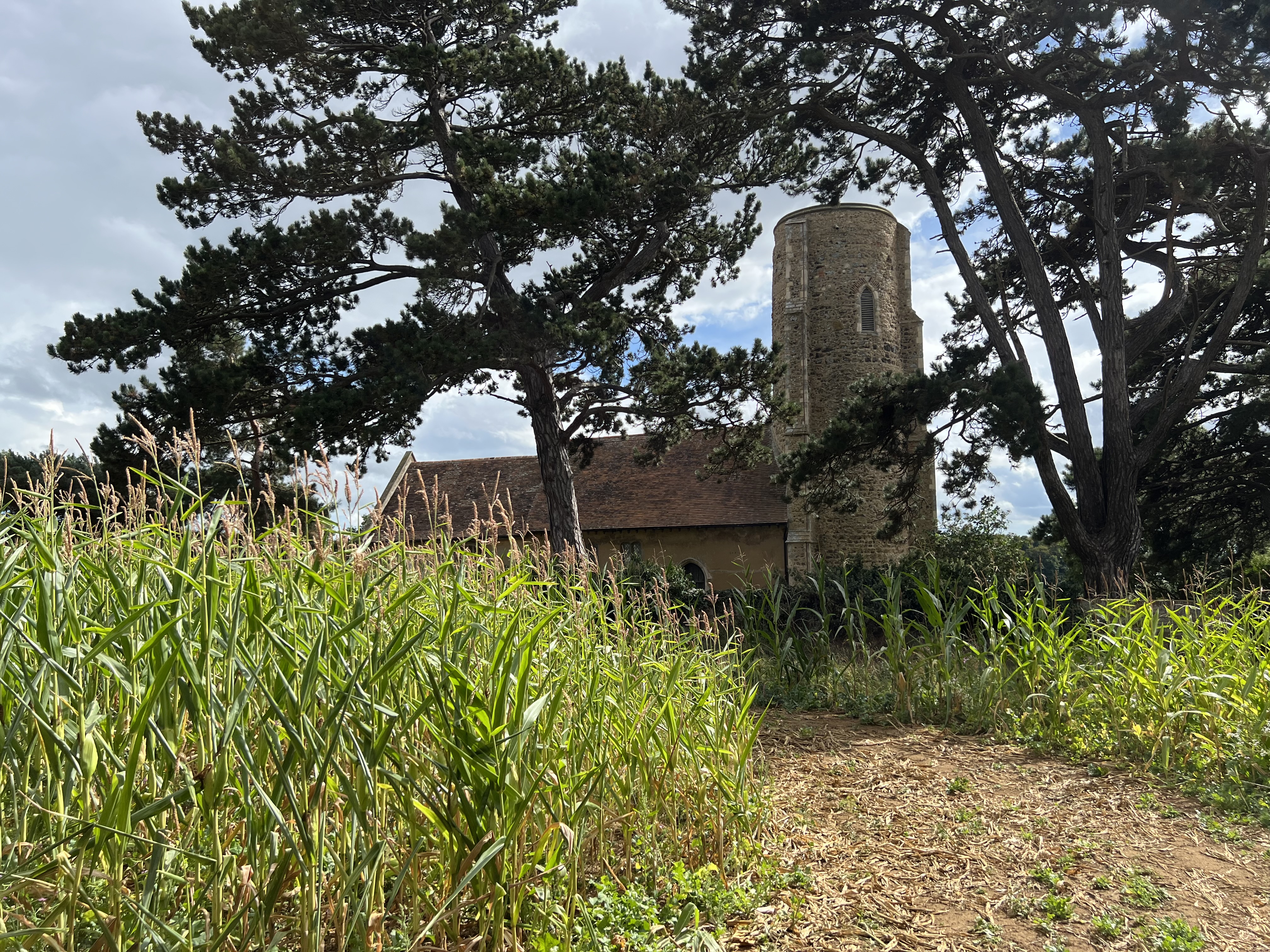
Ramsholt church, next to the Deben Estuary (photo Wild Justice)
Natural England refused the licence on the grounds that “It was not possible to rule out adverse effects to the integrity of the Special Protection Area (SPA) from the proposed gamebirds releases within the SPA boundary and/or its 500m buffer zone”.
The same licence applicant submitted a further application in May 2025, but Natural England rejected this one, too.
Guess what happened next?
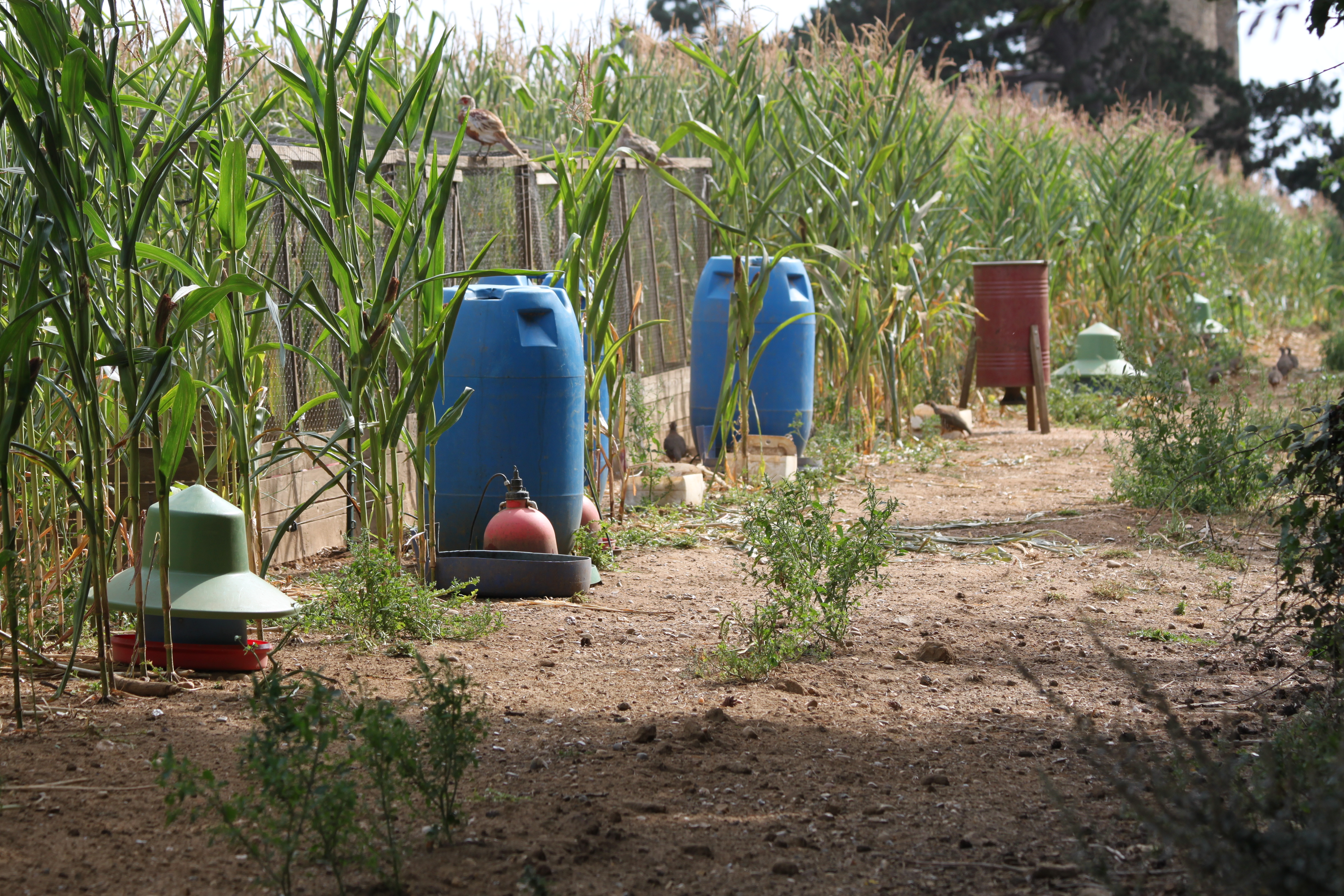
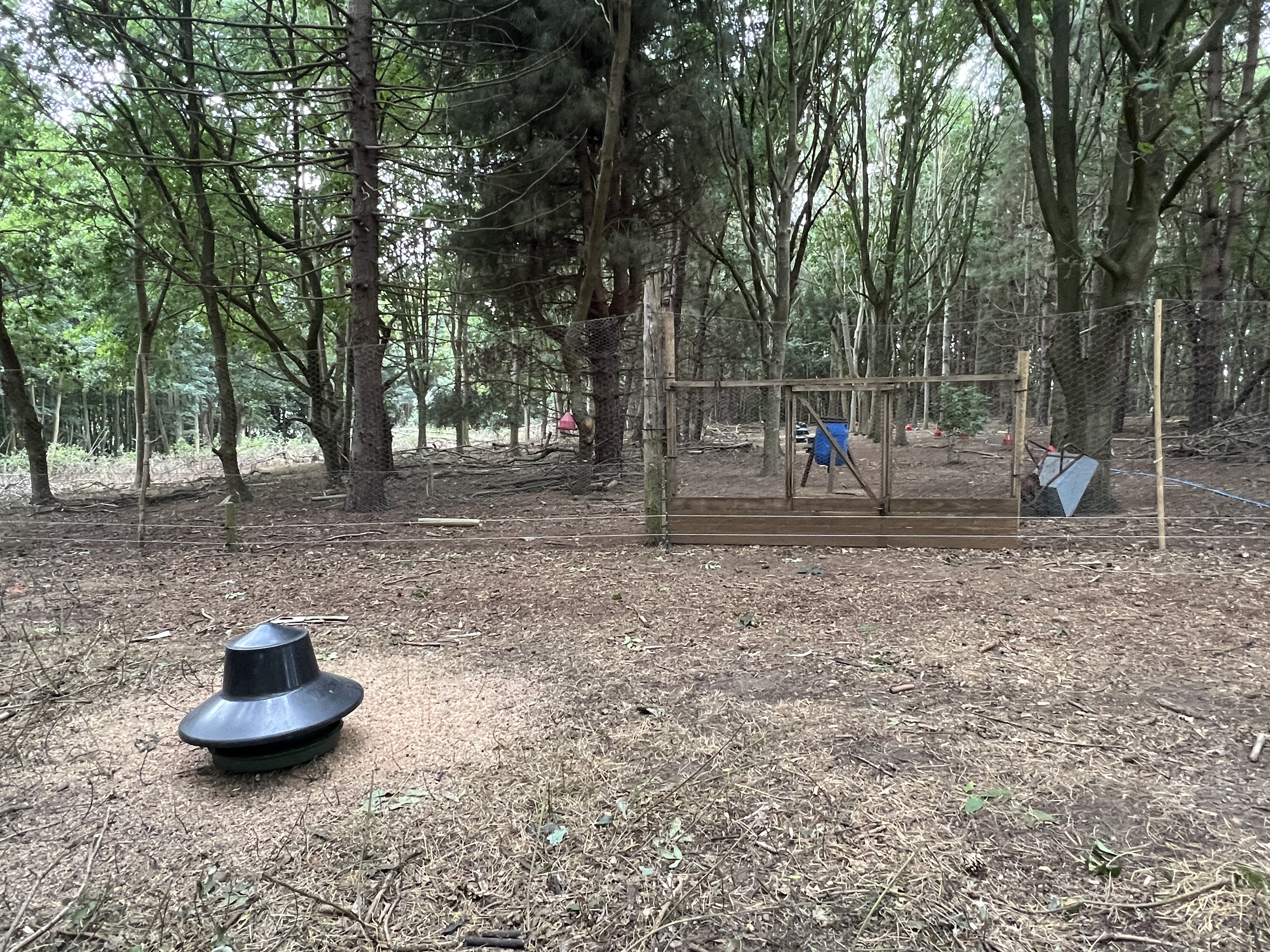
The shoot operator went ahead and released gamebirds within the 500m SPA buffer zone at Ramsholt! This is a criminal offence.
One of the unlawful Red-legged Partridge release pens situated in a thin strip of Maize in front of Ramsholt church (photo Wild Justice)
Not only that, whoever was in charge of the gamebird releases failed to comply with mandatory biosecurity measures (this is also a criminal offence), thus increasing the risk of spreading HPAI.
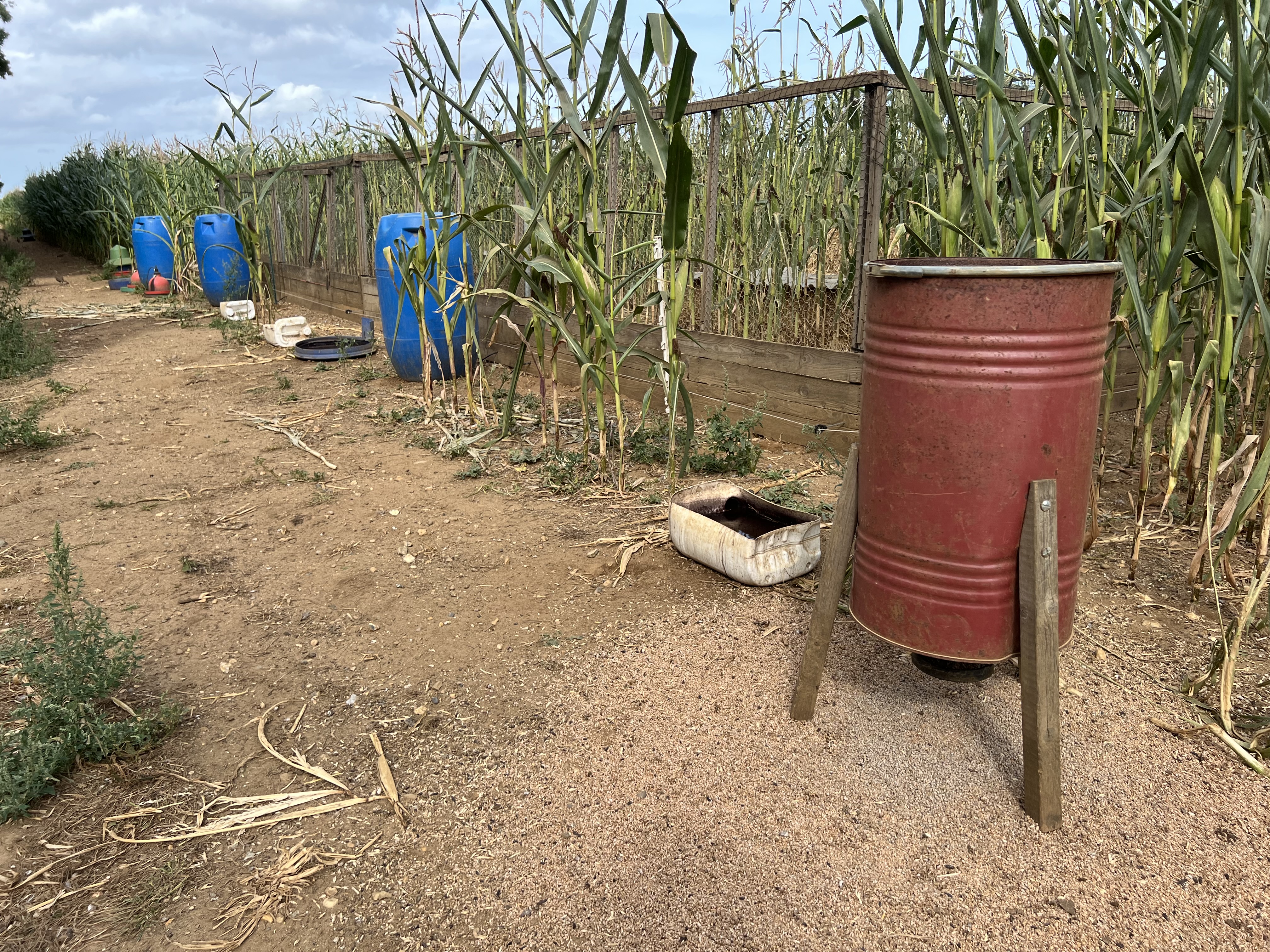
Biosecurity risk – unclean water containers by the RLP release pen (photo Wild Justice)
Biosecurity risk – spilled food must be cleared daily (photo Wild Justice)
Suffolk Police investigated the unlawful releases and issued a Community Resolution Order (CRO) to the shoot operator. Gosh, that’ll learn ‘im!
Suffolk County Council Trading Standards department investigated the unlawful non-compliance with biosecurity regulations and issued the shoot operator with ‘verbal guidance’.
Apparently, the shooting days still went ahead.
Good grief.
The explanations provided to Wild Justice by the Police and by Trading Standards of why more serious enforcement measures weren’t pursued in this case are well worth reading on the WJ blog. They’re laughable, particularly the explanation provided by Suffolk Constabulary, who gave credence to the shoot operator’s claim that he was new to the shoot and was “not linked” to the licence applicant. I find that to be implausible, for all the reasons given on the WJ blog.
As well as uncovering criminal activity, this Wild Justice investigation has highlighted huge gaps in the regulatory approach. There’s no statutory monitoring of gamebird releases and compliance with biosecurity regulations at protected sites and no formal mechanism for detecting potentially harmful activities. This particular case was only uncovered thanks to an observant member of the public who noticed the gamebirds running around the site and had the knowledge and sufficient curiosity to notify Wild Justice.
How many more examples might there be across the country? I’m aware of several, not yet reported in the public domain (but watch this space).
Over the next few months, Defra will need to decide whether it will issue General Licence 45 for this year’s shooting season. This is the General Licence that permits the release of gamebirds on or within 500m of an SPA. Last year, Defra withdrew GL45 due to the high risk of spreading HPAI. Given the high number of reported HPAI outbreaks since Oct 2025 (84 at the time of writing), I anticipate Defra will not issue GL45 this year.
If that happens, then it will fall to Natural England to make decisions about issuing individual licences to permit the release of gamebirds on/close to SPAs. Last year, Natural England took a sensible and precautionary approach and refused licences at many sites (see here), although as we’ve seen, some shoot operators might think the law doesn’t apply to them and the consequences are so minimal it’s probably worth them taking the risk.
Wild Justice relies entirely on donations to undertake its work. If you think what it does is important, please consider making a donation here. To sign up to Wild Justice’s free newsletter to be the first to hear about its latest campaigns and legal challenges, please click here.
Further to last week’s blog about a gamekeeper being due to appear in court charged with killing a Buzzard on a Pheasant shoot at Hovingham, North Yorkshire (here), the case was heard today at Scarborough Magistrates’ Court and Thomas Munday pleaded guilty.
In March 2024, secret RSPB filming caught gamekeeper Thomas Munday brutally killing a protected Buzzard whilst it was caught in a cage trap on a pheasant shoot near Hovingham, North Yorkshire.
Today, at Scarborough Magistrates Court, Munday pleaded guilty to killing a Buzzard and was fined £1,215.
Although cage traps can be legally operated under government licences, they have a history of being repeatedly used in unlawful ways to catch and kill birds of prey on land managed for gamebird shooting. These incidents are generally related to attempts by the operator to remove any potential threat to gamebird stocks, reared for commercial shooting.
The RSPB is urging the UK Government to introduce a licensing scheme for all gamebird shooting to deter bird of prey persecution and to promote better practices.
On 30 March 2024, a covertly deployed RSPB camera caught a gamekeeper brutally beating a protected Buzzard to death inside a cage trap set in woodland near Hovingham, North Yorkshire.
Screengrab from the RSPB’s covert footage showing gamekeeper Thomas Munday clubbing the Buzzard to death, having already bludgeoned it inside the crow cage trap. The casual level of brutality and the suffering he caused is very disturbing.
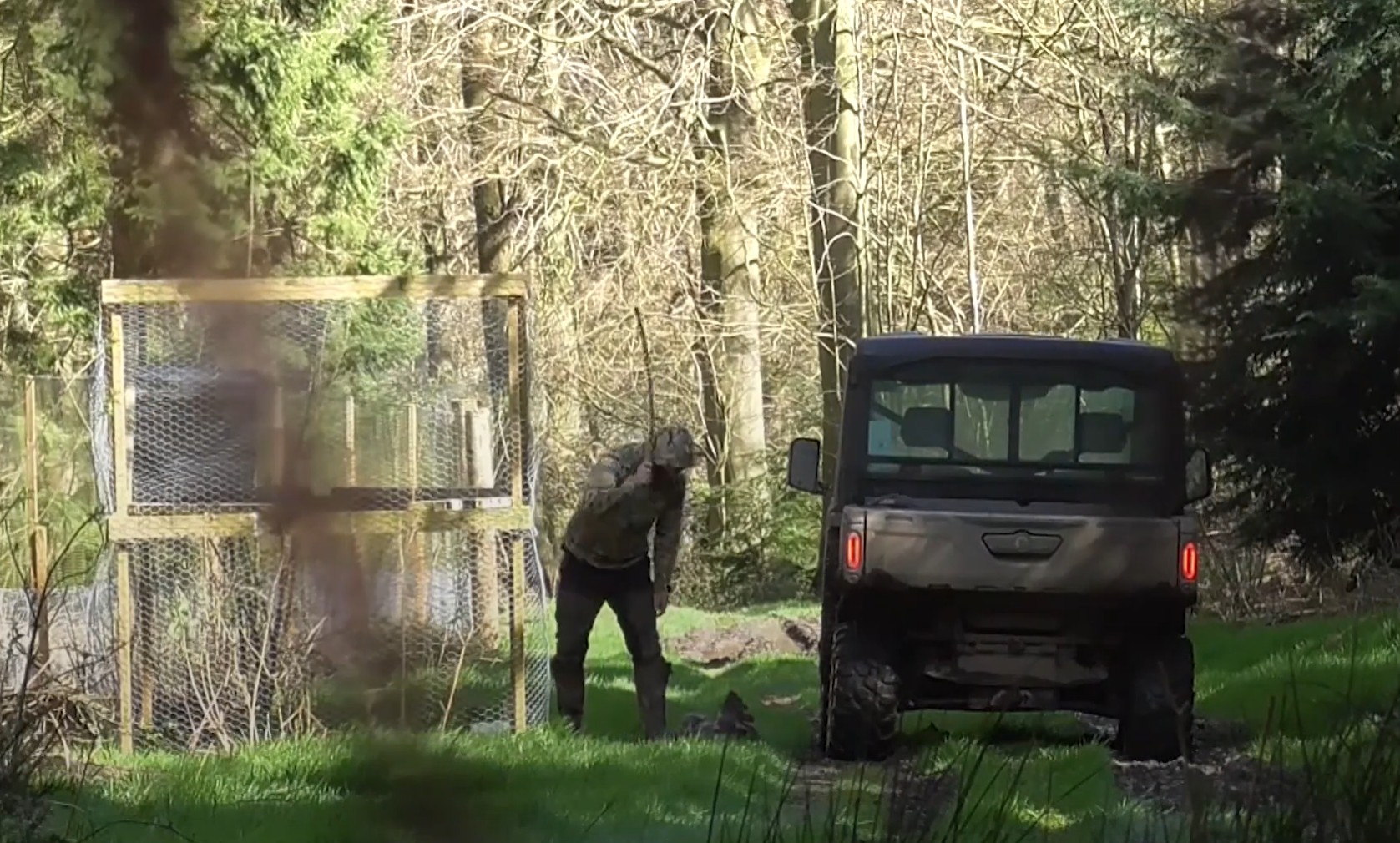
The footage shows a Buzzard entering the crow cage trap. Four hours later, a masked and hooded individual arrives at the trap in an all-terrain vehicle. He enters the trap and is seen repeatedly striking the Buzzard with a stick. The injured and incapacitated Buzzard is then removed from the trap – clearly still alive – and beaten several more times with the same stick. The individual then picks up the bird by its wing and throws it into the vehicle before driving away from the site.
The RSPB shared the footage with North Yorkshire Police, who later identified the individual in the footage as Thomas Munday – employed as a gamekeeper.
Of all individuals convicted of bird of prey persecution-related offences between 2009 to 2023, 75% were connected to the gamebird shooting industry and 68% were gamekeepers.
A police-led search of the land, assisted by the National Wildlife Crime Unit (NWCU), resulted in a number of items being seized including the stick used to kill the Buzzard. Forensic testing by the Scottish Agricultural Science Agency (SASA) funded by the Partnership against Wildlife Crime (PAW) Forensic Analysis Fund found traces of Buzzard DNA on the stick. Munday was subsequently charged with the illegal killing of the Buzzard, an offence under the Wildlife and Countryside Act 1981.
On 12 January 2026, at Scarborough Magistrates Court, Thomas Munday pleaded guilty to killing a Buzzard and was fined £1,215.
Crow cage traps can be legally used under Government General Licence, issued by Natural England, to control corvid species such as Carrion Crows or Magpies, on condition that licence conditions are adhered to. Under these conditions, if a bird of prey or any other non-target species is caught in the trap, on discovery the bird must be released at point of capture without undue delay.
Sadly, this method of targeted killing of birds of prey is a persistent problem in the UK particularly on land managed for gamebird shooting. In a period of ten-years (2015-2024), 30 confirmed incidents of birds of prey being caught and/or dying in unlawful crow cage traps were recorded in the UK. 97% of these incidents were associated with land managed for gamebird shooting. 34 birds of prey were involved in these crimes with Buzzards, Goshawks and Sparrowhawks the most common victims associated with these crimes.
Howard Jones, RSPB Senior Investigations Officer: “The casual and brutal killing of the Buzzard is extremely upsetting to watch and it’s clear that Munday has a complete disregard for the law, and the legislation that protects these birds. Frustratingly, this incident isn’t a one off but is just the latest example of the cruel and disturbing lengths some individuals will go to in order to illegally kill birds of prey.
“These crimes and the wider issue of bird of prey persecution is significantly linked to the gamebird shooting industry. Without long overdue regulation of gamebird shooting we expect to see these crimes continue.”
James Robinson, RSPB Chief Operating Officer said: “Although we welcome Defra’s recent announcement of a review of corvid traps, this latest incident underlines a far wider and deeply entrenched issue for our protected birds of prey.
“For decades, these species have been illegally killed on land managed for pheasant, partridge and grouse shooting. More than half of all 1,529 confirmed persecution incidents recorded from 2009-2023 were linked to gamebird shooting. These crimes will continue without meaningful legislative change.
“Through the introduction of a robust licensing system for all gamebird shooting across the UK, the illegal killing of birds of prey could be effectively deterred. Scotland took this welcome step in 2024 when it introduced licensing for grouse shooting. We need the Government to take action, now.”
Though we welcome the guilty verdict in today’s case, we are disappointed that the sentence imposed is at the lower end of the provisions available to the court. This penalty provides little deterrent to others who may consider committing similar crimes and fails to reflect the casual and callous acts of cruelty involved.
The RSPB thanks the North Yorkshire Police, the NWCU and the Crown Prosecution Service for their vital role in investigating and prosecuting this case.
Members of the public are urged to report any suspected incidents of bird of prey persecution by contacting the police on 101 and by submitting a report to the RSPB.
This can be done via the RSPB’s online reporting form at www.rspb.org.uk/report-crimes or by calling the RSPB’s confidential Raptor Crime Hotline on 0300 999 0101. Reports via the RSPB’s reporting form and Raptor Crime Hotline can be made anonymously.
ENDS
The RSPB covert footage can be viewed here, but BE WARNED, it includes animal cruelty, suffering and death.
My commentary:
I’ll keep this brief because I’m short of time today but I’ll be returning to this particular case later in the week as there are several important points that were not covered in the RSPB’s press release.
For now, the RSPB deserves huge credit for capturing this horrific crime on camera and ultimately securing a conviction. It’s interesting that the defence did not challenge the admissibility of the RSPB’s video footage and the court accepted it without question.
More soon…
UPDATE 16 January 2026: Commentary on the conviction of gamekeeper Thomas Munday (bludgeoned Buzzard to death on Hovingham Estate, North Yorkshire) here
The Police Service of Northern Ireland (PSNI) has launched an investigation and an appeal for information after a Peregrine was found with gunshot injuries in County Tyrone.
The Peregrine was found in a garden on Station Road, Strabane on the evening of Friday 9th January 2026. According to an article on the BBC News website, the PSNI said it was found with a leg injury and that ‘the injury was consistent with a bullet wound, which would require specialist treatment‘.
I doubt very much whether it’s a ‘bullet’ injury – it would have taken the bird’s whole leg off – much more likely to have been caused by a shotgun or an air rifle, or perhaps a catapult. Without seeing an x-ray it’s difficult to know.
According to my sources the Peregrine has a broken leg and is currently receiving expert care from an experienced wildlife rehabilitator.
18 January 2026: Update on the shot Peregrine in Strabane, Northern Ireland (here)
Three days before Xmas, DEFRA published its Animal Welfare Strategy for England, laying out the Westminster Government’s priorities and a framework for the changes it seeks to achieve by 2030.
The policy paper is wide-ranging and covers farmed livestock, companion animals and wildlife.
Two Labour manifesto pledges are included – “We will ban trail hunting and snares“, and it’s encouraging to read, “We will also conduct a review of the use of other wildlife traps“.
The strategy document can be downloaded / read here:
The key ‘actions’, of interest to me, are as follows:
We will put an end to trail hunting and consult in early 2026 on how to deliver a ban on trail hunting.
We will deliver on the manifesto commitment to ban the use of snare traps in England.
We will conduct a review of other traps used to catch wildlife in England for which welfare concerns have been raised and carefully consider any recommendations for further action. (E.g. Older spring traps, mole traps and live capture traps used to catch corvids).
We will consider how to bring forward and introduce a close season for hares.
We will review and look to strengthen penalties for cruelty against wildlife so that they are consistent with higher levels of sentencing available for animal welfare offences against pets and livestock.
We will improve our understanding of the welfare issues on how gamebirds are reared in the gamebird sector through issuing a call for evidence.
Whilst a timeframe for the consultation on how to implement a ban on trail hunting has been given as ‘early 2026’ (good!), no timeline has been given on when the ban on snares will be implemented.
Given the indiscriminate level of cruelty and suffering caused by snares, this ban really needs to enacted without delay. Snares have already been banned in Wales (since October 2023) and Scotland (since November 2024).
YouGov polling commissioned by the League Against Cruel Sports last year showed 71% support for a snare ban in England (the figure rose to 80% among people living in rural areas) – see here.
Last month, in response to DEFRA’s animal welfare strategy, the independent and authoritative Wild Animal Welfare Committee (WAWC) published an excellent position paper on snares – well worth a read:
I’m especially pleased to see in the animal welfare strategy for England that a review on other wildlife traps will take place (although again, no timescale is given for this), and particularly pleased to see that it includes crow cage traps.
The use and mis-use of these traps have featured heavily on the pages of this blog over the years, especially on gamebird shooting estates. Apart from the appallingly low welfare standards they afford to both decoy and trapped birds, they are also frequently used to facilitate the illegal killing of birds of prey.
This Buzzard was caught in a crow cage trap on a grouse-shooting estate in Scotland. Instead of being released, in the dead of night ‘somebody’ arrived on a quad bike, entered the padlocked trap, appeared to strike at something on the ground, removed something from the trap, and then drove off. As the cameras continued to roll, at dawn it became apparent that the Buzzard was no longer in the trap. [Screengrab from video footage on an RSPB covert camera)
Sometimes the use of these traps for illegal persecution is targeted (i.e. by using decoys specifically to attract raptors, e.g. pigeons and doves) but it can also be non-targeted. When a raptor is caught, accidentally, inside one of these traps, by law the trap operator should release the bird, unharmed, at the earliest possible time. However, repeated evidence, usually provided by RSPB covert cameras, has shown gamekeepers taking the opportunity to kill the trapped raptor, typically by bludgeoning it to death with a big stick there and then, or in recent years, the trapped raptor has been bagged up and carried away from the location, presumably to be killed without the risk of it being filmed.
Any proposal to improve animal welfare standards is to be welcomed and I applaud the Westminster Government for acknowledging that measures are needed across the board.
There’s clearly a lot of work to do and we are fortunate to have some excellent animal welfare charities and organisations in the UK whose input will be crucial to ensure this strategy is implemented as comprehensively, robustly and quickly as possible.