BBC programme ‘Caught Red Handed’ features conviction of buzzard-killing gamekeeper John Orrey

A BBC programme called ‘Caught Red Handed‘ has featured the conviction of buzzard-killing gamekeeper John Orrey and the role of the RSPB Investigations team in bringing him to justice.

Caught Red Handed‘ is a daytime TV programme, hosted by Dom Littlewood, that ‘looks at clever ways that the police and the public are catching crooks red handed‘. Currently being broadcast at 10am every weekday, this is bound to have brought the spectre of illegal raptor persecution to a much wider audience.

Orrey, you may recall, was convicted in January this year after covert footage provided by the RSPB caught him battering buzzards to death after he’d caught them in an illegally-set trap on a pheasant shoot at Hall Farm, Kneeton, Nottinghamshire (see here).

In the programme, previously-unseen footage of the police raid is shown:

There is an extensive interview with RSPB Investigator Tom Grose, who provides a behind-the-scenes explanation of the investigation. His poise and professionalism is exemplary.

This episode of Caught Red Handed is available on iPlayer for 29 days (here) and the feature lasts for about ten minutes, starting at 7.21 mins.

Perspective required as National Trust celebrates two successful hen harrier nests in Peak District National Park

The National Trust is celebrating two successful hen harrier breeding attempts in the Peak District National Park this year, in what it describes as ‘the most successful year for hen harrier breeding in the Peak District for over a decade‘.

Here is a press release issued by the National Trust this morning:

National Trust records most successful year for hen harrier breeding in the Peak District for over a decade

Seven hen harriers have successfully fledged from multiple nests on National Trust land in the High Peak, making 2022 the most successful year for hen harrier breeding on land cared for by the conservation charity in the Peak District for over a decade, despite two nest failures earlier this year.

[Hen harrier chicks, photo by Tim Melling]

The National Trust, RSPB and Peak District Raptor Group have been working closely together to encourage more birds of prey to live and thrive in the Peak District, by protecting birds currently living there, whilst also creating rich feeding and nesting grounds.

Work undertaken by the Trust includes cutting heather to allow a more diverse range of moorland plants such as sphagnum moss, bilberry and cottongrass to grow, which helps attract the different insects and small mammals which the birds rely upon for food. The charity is also working closely with tenants to ensure their land management practices support the vision for more birds of prey in the area.

Craig Best, General Manager of the National Trust in the Peak District said:A great deal of work has gone into encouraging more breeding pairs of these majestic birds to the Peak District, so this is brilliant news.

The presence of the birds indicates a plentiful and healthy food source, which shows the work we have done so far to improve the landscape is starting to provide ideal conditions for different species to thrive. However, we want to see more of these important birds of prey in the High Peak, as they play an important role in creating the right ecological balance in the landscape. That is why it is crucial that we continue to work together to achieve our aim of growing the population of birds of prey in the area and doing everything we can to prevent persecution.”

Mark Thomas, Head of investigations at the RSPB said:

Despite the suspicious loss of two hen harrier nests in this area earlier in the season [Ed: see here] we are delighted that further pairs have bred successfully and raised youngsters. This is a validation of the National Trust’s Moorland Vision, and a testament to the partnership work being undertaken to ensure hen harriers and other species flourish in our uplands. Hen harriers are protected by law – yet a government study in 2019 identified criminal persecution by humans as the main factor suppressing the UK hen harrier population. The Dark Peak is sadly one of the worst areas in the UK for raptor persecution, for this reason we will be keeping a close eye on the continuing survival of the chicks that have been tagged this year.”

To help monitor the birds progress and to aid understanding of the species, the birds have also been fitted with tracking tags by the RSPB and Natural England. The National Trust also works with the local Raptor Monitoring Group.

Mike Price from the Peak District Raptor Monitoring Group said: A mild winter, good prey availability and the fine weather during the nesting period have no doubt all contributed to what appears to be a successful year for breeding Hen Harriers both locally and nationally. It is another step along the journey to get a self-sustaining breeding population of Hen Harriers established in the area. Now the birds have fledged, the birds will face further threats, so we need to continue to work together to remain vigilant and do all we can to protect them.

Visitors and local residents can help with conservation efforts by staying on footpaths and keeping dogs on leads during ground nesting bird season, which lasts from the beginning of March to the end of July.

ENDS

When two nests inside a National Park are deemed a cause for celebration, and they amount to ‘the most successful breeding year for over a decade‘, you get a good idea of just how dire the situation is for hen harriers inside a National Park that has sufficient habitat and prey to host many, many more pairs.

The last time two hen harrier nests were successful on National Trust land in the Peak District National Park was back in 2006, fledging ten chicks. But those two nests were only ‘successful’ because a team of 40+ volunteers provided 24-hour-round-the-clock protection and supplementary feeding after the two breeding males ‘disappeared’ in suspicious circumstances (see here). Shockingly, they were only the second and third pairs to nest there in 140 years!

The National Trust was praised in 2016 when it terminated the shooting lease on one of its moors after video evidence emerged of an armed gamekeeper laying in wait next to a decoy hen harrier, presumably with the intention of luring in a live harrier and shooting it at close range (see here and here).

But despite that bold move by the National Trust, the suspected persecution of hen harriers in this National Park continues.

In 2018, a young satellite-tagged hen harrier called Octavia ‘disappeared’ in suspicious circumstances on a privately-owned grouse moor in the Peak District National Park (here).

In 2021, a displaying pair of hen harriers ‘disappeared’ in suspicious circumstances on another privately-owned grouse moor in the Peak District National Park (see here).

In February this year, another satellite-tagged hen harrier ‘disappeared’ in suspicious circumstances on another privately-owned grouse moor, neighbouring the grouse moor where Octavia vanished 4 years earlier (see here).

In May this year, two active hen harrier nests were abandoned on a National Trust-leased moor after the suspicious disappearance of two more breeding males, leaving ten eggs to chill and die (see here).

So actually, the news that two hen harrier nests have been successful this year on National Trust land inside the Peak District National Park goes against all the odds and for that, the National Trust, the Peak District Raptor Monitoring Group and the RSPB deserve to celebrate. However, as is emphasised in the National Trust press release, the seven fledglings are still not safe and face ongoing threats both inside the National Park and beyond.

Let’s see how long it takes before they feature on this sobering list of 70 (so far) hen harriers illegally killed or vanished in suspicious circumstances in the UK since 2018.

UPDATE 24th August 2022: Excellent BBC regional news coverage of hen harrier persecution & conservation in Peak District National Park (here)

Fergus Ewing MSP & his shooting industry pals disregard sanctions imposed on Moy Estate for wildlife crime

Look at the state of this.

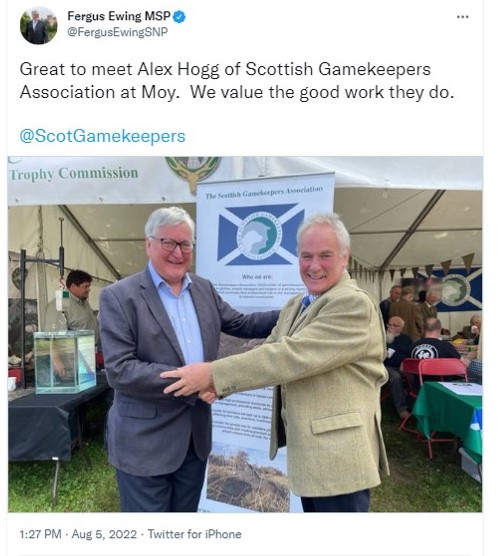
A tweet by Fergus Ewing MSP, former Cabinet Secretary for Rural Economy, posted yesterday at the Scottish Gamekeeper Association’s stand at the Moy Game Fair. I wonder who he’s referring to when he says ‘We’? Is he speaking on behalf of the Scottish Government?

The Moy Game Fair is hosted by the Moy Estate. That’ll be the disgraced Moy Estate that had a three-year General Licence restriction imposed on it in June this year (see here) after Police Scotland provided evidence to demonstrate wildlife crime had taken place on the estate, notably the discovery of a poisoned red kite and incidents related to alleged trapping offences, although the estate has long been recognised as a raptor persecution hotspot (e.g. see here, scroll down to below the press release).

An estate gamekeeper has recently been charged with the alleged shooting of a sparrowhawk and is due in court in September.

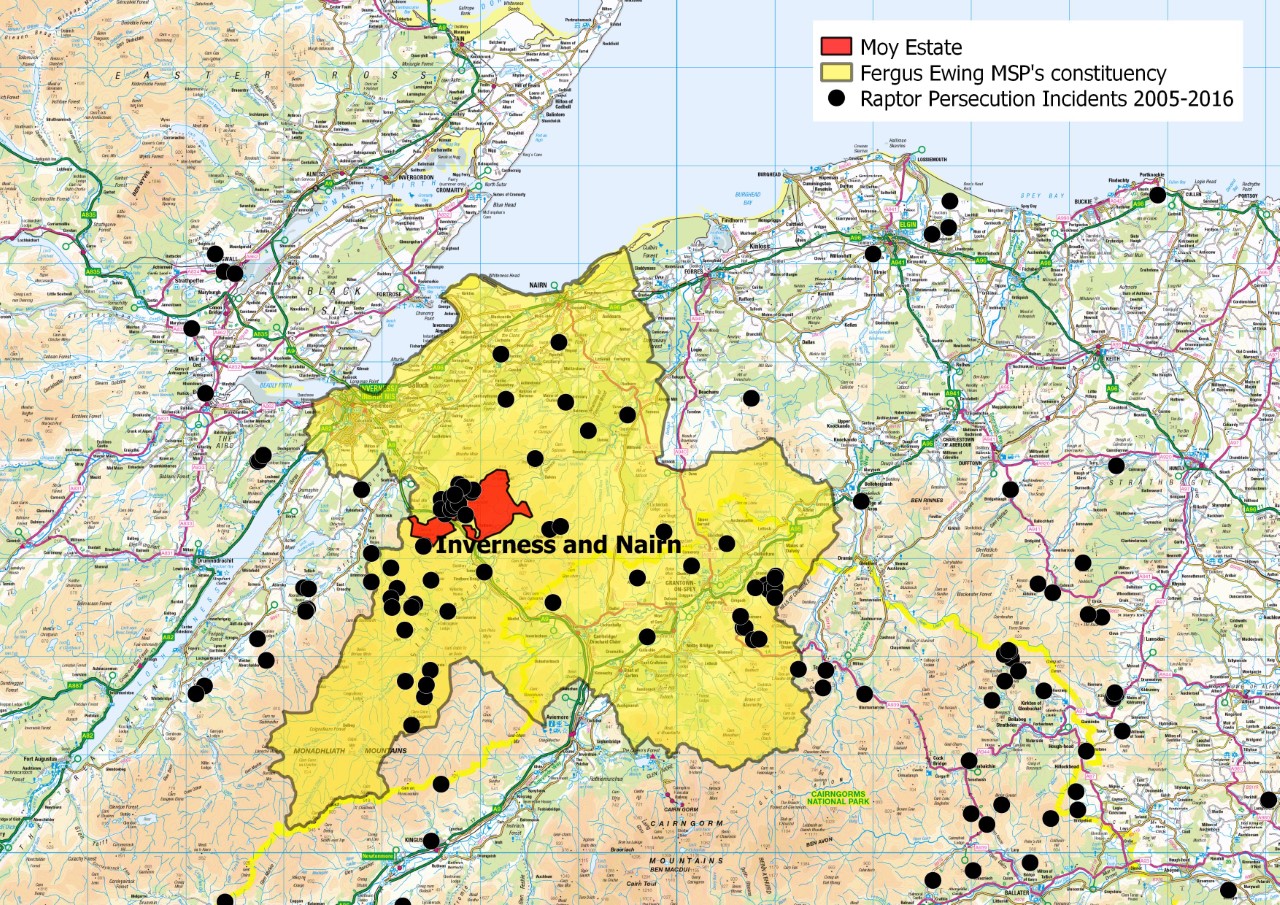
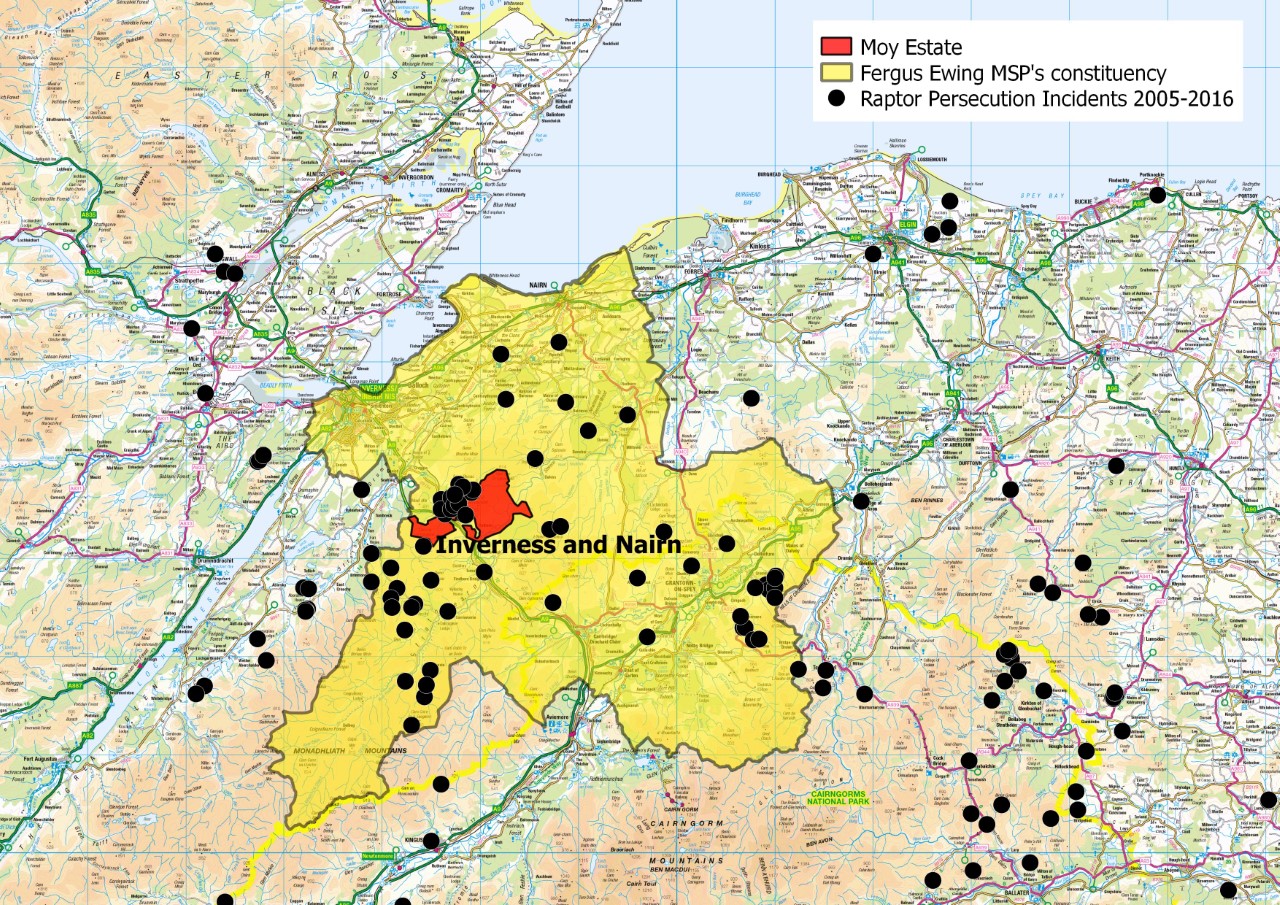
Here is a map we created way back in 2016 to highlight the extent of raptor persecution crimes in Fergus Ewing’s constituency and this shows the concentration of incidents on and close to Moy Estate. There have been further incidents since this map was created, hence the General Licence restriction imposed this year:

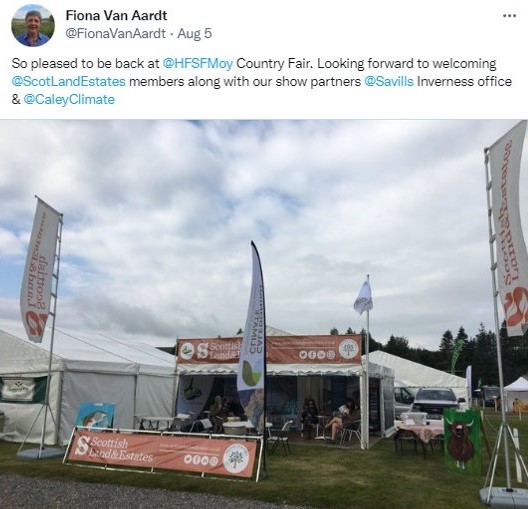
Also ignoring the sanction for wildlife crime on Moy Estate is Scottish Land & Estates (SLE), the lobby group for game-shooting estates across Scotland, as demonstrated by this tweet yesterday from SLE’s North of Scotland Regional Coordinator, Fiona Van Aardt:

So here’s a senior politician from the SNP Government, the Scottish Gamekeepers Association and Scottish Land & Estates, all effectively sticking up two fingers to the Government’s policy of sanctioning estates for raptor persecution.

When the policy of imposing General Licence restrictions as a tool for tackling rampant bird of prey persecution was first introduced in 2014, the then Environment Minister Paul Wheelhouse described the restrictions as being a ‘reputational driver‘. In other words, a sanctioned estate would not enjoy the benefits of being part of the shooting industry because the industry, with its claimed ‘zero tolerance’ approach to raptor persecution, would not wish to be associated with wildlife crime and this (hoped for) ostracization would stimulate a clamp-down on raptor-killing estates.

So much for that idea. It appears that the shooting industry, along with its political supporters, couldn’t give a monkeys. There’s been previous evidence of this on other so-called sanctioned estates (e.g. see here for examples).

Technically speaking, Mr Ewing and his shooting industry pals could argue that Moy Estate is not currently serving a General Licence restriction. How come? Well, because under the rules, if an estate appeals the GL restriction decision, the restriction is temporarily lifted whilst NatureScot considers the estate’s appeal. This is completely bonkers, of course, because a sanctioned estate has already had a chance to appeal the decision, when NatureScot first issues the notification for a restriction. But they’re then given another opportunity to appeal once the restriction has been imposed, and during that appeal process (typically four weeks) NatureScot removes the restriction so the estate can carry on as if the restriction never existed. I’m pretty sure that that’s what’s going on at Moy because the GL restriction decision notice for Moy Estate has been removed from the section of NatureScot’s website where currently-restricted estates are listed (here).

Although if Mr Ewing, the SGA and SLE were to rely upon this technicality, I don’t think that many people would view it as the shooting industry working in the spirit of wishing to stamp out raptor persecution, do you?

RSPB wants ‘action & delivery’ from Scottish Government on grouse moor licensing scheme

RSPB Scotland has published a blog today calling for ‘action and delivery’ from the Scottish Government on its promised grouse moor licensing scheme.

The Government announced in November 2020 that grouse shooting businesses in Scotland will need to be licensed to operate, under new proposals to tackle raptor persecution.

It also announced that muirburn will also only be permitted under licence, in order to protect wildlife and habitats, regardless of the time of year it is undertaken and whether or not it is for grouse moor management or improving grazing.

The Government stated there will also be a statutory ban on burning on peatland, except under licence for strictly limited purposes, such as approved habitat restoration projects.

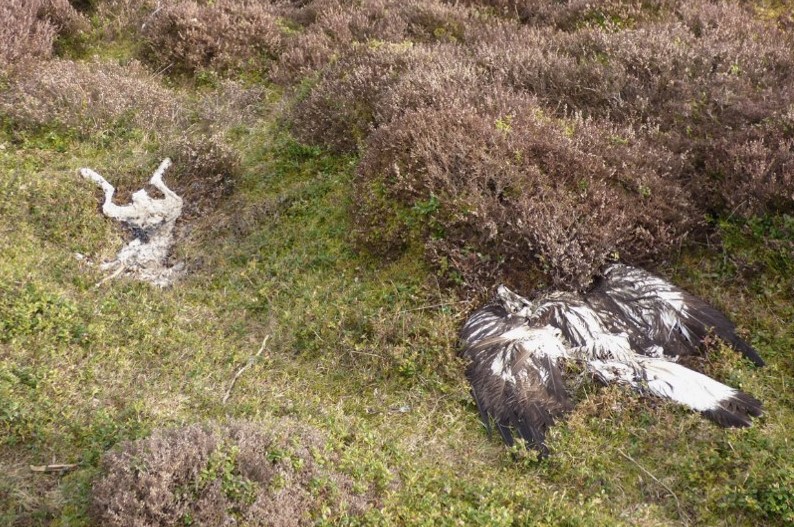
Since that announcement in November 2020, there hasn’t been any further action, but there has been plenty more evidence of illegal raptor persecution, including the poisoning of this golden eagle on a grouse moor at Invercauld Estate in the Cairngorms National Park:

RSPB Scotland writes:

We have been very patient, but nearly 20 months on from this announcement, we want to see some action and delivery on these promises by the Scottish Government. Proposals must be brought forward in the forthcoming Programme for Government in autumn 2022 for the introduction of grouse moor and muirburn licensing legislation in the next Parliamentary year“. 

You can read the full RSPB blog here.

Scottish Gamekeepers Association plan awards ceremony at disgraced Moy Estate

Remember all those recent headlines from the game shooting industry, declaring a ‘zero tolerance’ stance against raptor persecution?

Well quelle surprise, it seems their interpretation of ‘zero tolerance’ isn’t quite the same as everyone else’s.

Last month Moy Estate, a shooting estate in the Monadhliaths was given a three-year General Licence restriction, imposed by NatureScot on the basis of evidence provided by Police Scotland of wildlife crime against birds, specifically the discovery of a poisoned red kite in 2020 (here).

It was just the latest in a long line of raptor persecution incidents reported on or next to Moy Estate for over a decade, and another court case is due to be heard this autumn.

For an example of the history, here is a map we created way back in 2016 to highlight the extent of raptor persecution crimes in former Cabinet Secretary Fergus Ewing’s constituency (given his strong support of the Scottish Gamekeepers Association) and this shows the concentration of incidents on and close to Moy Estate:

The General Licence restriction is a bit like putting a school into ‘special measures’ – a status applied by regulators to indicate the school has fallen short of acceptable standards, although the main serious difference here of course is that a General Licence restriction is imposed on the basis of wildlife crimes being committed on the estate, rather than merely a shortfall in standards.

The main idea behind the introduction of General Licence restrictions back in 2014 was that they would act as a “reputational driver” for those sanctioned estates, according to the then Environment Minister Paul Wheelhouse (see here).

However, there has been no evidence that the game-shooting industry takes any notice whatsoever of such sanctions. For example, the Game & Wildlife Conservation Trust hosted a guided tour and BBQ on ‘the renowned Corsehope Shoot‘ in June 2017, at the same time that this estate was serving a three year General Licence restriction for wildlife crime; Edradynate Estate bragged about “a belter season“ at the same time it was serving a three-year General Licence restriction for wildlife crime; and this estate was also endorsed by the British Game Alliance, the game shooting industry’s own ‘assurance’ scheme, membership of which is supposed to indicate ‘rigorous and ethical standards’, whilst the estate was under a General Licence restriction for wildlife crime (see here).

So it comes as no surprise to see that the Scottish Gamekeepers Association (SGA) is not only intending to have a stand at the forthcoming Highland Field Sport Fair hosted by Moy Estate (now rebranded as the Moy Country Fair, presumably in an attempt to make it more palatable), but the SGA is also planning an awards ceremony at the event to announce the winner of the SGA Young Gamekeeper of the Year Award as well as presenting various Long Service Medals!

You couldn’t make this up!

The Moy game fair has previously attracted the likes of former Cabinet Minister Fergus Ewing who used his attendance to give a rallying speech to the game-shooting sector (here) and Scottish Land & Estates (SLE) also usually has a stand. I can’t remember if Moy Estate is a member of SLE, but it’ll be interesting to see if SLE puts in an appearance this year.

General Licence restriction imposed on Moy, a grouse-shooting estate, after discovery of poisoned red kite

Press release from NatureScot, 21st June 2022:

General Licence restricted on Highland estate

NatureScot has restricted the use of General Licences on Moy Estate for three years

The decision was made on the basis of evidence provided by Police Scotland of wildlife crime against birds.

This evidence included a poisoned red kite found on the estate in 2020, and incidents in relation to trapping offences.

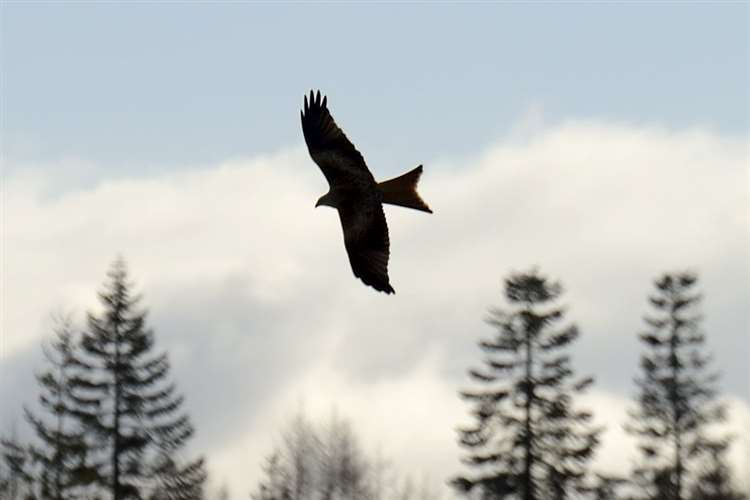
[Red kite. Photographer unknown]

Donald Fraser, NatureScot’s Head of Wildlife Management, said: “We consider the information from Police Scotland provides robust evidence that wild birds have been killed or taken or there has been intention to do so illegally on this land.

“Because of this, and the risk of more wildlife crimes taking place, we have suspended the use of general licences on this property for three years until June 2025. They may still apply for individual licences, but these will be closely monitored.

“NatureScot is committed to using all the tools we have available to tackle wildlife crime. This measure will help to protect wild birds in the area, while still allowing necessary land management activities to take place, although under tighter supervision.

“We believe this is a proportionate response to protect wild birds in the area and prevent further wildlife crime. We will continue to work closely with Police Scotland and consider information they provide on cases which may warrant restricting general licences.”

General licences allow landowners or land managers to carry out control of common species of wild birds, such as crows and magpies, to protect crops or livestock, without the need to apply for an individual licence.

In addition to this restriction, there are currently three other restrictions in place on Invercauld Estate in the Cairngorms National Park, Lochan Estate in Perthshire and Leadhills Estate in South Lanarkshire.

ENDS

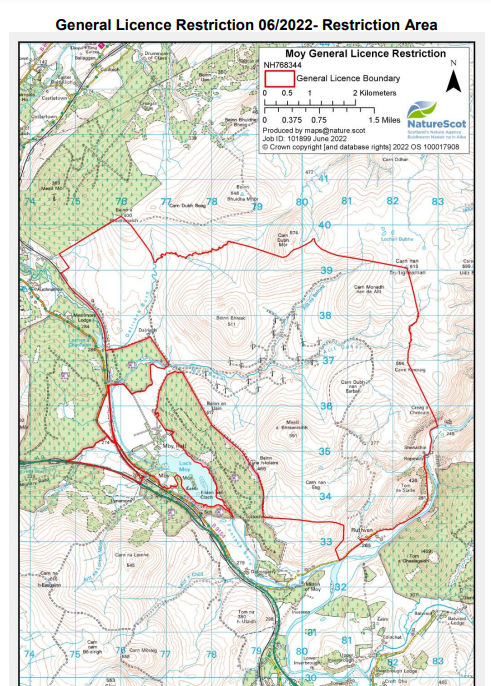
The restriction notice reads as follows:

In line with NatureScot’s published General Licence restrictions: Framework for Implementing Restrictions we hereby give notice that a restriction has been applied to the land outlined in red overleaf. This restriction prohibits the use of General Licences 01, 02 and 03 on that land between 21st June 2022 and 21st June 2025.

Please note that this restriction does not imply responsibility for the commission of crimes on any individuals.

This one has been a long time coming. Moy is one of those estates where if its name comes up in conversation amongst raptor conservationists in Scotland, eyes tend to roll and knowing looks are exchanged. It has been identified as a raptor persecution hotspot for many, many years.

Here is a map we created way back in 2016 to highlight the extent of raptor persecution crimes in former Cabinet Secretary Fergus Ewing’s constituency (given his strong support of the Scottish Gamekeepers Association) and this shows the concentration of incidents on and close to Moy Estate:

Here is a selection of examples, but this is by no means an exhaustive list:

Moy Estate was raided by police in 2010 after the discovery of poisoned bait and dead raptors and illegally set traps. A gamekeeper was later convicted of possession of a red kite after its bloodied corpse was found in the back of his vehicle. It had two broken legs, consistent with being caught in spring traps, and a head injury. A bloodied shinty stick was also found in the back of the vehicle. Notably, the gamekeeper wasn’t convicted for killing the kite, just for having possession of it. Nobody was charged with killing this kite.

These baited traps were discovered on the moor (the illegally-set spring traps were originally disguised under moss, removed here for evidential purposes). No charges were brought.

The remains of two further red kites were discovered on the moor, including a severed red kite leg and some wing tags that had previously been fitted to a kite, all found buried in holes under some moss. No charges were brought.

A jar in one of the gamekeeper’s houses contained the leg rings of four young golden eagles – nobody could account for how they had ended up inside that jar. Perhaps he’d found them whilst ‘metal detecting at his uncle’s farm’ like gamekeeper Archie Watson, who recently gave this implausible explanation to the court for how he’d come to possess BTO leg rings from a buzzard and a red kite attached to his keyring.

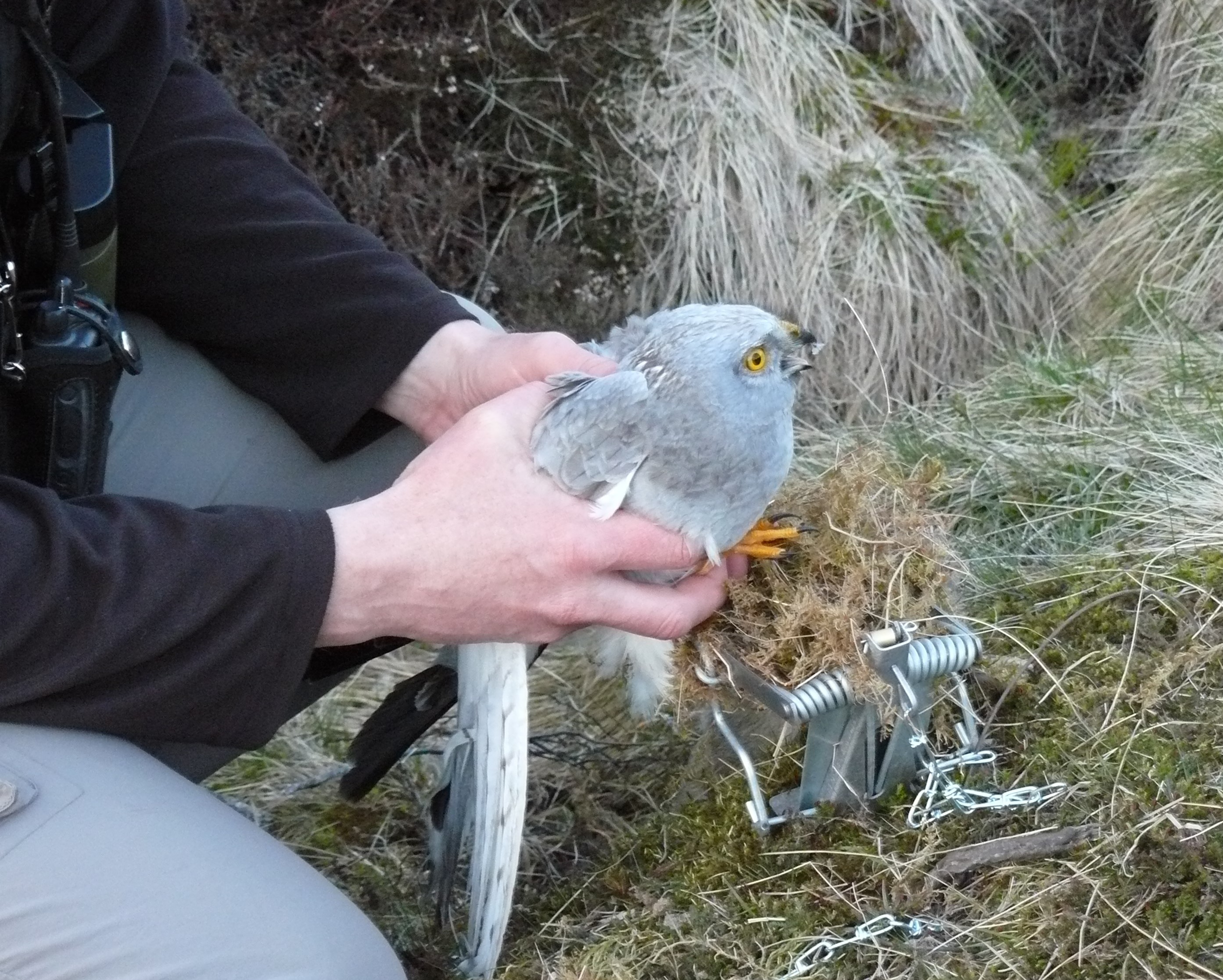
This male hen harrier was found caught by its leg in an illegally-set spring trap on Moy Estate in 2010. No charges were brought. It survived after being rescued by raptor workers from the Scottish Raptor Study Group.

In May 2011 a satellite-tracked red kite ‘disappeared’ on Moy, and another one ‘disappeared’ in August 2011.

In 2016 Police Scotland issued an appeal for information following the discovery of disturbed and abandoned buzzard and goshawk nests in the Moy Forest. One goshawk and four buzzard nests were abandoned in suspicious circumstances, with some evidence of illegal disturbance. These nests were being monitored by staff from Forestry Enterprise Scotland (see here). No charges were brought.

In 2017 masked gunmen were caught on camera at a goshawk nest in Moy Forest. A few days later the nest and a clutch of four eggs was found abandoned (see here). No charges were brought.

In 2018 Police Scotland issued an appeal for information after a buzzard was found caught in an illegal pole trap in the Moy area (see here). No charges were brought.

In 2020 a poisoned red kite was found dead, containing traces of a banned pesticide, leading to a police appeal for information (here).

In 2021 an individual was charged with the alleged killing of a bird of prey in this area. This case is believed to be progressing through the courts so I can’t comment further at this stage.

Of course, a General Licence restriction doesn’t amount to much of a sanction in real terms, as I’ve discussed on this blog endless times before (e.g. see here). However, it’s currently the only tool available to the authorities until we finally see the introduction of the promised grouse moor licensing scheme by the Scottish Government. Had that scheme been in place already, we’d hopefully have seen the removal of Moy Estate’s licence to shoot for a number of years, if not permanently.

Meanwhile, what will be really interesting to see is whether the Moy Game Fair goes ahead this year, given that the shooting organisations have all claimed to have a ‘zero tolerance’ approach to raptor persecution. I don’t think the likes of Scottish Land & Estates, Fergus Ewing MSP and the Scottish Gamekeepers Association can expect anything other than high-level criticism if they attend this event on an estate that has now been sanctioned for wildlife crimes by the statutory nature conservation advisor, based on evidence provided by Police Scotland. Mind you, the conviction of a gamekeeper on Moy Estate in 2011 didn’t stop them attending (see here and here).

UPDATE 14th July 2022: Scottish Gamekeepers Association plans award ceremony at disgraced Moy Estate (here)

UPDATE 6th August 2022: Fergus Ewing MSP & his shooting industry pals disregard sanctions imposed on Moy Estate for wildlife crime (here)

UPDATE 22nd August 2022: Moy Estate loses appeal against General Licence restriction imposed for wildlife crime (here)

Another gamekeeper convicted for poison offences on a pheasant shoot, but not charged for poisoned kite & shot buzzard

David Matthews, a gamekeeper with 50 years experience, has been convicted at Wrexham Magistrates Court for poison offences uncovered on the McAlpine Estate in Llanarmon Dyffryn Ceiriog, North Wales, where he has worked for 25 years.

In February 2021 a dead red kite was found on the estate by a member of the public and a later toxicology analysis revealed it had been poisoned with Bendiocarb.

[The poisoned red kite. Photo by RSPB]

When RSPB Investigations Officers subsequently visited the McAlpine Estate they found a dead buzzard inside a pheasant release pen. When the body was x-rayed, a piece of shot could be seen lodged in the bird’s skull.

[The shot buzzard found inside the pheasant release pen. Photo by RSPB]

A multi-agency search in October 2021 by North Wales Police, the Welsh Government, RSPB and the National Wildlife Crime Unit uncovered an unlocked barn containing 18 highly toxic products, including Cymag which has been banned since 2004. They also found the remains of a pheasant, inside a game bag on a bonfire site inside a pheasant release pen. The pheasant tested positive for Bendiocarb. Another dead buzzard was too badly decomposed to be tested.

Gamekeeper Matthews pleaded guilty to one charge relating to the possession of unauthorised pesticides. He received a total fine of £219.

You can read the full details of this case on the RSPB’s blog here.

In that blog, the RSPB state, ‘It remains unknown who killed the buzzard and the kite‘.

I’m pretty sure that the RSPB investigators, just like the rest of us, have a pretty good idea who might have been responsible but presumably there was insufficient evidence to charge anyone. Such is the nature of this game that it would be libellous to suggest a suspect.

It seems odd to me, though, that a gamekeeper who had worked on the estate for 25 years wouldn’t have noticed someone laying poisoned baits, placing the bait inside a game bag and leaving it on a bonfire site inside a pheasant release pen, and shooting dead a buzzard and leaving its corpse inside a pheasant release pen.

His £219 fine makes a total mockery of the system. Had this case been in Scotland, the fine for possessing an unauthorised poison would now be £40,000. That’s a serious deterrent.

£219 is not.

This is the reality and I’ll be reminding DEFRA Minister Lord Benyon of this the next time he repeats the Westminister Government’s tediously predictable claim that raptor-killing criminals face ‘significant sanctions…including an unlimited fine and/or a six month custodial sentence‘ (e.g. see this from Environment Minister Rebecca Pow in September 2021, and this from Richard Benyon in February 2022, and this from Rebecca Pow in February 2022, and this from Richard Benyon in April 2022).

Matthews is the 7th gamekeeper to be convicted in seven months across England, Scotland and Wales. There are still multiple cases pending court in the coming months. Clear evidence then that the game-shooting industry’s supposed ‘zero tolerance’ policy towards raptor persecution is simply just rhetoric and that the Government’s so-called ‘significant sanctions’ are complete bollocks.

The other convicted gamekeepers in recent months are:

Gamekeeper Shane Leech who was convicted in November 2021 for firearms and pesticides offences after the discovery of a poisoned buzzard found close to pheasant-rearing pens in Lakenheath, Suffolk (here);

Gamekeeper Peter Givens who was convicted in November 2021 for causing the death of a goshawk and a barn owl which starved to death in an illegally-operated trap on the Cathpair Estate in the Scottish Borders (here);

Gamekeeper Hilton Prest who was convicted in December 2021 for causing a sparrowhawk to starve to death in an illegally-operated trap in Cheshire (here);

Gamekeeper John Orrey who was convicted in January 2022 for battering to death two buzzards he’d caught in a cage trap on a pheasant shoot in Nottinghamshire (here);

Gamekeeper Rhys Davies from the Millden Estate in the Angus Glens, Scotland, who was convicted in May 2022 for animal cruelty relating to badger baiting (he’ll be sentenced at the end of June – here);

Gamekeeper Archie Watson who was convicted in June 2022 for raptor persecution and firearms offences after he was filmed throwing 8 dead raptors down a well on a pheasant-shoot in Wiltshire (here).

Well done to the multi-agency search team involved in bringing David Matthews to court.

BBC’s Countryfile to feature #EagleGate

Tomorrow’s edition of Countryfile will include a feature on the continued illegal killing of birds of prey in the UK, focusing on the recent poisonings of at least two white-tailed eagles in southern England (the one in Dorset and the one in West Sussex).

Filming took place last week and lovely presenter Charlotte Smith interviewed a number of people including Paul Morton (representing Birds of Poole Harbour) and me (representing Wild Justice) as we enjoyed a boat trip along the Wareham Channel looking for eagles, ospreys, marsh harriers and peregrines.

They also managed to bag an interview with Chris Loder MP, the local politician who didn’t want Dorset Police to investigate the eagle poisoning and I believe there’ll be contributions (probably denials and abuse) from Tim Bonner (Countryside Alliance) and perhaps statements from Dorset Police and the Dorset Police & Crime Commissioner, David Sidwick.

I’m hoping they asked Chris Loder MP what he thought David Sidwick meant when he told Loder: ‘You and I need to get our ducks in the row on this one‘ while discussing the murky police investigation into the poisoned eagle in Dorset.

I’ve no idea how the final edit will be presented, this is the BBC after all and they’ll want to be seen as being scrupulously impartial, which is fair enough.

I’m just delighted that they’ve chosen to feature the raptor persecution issue at all, and that six million viewers will learn that even though this is the 21st Century, eagles and many other raptor species are still being deliberately poisoned/trapped/shot in this country, predominantly by members of the game-shooting industry. No matter which part of the interviews the editors choose to show in the final cut, that is the message that the viewers will remember and it’s the most important message of all.

Countryfile airs on Sunday 12th June 2022 on BBC 1 at 7pm and will be available on iPlayer for 12 months.

Wildlife Crime Working Group seeks (& receives) assurance from Sussex Police re: poisoned eagle investigation

In February this year, I blogged about the suspicious deaths of two white-tailed eagles on two separate game-shooting estates – one in Dorset and the other one rumoured to be in West Sussex (see here).

Both eagles were from the Isle of Wight Reintroduction Project – a privately-funded but Government-backed five-year project bringing young sea eagles from Scotland and releasing them on the Isle of Wight to re-establish this species in part of its former range.

The dead eagle found poisoned on an unnamed shooting estate in Dorset remains an ongoing issue of concern, not least because Dorset Police chose to close the investigation prematurely without a proper explanation (see here, and more on that case shortly).

The dead eagle found poisoned on an unnamed shooting estate in West Sussex has received less attention, although in April I revealed this eagle had been poisoned with Bendiocarb and that toxicology results from a dead dog found on the same shooting estate were pending (see here).

The reason this eagle poisoning case has received less attention is simply down to the fact that Sussex Police has failed to publicise the crime, even though it took place seven months ago (Oct 2021)! However, I was pleased to see The Independent picked up the story from this blog, as did The Telegraph, so it did make the national news but we’ve heard nothing more from Sussex Police.

To ensure that Sussex Police doesn’t ‘do a Dorset Police’ and drop this investigation without an explanation, Wildlife & Countryside LINK’s Wildlife Crime Working Group, England’s largest coalition of organisations working to tackle wildlife crime, has written to the Chief Constable of Sussex Police seeking assurance to that effect.

Here’s the letter that was sent last week:

To her absolute credit, Chief Constable Jo Shiner phoned LINK that afternoon to reassure the Wildlife Crime Working Group that the Sussex investigation is very much ongoing and that she understands the need for possible raptor persecution crimes to be looked at closely. I’m told, by people who know these things, that a fast and personal response like this is unheard of.

Compare and contrast Jo Shiner’s response to that of the Chief Constable of Dorset Police, who had also received a letter from LINK (see here) seeking an explanation about the Force’s failure to investigate the poisoned eagle found dead in Dorset. He has yet to reply.

I’m really pleased to see LINK’s Wildlife Crime Working Group applying pressure in these cases to ensure they’re taken seriously by the respective police forces (not that that should even be needed), but should it really be down to wildlife and conservation NGOs to do this? Surely this is what our statutory agencies should be doing? Wilful blindness, writ large, again.

Another dead buzzard in Dorset – Police warn public of suspected poisoned baits

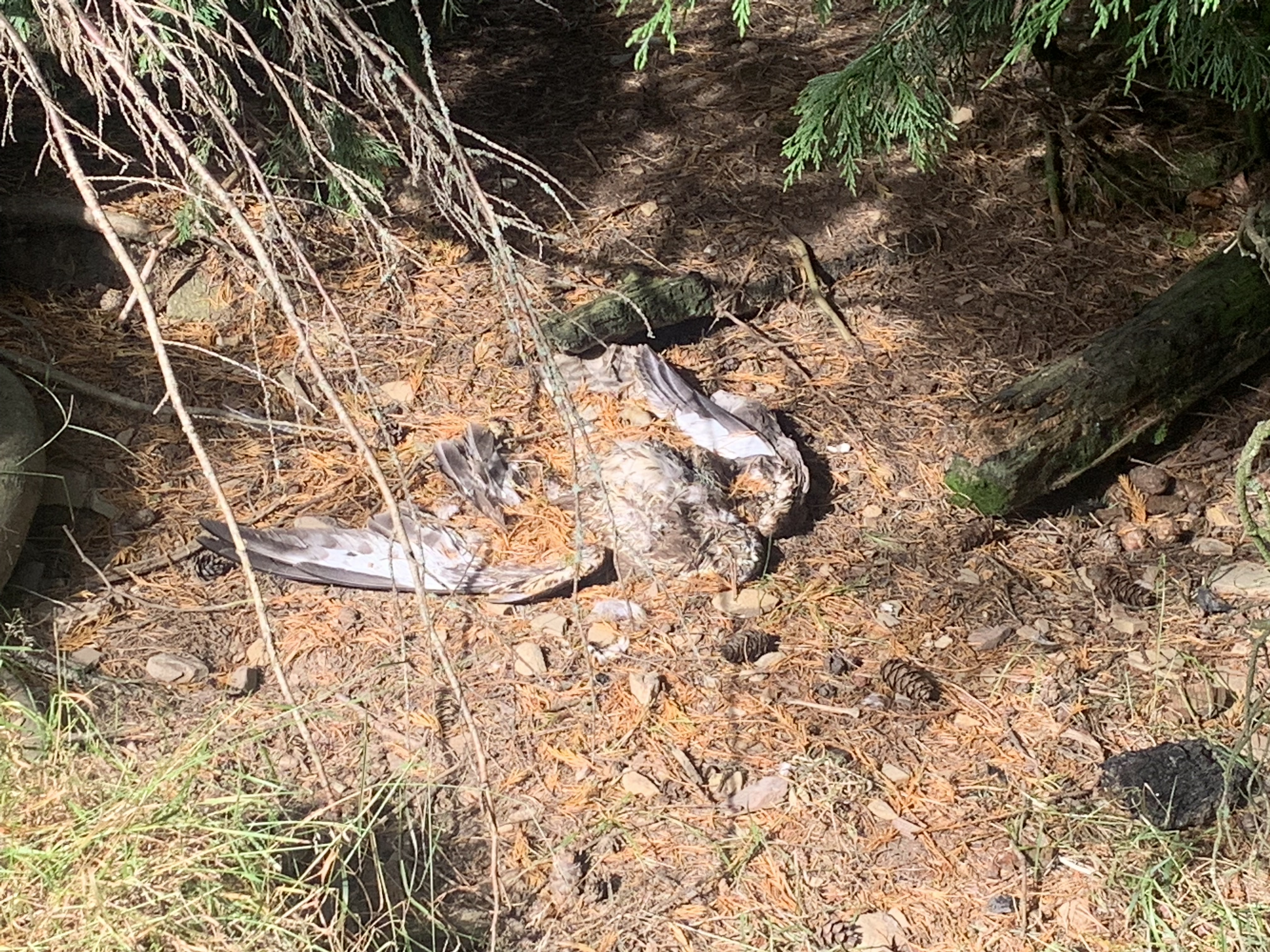
Yet another dead buzzard has been found in North Dorset.

Whilst the cause of death has yet to be ascertained (presumably the carcass has been sent for post mortem), yesterday PC Rob Hammond warned the public to keep their dogs on leads to avoid the risk of them coming into contact with potential poisoned baits.

Well done to PC Hammond for putting out this timely warning. Even though poisoning has not yet been confirmed, the potential risk to the public and their dogs is high so he’s done exactly the right thing.

Dorset is fast becoming quite the hotspot for raptor persecution. I’ve been looking through some reports from the last few years and have found the following incidents of raptor persecution recorded in the county:

May 2018: Buzzard found shot dead (here).

May 2018: Suspicious deaths of two barn owls and several more buzzards (here).

March 2020: Disturbance of nesting peregrines (here).

April 2020: Several buzzards were found dead within close proximity to each other in the Ashmore Wood area near Blandford. These birds were sent for testing and enquiries remain ongoing (here).

August 2020: Two buzzards, one dead, were found near the body of a rabbit. An owl and a further two buzzards were also found. Analysis has confirmed Brodifacoum in the buzzard which is likely to have caused the death. The second buzzard and the owl had background residues and the analysis on the rabbit was negative.

September 2020: A dead buzzard was found on a bridleway, it had been shot.

November 2020: A dead red kite and rat were found near a footpath. Analysis has confirmed Bendiocarb in the stomach contents of the red kite and in pots removed from a vehicle and a sachet in a shed, which is likely to be the cause of death. No residues were found in the rat.

February 2021: A buzzard and a red kite were found in a wooded area. Analysis has confirmed Brodifacoum in the liver of the red kite which will have contributed to its death, the levels of Brodifacoum in the buzzard are borderline and uncertain if the exposure contributed to its death. 

March 2021: A multi-agency raid was carried out on a shooting estate in North Dorset. A number of dead birds of prey and several pesticides, including banned substances, were located at the premises. A firearm was also recovered (here).

January 2022: A dead white-tailed eagle was found poisoned on a shooting estate in North Dorset. The post mortem found its liver contained 7 x lethal dose of rodenticide Brodifacoum. Inexplicably, Dorset Police closed the investigation before conducting a search (here).

February 2022: Another white-tailed eagle was suspected to have been poisoned on another shooting estate in North Dorset. This one survived (here).

February 2022: A dead buzzard and a dead red kite are found dead on a shooting estate in North Dorset, suspected poisoned. Toxicology results awaited (here).

April 2022: A dead buzzard found dead in the Ashmore area. Toxicology results awaited.

It’s pretty clear that Dorset has a raptor persecution issue and I understand there are several more investigations that have yet to be reported in the public domain. Given these incidents, and more, it’s astonishing that the local MP, Chris Loder, thinks the police shouldn’t ‘waste resources’ on investigating wildlife crimes.

It’s even more astounding that Dorset Police shut down the poisoned eagle investigation, without conducting a search, and continue to refuse any explanation for their decision and yet still the top brass claim to be taking raptor persecution ‘seriously’, not that anyone believes them anymore.

It’s heartening then to see on-the-ground officers like PC Rob Hammond, trying to do the right thing. I wonder how long it’ll be before he’s told to drop the case and/or stop investigating wildlife crime, as has his colleague, PC Claire Dinsdale?