2026 was another successful breeding season for Hen Harriers on the United Utilities Bowland Estate where the RSPB works in partnership with the water company United Utilities and its tenants to monitor and protect these iconic birds.
Nine Hen Harrier nests on the United Utilities Estate were monitored this year, eight of which were successful and fledged 30 young.
This follows a record year in 2025, where RSPB staff and volunteers recorded 14 Hen Harrier nests on the United Utilities Estate, of which 12 were successful and fledged 40 young. This represented the highest number of fledglings recorded in over 40 years.
But don’t be fooled into thinking that just because Hen Harriers are doing well on United Utilities land they’re doing well right across Bowland, because they’re not. We haven’t yet seen this year’s overall Hen Harrier breeding figures across England but last year there was only one successful Hen Harrier nest on privately-owned grouse moors in Bowland. Two blogs from Mark Avery are relevant (one from 2019 and one from 2026).
Here is the statement from the RSPB on this year’s Hen Harrier breeding success on United Utilities-owned moorland in Bowland:
SUSTAINED SUCCESS FOR HEN HARRIERS IN THE FOREST OF BOWLAND
Over the last decade, Hen Harrier numbers have steadily recovered in Bowland following their complete absence as a breeding species in 2016 and 2017. For the past six years, the population has stabilised at an average of 13 breeding females, fluctuating between 10 and 16 annually, with 84% nesting on the United Utilities Estate. This is comparable to the number of breeding females recorded in Bowland in the 2000s, before the population collapsed alongside the wider decline of the species in England.
Steady recovery in Bowland
2026 was another successful breeding season for Hen Harriers in Bowland; breeding numbers were lower compared to the record-breaking season in 2025 but breeding success was higher, likely owing to increased prey abundance. RSPB staff and volunteers monitored nine Hen Harrier nests on the United Utilities Estate, eight of which were successful and fledged 30 young. One nest failed as the female received insufficient food from her polygamous male and was forced to hunt herself, leaving her clutch unattended. A Lesser Black-Backed Gull was later observed visiting the nest, but it remains unclear if it scavenged the eggs after the female deserted or if it took advantage of her absence to predate the clutch. Two additional nests were recorded by Natural England on private estates, which were both successful and fledged a further six chicks, resulting in a total of 11 nests in the Bowland Fells.
Recovery reflects success of partnership
A melancholic note in an otherwise successful season – our oldest and most productive breeding female did not return to nest on the United Utilities Estate this year and has most likely perished over the winter. Fledged on Langholm Moor in 2017 and aptly nick-named ‘Scottish Fury’ for her aggressive behaviour, she first nested on the Estate in 2018. Over the following eight breeding seasons she fledged an extraordinary 35 chicks, making a remarkable contribution to the breeding population and leaving a lasting legacy, with some of her descendants also nesting in Bowland.
The sustained recovery of Hen Harriers in Bowland reflects the success of partnership working and the commitment of landowners and tenants. However, despite this local success, the species’ recovery across England continues to face significant challenges, including illegal persecution, changes in land use and habitat loss.
NatureScot has today announced a three-year General Licence restriction on two shooting estates: Milton of Drimmie Estate, near Blairgowrie, Perthshire, and Invermark Estate in the Angus Glens.
MILTON OF DRIMMIE ESTATE, PERTHSHIRE
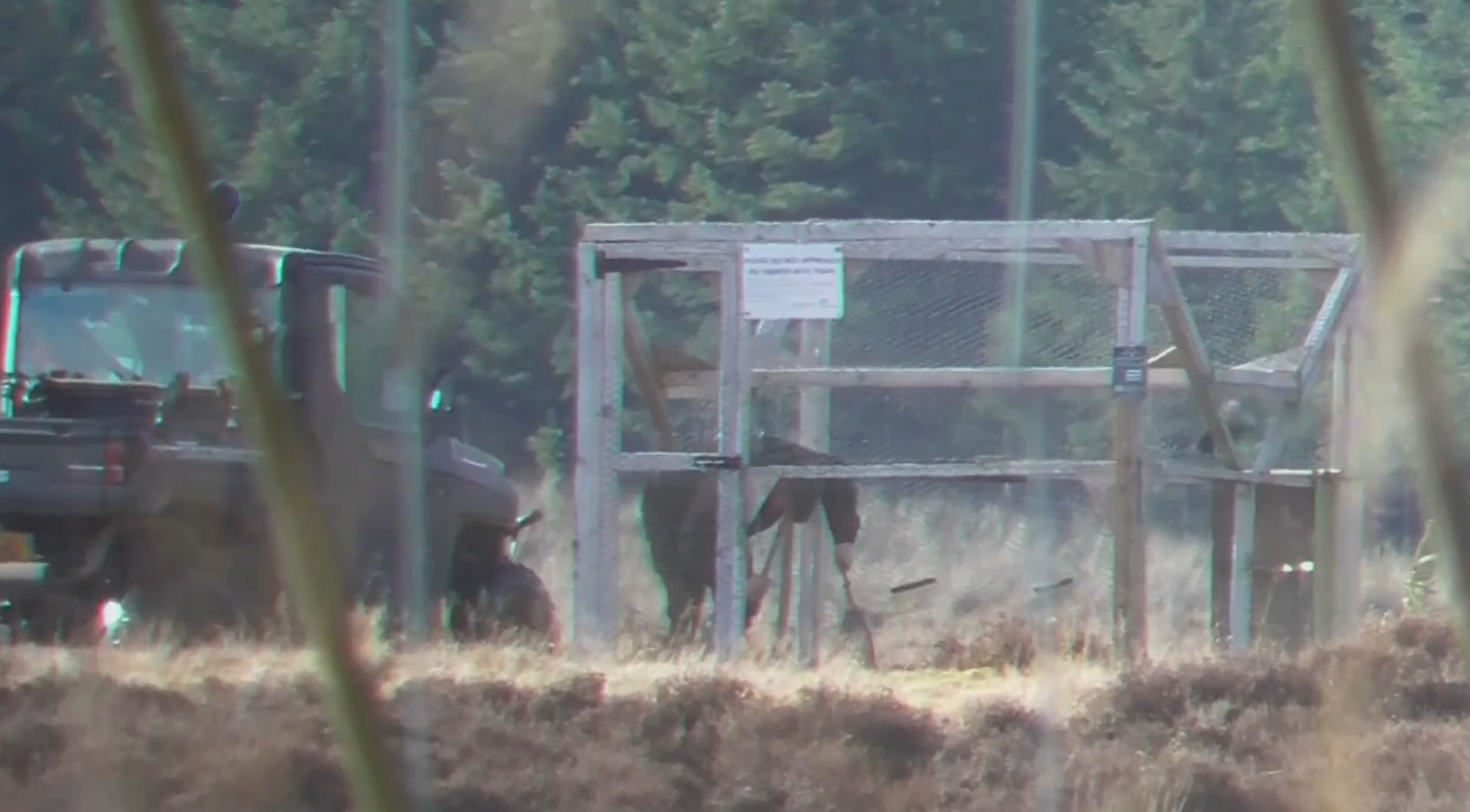
The Milton of Drimmie restriction relates to the conviction earlier this year of gamekeeper and ex-sex offender Russell Mason, after he was caught on camera battering to death a Goshawk that had been caught inside a Crow cage trap on the Pheasant-shooting estate in February 2024.
Screen grab from RSPB covert footage showing gamekeeper Mason beating the Goshawk to death inside a Crow cage trap on the Milton of Drimmie Estate, Perthshire
Mason received a derisory 200-hour Community Payback Order for killing the Goshawk (even though his crime passed the custodial threshold) and he was also fined £890 for firearms offences (see here).
As far as I’m aware, NatureScot delayed its decision to apply a three-year General Licence restriction on this estate whilst criminal proceedings against Mason were ongoing.
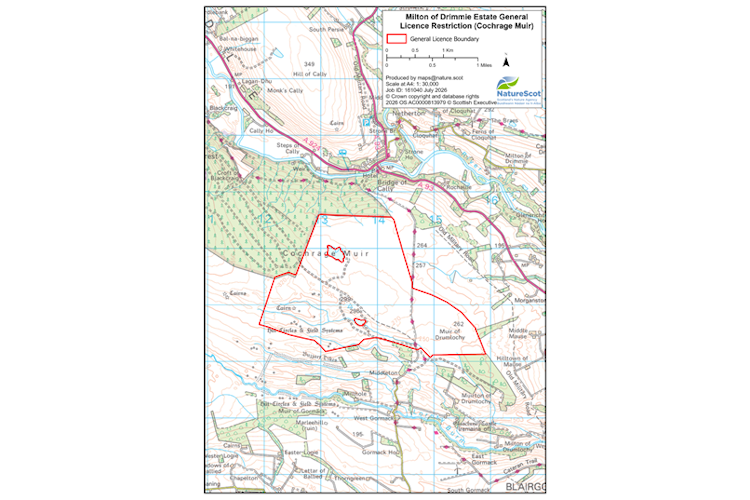
The General Licence restriction on Milton of Drimmie relates to Cochrage Muir (outlined in red on the map below), which is owned by Milton of Drimmie Estate, and prohibits the use of General Licences 01, 02 and 03 on that land from 7th August 2026 up to and including 7th August 2029.
INVERMARK ESTATE, ANGUS GLENS
The Invermark Estate restriction relates to the discovery of a Peregrine with shotgun injuries on 3 September 2024, close to grouse butts in the Glen Esk area of the notorious Angus Glens. The Peregrine was later euthanised due to the extent of its injuries.
This incident, and the subsequent decision to impose a three-year General Licence restriction, but not a revocation of a grouse-shooting licence, deserves its own blog, which I’ll try and write in the coming days.
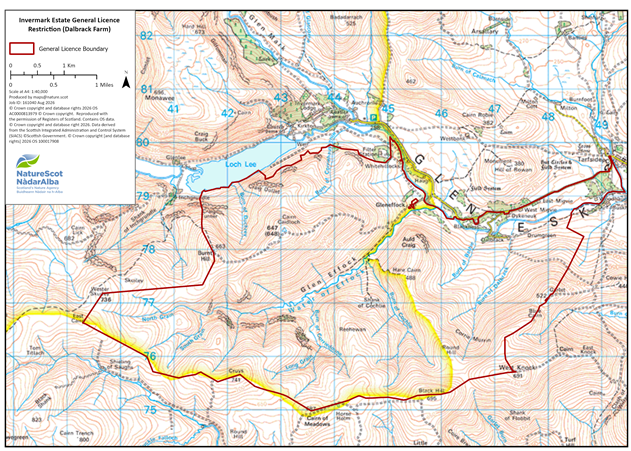
The General Licence restriction on Invermark Estate relates to Dalbrack Farm (outlined in red on the map below), which is owned by Invermark Estate, and prohibits the use of General Licences 01, 02 and 03 on that land from 7th August 2026 up to and including 7th August 2029.
Here is NatureScot’s announcement today:
7 August 2026
NatureScot has today restricted the use of general licences for three years on land at Milton of Drimmie Estate, Perthshire, and Invermark Estate, Angus.
The decision was made based on evidence provided by Police Scotland of wildlife crime against birds.
In the case of Milton of Drimmie, this relates to the conviction of former gamekeeper Russell Mason at Perth Sheriff Court on 17 March 2026 for killing a goshawk. The restriction will apply to the area of Cochrage Muir, where the offence took place.
In the case of Invermark Estate, the restriction will apply to the Dalbrack Farm area of the estate. NatureScot received robust evidence from Police Scotland in relation to the shooting of a peregrine which was discovered in this area.
Chris Dailly, NatureScot’s Head of Licensing, said: “We have decided, in discussion with Police Scotland, to suspend the use of general licences on these two areas of land for three years until August 2029.
“We are committed to using all the tools we have available to tackle wildlife crime. These measures will help to protect wild birds in these areas, while still allowing necessary land management activities to take place.
“We believe this is a proportionate response to protect wild birds and prevent further wildlife crime. We will continue to work closely with Police Scotland and consider information they provide on cases which may warrant restricting general licences.”
Individual licences may still be applied for, but these will be subject to strict record-keeping and reporting requirements and will be closely monitored to ensure licence conditions are met.
General licences allow landowners or land managers to carry out control of common species of wild birds, such as crows and magpies, to protect crops or livestock, without the need to apply for an individual licence.
In addition to these restrictions, there are currently three other restrictions in place in Scotland: on Lochindorb Estate in the Highlands and Raeshaw Estate and Watherston Wood in the Scottish Borders.
ENDS
General Licence restrictions, which have been available to NatureScot since 2014, are based on the civil burden of proof and are issued when NatureScot receives information from Police Scotland about wildlife crimes but where there is insufficient evidence to identify an individual offender for prosecution. Although, General Licence restrictions can also be imposed on estates where gamekeepers have been convicted of wildlife crimes, as in the Milton of Drimmie Estate case.
General Licence restrictions do not prevent an estate from game-shooting, nor do they prevent an estate from carrying out [lawful] predator control – this can still be undertaken if the estate applies for an ‘individual licence’ which may restrict the amount of predator control, the estate may be subject to compliance spot checks, and the licence holder must provide NatureScot with licence returns (i.e. indicate how many birds were killed, where, and when etc).
General Licence restrictions are not perfect as an effective sanction – they are nowhere near, as I’ve written about many times before (e.g. see here and links within). They do, however, work as a ‘reputational driver’, although in some cases reputation is apparently not an issue of concern.
I’ll come back to the shot Peregrine on Invermark Estate in a separate blog…
UPDATE 26 August 2026: Invermark Estate appeals 3-year General Licence restriction imposed after evidence of raptor persecution (here)
UPDATE 7 September 2026: FoI reveals some inconsistencies in Invermark Estate’s claims about shot Peregrine (here)
On Monday 20 July 2026, at Aberdeen Sheriff Court, all charges were dropped against two gamekeepers who had been on trial for the alleged shooting of Red Kites, as well as alleged firearms offences, in the Cairngorms National Park.
What follows is my understanding of the case, based on material published by the media, court documents, and conversations I’ve had with people who attended the trial. As far as I’m aware, the outcome of this case has not been reported formally, either by journalists, Police Scotland or the Crown Office & Procurator Fiscal Service. It’s pointless me asking for case details from the Crown Office or Police Scotland because they are protected by data protection regulations. For this reason, the following account should be treated with caution, i.e. it is not provided as a definitive account of the legal proceedings.
CASE BACKGROUND
On 4 February 2025 a member of the public notified the RSPB that a dead Red Kite had been found on private property in the Glenbuchat area of Strathdon, in Aberdeenshire, and the finder said that he had concerns that it might have been poisoned. The RSPB’s Investigations team collected the kite carcass and submitted it to Scotland’s Rural College (SRUC) lab for examination, notifying Police Scotland of their action. A short time later a post mortem revealed the kite had been shot, which led Police Scotland to open a wildlife crime investigation.
As part of that investigation, an appeal for information was issued by Police Scotland on 28 February 2025. Shortly afterwards another member of the public, William Johnstone, came forward with footage that had been captured on a night vision trail camera that he and local landowner, Roderick McGilvary, had installed in Knockie Wood (owned by Mr McGilvary) to monitor wildlife. Although the footage was not properly date/time stamped, Mr Johnstone and Mr McGilvary both stated that the footage had been captured over the preceding three weeks.
Location of Knockie Wood, Strathdon, in the Cairngorms National Park
Knockie Wood & surrounding grouse moor area, screen grabbed from a land sale brochure Aug 2026
The footage showed two armed individuals, with night vision equipment, carrying the body of a(nother) Red Kite. Mr Johnstone and Mr McGilvary both said they recognised the two armed men and named them as Graeme Rankin and Steven Hague, the Head Gamekeeper and underkeeper from nearby Glenbuchat Estate.
Mr Johnstone said he recognised the two men from shooting events he’d attended and from living in the local area. Mr McGilvary said he’d previously given Mr Rankin permission to kill ‘vermin’ on his land.
The trail camera footage was passed to Police Scotland and after examination, several officers, including a Firearms Licensing Officer, also said they recognised the two armed men as gamekeepers Graeme Rankin and Steven Hague.
On 1 May 2025 the Police executed a search warrant at the addresses of the two suspects and firearms were seized.
Following police interviews, to which both suspects gave ‘no comment’ replies, they were reported to the Procurator Fiscal and subsequently charged as follows:
Charge 1(GraemeRankin & Steven Hague) – Between 1 – 26 Feb 2025 at Knockie Wood, Strathdon, intentionally or recklessly killed a wild bird (Red Kite) with a firearm, contrary to Section 1(1)(a) of the Wildlife & Countryside Act 1981;
Charge 2 (Graeme Rankin & Steven Hague) – Between 1 – 26 Feb 2025 at Knockie Wood, Strathdon, were in possession and control of a dead wild bird (Red Kite), contrary to Section 1(2)(a) of the Wildlife & Countryside Act 1981;
Charge 3 (Graeme Rankin & Steven Hague) – On 3 or 4 February 2025 at [REDACTED], Glenbuchat, Strathdon, intentionally or recklessly killed a wild bird (Red Kite) with a firearm, contrary to Section 1(1)(a) of the Wildlife & Countryside Act 1981;
Charge 4 (Steven Hague) – On 1 May 2025 at [REDACTED], Glenbuchat, Strathdon, failed to keep keys for gun cabinets in a secure place, failed to ensure the key safe lock was secure and worked properly, and failed to secure ammunition, contrary to Section 1(2) of the Firearms Act 1968.
THE TRIAL
Both defendants pleaded not guilty to all charges so a two-day trial was scheduled to begin in Aberdeen on 9 December 2025. The defendants were each represented by an advocate of Kings Counsel (KC) status. Brian McConnachie KC, one of Scotland’s leading criminal lawyers, represented Graeme Rankin, and Shelagh McCall KC, also highly experienced, represented Steven Hague. Karen Rollo, an experienced Procurator Fiscal from the Wildlife and Environmental Crime Unit at the Crown Office, appeared for the prosecution.
Before proceedings really got going, the Sheriff made a declaration of being a monthly subscriber to the RSPB, which resulted in the two defence KCs lodging a motion that the Sheriff should consider recusing himself because the ‘public might perceive some bias’.
After giving the motion some consideration, the Sheriff agreed to stand down because this case involved RSPB staff members as witnesses for the prosecution.
Unfortunately, no other Sheriff was available immediately to hear the case so it was adjourned and rescheduled as a four-day hearing in April 2026, this time in front of Sheriff Peter Hammond.
Due to the large number of witnesses called by the prosecution in the first four days, the trial was further extended to another two days on 15-16 June 2026.
Prosecution witnesses included the finder of the first dead Red Kite (that was later confirmed shot), RSPB Investigations staff who had collected the kite carcass, William Johnstone who had installed the trail camera at Knockie Wood (landowner Robert McGilvary had since passed away but had previously provided a statement to Police Scotland), the SRUC vet who had performed the post mortem examination of the first dead Red Kite, a ballistics expert who could comment on the weapons and ammunition seen on the footage compared to what was seized during the search warrant, and multiple police officers who had been involved in viewing the captured footage, identifying the individuals (and their equipment) in the footage, and those involved in the execution of the search warrant.
There were significant delays at the start of the trial due to technical challenges in getting the video evidence to be shown in court; this seemed to be due to formatting issues regarding the ‘stitch video’ (a single film of various clips knitted together to make it easier to view). These were eventually resolved, although prosecution witnesses noted that the quality of the video shown in court was poorer than the raw footage they had been able to view at the police station.
A number of witnesses told the court that they couldn’t identify the suspects based on the poor quality of the footage shown in court but reiterated that they’d been able to identify them from the original footage at the police station.
Police Firearms Officer Tomas Spracklen told the court he’d attended Steven Hague’s cottage on 1 May 2025, alongside other officers executing the search warrant. He said he found that a safe, which stored keys to a gun cabinet, was not secure as he was able to access it and remove the key without having to use a code. He said that the key to a second gun locker was hanging on a hook behind a table leg just yards away in the same room where shotguns were kept. He also told the court that other Police Officers had found an unsecured pouch of ammunition in the gun room.
The two defence KCs challenged the provenance of the video footage, focusing on the fact that it wasn’t properly time/date stamped. They also challenged whether there had been procedural errors by the Police Officers during the execution of the search warrant.
The defence then lodged a motion to the Sheriff that on all charges, there was no case to answer. With respect to the charges of the killing of the second kite, they contended that the prosecution had failed to demonstrate that their witnesses had identified the defendants on the basis of the(poor quality)footage played in court, and that the prosecution had also failed to demonstrate that the footage captured was consistent with the dates of the charges libelled. They suggested, therefore that all these witnesses’ evidence should subsequently be disregarded.
The defence further suggested that the prosecution’s reliance on the established Scots Law ‘Moorov principle’ that allows for the use of similar factual evidence to corroborate multiple charges, should also mean that despite apparent similar circumstances surrounding the killing of the first Red Kite, if the charges above were dismissed, then charge 3 should also be dismissed.
The defence also argued that the fourth charge, relating to unsecure ammunition, should also be dismissed as they suggested that there was no corroboration of the lack of security of the accused’s gun room (i.e. the key to the gun cabinet hidden behind a table leg, shown to one Police Officer by the accused).
On 20 July 2026, the Prosecution made a lengthy submission in response to the defence’s motion, countering all of the above points, including giving examples of case law to support its case. However, although the Sheriff agreed that the footage captured was within the dates of the charges libelled, he accepted all of the other points made by the defence and made a ruling that there was no case to answer on all four charges. The defendants were then told they were free to go.
MY COMMENTARY
What follows is my opinion. It does not infer any guilt on the two defendants, but rather focuses on the mechanics of the case.
To start, it’s worth mentioning Police Scotland’s early appeal for information after they’d received confirmation from a post mortem that the first Red Kite had been shot. It was a direct result of that appeal that two witnesses came forward with their trail camera footage showing two armed men carrying a(nother) dead Red Kite, in the same area, and around the same time as the discovery of the first dead Red Kite. Some police forces don’t bother putting out appeals for information when birds of prey have been persecuted – this case highlights the value of issuing timely appeals, so plaudits to Police Scotland for making the effort to do so, and quickly.
On to the case itself…
It’s really difficult to comment on the legal complexities because (a) I wasn’t in court to hear the evidence; (b) I’m unsighted on any written submissions made to the court by both the prosecution and defence; (c) I didn’t hear, and nor have I seen, the Sheriff’s detailed explanation for his decision-making; and (d) I’m not a lawyer.
Nevertheless, the information that is available about the case raises some obvious, and in my view, serious, questions about the course of justice.
My main concern centres on the Sheriff’s ruling that the prosecution had not been able to establish, in court, the identities of the two armed men. That failure to identify them seems to be based entirely on the poor quality of the footage shown in court, even though multiple witnesses, including Police Officers, had given testimony (in sworn witness statements and in person before the court) that they had been able to identify them from the raw footage viewed at the police station.
If the video evidence in court was of such obvious poor quality, why wasn’t the trial adjourned until such time that better quality footage, which was known to exist, could be shown in court? I don’t know if a request for an adjournment was made and the Sheriff refused it, or whether it just simply wasn’t raised. It seems an absurdity to me that a trial can stand or fall on a technical failure that could have been so easily resolved.
Related to this, I don’t understand why the Sheriff was willing to accept the testimony of Mr Johnstone and Mr McGilvary that although their trail camera footage wasn’t properly time/date stamped, the footage related to the time period they’d said it related to, but then he wasn’t willing to accept the testimonies of serving Police Officers who’d stated that they’d been able to identify the suspects from footage they’d viewed at the police station. That makes no sense to me.
Another question I have relates to the apparent lack of corroboration about the alleged lack of security in the gun room. I thought that all Police Officers wore body-worn cameras these days, and that that footage is considered acceptable as ‘real evidence’ in court. Was body-worn camera footage available in this case and if so, why wasn’t it accepted? If no body-worn footage was worn, then it sounds like a fundamental cock-up was made by the Police Officers executing the search warrant, making easy pickings for the defence KCs.
From what I understand, I think the Crown Office can appeal ‘no case to answer’ decisions if it chooses to, but has to lodge an appeal within a relatively short time scale following the judgement. It’ll be interesting to see whether that happens in this case.
What we’re left with is the knowledge that two Red Kites were illegally killed in the Glenbuchat area of Strathdon during February 2025, one confirmed shot and the other one more than likely to have been shot. This area in the north-east part of the Cairngorms National Park has long been recognised as a raptor persecution hotspot but once again, the raptor killers, whoever they are, are getting away with it.
NB: For anyone considering leaving a comment on this particular blog, please remember that all charges were dropped against the two defendants. Any libellous comments, either direct or inferred, won’t be published.Comments about the legal process are welcome.
Press release from Roy Dennis Wildlife Foundation, Forestry England & Exmoor National Park Authority (4 August 2026)
THE FIRST WHITE-TAILED EAGLES RELEASED IN EXMOOR NATIONAL PARK
The return of white-tailed eagles to England has taken another step forward with the release of six young birds in Exmoor National Park, the first to be reintroduced here after they disappeared due to persecution over two hundred years ago.
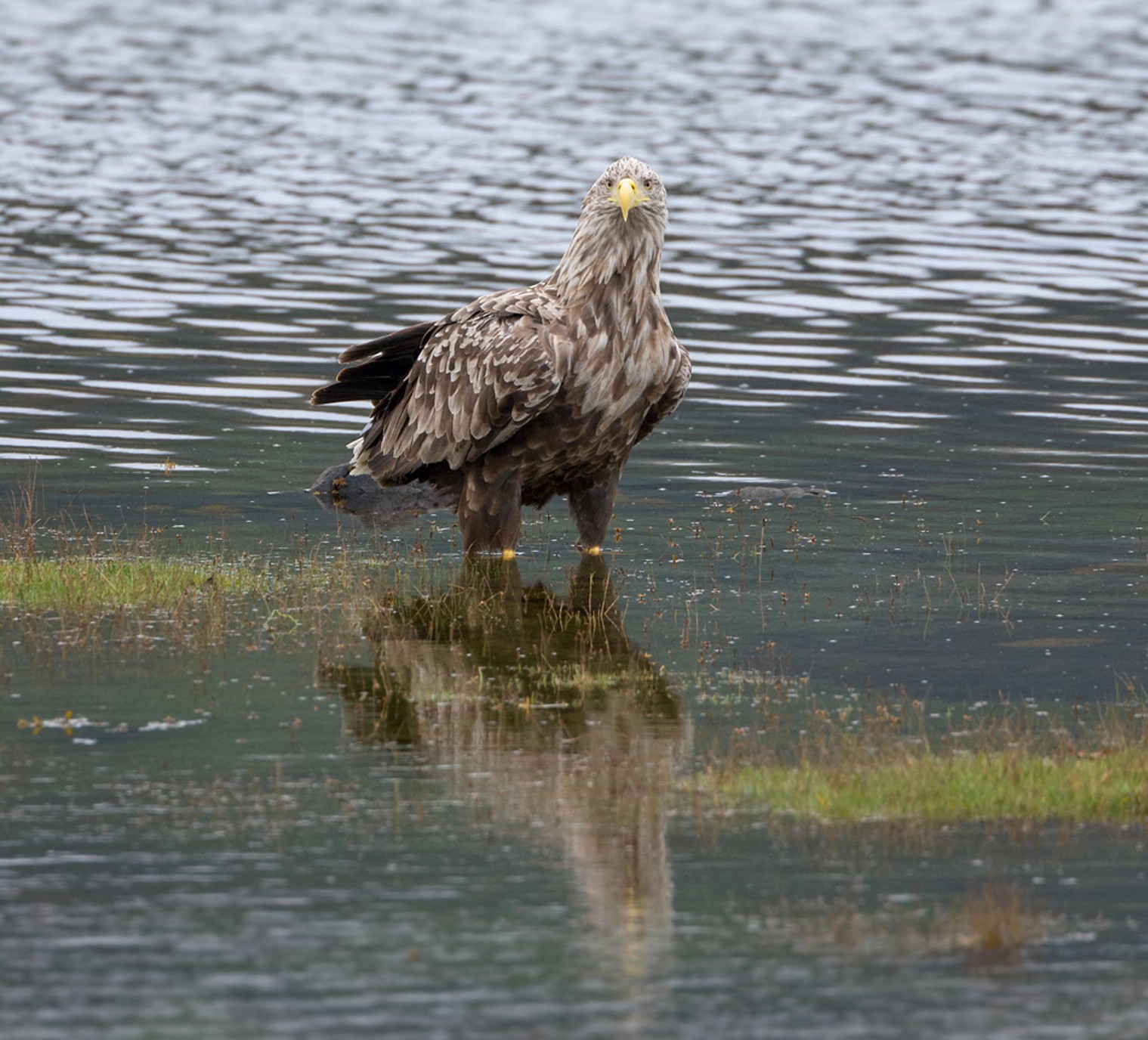
Two female White-tailed Eagles make their first explorations from release pens in Exmoor National Park
The releases are part of a project started in 2019 by The Roy Dennis Wildlife Foundation and Forestry England to restore this lost species, and the key role it plays in supporting biodiversity, to England. Since then, 45 white-tailed eagles have been released from the Isle of Wight. Several are now breeding and in 2023 the project celebrated the first white tailed eagle chick to be born in the wild in southern England since 1780.
The team are now working with Exmoor National Park Authority to release further White-tailed Eagles in a bid to boost the population and expand their breeding range into south west England. Up to 20 additional young birds will be released from this location over the next three years. The project will also continue to carry out releases from its base on the Isle of Wight.
Exmoor was chosen as an additional location after tracking data from the released birds showed the area had been frequently visited by several of them and provides suitable habitat. It is known that the species formerly bred along the Exmoor coastline, which continues to provide ideal foraging, including an abundance of fish, and breeding habitat for the birds.
Earlier this year, the six young birds were collected under a NatureScot licence from the wild in Scotland and brought to Exmoor. Here they have been cared for by a team of experts whilst becoming familiar with their new surroundings.
Before being released the birds were fitted with satellite trackers so their progress can be closely monitored by the project team. It is expected that the young eagles will travel widely across the UK and potentially into Europe before returning to the area to breed when they are four or five years old.
Zoe Smith from the Roy Dennis Wildlife Foundation said: “White-tailed eagles would have once been common natural sight across the south west of England. After so many years absent from this landscape it is a special moment to be returning them on Exmoor. We will closely monitor their progress as they explore and, in time, begin to settle across this region. Thank you to everyone in the local community who is working with us to support the return of these magnificent birds“.
Angela Eagle, Environment Secretary for Defra said: “Majestic white‑tailed eagles – a particular favourite of mine – are once again soaring above Exmoor and the Isle of Wight, reflecting this government’s commitment to reversing the decline of nature and protecting it for generations to come.
“We are investing £90 million into species recovery, marking the largest ever government investment to directly support threatened wildlife“.
Stephen Egerton-Read, Project Officer for Forestry England said: “It is incredible to be returning this once lost species back to England. Seven years into the project we can see just how well the eagles are settling along the south coast of England and the really positive reaction the public have to seeing them back.
“These additional releases on Exmoor will help to boost the population and expand their geographic range into the south west ensuring many more people can see these amazing birds and are inspired by seeing nature return in this way“.
Ali Hawkins, Senior Ecologist with Exmoor National Park Authority, said: “This is such an exciting moment for Exmoor and a real boost to biodiversity in the National Park, as white-tailed eagles play a crucial role in both marine and land-based ecosystems. We‘d like to thank all representatives taking part in the steering group and we will continue to work closely with the local community as the project progresses“.
A comprehensive feasibility study and public surveys were conducted before reintroducing the birds and a steering group made up of local organisations and members of the community has met and is helping to guide the project.
The reintroduction of Britain’s largest bird of prey is being conducted under licence from Natural England, the Government’s wildlife licensing authority.
ENDS
Previous blogs about the release of White-tailed Eagles on Exmoor:
2 January 2025: Public views wanted on plans to release White-tailed Eagles in Cumbria, Wales, Severn Estuary and Exmoor (here).
6 January 2025: Predictable backlash from NFU to proposed releases of White-tailed Eagles (here)
14 May 2026: White-tailed Eagles to be released in Exmoor National Park this year (here)
14 May 2026: Statement from Natural England on decision to licence release of White-tailed Eagles in Exmoor National Park, with additional commentary from me (here)
A couple of weeks ago I wrote about BASC’s grandstanding antics in response to a High Court ruling about the keeping of non-native gamebirds (Pheasants and Red-legged Partridges) on Special Protection Areas (SPAs) or within the 500m of the SPA’s boundary (see here).
BASC had framed its judicial review ‘win’ in such a way that led many in the gamebird shooting sector to think that the High Court had quashed the licences issued by Natural England for the restriction of gamebird releases on, or in the buffer zone, of almost all SPAs in England.
But that wasn’t the case at all. The High Court ruling related only to a condition of those licences – that of keeping gamebirds in pens on site – the licences required for the subsequent release of those gamebirds still remain in place, as does the condition relating to delayed release dates on some SPAs.
Hundreds of Red-legged Partridges released next to the Deben Estuary SPA in Suffolk in 2025 (photo by Ruth Tingay)
BASC’s vague statement about the judgement was mostly focused on bigging itself up, probably in an attempt to impress the BASC membership after BASC received widespread criticism from members for its perceived failure to stand up against the forthcoming ban on lead ammunition. Strangely, BASC’s statement said very little about the real-world consequences of the judicial review ‘win’. All BASC said about that was,
“BASC will now consider the detail of the 47-page judgement before issuing further advice on how this will effect shoots in or near SPAs in England“.
Since then, I haven’t seen any “further advice” from BASC, which seems a bit odd given that now is the time many of its members will be wanting to tip out thousands of gamebirds in to pens in preparation for release, before chasing them around the countryside and shooting at them.
The reason why BASC hasn’t been able to publicly issue any ‘further advice’ is probably because the court has yet to finalise the consequences of its earlier ruling, and it can’t complete that process until it has considered Natural England’s application to appeal the outcome of the judicial review.
What that means, in real-world terms, is that although Mr Justice Ritchie ruled last month that Natural England’s licence condition relating to the keeping of gamebirds in pens on site was unlawful, the licences, and their conditions, remain firmly in place until such time that the proceedings are fully concluded.
Both parties have since made submissions to the court about how they want the specifics of the ruling to play out, and there’ll be a ‘consequentials hearing’ at the High Court, expected to be in September, for the judge to make formal orders.
However, if the judge refuses Natural England’s application to appeal the original ruling, then Natural England may decide to apply to the Court of Appeal, which, if permission to proceed is granted, will take time and will further delay the final outcome of this case, certainly beyond the timescale of the release period of this year’s shooting season.
Earlier this year, retired Scottish gamekeeper David Campbell was found guilty of murdering his former colleague from the Edradynate Estate in Perthshire, Brian Low, in February 2024.
During a 13-day murder trial, the jury at Glasgow High Court heard that Campbell had held a ‘festering grudge’ against Mr Low and set out to ‘ambush’ and ‘execute’ him by lying in wait with a shotgun on a quiet country lane near Aberfeldy where Mr Low regularly walked his dog.
A couple of days ago I blogged about a forthcoming BBC documentary series, Murder Trial, which will feature the February 2026 trial of David Campbell (see here).
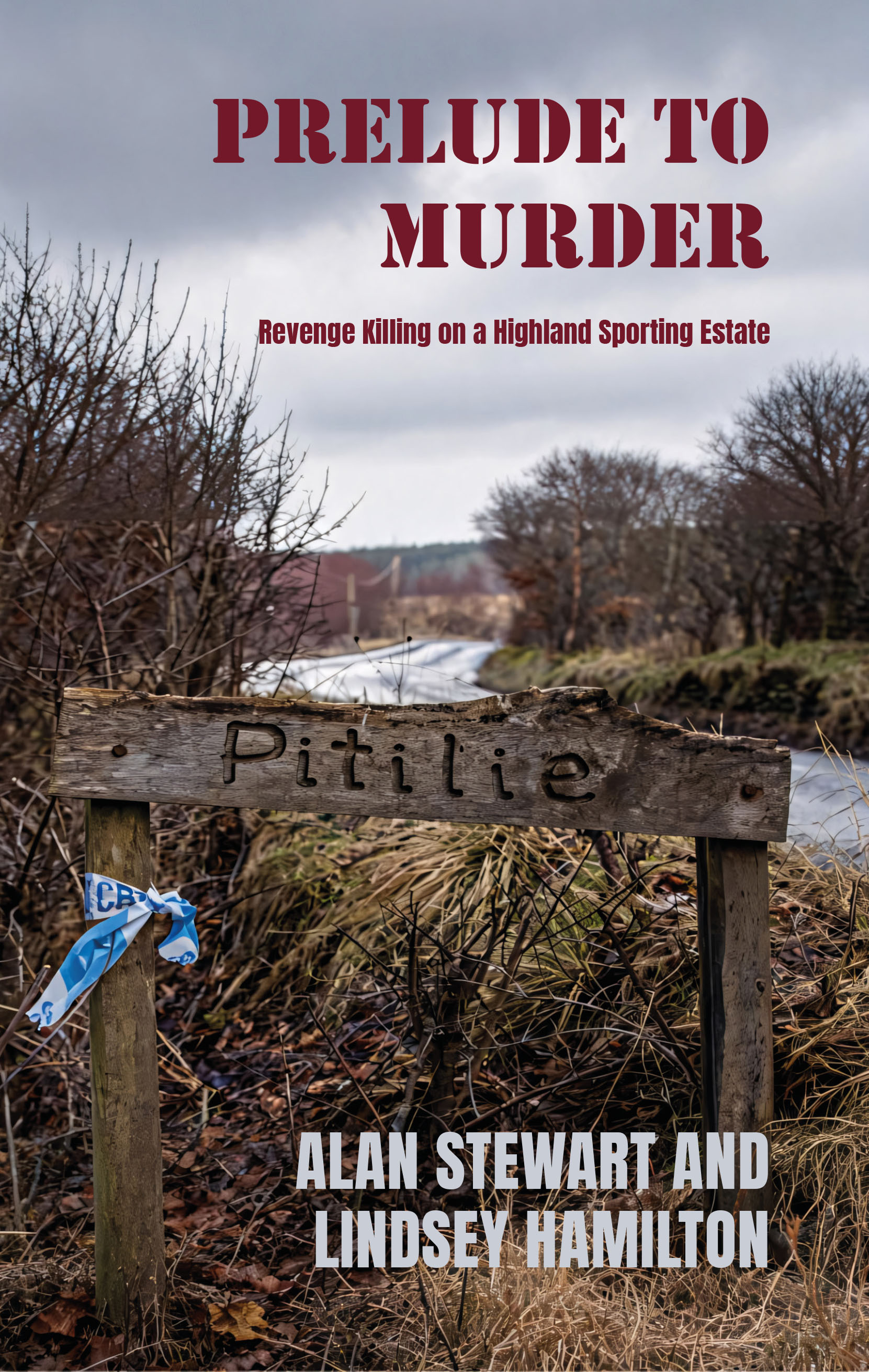
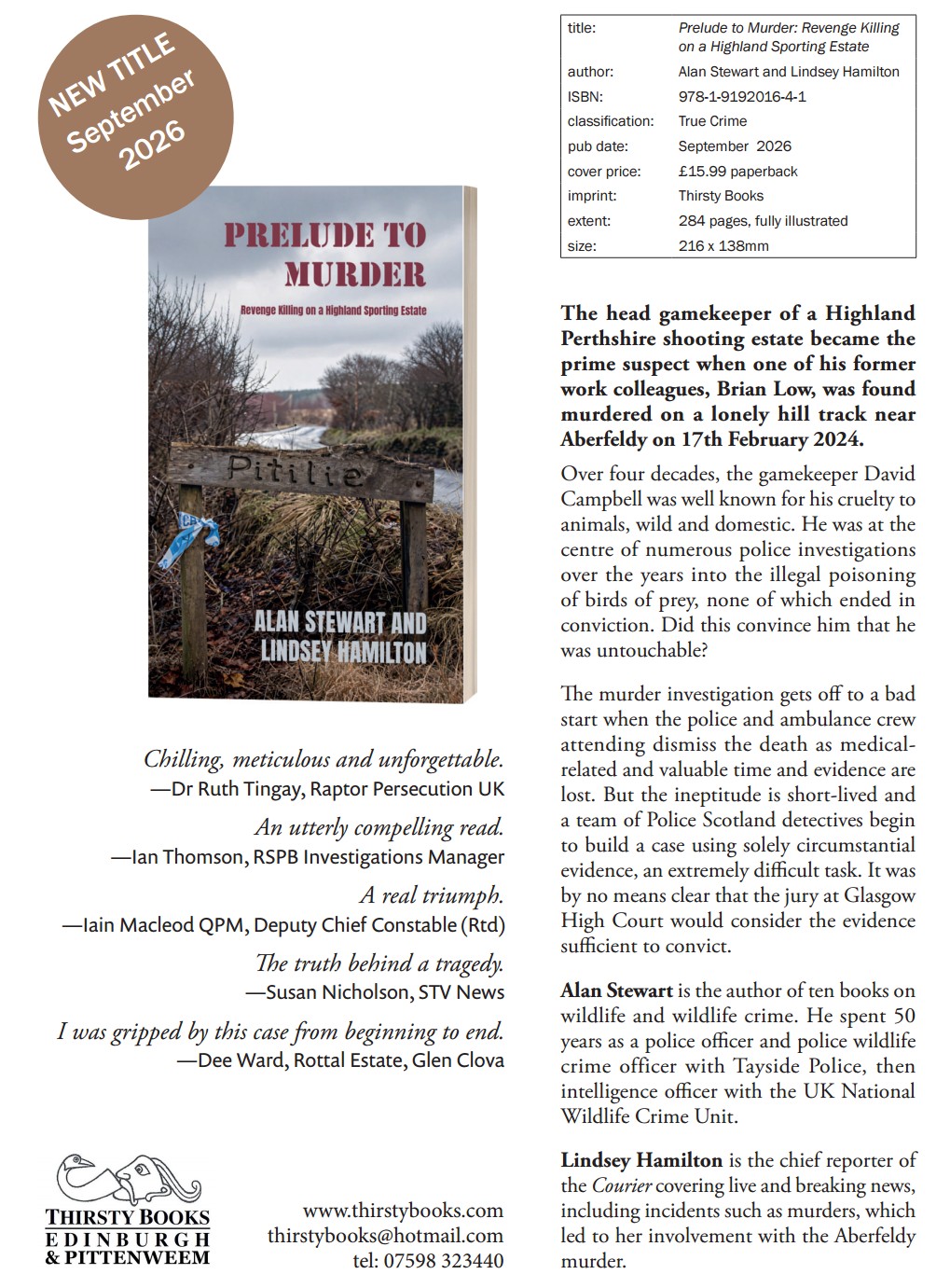
There’s also now a forthcoming book about the case, called Prelude to Murder: Revenge Killing on a Highland Sporting Estate, written by former Police Wildlife Crime Officer Alan Stewart and Lindsey Hamilton, Chief Reporter at The Courier.
The two authors are uniquely placed to provide first-hand accounts.
The book tracks the many police investigations into raptor persecution crimes at Edradynate Estate, in Perthshire, over a four-decade period that just happened to coincide with David Campbell’s employment as the Head Gamekeeper (1984-2018). Co-author Alan Stewart was involved in many of those investigations, as this notorious estate was on his patch as Police Wildlife Crime Officer for what was then Tayside Police.
Cleverly intertwined with Alan’s detailed, and frankly, chilling chronicle of events at Edradynate, is Lindsey Hamilton’s account of her involvement as a seasoned journalist, first sent to Aberfeldy to report on the police investigation into the murder of Brian Low, and then later attending Glasgow High Court to report on the trial of prime murder suspect, David Campbell.
Much has been written over the years about raptor persecution at Edradynate Estate and the failure to hold anyone to account, but this book contains more detail than I’ve seen published before. Similarly, the murder, the police investigation and the subsequent trial and conviction have also received extensive media coverage, but Lindsey’s first-hand experience brings insight and a real sense of the reaction within the local community.
If you want to know why sadistic gamekeeper David Campbell thought he could get away with murder, and why a local community had lived in fear of him for decades, this compelling account provides some answers. The warning signs were all there, in plain sight. It’s disturbing that a reign of terror was allowed to continue for so long, with such tragic consequences for Brian Low.
The book will be published in September 2026 and is available for pre-order, either directly from the publisher (ThirstyBooks) or if you want a signed copy, directly from Alan Stewart.
Note – the pre-publication flyer says the book is 284 pages, but it’s actually 184 pages.
UPDATE 6 September 2026: Book launch: Prelude to Murder – Revenge Killing on a Highland Estate (here)
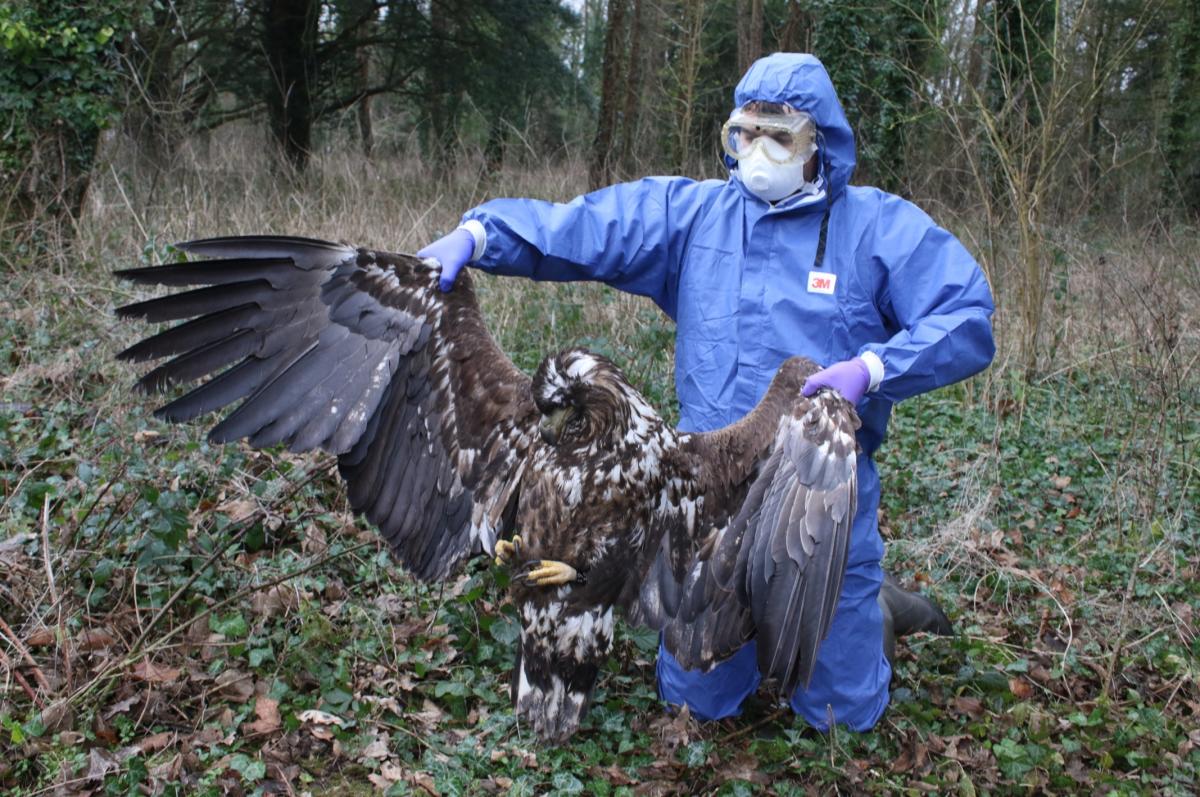
This young White-tailed Eagle was found dead in Dorset in 2022. It’s liver contained 7 x lethal dose of rodenticide. Photo by Dorset Police
WPRUK’s findings about further White-tailed Eagle poisonings only came to light as a result of extensive Freedom of Information requests. Dr Ed Blane, the scientist behind WPRUK and an expert in the exposure of wildlife to Second Generation Anticoagulant Rodenticides (SGARs), stated that many of the case details were still being kept secret by the Government.
He said:
“The death of these majestic birds in Dorset, and the high amounts of poison found in their livers, should cause alarm bells to start ringing across the country. What we see now is the total failure of Government approved policy meant to protect the environment, information being withheld and our wildlife paying the price. At the same time chemical companies are making profits from selling these poisons. We have Channel 4’s ‘Dirty Business’ meeting Rachel Carson’s ‘Silent Spring’!
“What is of particular concern are the plans to introduce eagles to other areas of England and Wales without addressing this growing poisoning issue. How many of these birds will suffer a similar fate as the Dorset eagles?“.
Since last week’s press release from WPRUK, a journalist from the Dorset Echo, Richard McLaughlin, has followed up on the story and he’s forced Natural England to admit the scale of the problem. His article, published yesterday, was headlined,
‘Every white-tailed eagle death in Dorset linked to rat poison‘
The full article can be read here, and it’s reproduced below to safeguard from future broken links.
‘Every white‑tailed sea eagle found dead in Dorset since the start of England’s reintroduction programme has carried residues of a powerful rat poison, Natural England has confirmed.
The poisonings have raised fresh questions over rodenticide use in the countryside.
Since 2019, Natural England has investigated 10 suspected white-tailed eagle poisonings in England, including nine deaths and one non-fatal illness; six cases were in Dorset: five deaths and one illness.
Natural England told the Echo toxicology tests found brodifacoum in all five dead Dorset eagles “at levels considered close to significant”.
Brodifacoum is a powerful rat poison that stops blood clotting and causes severe internal bleeding, and even small amounts can kill rodents, pets, farm animals and wild birds and poison predators that eat contaminated prey.
Experts said rodenticide toxicity probably contributed by leaving the birds more vulnerable to injury, starvation or other factors, although levels were “not high enough to be identified as the primary cause of death”.
Natural England’s list records Dorset eagles found in January 2022 (cause “unspecified”), May 2024 (starvation), March 2025 (trauma) and March 2026 (electrocution), plus a non-fatal illness in February 2022.
A fifth eagle died by electrocution in November 2024; Natural England said brodifacoum was found in all five at levels “above those expected from normal background exposure”, requiring further investigation into its use.
The results “suggest brodifacoum may not have been used in accordance with legal requirements designed to protect wildlife and prevent exposure of non-target species,” Natural England said.
The birds were reintroduced to southern England from the Isle of Wight under a Natural England-licensed project.
Investigations into the Dorset cases continue, with detailed evidence reports withheld until they end.
The Health and Safety Executive will publish the final outcomes and leads pesticide enforcement and the Government’s rodenticide stewardship scheme.
Wildlife Poisoning Research UK, which obtained much of the detail through freedom of information requests, says the Dorset cases show the stewardship scheme is failing and wants tighter controls on SGARs.
Conservationists say the findings raise questions over poison controls in areas used by reintroduced species and other protected birds of prey.
In a 2022 case, Dorset Police said tests were inconclusive and could not confirm deliberate intent or identify an offender despite detecting high brodifacoum levels’.
ENDS
Natural England’s admission was also picked up by the BBC News website, here.
Both articles include statements from Natural England about the rodenticide Brodifacoum being found in all five dead WTEs in Dorset at levels “above those expected from normal background exposure”, requiring further investigation into its use.
Natural England also said the results had ‘warranted a further investigation into the source, which suggested Brodifacoum might not have been used in accordance with legal requirements designed to protect wildlife and prevent exposure of non-target species’.
Gosh, do you think so?
The BBC’s article includes the following quote from an unnamed Natural England spokesperson:
“Natural England is firmly committed to the protection and recovery of white-tailed sea eagles and remains confident that reintroduction projects in Dorset are contributing to this national conservation goal.
“The findings from Dorset and elsewhere highlight the importance of responsible pesticide use and continued vigilance to reduce risks to wildlife and safeguard the long-term recovery of white-tailed sea eagles.”
These amount to nothing more than empty platitudes.
The total failure of the Government’s Rodenticide Stewardship Scheme, designed toprevent the widespread poisoning of wildlife by rodenticides,has been well documented (e.g. see this 2024 report from Wild Justice, here).
Birds of prey are particularly affected, and there is widespread evidence that rodenticides are being misused, sometimes deliberately, at shocking levels.
The Government could take some relatively easy steps to put a stop to all this, especially with stronger regulation of Brodifacoum, but so far, nothing.
But watch this space…
UPDATE 18 August 2026: White-tailed Eagle poisonings feature in Private Eye (here)
Earlier this year, retired Scottish gamekeeper David Campbell was found guilty of murdering his former colleague from the Edradynate Estate in Perthshire, Brian Low, in February 2024.
During a 13-day murder trial, the jury at Glasgow High Court heard that Campbell had held a ‘festering grudge’ against Mr Low and set out to ‘ambush’ and ‘execute’ him by lying in wait with a shotgun on a quiet country lane near Aberfeldy where Mr Low regularly walked his dog.
Convicted murderer & former Head Gamekeeper David Campbell (photo by Police Scotland)
Campbell’s conviction was not a surprise to many in the local community who’d lived in fear of him for years. He’d previously been a suspect in multiple police investigations into alleged raptor persecution crimes and other offences, with traces of poison found in pockets of his clothing and in his Land Rover, as well as dead raptors found concealed under the seat of his vehicle, but he was never convicted and often not even prosecuted, due to evidential difficulties, although in one case the Crown Office’s decision not to prosecute was not supported by Police Scotland.
The BBC’s award-winning documentary series Murder Trial was given permission to film inside the High Court during Campbell’s murder trial and the two-part programme, called Death of a Dog Walker, will air in August.
‘In 2024, the body of 65-year-old groundsman Brian Low is discovered on a country track in rural Aberfeldy, his beloved black Labrador Millie by his side. Police assume that Brian has suffered a medical episode, but six days later, the post-mortem reveals the shocking truth – Brian has been shot dead. His former colleague and gamekeeper on the estate where he worked, David Campbell, now stands trial for his murder.
With the site of the murder exposed to the elements for days, police are unable to forensically link anyone to the deceased. The prosecution builds a case against the accused around smaller, individual strands of circumstantial evidence while working to convince the jury that he is guilty beyond reasonable doubt’.
‘With Brian’s family desperately seeking justice and answers, the fate of the accused hangs in the balance. Witnesses unearth more shocking revelations, and the defendant takes the stand before the jury answer the ultimate question: guilty or not guilty?
As the police investigation team finally close in on their suspect, the court are shown dramatic footage from Campbell’s custody interview where tempers flare when allegations are put to him. The prosecution point to a guilty man on the ropes, while the defence argue it shows a police force under pressure to get their man.
As the case builds to a climax, with persuasive and gripping closing speeches from both sides, Campbell awaits his fate whilst Brian’s grieving family anxiously await justice – either way, lives will change forever’.
This programme will air on BBC 2 Scotland at 9pm on Tuesday 11 August 2026 and will be available on BBC iPlayer shortly afterwards.
UPDATE 2 August 2026: Book Review – Prelude to Murder: Revenge Killing on a Highland Sporting Estate (here)
The UK National Wildlife Crime Unit (NWCU) is a specialist police-led unit that provides intelligence, analysis and investigative expertise to support law enforcement agencies tackling wildlife crime. This work focuses on the national wildlife crime priorities which are currently listed as raptor persecution, Badger crime, bat crime, illegal wildlife trade (CITES) and illegal hunting, poaching and coursing. The unit is hosted by Hampshire Constabulary and has a main office in Stirling, Scotland, but homeworking throughout the UK is available.
The NWCU is currently advertising the following three vacancies:
Intelligence Analyst
Permanent position, full time (37hrs per week), salary range £37,020-£39,276. Closing date for applications: 2 August 2026 at 23.55hrs. Interviews week commencing 10 August 2026. Click here to apply.
Temporary position for two years (30hrs per week), salary range £37,026 – £39,276) pro rata. Closing date for applications: 9 August 2026 at 23.55hrs. Interviews week commencing 17 August 2026. Click here to apply.
Temporary position for two years (30hrs per week), salary range £37,026 – £39,276) pro rata. Closing date for applications: 16 August 2026 at 23.55hrs. Interviews week commencing 31 August 2026. Click here to apply.
Forty new satellite tags will soon track sea eagles in western Scotland to investigate how sea eagles and livestock interact
NatureScot has provided funding for the satellite tags for this collaborative research project, which brings together a broad team of experts to assess the extent of sea eagle predation of lambs and sheep. The transmitter tags are to improve understanding of the movement, behaviour of adult and juvenile sea eagles, as well as how they use and interact with the countryside.
The researchers will collate and analyse GPS (Global Positioning System) fix data received from the satellite tags to gather information on the ecology of Scotland’s sea eagle population.
Over the next two years, licenced ornithologists are fitting up to 35 satellite tags to sea eagle chicks when they are about eight weeks old. By then, the chicks are full-sized and getting ready to fledge from 10 weeks of age on. These tags –which can last for years—will give a unique insight into where the chicks travel after leaving their natal home range.
Target ranges for tagging will be within Argyll, Highlands, and the Western Isles.
The project also aims to deploy the remaining five tags on adult breeding sea eagles, which are more difficult to trap. Earlier this year, ornithologists using advice and techniques gained from European counterparts, trapped, tagged, and released an adult sea eagle on the Western Isles, boding well for success in this project. Farm managers who are comfortable hosting trapping work on their land may collaborate with this work.
The research project is a partnership between NatureScot, RSPB, Scotland’s Rural College SRUC, Natural Research Ltd, and a collective of independent ornithologists, which are sharing the costs of and resources for the project between them, with policy input from the NFU Scotland and the Scottish Crofting Federation. SRUC are also tracking lambs in Argyll using GPS neck collars as part of a separate research project. This research will complement and benefit the tagging project, giving a broad picture of how sea eagles and lambs interact.
Humans persecuted sea eagles—Scotland’s largest bird of prey—to extinction by the early 20th century. Since their reintroduction initially on the Isle of Rum between 1975 and 1985, the birds—now protected by law—have successfully repopulated the west of Scotland, expanding their range in all directions and increasing impacts on upland and hill sheep flocks.
The research group will report periodically to the National Sea Eagle Stakeholder Group and NatureScot will provide further updates on its website.
NatureScot Senior Ornithologist Andrew Stevenson said:
“This project will greatly add to our understanding of how sea eagles move around and their interaction with livestock. A key gap in our knowledge is what role immature eagles play in predating livestock, given they wander widely during their first three to four years until they settle on a territory. Tagging is the best way to get a handle on what they may be doing. While this collaborative partnership began because of the need for more information about livestock predation, the tag data will also help us understand how eagles use habitat, as well as other topics such as interaction with wind farms“.
Duncan Orr-Ewing, Head of Species and Land Management RSPB-Scotland (and Research Group Chair), added:
“Gathering evidence on the behaviour and movements of sea eagles is essential to create common understanding, and to inform future conservation and land management decisions. Latest technology in the form of GPS trackers fitted to Sea eagles can help deliver such outcomes sitting also alongside other initiatives being taken forward by the National Sea Eagle Stakeholder Group. The collaborative partnership approach to this project involving NatureScot, expert researchers, farming representatives and conservationists is very welcome, and we hope to present the results in due course“.
“NFU Scotland supports this satellite tagging project as a vital step towards building a clear, shared evidence base on sea eagle behaviour. For farmers and crofters in affected areas, understanding when and where interactions with livestock occur is critical. This research must lead to practical, targeted management solutions that give farmers confidence that impacts on livestock are being properly recognised and addressed“.
Scottish Crofting Federation Chief Executive Donna Smith said:
“Crofters are reporting increased sightings and issues with sea eagles each year so this research is a very welcome development. Building a greater understanding of how the sea eagles are interacting with livestock will hopefully lead to improved targeting of management measures in the future. We therefore look forward to supporting the research in whatever way we can and to seeing the findings in due course“.