Norfolk Constabulary’s Rural Crime Team has posted this on Twitter today:
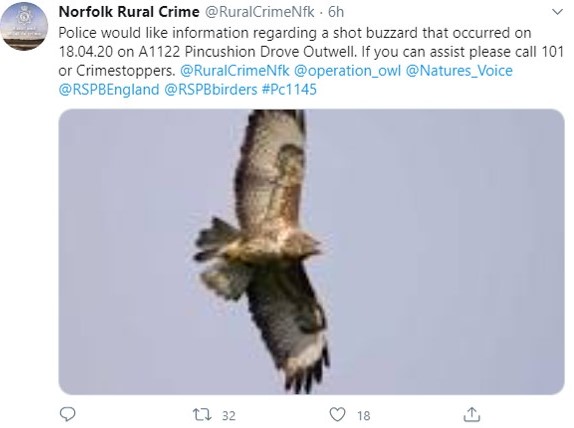
We haven’t been able to find any further published information – status of the bird, crime ref number etc.
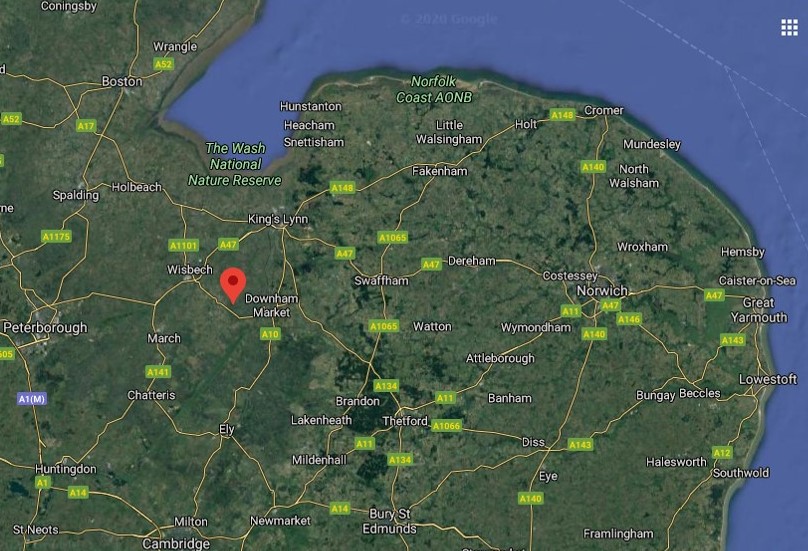
Here’s a map of the location:

Norfolk Constabulary’s Rural Crime Team has posted this on Twitter today:
We haven’t been able to find any further published information – status of the bird, crime ref number etc.
Here’s a map of the location:
Press release from Scottish animal welfare charity OneKind (29 May 2020)
Shocking footage shows pile of rotting animal carcasses set to lure animals into nearby traps
New footage passed through to leading animal welfare campaigns charity, OneKind, reveals snares set near a pile of rotting animal carcasses, apparently set by gamekeepers in Strathnairn, south of Inverness.
The footage can be viewed here
In order to maximise the number of red grouse and pheasants available for recreational shooting, gamekeepers target foxes. To lure foxes into snares, gamekeepers often lay snares around a ‘stink pit’: a place where the gamekeepers dump rotting animal carcasses. The smell of decomposing animals lures the foxes towards the dead animals, where they are then caught in the snares surrounding the pit.
The use of these stink pits is a fundamental part of intensive predator control on Scottish shooting estates.


OneKind’s Director Bob Elliot said:
“The use of stink pits to lure animals into cruel snares, which inflict considerable mental and physical suffering upon the animals trapped in them, shows a fundamental lack of respect for Scotland’s wild and domestic animals.
Although snares are set to target predators to the red grouse, non-target species are often found among the animals dumped in stink pits, and during our work in the field we have discovered deer, geese, salmon and even cats in stink pits.
In this recent case, the animals discovered in the grotesque stink pit included rooks and fox cubs. It’s a disgrace that this mass killing of rooks is still permitted and we were horrified to see that even young animals were treated as bait. Some of the rooks appeared to be juveniles, hardly surprising given that this is the time when they emerge from their nests and perch on branches before fledging fully. The welfare issues of shooting rooks have not been fully researched but one can safely assume that they suffer. Shooters seldom, if ever, use dogs to retrieve wounded birds and ensure they are despatched to put them out of their misery. Fox cubs are loved by so many of the Scottish public, and we know that the killing and dumping of them like this will be very upsetting to many.
We urge anyone out walking in Scotland to take photos and report any snares or snaring incidents through our dedicated snare awareness website, SnareWatch. We continue to raise awareness of the reality of snare use in our countryside, and the suffering these cruel traps inflict upon Scotland’s wild animals.
OneKind has long campaigned for a ban on stink pits and the sale, manufacture, possession and use of snares in Scotland and our petition for a review of snares and other traps is currently being considered by the Scottish Parliament. We have also produced a report, ‘Untold Suffering’, that details the scale and level of suffering inflicted on wild animals by these antiquated traps, highlighting why a ban is necessary.”
OneKind has notified Police Scotland about one snare photographed at the site, as it did not have a visible identification tag, which is a legal requirement. The question of whether stink pits are legal has been raised repeatedly by OneKind.
ENDS
Notes for Editors (from OneKind)
Press release from Scottish Greens (3 June 2020)
Concerns over wildlife crime during lockdown
‘Concerning’ wildlife crime during lockdown shows why greater protection and enforcement is needed, the Scottish Greens have said.
Speaking to Scottish Green environment spokesperson Mark Ruskell at Holyrood’s Environment, Climate Change and Land Reform Committee, Francesca Osowska, Chief Executive of Scottish Natural Heritage, said there has been reports of incidents concerning nesting birds, badgers and freshwater mussels during lockdown.
“That is a concern,” she said, pointing out SNH have not been able to respond in normal ways due to restrictions and have been referring cases to Police Scotland.
Commenting, Mark Ruskell said: “We’ve seen reports across the UK of criminals exploiting the lack of normal monitoring during lockdown to kill animals. I agree with SNH that this is extremely concerning.
“This is why current attempts to strengthen the law around wildlife needs to be stronger. I have proposed stronger protection for badgers and giving the SSPCA powers to investigate wildlife crime, both of which would prevent further crimes and make convictions more likely.
“We’ve also heard that the RSPB has been ‘overrun’ by reports of birds of prey being illegally killed by those emboldened by the absence of walkers and hikers. Travel restrictions are necessary, but they also apply to private estates. This crisis is not carte blanche for wholesale slaughter of Scotland’s wild animals.”
ENDS
On the topic of increased powers for the SSPCA, a subject that’s been covered extensively on this blog, Common Weal journalist Sean Bell has written an excellent synposis which includes this comment, hitting the nail on the head:
‘More broadly, the suggestion that, after nearly a decade of discussion and debate regarding expanded powers for the SSPCA, it is still somehow unclear “why the powers would be needed or what they are for” indicates either a severe lack of interest on the Scottish Government’s part, or an active attempt to roadblock progress on the matter‘.
You can read his article in full here
The Scottish Government chose not to expand the SSPCA’s powers in May 2017 (apparently based on ‘legal advice’) and this decision was buried in amongst an announcement that a review on grouse moor management would be undertaken (this later became known as the Werritty Review), for which we’re still waiting for a Government response.
With raptor persecution showing no sign of decrease since then (e.g. see here) and even continuing through lockdown, it’s good to see the Scottish Greens bringing the issue of increased SSPCA powers back to the Parliamentary table.
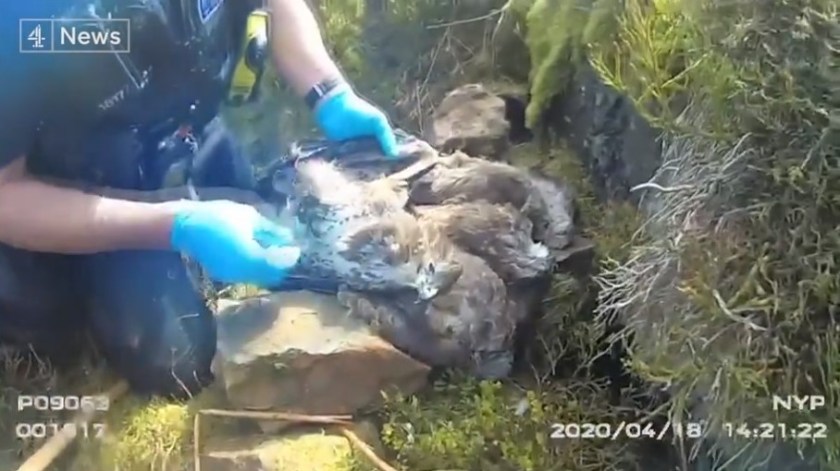
Last Friday afternoon, North Yorkshire Police appealed for information in relation to an ongoing investigation involving the discovery of five dead buzzards that had been shoved in a hole under a rock on an unnamed grouse shooting estate in Bransdale in the North York Moors National Park. X-rays have so far revealed that four of those five buzzards had been shot (see here).
[Police body camera footage captures the moment five dead buzzards are pulled from a hole where they’d been concealed on a grouse shooting estate in Bransdale, North York Moors National Park]
North Yorkshire Police has since released x-rays of three of those shot buzzards:

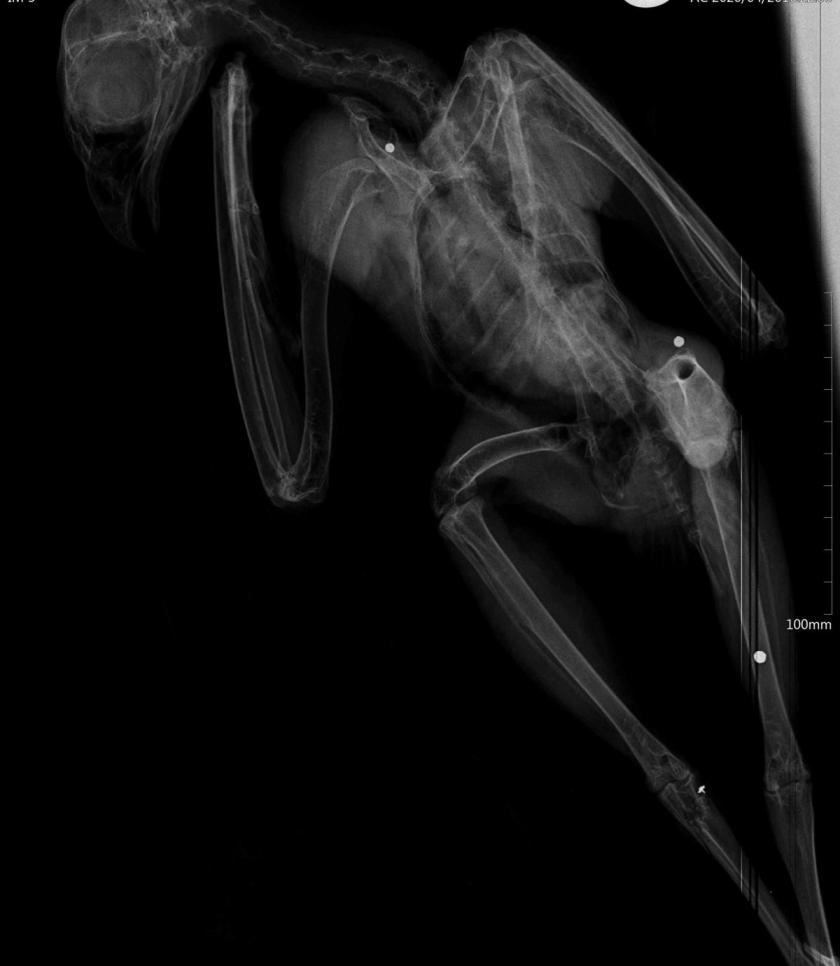
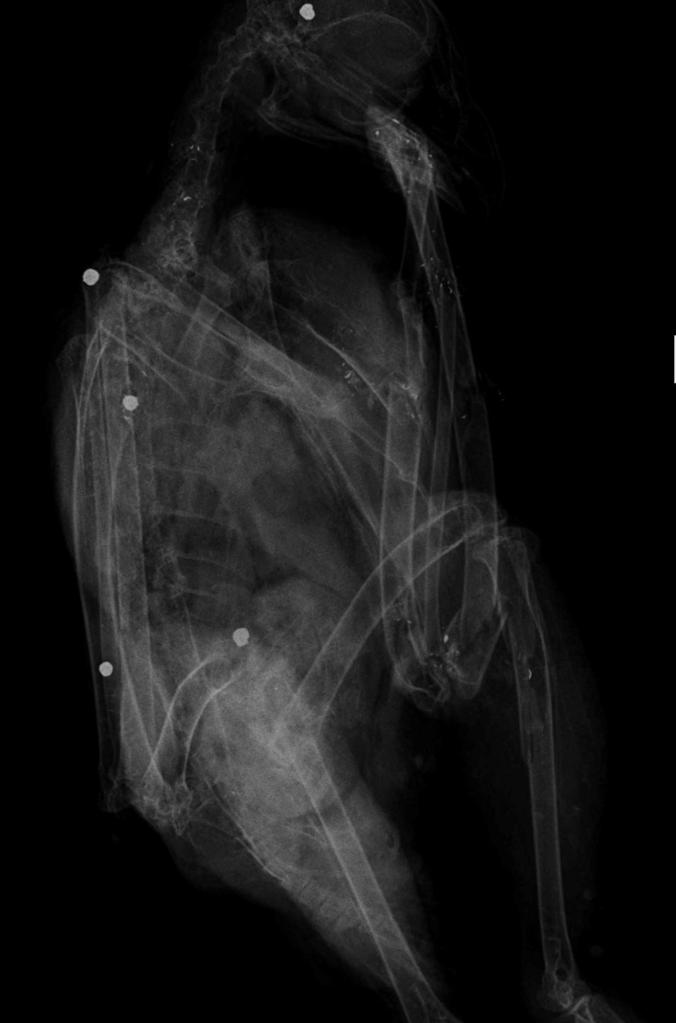
In relation to this incident and other ongoing investigations into raptor persecution, Inspector Matt Hagen from North Yorkshire Police’s Rural Crime Team told Channel 4 News, “All the shooting investigations that we’ve got going on at the moment are involving gamekeepers on grouse moors” (see here).
Given the game-shooting industry’s claims of a ‘zero tolerance’ stance to illegal raptor persecution (see here), you’d think this would be the perfect opportunity for the grouse shooting industry to offer its full support to the police investigation and encourage its members to step forward with information, especially if there was concern about dangerous unidentified armed criminals, killing protected species and running amok in a National Park, right?
Well apparently not. Having looked at the websites of the industry’s ‘leading’ organisations this morning, here’s what they’ve had to say about this latest crime:
Moorland Association: nothing
BASC: nothing
Countryside Alliance: nothing
National Gamekeepers Organisation: nothing
GWCT: nothing
Impressive, eh?
There is one group from the industry, however, who seems to have plenty to say, and it’s quite extraordinary.
The North Yorkshire Moors Moorland Organisation (NYMMO) is an apparently grassroots umbrella organisation that represents grouse moor gamekeepers in the North York Moors. It’s one of a number of regional moorland groups in the UK, established a few years ago as part of what looks like a propaganda exercise to promote grouse moor management in a favourable light. The NYMMO website doesn’t have a list of grouse-shooting estates on which its members work but we do know it has members that work in Bransdale (more on this in a future blog).
Here’s what the NYMMO posted on its social media channels on Sunday, in response to the news that five dead buzzards, four of which are confirmed as being shot, were discovered concealed in a hole on an unnamed Bransdale grouse shooting estate:
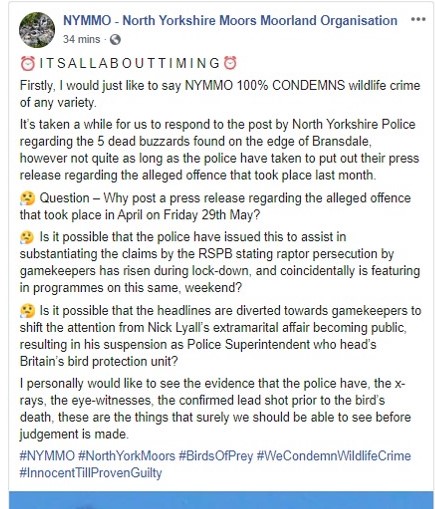
Does this strike anyone as evidence of an industry exhibiting ‘zero tolerance’ of raptor persecution? You can bet that some of those ‘leading’ organisations will be raging at the NYMMO for posting such an incredibly stupid and revealing statement in response to what is an horrific wildlife crime, especially as a number of those ‘leading’ organisations have a close and supportive relationship with the NYMMO. Although at least one BASC staff member (Gary Dockerty, BASC Upland Officer) has ‘liked’ this post on Facebook.
More on the NYMMO shortly….
Last night’s edition of Countryfile on the BBC included a ten minute slot on raptor persecution.
It’s available to watch on BBCiPlayer (here) for the next 11 months (starts 10.40 min).
To be honest, after watching the compelling piece on raptor persecution that featured on Channel 4 News on Friday (see here), Countryfile’s effort was a bit limp and underwhelming.
Having said that, we should bear in mind that to the average Countryfile viewer, the fact that gamekeepers are still killing birds of prey in 21st Century Britain will have been quite a shock so ten mins of exposure on such a prime time programme is to be welcomed. There was also some cracking footage of hen harriers.

But for those of us all too familiar with this subject, this programme grated in some areas.
Presenter Tom Heap pitched the subject as a ‘political war between gamekeepers and the RSPB’ – sorry, Tom, but you’re about ten years out of date. Look around, there’s an ever-increasing community of organisations and individuals who are fighting hard against the grouse shooting industry and not just on the raptor persecution issue.
Tom also repeated the wildly inaccurate but often cited claim that the game-shooting industry is worth £2 billion to the rural economy. It’s worth nothing of the sort – keep an eye on Mark Avery’s blog as we anticipate a forensic dissection of this particular topic. [Update: read Mark’s blog here]
Then we had Steve Bloomfield from BASC who was complaining about ‘sweeping statements’ being made about raptor persecution that, according to him, infer everyone in gameshooting is killing raptors. He might just as well have stamped his feet and said, ‘It’s so unfair!’ The so-called ‘sweeping statements’ that I’ve seen are nothing of the sort – they’re statements of fact. For example, that the RSPB has received an increase in reported raptor persecution incidents during lockdown and the majority of those have been on land managed for game shooting.
Another example, from a senior police officer (Insp Matt Hagen, North Yorkshire Police), who told Channel 4 News and Countryfile that reported incidents had certainly increased since lockdown and that ALL his investigations were currently centred on gamekeepers on grouse moors.
To be honest, I can’t be bothered to write anymore of a review. It’s just going over the same old ground, time and time again. Watch the video if you like but if you watched the Channel 4 News video on Friday you’ll not learn much new from this one.
Meanwhile, let’s get back to the Bransdale case and those industry connections…..
Two weeks ago the RSPB announced that it had seen a ‘surge’ in reported raptor persecution incidents since the Coronavirus lockdown (see here).
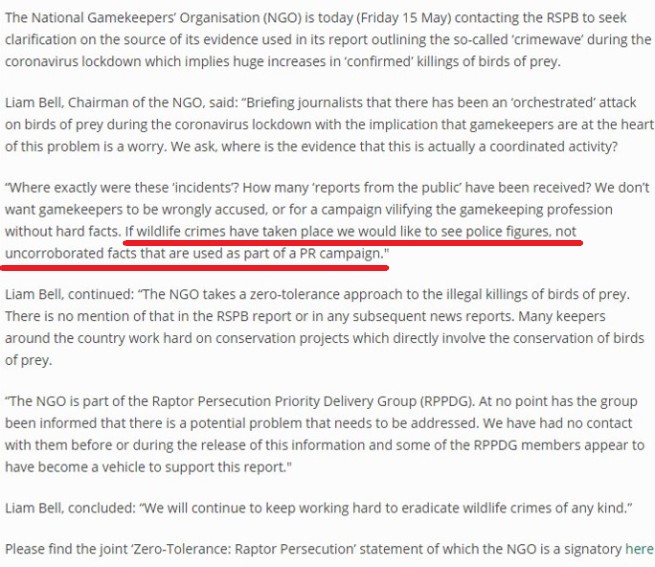
The response from the National Gamekeepers Organisation (NGO) was its usual attempt to undermine the credibility of the RSPB, bleat about being a signatory to an as yet undemonstrated stance of ‘zero tolerance‘ of raptor persecution, and to demand information from the police on recent raptor crimes (see here). Here is a copy of the NGO’s response, copied from it website (red bit highlighted by RPUK):
Fast forward two weeks and we had the excellent Channel 4 News special investigation featuring raptor persecution on North Yorkshire grouse moors (see here), which featured the utterly compelling dialogue between a senior police officer and the CH4 correspondent, as follows:
Alex Thomson (Channel 4 News correspondent): Lockdown has seen a sharp increase in reports of birds of prey found dead. We joined Inspector Matt Hagen of North Yorkshire Police as he followed up reports of a dead bird of prey seen in the Nidderdale area.
Inspector Matt Hagen: I’m absolutely shocked and disgusted at the level of raptor persecution that I am coming across.
Alex Thomson: Inspector Hagen told us that of 30 birds he’s collected in the past six months, only one has died of natural causes and his investigations lead clearly to a single group of suspects.
Matt Hagen: All the shooting investigations that we’ve got going on at the moment are involving gamekeepers on grouse moors.
Alex Thomson: All of them?
Matt Hagen: All of them.
Alex Thomson: Every single one?
Matt Hagen: That’s right.
The National Gamekeepers Organisation has now published a response to the Channel 4 News programme. Bear in mind that the programme delivered exactly what the NGO had previously asked for (i.e. details from the police instead of the RSPB) that placed gamekeepers at the centre of every single current criminal investigation relating to the illegal killing of birds of prey in North Yorkshire. Here’s what the NGO now has to say:
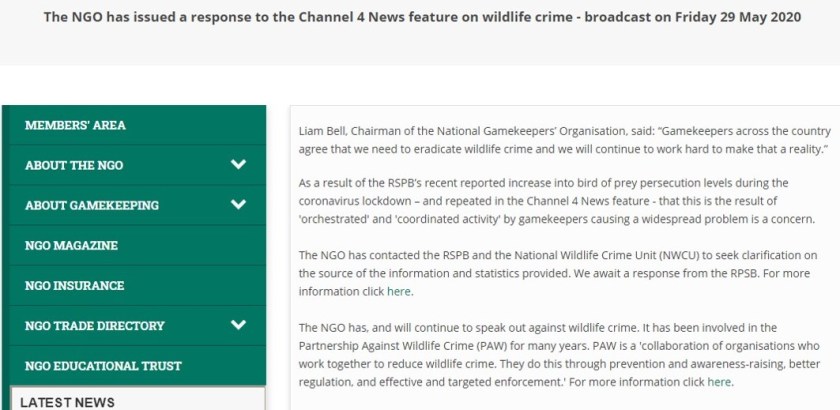
The NGO says the news “is a concern“. The NGO says it is seeking “clarification on the source of the information and statistics provided“. Where’s the condemnation? Where’s the disgust? Where’s the reaction to those shot buzzards being pulled out of a hole on a grouse shooting estate? This response is pathetic.
The NGO says it is part of the Raptor Persecution Priority Delivery Group (RPPDG) – which came as a bit of a surprise to us given that it resigned ‘permanently’ from the partnership after a massive tantrum in January last year (see here and here). Those decent organisations on the RPPDG who genuinely want to tackle illegal raptor persecution (e.g. RSPB, Northern England Raptor Forum, BAWC, North Pennines AONB, Sheffield Wildlife Trust) really need to start thinking about their positions on this forum. By remaining, they legitimise organisations such as the NGO (and others) who are able to use their membership as a badge of respectability and credibility. They’re making the good guys look like mugs.

Following the news yesterday that a buzzard had been found confirmed poisoned in the Nidderdale AONB (see here), that the RSPB had seen a further increase in reports of raptor persecution since lockdown, including four new cases in the Peak District National Park (see here), and the discovery of five dead buzzards hidden in a hole on a grouse shooting estate in Bransdale in the North York Moors National Park, four of which have so far been confirmed as shot (see here), Channel 4 News featured a timely ‘special investigation’ piece last night, exploring the link between the illegal killing of birds of prey and grouse shooting estates across North Yorkshire.
The six minute film can be viewed here.
It includes interviews with North Yorkshire Police Inspector Matt Hagen (head of NYP Rural Crime Team) whose commentary was utterly damning (see below), Will Watson, a gamekeeper from an unnamed Nidderdale estate who said raptor persecution needs “nipping in the bud” as though this is a newly-emerging problem!, Duncan Thomas from BASC who reeled out the tired old patter that it was an “absolute minority of people” that “may commit offences“. He also claimed that BASC “have expelled members” following convictions for raptor persecution (really? When was that, then?) and that the industry is “very good at policing ourselves” (completely missing the point that if that was the case, there’d be no need for this programme to be aired), Guy Shorrock from the RSPB who pointed to the evidence that raptor persecution on grouse moors is organised crime on an industry-wide scale, and four Nidderdale residents (Keith Tordoff, Debra Jenkins, Charlotte & Chloe Amber) who were courageous enough to go on camera and speak out against illegal raptor persecution, even though at least one of them has previously received abuse and threatening letters for his efforts.
BASC was clearly worried about how this film would portray the game shooting industry because a few hours prior to the programme airing, this statement appeared on the BASC website, which says more about BASC staff’s concerns about criticism from their members than it does for its concerns about ongoing raptor killing.
The programme starts explosively with what looks like Police body camera footage as officers retrieve the five dead buzzards concealed in a hole at Fox Hole Crags on the edge of Bransdale:
Take a look at the date stamp of this footage – 18 April 2020, in the middle of lockdown. Those buzzards looked ‘freshly dead’. The significance of this date will become apparent.
The most interesting part of the programme was the interview with Inspector Matt Hagen, who Channel 4 accompanied while he was investigating the discovery of yet another dead buzzard in Nidderdale.
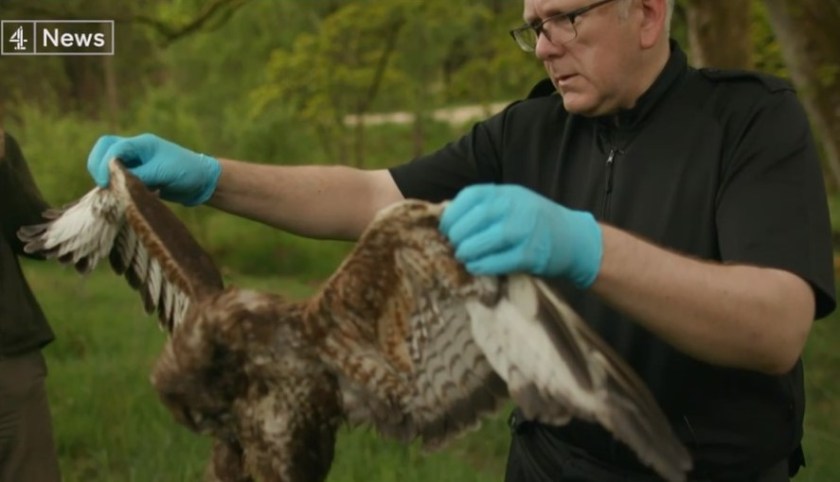
Here’s the transcript:
Alex Thomson (Channel 4 News correspondent): Lockdown has seen a sharp increase in reports of birds of prey found dead. We joined Inspector Matt Hagen of North Yorkshire Police as he followed up reports of a dead bird of prey seen in the Nidderdale area.
Inspector Matt Hagen: I’m absolutely shocked and disgusted at the level of raptor persecution that I am coming across.
Alex Thomson: Inspector Hagen told us that of 30 birds he’s collected in the past six months, only one has died of natural causes and his investigations lead clearly to a single group of suspects.
Matt Hagen: All the shooting investigations that we’ve got going on at the moment are involving gamekeepers on grouse moors.
Alex Thomson: All of them?
Matt Hagen: All of them.
Alex Thomson: Every single one?
Matt Hagen: That’s right.
Matt Hagen’s responses couldn’t have been clearer. Unequivocal, unambiguous and even to the uninformed Channel 4 viewer who might never have heard about raptor persecution, utterly compelling. Even the spin doctors from the grouse shooting industry will struggle with such devastating commentary, particularly because it came from a senior police officer directly involved with the investigations.
Now, about the date on that Police body cam footage where the dead buzzards were being pulled out of a hole in Bransdale in the North York Moors National Park – 18 April 2020. Channel 4 News filmed this interview with Matt Hagen over one month later, which indicates that grouse moor gamekeepers are under investigation for the shooting of those birds.
We’ll be exploring this further….
Well done to Alex Thomson et al at Channel 4 News for getting this issue on prime time TV.
North Yorkshire Police have issued the following press release today:
Appeal for information after buzzards found shot in Bransdale
North Yorkshire Police is appealing for information after five dead buzzards were found hidden in a hole in the ground on land below Fox Hole Crag, on the edge of Bransdale in the North York Moors.
Following information reported to the police in April 2020, officers attended the location and discovered five dead buzzards. The buzzards were then x-rayed, with four found to contain pieces of shot.
[X-ray showing one of the shot buzzards, via North Yorkshire Police]
So far, eight individuals have been interviewed under caution in connection with the incident. Enquiries are ongoing and if you have any information which could help this investigation please call 101 quoting reference number 12200063953.
All birds are protected by law, and it is a crime to intentionally kill, injure, or take any wild bird. Persecution of birds of prey is one of the five national wildlife crime priorities.
Find out more about how to recognise the signs of bird of prey persecution here: www.northyorkshire.police.uk/opowl-getinvolved
ENDS
Gosh, who might have been out shooting buzzards inside a National Park when everyone else was in lockdown? What a mystery.
The estate name hasn’t been given, but there aren’t that many estates in Bransdale.
[Bransdale (the dale, not the estate) according to Google maps]

[Fox Hole Crag, where the shot buzzards were found concealed in a hole]

[A view of one end of Fox Hole Crag, taken from near Fox Hole. Photo by Gavin Hatton, creative commons]
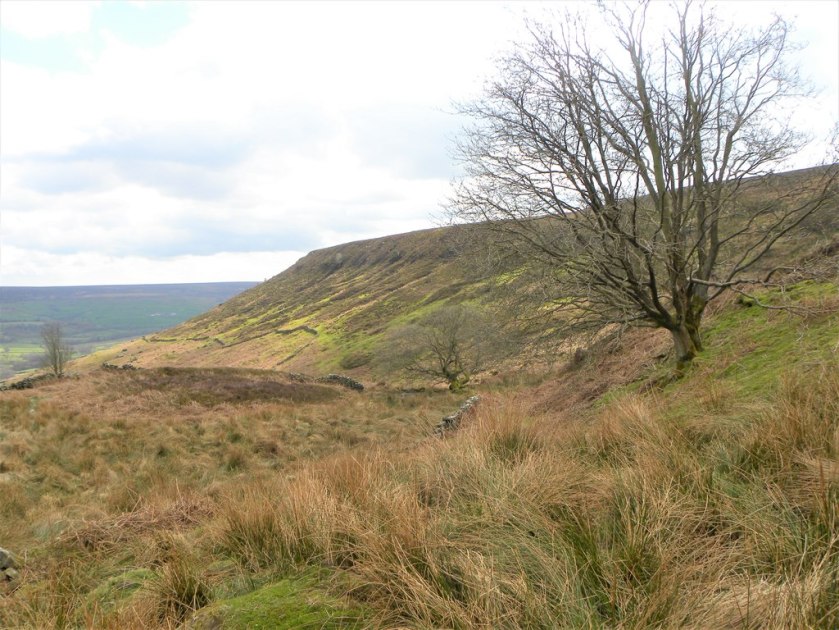
Looking at the site, North Yorkshire Police deserve some serious credit for locating hidden buzzards up there. They also deserve credit for bringing in eight individuals for questioning under caution. It’d be interesting to know whether any of those suspects gave anything more than a ‘no comment’ interview. Let’s hope the reported ‘ongoing enquiries’ include detailed forensic work on those corpses and anything else that might have been recovered from the site.
There have been a number of persecution incidents reported from this area in the past. In 2010 a shot goshawk was found at Bransdale (see here) and a post mortem reportedly revealed it had also been poisoned (see here). In 2012 a walker crossing the moorland in Bransdale found a dead sparrowhawk, also reported to have been shot (see here). In 2019 a buzzard was reportedly found shot on Bransdale Moor (see here).
There are many, many connections between Bransdale and figureheads in the grouse shooting industry and beyond; we’ll be examining some of those relationships in a series of forthcoming blogs. This incident may well provide the perfect platform for a demonstration of the grouse-shooting industry’s recent (but so far undemonstrated) claim of ‘zero tolerance’ for raptor persecution.
For now, if you have any information that could help the police’s criminal investigation please contact North Yorkshire Police on Tel: 101 and quote ref: 12200063953.
Don’t forget, tonight at 7pm Channel 4 News has a special investigation in to the wider issue of raptor persecution in North Yorkshire and Countryfile will also be covering it on Sunday evening.
UPDATE 30 May 2020: Channel 4 News highlights raptor persecution on North Yorkshire grouse moors (here)
UPDATE 31 May 2020: National Gamekeepers’ Organisation’s pathetic response to Channel 4 programme on rampant raptor persecution (here)
UPDATE 1 June 2020: BBC Countryfile highlights raptor persecution on grouse moors (here)
UPDATE 2 June 2020: 4 shot buzzards on a Bransdale grouse moor: shooting industry’s response (here)
UPDATE 10 September 2021: No prosecution for 5 shot buzzards found hidden on Bransdale Estate, North York Moors National Park (here)
Two weeks ago the RSPB said there had been a ‘surge’ in raptor persecution crimes during the Coronavirus lockdown period resulting in a number of police searches on various grouse moors across the UK (see here).
The shooting industry’s leaders responded to this news with their usual mind-bending, truth-twisting denials and obfuscation (see here).
This morning, in response to some of the accusations and denials made by the shooting industry, the RSPB has published a short video update:
The ~2 min video features Mark Thomas, head of investigations and the transcript is as follows:
Hi, it’s Mark Thomas from RSPB Investigations.
Thank you for your concern, disappointment and overall overwhelming support since last week’s news release about the surge in raptor crime.
Of the 56 incidents, 81% of those confirmed so far have a connection with land use for shooting, both in the uplands and in the lowlands.
Interestingly, the shooting world seem fixated on trying to show these incidents didn’t actually happen, particularly the red kite in Leeds which was shot on the city outskirts close to other confirmed persecution incidents. The latest news on this one is that a shooting syndicate are helping police with their enquiries.
This doesn’t look, feel or sound like zero tolerance, more like the usual denial. In fact the only progressive voice has been that of Shooting Times, who called out the issue and then swiftly became targets from their own peers. What chance of self regulation?
So where are we a week on?
Well unsurprisingly the figures have gone up, more confirmed and potential offences have come to light from the police, including four from the Peak District National Park alone. One of those being a buzzard that was found mortally injured and had to be put to sleep, the x-ray showing it had been shot with a shotgun on not just one but two separate occasions.
We’ve also received news from Norfolk Police of a shot buzzard in west Norfolk that also had to be put to sleep, and another dead buzzard in North Yorkshire which is currently being investigated.
We are aware of, and have been involved in, a number of other police investigations, some that we can’t talk about. Put simply, this is not going away.
We’ve been in close contact with the police and the National Wildlife Crime Unit, in fact supplying the NWCU with detailed line-by-line breakdown for each of the incidents we’ve detailed.
As always, we are science and evidence based. This isn’t an issue to be discussed behind closed doors, it’s of national public concern and a measure of that interest is why it’s being featured on Channel 4 News tonight and on BBC Countryfile on Sunday.
Please do tune in and let us know your views.
And finally, please do keep your eyes and ears open in the countryside. We need you to do that.
Thank you as ever.
ENDS
A couple of weeks ago North Yorkshire Police was warning Nidderdale residents about potential poisonous baits in the community after two dogs fell ill and one subsequently died – an investigation is ongoing but a veterinary expert suspected poisoning (see here).
Now North Yorkshire Police are having to warn the public again after toxicology analysis has confirmed that a buzzard found near Pateley Bridge in March had been illegally poisoned.
Here is the North Yorkshire Police press statement (27 May 2020):
Analysis shows buzzard killed by combination of four different pesticides
North Yorkshire Police is urging pet owners to be vigilant after analysis of a dead buzzard found near Pateley Bridge showed the presence of four pesticides in its system which are believed to be the cause of death.
In March 2020, a member of the public saw a buzzard fall out of a tree in Pateley Bridge, Nidderdale. It was taken straight to a local vet but sadly died soon after. The buzzard was sent to the Wildlife Incident Investigation Scheme (WIIS), administered by Natural England, for further analysis due to the circumstances surrounding its death.
[The illegally poisoned buzzard, barely still alive. Photo via North Yorkshire Police]

This analysis identified the presence of three pesticides in the buzzard’s gizzard and crop with a fourth pesticide detected in its kidney. The report received by the police from WIIS noted the bird’s good body condition and the fact there was a good quantity of mixed food in its crop – two factors which indicate it likely died as a result of exposure to the pesticides.
The pesticides identified in the buzzard’s system were; Bendiocarb, Carbofuran, Isofenphos, and Chloralose. Bendiocarb is licenced for use in England as an ingredient in a number of insect control products but should not be released into an environment where wildlife could come into contact with them. Carbofuran, Isofenphos and Chloralose are all banned substances which should not be used under any circumstances.
Unfortunately several birds of prey have been the victim of poisoning in Nidderdale over the past few years with similar mixtures of poisons found in the dead birds in the past.
North Yorkshire Police is investigating this incident and has so far not found any evidence to suggest how the pesticides reached the buzzard in this case or previous cases. Often, the poison may be laid on bait such as a rabbit carcass or other so police urge dog owners to be careful and not allow their dogs to eat any dead animals they might come across on a walk or during exercise.
Anyone with any information which could help the police track down those responsible for the illegal use of these is asked to contact North Yorkshire Police, quoting reference 12200084524.
Anyone misusing pesticides may be committing a variety of offences. If you come across an object which you believe may be contaminated with a pesticide or other poisons, please do not touch it. Instead take lots of photos of the scene and a detailed grid reference if possible. Report the situation immediately to the police giving all the information collected and why you suspect involvement of a poison.
The buzzard population has recovered in Yorkshire over the past few decades and they are now a common sight in Nidderdale. All birds are protected by law and it is a crime to intentionally kill, injure, or take any wild bird. Persecution of birds of prey is one of the five priority crimes for the National Wildlife Crime Unit. If anybody has information about persecution of birds of prey please call North Yorkshire Police on 101.
Find out more about how to recognise the signs of bird of prey persecution here: www.northyorkshire.police.uk/opowl-getinvolved
ENDS
The combination of four poisons used in the latest crime is interesting – it’s a familiar lethal cocktail that has been used on various grouse moors across the UK in recent years. It’s almost as though a batch has been pre-prepared and then distributed. Wouldn’t it be interesting if the geography of these occurrences matched the movements of, say, certain gamekeepers moving between jobs? There’s an analysis for the National Wildlife Crime Unit to undertake….
The Nidderdale Area of Outstanding Natural Beauty (AONB) is a well-known raptor persecution hotspot and Nidderdale residents will be used to receiving these warnings about illegal poisonous baits; there have been several police warnings in recent years (e.g. see here, here, here, here, here, here, here) as poison has been used routinely to kill off red kites inside this AONB and the surrounding area (e.g. see here).
And it’s not just red kites that are targeted here. We’ve blogged about Nidderdale many, many times including the poisoning and shooting of red kites, hen harriers, buzzards, marsh harriers on Nidderdale grouse moors (as reported by the AONB partnership in September 2019). As recently as January this year the police were appealing for information after a kestrel had been found shot and just three weeks ago they appealed for information after the shooting of a buzzard.
The shooting industry’s claimed stance of ‘zero tolerance’ on the illegal killing of birds of prey becomes more discredited every single day.
[Nidderdale AONB sign, photo by Ruth Tingay]


