We’re slowly making our way through the recently published Golden Eagle Satellite Tag Review.
What an incredible piece of research! It goes far deeper than answering the simple question, ‘Is there a pattern of suspicious activity surrounding the ‘disappearance’ of many satellite tagged golden eagles?‘ (Answer: an unequivocal YES). The authors, Dr Phil Whitfield & Dr Alan Fielding, deserve much credit not only for their forensic analysis and clarity of presentation, but also for the extent of their review, demolishing long-held myths about the supposed unreliability of satellite tags, the supposed harmful effect of satellite tagging golden eagles (at an individual and population level), and the notion that wind farms are responsible for the ‘disappearance’ of many satellite-tagged golden eagles in Scotland. If you have the time to read beyond the headlines in this review, you’ll be rewarded with some really useful information that exposes the grouse shooting industry’s interminable denial about what’s been going on, some of which we discuss below.
Last Wednesday, the day the review was published, the Scottish Gamekeepers’ Association responded with this official statement:
Statement (in full, as given to media early today): SNH Report into missing tagged eagles
A Spokesman for the Scottish Gamekeepers Association said: “Losing, on average, 4 tagged eagles per year across Scotland is totally unacceptable. The illegal killing of any eagle is condemned wholeheartedly by the SGA and all law abiding gamekeepers.
Although this study assimilates 12 years of evidence and makes difficult reading, it does acknowledge recent improvements in some grouse moors areas previously associated with suspected persecution. This change has contributed to the overall betterment of the golden eagle’s conservation status, as recently reported.
That said, problems clearly still exist in some hotspot areas and, in our view, this can only be tackled by all partners having access to the same telemetry data in order to arrive at shared and targeted solutions. If this had been happening over the past decade, there is a high likelihood these problems could have been tackled satisfactorily before now.
The SGA does not believe the report adequately tackles the threat wind farms pose to raptor species as there is a significant amount of published data from other countries which show a negative correlation between bird survival and turbine strike.
However, that is not an attempt in any way to detract from the report’s findings“.
END
The SGA says the report “made difficult reading“. It’s apparent, from their official statement, that the report also made for difficult comprehension (for them). They refer to recent improvements in some grouse moor areas which led to the golden eagle’s national conservation status changing from ‘unfavourable’ (largely due to illegal persecution) to ‘favourable’, as we blogged about here. However, what the SGA has conveniently forgotten to mention is the following statement from the golden eagle satellite tag review:
‘We also expect that there may have been some recovery in some parts of the central and eastern Highland regions where the species’ conservation status was previously unfavourable due largely to illegal persecution. These regions, however, still yield evidence of continued illegal persecution in parts, and so we would not expect recovery to the full capability of breeding birds being evident‘.
In other words, the recent improvements in some areas do not off-set the continued illegal persecution that is, quote, “still hampering overall recovery from historic, widespread persecution“.
The SGA does acknowledge that “problems still clearly exist in some hotspot areas” but then claim that “this can only be tackled by all partners having access to the same telemetry data in order to arrive at shared and targeted solutions. If this had been happening over the past decade, there is a high likelihood these problems could have been tackled satisfactorily before now”.
Eh? Are they suggesting that before the publication of this review, they were totally unaware of where these hotspot areas were? Talk about disingenuous. They’ve been made fully aware, for many years, of where these persecution hotspots are (some intensively managed grouse moors in the Monadhliaths, eastern Cairngorms, Angus Glens and parts of north Perthshire), through their participation in the PAW Scotland Raptor Group and also from widespread media coverage every time a sat tagged raptor has ‘disappeared’ or every time a raptor has been found illegally poisoned, shot or trapped in these, and other areas. Their feigned ignorance is ludicrous.

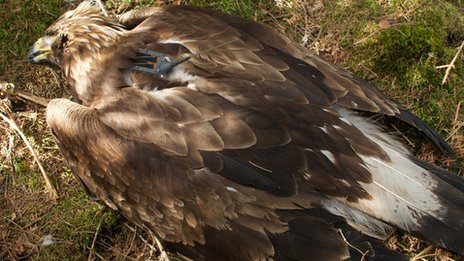
They argue that if they’d had access to the sat tag data, the illegal killing “could have been tackled satisfactorily before now“. How? By telling gamekeepers on the ground which tagged eagles are in the area so don’t shoot those ones? It’s worth remembering how the SGA reacted when they were given access to detailed information about one tagged golden eagle, that was illegally trapped on a grouse moor in the Angus Glens, suffering two broken legs as a consequence (both almost severed, according to the Golden Eagle Sat Tag Review), and then was moved, while still alive, in the middle of the night to be dumped in a lay by on Deeside 15km away and left to suffer an excruciating and miserable death (see here). Did the SGA accept the findings of the independent expert veterinary pathologist and come down like a tonne of bricks on the estate? No, they concocted the most outlandish explanation for what might have happened to that eagle and then slagged off the RSPB for suggesting a crime might have taken place (see here). If that’s the SGA’s idea of ‘tackling the problem satisfactorily’ then it’s no wonder the illegal killing continues.
Photo of the ‘Deeside’ golden eagle (RSPB)
This sat tag review has validated the long-held concerns of conservationists that parts of the grouse shooting industry are out of control, aided and abetted by the blind-eye turning of industry representatives, and this example is just one of many that shows the industry’s inability to self-regulate and why licensing is now very much on the cards.
The SGA’s response to the satellite tag review then comes back to one of their old favourites, wind farms. Not for the first time have wind farms been cited as being a more serious threat to Scottish raptors than illegal persecution (a myth we’ve debunked at least twice, see here and here). In the SGA’s latest statement it says:
“The SGA does not believe the report adequately tackles the threat wind farms pose to raptor species as there is a significant amount of published data from other countries which show a negative correlation between bird survival and turbine strike”.
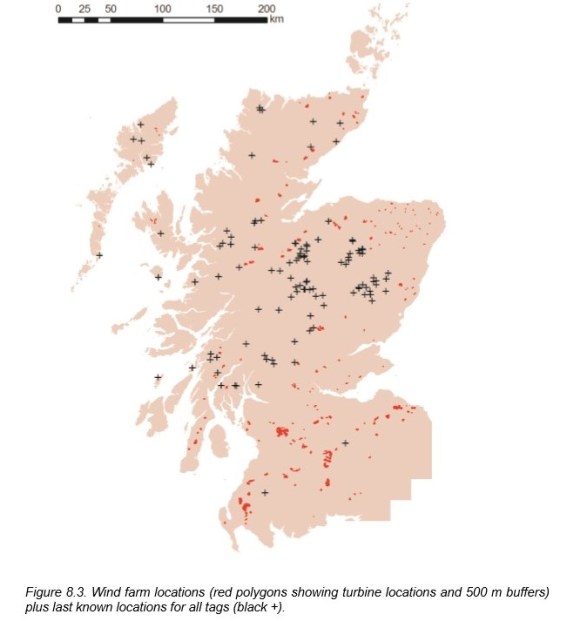
Dear God. Do they not understand that the potential collision risk of a wind farm will be calculated on innumerable variables (e.g. topography, altitude, wind speed, wind farm size, turbine size, species behaviour, etc etc etc) so just because a wind farm in one country has proven disastrous for some raptor species, it doesn’t then mean that all wind farms, wherever they are sited, are going to have the same negative impact. Of course there are issues, and these are well documented, but had the SGA bothered to read the in depth chapter on wind farms in this sat tag review, they’d have realised that wind farms have been ruled out for causing the ‘disappearance’ of so many satellite-tagged golden eagles. And not ruled out on a whim, but ruled out based on almost half a million location ‘fixes’ of 112 tagged eagles.
In fact, the review has more than adequately tackled the threat of wind farms to golden eagles in Scotland, and in addition to the review’s headline that ‘Wind farms were not associated with any recorded golden eagle deaths‘ the report also includes some startling revelations. Here are some direct quotes:
- No ‘stopped no malfunction’ last fixes [i.e. abruptly ‘disappearing’ eagles] were within 1 km of an operational wind farm [see map below]. It is difficult to envisage a situation whereby a trauma sufficient to suddenly destroy a tag would allow a bird to travel afterwards for more than 1 km.
- Moreover, records of tagged eagles close to wind farms were rare with only 0.005% of 360,711 fixes being within 150 m of an operational turbine. This indicated that even the risk of collision with a turbine blade was miniscule. Furthermore, it would add no support to a notion that technicians visiting turbines were discovering and then ‘covering up’ victims of collision, including moving dead birds away from the wind farm before, or then, curtailing the operation of the tag.
- Overall, there was no evidence that wind farms were a direct or indirect agent of anthropogenic influence on the sudden tag failures of many young golden eagles. The reverse was more evidentially likely – that young golden eagles appeared to avoid operational wind farms.
- Addressing the frequently heard accusation that wind farm technicians are removing and thereby ‘covering up’ the deaths of raptors that have been struck by a turbine blade, the report says: In Scotland this possibility seems remote given that: a) on incentive, the continued operation of no wind farm in Scotland is conditional on operational monitoring feedback in planning; b) technicians are not employed directly by the developer and are contracted independently by the turbine manufacturer and according to the projected lifespan of the wind farm; c) independent checks on reporting fatalities can be conducted at several wind farms by other contractors, and at least some developers (P. Robson pers. comm.) further blind-check these in staged exercises due to additional baseline legal requirements on environmental liability reporting; and d) many dead birds of prey (including tagged birds) have been routinely recorded incidentally by technical engineers and reported through several channels (e.g. Sansom et al. 2016, Urquhart & Whitfield 2016). In other words there are several checks and balances in Scotland to circumvent the possibility that carcasses of dead birds of prey would not be reported at wind farms and not disposed of once discovered (and even when relatively few birds will have been tagged). Nevertheless, our analyses were grounded to consider such a possibility; however remote.
- Interestingly, and by contrast, from the many data sources we have received and examined, we are not aware of dead tagged raptors having being reported by managers or employees of game bird shooting estates in Scotland.
So, after trying to muddy the water with commentary about the potential impact of wind farms, even though the review has clearly shown wind farms are not implicated in the ‘disappearance’ of over 40 satellite-tagged golden eagles, the SGA’s official response to the sat tag review concludes with the line:
“However, that is not an attempt in any way to detract from the report’s findings”.
Really? That’s exactly what it looks like to us.
Presumably, then, now the SGA has been made fully aware of where the persecution hotspots are (certain grouse moors in the Angus Glens, Monadhliaths, eastern Cairngorms and north Perthshire), not to mention the other well-known persecution hotspots that didn’t feature in this golden eagle report (e.g. certain grouse moors in the Moorfoots, Lammermuirs and Lowther Hills), we can now expect to see the SGA setting up some ‘targeted solutions’ in these areas? Can’t wait.


 Public prosecutors from Scotland’s Crown Office have dropped yet another case of alleged wildlife crime.

 As a brief interlude from what’s going on in Scotland, we thought we’d turn our attention back to England and the Government’s bonkers Hen Harrier brood meddling scheme….