Good news! Natural England pulls the plug on ‘reintroduction’ of Hen Harriers to southern England

It’s been a long time coming, but today Natural England has announced it is finally pulling the plug on its project to ‘reintroduce’ Hen Harriers to southern England.

It may sound odd that a pro-raptor conservationist sees this as good news, but I have long argued against this project, for a number of reasons, but predominantly because I saw it as an unhelpful distraction to tackling the real issue – that of the illegal killing of Hen Harriers on the grouse moors of northern Britain.

Hen Harrier by Pete Walkden

Natural England has been planning a so-called ‘reintroduction’ of hen harriers to southern England since 2016, as part of DEFRA’s ludicrous Hen Harrier Action Plan.

I think the proposed reintroduction project was initially supported by the pro-grouse shooting lobby because they thought that Hen Harriers could be removed from the northern grouse moors (under the equally ludicrous brood meddling scheme) and released into southern England, thus removing what they saw as a ‘problem species’ to the other end of the country, leaving them to get on with killing Red Grouse for fun (and money) without those pesky Hen Harriers ruining their sport (and profit).

An apt cartoon depicting what many of us saw as the intentions of the stakeholders in Defra’s Hen Harrier Action Plan. Cartoon by Gerard Hobley.

However, that plan was thwarted when it was pointed out that it would be a breach of international legislation to remove Hen Harriers from Special Protection Areas (SPAs) that had been designated specifically for Hen Harriers, and release them elsewhere.

I suspect that the pro-grouse shooting lobby continued to support the proposed ‘reintroduction’ into southern England because they knew that if even a handful of Hen Harriers were successful in the south, it would take the heat / attention off the continued illegal killing in the north.

We saw exactly this, when the brood meddling trial resulted in a few more pairs of Hen Harriers being allowed to breed – the ongoing illegal killing was simply brushed under the carpet by the grouse shooting lobby, and in many cases, outright denied using comically farcical logic (e.g. here) or grotesquely distorted reasoning (e.g. here).

But Hen Harriers don’t need to be ‘reintroduced’ to southern England, or anywhere else in the UK for that matter. They are perfectly capable of breeding in the wild and recolonising their former range, over a relatively short space of time, IF, and only IF, their survival isn’t curtailed by grouse moor gamekeepers shooting, trapping and poisoning them, pulling off their heads and legs, or stamping on their eggs and chicks.

Instead of wasting hundreds of thousands of pounds on this distraction project over many years, those funds could instead have been directed towards a focused enforcement plan to bring those criminals to justice.

For those interested, I’ve written extensively about this project since November 2016 and you can find links to the key blog posts here.

Here is today’s announcement from Natural England about the conclusion of the project:

NATURAL ENGLAND HEN HARRIER PROGRAMME – UPDATE TO SOUTHERN REINTRODUCTION PROJECT

By Sofía Muñoz, Senior Officer, Hen Harrier Southern Reintroduction

Background

The Hen Harrier Southern Reintroduction Project was set up in 2018 with the aim of establishing a wild, farmland-nesting population of hen harriers (Circus cyaneus) in southern England. 

The hen harrier is an iconic species and one of the UK’s rarest and most persecuted birds of prey. The combination of its beauty, charisma and rarity make this a highly cherished and valued bird. Hen harriers were once common across the UK but were driven to extinction across most of the British Isles during the 1800s. More recently, Natural England and many organisations have put great effort into helping them recolonise parts of Scotland and northern England. 

In England, their numbers are now estimated to have risen to 50 territorial pairs recorded in 2023, from four territorial pairs in 2016 – an increase of 1150%. Despite this increase in numbers, hen harriers remain at risk from illegal killing and disturbance, which is where human activities disrupt nesting sites, which can cause parent birds to abandon their nest and lead to failed eggs or chick deaths. 

Increasing hen harrier numbers is a particularly challenging task as they have a strong inclination to return to the same place they have hatched and fledged, meaning they don’t spread areas easily.  

Project timeline

In 2018, the Hen Harrier Southern Reintroduction project was conceived to encourage recolonisation of hen harriers further south in the UK. The project initially sought to translocate young hen harriers from continental Europe for release in the UK. However, collaboration between EU states and new importation rules for animals following the UK’s exit from the EU meant that translocation of young fledging birds became unfeasible due to extensive quarantine periods.   

Instead, a pioneering captive conservation breeding programme was developed which focussed on releasing offspring bred in the UK from adult birds imported from France and Spain. Beginning in late 2022, this ambitious programme hoped to boost the number of hen harriers in the UK with minimal impact on wild populations. The project sought to release a minimum of 100 juvenile hen harriers over a five-year period to ensure the best chances of success. 

In continental Europe, hen harriers nest on farmland which is directly comparable to much of the arable landscape across southern England. As part of the project, release pens were situated among an arable crop and these would be used to introduce chicks to the site from the captive breeding facility several weeks before fledging. It was hoped that this would enable them to familiarise themselves with the habitat and area around the release site, leading to them returning to breed in this same location in subsequent years. 

Latest situation

The third breeding season for the captive birds began in 2025. While the adult birds had not bred successfully in the first two years of the programme, advances in their breeding behaviour over the two years (20232024) had been noted. This meant that the team were optimistic that that things were moving in the right direction to eventually produce chicks for release. However, to the team’s disappointment, the females unfortunately laid infertile eggs in 2025, meaning that no chicks would be released this year.  

Future of the project

The Southern Reintroduction project constitutes one of six components of the Joint action plan for the recovery of the English hen harrier population (2016) being delivered by Natural England, with the support of DEFRA. It has been running in parallel with other activities, such as the long-term monitoring of the species in northern England

Following a thorough review, it has become clear that Natural England is no longer in a position to provide the long-term funding and resource needed to continue delivering the Hen Harrier Southern Reintroduction project, despite the progress to date. The difficult decision has therefore been made to conclude this project.  

The welfare of the hen harriers held in captivity for the conservation breeding programme remains the priority for the project through its closing phase. A number of options exist for the birds, and these will be explored in full. As they are unsuitable for release into the wild, they will be transferred into the care of a suitable host organisation. Organisations will be considered suitable where they are able to ensure the ongoing welfare of the birds for the remainder of their natural lives. In addition, Natural England would not preclude continuation of the conservation breeding programme under the leadership of the chosen organisation if the priority of welfare is maintained.  

Informing future conservation

Knowledge acquired through the delivery of this project can help to inform other conservation projects and expand our understanding of hen harrier biology. We have, for instance, gained a deeper insight into the health, genetics, and migratory patterns of hen harriers. 

We would like to express our gratitude to all our partners, who have contributed their time, expertise, and commitment to this project over the years. 

ENDS

I’ve asked Natural England for a copy of what it calls its “thorough review” of this failed project.

I’ll report if/when Natural England sends it to me.

Don’t hold your breath though, I’m still waiting for NE to send me a copy of its Hen Harrier Brood Meddling Social Science report that I asked for in April 2025 (here).

Oh, and we’re STILL waiting for NE to release this year’s Hen Harrier breeding figures, AND to release the details of at least seven post-mortem reports on dead Hen Harriers, many of them dating back over a year (here). More commentary on that from me to come shortly…

Judge rules RSPB covert video surveillance is admissible evidence in prosecution of gamekeeper Racster Dingwall

BREAKING NEWS….AND IT’S EXCELLENT NEWS!

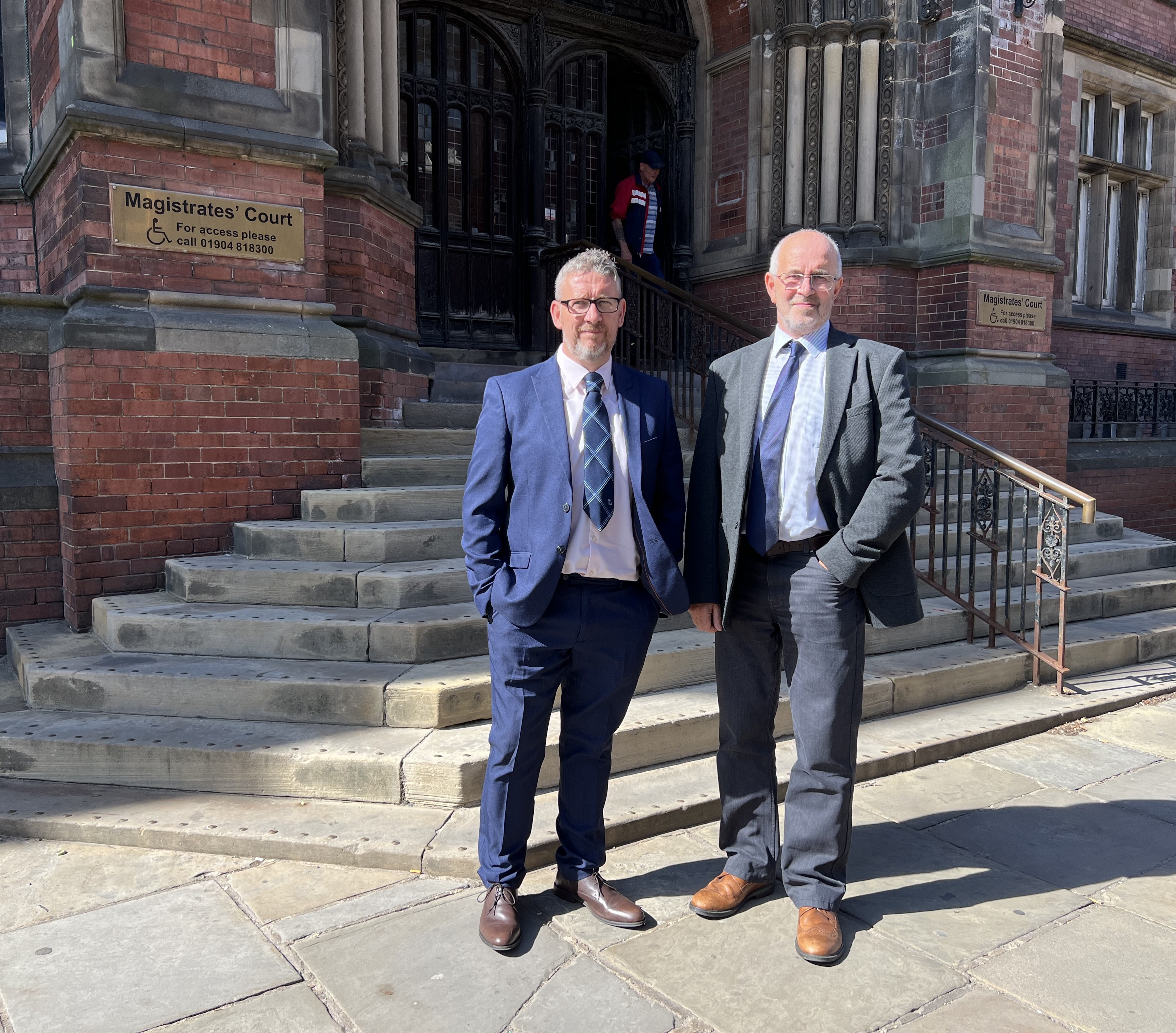
The District Judge presiding at York Magistrates Court has today ruled that the RSPB’s covert video and audio surveillance is to be considered admissible evidence in relation to the prosecution of gamekeeper Racster Dingwall.

He did not accept the defence’s argument that inclusion of the covert surveillance would have an adverse effect on the fairness of proceedings.

Mark Thomas and Ian Thomson from the RSPB’s Investigation Team attended York Magistrates Court today. Photo: Ruth Tingay

The case now moves to trial in January 2026 unless Mr Dingwall changes his not guilty plea in light of today’s ruling.

I’ll write a longer blog in the coming days, setting out the arguments and the Judge’s explanation for his decision.

In haste…

NB: Comments turned off as criminal proceedings are still live.

UPDATE 25 September 2025: More detail on court ruling accepting admissibility of RSPB’s covert surveillance in prosecution of gamekeeper accused of conspiracy to kill a Hen Harrier (here)

Gamekeeper Racster Dingwall back in court today for case relating to Hen Harrier shooting on a grouse moor in Yorkshire Dales National Park

Gamekeeper Racster Dingwall, 34, will appear at York Magistrates Court today for a hearing linked to his alleged involvement with the shooting of a Hen Harrier on a grouse moor (Coniston & Grassington Estate) in the Yorkshire Dales National Park on 2nd October 2024. He has pleaded not guilty.

This prosecution relies on the covert footage filmed by the RSPB’s Investigations team last autumn and later shown on Channel 4 News (here).

York Magistrates Court. Photo by Ruth Tingay

Dingwall faces two charges, according to the court notice:

  1. Possession of an article capable of being used to commit and summary offence under Section 1 to 13 or 15 to 17 of the Wildlife & Countryside Act;
  2. Encourage/assist in the commission of a summary offence believing it will be committed.

Today’s pre-trial hearing is expected to focus on legal arguments about the admissibility of the RSPB’s covert footage.

This was entirely to be expected. The defence team will be doing its best to have the evidence ruled inadmissible because without it, the prosecution will collapse.

We’ve been here many times before in similar cases. The last one I watched where the judge ruled the RSPB’s footage to be inadmissible was back in 2018, in relation to the illegal and brutal killing of two Peregrines on a grouse moor in Bowland. The legal arguments barely got going because the CPS lawyer was monumentally under-prepared, he hadn’t even watched the video footage in question, and was unable to answer the judge’s questions about it. The judge was really left with no other option than to rule the footage inadmissible and the case collapsed as a result (see here for more detailed blogs about that fiasco).

NB: Comments are closed until criminal proceedings have concluded.

Peregrine from Charing Cross Hospital found with shotgun pellet in leg

One of London’s resident breeding Peregrines, Tom, from Charing Cross Hospital in Hammersmith, is receiving veterinary care after an x-ray revealed a shotgun pellet lodged in his leg.

According to reports on social media, Tom was found grounded at the weekend and was taken for assessment at the South Essex Wildlife Hospital. It’s not clear from the information published whether the shotgun pellet was the cause of his grounding or whether it is an old injury that he’d survived.

All photos from South Essex Wildlife Hospital

Hopefully Tom will make a speedy recovery and can be returned to his territory ASAP.

The South Essex Wildlife Hospital has featured a few times on this blog, involved in the treatment and often successful rehabilitation of shot raptors from the south-east. It’s a registered charity – if you’d like to make a donation to support its work, please click here.

Hen Harrier persecution “is very much linked to grouse shooting” – Craig Best, National Trust General Manager, Peak District

Following yesterday’s news of a successful Hen Harrier breeding attempt this year on National Trust-owned moorland in the Peak District National Park (here), Craig Best, the NT’s General Manager in the High Peak, was interviewed on BBC Radio Derby about the significance of the successful nest and the importance of satellite-tagging the young birds (this year’s two Peak District tags have been paid for by the National Trust and the Peak District National Park).

Craig Best, National Trust General Manager, High Peak (photo supplied)

Craig is well known as an experienced, committed and passionate advocate for restoring the uplands and is the driving force behind significant & welcome changes in how the NT’s moorlands are managed in the High Peak (e.g. see here, here, here and here for earlier blogs).

He’s also not someone who pretends that illegal raptor persecution isn’t an ongoing issue and for that alone, he deserves much kudos.

The interview on BBC Radio Derby with host Becky Measures is just four minutes long and appears to be a cut from a wider conversation, but Craig gets his point across about Hen Harrier persecution. It can be heard here and is available on BBC Sounds for a year.

Here’s the transcript:

Craig Best: It’s brilliant that we’re seeing Hen Harriers nest on our land, on National Trust land in the High Peak, so yeah, you’re right, these birds suffer persecution, in fact they’re the most persecuted bird of prey in the UK.

Becky Measures: Why?

Craig Best: Well, all these birds nest on open moorland in really remote places, and what we’re finding is the vast majority of persecution happens on or near to land managed for grouse shooting. Hen Harriers obviously have to eat, so they’ll eat small mammals such as voles and shrews, but they’ll also take chicks of birds, and I’m sure they will take grouse chicks as well, so unfortunately these birds suffer high levels of persecution across the UK and they’re quite often shot.

Becky Measures: So how does tagging, then, protect them?

Craig Best: Yeah, so interestingly, we tag these birds, which is brilliant because it gives us data on where they fly, and some of these birds fly across the UK, we’ve even had some of the Hen Harriers that we’ve tagged in the past fly to places like France, so they cover huge distances, that gives us lots of information, it gives us information where they roost, where they might be feeding, but importantly, these tags are very expensive, they’re about a thousand quid each, but importantly they track the birds and when the bird ‘mysteriously disappears’ we’ve got some idea where that happens.

Beck Measures: Right, ok, so you’re able to kind of keep an eye on them and know what their movements are. It must be difficult to get the tags on them, though?

Craig Best: Yeah, so the tags are, I mean the people who do it are licenced by Natural England and we’re working really closely with our colleagues at the RSPB, but also there’s a volunteer group in the Peak District called the Peak District Raptor Group and all these individuals are experts, and when the birds are young on the nest, not able to fly, we approach them and carefully apply the tag.

But the tag provides much needed protection, so they’re less likely to be shot because if that tag stops working, or we find it, you know we don’t get the tag movements, clearly that could link to a persecution incident. Not always, sometimes these birds, like many other animals do, die naturally, but quite often what we’re finding across the UK and in the Peak District and places like North Yorkshire, these birds are persecuted and are shot in these remote areas and it’s very much linked to grouse shooting.

We invest millions in the upland landscape in the High Peak to restore our peatlands, restore the peat, you know, this landscape is fantastic for our drinking water, a lot of rain falls on our drinking water so whether you live in Sheffield or Manchester, that’s where it comes from, and we restore the landscape by establishing trees, because these places are just fantastic for nature and provide lots of services, such as flood risk reductions for people’s homes and businesses, but of course we invest this money and these pinnacle species such as Hen Harriers should be in much greater numbers. I think there’s something in order of 30-40 breeding pairs across the UK* so they’re really at risk of extinction if this persecution continues, but because we invest so much money, it’d be such a shame to not have these spectacular birds flying around and you know, like you referenced earlier on, your listeners and many people will have watched Springwatch and we saw a pair of Hen Harriers feeding and flying around and they’re just beautiful to look at and of course they have the right to exist like many other animals in the Peak District.

ENDS

*Craig was referring to England, not the UK. In 2024 there was a total of 34 Hen Harrier breeding attempts in England, of which 25 were successful, which is lower than the last two years, according to Natural England.

Chick success after translocated Golden Eagle breeds with one of ‘our’ wild satellite-tagged birds in south Scotland

One of the translocated Golden Eagles in southern Scotland has bred with one of ‘our’ wild satellite-tagged eagles, resulting in the successful fledging of a male eaglet.

This is the first fledging event from a nest of one of the translocated eagles and marks a major milestone for the South Scotland Golden Eagle Project.

The chick has been named ‘Princeling’ by Sir David Attenborough.

Golden Eagle chick ‘Princeling’ having a satellite tag fitted (Photo copyright Ian Georgeson)

The breeding pair got together in 2024 and built up a nest but didn’t breed. That’s not unusual behaviour for young Golden Eagles who can take up to six years to mature, although in areas where there’s little competition for territories (e.g. through depletion of the population by persecution, as in south Scotland), breeding can happen much earlier.

Emma, the female, had been translocated to south Scotland in 2021 and was named by the Scottish Government’s then Biodiversity Minister, Lorna Slater MSP, in memory of the women’s rights and equality advocate, Emma Ritch.

Keith, the male, fledged from a wild nest in Dumfries & Galloway in 2018 and was named Keith after a member of the local Raptor Study Group. He was satellite-tagged as part of a project run by RPUK and Chris Packham in association with experts from the Scottish Raptor Study Group and we’ve been tracking his movements ever since.

Here he is prior to fledging in 2018 (Keith is on the right, one of his parents on the left). This is footage from a nest camera which are routinely installed (under licence) at nest sites to help researchers monitor young eagles after they’ve been fitted with a satellite tag to ensure the tag/harness is not causing any health or welfare issues.

Photo copyright Scottish Raptor Study Group

After dispersing from his natal territory in November 2018, Keith hung around in Dumfries & Galloway for a few months before then suddenly making a beeline for the border and in to England. He stayed in Northumberland for a while (and was joined by at least one other tagged Golden Eagle that had been translocated to south Scotland) before heading back in to Scotland and heading over to his old haunts in SW Scotland before eventually finding his own territory and settling there in October 2023.

After their unsuccessful breeding attempt in spring 2024, Keith and Emma were photographed together in October 2024 on a camera trap at a food platform provided by the South Scotland Golden Eagle Project. They looked to be in excellent condition:

Keith on the right, with the much larger female Emma. Photo copyright South Scotland Golden Eagle Project

The location of their successful breeding attempt this year has had to remain a secret because, as we’ve seen, (here and here) Golden Eagles, along with many other raptor species, still face the threat of illegal persecution in this region and beyond.

The grouse shooting industry’s grotesque distortion of reality laid bare on Rod Liddle’s radio show

Journalist, broadcaster and Sunday Times columnist Rod Liddle hosted a 20 minute segment on the pros and cons of grouse shooting during his Saturday morning show on Times Radio last Saturday (9th August 2025), as pre-advertised in a blog here last week.

You can listen back to the discussion via the Times Radio website (here: starts at 02:04.05) and you can read / download the transcript here:

There were three interviewees – conservationist Dr Mark Avery, who was the instigator of the now 11-year old campaign to ban driven grouse shooting as detailed in his book, The Inglorious 12th: Conflict in the Uplands; Ben Macdonald, founder and director of a rewilding organisation called Restore; and Andrew Gilruth, CEO of The Moorland Association, the lobbying organisation for grouse moor owners in England.

I won’t comment much on Mark’s contribution – his thoughts on driven grouse shooting will be well known to regular readers of this blog and were characteristically robust.

It was the first time I’d heard Ben Macdonald speak on grouse shooting and although I found his opening remarks quite condescending towards those of us in the conservation sector who have spent years calling out the criminal elements of the driven grouse shooting industry and their unsustainable practices (does Ben think we should all have turned a blind eye?), I found his comments on restoring the ‘fundamentally depleted two-dimensional grouse moor landscape’ to be thoughtful and interesting.

The comments I really want to focus on, though, are those of Andrew Gilruth.

I’ve written previously about Andrew’s predisposition for what I’d call grossly misrepresenting scientific opinion when he worked for the Game & Wildlife Conservation Trust (GWCT), by cherry-picking information that helped present a favourable view of driven grouse shooting (e.g. see herehere and especially here). Whether he did this deliberately or whether he’s just incapable of interpretating scientific output is open to question.

This behaviour of spreading misinformation has continued, though, since he joined the Moorland Association in 2023, and last year resulted in his expulsion from the police-led Raptor Persecution Priority Delivery Group (RPPDG – a partnership to tackle the illegal killing of birds of prey in England & Wales).

Andrew’s opening line in his conversation with Rod Liddle didn’t bode well if you were hoping for a straight, undistorted conversation:

“… I also welcome, you know, Ben’s point, that Mark could only highlight what’s wrong …”

We don’t know what Rod Liddle asked Mark at the start of the discussion because it wasn’t included in the recording, but given Mark’s response it’s quite likely that he was asked to outline the problems with driven grouse shooting, to set the scene. We don’t know whether Rod asked Mark to speak about how to resolve those issues, but if he did, it wasn’t included in the programme, so for Andrew to argue that, “Mark could only highlight what’s wrong” was the first misrepresentation of many.

Rod moved the conversation swiftly on to the illegal killing of Hen Harriers on grouse moors and Andrew lost his composure within seconds. The sudden increase in his voice pitch was a dead giveaway.

I’ve written before about how the illegal killing of birds of prey is one of the most difficult issues for the driven grouse shooting to defend – because it’s indefensible. And Andrew couldn’t defend the persecution figures so instead he resorted to accusing the RSPB of publishing “unproven, unverified smears“. The irony wasn’t lost on me.

Those so-called “unproven, unverified smears” (actual crime incidents to you and me) have been accepted by everyone, including the Government, Police, Natural England, peer-reviewed journal editors – everyone except the grouse-shooting industry, some of whose members are the ones carrying out these crimes.

There’s now even a dedicated police-led taskforce that has been set-up to tackle these crimes (the Hen Harrier Taskforce), based on clear-eyed evidence, that is specifically targeting certain grouse moor estates in persecution hotspots, because that’s where the crimes are taking place, repeatedly.

To continue to deny that these crimes happen on many driven grouse moors, and to instead claim that they’ve been fabricated by the RSPB, is just absurd, but very, very telling.

Andrew then tried to use some tightly-selected prosecution data (produced by the RSPB – which, er, he’d just accused of being an unreliable source) to demonstrate that gamekeepers weren’t responsible for killing birds of prey. He chose a single year of data (last year’s) that just happened to not include any prosecutions of gamekeepers, and he used that as his sole evidence base to support his argument.

Had he picked any other year from the last fifteen or so, there’d quite likely be a gamekeeper conviction or two in there. However, selecting just a single year of data is wholly misrepresentative when you’re looking at trends, and a trend is exactly what we’re looking at when discussing which profession is most closely linked with the illegal persecution of birds of prey. To reliably identify a long-term trend you need to look at several years worth of data, and when you do that, here’s what the data tell us – it couldn’t be clearer:

From the RSPB’s most recent Birdcrime Report (2023), published Oct 2024

Andrew’s not averse to using long-term trend data when it suits his argument though – he stated that, “Hen Harriers are now at a 200-year high“. The problem with that argument is that he forgot to mention what the baseline was for that trend – Hen Harriers were virtually extirpated (locally extinct) in England as a breeding species by the late 19th Century, primarily due to persecution, so any increase since then is bound to look impressive!

He also forgot to mention that last year the Hen Harrier breeding population in England was in decline again; this year’s figures have not yet been released but the word on the ground is that the numbers have dropped further, and notably on driven grouse moors. The illegal killing continues – at least 143 Hen Harriers have ‘disappeared’ in suspicious circumstances or have been found illegally killed since 2018, most of them on or close to driven grouse moors, with at least 14 more cases yet to be publicised (see here).

I find it endlessly fascinating that the grouse shooting industry will claim ownership of a (short-lived) increase in the Hen Harrier breeding population on driven grouse moors and yet will absolve itself from any responsibility for the illegal killing of Hen Harriers on, er, driven grouse moors.

Rod moved the discussion on to heather burning and Andrew’s contortions were unceasing. He argued that moorland burning has been happening in the UK for 6,000 years, as though a reference to the slash and burn agriculture of the Neolithic period justifies the continued burning of moorland in the 21st Century.

Society, and science, has moved on, and we now know that the repeated burning of blanket bog is inconsistent with the UK’s international responsibilities to maintain/restore blanket bog to favourable conservation status. We know that only 16.4% of the UK’s SAC blanket peatlands are in good conservation condition, and we also know that burning on deep peat grouse moors continues, despite recent legislation that makes it illegal inside protected areas.

In 2023, two grouse moor owners were convicted for burning on deep peat in protected areas, one in the Peak District (here) and one in Nidderdale; embarrassingly, that estate was owned by a Board member of the Moorland Association (here) and that’s perhaps why Andrew failed to mention it.

All in all, I’m thankful that Rod Liddle hosted this discussion. Not because it moved the conversation on – it didn’t, at all – but because I think it demonstrated that The Moorland Association is still utterly incapable of moving with the times. Its grotesque and snide distortion of reality is laid bare for all to see. Negotiation remains futile against such perverse denial.

The campaign to ban driven grouse shooting will continue. Watch this space.

16 months (& waiting) for NatureScot to make decision on General Licence restriction relating to ‘shooting & killing’ of sleeping Golden Eagle called Merrick

Documents released under a Freedom of Information request show that the Scottish Government’s nature advisory agency, NatureScot, has been procrastinating for 16 months on whether to impose a sanction on an estate in relation to the ‘shooting and killing’ of a sleeping Golden Eagle called Merrick.

Merrick was a young satellite-tagged Golden Eagle, released in south Scotland in 2022 as part of the South Scotland Golden Eagle Project, a lottery-funded conservation initiative which translocated young Golden Eagles from various sites across north Scotland to boost the tiny remnants of the Golden Eagle breeding population in south Scotland that had previously been decimated by illegal persecution and had become isolated by geographic barriers.

Camera trap photo of golden eagle Merrick in 2022, from South Scotland Golden Eagle Project

A year after her release, which had seen her fly around south Scotland and down into northern England and back, on 12 October 2023 Merrick’s satellite tag suddenly and inexplicably stopped transmitting from a roost site in the Moorfoot Hills in the Scottish Borders where she’d been sleeping overnight.

A project officer from the South Scotland Golden Eagle Project went to her last known location where he found Merrick’s feathers and blood directly below her roost tree. Police Scotland later determined from the evidence that she’d been ‘shot and killed’ and that someone had then ‘removed her body and destroyed her satellite tag’ (see here).

Evidence from the crime scene – photo via South Scotland Golden Eagle Project

As with every single other case of satellite-tagged Golden Eagles whose transmitters had suddenly stopped sending data and who seemingly vanished in to thin air (a Scottish Government-commissioned report in 2017 showed that almost one third of 131 satellite-tagged Golden Eagles had disappeared in such circumstances, most of them on or close to driven grouse moors), the person(s) responsible for ‘shooting and killing’ Merrick and then disposing of her body and her satellite tag was not arrested, charged or prosecuted.

It was this lack of enforcement, largely due to the difficulties of identifying the actual individuals responsible and securing sufficient evidence to meet the threshold for a criminal prosecution, that led to the Scottish Parliament voting to pass the Wildlife Management and Muirburn (Scotland) Act 2024, which introduced grouse moor licences that could be withdrawn by NatureScot if gamekeepers and/or estates were found, based on the lower burden of civil proof (the balance of probability), to have been involved in the illegal killing of birds of prey.

Grouse moor licensing hadn’t been introduced at the time Merrick was ‘shot and killed’ and can’t be applied retrospectively so in the absence of a grouse shoot licence withdrawal, and the absence of a prosecution, that leaves a General Licence restriction as the only possible sanction that NatureScot could impose.

Not that I’d describe a GL restriction as an effective sanction, for reasons that have been explored previously on this blog (e.g. here and here). Nevertheless, it’s still something and, given the high-profile of Merrick’s death, you might think that making a decision on whether to impose a GL restriction would be a high priority for NatureScot.

But apparently, it’s not.

In June this year, I submitted an FoI to NatureScot to find out what was happening in relation to this potential GL restriction, as we head towards the two-year anniversary of Merrick’s killing. NatureScot replied in July with this:

‘We have received an information package from Police Scotland to this case, and it is currently under consideration‘ (see here for earlier blog).

I submitted another FoI in July and asked Naturescot:

Please can you advise the date on which NatureScot received the information package from Police Scotland?‘.

NatureScot responded this month, as follows:

We can confirm that we received an initial information package from Police Scotland on 18 April 2024, then additional information on 3 May 2024‘.

April 2024?? That’s 16 months (and counting) that NatureScot has been procrastinating on this. It hardly inspires confidence, does it?

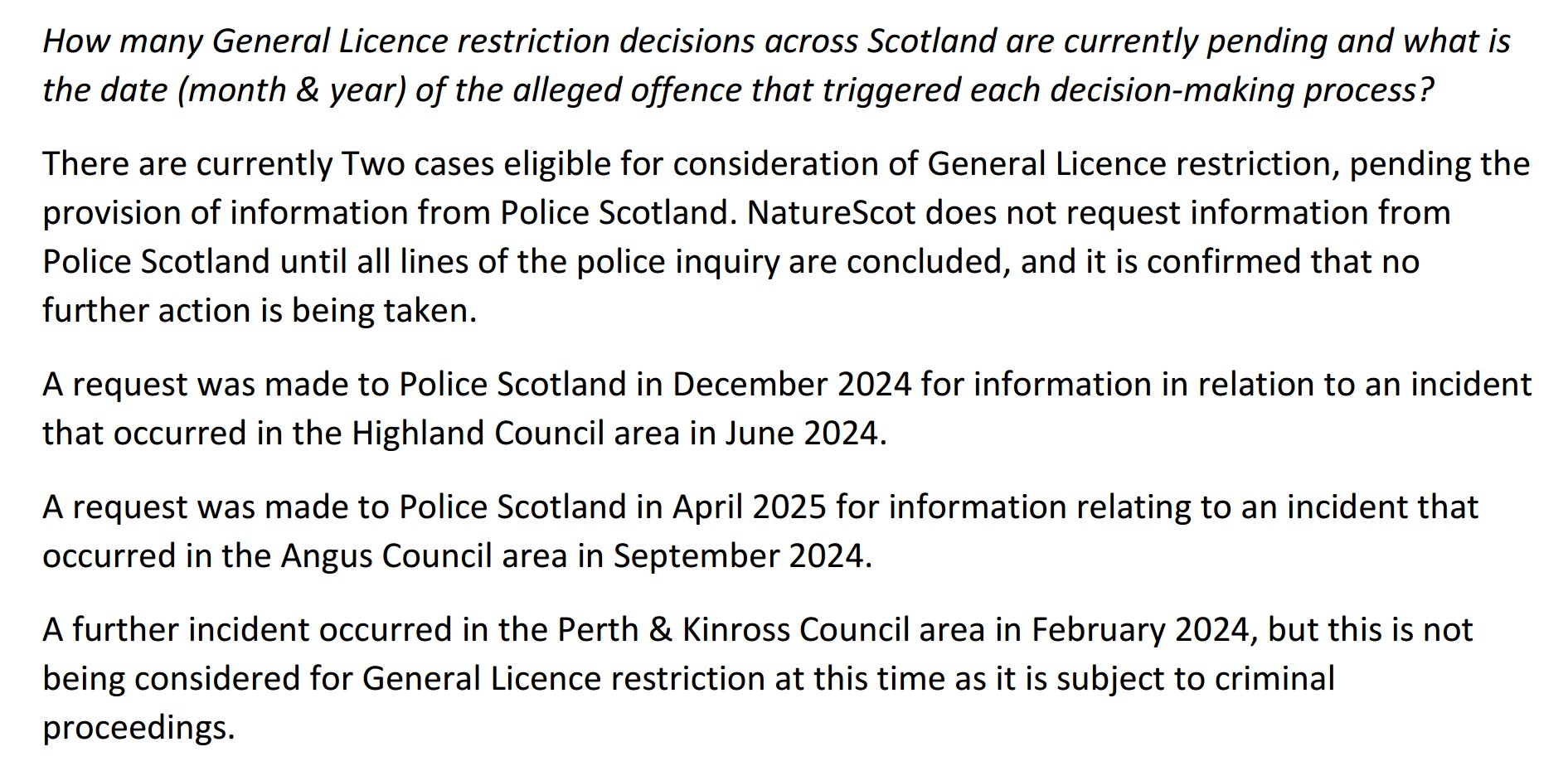
And the shooting and killing of a sleeping Golden Eagle isn’t the only raptor persecution case that’s awaiting a potential GL restriction decision. There are at least two others that I’m aware of – I’ll write about those in a separate blog because the cause of the delays in those two cases appears to lie at the feet of Police Scotland.

UPDATE 30 September 2025: 17 months (&waiting) for NatureScot to make decision on General Licence restriction relating to ‘shooting & killing’ of a sleeping Golden Eagle called Merrick (here)

Illegal persecution of birds of prey is again a major public concern in Yorkshire Dales National Park

Regular readers of this blog will know that the Yorkshire Dales National Park is a raptor persecution hotspot, and has been for many years.

Hen Harriers, in particular, have been prime targets for illegal killing on the grouse moors of the Yorkshire Dales.

Photo by Ruth Tingay

For example, the following quotes are from the RSPB’s recent report, Hen Harriers in the Firing Line:

Swaledale in the Yorkshire Dales National Park is statistically the worst location in England with three Hen Harriers confirmed to have been illegally killed and 14 more satellite-tagged birds suspiciously disappearing between 2016-2023

and

The most significant declines in Hen Harrier breeding in England in 2024 were observed in the North Pennines and the Yorkshire Dales, with decreases of 67% and 73% respectively, compared to 2023. Both regions are intensively managed for grouse shooting and have been linked to several confirmed and suspected Hen Harrier persecution incidents in recent years“.

Indeed, the forthcoming trial of a gamekeeper alleged to have been involved in the conspiracy to shoot and kill an untagged Hen Harrier relates to an incident filmed on a grouse moor in the Yorkshire Dales last October (as featured on Channel 4 News, here).

And yet another satellite-tagged Hen Harrier ‘disappeared’ in suspicious circumstances on a grouse moor in the Yorkshire Dales National Park earlier this year (here).

The Yorkshire Dales National Park was also where satellite-tagged Hen Harrier ‘Free’ was found dead. His post-mortem concluded that his ‘leg had been torn off while he was alive, and that the cause of death was the head being twisted and pulled off while the body was held tightly’ (see here). 

Hen Harrier ‘Free’ during post-mortem examination. Photo via Natural England.

With all this recent history in mind, I’ve been following the progress of the development of the Yorkshire Dales National Park Authority’s latest five-year Management Plan (2025-2030), due to be published shortly.

As part of the Management Plan process, the Management Plan Partnership undertook a six-week public consultation process in January 2024 to find out what issues were important to residents and visitors.

A total of 1,106 responses were received, of which 50% were from people indicating they live and/or work in the National Park; 16% were from younger people (18-34); and 4% were from people identifying as being from non-white ethnic groups.

The online questionnaire identified 18 issues from which people were asked to
rank their top six.

The top two priorities selected by respondents were:

  1. Help nature to recover by creating, restoring and connecting important
    habitats;
  2. Protect rare and threatened species, including ending illegal persecution of
    birds of prey.

That’s quite a significant result! And this isn’t the first time that the public has identified illegal raptor persecution as a major concern in this National Park (see here).

A second Management Plan consultation ran in January 2025 based on 40 proposed draft objectives, which included:

C6.   Support implementation of the national Wildlife Crime Strategy to end the illegal killing and disturbance of birds of prey and other wildlife by 2028.

This proposed draft objective for tackling the illegal killing of birds of prey in the Yorkshire Dales National Park is quite different from the objective listed in the previous Management Plan (2019-2024) which was this:

C5. Work with moorland managers and other key stakeholders to devise and implement a local approach to end illegal persecution of raptors, including independent and scientifically robust monitoring, and co-ordinated hen harrier
nest and winter roost site protection.

The latest draft objective for tackling illegal raptor persecution seems to have shifted significantly, away from the so-called ‘Bird of Prey Partnership’ approach, established in 2020 with representatives from the grouse-shooting industry, the raptor conservation community, RSPB, Natural England, Police, the Yorkshire Dales National Park Authority and the Nidderdale AONB (now renamed Nidderdale National Landscape) Authority.

That ‘partnership’, just like the similar one set up in the Peak District National Park and on which the Yorkshire Dales/Nidderdale Partnership was based, has failed miserably (e.g. see here) and has seen two of the ‘partners’ walk away (RSPB here, Northern England Raptor Forum here), both citing familiar complaints about the behaviour of the grouse moor lobby group, The Moorland Association.

The latest draft objective in the 2025-2030 Management Plan doesn’t mention the ‘partnership’ at all and instead focuses on ‘supporting the implementation of the [Police] National Wildlife Crime Strategy‘, which includes the national wildlife crime priorities of which raptor persecution is a key focus.

Does that mean a formal end to the Yorkshire Dales/Nidderdale Bird of Prey Partnership?

Let’s see.

General Licence restriction ‘under consideration’ in relation to shooting & killing of Golden Eagle ‘Merrick’ in south Scotland

I’m sure many of you remember the young, satellite-tagged Golden Eagle called ‘Merrick’.

She was part of the South Scotland Golden Eagle Project, a lottery-funded conservation initiative which translocated young Golden Eagles from various sites across north Scotland to boost the tiny remnants of the Golden Eagle breeding population in south Scotland that had previously been decimated by illegal persecution and become isolated by geographic barriers.

Camera trap photo of golden eagle Merrick in 2022, from South Scotland Golden Eagle Project

Merrick hit the headlines in autumn 2023 when her satellite tag suddenly and inexplicitly stopped transmitting on 12 October 2023 at a location in the area to the west of Fountainhall, between Heriot and Stow, close to the boundary of the Raeshaw Estate in the Scottish Borders.

Police Scotland issued an appeal for information in November 2023 in which they stated they believed Merrick ‘had come to harm’ but no further details were provided at that time.

We didn’t hear anything more for another six months but then in May 2024 the South Scotland Golden Eagle Project issued a press release that revealed evidence from the crime scene that led Police Scotland to believe that Merrick had been ‘shot and killed’, whilst she was sleeping in a tree, and that someone had then ‘removed her body and destroyed her satellite tag’ (see here).

The criminal who shot Merrick as she slept has not been arrested or charged. It’s the same old story – insufficient evidence to identify an individual and so whoever killed this eagle escapes without consequence, just like every single other eagle-killer in Scotland. Not one of them has ever been convicted.

New legislation was supposed to address this failure with the introduction of the Wildlife Management and Muirburn (Scotland) Act, whereby a grouse-shooting licence could be revoked in circumstances where, on the balance of probability, a crime was considered to have taken place where land was being managed for grouse shooting, but at the time of Merrick’s shooting this legislation wasn’t yet in place and can’t be applied retrospectively.

That just leaves a General Licence restriction as the only potential ‘sanction’ in this case, not that I’d describe a GL restriction as an effective sanction, for reasons that have been explored previously on this blog (e.g. here and here). Nevertheless, it’s still something.

As we head towards the two-year anniversary of Merrick being shot and killed, I wanted to know whether NatureScot had considered a General Licence restriction in this case, either on the land where Merrick was believed to have been shot or on land nearby. It was rumoured that this was under consideration over a year ago in June/July 2024 but I hadn’t seen any restriction notice so in June this year, I submitted an FoI to NatureScot to find out what the status was.

NatureScot replied to me on 21 July 2025 with this:

We have received an information package from Police Scotland to this case, and it is currently under consideration‘.

Tellingly, NatureScot didn’t elaborate on how long this decision had been under consideration so I’ve since submitted a further FoI request to find out on what date NatureScot received the ‘evidence package’ from Police Scotland which would allow NatureScot to begin its deliberations.

I await the response with interest.

UPDATE 11 August 2025: 16 months (& waiting) for NatureScot to make decision on General Licence restriction relating to ‘shooting and killing’ of sleeping Golden Eagle called Merrick (here).