Press release from Police Scotland (1 December 2025):
APPEAL FOR INFORMATION AFTER BIRD OF PREY SHOT IN ABERDEENSHIRE
Officers are appealing for information after a bird of prey was shot in Aberdeenshire.
On Saturday, 8 November, 2025, a member of the public found an injured goshawk in the Whiterashes area.
The bird was recovered with the help of the Wild Arc Wildlife Rescue Centre but died before arriving at a vet.
Following further enquiries, it was established that the bird had been shot.
Goshawk with a crow. Photo by Ronnie Gilbert
Constable Ann Ashman, of the Wildlife Crime Unit, said: “Goshawks are protected under the Wildlife and Countryside Act, and it is illegal to kill any protected species.
“Our enquiries are ongoing and we are working with our partner agencies to establish the full circumstances of this incident.
“I would appeal to anyone with any information that may assist our investigation to contact us. Your information could be vital in establishing what has happened.
“If you were in the Whiterashes area that day and saw anything suspicious – or have any information about shooting activity in the area – please contact us.
“Anyone with information is asked to contact Police Scotland on 101, quoting incident number 1942 of 8 November.”
Press release from Cairngorms National Park Authority (24 November 2025)
PEREGRINE NUMBERS IN DECLINE IN CAIRNGORMS NATIONAL PARK
The last UK-wide survey of peregrines took place in 2014 and covered Scotland as a whole, showing a 9% decline in numbers across the country. The Scottish Raptor Monitoring Scheme also found some evidence of a decline from 2009-18; however, no survey was undertaken to assess peregrine populations specifically within the National Park during that time.
In 2024 the Cairngorms National Park Authority collaborated with three of the regional branches of the Scottish Raptor Study Group: Highland, North East of Scotland and Tayside and Fife, to carry out a survey to establish how many peregrine sites within the National Park were occupied and assess their breeding success.
Raptor Study Groups have records going back to the 1960s of sites where peregrines have bred within the Cairngorms National Park and these were used as the basis for the survey. The study shows that the estimated number of peregrine pairs in the breeding season within the National Park has declined by 56% since 2002, with less than half of territorial pairs successfully fledging young in 2024.
Contributing factors are likely to include upland land management practices, decreased prey availability for peregrines, wildlife crime and, more recently, outbreaks of Avian Flu.
It is a complex picture, and more research is needed to understand the key factors and gain a better understand of upland raptor population dynamics – including interspecific competition (ie competition for resources between individuals of different species) and the influence of prey availability. It will require action from the Park Authority working with a range of partners, including the Raptor Study Groups, NGOs and estates on the ground, as well as NatureScot and other public bodies, to explore what can be done to try and turn the tide for peregrine and all raptors in the National Park.
Dr Sarah Henshall, Head of Conservation at the Cairngorms National Park Authority, said: “This is the first time we have been able to get a clear view of peregrine falcon numbers in the National Park and it paints a bleak picture. We will be working closely with Raptor Study Groups, estates and other experts to explore a range of options such as the installation of nest cameras to help us understand bird behaviour, DNA work to support wildlife crime prevention initiatives and GPS tagging to get information on bird movements and survival.
“Our ongoing conservation work, from ecological restoration to increasing the sustainability of moorland management, aims to benefit habitats for peregrine and other key upland species. This survey further highlights the importance of this work and strengthens our resolve to help this iconic bird thrive.”
The continued decline of Peregrines in the Cairngorms National Park comes as no surprise whatsoever, and its link to intensively-managed driven grouse moors even less so.
The illegal persecution of Peregrines on driven grouse moors is an issue that has been documented repeatedly in scientific papers since the early 1990s, nationally (e.g. see here) and regionally (e.g. see here for research from northern England). A particularly illuminating paper published in 2015 reported specifically on the decline of breeding Peregrines on grouse moors in North-East Scotland, including those on the eastern side of the Cairngorms National Park (here).
This latest report from the Cairngorms National Park Authority, based on fieldwork undertaken by the Scottish Raptor Study Group, is a welcome addition to the literature and will help inform the new requirement (under the Wildlife Management & Muirburn Act 2024) to monitor and report every five years on the status of a number of raptor species (Peregrine, Golden Eagle, Hen Harrier & Merlin) on grouse moors in Scotland as a measure of how well / badly the legislation is working.
The report’s findings are cautious, citing a number of factors that could be potential drivers influencing the recent decline (e.g. Bird Flu, interspecific competition etc) but these cannot, and do not, account for the long-term decline of Peregrines in the uplands, either within the Cairngorms National Park or in other upland areas. I’m pleased to see the report acknowledge this.
Let’s not kid ourselves. The Cairngorms National Park Authority has known for some time that illegal raptor persecution is a huge issue within the Park boundary – check out what the CNPA was proposing in 2013 to tackle the problem (see here) – unsurprisingly, it didn’t work.
The latest report includes an analysis of the relationship between Peregrine breeding site occupancy and the intensity of grouse moor management (ranging from ‘low’ to ‘high’ management intensity and everything in between).
The young Hen Harrier in question (Tag ID: 254843) was fitted with a satellite tag when she was a nestling in Northumberland on 5 July 2024.
In Natural England’s HH spreadsheet that was updated in August 2024, her status was given as follows:
Date of last contact:29 July 2024
Location of last contact:Northumberland
OS reference: Recovered awaiting PM
Status:Dead
There were no further details provided until 14 months later, when Natural England quietly updated its spreadsheet in October 2025. This bird’s status was now given as follows:
Date of last contact:29 July 2024
Location of last contact:Northumberland
OS reference:NY824937
Status:Dead
Notes on Loss:The recovered carcass was not suitable for any PM owing to level of decomposition
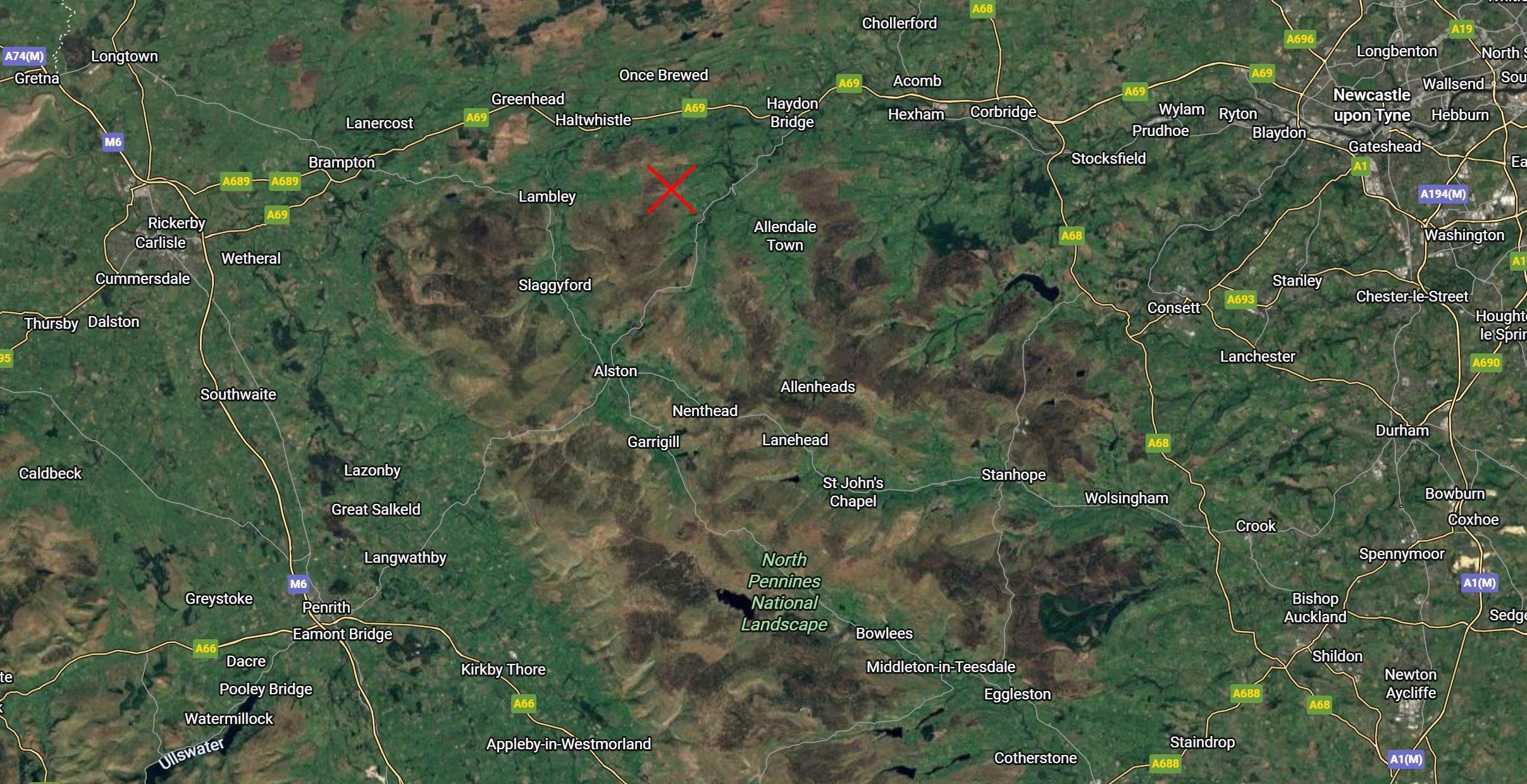
The grid reference places the last location in an upland area of Northumberland National Park, to the north east of Kielder Water. This area of moorland is not known to be a raptor persecution hotspot – indeed it’s one of the few strongholds for Hen Harrier breeding attempts in England – and there was nothing in Natural England’s spreadsheet notes to suggest she had been killed illegally. So we’re led to conclude it was a probable natural death.
Last known location of Hen Harrier 254843 according to Natural England info
But hang on a minute.
I’ve recently found a fascinating blog posted within the depths of the National Wildlife Crime Unit’s (NWCU) website that tells a very different story. It was published on 10 October 2025 and is entitled, ‘Cracking the Case: How Experts Uncovered the Truth Behind a Hen Harrier’s Mysterious Death‘.
The original blog can be read here, and I’ve copied it here incase the link is broken in the future:
When a young female hen harrier known as 254843 took her first flights over the moorlands of Otterburn, Northumbria, in July 2024, she became part of a vital conservation effort. Fitted with a satellite tag by Natural England (NE), this small device would help scientists track her journey, monitor her wellbeing, and contribute to the protection of one of the UK’s most threatened birds of prey.
But just weeks later, her signal stopped. What initially appeared to be a tragic but natural loss of a young bird soon revealed something far more sinister and set in motion a remarkable multi-agency investigation into suspected wildlife crime.
When NE staff noticed that 254843’s satellite tag had stopped transmitting, they followed established procedures to locate her. The bird’s remains were found roughly 1.2 kilometres from her nest close to where she had been learning to hunt under her parents’ watchful eyes. At first, the team suspected natural predation.
The remains of HH 254843 (photo Natural England)
HH 254843 with damaged tag (photo Natural England)
However, during recovery, one small detail caught their attention — a small, round dent and hole in the satellite tag. It was an anomaly that couldn’t be ignored.
This discovery triggered the involvement of the UK National Wildlife Crime Unit (NWCU) and the Harrier Task Force (HTF). Working closely with Natural England, the Northumbria Police Rural Crime Team, and scientific experts, they began piecing together what had really happened.
The first step was to send the remains and the tag to the Zoological Society of London (ZSL) for a detailed postmortem. Due to the bird’s advanced decomposition, the pathologists couldn’t confirm a cause of death, but their findings were enough to justify further forensic testing.
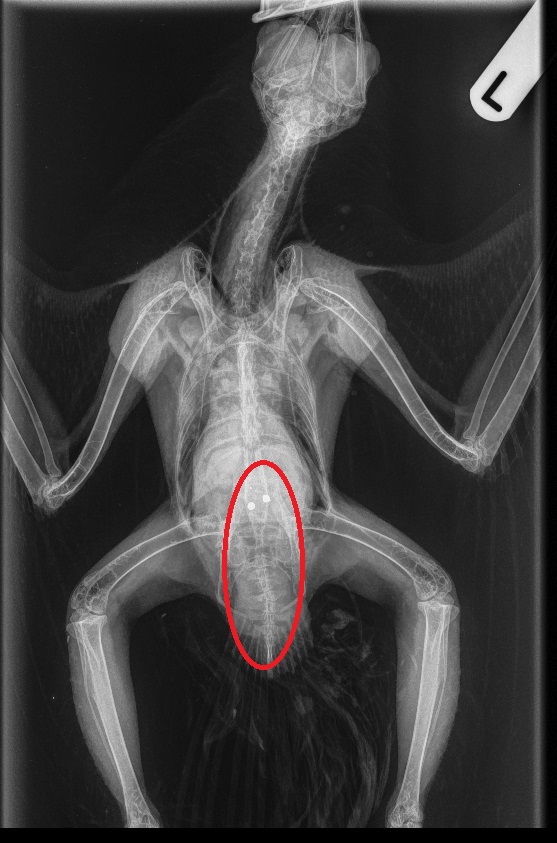
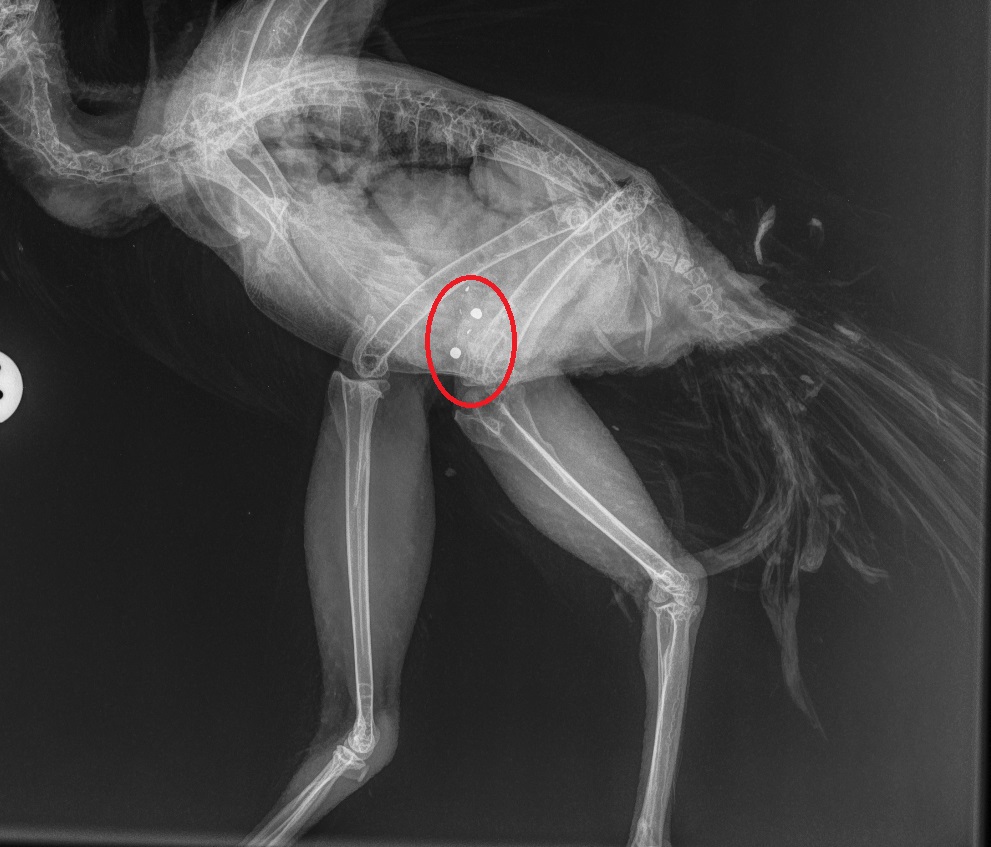
Radiograph of the carcass of HH 254843 and her satellite tag (photo by ZSL)
From there, the investigation moved to Nottingham Trent University (NTU), where specialists used CT scanning and chemical analysis to examine the damaged tag. Their results revealed elevated levels of lead around the hole a crucial clue pointing toward a lead-based projectile.
Finally, the tag was analysed by a ballistics expert from the Scottish Police Authority (SPA). The verdict: the damage was consistent with being struck by a shotgun pellet, likely from a birdshot cartridge fired from below the flying bird. Tests confirmed traces of lead, and the impact trajectory supported the theory of a shotgun discharge at an estimated distance of up to 30 metres.
The conclusion was clear. This was no accident of nature. It was a deliberate act of wildlife crime.
Shotgun damage to HH 254843’s satellite tag (photo by Scottish Police Authority)
Thanks to the combined expertise of scientists, conservationists, and law enforcement, the incident has been officially recorded as criminal damage. Each satellite tag costs around £2,800, not including the significant resources dedicated to fitting and monitoring them but the real loss is far greater, representing another blow to hen harrier conservation efforts.
The investigation also led to important lessons for future responses. New procedures now ensure that if anything suspicious is discovered during a bird recovery — no matter how small — the process halts immediately, and police take over to conduct a forensic recovery. This prevents potential evidence from being lost and strengthens the chance of bringing perpetrators to justice.
This case demonstrates the high level of skill, coordination, and dedication required to detect and investigate wildlife crime. From the precision of CT imaging and chemical testing to the meticulous work of forensic ballistics experts and the vigilance of conservation field teams every partner plays a crucial role.
It also serves as a reminder that wildlife crime is not victimless. Each illegal act damages not only individual animals but also the broader ecosystem and the tireless efforts of those working to protect it.
The public can play their part too. If you have any information about this incident or any suspected wildlife crime please report it.
Every report helps protect the wild places and species that make our countryside unique and ensures that those who threaten them are held accountable.
ENDS
It’s clear from the NWCU blog the extent of the effort, by multiple partners, to determine what happened here, and I applaud them for it.
I’m less impressed that this information hasn’t been given the media attention it deserves, nor that a link to the NWCU blog hasn’t been added to Natural England’s spreadsheet entry about the circumstances surrounding this Hen Harrier’s death. It really isn’t difficult.
I’m also interested that the NWCU blog states, “…the incident has been officially recorded as criminal damage“. This is presumably in reference to the shotgun damage caused to the satellite tag.
I wonder, though, how the death of Hen Harrier 254843 has been officially recorded…’Unknown’? ‘Suspicious’? ‘Illegally killed’?
The blog says, “The conclusion was clear. This was no accident of nature. It was a deliberate act of wildlife crime”. So why doesn’t Natural England’s spreadsheet reflect this?
HEN HARRIER ACTION APPEALS FOR INFORMATION AS ANOTHER RARE HEN HARRIER SUSPECTED TO HAVE BEEN ILLEGALLY KILLED IN SCOTLAND
A satellite tagged Hen Harrier, ‘Circe’, suddenly disappeared in the Moorfoot Hills, south of Edinburgh
As numerous recent incidents have shown, satellite tagged Hen Harriers that disappear in suspicious circumstances are highly likely to have been illegally killed
Hen Harrier Action are appealing for information which could help with the investigation
Thanks to donations from supporters in 2025, Hen Harrier Action funded the purchase of four satellite tags to monitor the movements of Hen Harriers in the UK.
One of the tags was fitted by RSPB staff to a juvenile female Hen Harrier named Circe before she fledged from her nest on Tarras Valley NatureReserve – a community-led rewilding project in Langholm, Dumfries and Galloway.
Hen Harrier ‘Circe’ being fitted with a satellite tag in 2025
In the days leading up to her disappearance Circe ranged across the Moorfoot Hills, south of Edinburgh. Her tag data shows that the tag was regularly transmitting but then sudden stopped with no sign of tag malfunction. The disappearance was reported to the National Wildlife Crime Unit and the area was searched but no body or tag has been found. Sudden stops without the tag being found are a huge concern, often indicating that the bird has been illegally killed.
Circe’s last transmission was on Tuesday 14th October at 2.07pm, not far from the well-known standing stones at Greenfieldknowe and the hiking trails around Whiteside Edge and Loncote Hill. She was less than four months old.
Though a legally protected species, Hen Harriers are one of the UK’s scarcest and most persecuted birds of prey in the UK. Dozens are satellite tagged each year to monitor their movements and wellbeing with the support of charities like the RSPB and local raptor groups. But despite being heavily protected in law for decades, many go missing each year due to suspected and confirmed illegal killing. In an effort to locate the body of Circe the charity has issued an appeal for information.
Hen Harrier Actiontrustee Adrian Rowe said “We are devastated by the loss. Circe was a healthy, thriving Hen Harrier and we had high hopes that she would go on to find a mate and raise a family. We know that the area is a popular walking route, and we are appealing for anyone who might have seen anything suspicious that Tuesday afternoon, or come across a dead bird of prey in the area, to get in touch.”
If you have information that could help, please call the RSPB’s Raptor Crime Hotline on 0300 999 0101, or the Wildlife Crime team at Police Scotland on 101.
ENDS
Well done to Hen Harrier Action for issuing a press release.
Hen Harrier Action has published the coordinates of Circe’s tag’s last known transmission, which according to Andy Wightman’s excellent website, Who Owns Scotland, appears to have come from the Portmore Estate, although no detail is provided about the tag’s transmission cycle or the accuracy of the final fix.
Red line = boundary of Portmore Estate. Orange X indicates last known transmission from Circe’s satellite tag.
There is no suggestion that Circe was killed on the Portmore Estate. I’m not aware of any previously reported illegal persecution incidents on this estate.
However, the wider Moorfoot Hills area is well-known as a hotbed of illegal raptor persecution, with many confirmed incidents of poisoning, shooting, illegal traps and ‘disappearing’ satellite-tagged raptors over the last 20 years.
Indeed, the Moorfoot Hills is where Golden Eagle ‘Merrick‘ was killed over two years ago, whilst she was asleep in a tree. Police Scotland believe she was shot and then her corpse was removed and her satellite tag destroyed in an attempt to hide the evidence.
A long-overdue decision is expected from NatureScot about whether a General Licence restriction will be imposed in relation to that appalling crime.
Other ‘missing’ satellite-tagged raptors in south Scotland at the moment include two Golden Eagles that vanished at the end of August (see here).
Press release from Northants Police (14 November 2025)
BIRD OF PREY KILLED IN TOWCESTER
Police officers from the Rural Crime Team are appealing for witnesses after a bird of prey was found dead in Towcester.
The Force were contacted by the RSPB following a report from a member of the public that a Sparrowhawk had been found dead in Redcar Road.
Following enquiries, it is believed the protected bird had been shot by a type of rifle sometime between 8am on Thursday, November 6 and 11.30am on Friday, November 7.
Sparrowhawk (photo by Ronnie Gilbert)
PC Emerson Knights of the Rural Crime Team said: “Sparrowhawks are protected under the Wildlife and Countryside Act 1981, and it is an offence to intentionally or recklessly kill or injure them.
“We believe this Sparrowhawk was fatally injured after being shot with either a high-powered air rifle or small calibre rifle and would like to hear from anyone who may be able to identify the person responsible for the bird’s death.”
Witnesses or anyone with information are asked to call Northamptonshire Police on 101 or alternatively contact Crimestoppers on 0800 555 111.
If ever there was an example demonstrating the high level of persecution faced by Hen Harriers on UK grouse moors, the lack of consequences for the offenders, and the lack of justice for the victims, the short life of a Hen Harrier called ‘Susie’ illustrates it all.
Susie hatched in Cumbria in 2020 and was satellite-tagged by Natural England on 21 July 2020. She first bred in Bowland in 2021, and the following year she moved up to a grouse moor near Whernside in the Yorkshire Dales National Park where she produced four chicks.
The Whernside nest was being monitored (nest camera) by Natural England as part of the ludicrous Hen Harrier Brood Meddling Trial. On 20 June 2022, NE researchers noticed that Susie’s satellite tag was unexpectedly and abruptly shown tracking approximately 35km away from her nest. An adult female should be attentive and close to her nest during this period. Her sudden exit from the nest area was worrying.
The following day, Natural England field staff visited the nest and made the grim discovery of three dead Hen Harrier chicks.
Reviewing the nest camera footage, they saw that after dark, at 9.54pm on 15 June 2022, the camera showed the nest site appeared normal with Susie settled in the nest with her chicks. However, at 9.59pm a sudden irregular ‘whiteout’ of the camera occurred, blinding the camera.
The camera used was movement-activated, and it was not triggered again until the following morning when footage captured apparently dead chicks in the nest and Susie attempting to feed them.
She could be seen removing her dead chicks from the nest. Three of these were found just outside the nest, and it is not known where she deposited the fourth.
Post-mortem examinations of the three chicks were subsequently conducted and showed that each suffered with multiple fractured bones including the humerus in one chick, both femurs in the second chick, and in the third chick, the humerus and a crushed skull. The fractures were complete and showed a considerable trauma had taken place for each chick.
It’s quite clear that ‘someone’ had visited the nest, disabled the camera, and stamped the chicks to death.
Six months later (!), in December 2022, North Yorkshire Police laid out the evidence and issued an appeal for information (see here).
Representatives from the grouse shooting industry responded by trying to manipulate the narrative of this brutal and sadistic crime (see here) and of course, nobody came forward with any information that could identify the person / people responsible.
The following year, in 2023, the story featured in a three-episode podcast by TheGuardian, called ‘Killing the Skydancer’ (here, here and here). Meanwhile, Susie bred successfully (unknown location) and fledged five chicks. It was to be her last breeding season.
In April 2024, Natural England published its latest update on the fate of its satellite-tagged Hen Harriers. It did so quietly, without any publicity whatsoever. Susie’s entry on that spreadsheet read,
‘Last known transmission 12 February 2024, Northumberland. Found dead. Site confidential. Recovered, awaiting post mortem’.
Nothing more was heard about Susie’s fate until a year later, in another spreadsheet update in April 2025. Susie’s entry now read:
‘Ongoing police investigation, final transmission location temporarily withheld at police request‘.
Again, there was no publicity about Susie, or about any of the other Natural England-tagged Hen Harriers that had either ‘vanished’ or had been found dead in suspicious circumstances.
Over one and a half year’s after Susie was found dead, the details have finally emerged, and once again Natural England has slipped them out quietly, without fanfare or commentary, in its October 2025 spreadsheet update. Susie’s entry now reads:
‘Found dead 12 February 2024, Northumberland, Grid reference NY759585. Confirmed dead, had been victim of shooting. When found dead remains would not allow determination of whether the bird died as a result of being shot. Bird died between 25 November 2023 and 12 February 2024‘.
Susie’s corpse was found on a grouse moor in the North Pennines National Landscape (a so-called protected landscape, formerly known as the North Pennines Area of Outstanding Natural Beauty, AONB), and the grid reference places her on what I believe to be the Whitfield Estate:
Susie had been shot at some point, but where, and when, is not known.
There is no suggestion that she was shot and killed on the Whitfield Estate – she could have been shot many months earlier and survived for a while before succumbing to her injuries. Without seeing the post mortem and x-ray results (which have not been published), it’s impossible to know whether her gunshot injuries caused any broken bones that could have impeded her ability to fly any distance.
That Susie was the victim of at least two separate persecution incidents (that we know about) during her three-and-a-half-year life, illustrates the severity of threat this species still faces in the UK. This should come as no surprise to anybody who has been following this blog for any length of time, nor to those who may have read the RSPB’s damning 2025 report, Hen Harriers in the Firing Line.
These appalling crimes continue because hardly anyone is ever brought to justice. There is rarely any consequence for the offenders, which gives them the green light to carry on.
There has been a change in tactics by the raptor killers in recent years, as we saw in the RSPB’s covert footage in Oct 2024 where three individuals were caught plotting, and then apparently shooting, a Hen Harrier on a grouse moor in Grassington in the Yorkshire Dales National Park. They specifically targeted the Hen Harrier that was not carrying a ‘box’ (a satellite tag) because they thought that by doing so their crime would be undetected. A gamekeeper is standing trial in January 2026 for his alleged involvement – he denies it – it will be up to the court to decide whether he was involved or not.
That case is a very uncommon prosecution, reliant on evidence provided by the RSPB’s excellent Investigations Team.
There won’t be a prosecution for the shooting of Hen Harrier Susie because there’s no evidence (that I’m aware of) that links an identified individual to that crime. Just as there was no prosecution of the person(s) responsible for stamping her chicks to death in their nest in 2022.
We all get it – finding sufficient evidence to prosecute those responsible for committing crimes in remote landscapes is incredibly difficult, but the investigating authorities could, and should, be doing much more to publicise these offences to raise awareness and help the general public spot suspicious activity.
The police’s appeal for information about the chick-stamping crime in the Yorkshire Dales National Park came six months after the event – that’s pathetic.
I haven’t seen ANY police appeal or press release about the shooting of Susie or the discovery of her corpse in Northumberland in February 2024. Not a single word.
Where is the publicity from the National Wildlife Crime Unit-led Hen Harrier Taskforce? The specialist group set up explicitly to tackle the ongoing illegal killing of Hen Harriers. Not a single word.
Where is the publicity from the police-led Raptor Persecution Priority Delivery Group (RPPDG), one of whose functions is apparently ‘awareness raising‘ and ‘raising the profile [of illegal raptor persecution] via media exposure‘? Not a single word.
Natural England has remained tight-lipped, as it always does, claiming that it requires the go-ahead from the police to issue any media. Why? Sure, in the early stages of a police investigation keeping quiet is often necessary to avoid alerting the perpetrator who may take the opportunity to remove/hide evidence before the police turn up. But 18+ months of silence, about a crime that relates to a publicly-funded project, and then to quietly slip out the information buried deep inside a spreadsheet?
An x-ray of a grounded Buzzard has revealed two embedded shotgun pellets and a broken tail, according to Brinsley Animal Rescue in Nottinghamshire.
A statement published by the charity yesterday reads as follows:
‘Last Sunday we admitted a buzzard that had been found grounded, the caller had been struggling to find a rescue who were able to help and had them for several days before we took the call, thankfully they had been feeding the buzzard and keeping them safe.
On examination it was clear there they weren’t the best of condition not least the tail position, which was to the side and the bird wasn’t able to move it. X-rays have confirmed that not only was the tail broken, but there are several shot gun pellets lodged in the bird. It is probable that they have been shot and the broken tail is a result of the bird crash landing.
We have successfully treated and released birds with broken tails, but not a bird of prey, whilst the bones will eventually fuse, its vital that they have full mobility before they can be released and only time will tell if this ends well‘.
The Scottish Government’s nature advisory agency, NatureScot, has been now been procrastinating for over 18 months on whether to impose a sanction on an estate in relation to the ‘shooting and killing’ of a sleeping Golden Eagle called Merrick. But apparently a decision is now expected “in the next few weeks”.
Merrick was a young satellite-tagged Golden Eagle, released in south Scotland in 2022 as part of the South Scotland Golden Eagle Project, a lottery-funded conservation initiative which translocated young Golden Eagles from various sites across north Scotland to boost the tiny remnants of the Golden Eagle breeding population in south Scotland that had previously been decimated by illegal persecution and had become isolated by geographic barriers.
Camera trap photo of golden eagle Merrick in 2022, from South Scotland Golden Eagle Project
A year after her release, which had seen her fly around south Scotland and down into northern England and back, on 12 October 2023 Merrick’s satellite tag suddenly and inexplicably stopped transmitting from a roost site in the Moorfoot Hills in the Scottish Borders where she’d been sleeping overnight.
A project officer from the South Scotland Golden Eagle Project went to her last known location where he found Merrick’s feathers and blood directly below her roost tree. Police Scotland later determined from the evidence that she’d been ‘shot and killed’ and that someone had then ‘removed her body and destroyed her satellite tag’ (see here).
There was limited scope for anyone to be charged and prosecuted for killing this eagle unless someone in the know came forward with sufficient evidence to identify the individual(s) responsible. In addition, the prospect of an estate having its grouse-shooting licence withdrawn as a consequence of this crime was zero, given that this offence took place prior to the enactment of the Wildlife & Muirburn (Scotland) Act 2024, the legislation that introduced grouse moor licensing.
That just left a General Licence restriction as a possible sanction. Not that I’d describe a GL restriction as an effective sanction, for reasons that have been explored previously on this blog (e.g. here and here). Nevertheless, it’s still something and, given the high-profile of Merrick’s death, you might think that making a decision on whether to impose a GL restriction would be a high priority for NatureScot.
Not so.
I wrote about NatureScot’s procrastination on this case in August (see here), after receiving a response to a Freedom of Information request I’d lodged in June 2025. That response confirmed that NatureScot had received an information package from Police Scotland, on which it would base its General Licence restriction decision, in April 2024.
I blogged again in September, highlighting that NatureScot had now procrastinated for 17 months. Unbeknownst to me at the time, that blog prompted two blog readers to write to NatureScot, and one of them lodged a formal complaint against the agency.
Blog reader Stuart Wilson has kindly given permission for me to share the response he received recently from NatureScot in relation to his complaint, which is almost identical to the response blog reader SusanH shared on this blog a few days ago on an unrelated post.
A young Buzzard was found in a field in Leominster, Herefordshire last week, unable to fly.
An x-ray revealed at least two shotgun pellets lodged in its body. It’s not known when the bird was shot, or where.
Photo by Sasha Norris
Photo via Sasha Norris
The Buzzard is currently receiving expert veterinary care from Dr Sasha Norris of Hereford Wildlife Rescue with assistance from Holmer Veterinary Surgery in Hereford and Battle Flatts Veterinary Clinic in Yorkshire.
Sasha reports that the Buzzard was ‘alert, bright and eating well’ this morning.
The absurd claim that White-tailed Eagles had ‘snatched’ five Shetland pony foals on South Uist hit the headlines at the end of August.
A crofter / farmer named Donald Cameron said that five of his Shetland pony foals had disappeared between May and July when they were a few weeks old, and that he could see ‘no other explanation’ other than they’d been taken by White-tailed Eagles.
The average healthy weight for a Shetland pony at birth would be around 20-27kg, with rapid daily weight gain up to around 36-45kg at a month old. White-tailed Eagles in the Western Palearctic weigh between 3.5-5kg (males) and 4.5-7kg (females).
The premise that an eagle could ‘snatch’ and then carry away something that is three times heavier than itself is plainly nonsensical.
On hearing Donald Cameron’s claims about the loss of his five Shetland ponies, NatureScot organised for expert eagle biologists to examine the prey remains in two White-tailed Eagle nests closest to Cameron’s croft. There was no trace of any Shetland pony body parts (and even if there had been, it still wouldn’t mean that the eagles had killed the ponies; it’s far more plausible that they could have scavenged a carcass). The only mammalian prey found were rabbits and Brown Rat, with most of the remains being seabirds, ducks and geese.
This fits with the findings of a recent and extraordinarily robust recent scientific paper, examining the diet of breeding White-tailed Eagles across Scotland over a 20-year study (1998-2017), where seabirds and wetland birds featured prominently in the diets of eagles on the Uists:
The same paper demonstrated that the number of lamb remains found in eagle nests has declined over the last 20 years:
On the rare occasion where eagles may still take the odd live lamb, there’s a Sea Eagle Management Scheme, run by NatureScot, where support is available for those who experience sea eagle predation impacts.
But Donald Cameron is not satisfied. He claims that the examination of the two closest White-tailed Eagle nests was ‘inconclusive’ and also claims that the eagles are “decimating everything we have”.
In the most recent sensationalist scaremongering article from The Telegraph on this subject (6th October 2025 – they’re really dragging out this story), it says that Mr Cameron believes the White-tailed Eagles are responsible for the so-called ‘eerie silence’ on Loch Druidibeag.
The article begins with this:
‘Visiting Loch Druidibeag 20 years ago, you might have spotted swans perched on the water, geese on the banks and curlews surveying the sheep grazing the slopes that rise dramatically from the water’s edge.
‘But today, the waters have fallen silent. Eerily so. Now, the only thing that moves in the loch, on the island of South Uist in the Outer Hebrides, is a battered rowing boat bobbing beside a jetty as waves lap against the shore.
‘Donald John Cameron’s family have farmed this land for generations. But he believes an ancient foe is responsible for the eerie silence – and that it has also snatched away some of his most cherished animals‘.
I put this claim to an ecologist who has lived and worked in the Outer Hebrides for many years:
“All bollocks! No change to the bird life in the Druidibeag area as far as I can see. It’s a great place for wildlife. Several hundred Mute Swans on Loch Bi just to the north“.
Funnily enough, a few years ago a journalist was sniffing around on a story about Loch Bi. A local farmer / crofter had told him that he’d seen White-tailed Eagles feeding on the carcasses of dead Mute Swans on Loch Bi, and he reckoned the eagles had killed them all. The story never appeared in the media after NatureScot informed the journalist that Bird Flu had killed the swans, and the eagles were doing what they do best – scavenging the remains.
Back to the latest article..
It continues: ‘… there are thought to be 150 pairs of the bird [WTE] now living on the island. In fact, the eagles are now an all too familiar sight for farmers.
‘Lambs have allegedly been abducted in the dead of night, dogs have been attacked and Mr Cameron claims his Shetland pony foals were snatched by the eagles.
‘Although conservationists have insisted there is no evidence eagles took the foals, it is easy to understand Mr Cameron’s concern. The White-tailed eagle’s wingspan can go to eight feet and it’s sharp talons mean it’s thought to be capable of snatching animals weighing up to 12kg‘.
FFS. There aren’t 150 pairs of WTEs on South Uist! Back to my ecologist friend:
“There are seven known territories on South Uist, with one or two other locations where pairs may be establishing so 7-10 pairs would be the best estimate. In the areas where the ponies are there are two territorial pairs“.
And since when have ‘sharp talons’ had any bearing on the weight that an eagle can carry?! The main physiological features that determine how much a raptor can lift/carry are primarily related to muscle strength, wing surface area and body weight. It’s utter nonsense to argue about the sharpness of its talons in this context.
It’s farcical to be writing about these things, and talking about lambs being ‘abducted in the dead of night’, but it all plays into the demonisation of raptors in general, but particularly of White-tailed Eagles.
It’s just the latest in a long history of baseless accusations made about this species, although this is the first time that the eagles have been accused of taking Shetland ponies – usually they’re accused of being a threat to babies and toddlers (e.g. see here and here), which of course feeds into sensationalist headlines that editors know will sell copy.
Mr Cameron told one journalist that the ponies were ‘like my pets’. Yep, if there’s one thing that will stir up irrational fear in the public, apart from threats to babies and toddlers, it’s threats to people’s pets. Just ask Donald Trump – I suspect he knew exactly what he was doing when he falsely accused immigrants from Haiti of killing and eating dogs and cats in Ohio:
“In Springfield, they’re eating the dogs, the people that came in, they’re eating the cats. They’re eating the pets of the people that live there.”
False hysteria would be funny if it didn’t have real world consequences. There are horrific consequences for those immigrants, of course, and for the eagles, those consequences are also very real. The Telegraph article claims that Jon Gillies, the Chief Executive of the company that manages the South Uist Estate, is calling ‘for the right to shoot down the eagles‘.
The article says: ‘He says this year’s attacks have led him to stop taking his show cocker spaniel on walks with him in the hills because “I don’t want my dog to be killed”. And he thinks the law that allows crofters to shoot a dog if it attacks animals should be extended to sea eagles.
‘Mr Gillies says: “I think that a crofter should have the right to protect their livestock, and I don’t believe that livestock should be sacrificed to protect another species.”
‘The 62-year-old, who grew up on the island, said: “I remember as a boy when local people would take matters into their own hands by going into the hills and burning out golden eagle nests because everybody thought they were taking sheep. Once the fear gets into people’s minds, that’s how they respond“‘.
EXACTLY! It’s all about generating fear and the media has a lot to answer for.
That photograph of a White-tailed Eagle standing on a bloodied dead lamb, with the eagle’s beak covered in blood and wool, is a case in point. It’s used over and over again whenever there’s a scare story about eagles killing lambs but the context is never provided by the newspaper.
Photo taken from The Telegraph article published 6 Oct 2025
I think this photo is used to add ‘credibility’ to the scare stories – a reader will look at it and think, ‘Oh, well there must be some truth in this story because look, there’s a photo of an eagle that’s killed a lamb ‘on a hillside in Scotland”.
But that photograph is staged, using a captive eagle and a dead lamb. The scene was set up by Pete Cairns, a brilliant conservation photographer who, ironically, uses powerful imagery to explore conflicting attitudes towards predators. Here he is on Twitter (X) in 2022, responding to the mis-use of this very photograph:
I have no idea what happened to Mr Cameron’s five Shetland ponies. Maybe they were stolen? Locals tell me the ponies are left to roam freely across miles of rugged moorland and they’re small enough to shove inside a van without anyone noticing. There are credible reports of Shetland pony theft in southern England in recent years (e.g. here, here, here, here and here).
Maybe it’s those pesky translocated sea eagles from the Isle of Wight? Cue journalist from The Telegraph making some phone calls…