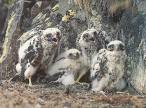
03 August 2007. Grampian Police are appealing for information following the discovery of two poisoned four week old peregrine falcon chicks in their nest in the Inverurie area.
Peregrine chicks
The birds were discovered at the end of May when members of the North East Raptor Study Group visited the nest to ring and weigh the birds.
The two chicks had full crops and, following a post mortem examination and toxicology report, it was discovered that their food source was contaminated with an illegal pesticide, resulting in their death.
Peregrines are a “Schedule One” bird under the Wildlife and Countryside Act 1981 and are specially protected. New penalties for killing peregrines include up to a £10,000 fine or 12 months in prison.
Dave MacKinnon, Force Wildlife Crime Officer for Grampian Police said: “We are unable to give the exact location of the nest as these birds are specially protected. What I can say is that it appears the chicks had been fed poisoned bait by their parents, laced with a banned pesticide.
According to an article written by an RSPB investigator and published in Scottish Bird News by the Scottish Ornithological Society (see link below), in June 2003, RSPB investigators received a tip-off that a peregrine nest site with a history of suspected deliberate interference was likely to be attacked imminently. Shortly afterwards, a 41 year old gamekeeper from the Haystoun Estate, Peebles, was allegedly filmed clambering across to the nest, removing the single peregrine chick, putting it inside a sack and walking off. The police arrived within minutes but the peregrine chick was never found.
The keeper was charged but when the case came to court on 24 March 2004, after two hours of legal argument Sheriff Farrell ruled that the video footage was inadmissable evidence because the RSPB did not have permission to be on the land for the purpose of detecting an offence.
It seems more than a little bit strange that a member of the public can be barred from telling a court about a crime, just because the landowner had not given permission for that person to be there! Surely, it is in any landowner’s interest to have criminals apprehended and dealt with by the courts? All very strange.
The gamekeeper was ultimately fined £300 and had his firearms certificates revoked after police officers found a weapon and ammunition in his unattended Landrover at the time of the incident. http://www.the-soc.org.uk/docs/SBN80.pdf
At Aberdeen Sheriff Court in 2007, a 34 year old gamekeeper of Lumsden, Huntley, was accused of killing a peregrine at Clova Estate, Huntley, Aberdeenshire in October/November 2006. He was also accused of having a bottle of poison at his home address and at Tomatin Estate (Invernesshire), and further accused of having an illegal pesticide (Carbofuran) in his possession at his home address and elsewhere.
After long court delays, in early 2009 he was found not guilty of a charge under Section 15(A) of the Wildlife & Countryside Act 1981.
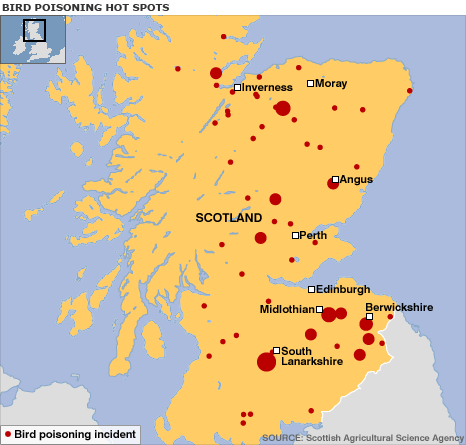
In January 2009, the Scottish government released its ‘Map of Shame’ showing confirmed poisoning incidents between 2004-2008. The map, using data from the Scottish Agricultural Science Agency (SASA), was hailed as a “significant step” in the fight against wildlife crime as it showed the scale of raptor persecution.
In reality, the map doesn’t tell us anything new at all. The RSPB has been producing these maps for years; the difference with this one is that for the first time, the Scottish Rural Property & Business Association (SRPBA) which represents landowners, agreed to its contents.
The map locates 88 incidents in which raptors were poisoned over the previous 5 years, including iconic species such as the golden eagle, white-tailed sea eagle, red kite, buzzard, tawny owl and peregrine.
What the map fails to tell us is the name of the shooting estates involved. What is the point of providing such a vague map? There is no point, other than to confirm what was already known – raptor persecution incidents are widespread across Scotland. If the SRPBA is as committed to stamping out wildlife crime as it claims it is, why wouldn’t it take every opportunity to name and shame those known to be involved?
It is not just wildlife-interest groups that are asking for the estates to be named. In September 2009, MSP Sarah Boyack (Scottish Labour) called for the government to name and shame the offending estates and said taking steps to reduce the number of incidents of wild raptors being shot and poisoned was a “matter of urgency”. http://news.stv.tv/scotland/121040-msp-name-and-shame-bird-killers/
The government is due to release the official 2009 raptor poisoning figures shortly….
According to the Hansard Report April 2004 (Hansard is the edited verbatim report of proceedings in UK parliament), the following illegal raptor persecution incidents were recorded in 1989:
Roxburghe Estate (nr Kelso, Scottish Borders) – 1 x buzzard killed by Mevinphos.
Carbeth Estate (Stirlingshire) – 1 x buzzard killed by Chloralose.
Langholm Estate (Dumfries & Galloway) – 1 x peregrine killed by Mevinphos.
Drumochter Estate (Dalwhinnie, Inverness-shire) – 1 x golden eagle killed by Chloralose.
Islay Estate (Strathclyde) – 1 x buzzard killed by Mevinphos.
Islay Estate (Strathclyde) – 1 x peregrine shot.
Monzie Estate (Crieff, Perthshire) – 1 x buzzard killed by Chloralose.
This report was published in the days when the government publicised the names of the Estates where illegal raptor persecution incidents had been recorded. Shame they don’t do that anymore – you have to wonder why? The Hansard report documenting these and other persecution incidents, can be read here: http://hansard.millbanksystems.com/written_answers/1994/apr/28/registers-of-scotland
According to a report in the Scotland on Sunday newspaper, raids on the Glenfiddich & Cabrach Estate in NE Scotland in February and March 1998 revealed widespread poisoning across the 41,500-acre estate owned by London property tycoon, Christopher Moran. Ten rabbits, six pigeons, six grouse and two hares were reportedly laced with the lethal pesticide Carbofuran and left out on the hill. Three illegal pole traps and an owl whose legs had been smashed by a trap were also reportedly found, along with a dead peregrine inside an estate landrover. Tests revealed the peregrine had been poisoned with carbofuran.
The head gamekeeper was convicted at Elgin Sheriff Court in October 1998 and fined £700.
The estate is owned by multi-millionaire Christopher Moran, a businessman with an interesting past: see here and here.
Two dead peregrines were found in June 2003, lying together below cliffs on a beach in an area known locally as the Three Moothed Caves in Findochty, Morayshire. Forensic testing showed that both had been poisoned with Carbofuran, and police believe the birds had been thrown off the top of the cliffs and dumped, as there wasn’t a known peregrine nest at the site.
A peregrine falcon found dead close to its nest in Strathaven, South Lanarkshire in July 2003 had been poisoned with Carbofuran. The male adult was part of a breeding pair. His female mate has not been since and their eggs ‘disappeared’ from the nest.
Peregrines face persecution from several sources. They are targeted by gamekeepers, especially on grouse moors, and also by egg collectors, falconers and pigeon fanciers.
A gamekeeper on the Farr Estate, Tomatin, Inverness-shire was fined £1,500 for attempting to trap rare birds of prey. The keeper was found guilty of laying traps to catch peregrine falcons and goshawks. The 37-year-old was convicted at Inverness Sheriff Court in January 2005 at the end of a trial which lasted two years.
Sheriff Donald Booker-Milburn found the keeper, of Strathdearn, Tomatin, guilty of two charges under the Wildlife and Countryside Act 1981.
The first charge stated that he set a crow cage funnel trap in Kyllachy with the intention of trapping peregrine falcons and goshawks. He used the trap with the funnel open, the door wired shut and two live feral pigeons set within the trap as bait.
The second accused him of possessing nine illegal gin traps, which can be used to trap wild birds and mammals such as foxes and wild cats, for criminal purposes.
RSPB Species Protection Officer Keith Morton said at the time: “We are very encouraged that the sheriff imposed a substantial penalty, as this will highlight the seriousness of this offence”. He added: “It will be interesting to see the reaction of the estate, we suspect there is a great deal of support about this activity among some employers.”
In October and December 1998, a dead golden eagle and a buzzard were found on the Glenalmond Estate in Perthshire. The carcass of a red grouse was found close by, and tests later showed it had been used as a poisoned bait. The golden eagle had been killed by ingesting the illegal pesticide, Yaltox.
In Perth Sheriff Court in December 2000, a local gamekeeper was acquitted of all charges. He was also acquitted of further charges related to laying poisoned baits for either a peregrine or a golden eagle.