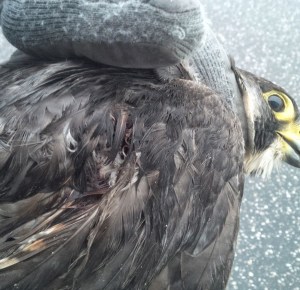
Police investigate shooting of young peregrine in Suffolk

shot perg suffolk aug 2014Suffolk police and the RSPB are appealing for information after the discovery of a young, injured peregrine near the village of Long Melford in Suffolk on 20th August. The bird had been shot.

The peregrine has survived and is currently being rehabilitated at a nearby falconry centre in the hope it can make a full recovery and be released back to the wild.

The RSPB is offering a £1,000 reward for information leading to a conviction.

Full news article here.

This is the 17th peregrine known to have been targeted in these isles this year. And these are only the ones that have reported – how many more have been killed?

In February, a poisoned peregrine was found dead in South Lanarkshire, Scotland (here). In March, a shot peregrine was found dead in Dorset, England (here). In April, a shot peregrine was found dead near Stirling, Scotland (here). In May, a shot peregrine was found critically injured in Devon, England (here). In June, the public foiled an attempted poisoning of six peregrines in Co. Dublin, Ireland (here). In June, a poisoned peregrine was found dead in North Wales (here). In July, four dead peregrines suspected to have been poisoned were found in Gwynedd, NW Wales (here). In August a shot peregrine was found critically injured in Co. Wexford, Ireland (here).

Ross-shire Massacre: five months on

It’s been five months since the discovery of 22 dead raptors (16 red kites + 6 buzzards) near Conon Bridge in Ross-shire – an incident we have termed the Ross-shire Massacre.

Since then, we’ve learned that 16 of these birds (12 red kites + 4 buzzards) were killed after ingesting an “illegally-held poisonous substance“. That information had to be dragged from Police Scotland in June, following some pretty outrageous allegations from the game-shooting industry (and at least one MSP) that the birds had been ‘accidentally poisoned’ by eating contaminated meat at the Tollie Red Kite Feeding Station.

Other than that, Police Scotland has refused to provide any further information, other than to say last month that the investigation “was continuing“.

In June, a member of the public made an FoI request to SASA (the government lab responsible for undertaking the toxicology anlayses on these birds) to ask for the name of the poison(s) and the name of the species affected, amongst other things. He received a reply from SASA on 30th June and he was told that it wasn’t in the public interest to disclose such information. SASA claimed that the public interest test was “outweighed by the public interest in ensuring that the ongoing police investigation is not jeopardised and that incomplete data are not released“. The member of the public submitted a request for a review of this decision and on 24th July 2014 he received a response from Hugh Dignon, a senior civil servant. Mr Dignon upheld the decision made by SASA and added:

“By withholding evidence that might, if prematurely released, prejudice a live investigation, we are maximising the likelihood that a conviction could be secured if a prosecution is taken forward“.

Come on, Hugh! There’s not a chance in hell of getting a prosecution, let alone securing a conviction, so many months after the crime took place. Who are you trying to kid? And since when has releasing the name of a banned poison ever jeopardised a live investigation? Er, that’ll be never. SASA has, for years, routinely published the name of the poisons that were used in crimes that are still subject to on-going investigations – why is this case so different? Why all the cloak and dagger? What’s to hide?

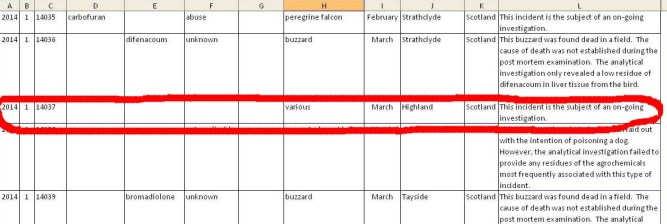
Here’s a screen grab of SASA’s latest poisoning data, which relate to toxicology tests undertaken in the first quarter of 2014. The reference circled in red is the information about the Ross-shire Massacre. SASA has redacted all the detail about the type of poison(s) detected (column 4), whether the incident was ‘abuse/mis-use’ etc (column 6), and they’ve even removed the names of the species they’ve tested – preferring to write ‘various’ instead (column 8). Compare and contrast these redactions to the entry at the top of the image, which relates to a poisoned peregrine found in Strathclyde in February – that case is also an on-going police investigation (ahem) and yet we’re allowed to see the name of the poison (Carbofuran), the type of incident (abuse) and the species affected (peregrine). Astonishing, isn’t it?

 SASA Q1 2014 ROSS-SHIRE MASSACREa

For previous posts on the Ross-shire Massacre click here

More poisoned peregrines in North Wales

North Wales Police are appealing for information following the discovery of a poisoned peregrine in June.

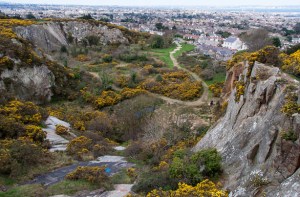
The bird was found at a quarry in Penmaenmawr and toxicology tests revealed it had been poisoned with a rodenticide.

It’s possible then that this was the result of an accidental poisoning (as rodenticides can be used under certain controlled conditions), but the death is being treated as suspicious because two years ago a pigeon was found, at the same quarry, smothered in poison and tethered to a rock – obviously placed as a poisoned bait (see here).

Press release from North Wales Police on the latest peregrine poisoning here.

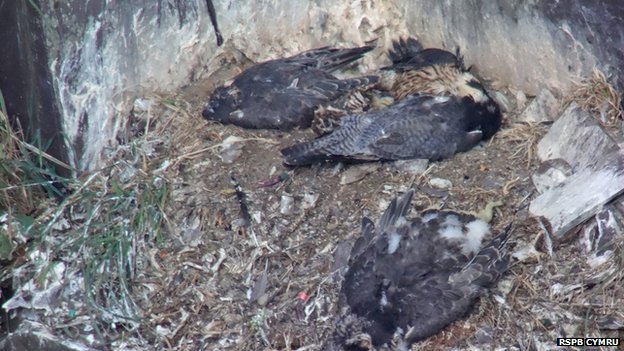
In July this year, four peregrines (3 chicks and 1 adult) were found dead on their nest ledge at a quarry site in the Nantlle Valley, Gwynedd. Police suspect they too had been poisoned (see here).

peregrines x 4 Nantlle valley July 2014

Young peregrine shot in Co Wexford

Perg Co WexA young peregrine falcon has had to be euthanised after it was illegally shot in Co Wexford, Ireland.

The news article in the Irish Times (here) doesn’t say when the bird was found but it can be assumed it was quite recently – the young bird had been ringed with a unique identification number so presumably the authorities know it was one of this year’s fledglings.

The bird was found at Ballynastraw near Enniscorthy and an x-ray revealed it had been hit with shotgun pellets in its wings and leg. A vet decided the injuries were too severe for the bird to be rehabilitated.

The National Parks and Wildlife Service has appealed for information. Dominic Berridge of NPWS said: “The finding of this bird is not an isolated incident. There have been attempts to poison and shoot birds at a number of nests and if people see anything suspicious like a tethered pigeon or a trap, NPWS staff should be called”.

Wheelhouse responds to latest raptor killings….by doing nothing

Paul-Wheelhouse-MSP Earlier today we blogged about the latest poisoning victim to have been uncovered in Scotland….a dead buzzard that was found in Fife in April (see here).

This evening, Environment Minister Paul Wheelhouse has issued the following statement:

“I have been hugely angered to learn about another case of a poisoned buzzard following on from a separate incident involving the illegal death of a hen harrier in Ayrshire. I have made it very clear that I will not tolerate these criminal and selfish acts and this form of criminality has also been roundly condemned by parliament in a recent debate.

These crimes are not the actions of people who value Scotland’s wildlife and natural environment and I encourage anyone with any information on these despicable crimes to contact Police Scotland on 101.

My officials are working on a pesticide disposal scheme to rid illegal substances from our countryside and I hope to see this up and running very soon while the implementation of changes to the General Licences is in the process of implementation.

Our ongoing review of wildlife crime penalties is due by December and these latest incidents only add to the evidence supporting a toughening of sanctions and penalties on perpetrators.”

We don’t doubt that he’s “hugely angered” – we all are – but we most certainly do question his commitment to taking meaningful action against the raptor killers.

A year ago, give or take a few days, the Minister introduced a series of what he described as ‘further measures’ to combat raptor persecution (see here). Since then, not one of these measures has yet been fully implemented. Also since then, we’ve seen examples, over and over again, of how these crimes are still taking place right across Scotland. Here are some of them:

June 2013: Shot buzzard in the Borders (see here), later revealed to also have been poisoned (see here)

July 2013:  Buzzard shot in the throat in North Ayrshire (see here)

August 2013: Red kite found shot at Leadhills (see here)

September 2013: Poisoned buzzard found in Stirlingshire (see here)

October 2013: Langholm hen harrier ‘Blue’ disappears (see here)

October 2013: Half-made raptor trap discovered in Angus (see here)

December 2013: Buzzard died of ‘unnatural causes’ near Tomatin (see here) [we now know it had been shot]

December 2013: Golden eagle ‘Fearnan’ found poisoned on Angus grouse moor (see here)

January 2014: Man reported for hen harrier death in Aberdeenshire (see here)

January 2014: Dead bird (species unknown) & suspected poisoned bait found in South Lanarkshire (see here)

February 2014: Poisoned peregrine found near Leadhills (see here)

March 2014: 22 poisoned raptors (16 red kites + 6 buzzards) found in Ross-shire (see here)

April 2014: Man arrested for alleged attempted raptor trapping in Aberdeenshire (see here)

April 2014: ‘Illegally-killed’ peregrine found near Stirling (see here) [we now know it had been shot]

April 2014: East Scotland sea eagle chick ‘disappears’ on Aberdeenshire grouse moor (see here)

April 2014: Gamekeeper charged for allegedly shooting, bludgeoning & stamping on buzzard in Dumfries (see here)

April 2014: Poisoned buzzard found in Fife (see here)

June 2014: Allegations emerge of ‘coordinated hunt & shooting’ of a hen harrier in Aberdeenshire last year (see here)

June 2014: Hen harrier died “as result of criminal act” near Muirkirk (see here)

These are just the ones that have been made public – we expect there to be a number of others that have not yet been revealed to the public.

Each time, we’ve asked Wheelhouse to act. Each time, he’s told us we need to ‘wait’ for the new measures to take effect but he has adamantly refused to give a time-frame of how long that wait should be. It’s crystal clear, even to a child, that The Untouchables are out of control and waiting for them to stop of their own accord is ridiculous.

The Minister’s response this evening is simply not good enough. A ‘poisoning amnesty’? It sounds good, but the truth is it’s been done before and with no effect. Carbofuran has been banned since 2001 – that’s 13 years ago! Does he really think that these disgusting poisoners are going to hand over their private stashes of poison when they know full well they can continue to use them without fear of consequence? The whole industry denies that poisoning is even happening!

We think the amnesty is being implemented so the Government can be seen to be doing ‘something’ but actually it’s just a bit of cynical window dressing in an attempt to delay taking the proper action that is needed. It’s just another excuse to do nothing.

And actually, this amnesty hasn’t been announced as a reaction to the recently-reported killing of the buzzard and the hen harrier. He announced his intention to launch an amnesty in his speech at the Police Wildlife Crime Conference several months ago. So what has he actually announced in response to the poisoned buzzard and the illegally-killed (probably shot) hen harrier? Absolutely nothing.

The Minister says he “won’t tolerate these criminal and selfish acts“. Sorry, Minister, but that is exactly what you’re doing.

If you feel strongly about this and agree that this government is still failing to address the widespread persecution of protected raptor species, we’d encourage you to email Mr Wheelhouse, cite the list of crimes (above) and demand he takes meaningful action or resign his position as Environment Minister. Email: ministerforenvironment@scotland.gsi.gov.uk

Members of public foil attempt to poison peregrine family

dalkey_quarryAn attempt to poison a family of peregrines (two adults and four youngsters) at Dalkey Quarry, part of the Killiney Hill Park in Co. Dublin, has been foiled thanks to three observant members of the public.

On the evening of 11th June, three walkers noticed two pigeons in distress at the quarry, close to the well-known peregrine’s nest ledge. On closer inspection, the pigeons were found to be tethered with fishing line and had had their wings clipped to prevent them from flying. While rescuing the pigeons, a wet substance was noticed on the back of their necks. It is suspected that this was poison, placed there in a deliberate attempt to kill the peregrines. The substance is being tested at a specialist lab.

If it was poison, those members of the public are lucky not to have been affected.

Full details of the story can be found on the BirdWatch Ireland website here.

It wouldn’t be the first time this barbaric method has been used to kill raptors. In 2011, two buzzards and a sparrowhawk were killed in Ireland after being attracted to live tethered pigeons that had been smeared with the banned poison Carbofuran (see here).

A feeble, question-dodging response from the Environment Minister

Peregrine poisoned Leadhills Feb 2014In early April we blogged about the poisoned peregrine that had been found close to the boundary of Leadhills Estate in South Lanarkshire (see here). We encouraged blog readers to email the Environment Minister with a series of questions about this specific incident and the broader topic of long-term raptor persecution in this particular area. We know from our site stats that over 100 of you emailed the Minister (well done and thank you) and perhaps this volume of email traffic was the reason for his delayed response.

Anyway, last week his formal response was eventually mailed out and we’ve been sent a few copies by several readers. As usual, it’s a fairly generic response and here is a general overview of what he had to say (or to be more precise, what his civil servant had to say on his behalf) -:

“Thank you for your letters to the Minister for Environment and Climate Change, Paul Wheelhouse. I have been asked to respond.

The Minister has been appalled at the recent incidents of raptor persecution including the mass poisoning in Ross-shire which has claimed the lives of 16 red kites and 6 buzzards. Clearly there have been other incidents across Scotland involving peregrine falcons and most recently a juvenile sea eagle, the first born to the reintroduced east coast birds, has gone missing in an area where raptors have been lost before. The mass poisoning is a terrible loss for the Black Isle and has rightly been condemned by the local community as well as the wider public. The Minister was heartened however, by the contributions made by members of the public, as well as landowners and farmers, to the reward fund set up by the Royal Society for the Protection of Birds (RSPB) for information which leads to a successful conviction.

These incidents threaten to undermine Scotland’s reputation as a country that cares for its wildlife and natural environment but reinforce the need for the new measures the Minister announced in July 2013.

In addition to these measures, the Scottish Government launched a Consultation to gather views on extending the investigative powers for inspectors in the Scottish SPCA in relation to certain wildlife offences. The Consultation will run from 31 March until 1 September 2014 and of course all views will be taken into account before a decision is made.

The possession of certain poisons is an offence in Scotland and in order to help rid our countryside of these dangerous chemicals, we shall be looking at building on existing mechanisms to remove them from Scotland’s environment.

You raised a number of specific points about the peregrine falcon poisoning incident in Lanarkshire and I will deal with each in turn below.

1. Why did Police Scotland tell a member of the public this was not a police matter? Will you launch an inquiry and publish the findings?

Police Scotland call handlers must consider the information they are given at the time of the call and not all reported incidents may be crimes. It would be inappropriate for the Minister to comment on Police operational matters.

2. Will you launch an inquiry into PC Everitt’s alleged response to this incident and publish the findings?

The Minister will not be making any statement based on speculative comments posted on social media sites about a serving Police officer. This would not be appropriate.

3. Will you launch an inquiry into why illegal raptor persecution continues to flourish in the Leadhills area, and publish the findings?

The area where the poisoned peregrine falcon was discovered was disclosed by Police Scotland as ‘the Abington area of South Lanarkshire’. The Minister will not be drawn into any speculation about a live police investigation which might prejudice the outcome of the investigation.

4. Will SNH use the new enabling clause in the General Licences to withdraw their use in the Leadhills area with immediate effect?

SNH will consider restricting the use of General Licences where they believe it is appropriate to do so, and on a case by case basis.

5. Over what period of time are you going to measure the success of the new measures introduced in July 2013?  It seems the threat of these new measures has not managed to stem the mass destruction of Scotland’s Natural Heritage.

The Minister has decided it would be inappropriate to impose exact time scales on the effect of the new measures as each measure is unique and will require its own consideration. However, it is hoped to report on the findings of the penalties review before the end of 2014.

Once SNH have had the opportunity to implement any General Licence restrictions the Minister will seek an update on how these have worked in practice. The final measure about Police Scotland use of technology can only be considered on a case by case basis and these are decisions made in the course of operational policing. It would be inappropriate for the Minister to seek to influence operational decisions of police colleagues in respect of an investigation.

Whilst current legislation and these new measures should be given due time to take effect, the Minister is on record confirming that he will take further action if it appears that current measures are insufficient. The Scottish Government takes this issue seriously and I hope that this response illustrates the extensive work that is taking place.

Yours sincerely,

Karen Hunter

Wildlife Crime Policy Officer”.

There’s nothing in his response that comes as a surprise. It’s full of the same old rhetoric that we get every time we ask for more robust action to be taken. To be fair to him, we can understand his view that the measures he brought in last July need time to take effect. The problem with that though, is that here we are, 10 months later, still waiting for many of those measures to actually be enacted and meanwhile the filthy criminals continue with their systematic persecution, knowing full well they’re still untouchable. His refusal to set a review date to assess whether his new measures have been effective is very disappointing. We’ll probably be here in the same place two years down the line, still waiting, and still counting the cost (in terms of raptor deaths) of this constant procrastination.

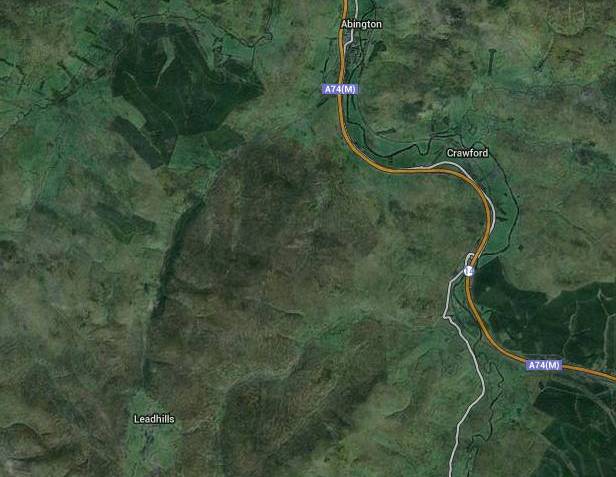
We were particularly disappointed with his answer to question 3. Perhaps he’s not familiar with the geography of South Lanarkshire, and especially the proximity of Abington village to the Leadhills Estate boundary. Here’s a map:

Leadhills Abington map

The big brown smudge in the middle (or, to borrow a phrase from George Monbiot’s latest excellent article, that “bare black misery“) is Leadhills grouse moor. The site where the peregrine was found poisoned with Carbofuran is closer to that grouse moor than it is to Abington village. That’s not to say that we’re accusing anyone from Leadhills Estate of being responsible for poisoning the peregrine, it’s just a clarification that the site falls within what we would describe as the ‘Leadhills area’ – an area with a 40+ year history of illegal killing, including plenty of Carbofuran abuse in recent decades. Perhaps Police Scotland chose to describe the site as being in the ‘Abington area’ to deflect attention from this being yet another persecution incident in what is one of  Scotland’s blackest areas for long-term raptor killing. It’ll make the crime stats look better is this one can’t be attributed to the Leadhills area.

We’ll look forward to hearing the results of their ‘live police investigation’….yeah, right.

Liam McArthur’s parliamentary questions answered (raptor crime in Leadhills area)

Liam McArthur MSPLast month, Liam McArthur MSP posed a series of parliamentary questions following our report on the poisoned peregrine found in the Leadhills area of South Lanarkshire (see here).

His four questions have now been answered; two by the Cabinet Secretary for Justice, Kenny MacAskill, and two by Environment Minister Paul Wheelhouse:

Question S4W-20745: Liam McArthur, Orkney Islands, Scottish Liberal Democrats, Date Lodged: 15/04/2014

To ask the Scottish Government what steps Police Scotland is taking to ensure that its staff are aware of their responsibilities regarding the protection of protected species.

Answered by Kenny MacAskill (15/05/2014):

The training of wildlife crime officers is a matter solely for the Chief Constable. It is not appropriate for Scottish Ministers to seek to intervene on operational policing matters.

I can advise however that since Police Scotland came into being on 1 April 2013, there have been significant changes to the structure and training for wildlife crime officers.

The strategic lead for wildlife crime which sits in the Specialist Crime Division is held by the Assistant Chief Constable. A Detective Chief Superintendent holds the portfolio lead and the post provides essential direction and governance around strategic issues relating to wildlife crime prevention and investigation.

A full time national Wildlife Crime Co-ordinator at Detective Sergeant level provides engagement with national issues relating to coordination, policy, performance and training, and supports the Detective Chief Superintendent.

In each of the 14 territorial divisions there are wildlife crime liaison officers who are supported by a Superintendent (or above). Wildlife crime officer posts can be either full or part-time and deal with crime prevention and investigation when required for operational policing issues.

It is important to highlight that the investigation of wildlife crime is not the exclusive preserve of dedicated staff, and a variety of investigative and intelligence resources and tactics are brought to bear on such matters, from local and national policing.

Our comment: This is basically a cut and paste response from the response he’s just given to Claire Baker MSP. We keep seeing this statement: “It is not appropriate for Scottish Ministers to seek to intervene on operational policing matters”, but hang on a minute, didn’t the Environment Minister ‘seek to intervene’ only ten months ago when he instructed the Lord Advocate to have a word with COPFS and Police Scotland ‘to ensure law enforcement utilises all investigative tools at their disposal in the fight against wildlife crime’? (see here). What’s that if it isn’t an intervention?

Question S4W-20746: Liam McArthur, Orkney Islands, Scottish Liberal Democrats, Date Lodged: 15/04/2014

To ask the Scottish Government whether it will hold an inquiry into reports that Police Scotland told a member of the public that the poisoning of a peregrine falcon in the Leadhills area was not a police matter.

Answered by Kenny MacAskill (15/05/2014):

Police Scotland is committed to investigating wildlife crime and have confirmed that on this occasion well established protocols and processes were adhered to in order to allow the bird to be recovered successfully. As a result of this, and the subsequent analysis carried out by Science and Advice for Scottish Agriculture identified that the bird had been poisoned, Police Scotland is now working in cooperation with both RSPB and National Wildlife Crime Unit to fully investigate this crime.

In any given case, police call handlers must consider the information they are given at the time of the call and not all reported incidents may be crimes. Police Scotland has also confirmed that no official complaint has been received from the reporter of the original incident.

Our comment: The police call handler told the member of the public (who was reporting this dead peregrine that had been found in suspicious circumstances in an area notorious for raptor crime) that it wasn’t a police matter. That is a fact. The police response was not in adherence with ‘well established protocols and processes’, as Mr MacAskill claims, unless those protocols and processes include ignoring a suspected wildlife crime. The only reason this poisoned peregrine was recovered successfully was because the member of the public bothered to call the RSPB, who then attended and collected the corpse. If the member of the public had not bothered to call the RSPB, this poisoned bird would not have been picked up nor recorded in the wildlife crime stats. That is also a fact. Police Scotland screwed up on this one, and rather than admit it and ensure they have procedures in place to stop it happening again, they are claiming success. That’s not very impressive. And they wonder why the public is losing (has already lost?) confidence in their ability to cope with wildlife crime?!

Question S4W-20747: Liam McArthur, Orkney Islands, Scottish Liberal Democrats, Date Lodged: 15/04/2014

To ask the Scottish Government what steps it is taking to combat illegal raptor persecution in the Leadhills area.

Answered by Paul Wheelhouse (12/05/2014):

The Leadhills area has been identified as a poisoning ‘hotspot’ in the maps that are published annually by the Scottish Partnership for Action Against Wildlife Crime. There have also been incidents in the area involving illegal shooting of raptors.

Operational policing and the targeting of enforcement activity in any specific area is a matter solely for Police Scotland.

The Scottish Government works closely with the police, conservation groups and landowners through the Partnership for Action Against Wildlife Crime (PAW) Scotland. The PAW Scotland Raptor Group has established a short-life working group tasked with developing a clear message that raptor persecution must stop now. The message will have the explicit backing of all PAW partners and be aimed in particular at those areas where raptor persecution is most persistent.

See also my response to S4W-20748 on 12 May 2014 which sets out the additional steps being taken by the Scottish Government and partners to combat illegal raptor persecution.

Our comments: Oh brilliant, here comes the PAW Raptor Scotland Group to save the day, once they’ve decided how to ‘develop a clear message that raptor persecution must stop now’. Is Wheelhouse really so stupid? The PAW Scotland Raptor Group has been established since 2009 (formerly called the Scottish Raptor Persecution Priority Delivery Group). They’ve had five (yes, five) years to develop a clear message that raptor persecution must stop! Why the hell do they have to form a ‘working group’ to come up with a few lines?? It’s simple, isn’t it? STOP ILLEGALLY PERSECUTING RAPTORS NOW. There, that’ll do it. Although perhaps when you realise which organisations are represented on this group (see here) it’ll become apparent why they’ve achieved so little in so long. We’ve been particularly scathing of this group before (see here) and we’ve seen no reason to change that view.

Question S4W-20748: Liam McArthur, Orkney Islands, Scottish Liberal Democrats, Date Lodged: 15/04/2014

To ask the Scottish Government whether there is sufficient evidence to assess the effectiveness of the new enforcement measures to tackle raptor persecution announced by the Minister for Environment and Climate Change on 1 July 2013.

Answered by Paul Wheelhouse (09/05/2014):

There is not yet sufficient evidence to assess the effectiveness of the new measures announced on 1 July 2013. A report on the review of penalties is due by the end of the year and the changes to the general licences will be fully implemented by Scottish Natural Heritage over the next few months. The use by the police of the full range of investigative techniques in raptor persecution cases is an operational matter, however it is unlikely that results would be seen less than 12 months after the announcement of new measures.

Our comment: It’s becoming more and more apparent that Wheelhouse won’t be pinned down to give a time scale for how long he’s prepared to wait to see whether these new measures have any effect. Is he thinking in terms of months or years? A lot will probably depend on the number of raptor crimes that are uncovered during the rest of this year, and particularly, the public’s response to those crimes. We must maintain this pressure on the government to act.

Well done again to MSPs Claire Baker and Liam McArthur for keeping these issues at the forefront of parliamentary business.

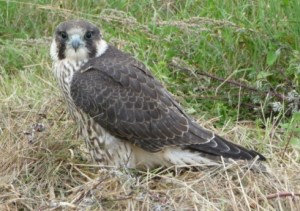
Peregrine shot in Devon as this year’s tally continues to rise

Perg shot seaton Devon May 2014A critically-injured peregrine was found at Seaton Beach in Devon on Bank Holiday Monday. The bird, soaked and unable to fly, was found by members of the public.

It was taken to a vets but had to be euthanized. Its injuries were consistent with a gunshot wound.

The police quickly issued an appeal for information (see here) and local birder Steve Waite has written about the incident on his blog (see here).

So here we are, another month, another reported raptor persecution crime to add to the year’s growing death toll:

Jan 2014: Shot buzzard, Norfolk.

Jan 2014: Dead bird (species unknown) & poisoned bait, South Lanarkshire.

Feb 2014: Shot buzzard, North Yorkshire.

Feb 2014: Shot buzzard, Norfolk.

Feb 2014: Shot sparrowhawk, Norfolk.

Feb 2014: Spring-trapped buzzard, West Yorkshire.

Feb 2014: Poisoned peregrine, South Lanarkshire.

Mar 2014: Shot peregrine, Dorset.

Mar-April 2014: Poisoned red kites (x 16) & buzzards (x 6), Ross-shire.

April 2014: Man arrested for alleged attempted raptor trapping, Aberdeenshire.

April 2014: Shot buzzard, North Yorkshire.

April 2014: Shot red kite, Northamptonshire.

April 2014: White-tailed eagle ‘disappears’ in suspicious circumstances, Aberdeenshire.

April 2014: Peregrine ‘illegally killed’, Stirlingshire.

May 2014: Shot peregrine, Devon.

Meanwhile, over in Northern Ireland a wildlife crime summit has learned that 90 raptors have been found poisoned there since 2006 – see here.

Parliamentary questions asked about poisoned peregrine at Leadhills

Peregrine poisoned Leadhills Feb 2014Three weeks ago we blogged about the discovery of a poisoned peregrine in the Leadhills area of South Lanarkshire, and the alleged response of Police Scotland & NWCU, who both seemed reluctant to handle the case (see here, here and here).

The authorities have refused to discuss the incident, claiming it would be inappropriate to comment on an on-going investigation. We argue that answering questions about how an initial telephone call was handled would have no impact whatsoever on any ‘investigation’ (and we don’t even believe there is an investigation, as the person who reported the dead bird has apparently been told by Police Scotland that a witness statement is not required!!!).

This stone-walling response is pretty common and we’re used to it by now. Many of us have written to the Environment Minister to demand an explanation about why the police and the NWCU allegedly ignored this reported crime but so far we’ve heard absolutely nothing in return. This silence doesn’t fill us with confidence that raptor persecution is being taken seriously.

One MSP isn’t satisfied with this official wall of silence.

Liam McArthur MSPLiam McArthur MSP, a Scottish Liberal Democrat representing the Orkney Islands (a very long way from Leadhills!!) has submitted a series of parliamentary questions about this Leadhills case, and more generally about the effectiveness of current enforcement measures to deal with raptor persecution. Good on him.

Question S4W-20745: Liam McArthur, Orkney Islands, Scottish Liberal Democrats, Date Lodged: 15/04/2014

To ask the Scottish Government what steps Police Scotland is taking to ensure that its staff are aware of their responsibilities regarding the protection of protected species. [Current Status: Expected answer date 15/5/2014].

Question S4W-20746: Liam McArthur, Orkney Islands, Scottish Liberal Democrats, Date Lodged: 15/04/2014

To ask the Scottish Government whether it will hold an inquiry into reports that Police Scotland told a member of the public that the poisoning of a peregrine falcon in the Leadhills area was not a police matter. [Current Status: Expected Answer date 15/05/2014].

Question S4W-20747: Liam McArthur, Orkney Islands, Scottish Liberal Democrats, Date Lodged: 15/04/2014

To ask the Scottish Government what steps it is taking to combat illegal raptor persecution in the Leadhills area. [Current Status: Expected Answer date 15/05/2014].

Question S4W-20748: Liam McArthur, Orkney Islands, Scottish Liberal Democrats, Date Lodged: 15/04/2014

To ask the Scottish Government whether there is sufficient evidence to assess the effectiveness of the new enforcement measures to tackle raptor persecution announced by the Minister for Environment and Climate Change on 1 July 2013. [Current Status: Expected Answer date 15/05/2014].

UPDATE: Answers to Liam McArthur’s questions have now been published – see here.