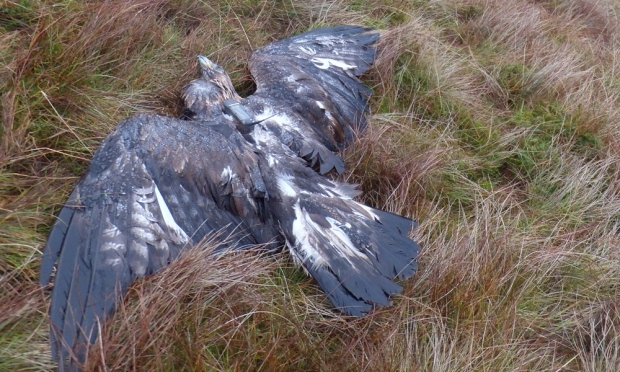
Poisoned peregrine found nr Leadhills boundary: police response appalling

Peregrine poisoned Leadhills Feb 2014In the middle of February, a member of the public found a dead adult peregrine falcon in suspicious circumstances close to the boundary of Leadhills Estate in South Lanarkshire.

The person who found it immediately ‘phoned Police Scotland and asked them to attend. The person was told that it wasn’t a police matter. The person queried that response and asked the Police to double check. The Police said ‘No, definitely not a police matter, call the RSPB’.

The member of the public was clued-up enough to know that it wasn’t an SSPCA matter because the bird was already dead (and therefore the SSPCA had no powers to investigate). So the person called the RSPB for help.

According to information provided to us by the member of the public, the RSPB called the National Wildlife Crime Unit (NWCU) and spoke to PC Charlie Everitt, who allegedly told them it wasn’t a police matter as there was no evidence of a crime having been committed. The RSPB asked if they could retrieve the corpse and permission was granted (this permission is needed for any RSPB-collected evidence to be admissible in a future criminal case, as the RSPB do not have any investigatory powers).

The RSPB collected the dead peregrine and submitted it for a post-mortem and it then went on to SASA for toxicology analysis.

We’ve been waiting to hear the results of those tests before we blogged about the incident.

Yesterday the results were made public – the peregrine had been poisoned (the name of the poison has not been released). However, the news didn’t come in the form of an all-singing-all-dancing Police Scotland press release. It came out, almost buried, in a BBC News article about the mass poisoning of red kites and buzzards in the Black Isle (see here).

We have several serious concerns about this incident.

First of all, the Police Scotland response. The operator who took the first telephone call didn’t realise that this was a police matter. That’s almost forgiveable – perhaps they were new, inexperienced, whatever. It’s not good enough though – had the member of the public not been clued up enough to know that they could contact the RSPB, this incident would have gone un-investigated and unrecorded.

Of greater concern is the alleged response of PC Charlie Everitt of the NWCU (pictured on the right of this photo, shaking hands with SGA Chairman Alex Hogg as they sign an MOU for greater partnership working on wildlife crime). For those who don’t know, PC Everitt is employed as the Scottish Investigative Support Officer at NWCU and one of his main roles is to focus on raptor persecution. Here is a description of his full role as documented in the Scottish Government’s report Wildlife Crime in Scotland, 2012:

The Scottish Investigative Support Officer (SISO) plays a significant role in partnership working and is jointly funded by SNH and Police Scotland. The SISO post (held by PC Charles Everitt) focuses on issues of significant threat in Scotland (raptor persecution and the illegal taking of freshwater pearl mussels). In addition, he leads and furthers investigations by providing expert advice, acting as a single point of contact and by providing corroboration to Wildlife Crime Officers” (see here, page 30).

PC Everitt is well aware of the long list of recorded raptor persecution incidents in the Leadhills area, and especially the frequency with which poisoned baits have been found. Here is our list of 44 known reported incidents in this area between 2003-2013. The latest poisoned peregrine becomes #45:

2003 April: hen harrier shot

2003 April: hen harrier eggs destroyed

2004 May: buzzard shot

2004 May: short-eared owl shot

2004 June: buzzard poisoned (Carbofuran)

2004 June: 4 x poisoned rabbit baits (Carbofuran)

2004 June: crow poisoned (Carbofuran)

2004 July: poisoned rabbit bait (Carbofuran)

2004 July: poisoned rabbit bait (Carbofuran)

2005 February: poisoned rabbit bait (Carbofuran)

2005 April: poisoned buzzard (Carbofuran)

2005 June: poisoned rabbit bait (Carbofuran)

2005 June: poisoned rabbit bait (Carbofuran)

2006 February: poisoned buzzard (Carbofuran)

2006 March: poisoned buzzard (Carbofuran)

2006 March: poisoned pigeon bait (Carbofuran)

2006 April: dead buzzard (persecution method unknown)

2006 May: poisoned rabbit bait (Carbofuran)

2006 May: poisoned rabbit bait (Carbofuran)

2006 May: poisoned egg baits (Carbofuran)

2006 June: poisoned buzzard (Carbofuran)

2006 June: poisoned raven (Carbofuran)

2006 June: 6 x poisoned rabbit baits (Carbofuran)

2006 June: poisoned egg bait (Carbofuran)

2006 September: 5 x poisoned buzzards (Carbofuran)

2006 September: poisoned rabbit bait (Carbofuran)

2006 September: poisoned rabbit bait (Carbofuran)

2007 March: poisoned buzzard (Carbofuran)

2007 April: poisoned red kite (Carbofuran)

2007 May: poisoned buzzard (Carbofuran)

2008 October: poisoned buzzard (Carbofuran) [listed as ‘Nr Leadhills’]

2008 October: poisoned rabbit bait (Carbofuran) [listed as ‘Nr Leadhills’]

2008 November: 3 x poisoned ravens (Carbofuran) [listed as ‘Nr Leadhills’]

2009 March: poisoned rabbit bait (Carbofuran)

2009 March: poisoned raven (Carbofuran)

2009 April: poisoned rabbit bait (Carbofuran)

2009 April: poisoned magpie (Carbofuran)

2009 April: poisoned raven (Carbofuran)

2010 October: short-eared owl shot

2011 March: illegally-set clam trap

2011 December: buzzard shot

2012 October: golden eagle shot (just over boundary with Buccleuch Estate)

2013 June: significant cache of pre-prepared poisoned baits found in woodland next to grouse moor

2013 August: red kite found shot and critically-injured in Leadhills village

Based on the bulging intelligence file available, PC Everitt, the lead intelligence officer for raptor persecution crimes in Scotland, should have immediately suspected this was a potential poisoning incident and should have either attended the scene himself or at the very least, directed a local Wildlife Crime Officer to attend. Why didn’t he? That deserves an inquiry.

Another concern is the pathetic publicity of this incident. Was it a case of ‘this is a good day to bury bad news so let’s sneak it out while everyone’s focusing on the mass poisoning incident in Ross-shire’?, because that’s what it looks like.

However, the biggest concern of all is that here, yet again, is another illegal raptor poisoning incident in the Leadhills area. The scale of these crimes in this one area is phenomenal. The number of criminal convictions in relation to the number of incidents is disgraceful – only two convictions have ever been secured here – and both involved gamekeepers employed on the Leadhills Estate.

With the number of confirmed poisoned raptors in Scotland this year already at 17, no more evidence is required to show that government initiatives and partnership working is wholly ineffective. Environment Minister Paul Wheelhouse MUST respond robustly and we must hold him to account.

We urge you to email Mr Wheelhouse and demand the following action:

1. Launch an inquiry into why Police Scotland told a member of the public this was not a police matter, and publish the findings.

2. Launch an inquiry into PC Everitt’s alleged response to this incident, and publish the findings.

3. Launch an inquiry into Police Scotland’s media response to this wildlife crime, and publish the findings.

4. Launch an inquiry into why illegal raptor persecution continues to flourish in the Leadhills area, and publish the findings.

5. Insist that SNH uses the new enabling clause in the General Licences to withdraw their use in the Leadhills area with immediate effect.

6. Insist that Mr Wheelhouse stipulates the exact time scale he intends to use to ‘see whether his new enforcement measures [introduced in July 2013] take effect’.

Environment Minister’s email address: Ministerforenvironment@scotland.gsi.gov.uk

Shot peregrine found dead near pheasant pen in Yetminster

From Lauren Jean on Twitter (@lau1180) –

This peregrine was found shot dead near a pheasant pen close to Millennium Woods near Yetminster, Dorset. The discovery has been reported to the police and the RSPB.

perg shot Yetminster March 2014

Wildlife protection laws have had little impact on driven grouse moors

Fearnan Angus Glens Dec 2013There’s an excellent article in the Scotsman today, written by Duncan Orr-Ewing, Head of Species and Land Management at RSPB Scotland.

He discusses the failure of wildlife protection laws to aid the recovery of several raptor species, including the hen harrier, golden eagle, red kite and peregrine, on land managed for driven grouse shooting.

Read the article here.

On a related issue, Mark Avery’s blog today is all about the e-petition for the licensing of grouse moors and gamekeepers (which ends today) – and hints at the growing frustration of those who have been relying on the authorities to ‘sort out’ the illegal persecution of raptors on driven grouse moors. There’s a particularly pertinent comment from Pete Cosgrove:

Has anyone assessed what other criminal enterprises get ignored by Government in this kind of way?

There’s a definite ‘something’ in the air…


Golden eagle found poisoned on Angus grouse moor

A two-year old golden eagle named ‘Fearnan’ has been found dead on a Scottish grouse moor. He had been poisoned with a banned pesticide. The poison hasn’t been named but we’ll take an educated guess at Carbofuran, the gamekeepers’ poison of choice.

Interestingly, there are three separate press releases about this latest disgraceful crime:

One from the government via PAW (here)

One from the police (here)

One from RSPB Scotland (here)

Usually, we’re lucky to see anything for at least 4-5 months after the crime so it’s somewhat surprising to see the scuffle for media attention on this one. Could this be a sign that Environment Minister Wheelhouse has put his foot down and demanded that timely press statements are released? We can’t think of any other reason why the police should suddenly change their tactics from seemingly apathetic to seemingly responsive.

Of course, regular blog readers will already know that Fearnan is not the only poisoned eagle to have been found dead in the Angus Glens. In fact, there’s been a fair bit of raptor persecution over the last nine years. Here’s a list of incidents we’ve compiled from various published reports:

2004 May, near Edzell: long-eared owl and two short-eared owls starved to death in crow cage trap.  No prosecution.

2004 May, Invermark Estate: peregrine nest destroyed. No prosecution.

2006 March, Glenogil Estate: poisoned rabbit bait (Carbofuran). No prosecution.

2006 April, Easter Ogil: poisoned buzzard (Alphachloralose). No prosecution.

2006 April, Easter Ogil: poisoned tawny owl (Alphachloralose). No prosecution.

2006 May, Glenogil Estate: poisoned rabbit bait (Carbofuran). No prosecution.

2006 June, Glenogil Estate: poisoned woodpigeon bait (Carbofuran). No prosecution.

2006 June, Glenogil Estate: Traces of Carbofuran found in estate vehicles & on equipment during police search. No prosecution. Estate owner had £107k withdrawn from his farm subsidy payments. This was being appealed, but it is not known how this was resolved.

2006 July, Millden Estate; poisoned sheepdog (Lindane). No prosecution.

2007 November, Glenogil Estate: Disappearance of radio-tagged white-tailed eagle ‘Bird N’ coincides with tip off to police that bird been shot. No further transmissions or sightings of the bird.

2008 May, ‘Nr Noranside’: poisoned white-tailed eagle ‘White G’ (Carbofuran, Isophenfos, Bendiocarb). No prosecution.

2008 May, ‘Nr Noranside’: poisoned buzzard (Bendiocarb). No prosecution.

2008 May, ‘Nr Noranside’: poisoned mountain hare bait (Carbofuran, Isophenfos, Bendiocarb). No prosecution.

2008 May, Glenogil Estate: 32 x poisoned meat baits on fenceposts (Carbofuran, Isophenfos, Bendiocarb). No prosecution.

2008 October, ‘Glenogil Estate: poisoned meat bait on fencepost (Carbofuran). No prosecution.

2009 March, Glenogil Estate: poisoned buzzard (Carbofuran). No prosecution.

2009 March, Glenogil Estate: poisoned buzzard (Carbofuran). No prosecution.

2009 April, Millden Estate: poisoned buzzard (Alphachloralose). No prosecution.

2009 July, Millden Estate: poisoned golden eagle ‘Alma’ (Carbofuran). No prosecution.

2009 August, Glenogil Estate: poisoned white-tailed eagle “89” (Carbofuran). No prosecution.

2010 May, ‘Nr Noranside’: poisoned red kite (Carbofuran). No prosecution.

2010 September, Glenogil Estate: poisoned buzzard (Chloralose). No prosecution.

2010 October, Glenogil Estate: poisoned buzzard (Carbofuran). No prosecution.

2010 October, Glenogil Estate: poisoned pigeon bait (Carbofuran). No prosecution.

2010 October, Glenogil Estate: poisoned pigeon bait (Carbofuran). No prosecution.

2011 February, Airlie Estate: buzzard caught in illegal crow trap. (see below)

2011 March, Airlie Estate: 3 x buzzard caught in illegal crow trap. Prosecution (!) but dropped after statement from suspect given to SSPCA deemed inadmissible.

2011 April, Millden Estate: shot buzzard. No prosecution.

2012 April, ‘Nr Noranside’: Remains of buzzard found beside pheasant pen. Suspicious death.

2011 June, Rottal & Tarabuckle Estate: dead kestrel inside crow cage trap. No prosecution.

2012 February, ‘Nr Edzell’: spring-trapped buzzard. No prosecution.

2012 February, ‘Nr Bridgend’: remains of buzzard found under a rock. Suspicious death.

2012 May, Millden Estate: satellite-tagged golden eagle caught in spring trap, then apparently uplifted overnight and dumped on Deeside. No prosecution.

2012 May, Glen Esk: disappearance of sat-tagged red kite. No further transmissions or sightings of bird.

2013 January, Invermark Estate: white-tailed eagle nest tree felled. No prosecution.

2013 November, Glen Lethnot: poisoned golden eagle. Prosecution? Highly unlikely!

We think you’ll agree, this is overwhelming evidence that some people in the Angus Glens are systematically persecuting birds of prey, they have been for many years, and those same people are avoiding criminal justice for their disgusting and illegal activities. We call them The Untouchables.

Why have they been able to avoid prosecution for so long?

Now would be a good time to ask the Environment Minister for an explanation. While you’re at it, please also mention your revulsion about the continued practice of illegal raptor persecution on driven grouse moors. The time for estate licensing is here; the game-shooting industry, quite clearly, cannot or will not self-regulate.  Emails to: ministerforenvironment@scotland.gsi.gov.uk
RIP Fearnan.

posioned GE Lethnot 2013

Gamekeeping orgs’ half-witted attempts to blur the truth

Birdcrime 2012Earlier this month the RSPB published two reports: one detailing raptor persecution crimes in Scotland during 2012 (see here) and one detailing raptor persecution crimes throughout the UK in 2012 (see here).

You’d think that the RSPB’s so-called ‘partners’ in the Partnership for Action Against Wildlife Crime (PAW) would welcome the reports, highlighting as they do the continued criminal persecution of birds of prey. That’s what PAW partners are all about, right? Raising public awareness and finding ways of cracking down on wildlife crime?

Apparently not.

Here is the response of the National Gamekeepers’ Organisation to the RSPB’s UK-wide report. In case they decide to remove it from their website, we’ve reproduced it here:

NGO Comments on the RSPB 2013 Birdcrime Report

Saturday 14th Dec 2013

The National Gamekeepers’ Organisation has issued the following comment on publication of the latest edition of the RSPB Birdcrime Report.

A spokesman for the National Gamekeepers’ Organisation said: “The NGO stands for keepering within the law and automatically condemns illegal activity. That is why the NGO is proud to be a member of PAW – the Partnership for Action Against Wildlife Crime. Furthermore, science has proven gamekeepers to be some of the most effective conservationists working in the British countryside today.

Intriguingly the RSPB’s shrill comments on persecution appear to lack the context that is essential for the public to form its own considered opinion. What the RSPB fails to mention in its news release is that the UK’s bird of prey population, taken as a whole, is thriving, with almost all species at record high levels. 

This seems a curious oversight for a charity required by law to educate the public in a balanced manner. This very important omission is intriguing, given the RSPB’s usually conscientious approach to its work. I believe it is fair to ask whether it’s perhaps to encourage charitable donations to the RSPB in the run-up to Christmas, a time of year when people are quick to put their hands in their wallets?

To view the RSPB 2013 Birdcrime Report News Release visit http://www.rspb.org.uk/media/releases/359085-sixty-years-of-protection-but-the-killing-continues

Good god, where do we start? With the bit about gamekeepers being ‘some of the most effective conservationists working in the British countryside today’?!! Or the bit about how we, the general public, are unable to form our own ‘considered opinion’ because the report apparently ‘lacks context’?!!

How about the statement: “What the RSPB fails to mention in its news release is that the UK’s bird of prey population, taken as a whole, is thriving, with almost all species at record high levels“.

The reason the RSPB ‘failed to mention’ this is probably because it’s a big fat massive distortion of the truth! ‘Almost all species at record high levels‘? That would be ‘almost all species’ apart from golden eagle, white-tailed eagle, hen harrier, red kite, goshawk, peregrine; all of which are being held at unnaturally low population levels thanks to illegal persecution, according to countless scientific studies.

And what on earth does ‘taking the UK’s bird of prey population as a whole‘ mean? Where’s the scientific validity of that? It’s absolutely meaningless pseudo-scientific rubbish! It’s like saying there’s no need to be concerned about the near-extinction of rhinos or elephants in Africa because big mammals ‘as a whole’ are doing ok.

sam4Not to be outdone in the idiot stakes, the NGO’s Scottish colleagues at the Scottish Gamekeepers’ Association have published their own statement in response to the RSPB’s Scotland Persecution report.  We’ve reproduced it here:

SGA STATEMENT: RSPB BIRD OF PREY REPORT

Following the release of an unofficial report by the RSPB today on the Illegal Killing of Birds of Prey in 2012, the SGA issued the following response. An SGA Spokesman said: “The RSPB has clearly spent a lot of money in writing this report, which entitles them to put forward their own viewpoint. “With this agenda in mind, it is important, that the public refer to the actual crimes, as published annually by the Scottish Government with information provided officially by the Police and SASA, rather than speculative possible or suspected cases, which are clearly going to confuse the public. “All PAW partners, including ourselves, are fully behind the printing of the official statistics annually, based on actual legal cases, and see no reason why this should change. “While we have been encouraged by the progress made, with the official statistics stating a record of only 3 confirmed cases of illegal poisoning of birds of prey in 2012, reports such as this do little other than damage to on-going partnership efforts designed to reduce crimes against birds of prey. “As stated consistently, the SGA continues to advocate legal means to solving countryside conflicts. Because of this, the clarity and impartiality provided by law is important to us.”

Again, not what you might expect from a PAW ‘partner’. According to the SGA, the public are ‘clearly going to be confused’ by the report’s contents. Really? Is anybody ‘confused’? We’re not – the report presents the facts in the most clear way possible – the illegal persecution of raptors continues to take place on game-shooting estates up and down the country. Our raptors are still being poisoned, trapped, shot, and bludgeoned to death on sporting estates and the majority of the criminals are still avoiding prosecution: we call them The Untouchables.

It’s also interesting to see the SGA continue to peddle the myth that poisoning is in decline. According to our 2013 figures, poisoning in Scotland has actually increased by 66% in this, the Year of Natural Scotland, and that’s not including the discovery of poisoned baits…if we included every single poisoned bait found this year (as each one had the potential to kill at least one raptor had the baits not been discovered and removed), then the figure would jump to a phenomenal 1,333% increase in poisoning!!!

The SGA claims that the RSPB’s report does ‘little other than damage the on-going partnership efforts designed to reduce crimes against birds of prey’. We would argue that the SGA’s continued involvement in the PAW Scotland raptor group, and the NGO’s continued involvement in the English PAW group, does little other than taint the credibility of the PAW concept. In fact it doesn’t just taint it – it soaks it in implausibility. The sooner the other PAW partners realise this and vote these gamekeeping organisations off the panel, the better. PAW is not going to achieve anything as long as some of the ‘partners’ continue to deny and distort the facts. Oh, and harbour convicted wildlife criminals.

North Yorks still worst place for raptor persecution in 2012

The RSPB has published its 2012 Birdcrime report documenting bird persecution throughout the UK.

North Yorkshire has once again come top of the league for the number of reported crimes against birds of prey (34), with Aberdeenshire a close second with 31 reported incidents. Both counties, of course, include large areas of land used for driven grouse shooting.

The 2012 report includes statistics that are all too familiar: confirmed shootings of short-eared owls, sparrowhawks, buzzards, barn owls, tawny owls, hen harriers, golden eagles, marsh harriers, and peregrines; confirmed nest destruction of peregrines, goshawks and barn owls; confirmed illegal spring-trapping of buzzards, golden eagle and peregrine; other types of illegal trapping (including crow cage traps) of sparrowhawks, tawny owls, buzzards and goshawks; and the confirmed illegal poisoning of ravens, red kites, buzzards, golden eagles, marsh harriers, peregrines, cats and dogs.

Remember, these are just the confirmed incidents. Plenty more ‘probable’ and ‘unconfirmed’ cases, and of course there are all the incidents that went undiscovered/unreported.

Does that sound to you like the game-shooting industry is cleaning up its act?

Well done to the RSPB for their meticulous work and especially for their willingness to share these data with the general public.

RSPB press release here

Download the RSPB’s 2012 Birdcrime report here

The photograph shows the shot hen harrier Bowland Betty, found on a North Yorkshire grouse moor in 2012. Nobody has been brought to justice for her death.

RSPB Scotland publishes 2012 persecution report

sam4RSPB Scotland has today published its annual persecution report which documents the known and suspected incidents of  illegal raptor killing throughout Scotland in 2012.

It’s a shame it’s taken so long to get it published, but that minor criticism aside, massive kudos and appreciation to them for their continued meticulous collection of these data and especially their willingness to publish them. Without these reports the general public, and probably the government, would be unaware of exactly what’s going on in our countryside. If we relied upon the ‘official’ figures (i.e. those ‘approved’ by the likes of Scottish Land & Estates, the Scottish Gamekeepers’ Association, Police Scotland etc) we wouldn’t know the half of it.

The 2012 report, just like all the previous 18 reports, makes for grim reading. Sure, it documents a reduction in the number of birds known to have been illegally poisoned last year; some people (guess who?) have spent much of 2013 shouting about this as being evidence of the game-shooting industry cleaning up its act – we know better – the 2013 figures (to date) show no such reduction and in fact show an increase in known poisoning incidents…but more of that next year. Let’s focus on the 2012 report for now.

Three things caught our attention in this report. The first thing was the Foreword by Stuart Housden, RSPB Scotland Director. This is the hardest-hitting Foreword of his that we’ve read. In the past it’s been a bit wishy-washy, with too many platitudes aimed at the landowning and gamekeeping communities and suggestions that the raptor killers are just an unrepresentative minority. This time it’s quite different:

It is evident that a significant number of individuals or estates illegally persecute birds of prey“.

Is this subtle change of language an indication that RSPB Scotland is tiring of the whole ‘partnership-working’ pretensions? Let’s hope so.

The second thing to catch our attention was an entry in Table 3 (page 24): Confirmed incidents of illegal killing or attempted killing (excluding poisoning) of birds of prey in Scotland, 2012

The entry of interest is this:

‘February. Buzzard caught in illegal spring trap. Nr Edzell, Angus’.

There isn’t any further detail about this incident, and it certainly hasn’t been publicised by the Police (no surprise there). However, for reasons that we can’t go in to right now, we are particularly interested in the details of this incident and would ask any blog reader with specific information to contact us, in confidence: raptor.persecution.scotland@hotmail.co.uk

The third thing that caught our attention was the Case Study: Poisoning in Progress (pages 19-20). This case relates to the discovery of poisoned corvids and poisoned bait found in the Borders in May 2012.

We’d blogged about this case in Sept 2012, criticising the Police for not publicising the discovery of poisoned birds and poisoned bait (see here). We also blogged about it in October this year, after the incident was excluded from the ‘raptor persecution’ section in the  Government’s ‘official’ 2012 Wildlife Crime Report (see here). We asked blog readers to contact the Environment Minister and ask why this incident had been excluded. Here is part of the reply received by one of our readers:

You ask why a bird poisoning incident was omitted from the Scottish Government’s first annual report into wildlife crime. I can advise you that the incident in question was not listed in the section on raptor crime because no raptors were involved“.

Now, have a read of the Case Study in the RSPB’s report. Guess what was found at the scene? “The feathers and bones of two dead buzzards, lying beside the old, dried-out carcases of two rabbits, in a wood beside a partridge rearing pen. A dead crow was also found a short distance away“.

That’s a pretty clear indication that raptors were indeed involved.

According to the Case Study report, the rabbits were covered in dead insects (a sure indication of the presence of poison) and they were submitted for toxicology analysis, along with the crow. The buzzards were not submitted as they were considered too decomposed.

The results – all contained the pesticide Bendiocarb.

There was no police follow-up, no search, no nothing. Why not, when there was clear evidence of long-term poisoning at the site? And even better, the site is a very well-known raptor persecution blackspot in the Borders, where many other poisoned raptors have previously been discovered.

It’s just the same old familiar pattern, same shit, same locations, different year. The sooner the Government launches its public consultation on increasing the powers of the SSPCA to allow them to investigate raptor persecution, the better. (Where is that consultation anyway? We heard it would be launched in mid-Oct. No sign yet…)

Anyway, well done and thanks again to RSPB Scotland – funny, lots of poisoning, trapping and shooting incidents but not a single ‘death by tree’ report!!

Download the report: The Illegal Killing of Birds of Prey in Scotland 2012

Rescued peregrine succumbs to its injuries

Last week we blogged about the valiant efforts made by a farmer, an RSPB warden, a politician and a falconer/gamekeeper to save a stricken peregrine that was believed to have been poisoned (see here).

We heard yesterday that she didn’t make it. Her body has now been sent to the veterinary labs at the Agri-Food and Biosciences Institute for testing.

Young peregrine shot

peregrine shotPolice in Bristol are appealing for information after a young peregrine was found injured by the side of the road in Queen Charlton, near Keynsham earlier this month. An x-ray revealed the bird had been shot.

The bird, which had been ringed as a chick in July, is now in the care of a local rehabilitation expert.

More details in The Bristol Post here.

Peregrine shot, barn owl chick stolen, hen harriers remembered

It’s been quite a day. The so-called ‘Glorious 12th’ has been taken back by the conservationists and re-named Hen Harrier Day, in an inspired move by Alan Tilmouth (read his blog entry here).

Although he only came up with the idea yesterday, Twitter has been alive today with hundreds of people using the #henharrier tag to celebrate these spectacular birds and to express their anger at the virtual extermination of the species on grouse moors across England. Unsurprisingly, the game-shooting organisations were conspicuously absent.

Mark Avery also came up with a plan to help hen harriers. He’s called it BanGS – see here.

Meanwhile, news came through that police in Bolton are appealing for information after an injured and distressed peregrine was found by the side of a road. It had been shot. Full details here.

Elsewhere, the Suffolk Wildlife Trust is appealing for information after a barn owl chick was stolen from the Carlton Marshes Nature Reserve last night. Information here.

In other news, we’ve been having a look at some VERY interesting literature – a copy of the Leadhills Estate gamebook (don’t ask how we got hold of it!!) – which very helpfully documents annual counts of killed ‘vermin’ over a considerable number of decades. ‘Vermin’ in Leadhills-speak includes hawks, badgers, otters, cats and ravens amongst others. It’s fascinating. We’ll be writing more on this in due course…

Leadhills game book vermin lists