Emmerdale actor speaks out against grouse moor burning & raptor persecution

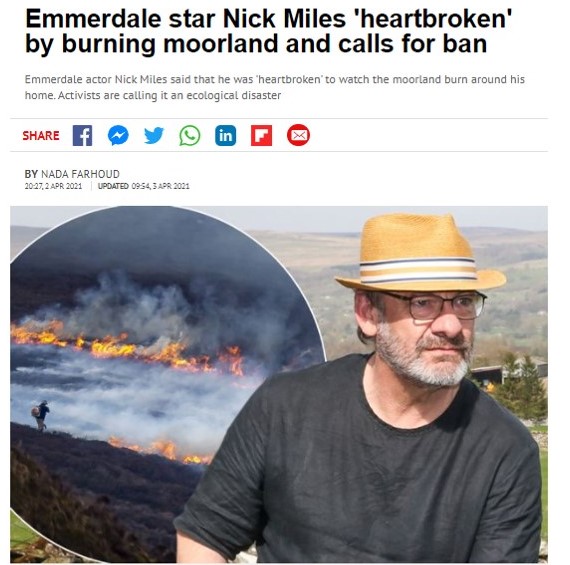
Hot on the heels of her last article on how burning Britain’s moorland is ‘an environmental disaster’ (here), the Daily Mirror’s Environment Editor, Nada Farhoud has a follow up article out today.

This time she interviews Emmerdale actor Nick Miles, who lives in the Yorkshire Dales National Park and has been a long-time supporter of conservation campaigns such as Hen Harrier Day.

Nick talks about his village ‘disappearing under a blanket of smoke’ when the gamekeepers have set the moors alight and how letters to his MP, Rishi Sunak, have fallen on deaf ears.

He also talks about how few red kites he sees in Upper Wharfdale (hardly surprising given its proximity to Nidderdale, where killing red kites on grouse moors is de rigueur) in comparison to Harewood, where Emmerdale is filmed and from where red kites were reintroduced and are doing well.

Read today’s article in the Mirror here (and watch out for the comedy input from Moorland Association Director Amanda Anderson).

Meanwhile in Scotland the fires also continue. I’ve been sent some horrific photographs that were taken in the Angus Glens two days ago – I’ll be publishing those later this weekend.

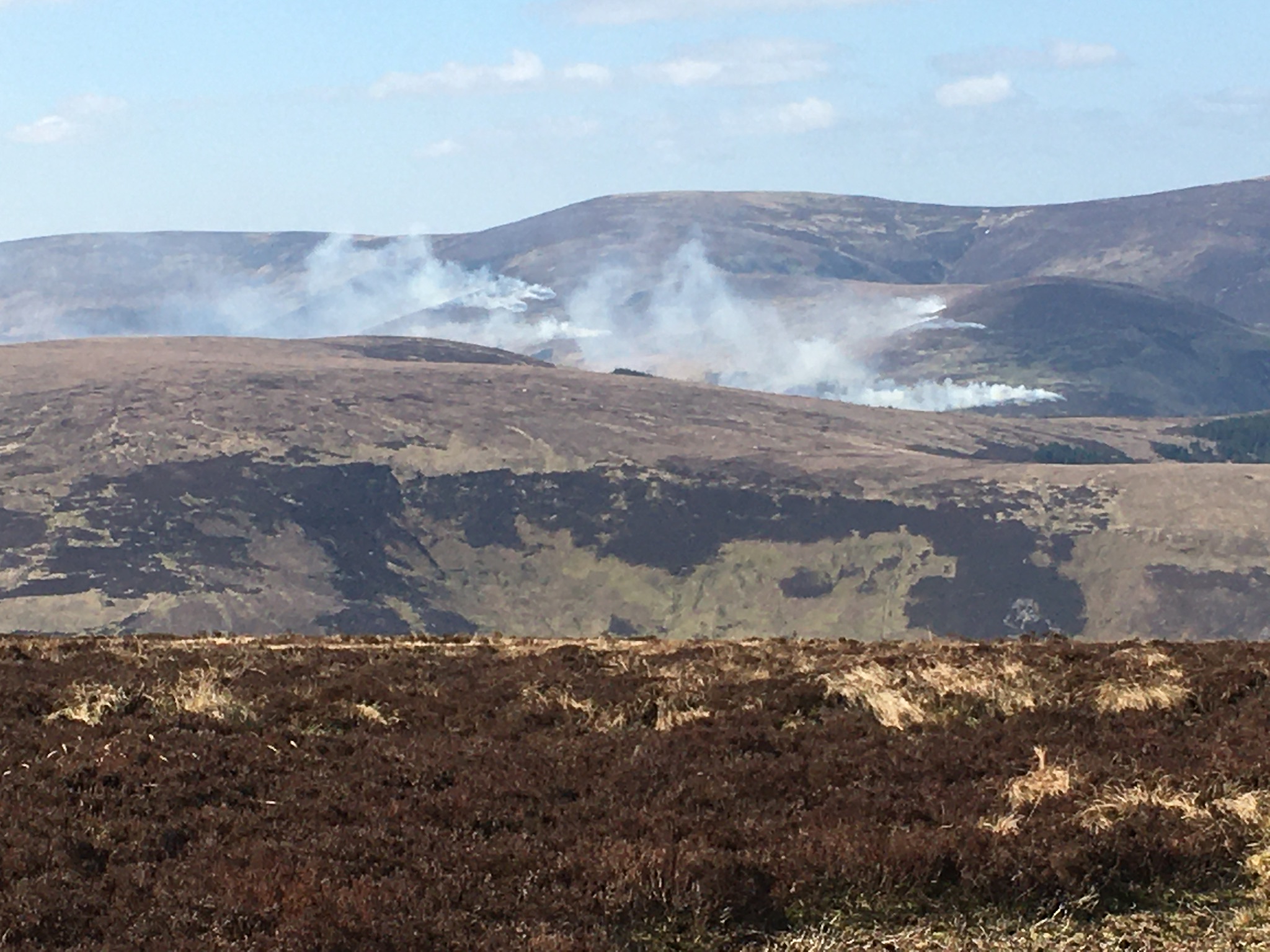
And here’s a photo sent in by another blog reader (thank you) taken yesterday in Manor Valley in the Borders:

It’s astonishing that not only is this burning still legal (although for how much longer remains to be seen) even though we’re in a climate and nature emergency, but that gamekeepers in Scotland can lawfully continue to set the moors alight until 15th April, and then with landowner’s permission can continue to light fires until 30th April.

Still, it’s a cracking wheeze for torching out hen harrier nests, peregrine breeding ledges and golden eagle eyries, which can then be explained away as ‘accidents’ (see here).

Pass the matches.

Peregrine found poisoned on grouse moor in Peak District National Park

Press release from RSPB (2nd March 2021)

Peregrine poisoned in Peak District National Park

A peregrine falcon, which was found dead on a driven grouse moor in the Upper Derwent Valley, has just been confirmed as illegally poisoned following official toxicology analysis – adding to the growing list of protected birds of prey illegally killed during 2020’s spring lockdown – many of which were in the Peak District National Park.

The adult male bird was found dead, on top of the remains of a wood pigeon, on 31 May 2020 by a fell runner on National Trust land. This was close to a known nest site which, like several other sites in the Dark Peak, has a long history of poor breeding success.

[The poisoned peregrine, photo by the Peak District Raptor Monitoring Group]

It was reported to Derbyshire Police, who recovered the carcass assisted by raptor workers, and the body was submitted for government toxicology testing. The results have just been published and confirm that the peregrine was illegally poisoned with the toxic insecticide bendiocarb: a substance we know is illegally used to kill birds of prey.

Mark Thomas, Head of RSPB Investigations, said: “This latest incident adds to an appallingly long and growing list of crimes against birds of prey which took place during the first national Covid lockdown in 2020. At the time, the RSPB was working flat-out with police to investigate a high volume of incidents, the details of which are now beginning to emerge.

It is clear that certain criminals took lockdown as an excuse to ramp up their efforts to kill birds of prey, wilfully ignoring lockdown and the laws which protect these birds.

Time and again, we are seeing birds of prey shot, trapped or poisoned on grouse moors. The link between illegal killing of peregrines and other raptor species and driven grouse shooting has never been clearer, and we urge the UK government to implement a licensing system for grouse moors in England, as is proposed in Scotland. Law-abiding estates would have nothing to fear from this, and it would act as a greater deterrent, keeping birds safe, in the sky, for all to enjoy.”

Peer reviewed studies, crime data and court convictions show that raptor persecution is more concentrated on and near driven grouse moors, where birds of prey are seen by some as a threat to commercially managed red grouse stocks. In fact, a recent paper statistically linked crimes against birds of prey in the Peak District National Park with land managed for Driven Grouse Shooting.

It is believed that the wood pigeon was a poison bait, laid deliberately with the intention of killing any bird of prey or raven which fed on it.

Steve Downing, Chair of the Northern England Raptor Forum, said: “Incidents like this are sadly not uncommon in the Dark Peak, where peregrine populations have crashed in recent years. What’s more, a poison bait like this, on open-access land, could easily be picked up by someone’s dog with disastrous consequences.”

Jon Stewart, National Trust General Manager, said: “We protect and care for places so nature and people can thrive. In a year when three pairs of peregrine successfully raised young on Trust land in the Dark Peak, half of all successful pairs on the Peak District moors, we were very upset to hear of this incident.

We continue to work closely with the RSPB, police and statutory agencies to take action to combat wildlife crime. We urge anyone with relevant information about this incident to contact the police and help end the illegal persecution of birds of prey.’’

All birds of prey are protected by the Wildlife and Countryside Act 1981. To intentionally kill or injure one is a criminal offence and could result in an unlimited fine or up to six months in jail.

If you have any information relating to this incident, call Derbyshire Police on 101.

If you find a wild bird of prey which you suspect has been illegally killed, contact RSPB Investigations on crime@rspb.org.uk or fill in the online form: www.rspb.org.uk/birds-and-wildlife/advice/wild-bird-crime-report-form/

If you know of someone killing birds of prey, please don’t stay silent: call the confidential Raptor Crime Hotline on 0300 999 0101.

ENDS

This latest crime should come as no surprise whatsoever to anyone even vaguely familiar with the Dark Peak area of the Peak District National Park. Dominated by driven grouse moors, this Park is notorious for raptor persecution and has been for decades, particularly impacting on goshawk and peregrine populations (e.g. see here), despite all the years of so-called ‘partnership’ efforts that have led to…..well, nothing but more of the same.

What is disappointing is that the poisoned bait and the dead peregrine were found on National Trust land – the NT has worked hard in the Park to restore raptor populations, even booting off a prominent sporting tenant three years ago (see here).

The press release is interesting, though. Once again, Derbyshire Police are conspicuously absent, the RSPB has had to lead on the publicity, and once again there has been a ridiculously long time lag between the commission of the crime and the publicising of it. There was a similar case in Derbyshire not so very long ago (see here) when this police force said that the circumstances of a poisoned buzzard being found dead next to a poisoned bait were ‘inconclusive’!

The 10-month time delay in publicising this latest poisoning case is very poor. The peregrine was found poisoned in May 2020 and the public isn’t made aware until March 2021? Now, we all know that Covid has had an impact on laboratory work and that’s unavoidable but I don’t believe for one second that it has taken the WIIS lab this long to produce the results. I think there’s more to it than that and I just wonder whether Derbyshire Police have played a role in the delay.

Something isn’t right and it needs sorting out, pronto.

UPDATE 11.30hrs: Mark Thomas, Head of RSPB Investigations has just tweeted:

‘The falcon was found on top of a plucked Wood Pigeon on National Trust land. Despite the investigation being closed, Derbyshire Police declined the opportunity to put this release out, we feel it is critical that the public are made aware due to the risk to them and their dogs‘.

I’ve asked Derbyshire Police’s Rural Crime Team, and the Chief Constable, why they refused to publicise this crime. Not only are there obvious public safety concerns but wildlife crime is supposed to be national wildlife crime priority.

Responses awaited.

Trial date set as man pleads not guilty to theft of peregrine eggs in Peak District National Park

A trial date has been set after a 60-year-old man pleaded not guilty yesterday to charges relating to the alleged theft of peregrine eggs in the Peak District National Park in Derbyshire last spring (see here).

Proceedings were brought following an investigation by Derbyshire Constabulary, supported by video evidence provided by the RSPB.

A trial date has been set for 28th July 2021.

NB: As this is a live case comments won’t be published until criminal proceedings have ended, thanks.

Wildlife crime on grouse moors in the Peak District National Park – an illustrated talk by Bob Berzins

Bob Berzins is a conservation campaigner who has spent a number of years highlighting the ecological damage caused by grouse-shooting interests on the moors of the Peak District National Park (e.g. see guest blogs he’s written for Mark Avery here, here, here, here, here, here, here and here).

Regular blog readers will be well aware that the Peak District National Park has been identified as a hotbed of illegal raptor persecution for many years (e.g. see here) and this reputation continued, in and around this National Park (!) even when the country was in lockdown last spring (see here).

[A shot buzzard found critically injured at Rushup Edge, near Mam Tor in the Peak District National Park on 13th January 2020. It had to be euthanised. Photo via Derbyshire Constabulary]

Bob’s willingness to speak out about his findings on these Peak District grouse moors has led to him being targeted, like so many of us, by a campaign of harassment and intimidation from members of the grouse shooting industry, presumably in an attempt to silence him.

It’s a measure of the man that he hasn’t quietly slinked off, even in the face of the most malicious abuse, but has instead stood his ground and continued to share his experience and knowledge.

A few days ago he gave an illustrated presentation (online, of course) to the Sheffield Green Party. His talk was entitled ‘Wildlife Crime in the Peak District’ and it’s now available to watch on YouTube:

Derbyshire man due in court in February for alleged theft of peregrine eggs in Peak District

Earlier this year Derbyshire Constabulary reported the theft of peregrine eggs from three different nests in the Peak District National Park (see here).

[Photograph by Barb Baldinger]

Ten days ago the police wrote on Facebook that an unnamed man had been charged in connection with the egg theft and also for a firearms offence. The suspect was identified after the RSPB had filmed an individual robbing one of the nests (see here).

This afternoon Derbyshire Constabulary issued a more formal statement on its website, as follows:

Man charged for theft of Peregrine Falcon eggs

A man has been charged with theft in connection with an incident in the spring where Peregrine Falcon eggs were allegedly stolen in the Peak District.

John Fenton, of Bridgemont, Whaley Bridge, was charged with the offence following an investigation by the Derbyshire Rural Crime Team and work by the RSPB.

It follows an incident in the Stoney Middleton area in May earlier this year.

Detective Constable Paul Flint of the Derbyshire Rural Crime Team said: “We take all reports of wildlife crime seriously and will seek to take action against offenders. This is a senseless crime and will not be tolerated. We would like to thank the RSPB for their support throughout.”

The 60-year-old is due to appear before magistrates at Chesterfield Justice Centre in February next year.

ENDS

As this is a live prosecution no comments will be published until criminal proceedings have ended.

UPDATE 20th February 2021: Trial date set as man pleads not guilty to theft of peregrine eggs in Peak District National Park (here)

Police raid property in poisoned peregrine investigation

At the end of October 2020, South Yorkshire Police published an appeal for information in relation to an investigation into the illegal poisoning of a young peregrine that had been found in Barnsley on 4th July 2020. Toxicology tests confirmed it had been killed with the highly toxic poison, Bendiocarb (see here).

[The poisoned peregrine. Photo via South Yorkshire Police]

Today, South Yorkshire Police has raided a property, under warrant, and seized what have been described as ‘a number of suspicious items’.

Here’s the police press release:

Warrant executed in connection to poisoned bird

A warrant has today (17 November) been executed at a property in Barnsley in connection to the poisoning of a protected wild bird.

Last month officers appealed for your help in finding those responsible for poisoning a juvenile peregrine falcon in the Fish Dam area of Barnsley.

Intelligence from the public assisted officers from the Barnsley Central Neighbourhood Team, the force’s Wildlife and Rural Coordinators, Crime Scene Investigation and members of the RSPB to carry out a search of a property on Abbots Road, under the Wildlife and Countryside Act 1981.

[‘Officers briefing before the warrant at Ring Farm, Cudworth’. Photo via South Yorkshire Police]

PC Fran Robbs de la Hoyde explains: “Peregrine Falcons are an important part of our local ecosystems, and are protected under The Wildlife and Countryside Act 1981.

“It is a shame that someone would wish to harm these animals in such a deliberate act. The bird is believed to have ingested bait laced with toxic substances.

“This morning we executed a warrant and found a number of suspicious items. Enquiries into persons involved in the offence are ongoing.

“We are committed to protecting our wildlife and will ensure that those responsible are brought before the courts.”

We are stronger with our communities help and we are always grateful for those who take the time to read, respond and share information in which they have to help officers with their enquiries.

ENDS

NB: As this is a live investigation comments won’t be published until criminal proceedings have ended.

Man charged in relation to alleged theft of peregrine eggs in Derbyshire Peak District

Earlier last year Derbyshire Constabulary appealed for information after a pair of peregrines in the Peak District abandoned their breeding attempt in suspicious circumstances (see here).

It was later reported that eggs had been stolen from three peregrine nest sites in the Peak District this spring (see here) and officers from Derbyshire Constabulary believed they were being stolen for the Middle Eastern falconry trade.

Earlier this evening Derbyshire Constabulary issued a statement on Facebook, as follows:

Things sometimes take a while to come to fruition in our job, but two of our lengthy investigations have finally reached the point where people can be charged and summoned to court to answer for their actions.

The first involves the theft from a farm in the Bradwell area of a collection of vintage tractor parts which were part of a long-term project and labour of love on the part of the owner. Many of the parts were recovered and a salvage business underpinned by crime operating in neighbouring South Yorkshire was uncovered. The recovery of some stolen car parts from Buxton was a bonus too.

Our regular followers will know that we’ve invested a lot of time and effort into the problem of bird of prey persecution and trying to fathom where these illegally taken eggs are ending up and who’s involved. We were very pleased, therefore, back in the spring when we were presented with excellent video evidence of someone taking some peregrine falcon eggs from a breeding site in the Peak District. Thanks to the power of social media helping to identify the suspect we embarked on another long investigation which has now yielded charges, not only for the egg taking offences but for a firearms offence too.

Whilst this is very encouraging for us and those others we work with it doesn’t mean we’ve cracked it. Quite the opposite, in fact, and we’ll be putting next season’s plan together over the coming weeks.

ENDS

Well done, Derbyshire Constabulary.

Shame the RSPB wasn’t credited for providing the covertly-filmed footage, though.

NB: As this is a live prosecution comments won’t be published until criminal proceedings have concluded.

UPDATE 17 November 2020: Derbyshire man due in court in February for alleged theft of Peregrine eggs in Peak District (here)

Peregrine fatally poisoned in Barnsley: South Yorkshire Police appeal for information

Press release from South Yorkshire Police (26 October 2020)

Information sought following the poisoning of a protected bird

Officers investigating reports of a bird of prey being deliberately poisoned are appealing for your help to find those responsible.

On Saturday 4 July officers found a juvenile peregrine falcon in ill health in the Fish Dam Lane area of Barnsley, the bird sadly died a short time later.

[The poisoned peregrine, photo via South Yorkshire Police]

Initial assessment of the bird indicated that it could have been poisoned. Following a forensic examination by the Wildlife Investigation Scheme it has now been confirmed that the bird had been poisoned with Bendiocarb, a highly toxic substance.

Peregrine falcons are protected under Sec1 of The Wildlife and Countryside Act 1981.

Investigating Officer PC Fran Robbs De La Hoyde said: “It is believed the poisoned peregrine falcon ingested bait laced with the poison which was deliberately set out to target the bird.

“There is nothing to suggest that this bait was laid in open land.

“This was a deliberate act that caused the death of a beautiful and protected bird. I am saddened by this and I am asking for your help to bring those responsible to justice.”

Tom Grose, RSPB Investigations Officer, said: “It’s always a privilege to catch a glimpse of a peregrine. The fastest birds in the world, they are highly adaptable creatures and often make their homes in urban areas these days.

“Bendiocarb is one of the most commonly-abused substances for killing birds of prey and we have sadly seen it used for this purpose on many occasions. It is illegal to kill these birds, and we urge anyone with information to come forward.”

Poisons commonly used to commit a crime like this are incredibly toxic to humans and pets. Should any person locate any dead or injured birds they are strongly advised not to touch them or let pets come into contact with them.

If you have any information that can help officers please call 101 and quote crime reference number 14/104692/20.

Alternatively, you can stay completely anonymous by contacting the independent charity Crimestoppers via their website Crimestoppers-uk.org or by calling their UK Contact Centre on 0800 555 111.

SYP are committed to the investigation of serious wildlife offences, including the poisoning of birds of prey.

ENDS

UPDATE 17 November 2020: Police raid property in poisoned peregrine investigation (here)

Two peregrines fatally poisoned in North Yorkshire: police appeal for information

Press release from North Yorkshire Police (21st October 2020)

Police appeal for information after peregrine falcons found dead near Tadcaster

Analysis finds carcasses containing pesticides

North Yorkshire Police is appealing for information following investigations into the death of two peregrine falcons found at a quarry near Stutton, Tadcaster.

[Photos by Guy Shorrock]

A member of the public who had been observing the mating pair of birds, found a male bird dead on a cliff ledge and following investigation by the RSPB and North Yorkshire Police to recover the carcass, a deceased female peregrine falcon was located in the bottom of the quarry.

Both birds were sent away for testing which confirmed high levels of Bendiocarb in their systems and this was found to be the cause of death. The male bird was found next to a pigeon carcass which it is believed may have been used as bait.

Bendiocarb is licensed for use as a pesticide in England but is highly toxic and should never be released into the environment where wildlife, such as birds of prey, could be exposed to it. The pesticide has been found used to kill birds of prey in North Yorkshire previously and as such, police believe this was a deliberate act of poisoning.

North Yorkshire Police Inspector Matt Hagen said:

“Poisoning a bird of prey is a crime and it is saddening each time we have another incident reported to us. Every investigation is thoroughly carried out with all lines of enquiry followed to try and find those responsible, but we cannot do this without the public’s help, please be our eyes and ears and report this type of incident to the police.

“I’m urging anyone who has any information about bird of prey persecution to get in touch with the police, someone out there knows who is committing these crimes and we need that information to ensure they are stopped.”

Despite extensive investigations, police have yet to identify those responsible for misusing this toxic substance. Anyone with information about this incident should contact North Yorkshire Police quoting reference 12200057190.

If you wish to remain anonymous, you can pass information to Crimestoppers on 0800 555 111.

ENDS

These peregrines were found poisoned six months ago in April 2020. There is no explanation given for the delay in publicising this crime but it is likely to do with long delays at the toxicology lab caused by the Coronavirus lockdown. It’s understood there is still a backlog of samples waiting to be analysed.

Birds of prey illegally poisoned in Staffordshire/Peak District National Park

It just never bloody stops.

Do you remember way back in May, during lockdown, Staffordshire Police asked the public to be vigilant after the discovery of a dead buzzard and two dead peregrines in the Peak District National Park? Officers suspected those protected raptors had been illegally poisoned and the corpses were sent for toxicology (see here).

Then in early June another peregrine was found dead in suspicious circumstances and that, too, was sent for toxicology analyses (see here).

[One of the illegally poisoned peregrines. Photo by Staffordshire Police]

Well guess what? The toxicology results are in and all four raptors were illegally poisoned with the same (unnamed) pesticide, and at least two of the incidents involved a pigeon bait which had been laced with the pesticide.

These illegal raptor poisonings are in addition to the confirmed illegal poisoning of a buzzard and a kestrel in Derbyshire at the beginning of lockdown (see here) and a shot buzzard found with horrific injuries in the Peak District National Park during the middle of lockdown (see here).

Staffordshire Police has issued a press statement about the latest four killings, as follows:

£1,000 reward for information after birds of prey poisoned

Reward offered for information after bird of prey poisoning incidents in Staffordshire during Covid lockdown.

The Royal Society for the Protection of Birds (RSPB) has offered a £1000 reward for information leading to a conviction after four birds of prey were found dead in Staffordshire.

The appeal follows three separate incidents over a three-week period during Covid lockdown. 

On Saturday 16 May, a common buzzard and peregrine falcon were sadly discovered dead in a wooded area of Longnor. On Tuesday 19 May a second peregrine falcon was found dead at Beeston Tor near Wetton. On Thursday 4 June, a third peregrine falcon was found dead in a quarry near Waterhouses. 

[The latest poisoning victims. Photos via Staffordshire Police]

Two of the incidents occurred in the Peak District National Park, and a few of the locations are believed to be near peregrine falcon breeding sites.

As there were no visible signs of injury, and following contact with Natural England the birds were submitted for post mortem examinations and toxicology tests to establish the cause of death as part of the Wildlife Incident Investigation Scheme (WIIS). The scheme investigates the death or injury of wildlife and companion animals that may have resulted from pesticide poisoning.

The results show that all four birds of prey were illegally poisoned by the same pesticide, and that at least two of the incidents involved a pigeon bait which had been laced with the pesticide. 

A police investigation into the circumstances is underway as all birds are protected by the Wildlife and Countryside Act 1981. To kill or injure one is a criminal offence and could result in an unlimited fine and/or up to six months in jail.

Officers are asking local residents and visitors to these areas to report any suspicious behaviour they may have witnessed in the days leading up to the discovery of the birds and to continue to be vigilant for the signs of criminal activity, including dead or injured birds, poisoned bait and traps.

Detective Inspector Tim Boulton, of the Staffordshire Police Rural and Wildlife Crime Unit, said: “To find out that these birds have been deliberately targeted and poisoned is truly dreadful. We are working to ensure those responsible are identified and brought to justice. 

“It is extremely concerning that a harmful substance has been placed in the countryside putting not only wildlife, but also people and pets at risk too. 

“If a member of the public comes across a dead bird or suspicious object, please do not touch or move anything. Please take photographs if you can and make a note of your surroundings and landmarks to help officers to locate it. Every piece of information may be crucial in prosecuting an offender.

“We would like to thank Natural England and the Peak District Natural Park for their assistance so far and we are incredibly grateful for the reward offered by the RSPB. 

“Any information, no matter how small and insignificant it may seem, could help with our on-going investigation. Someone out there knows who poisoned these birds, so please do the right thing and get in touch with the police directly or any of our specialist partners.”

Mark Thomas, RSPB Head of Investigations, commented “Peregrines are the fastest birds in the world, yet all too often the lives of these magnificent creatures are cut short by illegal persecution like poisoning.

“For incidents like this to repeatedly happen in a National Park is all the more alarming. If you have any information about any of these cases, or if you come across what you believe may be a poisoned bird of prey, please call the police immediately. You are our eyes and ears.”

Sarah Fowler, chief executive of the Peak District National Park, added: “I would to thank those individuals who have reported these incidents to the police, and it remains completely unacceptable that illegal activity against wildlife is taking place in and around the Peak District. The nature of poisoning witnessed in these cases is deeply worrying for species both within and outside our National Park boundary.  

“These incidents are particularly concerning in a year where many birds of prey – including the peregrine falcon – have successfully bred in other areas. We will continue to support the police in their investigations, and welcome any information from the public that may help capture those involved and bring them to justice.”

Dave Slater, Natural England’s Director for Wildlife Licensing and enforcement cases, said: “Raptor persecution is a national wildlife crime priority and a priority for Natural England. We are a committed partner with the Police and NGOs in tackling these despicable crimes. We would urge anyone witnessing or suspecting persecution to contact the police.”

Anyone with any information is asked to call one of the services listed below:

Staffordshire Police: 101 quoting incident number 232 of 16 May. You can also report online at http://www.staffordshire.police.uk/report or by sending a private message to Staffordshire Police on Facebook and Twitter.

Crimestoppers: 0800 555 111

RSPB’s confidential Raptor Crime hotline: 0300 999 0101.

ENDS