Stody Estate subsidy penalties: an update

IMG_4752 (2) - CopyOn 1st October 2014, gamekeeper Allen Lambert from the Stody Estate in Norfolk was found guilty of poisoning 10 buzzards and one sparrowhawk, which had been found dead on the estate in April 2013. He was also convicted of storing banned pesticides & other items capable of preparing poisoned baits (a ‘poisoner’s kit’), and a firearms offence (see here and here).

On 6th November 2014, Lambert was sentenced. Even though the magistrate acknowledged that Lambert’s crimes passed the custody threshold, he only received a 10 week suspended sentence for poisoning 11 raptors (suspended for one year), a six week suspended sentence for possession of firearms and nine poisoned buzzards (suspended for one year), and was ordered to pay £930 prosecution costs and an £80 victim surcharge.

On 5th October 2014, we blogged about the millions of pounds worth of subsidies that had been awarded to Stody Estate in recent years (see here) and we encouraged blog readers to contact the Rural Payments Agency (RPA) to ask whether Stody Estate would receive a financial penalty in the form of subsidy withdrawal for being in breach of the terms & conditions of their subsidy-fest.

On 10th October 2014, the RPA responded by saying they would consider what action could be taken against Stody Estate (see here).

Then it all went quiet.

In December 2014, one of our blog readers submitted an FoI to the RPA to ask what was happening. In January 2015, the RPA responded by saying they ‘weren’t able to provide a meaningful response’ but said they would take action if it was found to be appropriate to do so (see here).

Six months on, we thought it was time for an update so an FoI was sent to the RPA to ask whether they had implemented a subsidy penalty. This is their response:

Dear XXXXX XXXXX

Thank you for your email dated 5 July 2015 regarding Stody Estate.

Cross Compliance rules only apply to recipients of Single Payment Scheme or certain Rural Development scheme payment in the year in which a cross compliance breach is found.

The person prosecuted for the offences mentioned in your e-mail is not a recipient of either of these types of payment.  Therefore before RPA can take further action, it will be necessary to determine whether there [sic] a link between this person and a subsidy recipient and, if there is, whether that recipient can be considered liable for the actions of the person who committed the breaches.

Identifying whether the person prosecuted is linked to a subsidy recipient will form a key part of our investigations.

Should you have any further queries please contact us again quoting reference number XXXXX

Regards

Helen Hunter

Customer Service Centre, Operations

END

This is all very interesting. The mass illegal poisoning of birds of prey took place on Stody Estate and a Stody Estate employee, gamekeeper Allen Lambert, was convicted of these crimes and several others. But the Rural Payments Agency is still trying to determine whether there is a link between Lambert and the Stody Estate. Eh?

It’s not very convincing is it?

Perhaps the RPA should have a read of the judge’s comments about the relationship between Lambert and his (now former) employer – see here.

Gamekeeper’s trial collapses after District Judge rules RSPB covert video “disproportionate”

A Shropshire gamekeeper has been cleared of charges relating to the alleged illegal use of a trap after the District Judge pronounced the RSPB’s use of covert surveillance “disproportionate”.

Neil Wainwright had been accused of using a Larsen trap, illegally baited with two live quails, to trap birds of prey. The trap, set near to a pheasant pen, had been seen by an RSPB investigator (whilst walking on a public right of way), who had returned the following day to install covert video (on private land) to determine the identity of the trap user.

Footage from the camera had identified Wainwright, who was also reportedly seen carrying a dead buzzard. The RSPB then alerted the police who began an investigation, resulting in the Crown Prosecution Service taking the case to court.

This case featured several court hearings, and during one of these Wainwright had admitted using the trap baited with live quail but had claimed he was targeting mink, not birds of prey. So his use of the trap wasn’t in question (because he hadn’t denied using it); just his purpose for using it (which was the basis for some of the charges against him).

It’s very strange then, that the District Judge, Kevin Grego, should then exclude the video evidence and claim its use to be “disproportionate” because the RSPB didn’t have the landowner’s permission to film there. This implies that the RSPB should have sought the landowner’s permission, which would have been a complete non-starter because for all they knew, the landowner and/or the agent may have been complicit with any alleged offences so asking for permission to film would have defeated the objective of filming. It may also imply that the judge thought that the RSPB should have approached the police before setting the camera. However, for the police to have been involved they would have needed to seek authority to film under the Regulation of Investigatory Powers Act 2000. The chances of them getting that authority for what may be considered a minor offence (in terms of the scale used to categorize the seriousness of all crimes, not just wildlife crimes) on private land would be pretty slim.

In which case, any trap user intent on illegal activity to trap and kill birds of prey on private land can be assured that the chance of being prosecuted is virtually non-existent. In other words, they’re untouchable.

This is the second time this year that RSPB video footage in relation to the alleged mis-use of a trap by a gamekeeper has been ruled inadmissible in England – see here for earlier case. These are interesting developments because covert video footage has long been accepted as admissible in the English courts, as opposed to the difficulty of having it accepted by the Scottish courts. And although neither of these two recent cases set a legal precedent, you can bet your house that defence lawyers in future English cases will be pointing to these findings as they try to justify having similar evidence dismissed.

These examples serve to demonstrate, once again, just how high the odds are stacked against securing a conviction for wildlife crimes that take place in relatively remote areas where direct witnesses are few and far between.

Wainwright’s case wasn’t a complete failure though. He was convicted of three other offences which wouldn’t have come to light without this investigation in to the alleged mis-use of the trap: failure to properly store ammunition (two offences, for which he was fined a total of £300) and failure to store a dangerous chemical securely (Phostoxin, a highly toxic fumigant used to gas moles, rabbits etc) which was found in his vehicle (one offence, for which he was fined £200). He was also ordered to pay £85 costs and a £30 surcharge.

Previous blogs on this case here, here and here.

BBC news article on Wainwright’s trial here

Environment Minister hails Scotland’s wildlife killers

The world’s gone bonkers.

A few days ago we had Scottish Natural Heritage, the Government’s statutory nature conservation body, promoting Scotland’s dead wildlife pantry and the grouse shooting industry, claiming that red grouse are ‘healthy’, natural’ and harvested ‘sustainably’ when actually they’re anything but (see here).

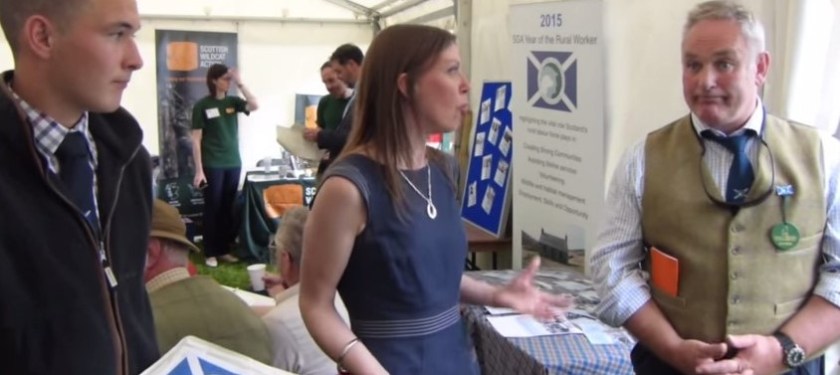
And now we have Scotland’s Environment Minister, Dr Aileen McLeod, praising “the significant and valuable contribution” of the Scottish Gamekeepers’ Association as she presented the SGA’s Young Gamekeeper of the Year Award 2015 at the Scottish Game Fair yesterday. Here’s what she had to say:

I just want to say, obviously, thank you very much, Alex [Hogg], and I’m absolutely delighted to be invited here this afternoon, this is obviously my first time I’ve ever been to the game fair as well so I’m really delighted to be here, the opportunity to be next to Alex and this young man as well [Duncan Seaton, the recipient of the award], so also I just thought it’d be a good opportunity just to thank the Scottish Gamekeepers’ Association for all the long term support which you have provided to Scottish Government in various areas of policy, development and implementation and making sure we are implementing best practices of conservation and wildlife and wildlife management and I think to be really honest without your guys significant and valuable contribution to the management of Scotland’s countryside, we really wouldn’t have the world famous landscapes which many people from home and abroad enjoy which makes such a valuable contribution to Scotland’s rural economy“.

You can watch the video here.

No mention, then, of the hundreds of thousands of native animals that are snared, trapped and shot on an industrial scale every year by gamekeepers to ensure that an artificially high surplus of game birds (some non-native) is available to be, er, shot? And that’s just the legal killing. No mention either of the illegal poisoning, trapping, shooting and beating to death of protected wildlife, particularly birds of prey, which we know takes place on a significant scale because it affects the population range of a number of species; that doesn’t happen on that scale if it’s ‘just a few rogues at it’.

We’ve been waiting for Dr McLeod to show her hand since she first took office last November. It looks like she just has.

McLeod SGA Game Fair 2015

Trial against gamekeeper Neil Wainwright gets underway

The trial against Shropshire gamekeeper Neil Wainwright got underway on Tuesday.

Wainwright, 55, of Norbury, Bishop’s Castle, is accused of baiting a Larsen trap with live quail to catch birds of prey. The offences are alleged to have taken place at Birch Hill Wood in Gatten, Stipperstones, in July 2014. Wainwright has denied these charges, but at an earlier hearing pled guilty to three other charges relating the storage of firearms, ammunition and poison (see here and here).

According to an article published yesterday in the Shropshire Star (see below), Wainwright’s defence is that he was using the Larsen to trap a mink, not birds of prey.

We always enjoy reading the far-fetched explanations of gamekeepers who have been accused of alleged wildlife crimes. Rarely plausible, they often push the boundaries of credibility. Recently-convicted Kildrummy Estate gamekeeper George Mutch’s explanation was a classic – he claimed he’d killed the goshawk he’d caught in his Larsen trap as a mercy mission because it was injured. The Sheriff in that case called it “a convenient lie”. Recently-convicted Swinton Estate gamekeeper Ryan Waite claimed the two illegal pole traps he’d set were for targeting squirrels, not raptors. Recently-convicted Stody Estate gamekeeper Allen Lambert claimed the 11 poisoned raptors found on his estate had been dumped there by someone with a vendetta against him.

It’s not just gamekeepers, either.

Following the discovery last month of 16 fox cubs found inside a barn in North Yorkshire in suspicious circumstances, Lord Middleton, a local landowner and hunstman reportedly suggested that the cubs ‘were being cared for by the Hunt for kind reasons’ (see here).

Wainwright’s trial will continue on 29th June 2015.

The Shropshire Star published an article yesterday about the first day of the trial although the article has now vanished from their website. Here’s a copy:

From Shropshire Star 17 June 2015

Neil Gordon Wainwright a gamekeeper used a metal Larsen trap designed to catch magpies, crows and jays he had baited with two live white quail to catch birds of prey at Birch Hill Wood in Gatten, near the Stiperstones, Shrewsbury, Magistrates Court were told by the RSPB. An inspector for the Royal Society for the Protection of Birds noticed the trap while walking on a public way and set up two covert cameras to record who came to attend to it.

Wainwright, 55, of Norbury, near Bishop’s Castle, denies charges of using a trap to kill or take a wild bird, possessing an article capable of being used to commit an offence, and failing to take steps to ensure that the needs of an animal were met.

The offences are said to have taken place between July 21 and 31 last year.

District judge Kevin Grego heard yesterday that an RSPB inspector had visited Birch Hill Wood on July 23 and believed that an offence was being committed.

Mr Richard Davenport, prosecuting, told the court that the inspector noticed that a Larsen trap had been baited with two white quails and set close to a pheasant release pen.

Howard Jones, RSPB inspector, said he had been walking on a public right of way when he saw the pheasant pen. He found the Larsen trap and then returned a day later to install the cameras.

Mr Jones said he and another inspector had checked the footage and over the course of several days the defendant was seen going to the trap.

At one point Wainwright was seen with a dead buzzard in his hands. The incidents were reported to the police and a warrant to search Wainwright’s home and outbuildings was carried out on August 5. Expert witness Dr Rodney Calvert, from Natural England and a specialist on trapping, said he had never known of a Larsen trap being used to catch anything other than crows or magpies.

Wainwright’s defence is that he was using the trap to catch mink and stoats which had been taking his game birds.

Dr Calvert said that using live quail as bait would not attract such animals but would be likely to attract wild birds.

Wainwright, who has several captive peregrine falcons and an owl at his home, said he had used the quail as bait “as an act of desperation”. He said he had been targeted by a mink and had decided to bait the trap to try and catch it.

The trial was adjourned until June 29 and will be heard at Telford Magistrates Court.

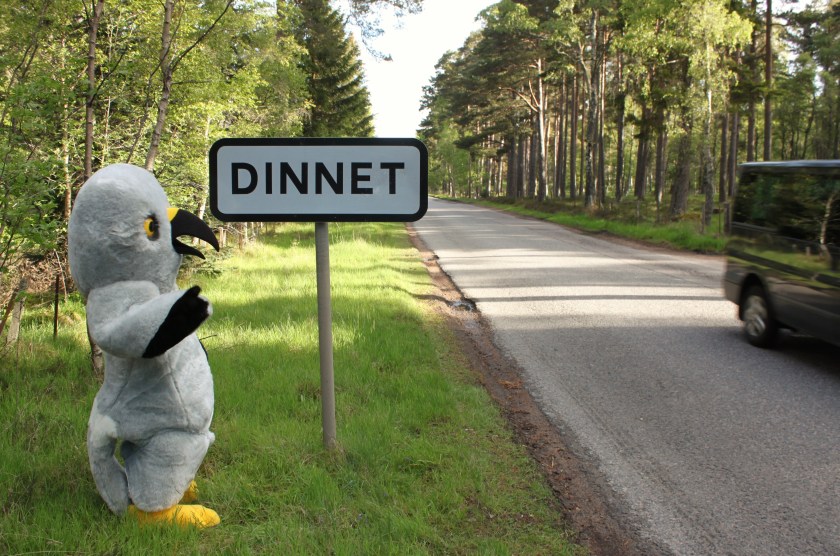
Henry’s tour day 45: Dinnet

Tues 16 June  Copy

Henry called in at Dinnet (Deeside) but would only visit in daylight hours – here’s why.

It’s actually not all that safe in the daytime either – here’s why.

Welcome to the Cairngorms National Park.

Judicial review: awaiting written decision

The judicial review brought by a Northumberland gamekeeper to question whether Natural England followed due process when they refused to give him licences to kill buzzards and sparrowhawks, has finished.

We now await the written decision of the judge, which can take weeks.

Useful background information about the judicial review process here and here.

Judicial review underway for gamekeeper who wants to kill buzzards

An important judicial review is underway at the High Court this week. It concerns the legal question about whether Natural England acted fairly when it refused licences to a gamekeeper to allow him to kill buzzards and sparrowhawks to protect his pheasants.

The JR has been brought by Northumberland gamekeeper Ricky McMorn and is backed by the National Gamekeepers’ Organisation.

Article in the Chronicle here.

We’ve blogged extensively about this over the last three years. See here for earlier posts, which include discussions about whether DEFRA/Natural England should entertain a licence application from a gamekeeper with a previous conviction for possession of a banned poison (apparently that’s not a problem), whether the National Gamekeepers’ Organisation should expel a member with a conviction for possession of a banned poison (apparently not), and whether there’s any scientific evidence to demonstrate buzzards (and sparrowhawks) have a substantially detrimental effect on game bird shoots (there isn’t).

Henry’s Tour day 42: Leadhills

Thurs 11th June Copy

Henry went with an armed escort to visit Leadhills in South Lanarkshire.

He looks a bit distressed. Perhaps he was being deafened by the booming gas guns that have recently been deployed on the grouse moors of the Leadhills (Hopetoun) Estate.

Or perhaps he’d just been told about the long list of wildlife crimes that have been discovered in this corner of South Lanarkshire; 46 confirmed since 2003, but only two resulting in successful convictions (2004 – Leadhills Estate gamekeeper convicted of shooting a short-eared owl; 2009 – Leadhills Estate gamekeeper convicted of placing out a poisoned rabbit bait).

Here’s the list, all from Leadhills unless otherwise stated:

2003 April: hen harrier shot [prosecution failed – inadmissible evidence]

2003 April: hen harrier eggs destroyed [prosecution failed – inadmissible evidence]

2004 May: buzzard shot [no prosecution]

2004 May: short-eared owl shot [gamekeeper convicted]

2004 June: buzzard poisoned (Carbofuran) [no prosecution]

2004 June: 4 x poisoned rabbit baits (Carbofuran) [no prosecution]

2004 June: crow poisoned (Carbofuran) [no prosecution]

2004 July: poisoned rabbit bait (Carbofuran) [no prosecution]

2004 July: poisoned rabbit bait (Carbofuran) [no prosecution]

2005 February: poisoned rabbit bait (Carbofuran) [no prosecution]

2005 April: poisoned buzzard (Carbofuran) [no prosecution]

2005 June: poisoned rabbit bait (Carbofuran) [no prosecution]

2005 June: poisoned rabbit bait (Carbofuran) [no prosecution]

2006 February: poisoned buzzard (Carbofuran) [no prosecution]

2006 March: poisoned buzzard (Carbofuran) [no prosecution]

2006 March: poisoned pigeon bait (Carbofuran) [no prosecution]

2006 April: dead buzzard (persecution method unknown) [no prosecution]

2006 May: poisoned rabbit bait (Carbofuran) [no prosecution]

2006 May: poisoned rabbit bait (Carbofuran) [no prosecution]

2006 May: poisoned egg baits (Carbofuran) [no prosecution]

2006 June: poisoned buzzard (Carbofuran) [no prosecution]

2006 June: poisoned raven (Carbofuran) [no prosecution]

2006 June: 6 x poisoned rabbit baits (Carbofuran) [no prosecution]

2006 June: poisoned egg bait (Carbofuran) [no prosecution]

2006 September: 5 x poisoned buzzards (Carbofuran) [no prosecution]

2006 September: poisoned rabbit bait (Carbofuran) [no prosecution]

2006 September: poisoned rabbit bait (Carbofuran) [no prosecution]

2007 March: poisoned buzzard (Carbofuran) [no prosecution]

2007 April: poisoned red kite (Carbofuran) [no prosecution]

2007 May: poisoned buzzard (Carbofuran) [no prosecution]

2008 October: poisoned buzzard (Carbofuran) [listed as ‘Nr Leadhills’] [no prosecution]

2008 October: poisoned rabbit bait (Carbofuran) [listed as ‘Nr Leadhills’] [no prosecution]

2008 November: 3 x poisoned ravens (Carbofuran) [listed as ‘Nr Leadhills’] [no prosecution]

2009 March: poisoned rabbit bait (Carbofuran) [no prosecution]

2009 March: poisoned raven (Carbofuran) [no prosecution]

2009 April: poisoned rabbit bait (Carbofuran) [gamekeeper convicted]

2009 April: poisoned magpie (Carbofuran) [no prosecution]

2009 April: poisoned raven (Carbofuran) [no prosecution]

2010 October: short-eared owl shot [no prosecution]

2011 March: illegally-set clam trap [no prosecution]

2011 December: buzzard shot [no prosecution]

2012 October: golden eagle shot (just over boundary with Buccleuch Estate) [no prosecution]

2013 May: shot otter found on estate [no prosecution]

2013 June: significant cache of pre-prepared poisoned baits found on estate [no prosecution]

2013 August: red kite found shot and critically-injured in Leadhills village [no prosecution]

2014 February: poisoned peregrine (Carbofuran) [‘Nr Leadhills’] [no prosecution]

Word has it from a local informant that a suspected shot raven was found on Leadhills Estate in May 2015. Post-mortem results are awaited.

Just a few weeks ago, we were sent footage of a young man dressed in camouflage who was lying on the moor holding a firearm, looking over at a plastic decoy peregrine which had been placed on top of a small mound. When he realised he’d been spotted, he removed the decoy and took off back down the hill on a quad bike. Can’t imagine who that was or what his intentions might have been.

Henry’s tour day 39: Moy Estate

Mon 8 June 2015 - Copy

Henry paid a visit to Moy Estate in the Monadliaths.

Regular blog readers will probably remember what was found on Moy Estate in 2010:

  • A dead red kite in the back of a gamekeeper’s vehicle. It had two broken legs and had died as a result of a blow to the head.
  • The remains of a further two dead red kites.
  • A red kite’s severed leg, along with wing tags that had been fitted to a sateliite-tracked red kite, hidden in holes covered with moss.
  • Six illegal baited spring traps set in the open.
  • A trapped hen harrier (still alive) caught in an illegally set spring trap.
  • A poisoned bait.
  • Four leg rings previously fitted to golden eagle chicks found in the possession of a gamekeeper.

A 20-year-old gamekeeper (James Rolfe – straight out of game-keeping college) was charged with possession of the dead red kite and was fined £1,500. No charges were ever brought against anyone for any of the other offences.

Previous blogs on Moy: see here, herehere and here. It’s particularly worth having a look at this, especially in light of recent hen harrier ‘disappearances’ in England. They weren’t necessarily shot (as the grouse-shooting industry keeps telling us) – they could just as easily have been trapped like this (as the grouse-shooting industry keeps forgetting to mention).

The gamekeeper on Moy was convicted four years ago in 2011. Since then, several more satellite-tracked red kites have ‘disappeared’ since their last signals emitted from Moy, and several buzzard and goshawk nests seem to fail each year. It’s quite windy at Moy. It was probably the wind that blew off those rings from the young golden eagles’ legs and blew them straight in to a jar inside the gamekeeper’s house. It was probably the wind that severed the leg of the red kite and then blew it in to a hole on the moor and then blew moss over the hole to cover it. It was probably the wind that blew away the more recent ‘missing’ red kites. It was probably the same wind that blew holes in those buzzard and goshawk nests, too. Still no breeding hen harriers on this estate – yep, must have been blown away.

Word has it that the game management on Moy Estate is being taken over by a sporting agent with whom we’re very familiar. Cue hundreds of thousands of pounds worth of night vision equipment to carry out his particular style of grouse moor management.

Henry left the estate before darkness fell. He lives another day, although he’s still single.

Head keeper on Glenogil Estate rescues red kite

Glenogil RK rescuedThe head gamekeeper on Glenogil Estate has reportedly helped rescue an injured red kite that was hanging upside down in a tree after becoming entangled in string.

Danny Lawson was apparently able to shoot off the branch so the kite fell to the ground. He disentangled the bird and took it to Thrums Veterinary Group in Kirriemuir. The vets say the bird is recovering well and is now being cared for by the SSPCA.

News article here.

Photo by Thrums Veterinary Group