No vicarious liability prosecution for Kildrummy Estate

Last month we blogged about whether anyone from the Kildrummy Estate in Aberdeenshire would face a vicarious liability prosecution for the criminal actions of Kildrummy gamekeeper George Mutch.

Mutch, as you may recall, was convicted in December 2014 for various wildlife crimes he committed on the Kildrummy Estate in August and September 2012, including the trapping of a goshawk which he then beat to death with a stick (see here). In January 2015, Mutch was sentenced to four months in prison; a landmark custodial sentence for a raptor-killing gamekeeper (see here).

In September 2015 we noticed that time was running out for a subsequent potential vicarious liability prosecution because after three years from the date the crime was committed, the case becomes ‘time-barred’ and a prosecution is no longer possible. We decided to ask the Crown Office for information about any pending vicarious liability prosecution (see here) but to be honest, we weren’t expecting much of a response.

However, the Crown Office has surprised us by issuing the following unusually open response:

Wildlife and environmental crime is a priority for the Crown Office and Procurator Fiscal Service. Such cases are investigated and prosecuted by our specialist Wildlife and Environmental Crime Unit, WECU. A report was submitted by the police against George Mutch alleging the unlawful taking and killing of birds of prey by him at Kildrummy Estate, Aberdeenshire in dates in August and September 2012 and considered by WECU. Following further investigation, a criminal prosecution was raised. Mr Mutch pled not guilty but was convicted of the offences after trial and in January 2015 he was sentenced to four months imprisonment.

Despite further investigations including investigations which focused on establishing vicarious liability, no-one else has been reported to COPFS in relation to the events which took place in Kildrummy Estate in 2012 and accordingly, no further prosecution, including any prosecution for a vicarious liability offence, has taken place“.

FAILSo, just to be clear, a vicarious liability prosecution is not underway, and as this case has now become time-barred (because the offences were committed in Aug/Sept 2012), as we understand it there won’t be a vicarious liability prosecution for this case in the future. Massive fail.

This will be a huge disappointment to all those who have been following this particular case, and especially for those who worked so hard to secure the initial conviction of Mutch. But perhaps more importantly, this is yet further evidence that the new and much-lauded Government measures to tackle raptor persecution are simply not working as well as they should be.

So what went wrong, and what are the potential ramifications for future vicarious liability prosecutions?

Let’s go back to that statement from the Crown Office, and particularly the first part of the sentence in the last paragraph:

Despite further investigations including investigations which focused on establishing vicarious liability, no-one else has been reported to COPFS…..”

It’s clear from this that attempts were made to identify somebody for a vicarious liability prosecution. There are at least three possible explanations for what happened next:

  1. An individual was identified but they were able to show that they had exercised ‘due diligence‘ in that they had written records demonstrating that they did not know the offences were being committed AND they had taken all reasonable steps AND exercised all due diligence to prevent the offences being committed. This is possible, of course, but in this particular case is fairly implausible given that during the trial, Mutch was asked, quite pointedly by the Fiscal Tom Dysart, whether he had received training [from his employer/supervisor] for the use of his traps, to which Mutch had replied ‘No’. Given Mutch’s claim, if his employer/supervisor had subsequently claimed due diligence as a defence to a vicarious liability prosecution, the case should have been heard in court where the Fiscal could challenge the veracity of the employer’s/supervisor’s claims.
  2. Police Scotland ran out of time for their investigation. This is plausible, seeing as Mutch was only convicted in December 2014 leaving just nine months before the case became time-barred. Having said that, if this is what happened it would reflect badly on Police Scotland because they should have been thinking about, and planning for, a potential vicarious liability prosecution way back in 2012 when they were first made aware of these crimes. The legislation enabling vicarious liability prosecutions was enacted on 1st January 2012, to much public fanfare, so the police can hardly claim they didn’t know about it at the time they were initially investigating these crimes in September 2012.
  3. It was impossible for Police Scotland to identify a suspect for a potential vicarious liability prosecution due to the complexity of ownership at Kildrummy Estate. On the one hand, this seems a pretty implausible explanation. Mutch, surely, knew who employed him and who paid his wages. But on the other hand, this explanation could be highly plausible given the convoluted information about ownership of the Kildrummy Estate as revealed by Andy Wightman’s excellent investigation earlier this year – see here. If this is indeed what happened in this case, it has far-reaching implications for future vicarious liability prosecutions. All an estate owner has to do to avoid a potential prosecution is register his/her land in an offshore tax haven because then the landowner becomes untraceable. Genius. For a fascinating and detailed explanation of how these tax havens work, and how the Scottish Government has so far refused to legislate against them despite recommendations, have a read of Andy’s latest blog – here.

Given the faith that the Environment Minister has placed in the use of vicarious liability prosecutions as an effective tool to tackle illegal raptor persecution (and thus sees no need to introduce further measures), and given the failure to prosecute in this particular case, as well as the huge public interest, an explanation is required about what did (or didn’t) happen here. The Crown Office has said it didn’t prosecute because Police Scotland didn’t report anybody for a potential vicarious liability prosecution. So, the next port of call for an explanation has to be Police Scotland. They can’t use their usual get out clause of saying ‘Sorry, can’t comment, it’s a live investigation’ because this case is no longer live. It’s very much dead in the water. So will they show some transparency and accountability here? Let’s hope so.

To ask Assistant Chief Constable Malcolm Graham why nobody was reported for a vicarious liability prosecution in relation to raptor persecution crimes at Kildrummy Estate in 2012, please email: ACC.CrimeMCPP@scotland.pnn.police.uk

Stody Estate subsidy penalties: another update

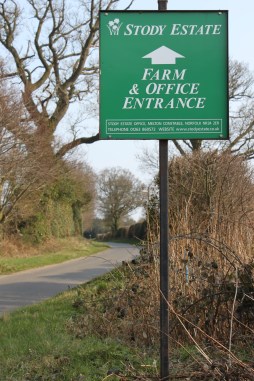
IMG_4752 (2) - CopyA year ago, gamekeeper Allen Lambert was convicted of a series of wildlife crime offences on the Stody Estate in Norfolk, including the mass poisoning of birds of prey (10 buzzards and one sparrowhawk) which had been found dead on the estate in April 2013 (see here and here).

We found out that the Stody Estate had received millions of pounds worth of agricultural subsidies (i.e. money given to them from our taxes to help them farm on the condition they look after the wildlife and wildlife habitats under their management) and we wanted to find out whether the Estate would now face a financial penalty in the form of a reduction in their subsidies for what was a very serious breach of the cross-compliance regulations.

One year later and we’re still trying to find out.

In October 2014, the Rural Payments Agency (RPA) told us they “would consider action against Stody Estate“, although one of our blog readers was told, “there is no investigation ongoing” (see here).

In December 2014, one of our blog readers contacted the RPA again to ask for an update. The RPA responded in January 2015 by saying “We are unable to provide you with any meaningful response as we do not hold any information that answers your questions” (see here).

In July 2015, we again wrote to the RPA to ask whether they had imposed a penalty on Stody Estate. We were told that as the convicted gamekeeper wasn’t the actual subsidy recipient, the RPA was trying to determine whether there was “a link” between the convicted gamekeeper and the subsidy recipient (i.e. his employer) and if so, whether the recipient (Stody Estate) could be considered liable for the actions of the gamekeeper (see here). Amazing.

As the one-year anniversary of the gamekeeper’s conviction approached, in September 2015 we wrote to the RPA again to see whether they’d now worked out “a link” between the convicted employee and his employer. Last week they responded with this:

The Rural Payments Agency (RPA) has notified the Stody Estate in Norfolk that a cross compliance breach occurred, as [sic] result of the actions of their gamekeeper. This is because the estate is vicariously liable for the actions of their employees. Under European cross compliance rules, the RPA is obliged to follow-up reports of cross compliance breaches brought to its attention. The rates of applicable reductions are explained in the scheme rules“.

So, the inefficient RPA has taken a year to decide that there was a cross compliance breach, but we still don’t know whether a financial penalty has been imposed, and if it has, what its value is.

According to the RPA’s ‘scheme rules’, cross compliance breaches can be categorised  as either ‘negligible’ or ‘intentional’, and the severity of the penalty is dependent on this.

For negligible non-compliance (falls below the standard of care expected of a competent claimant) subsidy payment is normally reduced by 3% but could range from 1-5% depending on the extent, severity, re-occurrence and permanence of the non-compliance.

For intentional non-compliance, payments will normally be reduced by 20%, but may be reduced to 15% or increased to 100% depending on the extent, severity, re-occurrence and permanence of the non-compliance.

What do you think? Is laying out banned poisons that kill 11 raptors a negligible or intentional non-compliance?

Given that we don’t know how the RPA will determine if the breaches were negligible or intentional, and given that we don’t know how much of our money was awarded to the Stody Estate in 2013 (the year the breaches occurred), although judging by the amounts they received between 2004-2012 it was probably a considerable sum (see here), it’s difficult for us to establish even a rough guesstimate of what the penalty might be, and that’s assuming that the RPA has decided a penalty is warranted.

So, we’ve written, again, to the RPA to ask whether a penalty has been imposed (and if not, why not) and if it has been imposed, how much is it?

Case against gamekeeper William Curr, Glenogil Estate: part 3

Glenogil sign RPSCopyCriminal proceedings continued yesterday against Scottish gamekeeper William Curr of Glenogil Estate in the Angus Glens.

Curr, 22, is accused of several wildlife crimes alleged to have taken place on the Glenogil Estate in August and September 2014.

An intermediate diet has been set for 19th January 2016 and a preliminary trial date of 9th February 2016.

Previous blogs on this case here and here

The gift of grouse: spectacular propaganda from the Angus Glens

Gift of GrouseWe love it when the grouse shooting community produces its propaganda pieces to spoon-feed to the (sym)pathetic right wing elements of the national press. It’s usually a masterclass in foot-shooting and provides us with ample material for a good laugh.

Take this month’s latest offering –  a published, commissioned report from the University of the Highlands & Islands:

Grouse Shooting, Moorland Management and Local Communities: Community Perceptions and Socio-Economic Impacts of Moorland Management and Grouse Shooting in the Monadhliaths and Angus Glens

and a video produced by the Angus Glens Moorland Group (basically all the gamekeepers that work there) entitled:

The Untold Story: Driven Grouse Shooting’.

The publication of these two pieces was celebrated at a Parliamentary reception last week (see here) hosted by Fergus Ewing MSP, Minister for Business, Energy and Tourism (a long-standing supporter of the Scottish Gamekeepers’ Association) and attended by gamekeepers and luminaries from the grouse shooting industry such as Doug McAdam from Scottish Land & Estates.

The report mostly suggests that there is great support for grouse moor management and all its ‘benefits’, from within the two communities surveyed. We’re not going to say very much about these findings at the moment other than to say that we are aware that someone has been analysing the survey questionnaire data and has discovered some fundamental flaws that basically render the report’s findings obsolete. We’ll return to this once the analysis has been completed. The report can be downloaded here: Grouse Shooting Moorland Management and Local Communities_2015

What we do want to blog about now is the hilarious video produced by the Angus Glens gamekeepers. This video (watch it here) was first published on the Inglorious 12th, timed to coincide with the opening of the grouse shooting season. It formed part of a new campaign called ‘The Gift of Grouse’, which is a one-year propaganda offensive, heavily promoted (and maybe even funded) by Scottish Land & Estates, and others, aimed at cleaning up the media image of the grouse shooting industry. Check out their website here.

For some reason, the video has now been re-launched this month, perhaps to coincide with the publication of the commissioned report. Whatever, that doesn’t really matter. This video really is a gift and an almighty own-goal.

You would think that if the grouse-shooting industry wanted to portray an image of lawful, environmentally-sensitive management, that they’d choose to focus on an area that wasn’t notorious as a massive wildlife crime scene, wouldn’t you? Well, apparently not.

This video is brilliant. It includes interviews with head gamekeepers from five grouse-shooting estates in the Angus Glens; some of these estate names will be very familiar to regular readers of this blog. The interviewees are: Jason Clamp (Millden Estate), Garry MacLennan (Invermark Estate), Martin Taylor (Glenlethnot Estate), Danny Lawson (Glenogil Estate) and Bruce Cooper (Glenprosen Estate). [Incidentally, one of these head keepers shares his name with a gamekeeper who was formerly employed on Skibo Estate in 2010 when three poisoned golden eagles were found poisoned. What an amazing coincidence. No prosecution for poisoning those eagles, natch, although the sporting manager was done for possession of a massive stash of banned Carbofuran].

The video provides a heart-warming narrative of the daily lives of gamekeepers in the Angus Glens, complete with a soothing musical backing track, where the keepers are keen to explain how they care for the welfare of all the wildlife in the Glens and how the emphasis is no longer on just the grouse, apparently.

Jason Clamp (Millden) says: “We’re not looking for massive bags of grouse” and “We’re not looking to kill thousands of grouse“.

That’s an odd statement coming from the head keeper of perhaps one of the most intensively-managed grouse moors in the area. According to the Millden Estate sales brochures (2010 and 2011) great emphasis is placed on the record number of grouse that have been killed / are available to be killed and this is a prime selling point. Record bag sizes are also apparently the main reason the estate owner decided to withdraw his estate from sale in 2011 (see here).

We’re also told by Garry MacLennan (Invermark) that the Angus Glens are great for raptors (ahem – see below) and the video bizarrely cuts to show what looks remarkably like a Gyr/Saker hybrid falconry bird….whatever it is, it certainly isn’t a native species and it certainly isn’t a wild bird living in those Glens.

Probably the most amusing thing about this video (and there is an awful lot to laugh at) is the title: ‘The Untold Story’. Oh, the irony.

Here are some of the untold bits of the untold story that, unsurprisingly, don’t feature in this film:

Known raptor persecution incidents in the Angus Glens 2004-2014 – 

2004 May, near Edzell: long-eared owl and two short-eared owls starved to death in crow cage trap.  No prosecution.

2004 May, Invermark Estate: peregrine nest destroyed. No prosecution.

2006 March, Glenogil Estate: poisoned rabbit bait (Carbofuran). No prosecution.

2006 April, Easter Ogil: poisoned buzzard (Alphachloralose). No prosecution.

2006 April, Easter Ogil: poisoned tawny owl (Alphachloralose). No prosecution.

2006 May, Glenogil Estate: poisoned rabbit bait (Carbofuran). No prosecution.

2006 June, Glenogil Estate: poisoned woodpigeon bait (Carbofuran). No prosecution.

2006 June, Glenogil Estate: Traces of Carbofuran found in estate vehicles & on equipment during police search. No prosecution. Estate owner had £107k withdrawn from his farm subsidy payments. This was being appealed, but it is not known how this was resolved.

2006 July, Millden Estate; poisoned sheepdog (Lindane). No prosecution.

2007 November, Glenogil Estate: Disappearance of radio-tagged white-tailed eagle ‘Bird N’ coincides with tip off to police that bird been shot. No further transmissions or sightings of the bird.

2008 May, ‘Nr Noranside’: poisoned white-tailed eagle ‘White G’ (Carbofuran, Isophenfos, Bendiocarb). No prosecution.

2008 May, ‘Nr Noranside’: poisoned buzzard (Bendiocarb). No prosecution.

2008 May, ‘Nr Noranside’: poisoned mountain hare bait (Carbofuran, Isophenfos, Bendiocarb). No prosecution.

2008 May, Glenogil Estate: 32 x poisoned meat baits on fenceposts (Carbofuran, Isophenfos, Bendiocarb). No prosecution.

2008 October, ‘Glenogil Estate: poisoned meat bait on fencepost (Carbofuran). No prosecution.

2009 March, Glenogil Estate: poisoned buzzard (Carbofuran). No prosecution.

2009 March, Glenogil Estate: poisoned buzzard (Carbofuran). No prosecution.

2009 April, Millden Estate: poisoned buzzard (Alphachloralose). No prosecution.

2009 July, Millden Estate: poisoned golden eagle ‘Alma’ (Carbofuran). No prosecution.

2009 August, Glenogil Estate: poisoned white-tailed eagle “89” (Carbofuran). No prosecution.

2010 May, ‘Nr Noranside’: poisoned red kite (Carbofuran). No prosecution.

2010 September, Glenogil Estate: poisoned buzzard (Chloralose). No prosecution.

2010 October, Glenogil Estate: poisoned buzzard (Carbofuran). No prosecution.

2010 October, Glenogil Estate: poisoned pigeon bait (Carbofuran). No prosecution.

2010 October, Glenogil Estate: poisoned pigeon bait (Carbofuran). No prosecution.

2011 February, Airlie Estate: buzzard caught in illegal crow trap. (see below)

2011 March, Airlie Estate: 3 x buzzard caught in illegal crow trap. Prosecution (!) but dropped after statement from suspect given to SSPCA deemed inadmissible.

2011 April, Millden Estate: shot buzzard. No prosecution.

2012 April, ‘Nr Noranside’: Remains of buzzard found beside pheasant pen. Suspicious death.

2011 June, Rottal & Tarabuckle Estate: dead kestrel inside crow cage trap. No prosecution.

2012 February, ‘Nr Edzell’: spring-trapped buzzard. No prosecution.

2012 February, ‘Nr Bridgend’: remains of buzzard found under a rock. Suspicious death.

2012 May, Millden Estate: satellite-tagged golden eagle seemingly caught in spring trap, then apparently uplifted overnight and dumped on Deeside with two broken legs & left to die. No prosecution.

2012 May, Glen Esk: disappearance of sat-tagged red kite. No further transmissions or sightings of bird.

2013 January, Invermark Estate: white-tailed eagle nest tree felled. No prosecution.

2013 November, Glen Lethnot: poisoned golden eagle ‘Fearnan’. No prosecution.

2014 October, Nathro: shot buzzard. Prosecution? Unknown.

There’s also no mention of the massacre of mountain hares known to take place across the Angus Glens. This photo shows a pile of slaughtered hares photographed on Glenogil Estate in 2012:

mountain-hare-cull-angus-glens-large - Copy

And no mention of the “savaged, stripped and blasted land” as portrayed in this photograph of Millden Estate in 2014 (by Chris Townsend):

Interestingly, a Parliamentary Motion has now been lodged (Jamie McGrigor, Tory) congratulating the Angus Glens gamekeepers on their video and welcoming the Gift of Grouse initiative. The motion hasn’t attracted a lot of support although some of the signatories are surprising, to say the least (see here).

Case against gamekeeper William Curr, Glenogil Estate: part 2

Glenogil sign RPSCopyCriminal proceedings have continued against Scottish gamekeeper William Curr.

Curr, 22, is accused of several wildlife crimes alleged to have taken place on the Glenogil Estate in August and September 2014. His case was adjourned at Forfar Sheriff Court on 10th September 2015 and will continue on 8th October.

Previous blog about this case here.

Kildrummy Estate: vicarious liability prosecution?

On 11th December 2014, Scottish gamekeeper (and SGA member) George Mutch was convicted of four wildlife crime offences that he’d committed on the Kildrummy Estate, Aberdeenshire in 2012 (see here).

On 12th January 2015, Mutch was given a four month custodial sentence for his crimes; the first gamekeeper to be jailed in the UK for killing raptors (see here).

Both his conviction and sentence were widely welcomed across the conservation community, not least because video evidence had been deemed admissible in this case and because the agencies involved in the investigation and prosecution had worked exceptionally hard to achieve these results.

Hopes were high that a subsequent vicarious liability prosecution would follow, especially when a journalist friend told us that Fiscal Tom Dysart had made a point of asking Mutch in court whether he’d received any training for the use of his traps, to which Mutch had replied, “No”. That response would indicate that a defence of ‘due diligence‘ wouldn’t stand up to scrutiny for anyone charged with being vicariously liable for Mutch’s crimes. All good so far, although Andy Wightman cast doubt over the feasibility of charging someone from Kildrummy Estate given the difficulty of establishing ownership there (read his blog here).

So seven months on, what’s happening now?

Well, it all gets a bit interesting around about now.  As we understand it, for offences committed under the Wildlife & Countryside Act, criminal proceedings MUST begin within three years from the date of the commission of the offence (two years in England & Wales). After three years, the case becomes ‘time-barred’ and it is no longer possible to prosecute.

Mutch was convicted of four offences, and the dates those offences were commissioned are as follows (info from COPFS press release, January 2015) –

  1. On 14 August 2012 & 15 August 2012, Mutch did intentionally or recklessly kill or take a wild bird, namely a goshawk.
  2. On 23 August 2012 and 24 August 2012, Mutch did intentionally or recklessly take a wild bird, namely a buzzard.
  3. On 28 August 2012, Mutch did intentionally or recklessly kill, injure or take a wild bird, namely a goshawk.
  4. Between 6 August 2012 – 13 September 2012, Mutch did use a trap to catch two goshawks and a buzzard.

Pay close attention to those dates. The first three offences are now time-barred (unless someone has already been charged) because it is over three years since they took place. The final offence is not quite time-barred, but will be by this Sunday (13 Sept 2015).

So, two big questions:

  1.  Has somebody from Kildrummy Estate been charged for a vicarious liability prosecution for the first three offences, and if not, why not?
  2. Is the Crown Office intending to charge someone (before Sunday) from Kildrummy Estate for a vicarious liability prosecution for the fourth offence, and if not, why not?

This case is of huge public interest and we don’t think it unreasonable to be asking questions, especially when successive Environment Ministers keep telling us that the effectiveness of Government policy against the raptor killers will be measured by the success of approaches such as vicarious liability.

If, like us, you’re curious about what’s happening with this case, you can email the Crown Office and ask them. The usual response when we ask about criminal cases is ‘As this case is on-going it would be inappropriate to comment’. It’s a handy ‘get out’ option when the authorities want to keep the public in the dark. The Crown Office could legitimately respond like this in this case, if they’ve already charged somebody. However, if they haven’t charged anybody, then the case is now time-barred and therefore cannot be said to be ‘on-going’.

Let’s see how transparent and accountable they wish to be. Emails to Helen Nisbet, Head of Wildlife & Environmental Crime Unit, Crown Office & Procurators Fiscal Office: Helen.Nisbet@copfs.gsi.gov.uk

Newlands Estate, where buzzard bludgeoned & stamped to death, is member of SLE & WES

2nd June 2015 CopyWell, well, well.

Following the sentencing today of Newlands Estate gamekeeper William (Billy) Dick for bludgeoning a buzzard with rocks and then repeatedly stamping on it (see here), we wondered whether the Newlands Estate was a member of Scottish Land & Estates (SLE).

Actually, we wondered this back in early August when Dick was convicted (see here), but SLE refused to answer at that time. It’s now clear why.

It turns out that the Newlands Estate is indeed a member of SLE. And not only that, it’s also an accredited member of SLE’s ‘Wildlife Estates Scotland’ (WES) initiative. You know the one, the much-lauded (by the game-shooting lobby) initiative ‘that aims to promote the best game and wildlife management practices, build recognition and raise standards through the introduction of an objective accreditation system’ (see here).

Oops.

SLE has issued a short statement this evening, as follows:

A spokesman for Scottish Land and Estates said: “Scottish Land & Estates has a clear and long -established policy of condemning all forms of wildlife crime. Those who engage in such activity should feel the full force of the law. Newlands Estate is a member of Scottish Land & Estates but that membership has been suspended voluntarily pending further inquiries and ongoing legal proceedings“.

It’s interesting that the estate’s membership has been suspended ‘voluntarily’ and only after the Estate’s gamekeeper had been sentenced. Why was the suspension ‘voluntary’? And why wasn’t suspension invoked in June 2014 when gamekeeper Dick made his first court appearance to answer the charges? And if not then, why wasn’t it invoked last month when Dick was convicted? Why wait until now? Nothing to do with pressure from blogs like this, surely?

WILDLIFE ESTATES SCOTLAND LOGOIt’s also interesting that SLE don’t mention the Newlands Estate’s membership of the Wildlife Estates Scotland initiative in their press statement. Not a word. That news has been gleaned from ITV (see here) and reads as follows:
Conditions of membership of Wildlife Estates Scotland include the requirements to maintain best practice standards of animal welfare and comply with all legal requirements and relevant Scottish codes of practice.

Wildlife Estates Scotland’s position is that it will suspend membership if it is notified of a prosecution or of a breach of relevant legislation.

The case of William Dick has been discussed with Newlands Estate, whose membership and accreditation under WES has been voluntarily suspended and will remain so until after further enquiries and any other legal proceedings have concluded.”

– WILDLIFE ESTATES SCOTLAND SPOKESPERSON

Vicarious liability prosecution: Andrew Walter Bryce Duncan

A prosecution is underway against Andrew Walter Bryce Duncan, who is alleged to be vicariously liable for the criminal actions of gamekeeper William (Billy) Dick, who was recently convicted of killing a buzzard in April 2014 (see here).

Duncan, 71, of Kirkton, Dumfriesshire, is understood to manage the pheasant shoot on the Newlands Estate where Dick committed his crimes. Dick is due to be sentenced in September.

At a hearing in Dumfries Sheriff Court on Tuesday 18th August 2015, a trial date was set for Duncan (23rd November 2015) with an intermediate diet due to be heard on 20th October 2015.

Great to see the Crown Office pursuing this prosecution. We’ll follow proceedings with interest.

Vicarious liability in relation to the persecution of raptors in Scotland (where one person may potentially be legally responsible for the criminal actions of another person) came in to force on 1st January 2012. To date there has only been one conviction – landowner Ninian Robert Hathorn Johnston Stewart was convicted in December 2014 of being vicariously liable for the criminal actions of Glasserton & Physgill Estates gamekeeper Peter Bell (see here).

SGA Committee Member wouldn’t mind setting Hen Harrier Day protesters on fire

There was an article in the Daily Record on Saturday about the forthcoming grouse shooting season (the Inglorious 12th) which outlined many of the reasons that have triggered a call to ban the ‘sport’. The piece included extensive quotes from Mark Avery (see here).

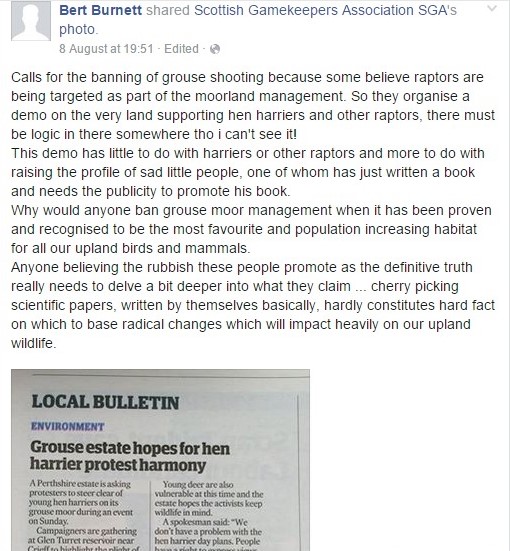
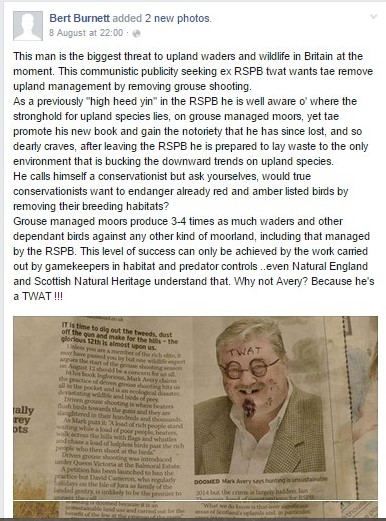
SGA Committee Member Bert Burnett has obviously thought long and hard about the arguments against driven grouse shooting and he presented them on his Facebook page on Saturday night. Watch out for a new SGA fund-raising drive to purchase some new crayons for Bert.

Bert Burnett Facebook Avery twat - Copy

On a related issue, he also shared his considered views on the Hen Harrier Day protesters who were due to gather in Perthshire the following day:

Bert Burnett Facebook HH Day Perthshire 1 - Copy

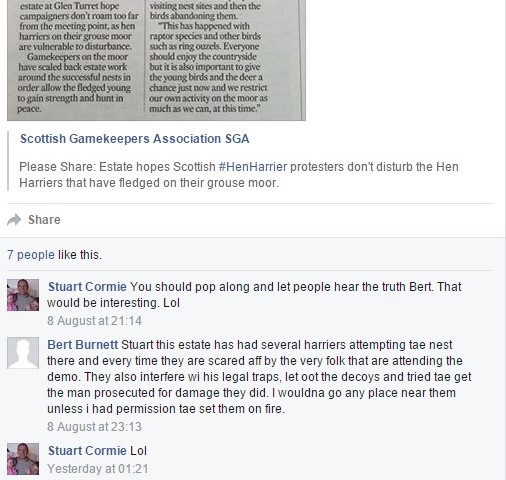
On a more serious and sinister note, when one of his Facebook acquaintances suggests that Bert should attend the protest demo, he said this:

Bert Burnett Facebook HH Day Perthshire 2 - Copy

It’s a perfectly illustrated example of why so-called ‘partnership working’ is nothing but a sham. It would also be interesting to know how Police Scotland view his comments when they assess his suitability to hold firearms and shotgun certificates. Threat to public safety springs to mind.

Gamekeeper accused of making death threats with firearms

Gamekeeper Ralph Sturgess is on trial for allegedly making death threats to his girlfriend after putting her in a headlock and pressing a loaded pistol to her forehead.

Hull Crown Court heard yesterday that after an evening at the pub, Sturgess, a former gamekeeper on Lord Hotham’s Dalton Estate in East Yorkshire, took pot shots at a noisy owl before attacking his girlfriend.

He has denied the charges. The trial continues.

Further details here