Arrest after dead buzzard found on Glasserton Estate

Dumfries and Galloway Constabulary have arrested and bailed a 62 year old man from Whithorn in relation to a number of offences under the Wildlife and Countryside Act 1981, following an investigation into the death of a buzzard, which was discovered on the Glasserton Estate, Whithorn, in December 2012. The case has been the subject of a detailed police investigation which included a forensic examination of the dead bird.

We don’t have any further details at the moment. Thanks to the journalist at Express newspapers for passing this info on to us.

If you think gamekeepers should be held to account under a licensing scheme, please sign this e-petition: HERE

Landowners & gamekeepers claim ‘misrepresentation’ on BBC’s The One Show

One-Show-smallScottish Land and Estates and the Scottish Gamekeepers’ Association have written a letter of complaint to the BBC, claiming ‘misrepresentation’ on The One Show programme.

The programme (see here and here) included a feature on golden eagle persecution and during a studio interview, the RSPB’s Stuart Benn laid the blame firmly at the door of gamekeepers on Scottish grouse moors.

Doug McAdam, Chief Exec of Scottish Land & Estates, took great exception to that statement and wrote a hilarious letter of complaint, on behalf of SLE and SGA, to The One Show’s executive editor, Sandy Smith.

Here is his letter: SLE SGA complaint about BBC One Show

According to dear old Doug, there have only been four dead golden eagles found since 2010 and no charges [for these deaths] have been brought against anyone involved in grouse moor management. Conveniently, he failed to include the other known incidents of dead raptors turning up on grouse moors since 2010 (including white-tailed eagles, red kites, hen harriers, buzzards, short-eared owls, sparrowhawks, peregrines, kestrels), or the critically-injured golden eagle found shot and left to die on a grouse moor, or indeed the satellite-tagged raptors (particularly golden eagles and hen harriers) who have all gone ‘missing’ after their last known signal was received from, er, a grouse moor. There may well be more of these ‘missing’ birds but of course we’re no longer allowed to hear about them after the introduction of the new PAW Scotland ‘protocol’ that aims to keep these incidents away from the public’s gaze (see here).

Apart from trying to play down the extent of persecution incidents on grouse moors, and inferring that a lack of criminal convictions is a good indicator that gamekeepers are not involved with the illegal killing of golden eagles on grouse moors, Doug goes on to emphasise the SLE’s involvement with PAW Scotland, as though membership of that ‘partnership’ should be a measure of good behaviour. We’ve all seen how effective these ‘partnerships’ can be, following the near-extinction of breeding hen harriers on English grouse moors during the six-year Hen Harrier Dialogue ‘partnership’ designed to resolve the conflict. Indeed, three raptor conservation organisations have now resigned from that particular ‘partnership’ because they recognised it could be used as a convenient political cover by certain organisations with grouse-shooting interests.

Doug makes an astonishing claim about the PAW Scotland partnership: “Our combined efforts with the police, rural communities, the RSPB and over 120 other relevant stakeholders have been universally acknowledged as a key factor in reducing the number of raptor persecution incidents“.

Talk about misleading! For a start, there are not 120 ‘relevant stakeholders’ in relation to addressing raptor persecution. Many of the stakeholders have absolutely no involvement in directly addressing raptor persecution – they are there to specifically address other types of wildlife crime such as poaching, theft of freshwater pearl mussels, bat persecution and badger persecution.

Secondly, where does this notion come from that work by PAW Scotland has been ‘universally acknowledged as a key factor in reducing the number of raptor persecution incidents’? Has it been ‘universally acknowledged’? We don’t think PAW Scotland has had any demonstrable impact whatsoever on the number of raptor persecution incidents – where’s the evidence? Perhaps by ‘universal’ he means those with a vested interest in having people think that illegal raptor persecution is being dealt with effectively (e.g. the police, SNH, Scottish Government, SLE, SGA etc etc).

Doug finishes by saying, “Owners of moorland estates all over Scotland look after golden eagles” (ahem) and he invites Sandy Smith to visit a grouse moor “to find out for yourself the valuable conservation measures being implemented“. Let’s hope Sandy takes him up on his offer. Ooh, which grouse moor to choose? We could give Sandy quite a few suggestions….

Sandy Smith responded with a letter of his own: One Show’s reply to SLE

He says he’s sent an email to all One Show staff and suppliers “asking them to ensure they don’t make assumptions about gamekeepers based on out of date or inaccurate assumptions“.

Interestingly, Sandy Smith was the former executive editor of Panorama – a programme recognised for its investigative journalism and an ability to differentiate between fact and PR. Let’s hope he’s taken those qualities with him to The One Show.

We’ve sent a letter to Sandy, giving him the URL of this blog, to ensure his staff are kept up to date and are not basing their work on inaccurate assumptions (spin). You may wish to do the same – send your email, marked for the attention of Sandy Smith, to: TheOneShowEmails@bbc.co.uk

If you think grouse moor owners and their gamekeepers need to be held to account for their activities, please sign this e-petition and share it with your friends and colleagues: SIGN HERE.

Here’s a photo showing how well golden eagles are looked after on some Scottish grouse moors. This one was found critically injured on Buccleuch Estate last aututmn – he had been shot and left to die, although it is not known on whose land he was shot. He is currently recuperating with the SSPCA after undergoing life-saving surgery. Needless to say, nobody has been charged for this crime.
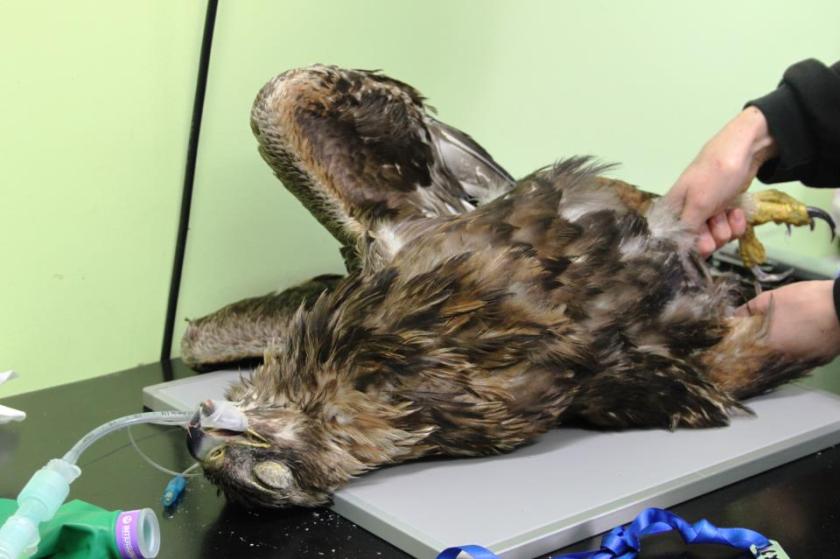

The shot golden eagle undergoing emergency surgery

Would you believe it, another guilty gamekeeper!

Another day, another location, another criminal gamekeeper, another wildlife crime conviction, another shit sentence.

This time it’s gamekeeper Shaun Leslie Allanson (37), convicted of crow cage trap misuse on the Blansby Park Estate, nr Pickering, North Yorkshire.

Today at Scarborough Magistrates Court, this ‘professional’ pleaded guilty to intentionally taking a buzzard using a live pigeon in a cage trap on 28 Aug 2012, and using a cage trap with a live pigeon decoy between 31 Aug and 19 Sept.

His punishment? 120 hours community service and £85 costs. Wonder if he’s a member of the National Gamekeepers’ Organisation? We’ll do some asking….

There’s a fuller story in the Telegraph here.

Well done North Yorkshire Police and well done to the Natural England employee who first recognised the crow trap was being used illegally and for releasing the buzzard to safety.

2 buzzards shot & dumped in ditch

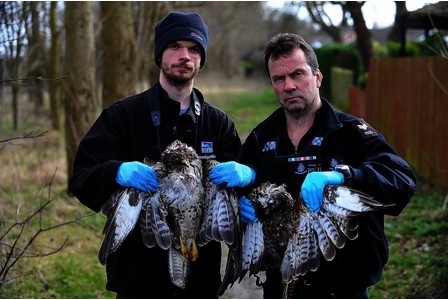
4571243Two buzzards have been shot and dumped in a ditch in East Yorkshire.
The birds were discovered by members of the public on Tuesday, on the edge of Burton Constable estate near Sproatley. The RSPB has offered a £1,000 reward for information leading to a conviction.

Well done to Humberside police for publicising this incident so quickly, and particularly well done WCO Sergeant Dave Jenkins who made a short video to increase awareness about this crime.

Full story (and video) here.

And for posterity, the video can be watched on YouTube here

And here’s coverage of the story on BBC News website here

SNH species action framework conference: presentations & podcasts

species action frameworkSNH have been under fire in recent weeks over their controversial decision to authorise the use of clam traps. (Thanks, by the way, to all of you who took the time to contact SNH on this issue – we await their latest response with interest).

However, sometimes SNH do things well and this blog entry reflects that. Last November (2012), SNH held a Species Action Framework Conference in Edinburgh to discuss the results of their five-year programme focusing on the conservation and management of 32 species (see website here). Kudos to them for recently publishing the presentations, both as downloadable PowerPoints as well as Podcasts.

The following presentations may be of particular interest to RPS readers:

Managing Species Conflicts (Steve Redpath, Aberdeen University). Powerpoint presentation here; podcast here.

Sea Eagle (Andrew Stevenson, SNH and Rhian Evans, RSPB). Powerpoint presentation appears to be unavailable; podcast here.

Hen Harrier (Des Thompson, SNH and Simon Lester, Langholm Moor Demonstration Project). Powerpoint presentation here; podcast here.

The hen harrier presentation and podcast is particularly amusing, with head gamekeeper Simon Lester brushing over the reasons why none of the 34 Langholm harrier chicks raised during the current Langholm project have ever returned to breed at Langholm (er, because they’re dead?). Can’t blame the hen harrier anymore for failing grouse stock so instead he concentrated on buzzards and ravens as the prime culprits, although without producing supporting evidence. He did say that 78% of tagged red grouse had been ‘killed or eaten by raptors’. That’s quite a misleading statement – there’s a massive difference between ‘killing’ and ‘eating’. Who’s to say that the ‘eating’ wasn’t the result of scavenging the dead grouse as carrion? Anyway, we look forward, hopefully in the near future, to seeing some hard data rather than having to rely upon Simon Lester’s ‘beliefs’.

We’ll be blogging more about the demonisation of buzzards at Langholm in a later post – we’re currently reviewing some fascinating data that show, fairly conclusively on first appraisal, that red grouse are not a major component of the buzzards’ diet at Langholm. Watch this space…

Gamekeeper charged with six offences

North Yorkshire police logoaA gamekeeper from Pickering, North Yorkshire, has been charged with six offences for the illegal use of cage traps to capture a buzzard.

This is the gamekeeper whose arrest was reported last October (see here). He has still not been named, and nor has the estate/shoot where the alleged offences took place. It is not yet known whether he is a member of the National Gamekeepers’ Organisation.

He has been charged with six offences under the Wildlife & Countryside Act and the Animal Welfare Act. He has been bailed to attend Scarborough Magistrates court next month. Article in the Ryedale Gazette & Herald here.

In other court news, the long-awaited verdict in the Lochindorb Estate hare snare trial is due tomorrow…..

Buzzard shot in the Irish Republic

Many thanks to the contributor who sent us the following article from the Leinster Express (dated 15 January 2013).

Take note of the strong words of condemnation from the Director of the National Association of Regional Game Councils.

Bird of prey dies after shooting

A protected bird of prey was shot and left for dead on New Years Eve near Ballacolla. The female common buzzard, believed to be one of a mating pair in the area, was rescued and treated, but so badly wounded it had to be later put to sleep.

The buzzard was initially brought to Dan Donoher, wildlife rehabilitator with Kildare Animal Foundation on New Years Day.

We got a call from the man who had found the bird injured in the Ballacolla Abbeyleix area. When he arrived up with it, the buzzard was cold and starving, so we put it into a special incubator, gave it fluids and painkillers and bandaged its wing. We thought maybe a car had hit it, or it had hit off wires. We took it to the vet the next day who x-rayed the wing, and found it had been shot with a shotgun. It had to be euthanized, because the damage was too great. It was upsetting to think someone would do this on purpose, buzzards are beautiful birds”, said Dan.

He said buzzards are not a threat to farm animals or humans. “They usually go for carrion or roadkill. This bird was probably one of a breeding pair, they are ony making a comeback”, he said.

The National Parks and Wildlife Service are investigating the shooting. Noel Bugler, conservation manager is appealing to the public for any information.

We are very concerned, this bird is a protected species and it is against the law to shoot it. It was gone from Ireland but came back after the practice of laying poison was banned twenty years ago. It normally feeds on carrion, rats or birds, it is harmless, it has got its place in Irish wildlife”, he said.

The NPWS have informed the Gardai about the incident. If traced, the person responsible for shooting the buzzard could face a fine from €1,000 if it is a first time offence, up to €5,000, under the Wildlife Act.

There is a higher fine for this because birds of prey need more protection”, said Mr Bugler.

The crime has been strongly condemned by the National Association of Regional Game Councils, who promote hunting, game preservation and conservation.

The shooting of birds of prey, who are all protected, can only be condemned in the strongest possible terms. The person who shot this bird is not fit to have a firearm. I would urge the authorities, if the person is identified, that they are prosecuted, have their firearm licence revoked and never allowed have one again. This is inexcusable. If I ever found one of my members was responsible for something like this, he would be out of the association so fast his feet wouldn’t touch the ground”, said Des Crofton, Director of the NARGC.

To help [people are] asked to contact the National Parks and Wildlife Service on 057 9137811.

Another poisoned buzzard in Scotland

SASA (the Government’s Science & Advice for Scottish Agriculture) have just published their latest ‘Summary of Incidents’ where they report on the number of animals that have been submitted for poisoning analysis, dating from January – September 2012 (see here).

It’s an interesting read. The results from the first three-quarters of 2012 suggest a decline in the number of reported raptor poisoning incidents. Does this reflect an actual decline in poisonings, or does it mask something more cynical, such as a change of tactics in the method of persecution used? Nobody can tell for sure at this stage, although you’d have to be pretty naive to believe the first explanation, especially after the recent shocking non-poisoning incidents such as the dead golden eagle found in a lay-by with two broken legs, believed to have been illegally trapped on an Angus grouse moor and then moved by vehicle in the dead of night and dumped by the side of the road, barely alive and left to suffer an horrific death. Then there was the golden eagle that was found shot and critically injured on a grouse moor in Dumfrieshire, now making a slow recovery. And then the shot hen harrier found dead on another grouse moor in Grampian. And these are just the ones we know about.

The latest SASA results show that a buzzard was found dead in Grampian in September 2012, confirmed to have been poisoned by the illegal pesticide Carbofuran. We don’t remember seeing any police reports about this incident. Perhaps they kept it quiet so as not to hinder their investigation? Fair enough, but it’s now four months later…Perhaps Grampian Police will report where was it found, and whether anyone is being charged. They probably won’t though; yet another incident being quietly swept under the carpet? We blogged about these poisoning incidents going unreported the last time SASA published their stats (see here).

There were a number of dead buzzards that were submitted to SASA for testing between Jan-Sept 2012, including the satellite-tagged ‘Buzz’, believed to be the first sat-tracked buzzard in Scotland (see here). His last signal came from near Brechin, Angus in late September. His corpse was picked up by the side of the road. Given the location and the on-going history of raptor persecution in the nearby area, his body was submitted for a post-mortem. He hadn’t been poisoned though – SASA concluded that his probable cause of death was starvation. It would have been nice if Tayside Police had provided information about this result, given so many were following his movements on Roy Dennis’ website…

Buzz wasn’t the only buzzard to starve to death. There are four other buzzards listed in the report with the same probable cause of death; strange really, when there are some people who maintain that buzzards are gorging themselves silly on gamebirds.

Interestingly, the dead golden eagle found in suspicious circumstances on Harris in June did not not appear in the SASA results, even though the press reported at the time that poisoning was suspected (see here). Perhaps Northern Constabulary will provide an update on the outcome of this one? Yeah, you’re right, of course they won’t.

Misleading guff from Scottish Land and Estates

scotsman_logo_200The following letter has appeared in The Scotsman in the continuing ‘debate’ on grouse moor management (see here to read the earlier articles).

“Logan Steele’s letter (14 Jan) which alleges that driven grouse shooting is only viable with the persecution of birds of prey, particularly the hen harrier, is misleading.

First, official statistics demonstrate a clear decline in the number of incidents of raptor persecution.

Second land management for driven grouse shooting delivers a huge benefit for other protected wildlife, especially waders, and sustains employment and communities in remote rural areas. This is something the suggested alternative of walked-up grouse-shooting would not do.

Of particular significance is clear evidence that where grouse and hen habitat and vermin management have declined in some hen harrier “special protection areas”, this has actually resulted in lower harrier populations, as well as declines in other species such as waders.

This is a more complex situation than some make out.

The Langholm Moor Demonstration Project, set up in partnership with the government to bring back driven grouse shooting in the presence of sustainable numbers of hen harriers, is where the best hopes of progress on this issue lie.

Results at Langholm so far are that neither harriers nor grouse have recovered – not what anyone expected, but each year scientific understanding improves and practical solution gets closer.

Making progress will involve compromise on all sides.

Organisations representing grouse moor managers such as SLE are fully behind this process and it is unfortunate that RSPB has pulled out of the mediation process in England. Perhaps Scotland provides the best opportunity to make progress now.  Douglas McAdam, Scottish Land & Estates, Musselburgh”

[Link to the letter here].

And he accuses Logan Steele’s letter as being misleading!

First, which “official statistics demonstrate a clear decline in the number of incidents of raptor persecution” is Doug McAdam referring to? The ones we know of only relate to known poisoning incidents, although they are limited to poisoned birds; they do not include the discovery of poisoned baits and nor do they include suspected poisoning incidents or unreported poisoning incidents. More to the point, they do not relate to other types of raptor persecution, such as shooting, trapping, nest destruction, ‘disappearing’ birds etc. The only statistics that account for all types of raptor persecution incidents are those compiled annually by the RSPB; statistics that have never been accepted by SLE or any other game-shooting organisation.

Second, McAdam says “land management for driven grouse shooting delivers a huge benefit for other protected wildlife, especially waders, and sustains employment and communities in remote rural areas“. Another misleading statement. Land managed for driven grouse shooting is not only bad for protected wildlife (golden eagles, white-tailed eagles, hen harriers, goshawks, red kites, buzzards, peregrines, ravens, pine martens, mountain hares etc etc) but it is catastrophic for other species too (foxes, weasels, stoats, crows etc etc). And that’s without even touching on the landscape-level environmental damage.

McAdam goes on to suggest that “making progress will involve compromise on all sides“. No it won’t. Making progress will depend entirely on whether the grouse-shooting industry will accept that they have to work within the law and put an end to illegal persecution. If they do, all well and good. If they won’t, then they face a direct action campaign to ban driven grouse shooting by those of us who are sick of waiting for the government to act on our behalf. Hollow promises just don’t wash anymore. Time’s up.

McAdam’s penultimate sentence is laughable. He’s trying to suggest that the RSPB are the unreasonable ones in this 20+ year saga, for walking away from the six-year long Hen Harrier Dialogue process (see here). They are definitely not the unreasonable ones – they recognised a sham process and got out. Until SLE start to publicly expel their member estates where raptor persecution is rife (and we all know who they are, and so should McAdam – if he doesn’t, he’s in the wrong job), then the credibility of SLE’s involvement in ‘making progress’ will be viewed with as much contempt as it deserves.

The importance of the “vicious” gamekeeper’s conviction

Hebblewhite carbofuranFollowing on from yesterday’s blog about the conviction of “vicious” gamekeeper Robert William Hebblewhite (see here), more information has emerged about what happened in court.

We mentioned yesterday how unusual it was for a gamekeeper to be convicted of actually killing the dead raptor(s) found on their land; typically, in case after case, the gamekeeper is convicted for the lesser offence of “possession” (e.g. of poison) and the charge for the actual killing is dropped. This has caused an immense amount of frustration, not only for those investigators who often spend months working on getting a case to court, but also for us, the members of the public, who feel a massive sense of injustice every time it happens.

Well, not so in this case. If you read the article published here, you’ll notice that the judge (in this case District Judge John Stobard) was having none of it.

The prosecutor (Mark Holmes) contended that Hebblewhite’s motive was clear. He was the gamekeeper on this shoot, with responsibilities for pest control. The shoot had been losing birds because buzzards were in the area (his words, not ours!). Pheasant carcasses laced with Carbofuran had been found next to the Carbofuran-poisoned buzzards. A jar of Carbofuran was found in Hebblewhite’s van (see photo). Hebbelewhite’s van had been seen going to the scene on several occasions.

Hebblewhite had pleaded guilty to possession of Carbofuran (the lesser offence) but not for poisoning the buzzards.

The defence argued that the poisoner could have been anyone.

District Judge John Stobard wasn’t fooled. He is reported to have said this:

The birds died from Carbofuran and here in a van is the very stuff  that killed them. The defence says it could have been anyone. Well, could it? I’m not here to discuss the case as a philosophical argument. What is the reality of the matter?

This defendant is here to secure the presence of the shoots that take place by the way of being a gamekeeper. He must look after the pheasants and protect them from other animals.

I think he has done so in an old fashioned and particularly nasty way by lacing the pheasant with Carbofuran in the full knowledge the buzzards would be killed.

It can only point to one conclusion – he did it“.

So finally, here’s a judge who put two and two together and didn’t make five. It’s quite telling though, that this is such an unusual result that we need to highlight it here. What does that say about how our justice system deals with raptor persecution crimes? What does it tell us about our low expectations for these court cases?

In Scotland we’re so used to seeing ridiculous legal obstacles placed in the way of justice that we now expect the poisoner/trapper/killer to get off. “Did you see the defendant place the poison? Did you see the eagle/buzzard/goshawk/red kite actually eat from that very poisoned bait? Was it filmed? Did you have permission to film on that land? Can you forensically match the poison on the bait/inside the dead raptor with the big stash of illegal poison found in the defendant’s house /shed /garage /vehicle /porch /gamebag /jacket pocket? No? Well then he can’t be convicted”.

Well done again to the RSPB Investigations Team, to the CPS, and particularly to District Judge John Stobard for seeing the bleedin’ obvious and acting upon it.

UPDATE: There’s an excellent news piece on this conviction from BBC Look North. Decent coverage and explains that raptor poisoning is a national issue. Great stuff. Available on BBC iPlayer here for limited period (starts at 11.58 – ends at 14.40).