The campaign group Wild Justice has announced the launch of its Raptor Forensics Fund, with an initial budget of £10K available to support police investigations in to raptor persecution crimes.
This fund was first proposed in April 2020 after discussions with a number of Police wildlife crime officers who were frustrated that funding cuts and delayed decision-making was impacting on their efforts to submit evidence for forensic testing in suspected cases of bird of prey persecution.
Several months on the fund has just launched this week with funding provided by Wild Justice, Northern England Raptor Forum, Tayside & Fife Raptor Study Group and a number of individuals.
The Raptor Forensics Fund will be administered solely by the PAW Forensics Working Group and guarantees funding support to police officers and other statutory agencies (e.g. SSPCA) to cover the cost of x-rays and post-mortems in the early stages of investigations and then potentially more funding to cover the full cost of further forensic analysis once a crime has been confirmed.
It is hoped this funding will increase the opportunities for police officers and other statutory investigators to get the raptor-killing criminals in to court.
Let’s see how long it takes before the first funding request appears. Not long, would be my bet.
For further information about the Raptor Forensics Fund please click here.
For further information about Wild Justice’s activities you can subscribe to the free newsletter here.
The main thrust of it is that the RSPB sees two separate approaches, one for driven grouse shooting in the uplands and one for lowland pheasant/partridge shoots, although there is a general principle for both, as follows:
‘First, we believe that new laws backed up by tougher enforcement will be needed to end the illegal killing of birds of prey, to end the use of lead ammunition and to end vegetation burning on peatlands. These practices are entirely incompatible with the imperative to address the climate and ecological emergency and there are perfectly practical alternatives.
Second, we believe that all intensive gamebird shooting should be regulated to reduce the negative environmental impacts‘.
There’s nothing stunningly novel about this, nor controversial. It’s just common sense and it shouldn’t have taken a year-long review to reach such a conclusion.
Here’s what the new policy says about driven grouse shooting:
For “driven” grouse shooting, where beaters drive the birds towards the guns, we believe that the intensification of land management practices over the last two decades is unsustainable and damaging. Between 2004 and 2016 there was a 62 per cent increase in the number of grouse shot. We have concluded that reform leading to an improvement in the environmental condition of our uplands will most effectively be achieved through the introduction of licences for “driven” grouse shoots. These would set minimum environmental standards which, if breached, would result in losing the right to shoot. The RSPB has today set out the principles for how this system could operate.
Our focus is not on “walked up” grouse shooting, but we will re-double our efforts to secure effective licensing for “driven” grouse shooting, and we will learn from the developments anticipated soon on this issue in Scotland. We will provide an annual assessment of progress and review our position within five years. Failure to deliver effective reform will result in the RSPB calling for a ban on driven grouse shooting.
To be perfectly honest, this announcement is a bit underwhelming. Perhaps it needs some time to sink in. They haven’t explained why they’ve decided to wait for five years before calling for a ban, when all the evidence to support an immediate ban is overwhelming, and much of that evidence has been collected by RSPB’s own staff!
It’s not clear what measures will be used to assess what the RSPB describes as annual ‘progress’ or ‘effective reform’. These details need to be made available.
Here’s what the new policy says about pheasant and partridge shooting:
‘For the release of non-native pheasants and red-legged partridges, we propose a different approach. From the data available, the number of birds released annually is estimated to have grown to at least 57 million. Our evidence review shows that habitats created by land managed for these birds can provide benefits for wildlife. Nevertheless, it also shows that there are substantial negative environmental consequences from the industrialised form of this shooting, including the direct and indirect impacts that released birds can have on other wildlife. This situation is recognised by some in the shooting community. A recent review of evidence published by Natural England and the shooting organisation, BASC, reached similar conclusions.
We are keen to work with public bodies and the shooting sector to help address the issues with urgency. Important first steps would be to ensure a reduction in the number of gamebirds being released and full compliance with existing reporting rules. Ultimately, we believe that further regulation will be necessary to drive up environmental standards. We will call for this within 18 months if significant progress is not secured‘.
Errm….well, waiting for 18 months is better than waiting for five years, but again, more detail is needed to understand what the RSPB judges to be ‘significant progress’.
Perhaps I’m being unfair. This morning’s announcement was simply an overview statement given during a ten minute slot during the AGM and knowing the RSPB there’s bound to be a stack of supporting evidence on which they’ve based their new policy and probably a much more in-depth description of the markers they’ll use to assess progress.
But yeah, still mostly underwhelmed at the moment.
The UK game-shooting industry is ratcheting-up its attempts to appear reasonable and law-abiding as the prospect of enforced regulation looms large.
Tomorrow (Saturday) the RSPB announces the results of its year-long review of its policy on gamebird shooting. There has been very little hint of what its new policy might be, but many of us are hoping its a lot stronger than its former policy and if it is, that will result in even more pressure being placed on Governments to introduce statutory enforcement to regulate the currently out-of-control gamebird shooting industry.
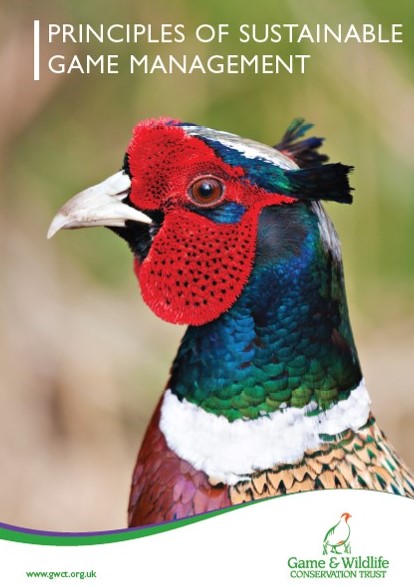
In a rather pathetic attempt to head this off at the pass, today saw the shooting industry in England and Scotland put forward a plea to the respective Governments to support what it calls ‘a new blueprint for the future of shooting’ in the form of a document called ‘The Principles of Sustainable Gamebird Management’, drafted by the GWCT.
The thing is, it’s not a ‘new blueprint’ at all. It’s the same old set of unenforced and unregulated ‘principles’ that the industry has failed to implement year after year. Had these principles been adhered to and self-regulated, the industry wouldn’t be in the mess it’s in now.
In Scotland a coalition of game shooting organisations operating under the banner of RELM (Rural Environment and Land Management) is using these principles as yet another way of trying to persuade the Scottish Government not to introduce a licensing scheme in response to the Werritty Review.
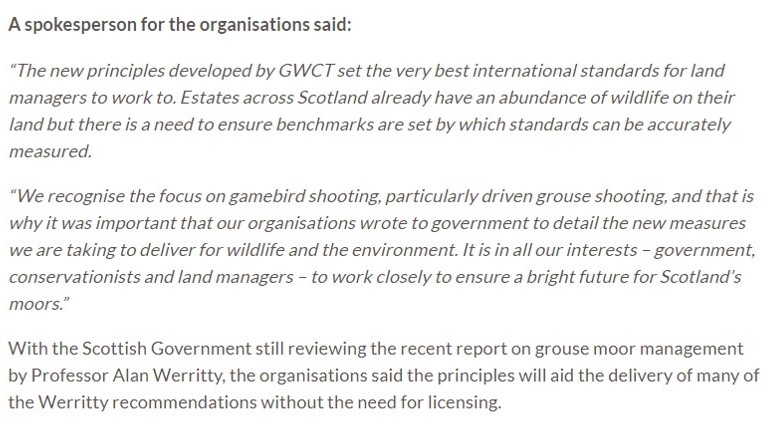
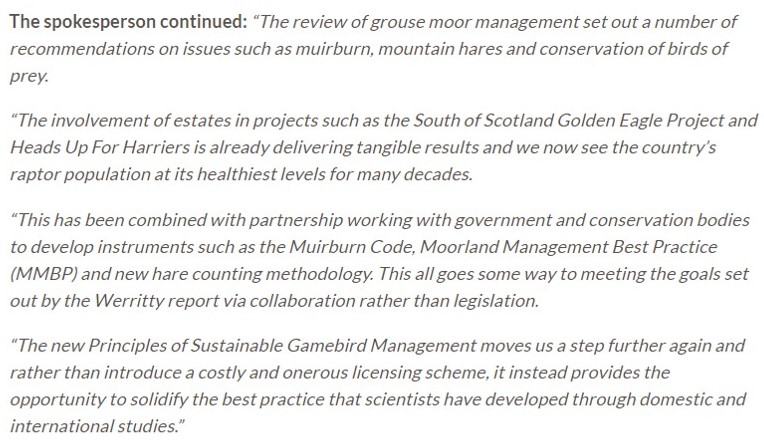
Here’s a desperate press release from Scottish Land & Estates, on behalf of fellow RELM members BASC, Scottish Gamekeepers Association, Countryside Alliance and SACS, explaining why new legislation apparently isn’t required:
As usual, many of the claims made in this statement are brazenly misleading. The Heads up for Hen Harriers project is a greenwashing sham that is definitely not delivering the tangible conservation results it was supposed to (see here), the Muirburn Code is repeatedly ignored, even during a global pandemic (e.g. see here), golden eagles are still being persecuted in areas of high-intensity grouse moor management (see here), as are hen harriers, resulting in significant population decline (see here), peregrines have been systematically removed from many former territories on grouse moors (see here) and merlin populations are suffering due to the intensification of grouse moor management in some areas (see here).
Tomorrow we’ll learn what the RSPB intends to do and sometime soon we might learn what the Scottish Government intends to do….and then the public can decide what it intends to do.
Chief Inspector Louise Hubble is leaving her role as Chair of the National Wildlife Crime Unit (NWCU) in November.
In a letter to colleagues last month, Lou wrote, ‘I am writing to notify you that my two year secondment to the NWCU, which was extended by twelve months last year, concludes in November 2020. Following discussions with Hampshire’s Chief Officer Group it has been decided that I will return to Hampshire in November 2020. I do not know at this time which role I will be going in to but after 21 years as a Wildlife Crime Officer I hope to still be involved in the world of wildlife at some level. I will certainly continue to enjoy my passion for wildlife in my spare time regardless of my policing role‘.
[Lou filming with Chris Packham in the raptor persecution hotspot of Strathbraan, Perthshire. Photo by Ruth Tingay]
It’s not clear whether she jumped or was pushed, but I reckon most of us will have our own view on that. If you work in wildlife crime enforcement in the UK and you’re seen to be doing a decent job, you can expect to be targeted by those who would rather you kept your mouth shut and who have the influence and connections to try and make sure you do.
Lou experienced this first hand (see here and here).
Lou’s departure is really disappointing news, not just for her personally – she is as passionate and focused about her role as anyone you’re likely to meet – but for those of us with long memories about some of the former heads of the NWCU, Lou’s departure signals not just a huge loss for wildlife crime enforcement, but also a weariness that her replacement, whoever that may be, will be starting from scratch, all over again.
There’s still a big question mark over the usefulness and effectiveness of the NWCU as a whole – undoubtedly the unit excels in some areas but is less effective in others and there are still some ‘personalities’ in there that make partnership-working a challenge, to say the least. But Lou wasn’t one of those. She was/is highly respected by those of us in the conservation community for her hard work and high standards.
If you’re reading this, Lou, thanks for your efforts.
The name of Police Supt Nick Lyall should be familiar to readers of this blog. Nick, whose day job was Head of Operations at Bedfordshire Police, was also the latest incumbent tasked with chairing the poisoned chalice of the RPPDG (Raptor Persecution Priority Delivery Group) in England and Wales.
The RPPDG had been nothing more than a pantomime of so-called partnership, having achieved precisely nothing towards tackling illegal raptor persecution despite years and years of meetings (since 2009!), mainly because the group membership was dominated by representatives of the game-shooting industry who took every opportunity to frustrate any attempt to change the status quo. This wasn’t helped by a succession of weak Chairs who either didn’t have the interest or drive to bring about change. This ‘Priority Delivery Group’ was neither a priority nor a delivery group – it was simply a sham group the game-shooting industry, and Government, could point to to pretend they were addressing raptor crime.
Nick brought a change of pace and enthusiasm to the role and he was widely supported by the conservation community for his efforts and most importantly, for his willingness to be open and transparent with both sides (e.g. see here).
Nick achieved a massive amount in just over 12 months, much of it behind the scenes including some highly significant meetings with, let’s call them, ‘well known sporting agents’. There is no doubt whatsoever that the game shooting industry as a whole was feeling the heat, partly thanks to Nick’s efforts, and this was recognised last year when he received the WWF Wildlife Crime Operation of the Year Award for his vision of turning Operation Owl from a regional to a national awareness-raising campaign.
Earlier this year Nick was suspended by Bedfordshire Police pending an investigation in to claims he had lied about an alleged affair with a police colleague. At a tribunal last week he was found guilty of misconduct and another hearing is now scheduled to determine his future with the police.
This is a major blow for those of us interested in tackling the ongoing slaughter of birds of prey on the UK’s game-shooting estates, although judging by the disgraceful social media gloating being done by certain BASC staff members, not everyone shares our disappointment.
It’s highly unlikely Nick will have any further involvement in the RPPDG so another Chair will have to be appointed and the whole cycle starts again.
Watch this space.
And Nick, if you’re reading this, thank you for your hard work and commitment to tackling these appalling crimes.
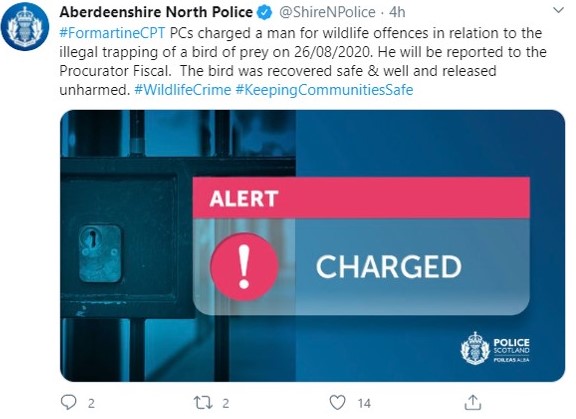
A 38-year-old man has been ‘cautioned and charged’ for wildlife offences in relation to the illegal trapping of a bird of prey on 26th August 2020 in Aberdeenshire, according to Police Scotland.
PC Davis is quoted as saying:
“Police responded to a report of a trapped bird of prey which was recovered safe and well and released unharmed.
Police Scotland take wildlife crime seriously and appreciate the assistance we get from our communities.
If you have information or concerns you can contact us on 101“.
The species ID of the trapped raptor has not been published, nor have any further details of the location, type of trap etc.
As this individual has been charged, comments on this case will not be published on this blog until criminal proceedings have finished. Thanks for your understanding.
[Tweet from Aberdeenshire North Police earlier this afternoon]
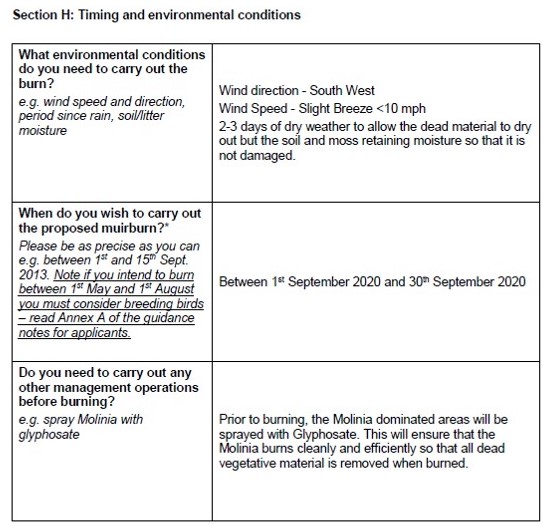
Further to yesterday’s blog where it was revealed that earlier this summer, Mark Osborne, the agent/manager at Leadhills Estate had applied to SNH for an out-of-season muirburn licence to allow him to set fire to parts of the grouse moor after being sprayed with toxic glyphosate (see here), here’s what happened next.
[Setting fire to the grouse moors at Leadhills in previous years. Photo by Ruth Tingay]
SNH’s licensing department sent Osborne’s 2020 licence application to other members of staff for their comments. It’s interesting to note that Leadhills Estate applied for a similar licence in 2019 but this was refused, for reasons not yet known. Those documents have been requested from SNH via a Freedom of Information request but haven’t yet arrived.
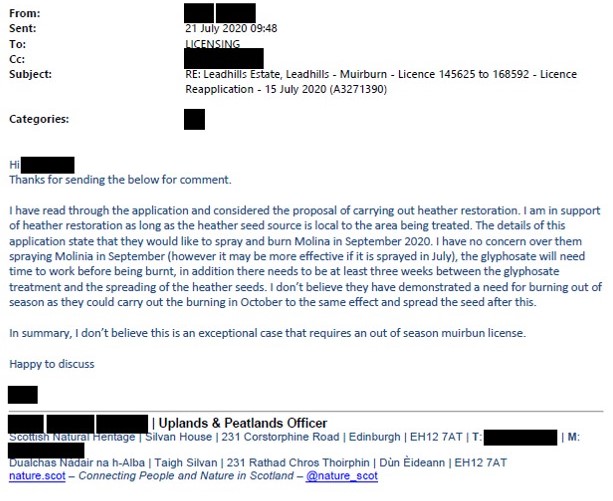
It’s not known how many members of staff were invited to comment on Osborne’s 2020 licence application, or from which departments, because SNH has chosen to hide some internal correspondence on this issue (for example, there is no indication in the material released under a Freedom of Information request that Leadhills Estate’s status of being subject to a General Licence restriction for ongoing wildlife crime was even considered at this stage) but the following response was given by SNH’s Uplands and Peatlands Officer, who, alarmingly, doesn’t seem to think there’s any issue in principle with spraying the grouse moor with glyphosate and then setting fire to it, but does argue that this could be undertaken during the muirburn season (starts 1st Oct) and doesn’t require a special out-of-season licence:
Subsequently, SNH decided to refuse this latest licence application and notified Osborne on 14 August 2020 as follows:
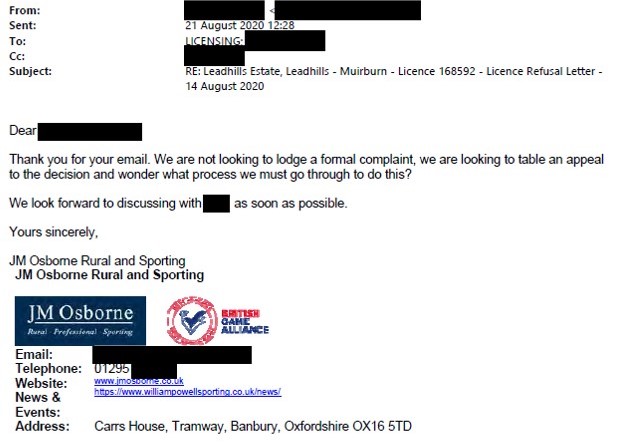
On 18th August 2020 Osborne appealed the decision, stating that the glyphosate spraying had already been undertaken:
On 21st August 2020 SNH wrote back to Osborne to say they were treating his appeal as a formal complaint. Osborne wrote back the same day and said he wasn’t making a formal complaint, he was appealing SNH’s decision to refuse the out-of-season muirburn licence:
More to come on this saga…..
UPDATE 19th October 2020: SNH considers appeal from Leadhills Estate to undertake out-of-season muirburn (see here)
Every report of a shot raptor is shameful, but there’s just something even more senseless about shooting a kestrel.
[Photo by Annette Cutts]
A kestrel has been shot and killed in the Pudsey area of Leeds, West Yorkshire, according to a tweet from West Yorkshire Police’s Leeds Wildlife and Rural Crime Team today.
No further details have been made available yet, i.e. date, specific location or type of weapon etc.
If anyone has any information please contact West Yorkshire Police on 101 and quote the crime reference number #13200496679.
Do you remember back in April, during lockdown, Scottish Greens MSP Andy Wightman secured an amendment to the Coronavirus (Scotland) Bill (Emergency Bill) that meant that ALL muirburn was banned (temporarily, until the emergency regs were revaluated on 30 Sept 2020) (see here). This temporary ban was intended to relieve pressure on emergency services, who frankly had better things to do than attend wildfires that had resulted from poorly-managed muirburning on grouse moors.
And do you remember the Leadhills (Hopetoun) Estate in South Lanarkshire? You know, Lord Hopetoun’s gaffe with it’s very very very long history of people finding illegally poisoned, shot and trapped birds of prey, illegally-set traps and poisoned baits on the estate? A history that continues and has resulted in the estate currently being the subject of a three-year General Licence restriction after Police Scotland told licensing authority SNH there was ‘clear evidence’ of ongoing wildlife crime, although insufficient evidence to identify an individual suspect (see here).
Well, that information provides the backdrop for the next few blogs about Leadhills Estate.
Jaw-dropping audacity on every level.
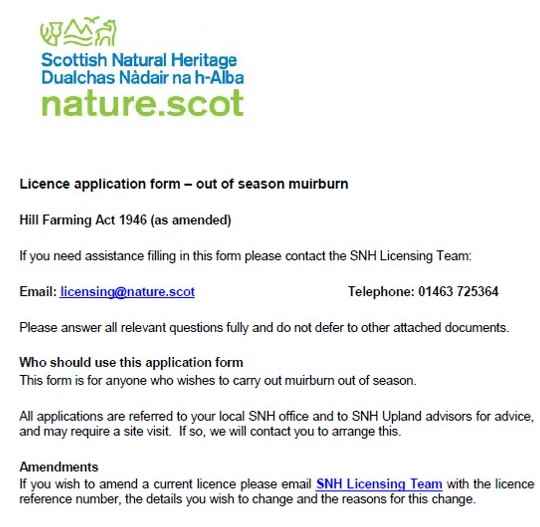
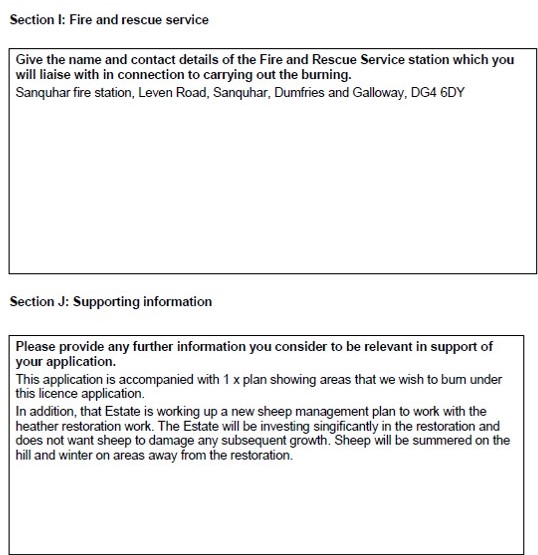
First of all, take a look at this. It’s an application from well-known grouse moor manager/agent Mark Osborne to SNH, made on 15th July 2020, asking for an out-of-season licence to set fire to parts of the grouse moor on Leadhills Estate.
Have a read of the licence application details, consider the necessity of the proposed work, consider the estate’s current status of being sanctioned, and consider whether it would be appropriate for SNH to approve this application.
More to come…..
UPDATE 6 October 2020: What happened next with licence application for out-of-season muirburn on Leadhills Estate (here)
UPDATE 19 October 2020: SNH considers appeal from Leadhills Estate to undertake out-of-season muirburn (here)
UPDATE 11 November 2020: SNH grants licence to Leadhills Estate for out-of-season muirburn (here)
UPDATE 13 November 2020: Political questions being asked about out-of-season muirburn licence issued to Leadhills Estate (here)
Do you remember way back in May, during lockdown, Staffordshire Police asked the public to be vigilant after the discovery of a dead buzzard and two dead peregrines in the Peak District National Park? Officers suspected those protected raptors had been illegally poisoned and the corpses were sent for toxicology (see here).
Then in early June another peregrine was found dead in suspicious circumstances and that, too, was sent for toxicology analyses (see here).
[One of the illegally poisoned peregrines. Photo by Staffordshire Police]
Well guess what? The toxicology results are in and all four raptors were illegally poisoned with the same (unnamed) pesticide, and at least two of the incidents involved a pigeon bait which had been laced with the pesticide.
These illegal raptor poisonings are in addition to the confirmed illegal poisoning of a buzzard and a kestrel in Derbyshire at the beginning of lockdown (see here) and a shot buzzard found with horrific injuries in the Peak District National Park during the middle of lockdown (see here).
Staffordshire Police has issued a press statement about the latest four killings, as follows:
£1,000 reward for information after birds of prey poisoned
Reward offered for information after bird of prey poisoning incidents in Staffordshire during Covid lockdown.
The Royal Society for the Protection of Birds (RSPB) has offered a £1000 reward for information leading to a conviction after four birds of prey were found dead in Staffordshire.
The appeal follows three separate incidents over a three-week period during Covid lockdown.
On Saturday 16 May, a common buzzard and peregrine falcon were sadly discovered dead in a wooded area of Longnor. On Tuesday 19 May a second peregrine falcon was found dead at Beeston Tor near Wetton. On Thursday 4 June, a third peregrine falcon was found dead in a quarry near Waterhouses.
[The latest poisoning victims. Photos via Staffordshire Police]
Two of the incidents occurred in the Peak District National Park, and a few of the locations are believed to be near peregrine falcon breeding sites.
As there were no visible signs of injury, and following contact with Natural England the birds were submitted for post mortem examinations and toxicology tests to establish the cause of death as part of the Wildlife Incident Investigation Scheme (WIIS). The scheme investigates the death or injury of wildlife and companion animals that may have resulted from pesticide poisoning.
The results show that all four birds of prey were illegally poisoned by the same pesticide, and that at least two of the incidents involved a pigeon bait which had been laced with the pesticide.
A police investigation into the circumstances is underway as all birds are protected by the Wildlife and Countryside Act 1981. To kill or injure one is a criminal offence and could result in an unlimited fine and/or up to six months in jail.
Officers are asking local residents and visitors to these areas to report any suspicious behaviour they may have witnessed in the days leading up to the discovery of the birds and to continue to be vigilant for the signs of criminal activity, including dead or injured birds, poisoned bait and traps.
Detective Inspector Tim Boulton, of the Staffordshire Police Rural and Wildlife Crime Unit, said: “To find out that these birds have been deliberately targeted and poisoned is truly dreadful. We are working to ensure those responsible are identified and brought to justice.
“It is extremely concerning that a harmful substance has been placed in the countryside putting not only wildlife, but also people and pets at risk too.
“If a member of the public comes across a dead bird or suspicious object, please do not touch or move anything. Please take photographs if you can and make a note of your surroundings and landmarks to help officers to locate it. Every piece of information may be crucial in prosecuting an offender.
“We would like to thank Natural England and the Peak District Natural Park for their assistance so far and we are incredibly grateful for the reward offered by the RSPB.
“Any information, no matter how small and insignificant it may seem, could help with our on-going investigation. Someone out there knows who poisoned these birds, so please do the right thing and get in touch with the police directly or any of our specialist partners.”
Mark Thomas, RSPB Head of Investigations, commented “Peregrines are the fastest birds in the world, yet all too often the lives of these magnificent creatures are cut short by illegal persecution like poisoning.
“For incidents like this to repeatedly happen in a National Park is all the more alarming. If you have any information about any of these cases, or if you come across what you believe may be a poisoned bird of prey, please call the police immediately. You are our eyes and ears.”
Sarah Fowler, chief executive of the Peak District National Park, added: “I would to thank those individuals who have reported these incidents to the police, and it remains completely unacceptable that illegal activity against wildlife is taking place in and around the Peak District. The nature of poisoning witnessed in these cases is deeply worrying for species both within and outside our National Park boundary.
“These incidents are particularly concerning in a year where many birds of prey – including the peregrine falcon – have successfully bred in other areas. We will continue to support the police in their investigations, and welcome any information from the public that may help capture those involved and bring them to justice.”
Dave Slater, Natural England’s Director for Wildlife Licensing and enforcement cases, said: “Raptor persecution is a national wildlife crime priority and a priority for Natural England. We are a committed partner with the Police and NGOs in tackling these despicable crimes. We would urge anyone witnessing or suspecting persecution to contact the police.”
Anyone with any information is asked to call one of the services listed below:
Staffordshire Police: 101 quoting incident number 232 of 16 May. You can also report online at http://www.staffordshire.police.uk/report or by sending a private message to Staffordshire Police on Facebook and Twitter.