New study: raptor persecution in Wales 3 x more likely in areas managed for driven gamebird shooting

Press release from RSPB Wales (24th August 2021)

New research sheds light on crimes against birds of prey in Wales

The theft of eggs and chicks of birds of prey has almost ceased in Wales, but persecution rates are not declining – according to a new RSPB Cymru review, published today.

Crimes against raptors in Wales 1990-2019 – written by RSPB Cymru and published by the Welsh Ornithological Society – summarises the plight of raptors in Wales over the past three decades.

One of the key findings is that since the 1990s, egg and chick theft has almost ceased. Theft used to be a major problem in Wales, with eggs of raptors such as peregrines and red kites stolen by collectors. The chicks of goshawks and peregrines have also been targeted for the purposes of selling to falconers, including in the Middle East. But tougher penalties and a shift in public awareness and attitude has resulted in the detection of only a handful of cases in Wales over the past decade.

On the other side of the coin, the picture for raptor persecution (by shooting, trapping and poisoning) is less positive. While the number of confirmed incidents of raptor persecution fell in 2000 – 09 compared to the previous decade, there has been a marginal increase in the past decade. However, the real total could be much higher, as the number of confirmed persecution cases could only be the tip of the iceberg.

[This buzzard was found shot dead near Powys]
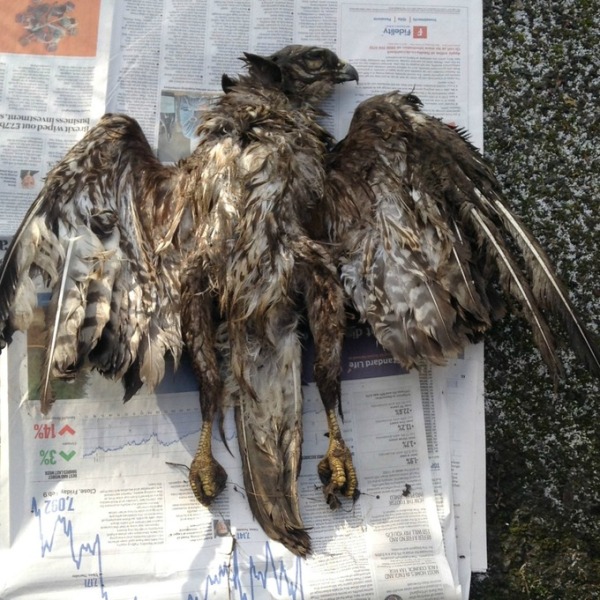
Most worryingly of all, the rate of poisoning cases has increased in the last 30 years, with 52 cases confirmed in the last decade. While laying poison baits in the open has been illegal since 1911, the review suggests that it remains a problem for wildlife in the Welsh countryside. Birds of prey, wild mammals and even household pets can fall victim to the abuse of pesticides.

Julian Hughes, RSPB Cymru Head of Species and lead author of the paper, said:

“There has been good progress made over the past three decades to reduce the rate of crimes against our majestic birds of prey. The dramatic reduction in the theft of egg and chick shows that tougher action really does work. This has helped the welcome return of birds such as red kite that was once on the brink of extinction. However, the rise in persecution, and especially poisoning cases, is a big worry. There’s still work to be done to root out these deplorable acts of crime against wildlife.”

The paper also shows that the probability of a persecution incident in 2010-19 was three times higher in areas where driven shooting of gamebirds is available for sale.

Julian Hughes continued:

“The relationship between raptor persecution and driven shooting was stronger than we expected, and we think this deserves further investigation to understand.”

Anne Brenchley, Chair of the Welsh Ornithological Society, said:

“Public awareness of raptor persecution has heightened in the last thirty years, often due to the concerted efforts of the RSPB. The Welsh Ornithological Society fully supports all attempts to reduce raptor persecution, particularly investigating the apparent link between persecution and gamebird management. We hope that the levels of detected illegal raptor persecution continues to decrease over the next thirty years.”

Rob Taylor, Welsh Government Wildlife and Rural Crime Coordinator, said:

“Historically the human race has affected the population and even existence of many birds and habitats within Wales, for a variety of reasons. As a nation we have many iconic birds that proudly adorn our skies and we give credit to the work of the few who have gone that extra mile to maintain their essential conservation. The red kite and osprey are a prime example of a success story within Wales, although these can be still subject to unnecessary persecution even in 2021. We, the police and our key partner agencies, have a duty to prevent the further persecution of any bird within Wales and protect them and their habitats for future generations to come. My new role, sponsored by the Welsh Government, will ensure that we remain focused as a nation and the establishment of a Wales Bird Crime Enforcement Group will bring together the necessary expertise to achieve that. Our work today will maintain the natural beauty of our Welsh birds and visitors for generations to come.”

ENDS

The research paper has been published today in the journal of the Welsh Ornithological Society. Here’s the citation:

Hughes, J., Mason, H., Bruce, M. and Shorrock, G. (2021). Crimes against raptors in Wales 1990-2019. Birds in Wales 18 (1): 3-19.

The research paper can be downloaded here:

Grouse moor reform is ‘matter of urgency’ under new Scottish Government/Greens draft powershare agreement

The new draft powershare agreement between the SNP and the Scottish Greens announced on Friday has received a fair bit of media coverage, as you’d expect.

So far the general response from the conservation world has been cautiously optimistic (e.g. see RSPB response here) whilst the response from land and estate owners has been nervous and uneasy (e.g. see SLE response here) and the response from gamekeepers has been malicious, personally abusive and entirely expected (I won’t post that here).

The best response to the proposed powershare agreement I’ve read so far was from Friends of the Earth Scotland Director (and partner in the REVIVE coalition for grouse moor reform), Dr Richard Dixon, who was quoted in The Guardian on Friday and said that on balance, the proposed deal should lead to stronger climate action:

“When two parties work together there has to be compromise … The question for the environment is whether this agreement pushes the SNP sufficiently further than they would already have gone for it to be worth the Greens having to make their own compromises. On the basis of this draft, the answer is likely yes with strong extra action on areas that make a difference to climate change and a review of oil and gas promised“.

The new draft agreement has been approved by the SNP’s ruling body but members of the Scottish Greens will not vote on it until next weekend.

The draft agreement is based on two key documents:

First there’s the draft ‘cooperation agreement’, which details how this powershare is envisioned to work, the expectations of both parties and the processes put in place to facilitate this new agreement.

Download the draft cooperation agreement here:

The second document is the draft ‘policy programme’ which details the key areas of policy on which the two parties have agreed to cooperate. The policy areas where the two parties have agreed to disagree can be found in Annex 1 of the draft ‘cooperation agreement’.

Download the draft policy agreement here:

If you turn to page 50 of this draft policy programme you’ll find this important statement on species protection:

This policy statement isn’t offering us anything new at all in terms of grouse moor reform and increased powers for the SSPCA, but what it does do is underline the commitment previously made by the SNP (although as ever, we’re still waiting for them to deliver on both issues, even though grouse moor reform & tackling wildlife crime are both described as being ‘a matter of urgency’ in this policy document).

However, as the overall cooperative agreement would place the Scottish Greens right at the heart of the decision-making process on these issues, which are both subjects on which the Greens have campaigned with tenacity and determination, then I think we could expect faster progress than we’d otherwise get with just the SNP in charge.

The very first part of this policy statement on species protection, ‘We will review the wider species licensing system with a view to ensuring that the law is being applied correctly and that lethal control is only licensed where the conditions required for such a licence are demonstrably being met‘ is also of significant interest and it’s worth reading Mark Avery’s take on it (here).

I understand that NatureScot is already engaged in behind-the-scenes discussions with various stakeholders on the subject of a licensing review, and not just those from the dark side either, but it’ll need to go to public consultation if any changes are to be made to improve what is currently a light touch and thus open-to-abuse licensing scheme.

On the whole I don’t think this powershare agreement is going to deliver anything dramatic or particularly game-changing within its five-year duration, but what it does do is provide an important opportunity for the Scottish Greens to apply pressure from within to try and stop the SNP’s can-kicking marathons on issues it has promised to deal with for years and years but still hasn’t.

That’s surely worth a go, right?

Dead kestrels & hedgehogs dumped in layby on Isle of Sheppey, Kent

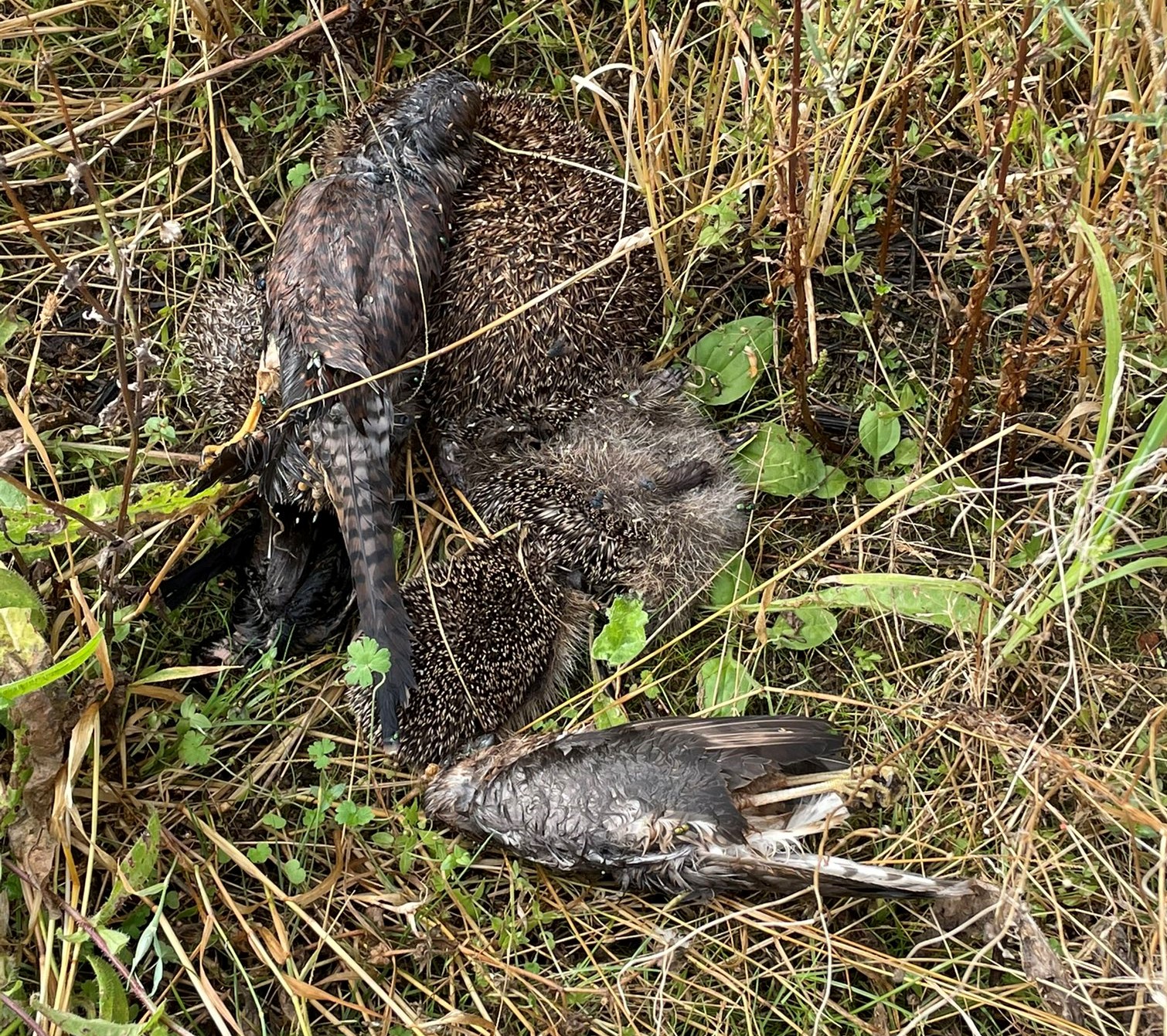
Gruesome photographs have emerged this morning of dead wildlife found dumped in a pile in a layby near Harty on the Isle of Sheppey, Kent.

The person who found the corpses (@neish397) identified them as three kestrels and ten hedgehogs. He posted the photos on Twitter and asked for advice about what to do. He tried to report this incident as a suspected wildlife crime to Kent Police using the 101 reporting system but was apparently told by a call handler that he needed to report it online.

Fortunately, the RSPB Investigations team were also alerted and are currently dealing with this incident.

Golden eagles have been illegally killed on Scottish grouse moors for 40+ years but apparently we shouldn’t talk about it

In response to the news that Police Scotland are investigating the circumstances of five eagles found dead in the Western Isles earlier this month (see here), Scottish Land & Estates (SLE), the grouse moor owners’ lobby group has issued what I’d call a staggeringly disingenuous statement, where the blame for ongoing raptor persecution appears to be being projected on to those of us who dare to call out the shooting industry for its ongoing war against birds of prey.

Here’s SLE’s statement in full, dated 20 August 2021:

Response to raptor fatalities should not depend on location or landuse

Reports of five eagles being found dead on the Western Isles are very serious. 

Police Scotland has said that officers are investigating and it is to be hoped that the facts of these potentially shocking incidents are established as quickly as possible.

The birds – four golden eagles and a white-tailed sea eagle – were found at separate locations on Lewis and Harris and it is said that, at this stage, they are not linked.

No grouse shooting takes place on the Western Isles and we wholeheartedly support the police’s appeal for information and anyone who can help should call Police Scotland on 101, or make a call anonymously to the charity Crimestoppers on 0800 555 111.

It has been suggested that intraguild predation – where one species predates on another – may be one possible explanation in these cases but equally we accept there is the prospect that a terrible wildlife crime has been committed to protect livestock.

If that is the case, outright condemnation is the only rightful response.

That applies wherever raptor persecution takes place.

The response from some quarters thus far to the incidents on the Western Isles is in sharp contrast to what happens over alleged incidents that occur in areas where land is managed for grouse shooting. In these cases organisations and campaign groups are very quick off the mark to point fingers. If a wildlife crime takes place on land managed for shooting, livestock farming or any other land use (and such incidents are thankfully rare, becoming more so all the time) then it must be investigated and the culprits should face the full force of the law. It can be difficult to prosecute but Scotland now benefits from some of the most stringent laws against raptor persecution in Europe. A lot more could be achieved with less finger pointing and more constructive collaboration on the ground. Scotland is fortunate to have historically high numbers of golden eagles and we want to see even more of them.

ENDS

So SLE is unhappy that campaigners keep ‘pointing fingers’ at the grouse-shooting industry whenever an illegally shot / poisoned / trapped bird of prey is discovered dead or critically injured on, er, a driven grouse moor?!!!!!!!!!

Or when satellite-tagged hen harriers and golden eagles keep ‘disappearing’ in suspicious circumstances, on or close to driven grouse moors.

If these crimes were just a one-off, once-in-a-blue-moon occurrence then yes, perhaps SLE would have a point. However, the connection between the driven grouse shooting industry and the illegal persecution of birds of prey has been clear for decades, and backed up with endless scientific papers and Government-commissioned reviews (here are the latest for golden eagle and for hen harrier).

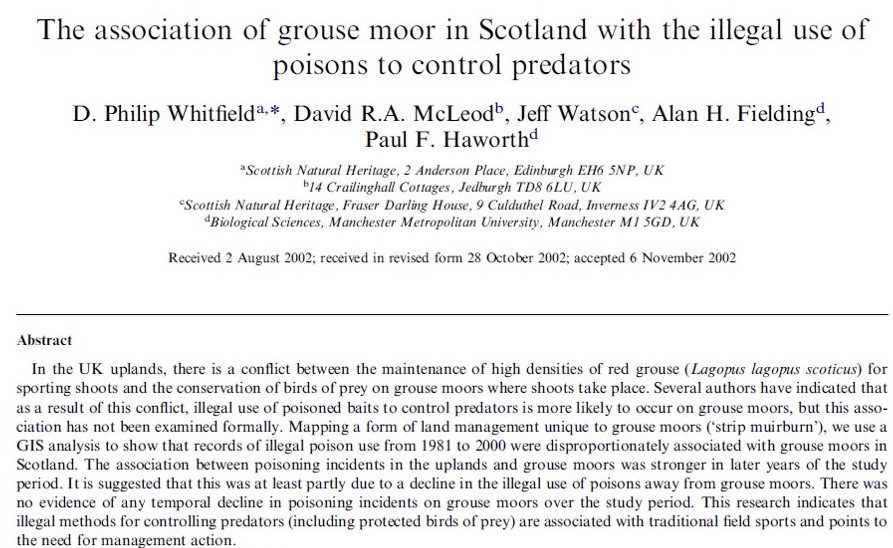
Here’s an example of how long this has been going on – a scientific paper published in 2002, using data from 1981-2000 – demonstrating an indisputable link between grouse moors and illegal poisoning:

1981 – that was 40 years ago!!

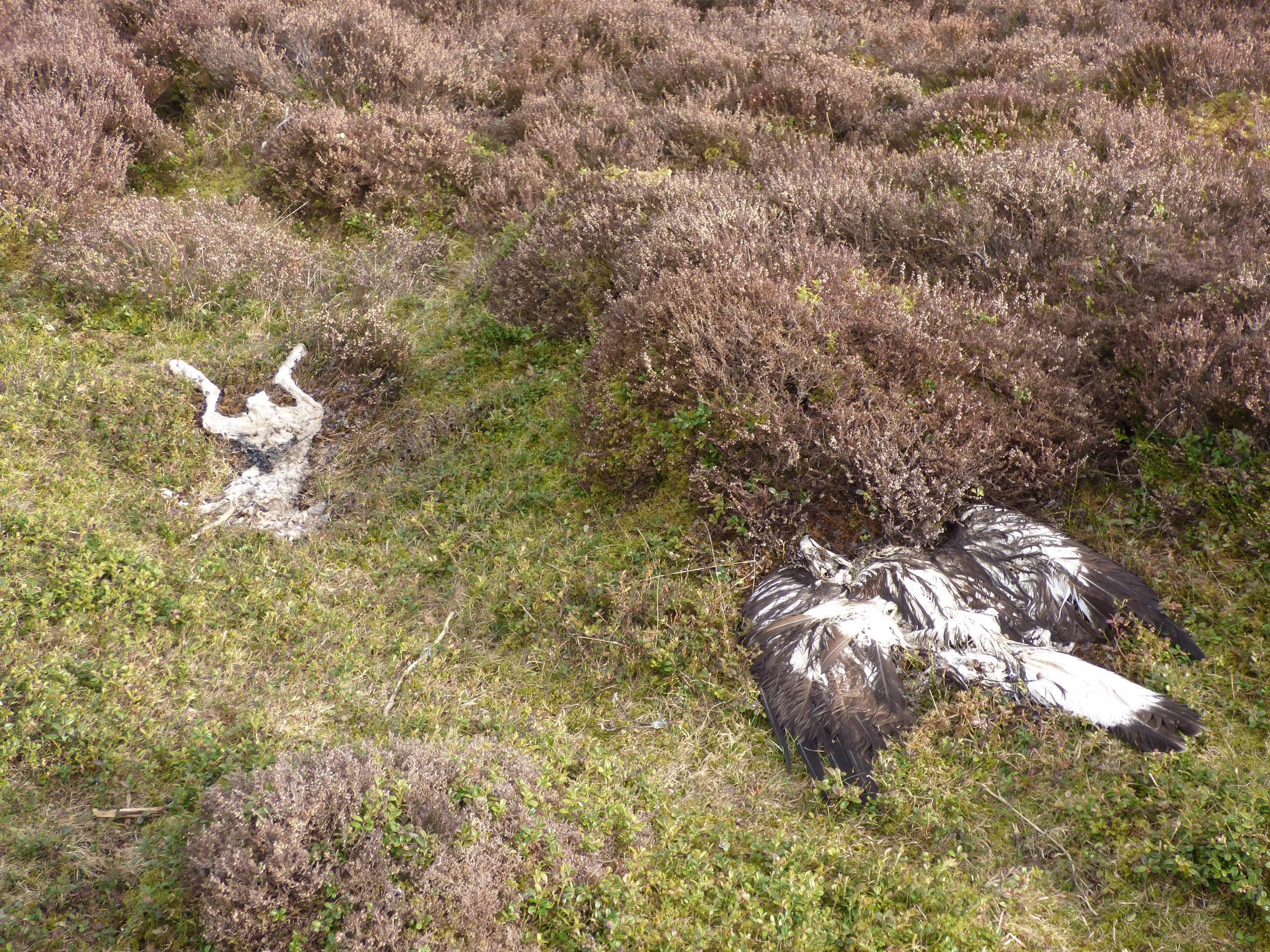
And yet here we are in 2021 and still illegally poisoned golden eagles are being found dead on grouse moors and still nobody has ever been successfully prosecuted in Scotland for killing a golden eagle. The most recently confirmed poisoned eagle was this one inside the Cairngorms National Park, right next door to the royal estate of Balmoral. In fact this eagle is believed to have fledged on Balmoral a few months before it flew to neighbouring Invercauld Estate (an SLE member, no less) where it consumed a hare that had been smothered in a banned pesticide and laid out as a poisoned bait. The person(s) responsible for laying this poisoned bait have not been identified.

[Poisoned golden eagle laying next to poisoned mountain hare bait, Invercauld Estate, Cairngorms National Park. Photo by RSPB Scotland]

Such is the extent of illegal persecution on some driven grouse moors, it is having (and continues to have) a population-level effect on some species, including golden eagles, hen harriers, red kites and peregrines.

And such is the extent and quality of this scientific evidence, the Scottish Government has committed to implementing a licensing scheme for grouse shooting in an attempt to try and rein in the criminal activity that underpins this so-called ‘sport’ because Ministers recognise the grouse-shooting industry is incapable of self-regulation.

I don’t know what SLE means when it says it wants ‘more constructive collaboration on the ground‘. Perhaps it means that gamekeepers will step forward and provide more than ‘no comment’ interviews when the police are investigating the latest crime on a grouse-shooting estate, instead of offering the usual wall of silence?

Perhaps it means the estate owners will refuse to employ the sporting agents and head gamekeepers whose methods are well known to include routine raptor persecution? (These individuals are well known – it’s no secret within the industry who they are).

Or perhaps it means that the shooting industry itself, including the game-shooting organisations, the shooting press etc will blacklist those estates known to still be killing birds of prey, instead of accepting funding donations from them and pretending that they don’t know what’s going on there?

That’d be useful, constructive collaboration, wouldn’t it?

Until all of that happens, SLE and the rest of the grouse shooting cabal can expect people like me and my colleagues in the conservation field to continue shining a bloody great big megawatt spotlight on this filthy industry.

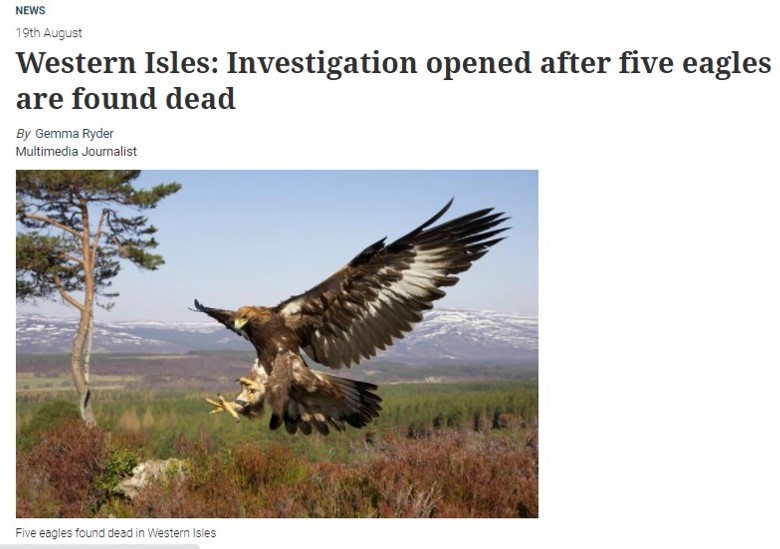
Five eagles found dead in Western Isles – Police Scotland open investigation

Police Scotland have opened an investigation on the Western Isles after the discovery of five dead eagles within the space of a week.

Two golden eagles and a white-tailed eagle were found dead on the Isle of Harris on 7th August, and another two golden eagles were found dead on the Isle of Lewis on 14th August 2021.

This article about the discoveries appeared yesterday in The Herald:

Police say they are investigating after five eagles were found dead in the Outer Hebrides in a space of a week. 

Two golden eagles had been found dead two miles south of Bragar on the Isle of Lewis on August 14. 

While two golden eagles and white tailed sea eagle were found dead near Bowglass on the Isle of Harris, a week before on August 7. 

The birds found on August 7 were significantly decomposed but forensic work is being undertaken to try to establish how they died.

Although the eagles were found dead in similar circumstances, the incidents are not being treated as linked.

Inspector Jane MacKenzie said: “Around 1.25pm on Saturday 14 August 2021, officers received a report that two golden eagles had been found dead two miles south of Bragar on the Isle of Lewis. Enquiries are ongoing to establish the full circumstances.

“Enquiries are also ongoing after two golden eagles and white tailed sea eagle were found dead near Bowglass on the Isle of Harris on Saturday, 7 August, 2021. They were significantly decomposed but forensic work is being undertaken to try to establish how they died.

“Eagles are protected birds of prey and Police Scotland will always investigate reports of these birds being found dead. It can be highly complex, requiring detailed scientific work, but we will always strive to bring anyone responsible for this type of wildlife crime to justice.

“Anyone with information about these birds, or any wildlife crime, can contact Police Scotland on 101, or make a call anonymously to the charity Crimestoppers on 0800 555 111.”

ENDS

That police quote is fairly circumspect, which is perhaps understandable given the investigation is still in the early stages and this isn’t an official police press release. However, local information provided to me suggests the investigation into the first incident is much further ahead than has been indicated here. Based on that information, I’m very surprised to see the journalist claim the incidents are not being treated as linked (presumably that information came from the police?). Hmm, I wonder…..

Although if a crime is confirmed, don’t expect the investigation to result in a prosecution. Despite Inspector MacKenzie’s fine words, which undoubtedly were given with genuine sincerity, I’m not aware of anybody being convicted for killing an eagle in Scotland.

Ever.

If you have information about these five dead eagles, please contact Police Scotland on 101.

Shot goshawk in notorious persecution black spot: police investigation reaches dead end

In July this year, a shot goshawk was found in one the country’s most notorious raptor persecution black spots in the northern Monadhliaths in the Highlands (see here).

A member of the public discovered the dead bird in woodland managed by Forestry Land Scotland (FLS), which is close to land managed for grouse and pheasant shooting. The corpse was retrieved by the Police, FLS and the RSPB and sent for post mortem where it was confirmed it had been shot.

It is by no means unusual that masked gunmen will visit public woodland to attack goshawk nests (e.g. see here, here and here) especially as this highly efficient predator is a perceived threat to gamebird stocks and as such is despised by many in the game-shooting industry.

Police Scotland issued a timely appeal for information (here) and opened a criminal investigation.

Unfortunately, as with so many raptor persecution crimes, that investigation has now reached a dead end. A police spokesperson has advised that ‘all lines of enquiry have been completed, including CCTV, door to door enquiries, local enquiries, vet analysis of the remains, x-ray of remains, background checks, social media and traditional media press release‘.

There haven’t been any arrests and there won’t be any prosecutions unless new information comes to light.

Of course, this doesn’t mean that the crime didn’t take place (some in the game-shooting industry would have you believe that no prosecution = no crime), it just means that yet again, someone with access to a gun in this area has been able to commit a crime and will face zero consequences, just like the last time, and the time before that, and the time before that, and…..etc etc.

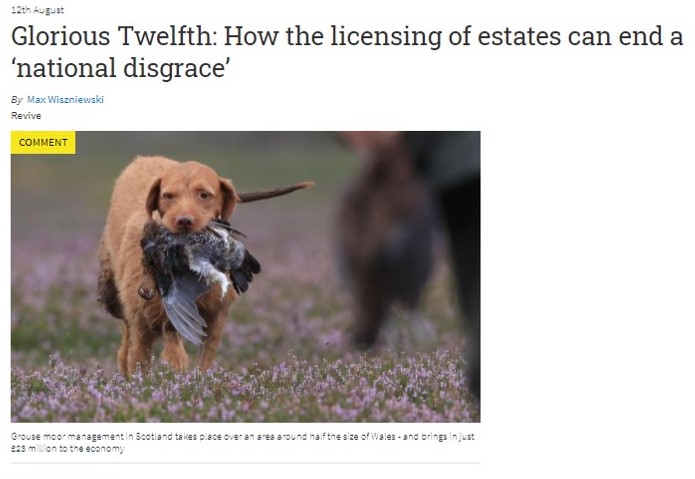
‘How licensing grouse estates can end a national disgrace’

Max Wiszniewski, the campaign manager for Revive, the coalition for grouse moor reform, had this article published in The National last week, timed to coincide with the opening day of the grouse-shooting season.

TODAY marks the opening of the controversial grouse shooting season. But is it still the “glorious twelfth”?

Polling has previously shown that seven in 10 Scots are against the so-called sport. The common association between grouse moors and the illegal persecution of Scotland’s protected birds of prey has been ruining the industry’s reputation for decades. As far back as 1998, Donald Dewar called it a “national disgrace” and it remains so today, more than 20 years later.

For this reason the Scottish Government has committed to introduce licences on grouse shooting estates, despite protestations from industry lobbyists. The fact that a licence has never been required to manage shooting estates will be shocking to some, but the Government recognises that the failure of self-regulation has left the industry with no-one to blame but themselves.

Put simply, a licence would mean that if the law is broken or if the terms of a grouse moor licence is not adhered to then an estate could lose that licence.

The REVIVE coalition believes there is a circle of destruction that surrounds grouse shooting which goes well beyond potential illegality and the more people that know about it, the more they will question why it is allowed to continue.

More than 100,000 foxes, stoats, weasels, crows and non-target species like hedgehogs are (legally) snared, trapped and killed in Scotland each year on grouse moors. Grouse, a wild animal, are medicated en masse by tens of thousands of toxic chemical grit stations to keep their numbers unnaturally high.

Meanwhile, in the year we host COP26, much of Scotland’s uplands are still subjected to heather burning which threatens the environment, our vital peatlands, restricts biodiversity and reinforces barren monocultures. Scotland’s peat contains much more carbon than all the UK’s forests put together and yet the burning continues. Tons of lead shot is sprayed across the uplands while bulldozed hill tracks scar the landscape and remain unregulated.

All of this and more takes place to make sure that a few more grouse can be shot by a few people for sport over huge swathes of Scotland. The terms of the grouse moor licence will be key and must address these wider issues.

Grouse are an iconic Scottish bird yet shooting them out of the sky as part of driven grouse shooting – the most unsustainable kind of shooting that depends the most on “high bag numbers” – is a blood sport that goes back to Victorian times. But the economic benefits to the public for maintaining this frivolous pursuit is not as high as many might think.

Grouse moor management in Scotland takes place over an area around half the size of Wales – and brings in about £23 million to Scotland’s economy – 0.02% of the economy. To put this another way, if Scotland’s economy was the height of Ben Nevis grouse shooting’s contribution would be the height of a bottle of Irn Bru.

Wildlife tourism, a burgeoning industry that sometimes involves shooting animals with cameras instead of guns, already brings in about five times more to our economy. Forestry and its associated industries also bring in many times more to the economy. The point is that while there is no silver bullet, a mosaic of more environmentally friendly alternatives to grouse shooting are available now benefit our people and our wildlife as well.

The Scottish Government should have nothing to be afraid of despite a powerful grouse shooting lobby. Within the Scottish National Party REVIVE, The Coalition for Grouse Moor Reform’s aims are immensely popular. A member’s resolution to end the circle of destruction of grouse shooting was the most backed motion submitted for the last SNP conference. It was signed by more than 25 party branches and MSPs. The Scottish Greens and Scottish Labour are also keen to meet this ambition so the only thing in the way of the Government seems to be political will.

REVIVE represents the middle ground in this debate. We are not calling for a full ban on all grouse shooting but for an end to all the unsustainable activities that take place to make sure there are more grouse to shoot for sport. Driven grouse shooting likely depends on these unsustainable practices but it’s up to the industry to prove that it does not.

If driven or any other type of grouse shooting depends on muirburn, mass chemical medication, unregulated bulldozed hill tracks and the slaughter of hundreds of thousands of animals to sustain it, then perhaps it doesn’t deserve to exist. Licensing should be used to end the circle of destruction and to help make huge swathes of Scotland sustainable again.

In a time of climate and biodiversity crisis we must urgently move towards better land uses via a just transition. If we don’t act on this then how can we expect to transition away from far bigger industries like oil?

If we do act, then unsustainable grouse moor estates will no longer represent the peak of what’s possible in the rural areas they occupy. By unlocking our land’s potential, in tandem with greater land reform, we can open the door to thousands more jobs across rural Scotland than are currently allowed to exist.

If Scotland is to become a modern 21st century nation, moving away from unnecessary and harmful archaic practices like driven grouse shooting is essential. When we show the political will to do it, this will be to the benefit of all our people, our wildlife and crucially, the environment.

ENDS

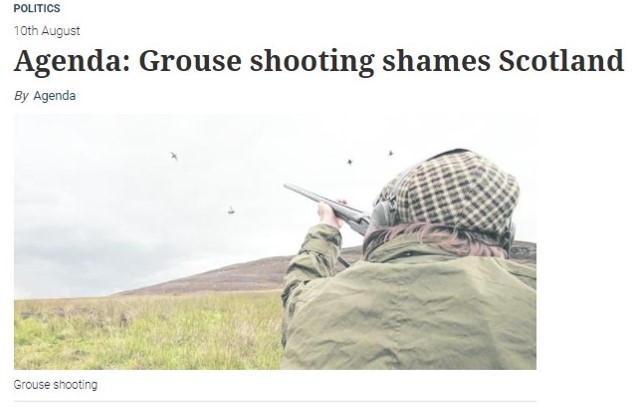
‘Grouse shooting shames Scotland’

To coincide with the start of the Inglorious 12th (the opening of the grouse shooting season) last week, The Herald ran this piece written by Robbie Marsland, Director of the League Against Cruel Sports Scotland and a founding member of Revive, the coalition for grouse moor reform.

It’s reproduced in full here:

No one knows how many wild red grouse will be shot during the Scottish shooting season starting on 12 August. Neither do we know how many of those birds will be left wounded and suffering as they wait to be put out of their misery. This is because grouse shooting is almost entirely unregulated.

There are estimates that the UK wide number of grouse killed each year is around 600,000. If that’s true, then it would seem likely that around half will be shot in Scotland.

But how do the grouse withstand an annual carnage of around 300,000 birds shot for entertainment? The answer is an innocuous word – “management”.

Grouse moor management means protecting the grouse from anything that threatens them to make sure there are enough to shoot for entertainment.

Birds of prey eat grouse and although they have full legal protection there is a mysterious absence of mating pairs on Scottish shooting estates.

Mountain hares are also seen as a threat as they are thought to spread disease or compete for food. For years and years on average 26,000 were killed each year to increase the number of grouse that could be killed for entertainment. The good news here is that the Government recently introduced a licensing scheme but we don’t yet know to what extent it will stop this killing.

Foxes, stoats and weasels also naturally predate on grouse. The League Against Cruel Sports’ recently published report, Calculating Cruelty, based on a survey of seven Scottish estates calculated that traps and snares are responsible for the deaths of around 200,000 animals each year, 40% of which weren’t even the target species. All to increase the number of grouse to be shot.

Crows and ravens also naturally take grouse in the wild. You need a license to shoot a raven but no one knows how many crows are captured and killed in cage traps or simply shot.

All this killing to kill goes on year in, year out.

Some people think grouse shooting brings in lots of money and jobs. But the truth is that this is just wrong. According to the industry’s own figures grouse shooting brings in £23 million a year. But when you consider that just one Tesco store can turn over around £44 million a year, it becomes clear what a drop in the ocean grouse shooting contributes to the economy.

However, the paltry contribution this so-called industry makes to the Scottish economy is nothing compared to the immorality of killing hundreds and thousands of animals to make sure it’s possible to kill hundreds of thousands more animals purely for entertainment.

This is why at the beginning of this grouse shooting season the League is calling on the Scottish Government to prevent animals being killed for the purpose of increasing the population of another animal so that more can be shot for entertainment. Killing to kill must stop.

ENDS

Police to undertake social media checks for gun licence applicants after Plymouth mass shooting

The news that police forces in England and Wales will be checking the social media accounts of gun licence applicants is very welcome news, especially as abuse by gamekeepers and other gun holders against conservationists intensifies (e.g. see here, here, here, here, here).

According to an article in The Times this weekend, the Westminster Government will publish statutory guidance this autumn outlining how police forces handle firearm and shotgun licence applications. This is in the wake of the horrific mass shooting in Plymouth last week by a 22-year old, who despite having a history of posting violent and misogynistic abuse on social media, was still approved to have a weapon, which he went on to use with utterly tragic consequences.

In another article, Former Metropolitan Police Commissioner Lord Stevens told the Telegraph this weekend that UK police forces should perform thorough online checks into people applying for firearms licences following the shooting on Thursday. He called for a more in-depth ‘trawl’ of internet posts to try to establish whether people trying to get police approval for a gun have a history of making hateful comments online.

“The gunman was clearly a dangerous man – there is no doubt he was a threat. The videos he made should have been taken into account when he applied for a shotgun licence.

“There needs to be trawling of online content for an in-depth assessment of who these people are and what they think. We need to ensure that guns do not fall into the hands of dangerous people“.

Referring to the highly misogynistic posts made by incels [involuntary celibates] on forums and chat rooms, he said: “I would suggest people posting these kinds of comments clearly pose a concerning threat“.

According to the Telegraph, Jonathan Hall QC, the Government’s independent reviewer on terrorism legislation, also supported calls for considering the social media profiles of those looking to get hold of a gun.

“Obviously we don’t want to live in a society where what we do online is routinely looked at by the state, but I see the force of the point that social media may be a valuable source of information about risk in the context of firearm licensing“, he said.

Police Scotland are apparently ahead of the game. Three years ago a review by HM Inspectorate of Constabulary in Scotland (HMICS) concluded that online activity is a key source of information when deciding whether someone is suitable to own a gun.

In response to the report, Police Scotland Assistant Chief Constable Mark Williams said: “Where concerns are raised, we may use social media as one of a number of sources of information during our checks. Looking to the future, we are considering expanding this approach as part of the national licensing process.”

Hopefully the new statutory guidance of checking social media accounts won’t be restricted to just incidences ‘where concerns are raised’ [about an applicant] but rather this becomes a standard, routine examination for all applicants. The cost of this increased scrutiny should be placed firmly at the door of the gun licence applicants, and not be heavily subsidised by the tax payer as current gun licensing is.

It’ll also be interesting to see how the police deal with abusive and aggressive gun owners who maintain a hidden identity on social media. There are quite a few of those claiming to be from the game-shooting world, some of whom hide their identities quite successfully, others not so well, and none of whom are called out by the mainstream game-shooting organisations (indeed, some of those organisations even share the abuser’s posts!).

If you have any concerns about the suitability of someone who you believe is a firearms / shotgun certificate holder, whether they’re from the game-shooting world or not, please don’t hesitate to report him/her to the relevant police station.

‘Persistent intimidation’ – raptor conservationists face ongoing harassment from gamekeepers

Award-winning investigative journalism website The Ferret published an article last week with an account of how raptor conservationists are facing ongoing harassment from gamekeepers and supporters of the grouse-shooting industry.

Thanks to journalist Stuart Spray for the invitation to contribute to this piece.

It’s reproduced here in full:

Conservationists working to protect rare birds of prey claim they are being abused online and intimidated in the field by gamekeepers and supporters of the grouse shooting industry.

Logan Steele, communications secretary for the Scottish Raptor Study Group (SRSG), made up of conservationists working to protect rare birds of prey, told The Ferret that he is regularly contacted by workers who say they have been targeted in the line of their work.

Steele says members report incidents such as being surrounded by armed gamekeepers – often in 4x4s or on quad bikes – being followed for hours on end whilst out monitoring, being abused verbally, having tyres let down, having police called on them and even being spat at whilst drinking in the local pub.

He claims the intimidation is widespread, but most raptor workers are not prepared to go on record for fear of reprisals.

The SRSG, set up in 1980, has more than 350 voluntary members monitoring the vast majority of the 6,000 plus raptor territories checked annually as part of the Scottish Raptor Monitoring Scheme.

The scheme supplies data to organisations like the British Trust for Ornithology (BTO), RSPB and NatureScot – the Scottish Government’s wildlife watchdog – to help understand population dynamics and inform conservation priorities. Members of SRSG also gather information on raptor persecution.

Gamekeepers have also previously claimed to be subjected to abuse. In a survey last November by the BASC, Countryside Alliance, Game Farmers Association and National Gamekeepers Association 64 per cent of Scottish gamekeepers said they had experienced threatening behaviour or abuse from members of the public at least once every year.

The study, which surveyed 152 gamekeepers, also found the majority (79 per cent) felt ‘less optimistic’ due to ‘targeted anti-shooting campaigns and the negative portrayal of shooting in the public domain’.

But Steele said conservationists were suffering. He added: “Our members on some driven grouse moors continue to be subjected to persistent levels of intimidation and abuse from gamekeepers. It is patently clear that raptor workers and indeed the wider public are not always welcome on some driven grouse moors“.

Steele has himself been trolled online several times. “On one occasion an ex-gamekeeper boasted online that he had fitted a tracking device to my car and knew I was at home“, he said. Concerned that he was being followed he got the car checked over but no tracking devices were found.

An image Steele posted of himself online with a hen harrier chick in 2006 was allegedly downloaded and regularly reposted on two ex-gamekeeper’s social media pages along with claims accusing him of professional malpractice without evidence.

Consultant ecologist, Andrea Hudspeth – who along with Steele received an RSPB award in 2017 for raptor campaign work – claimed she also felt threatened on shooting estates.

She added: “I have been monitoring raptors on a grouse shooting estate for a number of years now and have always been made to feel unwelcome, so much so that I don’t feel safe going there on my own.

She claimed the experience could be intimidating. Of one estate she said: “Having phoned the day before to let the estate know I was coming, I was told where I could and couldn’t go as they were shooting foxes that day. He [the head gamekeeper] told me that if I strayed into the wrong area, it wouldn’t be his fault if I got shot. At the time, that sounded like a veiled threat“.

Dr Ruth Tingay, an award-winning conservationist and director of Wild Justice, a not-for-profit organisation set up with broadcaster Chris Packham and environmental campaigner Mark Avery to ‘fight for wildlife in the courts and in the media’, told The Ferret she was subjected to online abuse on an almost daily basis.

Tingay, who runs the Raptor Persecution UK blog, claimed she received comments online that were routinely misogynistic and homophobic and involved personal slurs on her appearance and character.

“My personal telephone number has been published online and folk have been incited to make abusive phone calls. I have also received abusive text messages,”, added Tingay.

“My home address has been published and shared on social media. Photographs of my home have been published and shared on social media. I have been followed and photographed on grouse moors and these have been published on social media with accompanying defamatory comments.

“I have been accused of fabricating evidence, of perverting the course of justice, of inflicting cruelty to wildlife, of killing eagles, of planting evidence, and conversely, and bizarrely, of withholding evidence from the police, of lying to the police, of lying to ministers, of lying to supporters, of lying in general“.

Tingay says the targeted harassment has been going on for the last six years and shows no signs of stopping. Earlier this week she was described by one shooter as “absolute poison” and another shooter opened a discussion titled: ‘Is Tingay a witch?’

“These individual comments are, of course, pathetic and laughable and are easy to shrug off, so obvious is the desperation behind them”, she said. “But it’s the accumulation of the comments, that’s when the problem starts.

“It’s relentless, and I think that’s very, very dangerous. That constant tide of abuse would take its toll on even the most resilient person. I’ve put measures in place to deal with it and I’m fortunate to be working with a world-class mental health coach. That’s not what I expected to need when I decided to work in the field of raptor conservation“.

However, Steele also insisted that most conservationists and grouse shooters, landowners, stalkers, ghillies and gamekeepers had a “very good working relationship”. He claimed those behind the abuse were trying to create a “false, them-and-us situation”.

“The issue really resides with a small number of driven grouse shooting businesses”, he added. “In recent years we have seen some estates beginning to moderate their attitudes to raptor persecution which is very encouraging“.

The Ferret contacted the Scottish Gamekeepers Association, the landowners’ representative group Scottish Land & Estates and the Countryside Alliance. None of the organisations replied to requests for comment.

However, Scottish Gamekeepers Association chairman Alex Hogg has previously said gamekeepers are currently being “undervalued” and called for action to be taken on the abuse they have faced.

ENDS