Blog

Grouse shooting industry’s reaction to news of 3 x missing hen harriers

Following the RSPB’s announcement on Thursday that three of this year’s satellite-tagged hen harriers have already ‘disappeared’ in suspicious circumstances on three grouse moors (here), we predicted that the grouse shooting industry’s ‘leaders’ would respond with a wall of silence, just as they have previously (e.g. see here).

We weren’t wrong.

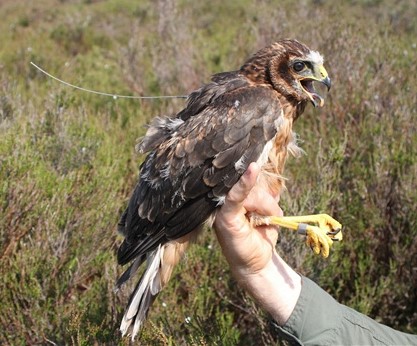
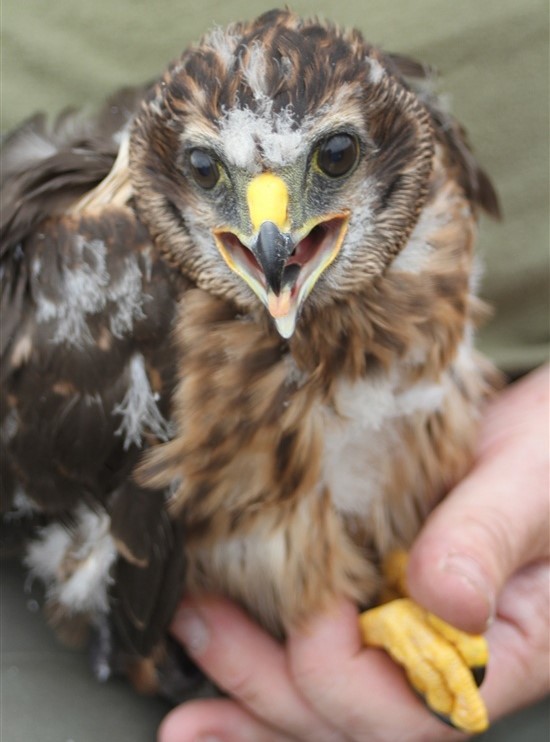
[One of the missing three: ‘Hilma’, photo by Steve Downing]

Two days on, after searching websites and twitter feeds, here’s how the ‘partners’ of the Raptor Persecution Priority Delivery Group (RPPDG, also known as the PAW Raptor Group) have responded:

Countryside Alliance – no public statement

BASC – no public statement

National Gamekeepers Organisation – no public statement

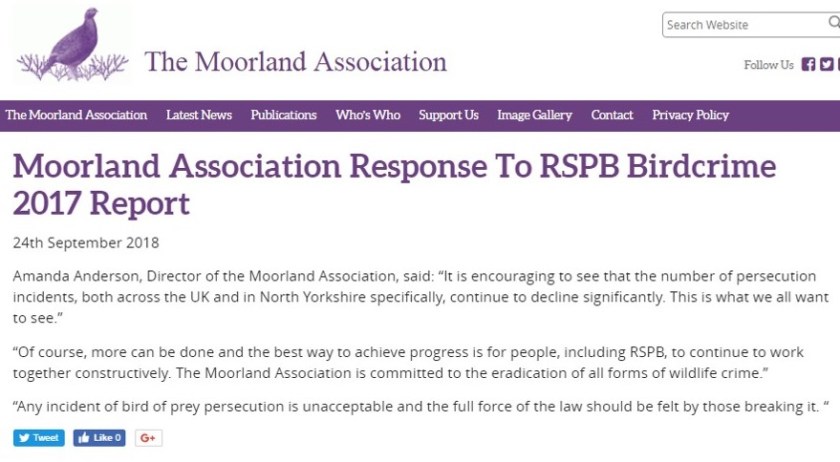
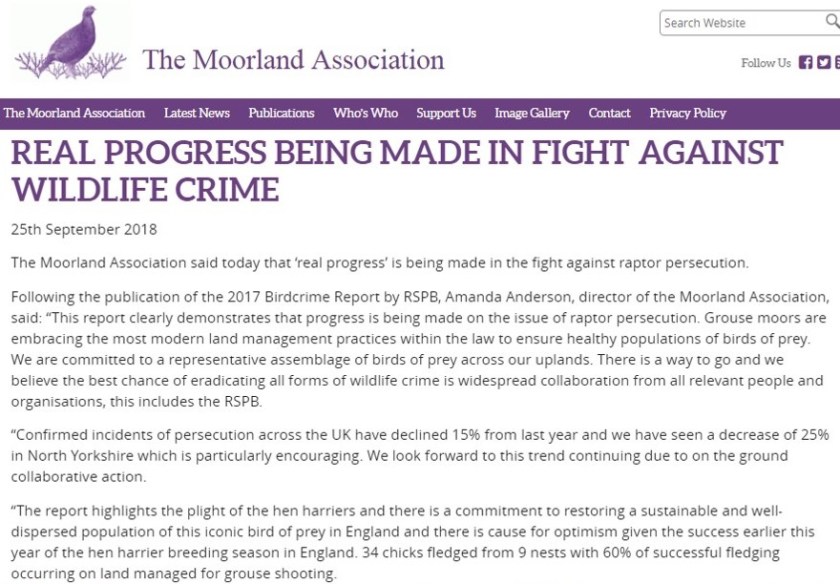
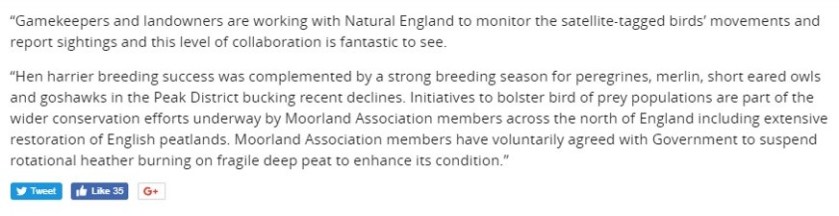
Moorland Association – no public statement

Country Land & Business Association – no public statement

Natural England – no public statement

DEFRA – no public statement

Northern England Raptor Forum – full public statement here

NERF’s statement is excellent, and as usual, it doesn’t pull any punches. It talks about the never-ending cycle of persecution on driven grouse moors and how the grouse shooting ‘partners’ of the RPPDG are not part of the solution, they are part of the problem.

Why is this charade of ‘partnership-working’ still allowed to continue? It’s been running for seven years and absolutely nothing has changed. Nothing. Not one thing.

And nor will it, when the grouse shooting industry’s so-called leaders refuse to even publicise the raptor persecution hotline to encourage their members to report suspected raptor crime!

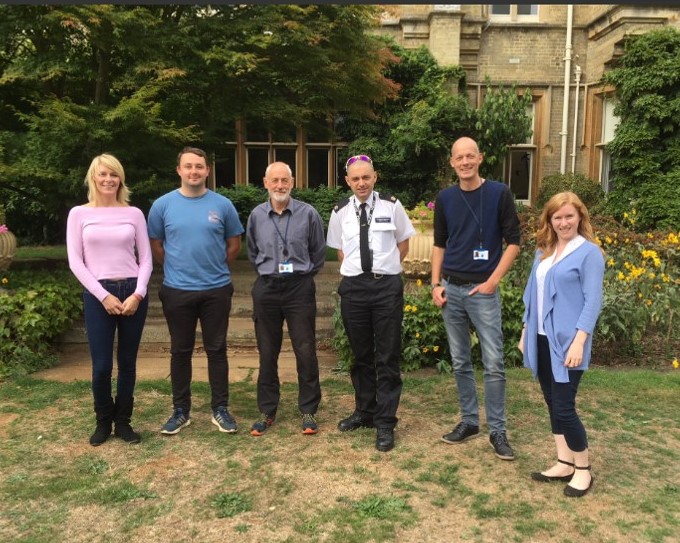
The RPPDG has a new Chair – Police Supt. Nick Lyall of Bedfordshire Police. We’ve been impressed with his willingness to listen – he contacted us directly and asked to talk – that’s never happened before. It’s clear that he wants to make a difference and understands that the status quo is unacceptable, but we don’t yet know what changes he intends to bring.

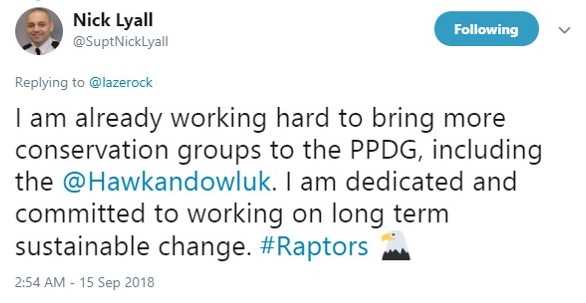
Although, he tweeted this afternoon that he intends to bring more conservation groups to the RPPDG and cited the Hawk & Owl Trust as one of them!

That’ll be the Hawk & Owl Trust that’s in bed with the grouse shooting industry in pursuit of the ludicrous hen harrier brood meddling scheme (here) and which is now facing two legal challenges from conservationists in the High Court in December (here); that lost its former President, Chris Packham, over the decision to partner with the grouse shooting industry on brood meddling (here); is prepared to turn a blind eye to the criminal activities of the driven grouse shooting industry when it suits (see here); is unwilling to be transparent about the illegal shooting of one of its own satellite-tagged hen harrriers (see here); and has been accused by its own members of being apologists for raptor persecution on driven grouse moors (here).

We look forward to a lively discussion with Nick later in the week!

3 more satellite-tagged hen harriers ‘disappear’ – all on grouse moors

You could set your clock by the regularity of these reports. In news that will shock absolutely no-one, the RSPB has announced the sudden and inexplicable ‘disappearance’ of three young satellite-tagged hen harriers.

All three had hatched this year, all three had vanished before the end of August, and in all three cases the tag’s last known fix came from a driven grouse moor.

Photo of Hen Harrier Octavia, by Steve Downing:

Read the RSPB blog here

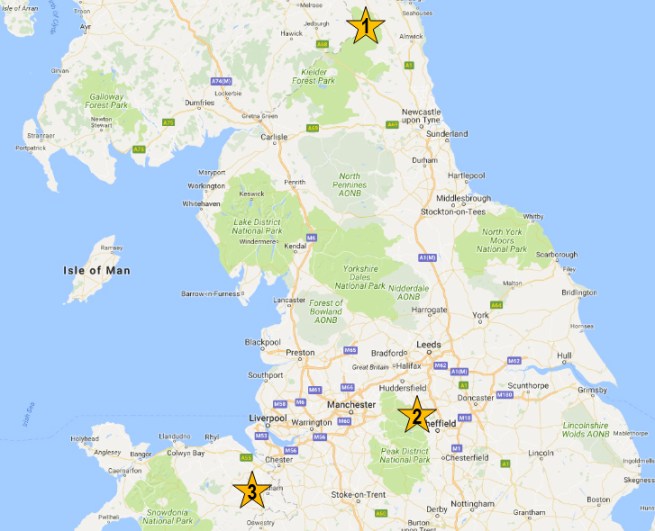
The three ‘missing’ harriers are Hilma (1), Octavia (2) and Heulwen (3).

[RPUK map]

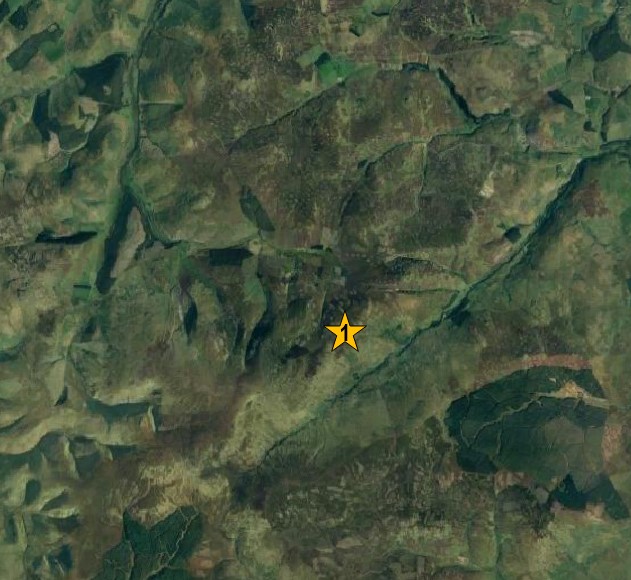
According to the RSPB blog, Hilma’s last known tag fix was on 8 August 2018 ‘near Wooler, Northumberland over land managed for driven grouse shooting’.

From the map on the RSPB blog, we believe this to be on the Lilburn Estate. We’ve blogged about the Lilburn Estate recently (see here).

Here’s a close up map of the habitat at Hilma’s last known location. The rectangular strips of burnt heather give the game away a bit, eh?

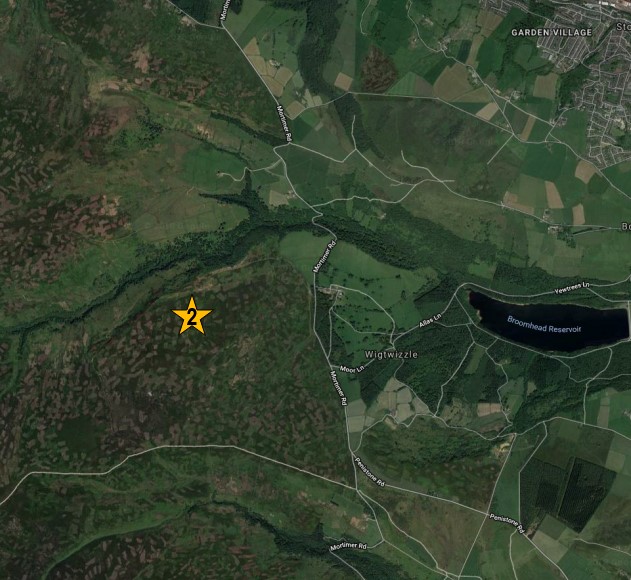
According to the RSPB blog, Octavia’s last known tag fix was on 26 August 2018 on ‘privately owned grouse moors near Sheffield’.

From the map on the RSPB blog, we believe this to be the Broomhead Estate in the Peak District National Park. We’ve blogged about the Broomhead Estate quite recently (here, here and here).

Here’s a close up map of the habitat at Octavia’s last known location. The rectangular strips of burnt heather give the game away a bit, eh?

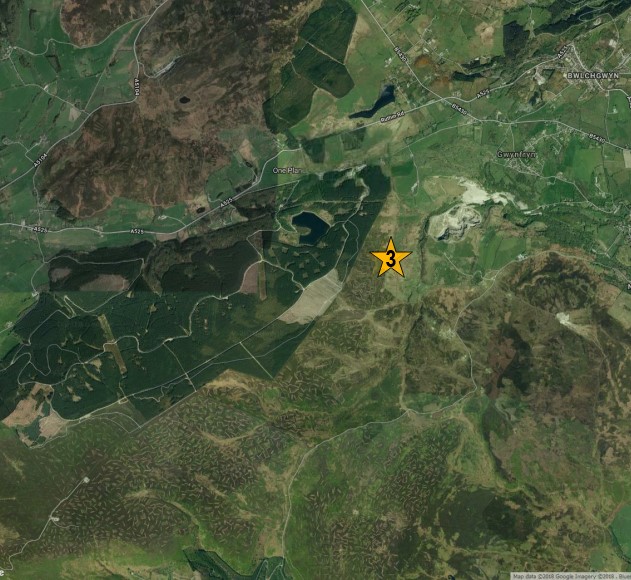
According to the RSPB blog, Heulwen’s last known tag fix was on 29 August 2018 ‘in the vicinity of Ruabon Mountain’.

From the map on the RSPB blog, we believe this to be the Ruabon grouse moor. We’ve blogged about this grouse moor recently (see here, here).

Here’s a close up map of the habitat at Heulwen’s last known location:

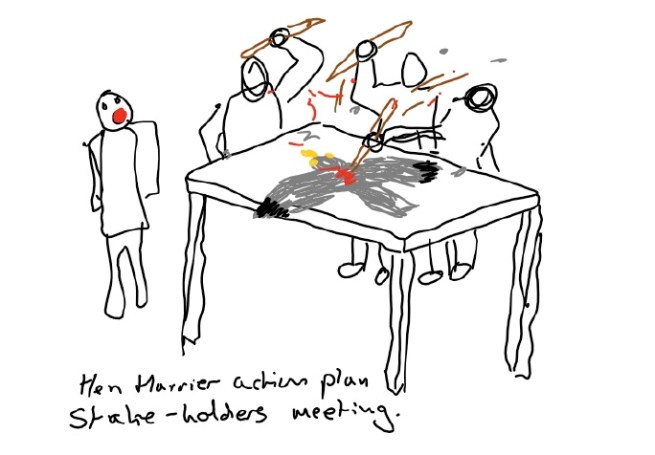
And cue obfuscation, denial and deflections from the grouse shooting industry’s social media trolls, deathly silence from the grouse shooting industry’s representative bodies, and wilful blindness (and continued silence) from DEFRA, Michael Gove MP, Therese Coffey MP, Natural England and anyone else who thinks we’re stupid enough to believe that the HH Action Plan is helping hen harrier population recovery.

Cartoon by Gerard Hobley


North Wales Police investigating “possible disappearance” of another satellite-tagged hen harrier

The North Wales Police Rural Crime Team has posted the following statement on Twitter this morning:

There isn’t much detail to go on but presumably this harrier’s tag has suddenly and inexplicably stopped in highly suspicious circumstances, just like the 79% of other tags fitted to hen harriers between 2007-2017 (and remember this is 79% of tags fitted by Natural England – it does not include any tags fitted by the RSPB – we’re expecting that analysis sometime next year).

What’s interesting though, is the location from where this hen harrier’s satellite tag last tranmsitted: the “Llandegla area”. This is very close to the location where another satellite-tagged hen harrier (Aalin) ‘disappeared’ in suspicious circumstances in February this year near the Ruabon grouse moor (see earlier blog on Aalin’s disappearance here).

Hopefully more details about this latest hen harrier’s “possible disappearance” will be published soon.

UPDATE 13 September 2018: 3 more satellite-tagged hen harriers disappear – all on grouse moors (here)

Well done, Private Eye!

For a second consecutive issue, Private Eye has featured a piece on the illegal persecution of raptors on grouse moors.

Here’s what appeared in yesterday’s edition:

And here’s what appeared in the previous edition two weeks ago:

Well done that journalist, more of this please!

Crowdfunder launched to support the Peoples Walk for Wildlife

On Saturday 22 September 2018 Chris Packham will lead the first Peoples Walk for Wildlife in London’s Hyde Park.

Everyone is invited to come along to show your support for Britain’s beleaguered wildlife and unite in a call for greater action from those with the power to bring change.

An event like this costs money, a surprising amount of money, and Chris has just launched a crowdfunder appeal to help cover some of those costs. He explains all in this video:

The crowdfunder page can be found HERE

Please support this with a few quid if you can.

Thanks

Whernside Estate: more reaction to gamekeeper’s conviction for shooting owls

On Tuesday gamekeeper Tim Cowin was convicted for shooting, and then stamping on, two short-eared owls before then hiding the corpses on a grouse moor on the Whernside Estate in the Yorkshire Dales National Park (see here).

[Gamekeeper Cowin being arrested on the Whernside Estate shortly after shooting and then stamping on two short-eared owls and hiding their corpses on the moor. Photo by Guy Shorrock, RSPB]

Cowin’s conviction was widely welcomed by the public, and there was also comprehensive revulsion at his criminal and sadistic behaviour after people were able to watch the extraordinary video footage captured on scene by the RSPB’s Investigations Team.

Several organisations involved in the Raptor Persecution Priority Delivery Group (RPPDG – the PAW Raptor Group) have since published statements on their respective websites:

North Yorkshire Police Rural Task Force’s statement can be read here, and it mentions how this conviction ‘should serve as a warning’ to others committing wildlife crime in North Yorkshire.

North Yorkshire Police Crime Commissioner Julia Muligan, who had the foresight to establish the Rural Task Force in response to N Yorkshire’s reputation as a wildlife crime hotspot, has also issued a statement, here. Julia’s statement focuses on the value of the police working in partnership with the RSPB to catch the raptor killers.

The Northern England Raptor Forum (NERF) has also published a long statement (here), also praising the efforts of the RSPB and North Yorkshire Police (and the CPS) and takes a justified side swipe at fellow RPPDG member, the Moorland Association, for its failure to do likewise.

And what about the other members of the RPPDG ‘partnership’? Three days on, what statements have been issued by the game-shooting industry’s RPPDG representatives about this successful conviction and the outstanding efforts of the RSPB, North Yorkshire Police and the CPS to expose yet another criminal gamekeeper? (Don’t forget, part of the RPPDG’s role is to provide publicity about illegal raptor persecution to ‘build trust and transparency’).

Moorland Association – we blogged about the Moorland Association’s statement on Wednesday (here) which was fully supportive of the Whernside Estate (allowing it to retain its membership of the MA) and didn’t mention the RSPB, Police or CPS at all.

National Gamekeepers Organisation – no statement

British Association for Shooting & Conservation – no statement

Country Land & Business Association – no statement

Countryside Alliance – no statement

Game and Wildlife Conservation Trust – no statement (GWCT isn’t a member of the RPPDG but we include them here because they have a prominent role in the game-shooting world).

This deafening silence comes as no surprise. We’ve seen it time and time again from these so-called ‘partners’ – we either get silence, or a demented attack on the RSPB.

For example, not one of them issued a statement after a gamekeeper was filmed with a poisons cache on the East ArkengarthDale Estate (here), nor after men dressed as gamekeepers were filmed shooting at nesting marsh harriers and then removing their eggs on Denton Moor (here).

We did get statements from the Moorland Association, BASC and the Countryside Alliance after the collapse of a prosecution against a gamekeeper who was alleged to have been filmed trapping a peregrine on its nest ledge on the Bleasdale Estate (here). BASC’s statement was pretty good (here) but the statements from the Moorland Association and Countryside Alliance were appalling.

We blogged about the Moorland Association’s statement on the Bleasdale case (here), which focused on trying to undermine the integrity and credibility of the RSPB.

The Countryside Alliance didn’t issue a statement on its website when the RSPB eventually published its Bleasdale video nasty, but what it did do was have an article published in the Shooting Times earlier in the year, when the Bleasdale prosecution case had collapsed. The article, attributed to Countryside Alliance CEO Tim Bonner, was basically a re-hash of an article the CA had published on its website the previous year, attacking the RSPB for its use of covert filming in Scotland (and incorrectly asserting that the RSPB and police should seek authorisation under the RIPA legislation for such filming, even though RIPA authorisation will not be approved as raptor persecution is not considered ‘serious crime’ by the Sentencing Council).

The title of Bonner’s re-hashed article published by the Shooting Times (June 2018) tells its own story of the game-shooting industry’s attitude to tackling illegal raptor persecution – smug, sniggering and sneering:

These aren’t ‘partners’, genuinely interested in stopping raptor crimes on land managed for game shooting. If they were, they’d all be falling over themselves to heap praise on the actions of the RSPB and North Yorkshire Police that resulted in Cowin’s conviction. None of them have.

They’d all have promoted the RSPB’s raptor crime hotline which allows people to report suspected raptor killers in confidence (here). None of them have.

They’d all be publicly blacklisting the estates and sporting agents known to be involved with the illegal killing of raptors. None of them have.

And they’d all be queuing up to ask the police and RSPB to install covert cameras to monitor the security of any Schedule 1 raptor species nesting on their land. None of them have, although they’re quite happy to install stealth cameras to film the visiting public.

[Photo by Ruth Tingay]

Whernside Estate retains membership of Moorland Association

Following on from yesterday’s news that gamekeeper Timothy Cowin had been convicted for shooting and then sadistically stamping to death two protected short-eared owls on a grouse moor on the Whernside Estate in the Yorkshire Dales National Park (see here), public anger has been justifiably prominent.

Many have commented on Cowin’s pathetic sentence (a £1,210 fine) but there has also been considerable commentary on social media about why the landowner hasn’t also been prosecuted.

If these crimes had taken place in Scotland, there would have been an opportunity to prosecute the landowner and/or shooting agent for alleged vicarious liability, following the introduction of the WANE Act 2011. Although in Scotland a prosecution may not have followed automatically, especially if the landowner and/or agent was able to show due diligence, or if the landowner couldn’t be identified, or if the prosecutors deemed it wasn’t in the public interest to proceed. Since the legislation was enacted on 1 January 2012, six and a half years ago, there have only been two successful prosecutions for vicarious liability in relation to raptor persecution (here and here); two others have failed (here and here) and others simply haven’t been considered for reasons that haven’t been made clear to us (e.g. see here).

However, as Whernside Estate is in the Yorkshire Dales National Park, not in Scotland, there is no hope that a prosecution for alleged vicarious liability will follow in this case.

[RPUK Map showing location of Whernside Estate, which is located in the county of Cumbria but also lies within the boundary of the Yorkshire Dales National Park]

So with no prospect of a further prosecution, the least that could be expected would be for the grouse moor owners’ lobby group, the Moorland Association, to expel the Whernside Estate from the ranks of its membership, right?

Well, no. The Moorland Association has done the exact opposite and has instead chosen to publish a statement in support of Whernside Estate and confirmed the estate’s continued membership in the Moorland Association:

Amanda Anderson’s justification for not expelling Whernside Estate rests with the Moorland Association’s “satisfaction” that the estate had taken “all appropriate measures” to ensure its staff acted within the law and this included written correspondence between the estate and gamekeeper Cowin. Without seeing this correspondence it’s impossible to know whether this evidence would have been sufficient to meet the standards of due diligence required as a defence against vicarious liability in Scotland. It’s our understanding that in Scotland, this correspondence may not be enough to demonstrate due diligence, and other measures may also be required such as the landowner and/or agent undertaking spot checks on their employees and having a written record of those checks.

It’s fairly apparent from the detail we do know about Cowin’s case that had adequate spot checks been undertaken, questions would have been raised about Cowin being in possession of a plastic peregrine decoy, and importantly, his possession of a calling device that had been loaded with the calls of several raptor species, presumably to be used to entice raptors, perhaps towards a plastic decoy, where they could then be shot at close range.

Unfortunately we’ll never get to hear about the details of the estate’s claimed supervision of Cowin because, as there’s no provision for a potential prosecution for alleged vicarious liability in relation to raptor persecution in England, the estate doesn’t have to present this information to the authorities for scrutiny. We only have the word of the Moorland Association, which, of course, has a long track record of denying the bleedin’ obvious.

But let’s take the word of the Moorland Association, and the Whernside Estate, at face value and assume that Cowin’s crimes were as abhorrent to them as they are to the rest of us. That leads to a very interesting question. Two questions, in fact.

Firstly, no matter what claims the Moorland Association makes in all these so-called ‘partnership’ meetings trying to combat illegal raptor persecution, the Moorland Association, and its members, have absolutely no control or influence over gamekeepers working on grouse moors. Cowin is a perfect example of this. If, as the MA and the Whernside Estate claims, Cowin had undergone training, refresher training, and had signed an employment contract undertaking to work within the law, he STILL went on to commit these crimes. So what, exactly, is the point of the Moorland Association attending these ‘partnership’ meetings if it can’t offer any guarantees that gamekeepers won’t kill raptors on grouse moors?

[Gamekeeper Cowin, leaving Whernside Moor after shooting and stamping on two short-eared owls and hiding their corpses. Photo by Guy Shorrock]

Secondly, if the Whernside Estate was “dismayed” at Cowin’s actions of shooting and then stamping on those two short-eared owls, and being in possession of a calling device with raptor calls loaded on to it, did the Whernside Estate pay for Cowin’s legal representation?

Cowin’s solicitor was Michael Kenyon. Mr Kenyon was unlikely to have been a random duty solicitor called in to the police station to represent Cowin when he was questioned and later charged. Mr Kenyon is a well known figure in the game shooting world and is considered a ‘leading expert’ in firearms law and wildlife crime and once served as the legal advisor to the National Gamekeepers’ Organisation (see here) so it seems likely that he was chosen specifically to defend Cowin based on his expertise.

We had thought that perhaps Cowin’s legal representation costs had been covered by his presumed membership of the National Gamekeepers’ Organisation, especially given Mr Kenyon’s links, but according to a tweet from the NGO this morning, Cowin “was not and never has been a member of the NGO“. So it would seem unlikely the NGO paid.

Did Cowin himself pay for Mr Kenyon’s legal services? Perhaps, but this seems unlikely given what the court heard yesterday about Cowin’s financial means.

Was Cowin a member of another ‘professional’ group whose membership dues include the cost of legal representation if faced with a prosecution in relation to gamekeeping activities? We don’t know.

Did the Whernside Estate pay for Cowin’s legal representation? We don’t know that either, but we do know that somebody accompanied Cowin to several court appearances and although we cannot identify that person, it was suggested to us that it was Cowin’s boss. It may well have been, as he was certainly chatty with Mr Kenyon, heard discussing the number of grouse available to shoot on Mossdale Estate (remember them?), but equally as plausible is an explanation that it may have been a member of Cowin’s family attending court to support him.

Unfortunately we’ll never get to find out who paid for Cowin’s defence.

We were also interested in what the other ‘countryside’ organisations had to say about Cowin’s conviction. Would they all be condemning his actions and saluting the efforts of the RSPB et al in securing a successful outcome? Here’s what we found, at the time of writing this blog:

GWCT – silence

BASC – silence

NGO – silence, apart from responding to a tweet to confirm Cowin was never a member.

Countryside Alliance – silence on Cowin’s conviction but leading with the news that the prosecution of three hunting group members for alleged hunting and wildlife crime offences had been dropped, and focusing on the “wasted public resources” by “animal rights extremists” in bringing this case to trial. Interesting – we could argue the same point about the amount of wasted public resources spent in Cowin’s case as it was dragged around five different courts in NW England before his eventual guilty plea.

During our searches for commentary from the grouse shooting industry we did stumble across an article about grouse shooting on Whernside Estate that had been published in The Field magazine in 2012. Strangely, the article seems to have been removed from The Field’s website archives but fortunately we were able to find a cached version elsewhere. It makes for an interesting read, especially the bit about Headkeeper Tim Cowin working as a joiner!

UPDATE 31 August 2018: Whernside Estate: more reaction to gamekeeper’s conviction for shooting owls (here)

Gamekeeper convicted for killing two short-eared owls on grouse moor in Yorkshire Dales National Park

A gamekeeper was convicted at Lancaster Magistrates Court this morning for the killing of two short-eared owls on a grouse moor in the Yorkshire Dales National Park.

Timothy David Cowin, 44, pleaded guilty to shooting the owls on the Whernside Estate in Cumbria (inside the Yorkshire Dales National Park boundary) and to being in possession of a calling device that held the calls of several raptor species.

[Gamekeeper Cowin trying to leave the moor after shooting two short-eared owls. Photo by Guy Shorrock, RSPB]

His sentence? A pathetic £1,210, broken down as £400 for killing each short-eared owl, £200 for possessing the calling device, £170 costs and a £40 victim surcharge. The court heard that Cowin was suspended by the Whernside Estate pending the prosecution but then he later resigned and now apparently works as a joiner in Sedburgh.

Cowin committed these offences in April 2017 and was witnessed doing so by three members of the RSPB’s Investigations Team who just happened to be on the moor. The crimes were videoed (from a distance), and Cowin was observed shooting the owls, then stamping on them, and then disposing of the bodies – one hidden inside a stone wall and one stamped in to the peat. The quick-thinking RSPB team called the police, carried on filming, and one of them made his presence known to Cowin as Cowin tried to leave the moor, resulting in a chase across the hills before the police arrived to arrest him and retrieve the corpses.

For full details, have a read of this RSPB blog here.

And then watch this remarkable RSPB video:

We’ve blogged about this case previously (here), as it’s been dragged around five courts in north west England over a six-month period. At several stages it looked as though it was going to be abandoned on a legal technicality (paperwork issues this time, instead of contesting the admissibility of video evidence), as we’ve seen so often with other cases in recent years, and it is testament to the dedication of all those involved in the prosecution (RSPB, North Yorkshire Police Rural Taskforce, and the Crown Prosecution Service, who all put in extra hours) that it stayed on track and resulted in a conviction.

Of course it wouldn’t have got to court in the first place if it hadn’t been for the RSPB’s Investigations Team being on that grouse moor to install a covert camera for what had looked to them like previous suspicious activity. But just being there wouldn’t have been enough. The team was also skilled enough to recognise what Cowin was up to, quick-witted enough to film him, sharp enough to call the Police as the crime was in progress, and fit enough to chase Cowin across the moor when he was trying to escape. Added to their outstanding efforts was the swift response from North Yorkshire Police to get up to the grouse moor in time to arrest him. And then the dedicated, committed efforts of both the RSPB and the police to return early the next day to search for the second owl corpse before Cowin had an opportunity to get back on the moor and remove the evidence. In court, CPS prosecutor Rachel Parker was forensic in rebutting the attempts by the defence solicitor to have the case thrown out.

The actions of all involved in this successful prosecution were exemplary. Will the grouse shooting industry praise their efforts and encourage them to continue routing out the criminal gamekeepers known to be routinely committing these offences?

Unlikely.

We’ll no doubt hear the disingenuous bleating of the Moorland Association, GWCT, National Gamekeepers Organisation, Countryside Alliance etc, all condemning wildlife crime before swiftly returning to their usual criticism of the RSPB and its efforts to fight the continuing illegal persecution of raptors on driven grouse moors.

There are plenty more ‘Cowins’ out there, and despite the efforts of the grouse shooting industry to deny the extent of these crimes and pay for expensive lawyers to defend the criminals responsible, the public is becoming increasingly aware of how big a problem this is, through the efforts of the RSPB and its genuine conservation partners.

Today’s verdict doesn’t help those two short-eared owls; it’s too late for them, but Cowin’s conviction is yet another nail in the coffin of the driven grouse shooting industry. Kudos to all involved.

UPDATE 29 August 2018: Whernside Estate retains membership of Moorland Association (here)

UPDATE 31 August 2018: Whernside Estate: more reaction to gamekeeper’s conviction for shooting owls (here)

[PC Carr retrieving the pitiful corpse of the second short-eared owl that had been shot then stamped in to the ground. Photo by Guy Shorrock]

Two men charged in connection with wildlife crime investigation in Scottish Borders

A month ago we blogged about a Scottish gamekeeper who had been charged for a series of wildlife crime offences alleged to have taken place in the Scottish Borders (see here).

This morning Police Scotland has issued an official press statement in relation to this case, as follows:

Men charged in connection with wildlife crime investigation, Scottish Borders

Two men have been charged following an investigation into wildlife crime offences committed at a rural estate in the Scottish Borders.

The pair aged 59 and 57 are scheduled to appear in court at a later date.

END

It’s short on detail but it’s very good to see this case progressing.

Thanks to the person from the Police Scotland media team for alerting us to this news.

New satellite tag data reveal suspicious clustering of ‘missing’ hen harriers on English grouse moors

[UPDATE 27th August 2018: The three maps below have now been updated to account for the inaccurate grid reference of one ‘missing, fate unknown’ hen harrier – now accurately shown to have ‘disappeared’ in North York Moors National Park, and not in Bowland AONB]

Well, well, well.

The Westminster Government’s statutory nature conservation agency, Natural England (NE), has chosen to publish its long-awaited hen harrier satellite tag data late on a Saturday evening of a Bank Holiday weekend. No announcement, no fanfare, just quietly uploaded to the DEFRA website, probably hoping that nobody would notice.

After having a preliminary look at these data, it’s no wonder NE doesn’t want to shout about them because they validate our long-held view that NE has been shielding the hen harrier-killing criminals within the driven grouse shooting industry for years, instead of dragging them before the courts and closing down their filthy ‘sport’.

Photo of a satellite-tagged hen harrier. A post-mortem revealed it had been shot.

NE has been satellite-tagging hen harriers since 2007 and a lot of them have ‘disappeared’ in suspicious circumstances (e.g. here). As many regular blog readers will know, we, and others (notably Mark Avery) have been asking NE to publish these hen harrier satellite tag data for a long time. We came quite close to getting the information from this publicly-funded research about a year ago, when NE published part of its ten-year data set but crucially, it excluded all meaningful grid references and any information about the land use in the areas where these hen harriers had ‘disappeared’.

We accused NE of a cover up (see here and here) and pursued the data via many FoI requests but all to no avail. NE told us that as the 11-year NE-funded PhD study had finally been ditched (here), external experts would instead be analysing the data and we could expect the results to be submitted for peer-review publication in 2018.

The findings of that study by external experts were presented at an international ornithological conference in Vancouver yesterday morning, and NE, realising it could no longer justify withholding the data without facing another legal challenge, published the updated satellite tag data late last night.

The new hen harrier satellite tag data have been published on the DEFRA website here

The update is the same spreadsheet that NE published last September but now, importantly, also includes six figure grid references for the ‘last known fix’ from the satellite tags of most of the 59 hen harriers tagged by NE between 2007-2017.

We haven’t had time to look at these data very closely but for now we’ve produced some quick and dirty maps to show the distribution of ‘missing’ hen harriers and those that have been found dead, confirmed to have been killed illegally. Remember, these are the hen harriers that have been satellite-tagged by NE – the map does not include the data from RSPB’s Hen Harrier LIFE Project, so these maps will show an even bleaker picture once the RSPB has analysed the data from its tagged birds.

Here’s the overview map:

[Red star: HH found dead & confirmed illegally killed; Orange star: HH missing, fate unknown; Yellow star: Hen Harrier ‘John’, missing, fate unknown; Black star: hen harrier missing fate unknown but grid reference withheld]

The reason hen harrier John (yellow star) has been highlighted separately is because on NE’s updated spreadsheet, the data are only presented up to September 2017, and so John is shown as still being alive. However, we know that John ‘disappeared’ on Threshfield Moor in the Yorkshire Dales National Park in early October 2017 and so now joins the many others classified as ‘missing, fate unknown’.

The three black stars represent hen harriers that are listed in NE’s data set as ‘missing fate unknown’ but the grid references for these three harriers have been withheld, and the birds’ last known fix locations are given as ‘Bowland’, ‘Bowland’, and ‘Sheffield’. Presumably there is good reason to withhold these grid refs (perhaps they identify commonly-used roost sites?) so we’re not going to quibble about that. Consequently, the black stars are not placed accurately, just in the general area of ‘Bowland’ and ‘Sheffield’ (and presumably ‘Sheffield’ refers to a location close by, perhaps in the Peak District National Park).

You can see from this first overview map that there appears to be quite a bit of ‘clustering’ of last known fix locations in Yorkshire and Bowland, so let’s have a closer look at a regional scale:

Gosh, there does seem to be a lot of ‘missing’ hen harriers clusted in the Yorkshire Dales National Park, Nidderdale Area of Outstanding Natural Beauty, and Bowland Area of Outstanding Natural Beauty – all highly designated protected landscapes.

Shall we look a bit closer?

And there you have it. A suspicious spatial clustering of ‘missing’ or confirmed persecuted hen harriers in the Yorkshire Dales National Park, Nidderdale AONB and Bowland AONB – all areas where the landscape is dominated by intensively managed driven grouse moors.

Haven’t we seen this suspicious spatial clustering somewhere else? Ah yes, the map that shows the ‘missing’ satellite-tagged golden eagles in Scotland, where the spatial clustering appears in some areas that are intensively managed for driven grouse shooting.

Imagine that.

What’s that quote? “You can hide the bodies, you can hide the tags, but you can’t hide the pattern” (Dr Hugh Webster).

Looking at NE’s data spreadsheet, 47 of the 59 hen harriers satellite-tagged by NE between 2007-2017 are ‘missing, fate unknown’. That’s a whopping 79.6%!

Now obviously, these last known fix location data are of great interest to us and we await the publication of the full scientific analyses of all the tag data with great interest. But perhaps what is more interesting is what these data reveal about NE’s complicity in shielding the criminals within the grouse shooting industry.

Knowing full well what its own satellite tag research was showing, why has NE suppressed these results for so many years whilst working in so-called ‘partnership’ with the grouse shooting industry and sat back in silence whilst those same grouse shooting industry representatives have consistently denied, even in Parliament, the extent of their industry’s role in the systematic killing of hen harriers?

More blogs on this to come.