
Press release from NatureScot (17 July 2026)
Forty new satellite tags will soon track sea eagles in western Scotland to investigate how sea eagles and livestock interact
NatureScot has provided funding for the satellite tags for this collaborative research project, which brings together a broad team of experts to assess the extent of sea eagle predation of lambs and sheep. The transmitter tags are to improve understanding of the movement, behaviour of adult and juvenile sea eagles, as well as how they use and interact with the countryside.
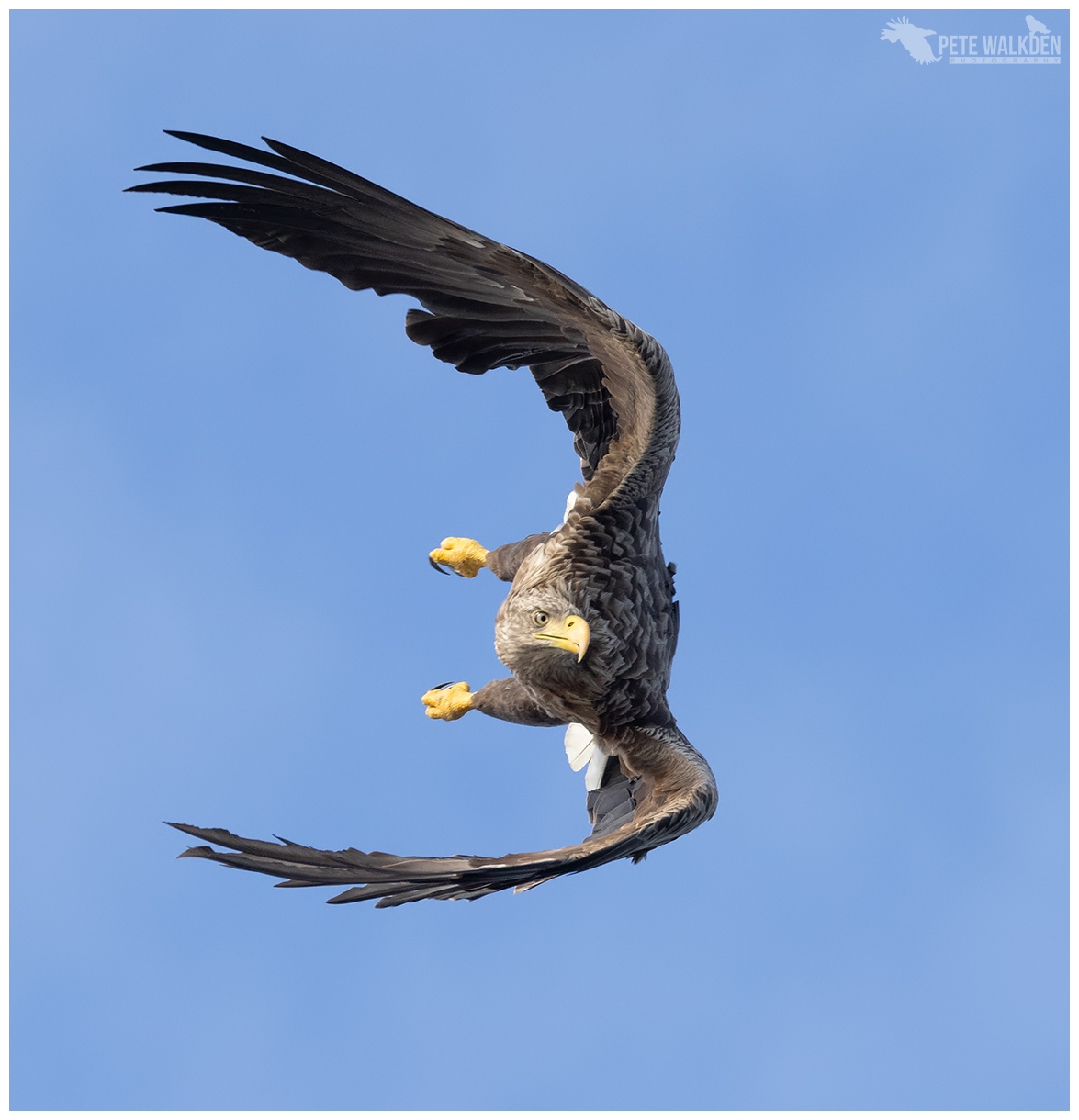
The researchers will collate and analyse GPS (Global Positioning System) fix data received from the satellite tags to gather information on the ecology of Scotland’s sea eagle population.
Over the next two years, licenced ornithologists are fitting up to 35 satellite tags to sea eagle chicks when they are about eight weeks old. By then, the chicks are full-sized and getting ready to fledge from 10 weeks of age on. These tags –which can last for years—will give a unique insight into where the chicks travel after leaving their natal home range.
Target ranges for tagging will be within Argyll, Highlands, and the Western Isles.
The project also aims to deploy the remaining five tags on adult breeding sea eagles, which are more difficult to trap. Earlier this year, ornithologists using advice and techniques gained from European counterparts, trapped, tagged, and released an adult sea eagle on the Western Isles, boding well for success in this project. Farm managers who are comfortable hosting trapping work on their land may collaborate with this work.
The research project is a partnership between NatureScot, RSPB, Scotland’s Rural College SRUC, Natural Research Ltd, and a collective of independent ornithologists, which are sharing the costs of and resources for the project between them, with policy input from the NFU Scotland and the Scottish Crofting Federation. SRUC are also tracking lambs in Argyll using GPS neck collars as part of a separate research project. This research will complement and benefit the tagging project, giving a broad picture of how sea eagles and lambs interact.
Humans persecuted sea eagles—Scotland’s largest bird of prey—to extinction by the early 20th century. Since their reintroduction initially on the Isle of Rum between 1975 and 1985, the birds—now protected by law—have successfully repopulated the west of Scotland, expanding their range in all directions and increasing impacts on upland and hill sheep flocks.
The research group will report periodically to the National Sea Eagle Stakeholder Group and NatureScot will provide further updates on its website.
NatureScot Senior Ornithologist Andrew Stevenson said:
“This project will greatly add to our understanding of how sea eagles move around and their interaction with livestock. A key gap in our knowledge is what role immature eagles play in predating livestock, given they wander widely during their first three to four years until they settle on a territory. Tagging is the best way to get a handle on what they may be doing. While this collaborative partnership began because of the need for more information about livestock predation, the tag data will also help us understand how eagles use habitat, as well as other topics such as interaction with wind farms“.
Duncan Orr-Ewing, Head of Species and Land Management RSPB-Scotland (and Research Group Chair), added:
“Gathering evidence on the behaviour and movements of sea eagles is essential to create common understanding, and to inform future conservation and land management decisions. Latest technology in the form of GPS trackers fitted to Sea eagles can help deliver such outcomes sitting also alongside other initiatives being taken forward by the National Sea Eagle Stakeholder Group. The collaborative partnership approach to this project involving NatureScot, expert researchers, farming representatives and conservationists is very welcome, and we hope to present the results in due course“.
Georgia Watson, NFUS Policy Manger – Climate, Land & Business, said:
“NFU Scotland supports this satellite tagging project as a vital step towards building a clear, shared evidence base on sea eagle behaviour. For farmers and crofters in affected areas, understanding when and where interactions with livestock occur is critical. This research must lead to practical, targeted management solutions that give farmers confidence that impacts on livestock are being properly recognised and addressed“.
Scottish Crofting Federation Chief Executive Donna Smith said:
“Crofters are reporting increased sightings and issues with sea eagles each year so this research is a very welcome development. Building a greater understanding of how the sea eagles are interacting with livestock will hopefully lead to improved targeting of management measures in the future. We therefore look forward to supporting the research in whatever way we can and to seeing the findings in due course“.
ENDS


Perhaps satellite tag some lambs to determine if lambs are taken alive or if they were already dead before being taken. Obviously not feasible to tag all lambs but a sample would help, particularly when large losses are being claimed.
Lamb tagging has been done before (over 10 yrs ago) where a small plastic black box (radio tag), about the size of a matchbox, was attached to lambs’ necks in a study about alleged lamb-killing eagles. The results showed that not one single lamb was killed by an eagle. The crofters claimed the eagles had been ‘put off’ because of the radio collars/tags. They also claimed that the eagles had been given supplementary food during the study period, and that some eagles had been ‘bird-napped’ to remove them from the study area.
The obvious solution then – attach black-coloured matchboxes to lamb necks.
Yes I’m always bringing up what happened at Gairloch too https://www.scotsman.com/news/sea-eagles-not-taking-lambs-to-slaughter-2473455 and as some people clearly didn’t get what they wanted out of it the pathetic attempts to discredit the study. Clearly enough time has passed since then the usual suspects hope enough people have forgotten about it (which is why it’s a good idea to keep bringing it up) to try again with the sea eagles are eating all our lammy kins tripe. Having had dealings with crofters on Lewis, I really wish that just once, just once that when crofters start bleating about being put upon, or neglected, or getting unfair treatment, or about being ‘poor’ or about the clearances that they were just told to get stuffed and stop chancing it. As I don’t know ‘the language’ I can’t translate it into Gaelic, but if someone else can I suggest a new motto for Lewis “Oh, but can we not get it for free?” – based on experience it would be most appropriate.
I believe this is also being under taken with limited numbers of lambs.
“NatureScot has provided funding for the satellite tags for this collaborative research project, which brings together a broad team of experts to assess the extent of sea eagle predation of lambs and sheep….”
Hmmm…..
Two questions.
Will it also help monitor white tailed eagles carrying of small horses and children as we have seen alleged before 😉
If it does show predation of lambs, I trust any feedback will compare any losses as a result of other factors which cause lamb mortality.
It will be good to have some actual science, rather than the bigoted anecdotal evidence of crofters and other antis. As the Fifer said, it is important that any interaction is set against other mortality causes and they don’t ignore the impact of domestic dogs on sheep, 13,000 per year, as happens when they want to justify killing foxes, badgers and Corvids.
There’s been endless scientific studies and monitoring, for years and years. None of which has provided any evidence of widespread lamb-killing by eagles. Although that’s not to say the sat-tagging won’t be useful/interesting – it will be, but probably not for the reasons the crofters think it will be!
I was being just a tad facetious