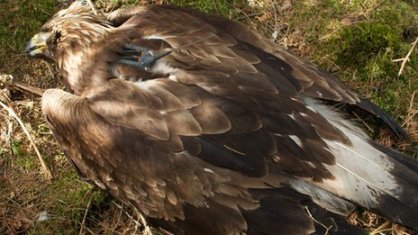
 Last month we encouraged blog readers to contact Tayside Police Chief Constable Justine Curran to ask for further clarification about the way Tayside Police had handled the investigation into the death of a golden eagle. This young eagle was believed to have been illegally trapped on an Angus grouse moor and then moved, in the dead of the night, to a lay-by in Aberdeenshire where it was left, with horrific injuries, to die a slow and undoubtedly agonising death. See here and here for earlier blog posts about this case.
Once again our blog readers stepped up and contacted Tayside Police and once again this has paid off; Tayside Police have responded. We’ll come to that in a minute, but first of all a big thank you to everyone who tweeted, facebooked and shared the story on their own blogs and websites – people power in action. We’re convinced that it was the sheer volume of emails that prompted the response from Tayside Police, so well done to all involved.
Tayside Police also deserve credit for responding. This is the second time they’ve posted a comment on this blog and to be honest, we didn’t expect them to do it twice. However, although they deserve credit for responding, the content of their response still leaves a lot to be desired.
As a quick re-cap, here is a summary of the questions that were asked of Tayside Police:
- Is the death of this golden eagle being treated as a CRIME?
- Were attempts made to recover evidence from a wide search area?
- Were attempts made to recover evidence from vehicles and buildings?
- Why hasn’t Tayside Police publicised the death of this eagle?
- Did Tayside Police provide details of the post-mortem to any defence agent?
- Did Tayside Police advise the Minister’s office that the eagle’s injuries could have been caused by anything other than a spring-type trap? If so, what did they say could have been the cause of the injuries?
We’ll come back to each question once you’ve read the full police response. As before, their response was made via the comments section of the blog and we’re reproducing it here in case anyobody missed it:
 Comment from Wildlife and Environmental Crime Officer Tayside Police
Thank you for bringing these matters to my attention and by way of assurance, on behalf of Tayside Police, I am now in a position to provide an update in regard to many questions asked through the Blog. In order to deal with this effectively in the future, I would ask that any further correspondence be directed to this email address in order that they can be dealt with appropriately – mail@tayside.pnn.police.uk
You will appreciate that it has taken some time to consider the issues raised. The following comments take into account the on-going investigation into the death of the Golden Eagle in May 2012, as we continue to attempt to establish the exact cause of the eagle’s death.
This reported incident was recorded as a crime in Tayside area and has been investigated as such. Along with our partners in Grampian Police and the RSPB Investigations Unit, I have carried out a full and comprehensive enquiry into this incident. The enquiry remains ongoing and we have unfortunately yet to identify those responsible.
In every investigation, Police and other partner agencies consider the use of the media. In this case utilising the media was indeed considered by the enquiry team and after discussion with partners, it was decided not to publish the incident. Be assured that the media are considered in every investigation by Police and other agencies but I am content that the correct decision was made in this case.
As per Karen Hunter’s (Scottish Government) letter of the 24th October 2012 “It is extremely frustrating (for all involved in the investigation of wildlife crime) that it is so difficult to detect, and in some cases to prosecute and convict those responsible for wildlife crimes. However while it easy to make suppositions about circumstances of an apparent offence as reported in the media, wildlife crime must be subject to the same standard of proof as any other crime. Police and prosecutors also apply the same stringent procedure for dealing with wildlife crime as for any other sort of crime.”
In Scotland, in all cases, sufficient and admissible evidence is required to report a case to the Procurator Fiscal.
A charge may be proved by purely circumstantial evidence, by accounts from two or more credible witnesses or a combination of the two types of evidence but, in order to be sufficient, the material facts and circumstances must point only to one conclusion, and that is, the guilt of the accused. It is not necessary to have corroboration of every fact and circumstance in a chain of circumstantial evidence but the more important circumstances should be corroborated.
Evidence must also be legally admissible which means it has to have been obtained by legal means. Only competent evidence will be admitted by the courts. The court alone decides what evidence in a particular set of circumstances is admissible.
To clarify Police procedures, there can often be sufficient evidence to suggest a crime has been committed to allow for further investigation, but this does not automatically infer there is enough evidence to report the matter to the Procurator Fiscal or indeed secure a conviction. This is the current situation.
Please be advised that in relation to some of the more specific questions, asked regarding the on-going investigation, we can not disclose information due to the risk of compromising the investigation. However we can confirm that Tayside Police did not allow any access to the Golden Eagle carcass to any defence agent.
Be assured that Tayside Police are eager to bring the perpetrators to justice and in conjunction with the other agencies referred, Tayside Police will continue to investigate all circumstances surrounding this incident with a view to identifying those responsible. Police and other agencies will apply appropriate and proportionate resources to this type of crime on every occasion and diligent enquiry will be carried out.
Tayside Police will also continue to support and develop all preventative measures available to us and our partners to minimise the threat of any further such incidents occurring in the future.
I trust my comments will be of use to all those who have contacted Tayside Police regarding this incident.
In regard to other general questions, I can advise that this information can be accessed via your own website, the SASA website and RSPB website.
For any further comments or information that can assist us in this investigation please contact: mail@ tayside.pnn.police.uk , call 0300 111 2222 or speak to any Police Officer.
So, let’s go back to each question in turn.
Q1. Is the death of this golden eagle being treated as a crime? A. Yes.
Q2. Were attempts made to recover evidence from a wide search area? A. We can not disclose information due to the risk of compromising the investigation.
Q3. Were attempts made to recover evidence from vehicles and buildings? A. We can not disclose information due to the risk of compromising the investigation.
Q4. Why hasn’t Tayside Police publicised the death of this eagle? A. In every investigation, Police and other partner agencies consider the use of the media. In this case utilising the media was indeed considered by the enquiry team and after discussion with partners, it was decided not to publish the incident. Be assured that the media are considered in every investigation by Police and other agencies but I am content that the correct decision was made in this case.
Q5. Did Tayside Police provide details of the post-mortem to any defence agent? A. We can confirm that Tayside Police did not allow any access to the golden eagle carcass to any defence agent.
Q6. Did Tayside Police advise the Minister’s office that the eagle’s injuries could have been caused by anything other than a spring-type trap? If so, what did they say could have been the cause of the injuries? A. No response.
So what have we learned?
That Tayside Police won’t provide detailed information about the nature of their search. We didn’t really expect them to and in any case we already know (from other sources) that a search warrant was not requested for this investigation. It’s hard to understand why not but we’re unlikely to get an explanation.
We’ve learned that Tayside Police considered using the media to publicise this case but chose not too. Actually we didn’t just learn that, we already knew they hadn’t publicised it – what we asked was why they hadn’t publicised it. No satisfactory answer was received.
We’ve learned that Tayside Police didn’t allow any defence agent access to the eagle carcass. What we specifically asked though was whether they allowed a defence agent access to the post-mortem results. No satisfactory answer was received. Our sources suggest that a defence agent did have access to the post-mortem results, although who gave him that access remains a ‘mystery’.
 The most important thing we learned was that this incident IS being treated as a crime by Tayside Police. That is reassuring, but begs the question then, who advised the Minister’s office to put out this statement:
“The reports may suggest that the circumstances of this incident were suggestive of an offence however there is no hard evidence and it remains possible that there is an alternative explanation“.
Tayside Police didn’t answer this question directly but we can infer that, as they were treating the incident as a crime, the advice to the Minister probably didn’t come from them. It’s also fair to assume that the advice didn’t come from the Police’s partner agency in this investigation, the RSPB, as they were the ones to put out a press release stating that they believed the eagle had been caught in an illegally-set trap. So who did advise the Minister? This is an important question; we need to be reassured that the Minister is not taking advice from anybody who has a vested interest in covering up this crime. Let’s ask him: “From whom did the Environment Minister’s office take advice that suggested this eagle’s death was anything other than a crime?” Email to: ministerforenvironment@scotland.gsi.gov.uk

 The following letter has appeared in The Scotsman in the continuing ‘debate’ on grouse moor management (see
  Happy Hogmanay!
 Earlier in December we blogged about SNH’s decision to authorise the use of clam-type traps under the 2013 General Licences, despite the concerns of a number of organisations that these traps are likely to cause injury to non-target species, especially raptors (see
  This isn’t especially new news, as it happened in the summer, but we were reminded of it today after reading something on Mark Avery’s blog – more on that later – and it does seem pertinent to blog about it now.
 Some argue that conservation groups shouldn’t be sitting at the table with representatives from an industry that has been responsible for killing off England’s breeding hen harrier population. Others argue that the quota scheme may be the best way forward because at least there’d be some harriers, which is a better proposition than having none. Others have suggested that the quota system would never get off the ground anyway because the grouse moor owners would have to ‘allow’ a certain number of breeding hen harriers on their estates and they’ve shown themselves incapable of tolerating any.
 Following on from earlier blog posts about SNH’s latest baffling decision to authorise the use of clam-type traps in the 2013 General Licences (see
  Following yesterday’s blog and the request to SNH to publish all the consultation responses relating to the 2013 General Licences (see
  In October we blogged about how SNH was preparing to make changes to the 2013 General Licences via a public consultation process (see
  However, the biggest concern is that SNH has officially authorised the use of ‘clam’-type traps (see above), even though they are fully aware of concerns that these traps are likely to cause injury to non-target species (e.g. see
  We were expecting a verdict yesterday on the Lochindorb Estate hare snare trial, but Sheriff Abercrombie had other ideas.
