Lochindorb Estate hare snare trial: case continued!

Mountain hare (Photo: Neil McIntyre)We were expecting a verdict yesterday on the Lochindorb Estate hare snare trial, but Sheriff Abercrombie had other ideas.

The case has now been continued until 29 January 2013.

Clearly the sheriff recognises the significance of this test case and wants extra time to consider all the evidence.

Lochindorb Estate hare snare trial: verdict expected today

The long-running hare snare trial is expected to end today if Sheriff Abercrombie has reached a verdict.

We’ve blogged a lot about this case as the verdict could have far-reaching consequences on the way our uplands are managed, with a particular impact on grouse moor management practices.

Earlier posts can be read here (and see links within).

Two weeks ago the court heard the final pieces of evidence from the defence team, which consisted of a string of gamekeepers insisting that the type of snare used in this case is ‘selective’ (i.e. it doesn’t trap any species other than the target species). It must be a magic snare.

Many thanks to the contributor who send us a copy of the Badenoch & Strathspey Herald, dated 22 November 2012, with a summary of the evidence heard in court:

Gamekeepers tell trial of ‘selective’ snares

THREE gamekeepers have given evidence at the trial of a colleague facing allegations of illegal snaring of mountain hares on Lochindorb Estate more than three years ago.

The keepers told Sheriff Ian Abercrombie they had used the type of snare set by David Taylor and caught nothing other than mountain hares.

Former Lochindorb keeper Alexander McConnachie (66), Stuart Kennedy (45), from Tomatin, and Alan Hodgson (54), head keeper at Dalmagarry and a committee member of the Scottish Gamekeepers’ Association with special responsibility for snaring issues, told the trial they had all used the “W”  shaped snare, also known as a bow snare, as a means of controlling mountain hares on high ground on their estates.

David Taylor (65), who recently retired from his role as head keeper at Lochindorb, was charged with setting snares on April 14, 2009 on land at Lochan-t-Sidhie which were indiscriminate in which animals they could catch, contrary to the Conservation (Natural Habitats) Regulations which became law in 1994.

The trial, which started in March, reached its sixth day on Friday [16 Nov 2012] when the evidence was concluded.

Sheriff Abercrombie has agreed to written submissions being provided by both the Crown depute fiscal Iain Smith and the defence agent David McKie.

In evidence, Mr McConnachie said he was head keeper on Lochindorb between 1972 and 1993 before the new legislation came into place. He told the trial that where the snares were set, 1,500 feet above sea level, there were very few other species to be found.

Wildlife expert Hugo Straker (57), a senior adviser with the Game and Wildlife Conservation Trust and an expert on snaring law in Scotland, had earlier told the trial that the snares could be selective depending on how and where they were set. He also differentiated between a trap and a snare. In his opinion he said a trap was a spring-loaded device which can kill or trap an animal live while the snare was a “restraining device” which can kill.

Mr McConnachie told the court snares are never referred to as traps. ‘A trap is a mechanical device’, he said. Often they were concealed in a box to trap the targeted species and for the protection of other mammals. Wire cage traps, known as Larsen traps, were also used to control crows.

He said he used the “bow” snare used by Taylor extensively between 1990 and 1993 on Lochindorb because of the increase in tick of the moor.

Asked if he had ever found other animals caught in the snares he replied: “No, never. They are very selective, very humane and highly visible. I never caught anything else in them”.

He said you would get the occasional fox or roe dear [sic] at that level but it was quite rare to see a golden eagle.

Asked by depute fiscal lain Smith if an animal broke a snare how he would know it was a hare that did this. He said there was always evidence of hare fur nearby if a snare broke.

Mr Hodgson said the snares were perfectly legal at the time but gamekeepers had stopped using them because of this court case. He commented: “I would use them again in a minute. They were a brilliant tool. Easy to carry, easy to set and highly visible”.

Mr Hodgson said foxes and deer avoid them because they have forward vision. However, he said: “Hares have blind spots because their eyes are on the side of their heads, unlike predators”. He said he used them for nine years and never once found another species in them.

The trial was told by Mr Straker that since the alleged offence there had been major changes in law governing the use of snares going through parliament and all snares must have stops so mammals caught are not throttled and can be put down humanely. Everyone using them will require to be trained and certificated by a Scottish Government approved body and, from April next year, every snare will carry the operators certification number.

Police Constable Eric Sharkey (45), a wildlife officer with Northern Constabulary, inspected the site after a tip-off from a member of the public.

RSPB Scotland: 2011 persecution report published

RSPB Scotland has just published its latest report, The Illegal Killing of Birds of Prey in Scotland in 2011. You probably won’t be surprised or shocked by the content, especially if you’ve read the previous 17 annual reviews. In fact, when you read this 18th review, you might get a strong sense of déjà vu.

It opens with a Foreword by Stuart Housden, Director of RSPB Scotland. Apart from the new photo, this foreword looks like a cut and paste job from the 2010 report, with a few words or sentences added or adjusted. To be fair, not much has changed since the 2010 report was published so perhaps he felt justified in repeating what he’d written the previous year.

Then there are RSPB Scotland’s strategic recommendations for addressing raptor persecution. Again, these show a remarkable similarity to the recommendations made in the 2010 report, and also in the 2009 report. The recommendations were / are still good and to see them repeated again is a useful indicator of how little progress has been made by those with the power to push them forward.

Next come the tables showing the confirmed and probable persecution incidents recorded by the RSPB during 2011. It’s these tables that the game-shooting lobby usually object too – they’re especially reluctant to accept the ‘probable’ incidents although to date, they’ve failed to provide a convincing argument to account for any of them.

The data in the 2011 tables demonstrate once again that illegal raptor persecution is widespread, with incidents reported in Perthshire, Angus, South Lanarkshire, Aberdeenshire, Dumfries-shire, East Ayrshire, Borders and Inverness-shire. We counted 15 very familiar-sounding locations within these regions, although there are a few notable absentees this time. Have they stopped their criminal activities or have they just got better at covering up? Time will tell.

Just focusing on the confirmed incidents, in total 17 incidents of deliberate poison abuse were confirmed during 2011, involving 20 victims: 7 buzzards, 4 red kites, 1 golden eagle, 2 peregrines, 2 ravens and 4 other bird species. Sixteen other illegal incidents relating to shooting, nest destruction, and the use of uncovered spring traps or cage traps were confirmed. The victims included 8 buzzards, 2 peregrines, 1 goshawk, 1 sparrowhawk, 2 kestrels and 1 short-eared owl. As in previous years, not all of these incidents were publicised at the time they occurred. It’s a continual disappointment that several years have to pass before the public learns of these appalling crimes.

Once again the occupations and interests of those convicted for illegal raptor persecution crime have been analysed (data from 2003-2011 inclusive). 87% of them were gamekeepers (7% pigeon racers, 3% pest controllers, 3% farmers).

The report includes an interesting case study of poisoned raptors that have been found in recent years on the Glen Kyllachy and Farr Estate near Inverness. Very little of this information has been previously published and certainly this is the first time these photographs have been published. It’s a shame it’s taken several years for the info and images to reach the public domain but nevertheless it’s very encouraging to see RSPB Scotland highlight these cases, especially as Northern Constabulary hasn’t bothered.

All in all the report makes for grim reading, but nobody should be surprised by that. We all owe a large debt of gratitude to the RSPB’s Investigations Team for meticulously collecting these data and especially for making them publically available.

TO DOWNLOAD A COPY OF THE REPORT CLICK HERE

Here’s some media coverage:

RSPB Scotland press release here

BBC news article here

STV news article here

Herald Scotland article here

Scottish Gamekeepers Association: statement here

Scottish Land and Estates: nothing yet

@SNHMedia: “SNH report finds vast majority of gamekeepers highly qualified”. Link to this.

PAW Scotland: nothing yet

Update on the curious incident of the eagle in the night-time

Following on from yesterday’s blog entry, The curious incident of the eagle in the night-time (see here), we have an update…

First of all, a big thank vote of thanks to all of you who tweeted and shared the story on Facebook to help raise awareness about this situation. Special thanks to five Twitter users in particular: @TripleSter; @RareBirdAlertUK; @benjaminbittern; @Cekaelta; @ChrisGPackham.

Secondly, another big vote of thanks to everyone who made an effort and sent an email to Tayside Police’s Chief Constable to ask whether the death of this golden eagle was the subject of a criminal investigation. Your efforts have had an impact – a Tayside Police spokesman has responded by writing a comment on the blog. We’re reproducing it here so it doesn’t get buried:

We are concerned regarding this matter and, along with our partners in Grampian Police and the RSPB Investigations Unit, as well as our own Wildlife and Environment Officer, are continuing to undertake enquiries. Please be assured that Tayside Police will continue to investigate all circumstances surrounding this incident with a view to identifying those responsible and holding them to account for what is a terrible deed. Anyone who has information that can assist us should call 0300 111 2222, or speak to any officer“.

Before we discuss their comment, we’d like to acknowledge Tayside Police for engaging in the discussion. Although they have a duty to respond to emails sent to them by members of the public, they aren’t obliged to post comments on blogs or a similar forum and they deserve some credit for doing so in this instance.

Now, let’s get down to what they said:

They are concerned. That’s good.

They are continuing to make enquiries. That’s very good, but can we clarify that “this matter” / “incident” / “terrible deed” is in fact a CRIME? There seems to be a reluctance to use this term. This is an important distinction to make as it will affect the official wildlife crime stats that the police now have to provide to the Scottish Government each year (this requirement was brought in with the WANE Act) and also the ‘stats’ that the persecution-deniers trot out each year to ‘prove’ that illegal raptor persecution is ‘in decline’.

They are conducting their enquiries in partnership with Grampian Police and the RSPB Investigations Unit. That’s also very good.

They will “continue to investigate all circumstances surrounding this incident with a view to identifying those responsible and holding them to account for what is a terrible deed”. That sounds very good but is it anything more than just a media sound bite designed to placate an increasingly frustrated general public? It’s been six months, nearly seven months, since that eagle was found dead in early May 2012. What chances of finding any evidence now or in the future, so long after the event?

In the interests of transparency, we’d like to ask some further questions about the investigation to date. Obviously we don’t wish to jeopardise an on-going criminal investigation and so Tayside Police may not wish to answer these questions, although it is common practice for police forces to release some information during criminal inquiries so let’s see if they’re able to help this time. The questions that we’re asking should not have any negative effect on their continuing enquiries because it’s probably fair to say this investigation is now dead in the water; nobody is going to be brought to justice for the death of this eagle. We also know that the Scottish Gamekeepers Association is conducting its own ‘inquiry’ and that information about this investigation may have been passed to them by Tayside Police. If so, we hope the police will not treat us any differently.

We’d be interested to learn whether, during the early stages of the investigation, attempts were made to recover evidence from a wider search area of the land where the eagle was motionless for 15 hours before it was moved north to the lay-by where it was left to die? Also, were attempts made to recover evidence (e.g. eagle feathers or blood) from any vehicles or buildings that may have been used in this crime?

We’d also be interested to learn why Tayside Police haven’t publicised this incident, either at the time the dead eagle was discovered, or in the following months (e.g. with an appeal for information)? Tayside Police regularly post news items, appeals for information and investigation updates in the news section of their website; we wonder why this case was treated differently?

We also understand that there might have been some sort of approach by a defence agent wishing to access the dead eagle and/or the post-mortem results and we suspect this might have been an attempt to discredit the findings of the official post-mortem. i.e. to challenge the conclusions drawn by experts at the Scottish Agricultural College lab that the eagle’s severe leg injuries could have been caused by a spring-type trap. Did Tayside Police provide the findings of the official post-mortem to any defence agent? 

And finally, we go back to the Environment Minister’s statement about this incident. In whose interest was it to suggest that this was not a criminal offence? Who advised the Minister that the eagle’s injuries could have been the result of anything other than a criminal offence? It probably wasn’t the RSPB Investigations Unit given they put out a press release stating that they believed the eagle had been caught in an illegally-set trap (see press release here). That only leaves the police, unless of course the Minister’s office is taking advice from a defence agent, and that would certainly seem absurd. If it was Tayside Police, and we’re not saying it was, doing so would appear to undermine a criminal investigation before it even got off the ground (no pun intended).

Surely a government minister would not release a statement unless he was sure the advice he had being given was accurate? So, did Tayside Police advise the Minister’s office that the eagle’s injuries could have been caused by something other than a spring-type trap? If they did, it’d be interesting to know what the Minister’s office was told could have caused the eagle’s injuries other than a spring-type trap.

We’re calling on our blog readers to help find answers to these questions by asking Tayside Police, en-masse, to provide clarification on the above points. Just writing about the issues on a blog can help raise awareness but it’s unlikely to produce tangible results – the police aren’t obliged to respond (although, as mentioned above, Tayside Police, to their credit, did so yesterday and for that we applaud them). However, they are obliged to respond to individual emails from the general public.

This is an opportunity to shine a light on the investigation of raptor persecution crimes in the Tayside region. Regular blog readers will be well aware that the death of this golden eagle is not an isolated incident;  this region has seen more than its fair share of illegal raptor persecution in recent years, including the discovery of poisoned golden eagles, white-tailed eagles, buzzards, red kites, sparrowhawks, tawny owls, crows, as well as a series of poisoned baits. Very few of these crimes have resulted in prosecutions.

Here’s a summary of the questions to be asked:

  • Is the death of this golden eagle being treated as a CRIME?
  • Were attempts made to recover evidence from a wide search area?
  • Were attempts made to recover evidence from vehicles and buildings?
  • Why hasn’t Tayside Police publicised the death of this eagle?
  • Did Tayside Police provide details of the post-mortem to any defence agent?
  • Did Tayside Police advise the Minister’s office that the eagle’s injuries could have been caused by anything other than a spring-type trap? If so, what did they say could have been the cause of the injuries?

Please send questions to Tayside Police Chief Constable Justine Curran: justine.curran@tayside.pnn.police.uk

The curious incident of the eagle in the night-time

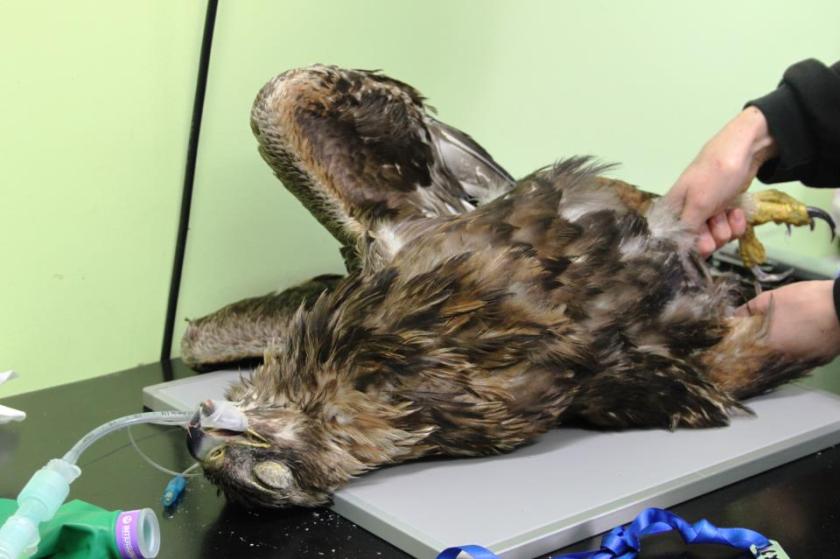
Six months ago, a dead golden eagle was found close to a lay-by on a quiet road in Aberdeenshire. The bird’s satellite-tracking data showed it had remained motionless on an Angus grouse moor for 15 hours, before inexplicably moving 15km north to the lay-by, in the dead of night, where it was found dead several days later. A post-mortem conducted by the Scottish Agricultural College laboratory in Aberdeenshire concluded that the eagle had suffered two broken legs due to trauma “that could be consistent with an injury caused by a spring type trap“. The SAC said the severity of the eagle’s injuries “would prevent the bird from being able to take off“.

This incident was not reported in the press until September 2012, four months after the eagle’s carcass had been discovered (see earlier blog on this here). Notably, the news was not released by Tayside Police, or Grampian Police; it was the RSPB that went public on this.

Since then there has been much confusion and muddying of the waters surrounding this case. As soon as the RSPB’s press release hit the national media, Environment Minister Paul Wheelhouse tweeted this:

26th September 2012 @PaulWheelhouse: This is a terrible story of an eagle suffering a lingering death – anyone with info please contact the police. He linked his tweet to this BBC news story.

It seems that like the majority of us, the Environment Minister considered this eagle’s death to be linked to a criminal offence. Why else would he have urged people to contact the police with information?

The public’s response to the media stories resulted in many people writing to the Environment Minister to express their outrage at the illegal killing of yet another golden eagle. The Minister’s response in early October was baffling; despite all the evidence to the contrary (sat tag data, corpse found, post-mortem results, and a long, long history of illegal raptor persecution linked to game management practices on grouse moors), as well as the inference from his earlier tweet that he believed this eagle’s death to be the result of a criminal act, the Minister’s aide said this:

The reports may suggest that the circumstances of this incident were suggestive of an offence however there is no hard evidence and it remains possible that there is an alternative explanation” (see here for earlier blog on this).

This statement led to further angry letters to the Minister, and on 24th October his aide wrote the following response to one of our blog readers:

You have commented on the Minister’s letter regarding the incident involving a young golden eagle in Aberdeenshire. Please allow me to clarify. The reports may suggest that the circumstances of this incident were highly suggestive of an offence involving illegal persecution. However, whilst that may be the most likely explanation, there is unfortunately no hard evidence to that effect. In the circumstances therefore it is not appropriate to comment on this case as an example of illegal activity. However, clearly the RSPB have offered a reward for information and it remains possible that this may yet be treated as a criminal matter” (click here to read the full letter in the comments section of an earlier blog on this).

So here we are in November and it is still not clear whether this case is being treated as a criminal investigation:

  • The Environment Minister thinks that it’s inappropriate to class this incident as a criminal matter.
  • Tayside Police haven’t put out any media statements whatsoever about this eagle.
  • Grampian Police haven’t put out any media statements whatsoever about this eagle.
  • PAW Scotland haven’t put out any media statements whatsoever about this eagle.

Wildlife crime, and specifically the illegal persecution of raptors, has been identified as a priority issue by the Scottish Government and the Scottish Police. We’re repeatedly told that raptor persecution incidents will be robustly investigated and the perpetrators brought to justice. Given the above bullet points, are we reassured that this is the case? Where’s the transparency? Some might argue that this is a deliberate attempt to suppress the figures concerning the number of illegally-killed golden eagles in Scotland. The question to be asked is very clear and very simple:

Is the death of this golden eagle the subject of a criminal investigation?

Let’s ask Tayside Police Chief Constable Justine Curran. Email: justine.curran@tayside.pnn.police.uk

Hare snare trial drags on

The hare snare trial, which is trying to establish whether a snare is a ‘trap’ (in legal terms) and if so, whether that trap is selective or non-selective, continued at Inverness Sheriff Court last Friday. The trial is centred on the allegation that a gamekeeper used illegal snares to take or kill mountain hares on Lochindorb Estate. He denies the charge. See here for background info on this landmark case.

The case was continued and is now set to conclude at the end of this month.

Here’s an earlier report by the SSPCA which shows that snares are, amongst other things, indiscriminate. Here’s an earlier scientific report, commissioned by DEFRA and undertaken by the Central Science Lab and GWCT, which shows that snares are, amongst other things, indiscriminate.

Here’s a link to the SSPCA website where they report on today’s conviction of a Scottish farmer (Iain Hugh McFadzean) for causing a badger unneccessary suffering in an illegally set snare. Well done once again to the SSPCA – another successful wildlife crime conviction to their credit. Can’t understand why the Scottish Government is dragging its heels in bringing forward the consultation to increase SSPCA’s powers. Unless of course they’re under pressure from certain groups who want to remain free to commit wildlife crime without being caught…

2013 general licence consultation: OneKind’s response

Last month we blogged about how SNH was preparing to make changes to the 2013 General Licences via a consultation process (see here).

General Licences are not exactly what they say on the tin – they’re general but there’s no approval process for anyone to have one. If you want to kill certain bird species using certain methods, you don’t need to demonstrate any qualification or competence or even have proven experience: you simply download a copy of a General Licence and as long as you’ve read it (or say you’ve read it) and understood the terms, you’re good to go. It’s strange that it’s even called a ‘licence’ given that the user doesn’t have to do anything special in order to get one.

There are very obvious concerns with this form of ‘licensing’, as well as the ‘licences’ themselves, and we’ve blogged about some of these concerns before (e.g. see here, here, here, here and here).

The consultation has now closed and we expect to see the ammended new ‘licences’ on the SNH website in early December. It would also be interesting to see copies of all the comments that had been made during the consultation process. Whether SNH will publish those remains to be seen.

One group that participated in the consultation process was the animal charity, OneKind. They’ve published their responses which can be read here. Well done indeed.

Raptor Persecution: still a national disgrace

The following article has been published in the autumn edition of Wild Land News, the magazine of the Scottish Wild Lands Group (visit their website here). The magazine should be posted online in the near future and we’ll provide a link when it’s available. Congratulations to the SWLG’s magazine editor, Calum Brown, for providing a platform for this subject. UPDATE: Magazine now published online. Link here.

Raptor Persecution: Still A National Disgrace. By Bob McMillan.

Bob McMillan has had a lifelong interest in birds of prey. He retired as Assistant Chief Constable in Tayside Police in 1998 at which time he was the ‘lead officer’ on wildlife crime in Scotland on behalf of ACPOS. He represented Scottish Raptor Study Groups on PAW Scotland and the Raptor Priority Persecution Group until 2011. He now lives on Skye and runs the website www.skye-birds.com

My childhood in the 1950s had been spent in a rural village near Dunblane in south Perthshire surrounded by sporting estates. To see a Buzzard or a Kestrel was a rarity, let alone a Hen Harrier. An early interest in birds was cultivated by older friends, one of whom had found breeding Harriers on a moor on the nearby Cromlix estate. He subsequently studied and photographed the birds, much to the consternation of the local estate which eventually took out a civil action and interdicted him from the ground. Twice prosecuted for breach of interdict, the case remains unique amongst individuals who have put themselves on the line to protect birds of prey from the illegal actions of gamekeepers and sporting estates.

Eddie Blake from Dunblane died recently. Somewhat eccentric, he received little support for his actions from the ornithological establishment who shunned him. In 1952 Blake had recorded the first breeding record of Montagu’s Harrier in Scotland on Braco Moor. Though the pair returned the following year, the female was shot. There have only been five recorded breeding attempts in Scotland and the last of these was in 1955. Montagu’s Harriers might still be breeding in Scotland today were it not for persecution, but rarely merit a mention alongside formerly extinct species such as Osprey, Red Kite and White-tailed Eagle.

When I joined the police service in 1963 my final interview was by the Chief Constable at Callander Police Station. Bedecked in tweeds and with two spaniels at his heels, George Glendinning was every inch the country squire. Any discussion about Blake’s interdict was strictly off limits but I later learned that Glendinning was a regular shooting guest on Cromlix estate. The influence of landowners on local policing was profound in the 1960/70s and vestiges of it remain today. Rural police officers had access to free fishing and shooting, which invariably meant an immediate response to suspected poachers, or for that matter, to ‘suspicious trespassers’ who were simply enjoying their Scottish right to roam. Many gamekeepers were Special Constables. Rural shoots in Perthshire would have been unsustainable had it not been for the many police officers who acted as ‘beaters’ at pheasant shoots on their days off. Though trained and aware of wildlife crime, such cultural influences would make them strongly anti-poaching, and more likely than not to turn a blind eye if an occasional Sparrowhawk was accidentally ‘taken out’ during a Pheasant drive. The police response to reports of illegal trapping or poisoning of birds of prey, up until the end of the 1980s, was likely to be ambivalent. Some raptor enthusiasts would argue it remains fairly unpredictable to this day.

Despite most raptors having legal protection since 1954, persecution by gamekeepers and those with sporting interests in grouse moors and lowland estates remains a major problem. In 1998 Scottish Raptor Study Groups carried out an assessment of the extent of the illegal killing of raptors in Scotland. Published by the Scottish Office, it was launched at the Scottish Wildlife and Countryside Fair at Kinross, where the late Donald Dewar, then Secretary of State for Scotland, expounded the view that persecution of birds of prey was a national disgrace. As a retiring Assistant Chief Constable in Tayside Police, who took the lead on wildlife crime in Scotland, my last public duty was to meet Donald Dewar at the event. In the context of the persecution of raptors, this was a major political statement, and the expression “a national disgrace” was used by many others subsequently. The reality was that the expression had been conjured up by a senior civil servant and Donald Dewar posed the question as to whether he could actually say it. The fact that he decided to say it represented a major politicisation of the issue, though not necessarily a turning point.

Having found my first poisoned Golden Eagle at an eyrie in Perthshire 40 years ago these problems were not new to me, as was the case for other raptor enthusiasts. What was new, however, was that senior politicians and officials of agencies such as Scottish Natural Heritage were, for the first time, prepared to speak out against the problem. Raptor persecution was by no means rare, and the killing of adult birds and destruction of nests continued or even increased during the 1990s. Donald Dewar also said that the Government, and the soon to be Scottish Parliament, “will take all possible steps to eliminate persecution.” Fifteen years on from this statement, perhaps finally, some progress is being made.

The Partnership for Action on Wildlife Crime (PAW) brings together the Police, HM Revenue and Customs, and representatives of Government Departments and voluntary bodies with an interest in wildlife law enforcement. It provides a strategic overview of enforcement activity, considers and develops responses to strategic problems, and looks at issues of strategic concern. Its main objective is to support the networks of Police Wildlife Crime Officers (PWCO). As part of the overall UK-wide structure, PAW Scotland has existed for at least 20 years. Although it has been responsible for many preventive initiatives post-devolution, and despite Donald Dewar’s commitment, it lacked strategic support from a number of the key agencies.

Since the SNP administration came to power that has significantly changed, initially under the leadership of the then Minister for Environment Michael Russell and, since then, through subsequent ministers. A major turning point was the Borders Golden Eagle poisoning incident in 2007 which led to two parliamentary debates on Wildlife Crime and the police thematic inspection ‘Natural Justice’. This led to the publication in September 2008 of the Scottish Wildlife Crime Reduction Strategy which is being implemented through a PAW Scotland plenary and executive group, and a number of sub-groups.

The persecution of raptors had been a major factor in influencing this new strategic commitment, and although a Raptor Persecution Priority Group was established, it has been slow to make progress and is still to report. The pro-shooting lobby has been extremely influential within PAW Scotland and within this group. In terms of the protection of raptors, much of this has muddied the waters and not been particularly constructive. Whilst it is important to have a partnership approach to deal with these problems, some question whether it is appropriate that the perpetrators, in the main gamekeepers and the sporting estates which condone these crimes, should be part of it. (More details of the work of PAW Scotland can be found at http://www.scotland.gov.uk/Topics/Environment/Wildlife-Habitats/paw-scotland/).

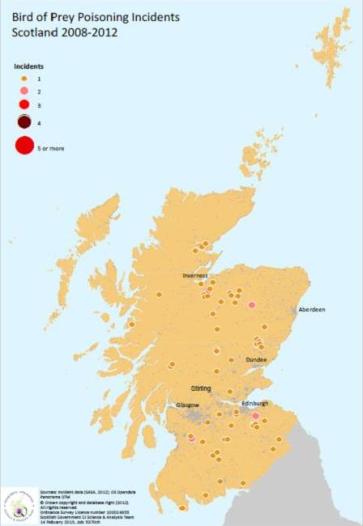
The accurate recording of wildlife crime incidents involving raptors is a major challenge and most will be aware that the RSPB in Scotland produce an annual report. Annual maps of incidents (‘maps of shame’) can also be found on the website above. A major challenge is to make sure that all wildlife crime incidents are reported to the police, preferably to Wildlife Crime Officers who are known locally. It is equally important to make sure that RSPB Investigations staff are also aware of any incidents reported to the police. Wildlife crimes such as suspected shooting or poisoning of birds, destruction of nests or eggs, or reckless disturbance should be reported at the time and without delay. The remains of dead birds of prey, irrespective of age or condition, may be important evidence and require forensic examination. Advice on what to do if you find a suspected incident is available on the PAW Scotland website.

Recently-published research showed that illegal persecution remained particularly prevalent on grouse moors, and for raptor workers and those who visit wild land this is perhaps nothing new. The recent recovery of a poisoned Golden Eagle in Morar and a shot White-tailed Eagle on Skye confirms that birds are at risk throughout the Highlands, not just on sporting estates. Some local populations face the prospect of significant decline unless action is taken. In areas of Scotland such as the Black Isle the re-establishment of the Red Kite continues to be jeopardised by illegal persecution, and each year brings further reports of the destruction of Hen Harriers and Peregrines.

Satellite telemetry is now being used extensively on several species of birds of prey, primarily intended to trace the movements of young birds to gather information which assists their long-term conservation. An unintended outcome from this new science is that when signals indicate a bird has stopped moving, follow-ups have established that birds have been trapped, shot and poisoned. Without satellite telemetry these crimes would never be known about. The Golden Eagle ‘Alma’, poisoned in 2009, is one such example. Unfortunately a significant number of recent persecution casualties involving our large raptors have been found in this way, supporting the argument that reported incidents represent the tip of the iceberg.

The ‘Natural Justice’ thematic inspection recommended dedicated Wildlife Crime Officers in every force. The reality is there are now fewer WCOs than existed when the inspection was carried out. Strathclyde, the largest force in Scotland, have had no full-time post for some years. With a single national police force just months away there is little evidence that there is any genuine commitment on the part of the police service to meet many of the earlier recommendations. Whilst we can work in partnership, increase awareness, improve legislation and ensure landowners and employers accept vicarious responsibility, we can achieve nothing without a properly trained and professional police service which can rise to the challenge. Regrettably, the number of successful prosecutions remains extremely low, and there is a need to ensure that, in terms of enforcement and investigation, the limited resources dedicated to this field of work are properly supported so that much of the political and public relations rhetoric can be converted into tangible results.

I was part of a delegation from Scottish Raptor Study Groups which met Roseanna Cunningham when she was Minister for Environment in November 2010, and we recommended that a dedicated investigative unit be established, comprising trained WCOs and specialists from the RSPB, SSPCA and SNH, with a remit to cover the whole of Scotland, untrammelled by force boundaries. Many will argue, politicians amongst them, that only a few rogue estates and gamekeepers are involved, but any review of the so-called ‘maps of shame’ and the RSPB maps which preceded them, would find that hundreds of estates have been involved in incidents during the last ten years. Uniquely, there are also several estates with histories of persecution going back 30 years. As long as the police have responsibility to investigate such crimes, there is a need for them to develop a cutting edge and target the perpetrators. There would never be a better time to establish a specialist unit than now.

Some fifty years on from my childhood days in south Perthshire I will certainly be able to see Buzzards, Kestrels, Sparrowhawks and even Red Kites when I visit. Unfortunately Hen Harriers remain absent from the moors of Cromlix and Braco. Golden Eagles show little sign of expanding their range, and there is a real risk that fifteen years on from the branding of the problem ‘a national disgrace’, the fate of some of the iconic species which occupy our wild land remains in the balance.

Evil feathered babysnatchers poised to take over Scotland

The Modern Poisoners’ Society has reacted angrily to the news that sea eagles are set to breed in urbanised East Scotland.

Their outburst was prompted by an article in yesterday’s Scotsman that reported on the latest phase of the East Coast Sea Eagle Reintroduction Project (see here).

Albert Hogburn, Director of the Twat Unit in the Modern Poisoners’ Soc said: “First it was the west coast, now it’s the east coast, what next, are we going to see eagles in Southern Scotland, too? It’s outrageous! We’re going to be the laughing stock of Europe if we’re not careful and what would that do to our fragile economy? Nobody’s going to visit Scotland if we’ve got these evil feathered babysnatchers lurking on top of every doctor’s surgery, sharpening their talons on the roof tiles ready to pounce.

But don’t you worry. Obviously we’ll continue to use poison out in the countryside, because that’s our bread and butter, but we’ve got to have a different strategy for use in urban areas. I’ve had my twats working 24/7 on a new trap design – forget the Clam Trap, we’ll soon be unveiling the Pram Trap, just as soon as our government funding comes through. It’ll be better than the Clam Trap because you can’t really use those in the High Street, whereas the Pram Trap, which works by attaching nooses to the pram’s hood so that when the babysnatcher comes down for the kill its feet will get tangled up, can be rolled out across towns and cities in full public view. We’re also working on a partnership with one of the supermarkets to offer 10% discount to all customers who come in with a dead babysnatcher. The promotion booth will probably be positioned next to the lottery stand at the front of the store. People will feel lucky if they’ve managed to kill a babysnatcher, so lottery ticket sales should increase ten-fold. It’ll be win-win. How bloody fantastic is that?”.

Donald Spewing-Moore from the Royal Bird Protection Society said: “I thought they were up to something. I saw them last week huddled up inside a grouse butt, deep in conversation and guarded by 40 armed naked virgins. I shouted, ‘Oi, Twats, what you doing?’ but they didn’t hear”.

Clap Trap

SNH is seeking input as it prepares to make changes to the 2013 General Licences.

This is a welcome move. The 2012 General Licences are not really fit for purpose, to say the least. We’ve blogged before about certain aspects of these licences, particularly those relating to the use of crow cage traps (see Crow traps: what you should know Part 1 here, Part 2 here, and Part 3 here) as well as clam traps (see here and here).

However, when you have a look at the consultation letter put out by SNH (see here) you’ll notice that they’ve carefully avoided many of the most concerning issues.

To better understand some of these issues, please read Crow Traps: What you should know Part 2 (here is the link again). These issues include (but are not limited to) compliance (or not) with European environmental legislation; welfare concerns; poor trap design that allows indiscriminate species trapping; year-round use (as opposed to seasonal use); ineffective regulation of crow trap users; ineffective monitoring of crow trap use (i.e. number and species caught/killed); inability to identify an individual trap user; and a lovely get-out clause for any General Licence user with an unspent criminal conviction.

The highly contentious issue of the ‘clam trap’ (also known as ‘Larsen mate trap’, ‘snapper trap’ and ‘butterfly trap’) has been raised in this consultation, although SNH’s plans for how to deal with it are astonishing. They recognise that welfare concerns remain about the use of these traps, but instead of banning them until independent research shows they are safe to use, they’ve decided to continue their use and commission research on their use “shortly”. They do suggest that they’ll require clam trap users to notify them of intended use, but really, what’s the point of that, other than being able to identify users as potential participants in their future ‘evidence gathering’ exercise?

When you consider the high level of training and accreditation required by those who want to trap wild birds for scientific research (i.e. bird ringing) and compare this with the very low standards required for those who want to trap wild birds to kill them (sorry, ‘control them for conservation purposes’), you realise what a joke the current system is.

The consultation is open until 9th November 2012. You can fill in the form (here is the link again), or, if you think that there are important issues that haven’t been addressed on the consultation form, why not write directly to SNH and explain your concerns? Email your comments to Robbie Kernahan, Head of Wildlife Operations, SNH: licensing@snh.gov.uk

SNH plan to publish a revised suite of General Licences for 2013 by early December.