The Environment Minister Paul Wheelhouse has today announced what he calls ‘further measures’ to tackle the on-going problem of illegal raptor persecution in Scotland. Here is his statement in full:
“Since I took on responsibility for this portfolio, I have been clear that one of my priorities is to bear down on the illegal persecution of raptors that continues to blight the Scottish countryside and tarnish Scotland’s reputation. These outdated, barbaric and criminal practices put at risk the conservation status of some of our most magnificent wildlife. They also harm our reputation as a country which values its environment and wildlife and undermine the growing tourism sector that is built on that reputation.
We have achieved much since 2007. We have a robust legal framework that protects birds of prey and their nests, including the new vicarious liability provisions. We have dedicated resources in Police Scotland and the Crown Office and Procurator Fiscal Service (COPFS). We are leading the way in the UK in the development of wildlife crime forensics work, and we continue to work at building a broad-based alliance through the Partnership for Action Against Wildlife Crime (PAW Scotland).
In 2012 we saw a very welcome reduction in poisoning cases. However a number of recent reports, some of which are in the public domain and some of which are still subject to police enquiries, suggest that there is still a problem with the use of poison as well as cases involving illegal trapping and shooting. I have decided therefore that the time is right to bring forward some further measures which I hope will deter those involved in illegal activities.
Wildlife crime, and raptor persecution in particular, often takes place in remote locations or in the dark of night. By its very surreptitious nature, the likelihood of being seen by a member of the public who can report the matter to the authorities is small.
I have spoken with the Lord Advocate, who maintains a close personal interest in all wildlife crime. We are both keen to maximise the opportunity for offences to be detected and offenders to be tracked down.
The Lord Advocate has instructed the specialist prosecutors in the Wildlife and Environmental Crime Unit to work with Police Scotland to ensure that law enforcement utilises all investigative tools at their disposal in the fight against wildlife crime.
This work will take place within the National Wildlife Crime Co-Ordinating Forum – a group attended by police Wildlife Crime Liaison Officers from across Scotland and the police’s full-time Scottish Wildlife Crime Co-Ordinator, as well as senior police officers, the National Wildlife Crime Unit, Scottish Government officials and the specialist prosecutors from the Wildlife and Environment Crime Unit within COPFS.
Secondly, in my capacity as Chair of PAW Scotland, I intend to establish a group to carry out a review and report to me on how wildlife crime is treated within the criminal justice system, including examining whether the penalties available for wildlife crime properly reflect the seriousness of the damage caused to vulnerable wildlife and fragile habitats and ecosystems.
Thirdly, I will be asking Scottish Natural Heritage in their capacity as the authority for licensing decisions under section 16 of the Wildlife and Countryside Act to examine how and in what circumstances they can restrict the use of General Licences to trap and shoot wild birds on land where they have good reason to believe that crimes against wild birds have taken place. These General Licences allow the holders to carry out actions that would otherwise be unlawful if undertaken, without any reference to SNH. We regard the use of General Licences as a privilege that should not be extended in circumstances where there is evidence that their use may be facilitating illegal activities.
In putting together these measures I have sought to focus only on those individuals and businesses where there are very good reasons to believe they are involved in illegal practices. I am very keen to avoid anything that places an unfair burden on the majority of shooting businesses that are law-abiding and responsible members of the rural community. I should also say that I think it is important that wildlife crime is treated in exactly the same way as other types of crime. This means information about cases should be handled in the same way as in other types of crime and that the police and prosecutors are allowed the time and space to carry out whatever investigations they believe to be necessary according to their own professional judgement. We should not descend into allowing trial by leak and accusation. There is a responsibility on us all to avoid that.
In conclusion I wish to reiterate that eradicating raptor persecution in Scotland remains a high priority for the Scottish Government. It is not however the sole responsibility of the Scottish Government. Law enforcement clearly has a key role to play and I am confident that we are ratcheting up the pressure on those committing acts of illegal persecution. However, everyone involved in the Scottish countryside, and in particular those involved with shooting, should make abundantly clear their disapproval to the minority whose actions are tarnishing the reputation of Scotland’s country sports”.
So, this is the much anticipated ‘action’ against illegal raptor persecution that’s been promised since last autumn when Paul Wheelhouse was appointed. Whilst we welcome his willingness to engage with the issue (in stark comparison to his English counterpart who won’t even admit there’s a problem), we see these latest measures as tiny baby steps in the right direction, and not the decisive hefty stamp that could have been delivered.
The first four paragraphs of his statement are just introductory comments with the usual rhetoric, such as, “We have achieved much since 2007”. Actually, we haven’t. Raptors are still being illegally killed on land managed for game-shooting and more often than not the criminal(s) involved are not being prosecuted. In the few instances where they are prosecuted, there is evidence of extensive plea-bargaining resulting in convictions only for the minor offences, not for the major crimes.
“In 2012 we saw a very welcome reduction in poisoning cases”. No, we didn’t. What we saw was a reduction in the number of reported poisoning cases; that’s a very important distinction. Members of the game-shooting industry (and government, it seems) have made much of this claim, using it as an example of how the industry is cleaning up its act. They won’t be able to make the claim for much longer – we understand that there have been several poisoning incidents already in 2013 and we’re only half-way through the year. Naturally, once again the public haven’t (yet) been informed about these poisonings even though they took place several months ago. We’ll come back to this issue.
The first ‘new’ measure that Wheelhouse is introducing is this:“The Lord Advocate has instructed the specialist prosecutors in the Wildlife and Environmental Crime Unit to work with Police Scotland to ensure that law enforcement utilises all investigative tools at their disposal in the fight against wildlife crime”.
This is interesting, particularly because it immediately follows this paragraph:
“Wildlife crime, and raptor persecution in particular, often takes place in remote locations or in the dark of night. By its very surreptitious nature, the likelihood of being seen by a member of the public who can report the matter to the authorities is small”.
Does this mean that prosecutors in Scotland are being told by the Lord Advocate that they should now accept covert video surveillance as admissible evidence? If this is the case then it would be a very welcome step indeed. Covert film footage is routinely accepted as admissible evidence in England, but in Scotland it continues to be blocked by the Crown Office prosecutors. Why? We don’t know – we’ve never heard a satisfactory explanation. If our assumption is correct (and of course it may not be) and covert footage is to be accepted, then Wheelhouse deserves a good deal of credit for this single measure. We’ll be watching this potential development with great interest.
His second measure is to establish (yet another) group within the framework of PAW Scotland, “to carry out a review and report to me on how wildlife crime is treated within the criminal justice system, including examining whether the penalties available for wildlife crime properly reflect the seriousness of the damage caused to vulnerable wildlife and fragile habitats and ecosystems”. We’re not so impressed with this plan; it seems to be reinventing the wheel. A similar review was carried out in 2008 (Natural Justice 2008) following the poisoning of the last remaining breeding female golden eagle in the Scottish Borders in 2007. That review made many recommendations to improve the efficiency of detecting and prosecuting wildlife crime in Scotland, some of which have since been implemented but many have not. It would perhaps have been a good opportunity for Wheelhouse to critically evaluate the implementation of those recommendations made five years ago, rather than start off the process again from scratch, which just leads to further delays in addressing the actual problem.
The third and final new measure is what we would call a fig-leaf approach to tackling illegal raptor persecution. Wheelhouse says: “I will be asking Scottish Natural Heritage in their capacity as the authority for licensing decisions under section 16 of the Wildlife and Countryside Act to examine how and in what circumstances they can restrict the use of General Licences to trap and shoot wild birds on land where they have good reason to believe that crimes against wild birds have taken place. These General Licences allow the holders to carry out actions that would otherwise be unlawful if undertaken, without any reference to SNH. We regard the use of General Licences as a privilege that should not be extended in circumstances where there is evidence that their use may be facilitating illegal activities”.
At a superficial level, a restriction on the use of the General Licence sounds like a positive action. But let’s just think about the practicalities. First of all, Wheelhouse suggests that the General Licence may be restricted where SNH have “good reason to believe that crimes against wild birds have taken place”. That sounds like SNH would require a lower burden of proof to show that crimes against wild birds have taken place than say, for example, a criminal conviction. In real terms, how would that work? What would constitute ‘good reason’? The discovery of a poisoned or shot bird on a particular piece of land? In legal terms that’s not enough evidence for a conviction because the estate in question could legitimately argue (no matter how implausible) that the dead bird had been planted by someone with a grudge against them, or that the bird had been poisoned/shot elsewhere and just happened to fly on to their estate where it finally succumbed to its injuries. We can be certain that if SNH tried to use such evidence as giving them ‘good reason to believe that crimes against wild birds have taken place’ they would face a strong legal challenge by the estate’s lawyers. So then we’re back to the current situation whereby a conviction in a court of law is the only acceptable proof that the crime was committed by someone associated with the estate where the dead bird was found and those convictions are, as we all know, almost as rare as rocking horse shit.
But even if SNH could use a lower burden of proof as reason to believe a crime had been committed, there would still be difficulties. The use of General Licences is barely monitored or enforced due to the high volume of people operating under their terms. By their very nature, a General Licence is not actually issued to an individual – you don’t have to apply to use one and there isn’t even a competency test that you must first pass – it’s an open ‘licence’ that anyone can use to carry out what would otherwise be unlawful activities, such as the killing of so-called ‘pest species’ such as crows. We occasionally see a prosecution for an offence relating to a General Licence, e.g. when the operator of a crow cage trap has failed to meet the licence’s terms and conditions, but these prosecutions are rare and incidental. No statutory authority is regularly monitoring the use of General Licences (e.g. SNH don’t do it, the police don’t do it) – we don’t even know how many people are operating under the General Licences because the operators are not required to submit annual returns. So, if SNH did ‘restrict the use’ of a General Licence on a particular piece of land, who would be enforcing that restriction? How would we know whether a restriction was in place? Would the location and name of the estate be published? For how long would the restriction be in place? What would be the penalty if an estate was found to be flouting the restriction?
All in all, this proposed new measure has glaring loopholes that in practical terms would be very difficult to close. It’s hugely disappointing that the Minister has taken this route instead of another option that is already available to him in the provisions of the Wildlife & Countryside Act – that is, the ability to enforce a (temporary) ‘closed season’ on the hunting of a particular game bird species in a particular area (or in this case, a specific estate). For example, in exceptional circumstances a Minister can impose a temporary moratorium on shooting specific species during periods of prolonged severe weather. The authority to impose such restrictions is already there in the legislation – it wouldn’t require the lengthy drafting of new legislation – if he wanted to enforce a temporary ban on, say, driven grouse shooting on a particular moor, he could do so. This measure would fit with his approach of only targeting the criminals, not the ‘law-abiding majority’ (his words, not ours) so why isn’t he pursuing it? Just another missed opportunity.
One final point about the Minister’s statement – the bit in his penultimate paragraph where he says this:
“I should also say that I think it is important that wildlife crime is treated in exactly the same way as other types of crime. This means information about cases should be handled in the same way as in other types of crime and that the police and prosecutors are allowed the time and space to carry out whatever investigations they believe to be necessary according to their own professional judgement. We should not descend into allowing trial by leak and accusation. There is a responsibility on us all to avoid that”.
We whole-heartedly agree that wildlife crime should be treated in exactly the same way as other types of crime. This means that these crimes should be properly publicised in the media, just as other crimes are, and especially when they involve the discovery of potentially-fatal poisons that put the general public at significant risk. We hold very strong opinions on this and are adamant that it is not in the public interest for the police to keep these crimes hidden from view for months on end. Until we see an end to this ridiculous culture of silence we’ll continue to blog about these crimes with a measured, accurate and responsible approach.
We’ll be blogging later this week with some specific questions for Paul Wheelhouse….
Scottish Land & Estate’s response to the announcement here.
RSPB Scotland’s response here.
Scottish Gamekeepers’ Association response here.
BASC Scotland’s response here.

 Fieldworkers from Project Raptor have posted an interesting article on their website about the discovery of what appears to be a half-made raptor trap found in woodland on a Scottish game-shooting estate (see here).
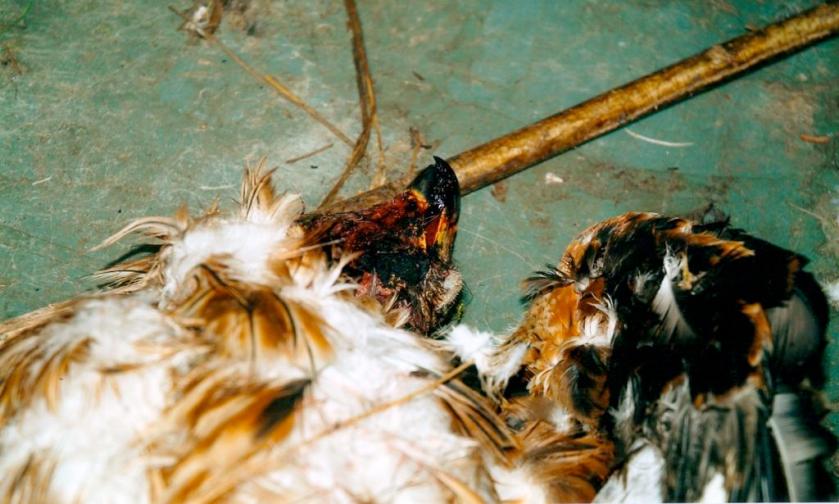
 MAY 2006: A dead adult golden eagle was found on the Dinnet & Kinord Estate, near Ballater, Aberdeenshire. Tests revealed it had been poisoned by the illegal pesticide Carbofuran. Grampian Police launched an investigation. Seven years and 2 months later, nobody has been prosecuted.
 JUNE 2006: A dead golden eagle was found on Glen Feshie Estate in the Cairngorms. Tests revealed it had been poisoned by the illegal pesticide Carbofuran. Northern Constabulary launched an investigation. Seven years and 1 month later, nobody has been prosecuted.
 AUGUST 2007: A dead adult female golden eagle was found on an estate near Peebles in the Borders. She was half of the last known breeding pair of golden eagles in the region. Tests revealed she had been poisoned by the illegal pesticide Carbofuran. Lothian & Borders Police launched an investigation. Five years and 11 months later, nobody has been prosecuted.
 AUTUMN 2007: Tayside Police received a detailed tip-off that a young male white-tailed eagle (known as ‘Bird N’) had allegedly been shot on an estate in Angus. The timing and location included in the tip-off coincided with the timing and location of the last-known radio signal of this bird. Five and a half years later, the bird has not been seen again. With no body, an investigation isn’t possible.
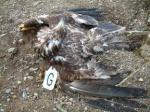 MAY 2008: A one year old male white-tailed eagle hatched on Mull in 2007 and known as ‘White G’ was found dead on the Glenquoich Estate, Angus. Tests revealed he had been poisoned by an unusual concoction of pesticides that included Carbofuran, Bendiocarb and Isofenphos. A police search in the area also revealed a poisoned buzzard, a baited mountain hare and 32 pieces of poisoned venison baits placed on top of fenceposts on the neighbouring Glenogil Estate. Laboratory tests revealed the baited mountain hare and the 32 poisoned venison baits contained the same unusual concoction of highly toxic chemicals that had killed the white-tailed eagle, ‘White G’. Five years and 2 months later, nobody has been prosecuted.
 JUNE 2009: An adult golden eagle was found dead at Glen Orchy, Argyll, close to the West Highland Way. Tests revealed it had been poisoned by the illegal pesticide Carbofuran. Strathclyde Police launched a multi-agency investigation. Three years and 3 months later, estate employee Tom McKellar pled guilty to possession of Carbofuran stored in premises at Auch Estate, Bridge of Orchy and he was fined £1,200. Nobody has been prosecuted for poisoning the golden eagle.
 JULY 2009: A two year old female golden eagle known as ‘Alma’ was found dead on the Millden Estate, Angus. Tests revealed she had been poisoned by the illegal pesticide Carbofuran. Alma was a well-known eagle – born on the Glen Feshie Estate in 2007, she was being satellite-tracked and her movements followed by the general public on the internet. Tayside Police launched an investigation. Four years later, nobody has been prosecuted.
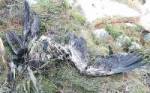 AUGUST 2009: A young white-tailed eagle was found dead on Glenogil Estate, Angus. Tests revealed it had been poisoned by the illegal pesticide Carbofuran. Tayside Police were criticized in the national press for not releasing a press statement about this incident until January 2010. Three years and 11 months later, nobody has been prosecuted.
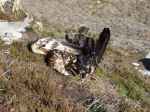 MAY 2010: Three dead golden eagles were found on or close to Skibo Estate, Sutherland. Tests revealed they had been poisoned; two with Carbofuran and one with Aldicarb. Northern Constabulary launched a multi-agency investigation. One year later (May 2011), Sporting Manager Dean Barr pled guilty to possession of 10.5 kg of Carbofuran stored in premises at Skibo Estate. Three years and 2 months later, nobody has been prosecuted for poisoning the three golden eagles.
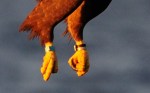 JUNE 2010: Leg rings with unique identification numbers that had previously been fitted to the legs of four young golden eagles in nests across Scotland were found in the possession of gamekeeper James Rolfe, during a multi-agency investigation into alleged raptor persecution at Moy Estate, near Inverness. It is not clear how he came to be in possession of the rings. The bodies of the eagles from which the rings had been removed were not found. No further action was taken in relation to the discovery.
 JUNE 2010: A golden eagle and a white-tailed eagle were found dead on Farr & Kyllachy Estate, Inverness-shire. Tests revealed they had been poisoned by the illegal pesticide Carbofuran. Northern Constabulary apparently did not search the property until July 2011. Three years and 1 month later, nobody has been prosecuted.
 DECEMBER 2010: A decomposing carcass of a white-tailed eagle was found and photographed on Logie (Lochindorb) Estate, Morayshire. It was reported to Northern Constabulary. By the time the police arrived to collect it, the carcass had disappeared. The police said they couldn’t investigate further without the body.
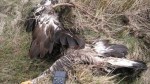 MARCH 2011: The body of a young golden eagle was discovered on North Glenbuchat Estate, Aberdeenshire. Tests revealed it had been poisoned by the illegal pesticide Carbofuran. Grampian Police launched an investigation and raided the property in May 2011. Two years and 4 months later, we are not aware of any pending prosecutions.
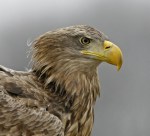 APRIL 2011: The body of a white-tailed eagle was found at the base of cliffs on Skye. The person who discovered it (a professional medic) considered it to have been freshly shot with a rifle, decapitated with a sharp implement and thrown from the cliff top. He took photographs and alerted Northern Constabulary and RSPB. There was a delay of two weeks before the now probably decomposed carcass was collected. A post-mortem was inconclusive. This incident was not made public until one year later after a tip off to this blog. Two years and 3 months later, we are not aware of any pending prosecutions.
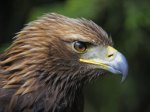 NOVEMBER 2011: The signal from a satellite-tracked young golden eagle (hatched in 2010) stopped functioning when she was at a location in the Monadhliaths, a well-known raptor persecution black spot in the Highlands. Her last known location was checked by researchers but there was no sign of the bird. Another technical malfunction of a satellite transmitter or another ‘disappearance’ in suspicious circumstances?
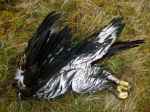 MARCH 2012: The body of a young golden eagle being tracked by satellite was discovered in Lochaber. Tests revealed it had been poisoned with the banned pesticides Aldicarb and Bendiocarb. Information about this incident was not made public until three months later. One year and 4 months later, we are not aware of any prosecutions for poisoning this bird.
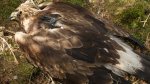 MAY 2012: The dead body of a young satellite-tracked golden eagle (hatched in 2011) was discovered near a lay-by in Aboyne, Aberdeenshire. The data from its satellite tag & the injuries the bird had when found (2 broken legs) suggested it had been caught in an illegal trap in the Angus glens and then removed, under cover of darkness, to be dumped in another area where it was left to die, probably a slow and agonising death. Information on this incident was not released until almost five months later, by the RSPB. It appears the police failed to properly investigate this incident as we understand that no search warrants were issued. One year and 2 months later, we are not aware of any pending prosecutions for killing this bird.
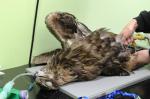 OCTOBER 2012: An adult golden eagle was found shot and critically injured on grouse moor at Buccleuch Estate, near Wanlockhead, South Lanarkshire. The bird was rescued by the SSPCA and underwent surgery but it eventually succumbed to its injuries in April 2013. Nine months later, we’re not aware of any pending prosecutions for shooting this bird.
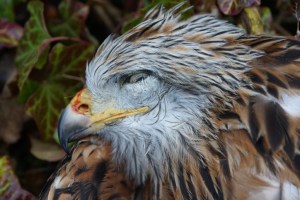 A press release has gone out this morning appealing for information after a dead red kite was discovered on Royal Deeside. According to the information released (see