Poisoning stats down, incredulity up

Poisoning 2008-2012The ‘official’ 2012 incidents of confirmed poisoned raptors in Scotland have just been published and show a marked decline in the number of poisoning incidents. According to the latest figures, the number of reported poisoned raptors fell from 16 in 2011 to three in 2012 (one golden eagle and two buzzards).

PAW Scotland press release here

BBC news article here

Are these figures an accurate reflection of what’s going on? We don’t think so. In fact we know they’re not. What the latest poisoning maps fail to show is the number of poisoned baits that were discovered in 2012, the number of other bird species that were poisoned in 2012, and the number of other animals that were poisoned in 2012. And obviously the maps don’t show the poisoning incidents that went undetected/unreported in 2012.

We know for certain that missing from this map is a poisoning incident recorded in the ‘Border’ region in May 2012. According to the published SASA statistics, a poisoned raven and crow were found, along with meat bait and two rabbit baits. This incident is listed as being subject to an ‘on-going police investigation’. Notably, this incident was not reported in the press. Why not? More importantly, why is this incident missing from this map? Why is the focus just on the number of confirmed poisoned raptors? Yes, the illegal poisoning of raptors is of huge concern, but it’s not just raptors that are victim to this barbaric practice. By excluding the discovery of poisoned baits and other types of poisoned species, the wider picture is not being shown. Why is that?

For example, we also know from the SASA stats that a horse and a dog were poisoned with Strychnine in January 2012, a cat was poisoned with Carbofuran and Isofenphos in March 2012, and another cat was poisoned with Carbofuran and Isofenphos in July 2012. None of these incidents appear on this map. There may well be others but the published SASA stats only go up to September 2012 – there’s the customary six-month delay in publishing more recent incidents. Obviously it’s not in the public interest to know where and when lethal poison is being laid out until many months after the event.

On a similar note, has anyone noticed the dot on the map in the Whithorn region (SW Scotland)? Could this possibly be the dead buzzard we blogged about last week (see here)? All we were told was that a man had been arrested following an investigation into a dead buzzard that had been found on the Glasserton Estate. Why didn’t the police press statement mention that the forensic tests confirmed it had been poisoned? Why are we not warned when potentially lethal poisoned baits are being placed out in areas where we might visit with our children and our pets? Why is it so difficult to tell the public what’s actually going on?

On a superficial level then, the latest figures suggest that all those people who’ve been busily poisoning our raptors for the last 100+ years have suddenly stopped. It’s highly implausible, but of course it is possible. Other possibile explanations include (a) the illegal poisoners have just got better at hiding the evidence; (b) they’ve switched to a new type of poison that isn’t currently being screened for in the SASA lab; (c) they’ve switched from poisoning as their method of choice to other methods that are less detectable, such as shooting and trapping.

Fortunately, the authorities are wise to point (c). Environment Minister Paul Wheelhouse said: “There has been real progress but we will not be complacent. I am determined to stamp out these practices once and for all and will remain vigilant to any change in approach being taken by those who seek to persecute raptors“. Of course, this statement is almost a carbon copy of statements made by previous Environment Ministers, going back several years, all of whom were ‘determined to stamp out illegal raptor persecution’ and all of whom failed. The current Minister has recently been presented with three perfect opportunities to make a stand: the dead golden eagle found on Deeside with two broken legs which is believed to have been caught in an illegal trap on an Angus grouse moor before being dumped further north away from the estate (we’ll be blogging more about this case in the next few days); the shot and critically injured golden eagle found on a grouse moor in Dumfries and Galloway; and the shot hen harrier that was found dead on another sporting estate in Grampian. It’ll be interesting to see how many more of these incidents he will tolerate before stronger sanctions are applied. Or, more to the point, how many more incidents we will allow him to tolerate.

Landowners & gamekeepers claim ‘misrepresentation’ on BBC’s The One Show

One-Show-smallScottish Land and Estates and the Scottish Gamekeepers’ Association have written a letter of complaint to the BBC, claiming ‘misrepresentation’ on The One Show programme.

The programme (see here and here) included a feature on golden eagle persecution and during a studio interview, the RSPB’s Stuart Benn laid the blame firmly at the door of gamekeepers on Scottish grouse moors.

Doug McAdam, Chief Exec of Scottish Land & Estates, took great exception to that statement and wrote a hilarious letter of complaint, on behalf of SLE and SGA, to The One Show’s executive editor, Sandy Smith.

Here is his letter: SLE SGA complaint about BBC One Show

According to dear old Doug, there have only been four dead golden eagles found since 2010 and no charges [for these deaths] have been brought against anyone involved in grouse moor management. Conveniently, he failed to include the other known incidents of dead raptors turning up on grouse moors since 2010 (including white-tailed eagles, red kites, hen harriers, buzzards, short-eared owls, sparrowhawks, peregrines, kestrels), or the critically-injured golden eagle found shot and left to die on a grouse moor, or indeed the satellite-tagged raptors (particularly golden eagles and hen harriers) who have all gone ‘missing’ after their last known signal was received from, er, a grouse moor. There may well be more of these ‘missing’ birds but of course we’re no longer allowed to hear about them after the introduction of the new PAW Scotland ‘protocol’ that aims to keep these incidents away from the public’s gaze (see here).

Apart from trying to play down the extent of persecution incidents on grouse moors, and inferring that a lack of criminal convictions is a good indicator that gamekeepers are not involved with the illegal killing of golden eagles on grouse moors, Doug goes on to emphasise the SLE’s involvement with PAW Scotland, as though membership of that ‘partnership’ should be a measure of good behaviour. We’ve all seen how effective these ‘partnerships’ can be, following the near-extinction of breeding hen harriers on English grouse moors during the six-year Hen Harrier Dialogue ‘partnership’ designed to resolve the conflict. Indeed, three raptor conservation organisations have now resigned from that particular ‘partnership’ because they recognised it could be used as a convenient political cover by certain organisations with grouse-shooting interests.

Doug makes an astonishing claim about the PAW Scotland partnership: “Our combined efforts with the police, rural communities, the RSPB and over 120 other relevant stakeholders have been universally acknowledged as a key factor in reducing the number of raptor persecution incidents“.

Talk about misleading! For a start, there are not 120 ‘relevant stakeholders’ in relation to addressing raptor persecution. Many of the stakeholders have absolutely no involvement in directly addressing raptor persecution – they are there to specifically address other types of wildlife crime such as poaching, theft of freshwater pearl mussels, bat persecution and badger persecution.

Secondly, where does this notion come from that work by PAW Scotland has been ‘universally acknowledged as a key factor in reducing the number of raptor persecution incidents’? Has it been ‘universally acknowledged’? We don’t think PAW Scotland has had any demonstrable impact whatsoever on the number of raptor persecution incidents – where’s the evidence? Perhaps by ‘universal’ he means those with a vested interest in having people think that illegal raptor persecution is being dealt with effectively (e.g. the police, SNH, Scottish Government, SLE, SGA etc etc).

Doug finishes by saying, “Owners of moorland estates all over Scotland look after golden eagles” (ahem) and he invites Sandy Smith to visit a grouse moor “to find out for yourself the valuable conservation measures being implemented“. Let’s hope Sandy takes him up on his offer. Ooh, which grouse moor to choose? We could give Sandy quite a few suggestions….

Sandy Smith responded with a letter of his own: One Show’s reply to SLE

He says he’s sent an email to all One Show staff and suppliers “asking them to ensure they don’t make assumptions about gamekeepers based on out of date or inaccurate assumptions“.

Interestingly, Sandy Smith was the former executive editor of Panorama – a programme recognised for its investigative journalism and an ability to differentiate between fact and PR. Let’s hope he’s taken those qualities with him to The One Show.

We’ve sent a letter to Sandy, giving him the URL of this blog, to ensure his staff are kept up to date and are not basing their work on inaccurate assumptions (spin). You may wish to do the same – send your email, marked for the attention of Sandy Smith, to: TheOneShowEmails@bbc.co.uk

If you think grouse moor owners and their gamekeepers need to be held to account for their activities, please sign this e-petition and share it with your friends and colleagues: SIGN HERE.

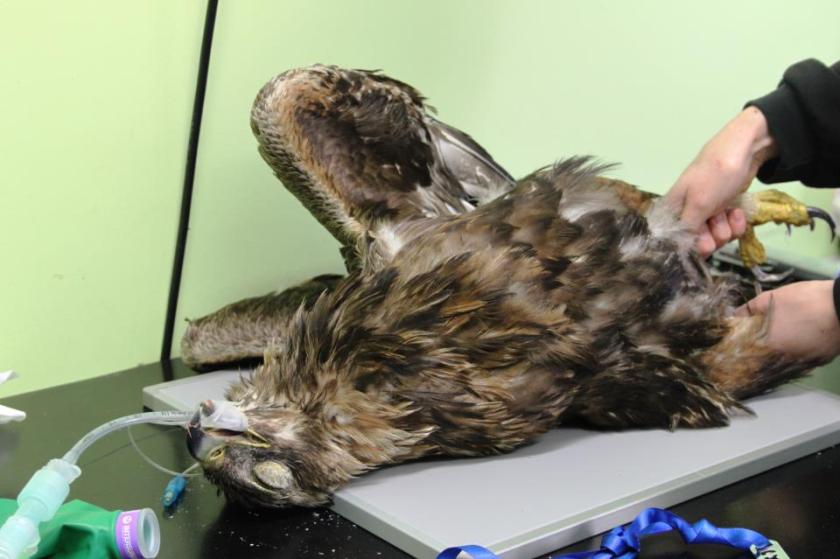
Here’s a photo showing how well golden eagles are looked after on some Scottish grouse moors. This one was found critically injured on Buccleuch Estate last aututmn – he had been shot and left to die, although it is not known on whose land he was shot. He is currently recuperating with the SSPCA after undergoing life-saving surgery. Needless to say, nobody has been charged for this crime.

The shot golden eagle undergoing emergency surgery

Northern England Raptor Forum walks out of Hen Harrier Dialogue process

In the last few days, many of us have been flabbergasted (or not) at the flat denials from several game-shooting industry representatives about the issue of illegal raptor persecution. Despite years, no, decades, of overwhelming scientific evidence to the contrary, these industry leaders still refuse to accept the reality.

 In a way it’s good that they continue to display such open indifference because by doing so an increasingly-aware public are given an opportunity to see what the rest of us have been seeing for years. In the end, we firmly believe it will be the strength of public opinion that forces a change and finally puts an end to the decades of illegal killing. Nevertheless, as laughable as the industry’s excuses and explanations are, it is still frustrating to hear them because you know that as long as that’s what the leaders are thinking then the criminals within that sector won’t be inclined to stop the persecution.

nerf logo3So, take that sense of frustration you felt when you heard the latest denials, and multiply that by six years, and then add in the fact that over the same period the hen harrier breeding population has been reduced to a single pair in England, and it will come as no surprise to learn that the Northern England Raptor Forum (NERF) has resigned from the Hen Harrier Dialogue process. Indeed, you might well ask what took them so long!

For those who don’t know what the Hen Harrier Dialogue process is, you can read about it here. NERF, representing a suite of dedicated raptor study groups in northern England, has been involved in the Dialogue since day one, back in June 2006. Last summer, the RSPB were the first group to walk away from the process. Now NERF have walked, as of January 31st 2013. We understand that the Hawk and Owl Trust, the only other pro-raptor partner in the process, is still in it, for now at least.

Here are some excerpts from a NERF letter that leave no room to doubt their reasons for walking out:

Following the last meeting in June 2012, NERF members undertook a wide-ranging internal debate about continuing our involvement with the Hen Harrier Dialogue. At the conclusion of our discussions NERF members unanimously elected to resign from the Dialogue process with immediate effect. This decision has not been undertaken lightly. We believe that far from assisting the re-establishment of a viable and self-sustaining healthy English population of Hen Harriers that is free and able to share wild open spaces unmolested with red grouse the evidence reveals that the exact opposite has been achieved.

Despite many years of attempting to seek a resolution to the perceived conflict of interest between commercial driven grouse shooting and Hen Harriers, NERF can find no evidence of any progress towards that goal. Indeed the opposite is the case. In 2006 46 young fledged, four years later only 23 young fledged and in 2012 just one pair successfully reared young. Even the higher figure masks the reality that the successes are almost invariably located on the United Utilities Estate in Bowland or from nests that were guarded around the clock by volunteers. It should also be remembered that there is sufficient habitat in England to support 332 pairs. No matter how optimistic the analysis of the intervening years, this attempt at conflict resolution, from the Hen Harrier’s perspective, can only be judged to be a resounding failure.

It is the opinion of NERF members that our continued participation in the Dialogue lends an air of respectability to a process that is fundamentally flawed. The Dialogue was tasked with seeking conflict resolution to what is a shameful situation where a species is being illegally persecuted to oblivion simply because it is perceived to threaten the sporting interests of a very small minority of individuals. To achieve the required outcome NERF accepted that there needed to be compromise. However despite our best efforts we can find no evidence that some of those organisations that represent the grouse shooting industry have either a genuine intention to accept anything other than a zero upland population or the ability to guarantee that the grouse moor managers they represent will implement any strategy agreed through the Dialogue.

There is ample evidence to show this to be the case:

  • The English Hen Harrier population is so perilously low that there is no longer any conflict with commercial driven grouse shooting and yet the birds continue to be persecuted, as evidenced by the recent death of ‘Bowland Betty’ in the Yorkshire Dales.
  • The continued public denial by grouse moor managers that persecution is widespread within the industry gives NERF members no reason to believe that participation of the industry representatives is anything other than a political gesture intended to divert attention away from that very persecution being undertaken by their members.
  • The scientific modelling developed specifically to aid the search for a resolution was originally rejected by the shooting community and further modelling was undertaken at their behest. The resultant data emphatically show that two pairs of Hen Harriers can be accommodated on 5,000 acres without any commercial impact. Indeed the same data reports that the impact by three pairs is insignificant. This scientifically based model was rejected with a counter offer of one pair per 10,000 acres. This offer represents a 75% shift away from the science and it is difficult to see it as anything other than yet one more delaying tactic.
  • In an effort to reduce the potential impact of grouse chick predation diversionary feeding was trialled and shown to work. The proposed expansion to the scheme was rejected by several of the shooting organisations for no discernible reason. Once again the search for a solution was stalled.
  • The proposal to introduce a brood capture, cage and release scheme was always going to be unpalatable to raptor workers; nonetheless NERF was prepared to leave the proposal on the table for discussion once the population had returned to ‘carrying capacity’. Years after the scheme was initially proposed and with no actual progress being made the National Gamekeepers Organisation announced in 2012, the same year that only one pair nested successfully in England, that the scheme may need to be implemented as soon as two pairs, or one polygamous male and two females, attempt to breed on the same ground. Thus the brood capture, cage and release programme would be implemented when the English population reached three individuals, less than 0.5% of the ‘carrying capacity’ of 332 pairs. This is completely unacceptable not only to conservationists but to all right-minded people. Any future discussions in respect of that scheme were halted with that single statement. More years lost in a pointless discussion, but perhaps that was the intention.

NERF is no longer willing to have its reputation tarnished by involvement with a process that is, in our opinion, being deliberately frustrated by organisations that have failed to demonstrate any willingness to find a solution to what is after all an irrational and outdated belief that Hen Harrier numbers must be subjected to lethal control for the benefit of the grouse shooting industry.

Deeside golden eagle fiasco rumbles on as SGA release their ‘report’

The shambolic investigation into the death of the Deeside golden eagle last year continues (see here, here, here, here, here, here, here for our previous blogs about this appalling case).

This morning, the Scottish Gamekeepers’ Association released a media statement and their investigatory ‘report’ into what they think happened to this eagle. It’s death was probably the result of a terrible accident, apparently. They say they only released their report because they became aware that it had been the subject of Freedom of Information requests to the Scottish Government.

At this stage, we are only posting their media statement, their ‘report’, and the RSPB’s response. We will be discussing the case as a whole, including the SGA’s conclusions, in a later blog, as we are awaiting responses from several FoI requests that potentially could be quite illuminating.

SGA media statement download: SGA RELEASE REPORT INTO EAGLE DEATH[1]

SGA investigatory report download: SGA Report, eagle death, Deeside[1]

RSPB media response:

RSPB Scotland responds to Scottish Gamekeepers Association eagle report

Responding to a statement released this morning by the Scottish Gamekeepers Association (SGA), Duncan Orr-Ewing, Head of Species and Land Management at RSPB Scotland, said:

“We reject absolutely these unprofessional assertions of the SGA in today’s press release concerning the case of the dead golden eagle found on Deeside in May 2012. Our previous media statement followed proper discussion and approval from the police, and was in full accordance with our joint working protocol. The official post mortem report concluded that the bird had suffered two broken legs due to trauma “that could be consistent with an injury caused by a spring type trap” and that the severity of these injuries “would prevent the bird from being able to take off.”

This is a rather desperate statement from the SGA, which seemingly does more to reveal their true nature as apologists for the worst types of wildlife crime, as they try to defend the indefensible. Indeed, it calls into question their very commitment to the aims and objectives of the Partnership for Action Against Wildlife Crime Scotland (PAWS).

The illegal killing of golden eagles in Scotland is still a serious conservation issue, undermining the health of their population, and bringing international shame to our country. Over the past few years there have been a number of appalling cases involving the criminal killing of golden eagles, some of which have only come to light following the use of satellite tag technology. Rather than seeking excuses, we believe that the Scottish Gamekeepers Association’s efforts would be better directed at tackling those within their sector who still encourage such outdated practices”.  

The dead golden eagle     

Some comments on last night’s ‘Inside Out’ programme on hen harrier persecution

So, what did we learn from last night’s Inside Out programme on the illegal persecution of hen harriers?

According to Martin Gillibrand, the Moorland Association’s secretary, there is ‘no evidence’ that gamekeepers have been involved in hen harrier persecution, and the cause of their near extinction as a breeding species in England is “as a result of some very bad springs, breeding productivity has fallen off and the numbers have gone down“. Ah, so climate change is the real problem then. So if we all turn down our central heating and get our lofts insulated the hen harriers will be ok. It’s the same old story – give any explanation for the demise of the hen harrier except for the most obvious one.

Funny that he didn’t mention an earlier Moorland Association statement, given as written evidence during the recent parliamentary audit on wildlife crime (see here) –

“Until a full set of special rules allowing the positive management of hen harriers breeding on grouse moors is forthcoming from the Environment Council’s Hen Harrier Dialogue, moorland owners are within their rights and the law to deter the birds from settling on their moors to breed.”

Nor did he mention previous correspondence between the Moorland Association and DEFRA minister [grouse moor owner] Richard Benyon, discussing the possibility of derogations from international law that would allow for the legal ‘management’ of hen harriers (see here).

What else did we learn? Well, as predicted, the recent introduction of vicarious liability legislation in Scotland was touted as the solution to end raptor persecution. Unsurprisingly, this view was presented by Des Thompson of SNH – an organisation with a vested interest in making everyone believe that they’re dealing with the on-going (59 years and counting) problem of illegal raptor persecution. According to Des Thompson:

We are seeing some real signs of success. There are indications now that the recorded incidents of poisoned birds of prey is declining“.

He went on: “We were despairing in Scotland a couple of years ago but things have got a lot better“.

Have they? Yes, the number of recorded poisoning incidents has dropped, but does that mean poisoning has dropped, or poisoning is still going on but it’s now better hidden, or that recorded poisoning incidents have dropped because other methods of persecution are now being employed? Here are three examples that suggest things have not ‘got better’ (see here, here and here).

It’s interesting that SNH should interpret the drop in recorded poisoning incidents as a ‘success’, when the only true measure of success will be if raptor populations (especially hen harrier and golden eagle) recover. If they do recover, it will take several years to see it. Sorry, but to suggest at this early stage that vicarious liability has been a ‘success’ is utter rubbish – it’s a statement with more spin than a Zanussi.

Yesterday we blogged about how vicarious liability isn’t the solution to solving the issue of illegal raptor persecution, mainly because the crux of the vicarious liability concept is that the individual criminal first has to be identified before his/her employer can be charged under the new legislation. However, this was written from a Scottish perspective, where evidence such as covert video surveillance (identifying an individual actually committing the crime) is so often banned as admissable evidence in court. However, in England, this type of evidence is frequently accepted in court and has been used very successfully to convict criminal gamekeepers. So, in this context, vicarious liability, if it was to be introduced in England, might just work.

If you missed last night’s programme you can watch it on iPlayer (here) for a limited period.

We’ll be blogging later today about the latest development from the Hen Harrier Dialogue…

For anagram fans: A SAD MORONS COALITION / MOORLAND ASSOCIATION

‘No evidence’ of gamekeepers persecuting hen harriers, says Moorland Association

As a prelude to this evening’s programme about the illegal persecution of hen harriers, there was a short piece on BBC Radio Newcastle this morning.

In an astonishing interview, the secretary of the Moorland Association (the representative body of grouse moor owners) suggests that there is ‘no evidence’ of gamekeepers being involved with the illegal persecution of hen harriers.

Fortunately, Guy Shorrock of the RSPB’s Investigations Team was on-hand to provide an eloquent and well-informed rebuttal.

It’s remarkable that the Moorland Association are still in denial, even though we’re all well aware that this species is on the very brink of becoming extinct as a breeding species in England. It’s especially remarkable given that the Moorland Association have been party to the Hen Harrier Dialogue – the discussion process set up specifically to find ways of addressing the conflict between grouse moor management and hen harriers (now in its 7th year). We’ll be blogging about the latest news from the Hen Harrier Dialogue shortly – and given the Moorland Association’s flat denial that hen harrier persecution exists, you won’t be surprised to find out the latest development…

Meanwhile, listen to this morning’s radio interview (here, starts at 1.25.30 and ends at 1.31.06) and be sure to watch the tv programme this evening (here).

Photograph below shows a hen harrier being removed from an illegally-set trap on a Scottish grouse moor in 2010. This bird was lucky – he survived. Nobody was prosecuted for setting the illegal trap.

Hen harrier being removed from illegal trap on Moy Estate

Clam traps: SNH in the last chance saloon

snh_logoOn Tuesday we blogged about SNH’s response to our concerns over the on-going clam trap fiasco (see here). We said we would outline what we thought the next step should be. Here are our thoughts:

There are two main issues. The first one is that the consultation process was flawed. It did not meet the standard required by the Scottish Government’s ‘Consultation Good Practice Guide’, which is applicable to an agency like SNH (see here).

For example, consultations should allow “at least 12 weeks to respond”. This particular consultation opened on October 1st 2012 and closed on November 9th 2012, thus only allowing 5.5 weeks in which to respond. In addition, in order to be transparent, SNH should have provided feedback on how each and every point raised during the consultation was treated. As far as we can tell, this has not taken place. Instead, it appears that the majority of points raised have been ignored (in terms of the final outcome of the consultation). In which case it could be argued that the whole consultation was pointless; SNH had already decided what they were going to do, regardless of the majority view of respondents, and they were just going through the motions of holding a public consultation to appease those of us who might object to their proposals.

The second main issue is the basis of evidence that SNH used to approve the use of clam-type traps. According to SNH, the consultation did not provide any evidence that clam-type traps were unsafe for target and/or non-target species, or a threat to protected species. Instead, they argued that as clam-type traps had previously been in use (albeit probably illegally!) it would be “disproportionate to ban their use outright”. There are several problems with this argument.

First of all, it is clear that no independent testing has taken place to provide evidence that these traps are safe. If SNH are using the ‘lack of available evidence’ to show that the traps are unsafe, then surely that mandate should also apply to demonstrate that the traps are safe before they are authorised for use? Is there any evidence to show that the traps have no welfare or lethal impacts to either target or non target species, which may include protected species, to justify their use? If there is evidence, it has not been made available to the public, in which case, SNH should have applied the precautionary principle and not authorised these traps until such time as independent testing shows they pose no threat to animal welfare as well as no impact on non-target species, some of which may be protected species.

Secondly, SNH have argued that by restricting the type of bait for these traps (bread and eggs only), they have “minimised the risk to non-target species”. Whilst this may be applicable to raptors, it certainly does not minimise the risk to other protected, non-target species, including the pine marten, a species that loves to eat eggs! According to SNH’s own website, it is an offence to intentionally or recklessly capture a pine marten unless you have a special licence to do so (see here). So why authorise a trap that, depending on its location, is highly likely to capture a pine marten?!

Thirdly, SNH said that it would be “disproportionate to ban their [the traps] use outright”. But, if you read the responses to the consultation, the majority of respondents were not asking for an ‘outright ban’ – they were asking for independent testing prior to the traps being authorised. Furthermore, there are alternative traps (Larsen trap) that could be used if clam-type traps were not approved this year or until such time as a trial showed that they are safe. So for SNH to say that not approving their use is ‘disproportionate’ is overstating the reason for approving the use of these traps.

So, where to go from here? In the first instance, we propose that people contact SNH and ask them to provide evidence to show that clam-type traps have no welfare or lethal impacts on either target or non-target species, and if they can’t provide such evidence then they should pull the clam-type trap from the General Licences until such time as that evidence is available.

This is SNH’s last chance to act. If the evidence is not forthcoming and SNH still refuse to withdraw the clam-type trap from the General Licences, then the next step would be to go to the Ombudsman and ask whether SNH has carried out this consultation appropriately.

If that fails, then we think there is a very strong case for making a formal complaint against SNH to the EU, for failing to protect the very species that they have a statutory duty to protect. This complaint wouldn’t just be limited to the clam-type trap issue – it would cover other traps that SNH have authorised, including crow-cage traps, without addressing the legitimate concerns about their use. These concerns have been raised over and over again during the last few years (see the current and previous consultation responses of groups such as RSPB, SRSGs and OneKind for examples) and SNH has consistently ignored them. They may argue that they’re going to address these concerns in their proposed ‘Code of Practice’ that they say they will develop ‘early this year’. The problem with that is it has not been made clear whether they will actually address all the concerns, and even if they do, whether this ‘Code of Practice’ will be a voluntary code (in which case it’ll be worthless) or whether breaking this code will be considered a formal breach of the conditions of the General Licence (and therefore should result in a prosecution).

It’s time to get serious. Please consider emailing SNH. It only takes a minute. The complaint should go right to the top again: Ian Jardine, (Chief Executive SNH) – ian.jardine@snh.gov.uk

If you’re not sure what to write, either copy the blog URL into the body an email, or you could use the following text as a guide – simply cut and paste or adapt it to your own words:

Dear Dr Jardine,

Re: the recent SNH consultation which led to the authorisation of clam-type traps in the 2013 Open General Licences.

Please can you provide the evidence you have used to demonstrate that clam-type traps have no welfare or lethal impacts to target or non-target species. If the evidence is unavailable, please consider withdrawing the use of clam-type traps from the Open General Licences until such time as independent and rigorously tested evidence is available.

Thanks.

Gamekeeper charged with six offences

North Yorkshire police logoaA gamekeeper from Pickering, North Yorkshire, has been charged with six offences for the illegal use of cage traps to capture a buzzard.

This is the gamekeeper whose arrest was reported last October (see here). He has still not been named, and nor has the estate/shoot where the alleged offences took place. It is not yet known whether he is a member of the National Gamekeepers’ Organisation.

He has been charged with six offences under the Wildlife & Countryside Act and the Animal Welfare Act. He has been bailed to attend Scarborough Magistrates court next month. Article in the Ryedale Gazette & Herald here.

In other court news, the long-awaited verdict in the Lochindorb Estate hare snare trial is due tomorrow…..

Eagle persecution featured on the One Show

One-Show-smallYesterday evening, the BBC’s One Show ran a feature on golden eagle satellite-tracking in Scotland, featuring two legendary raptor fieldworkers from the RSPB, Stuart Benn and Brian Etheridge.

Thanks to these two, the message about illegal raptor persecution was heard by a mainstream tv audience (an estimated 5 million viewers) both during the film (when they were sat-tagging an eaglet) and then again when Stuart was interviewed in the studio.

Two top blokes doing a top, top job. Well done!

For anyone who missed it, catch it on BBC iPlayer here (20.37 min – 28.41 min) for a limited period.

Here is a link to Stuart’s blog about the filming day last summer.

Another poisoned buzzard in Scotland

SASA (the Government’s Science & Advice for Scottish Agriculture) have just published their latest ‘Summary of Incidents’ where they report on the number of animals that have been submitted for poisoning analysis, dating from January – September 2012 (see here).

It’s an interesting read. The results from the first three-quarters of 2012 suggest a decline in the number of reported raptor poisoning incidents. Does this reflect an actual decline in poisonings, or does it mask something more cynical, such as a change of tactics in the method of persecution used? Nobody can tell for sure at this stage, although you’d have to be pretty naive to believe the first explanation, especially after the recent shocking non-poisoning incidents such as the dead golden eagle found in a lay-by with two broken legs, believed to have been illegally trapped on an Angus grouse moor and then moved by vehicle in the dead of night and dumped by the side of the road, barely alive and left to suffer an horrific death. Then there was the golden eagle that was found shot and critically injured on a grouse moor in Dumfrieshire, now making a slow recovery. And then the shot hen harrier found dead on another grouse moor in Grampian. And these are just the ones we know about.

The latest SASA results show that a buzzard was found dead in Grampian in September 2012, confirmed to have been poisoned by the illegal pesticide Carbofuran. We don’t remember seeing any police reports about this incident. Perhaps they kept it quiet so as not to hinder their investigation? Fair enough, but it’s now four months later…Perhaps Grampian Police will report where was it found, and whether anyone is being charged. They probably won’t though; yet another incident being quietly swept under the carpet? We blogged about these poisoning incidents going unreported the last time SASA published their stats (see here).

There were a number of dead buzzards that were submitted to SASA for testing between Jan-Sept 2012, including the satellite-tagged ‘Buzz’, believed to be the first sat-tracked buzzard in Scotland (see here). His last signal came from near Brechin, Angus in late September. His corpse was picked up by the side of the road. Given the location and the on-going history of raptor persecution in the nearby area, his body was submitted for a post-mortem. He hadn’t been poisoned though – SASA concluded that his probable cause of death was starvation. It would have been nice if Tayside Police had provided information about this result, given so many were following his movements on Roy Dennis’ website…

Buzz wasn’t the only buzzard to starve to death. There are four other buzzards listed in the report with the same probable cause of death; strange really, when there are some people who maintain that buzzards are gorging themselves silly on gamebirds.

Interestingly, the dead golden eagle found in suspicious circumstances on Harris in June did not not appear in the SASA results, even though the press reported at the time that poisoning was suspected (see here). Perhaps Northern Constabulary will provide an update on the outcome of this one? Yeah, you’re right, of course they won’t.