Adjournment #4 in case against Moy gamekeepers

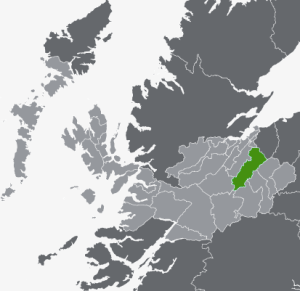
The case against Moy gamekeepers James Roderick Rolfe and Wayne Grant was heard at Inverness Sheriff Court today. No plea was taken and the case has been adjourned for the 4th time. It will continue on 26 May 2011.

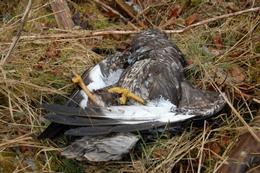
Both men face charges under the Wildlife & Countryside Act 1981. Rolfe is accused of possessing a dead red kite at the Gate Lodge, Moy on 3 June 2010. Grant is accused of having 56 black-headed gull eggs in an outbuilding at his home on the same date.

For background info on this case please see blog posts 3 June 2010, 4 June 2010, 23 March 2011, 8 April 2011 and 5 May 2011.

2nd Red kite shot in Cumbria

Another one of the red kites reintroduced to Cumbria last year has been found shot dead, according to the BBC. This is the second kite from this group to have been killed this way in an 8-month period. The bird was killed by a single shot-gun blast and police are now investigating.

Border Regional News video story: http://www.itv.com/border/red-kite-shot-dead37788/

BBC news story: http://www.bbc.co.uk/news/uk-england-cumbria-13429000

Case against Moy gamekeepers adjourned for 3rd time

Further to blog posts 3rd June 2010, 4th June 2010, 23rd March 2011 and 8th April 2011…

The case against Moy Estate gamekeepers Wayne Grant and James Rolfe was today adjourned for the third time at Inverness Sheriff Court. Neither of the accused made an appearance and the case continues without plea on 19 May 2011.

Latest on Moy Estate case

Surprise surprise! The Moy Estate case has been adjourned for a second time. Gamekeepers Wayne Grant and James Roderick Rolfe, facing charges under the Wildlife and Countryside Act 1981, did not attend the court hearing yesterday at Inverness Sheriff Court, and no plea was entered. Their case has been adjourned until 5 May 2011, again at Inverness Sheriff Court.
For background reading to this case, see blog posts 3 June 2010, 4 June 2010 and 23 March 2011.

Five separate poisoning incidents unreported at end of 2010

Earlier this month, PAW Scotland released the ‘2010 poisoning hotspots’ maps as part of their annual reporting. Along with the maps, they released a report called ‘Bird of Prey Poisoning Incidents 2006 to 2010 – Incident Details’. Here is a PDF of that report: 0114784

The name is a bit of a misnomer, as the ‘incident details’ are about as vague as you can get. However, the report does have its uses. There appear to be five separate poisoning incidents that took place between October and December 2010 that were not apparently reported/publicised in the press; three incidents in Tayside and one each in Lothian & Borders and Strathclyde. An internet search has failed to locate any information about these cases. Why do you think Tayside Police, Lothian Police, Strathclyde Police, and the RSPB (if they were involved in the investigation) were so quiet about these incidents?

Ref 10192: 1 buzzard poisoned by carbofuran, 2 pigeon baits. Oct 2010, Tayside.

Ref 10196: 2 buzzards poisoned by carbofuran isofenphos. Oct 2010, Tayside.

Ref: 10204: 1 buzzard poisoned by carbofuran. Nov 2010, Lothian & Borders.

Ref 10206: 1 buzzard poisoned by carbofuran, 1 pheasant bait. Nov 2010, Strathclyde.

Ref 10225: 1 red kite poisoned by chloralose. Dec 2010, Tayside.

Update on Moy Estate case

Following our blog posts on 3 June 2010 and 4 June 2010…….

According to an article published in the Press & Journal last week, two men will appear at Inverness Sheriff Court next month to face charges following the police raid on Moy Estate last June.

Gamekeepers James Rolfe (now 20), of The Gate Lodge, Moy, and Wayne Grant (now 32), of Limetree Cottage, Moy, are charged with offences under the Wildlife & Countryside Act 1981. Rolfe is accused of possessing a dead red kite at the Gate Lodge, Moy, on June 3 2010, while Grant is charged with having 56 black-headed gull eggs in an out-building at his home on the same date.

The case was called at Inverness Sheriff Court last week but neither defendant was at the hearing. Fiscal depute Karen Smith said that lawyers for the two men had asked for the case to be continued without plea. The case was adjourned until 7 April 2011.

Thank you to the contributor who sent us a copy of this newspaper article. We have been unable to find an on-line link.

illegal poisoning hampers red kite population growth in Scotland

On the face of it, Scotland’s red kite population appears to be doing well. Red kites used to be a common and widespread feature of our countryside, but became extinct in almost the entire United Kingdom in the early 1900s, after gamekeepers persecuted them to oblivion. A national reintroduction project began in 1989, bringing kites from mainland Europe and releasing them at strategic locations throughout the country.

Figures just released from the 2010 breeding season show that in Scotland, the numbers of breeding pairs are thought to be at their highest level since the project began in 1989. 166 breeding pairs were located, and 291 young fledged – an increase on 2009 figures.

However, recent scientific research has shown that the Scottish red kite population is not growing as rapidly as a similar reintroduced population in southern England, mainly due to the continued use of illegal posion being laid out in the Scottish countryside. As kites are a scavenging species, they are particularly susceptible to feeding from poisoned baits. At least 6 red kites were poisoned in Scotland in 2010 – and these were just the ones that were found. The illegal poisons Carbofuran and Aldicarb were responsible for their deaths. We also know about several more red kites that had been found dead in suspicious circumstances but that the police chose not to investigate. In addition to the illegal poisoned baits, 11 young kites died after eating prey that contained high concentrations of legal rodenticide. Although legal, there are still precautions needed when using rodenticides and efforts are being made to ensure that those people using this method of poison are fully aware of the user guidelines, especially about placement of the bait.

In addition to illegal and legal poisoning, in recent years Scottish red kites have also been killed illegally by being shot, and by being caught by the legs on a spring trap and being clubbed to death.

BBC News story: http://www.bbc.co.uk/news/uk-scotland-highlands-islands-12088673

police investigate suspicious red kite deaths in Northumberland

Police are investigating the deaths of five red kites in the North-East of England. The deaths in the Northumberland area span a period of seven months and appear to be the results of poisoning.

Full story here: http://www.thenorthernecho.co.uk/news/8683086.Red_kite_deaths_could_be_due_to_poisoning/

Irish government finally bans poisons used to kill raptors

This 3 yr old sea eagle was poisoned in Ireland earlier this year

New regulations came into force in the Irish Republic yesterday, finally banning the use of all poisons for pest control, apart from those used for rats and mice.

This has been a long time coming, and full credit should be given to The Golden Eagle Trust, who have long campaigned for this ban as they try to re-introduce the golden eagle, white-tailed eagle and red kite to their former ranges across the country.

Whilst the ban will not stop poisoning incidents (look at the continued number of poisoning incidents in Scotland and England where the ban has been in force for several years), it does send a clear message from the Irish government that they wish to address the issue of illegal raptor persecution. Kudos to them for taking this important step.

At least 12 re-introduced raptors have been killed by poison in Ireland this year alone, including golden eagles, sea eagles and red kites. Both the Scottish and Norwegian governments, who licence the capture of eagles in their countries for release in Ireland, have expressed grave concern at the poisonings, and failure to tackle the problem could result in the governments withdrawing their co-operation. This is quite a laughable position for the Scottish government to take, given their complete inability to effectively address raptor persecution in this country. So far, at least. They do have a chance to make significant improvements with the forthcoming WaNE bill, but the bill is still only in Stage 1 of the legislation process so there’s a long way to go yet.

A side-benefit of the new Irish legislation may be in reducing the amount of illegal poison that arrives in Scotland each year, believed to be smuggled in from Ireland where, prior to the new legislation, poison could be bought legally. Clearly it will take some time for all the poison currently in circulation in Ireland to be disposed of, but the long-term view is optimistic.

For the news story click here: http://www.independent.ie/national-news/ban-for-poison-used-to-kill-birds-of-prey-2383731.html

The Golden Eagle Trust website here: http://www.goldeneagle.ie/

RSPB Birdcrime 2009 Report Shows Continuing Raptor Persecution

The RSPB’s annual Birdcrime 2009 report was published today and shows that 2009 was the second worst year for raptor persecution in the last decade.

This depressing report shows that there were 384 reported persecution incidents against birds of prey in the UK  during 2009, 123 in Scotland, 224 in England, 17 in Wales and 11 in Northern Ireland, 9 incidents could not be allocated to a single country and were recorded at a UK level. Incidents include trapping, shooting, poisoning and nest destruction.

Again the trend showed that most incidents involved game shooting interests with a bias towards the upland grouse moors in Scotland and Northern England where the main victims of persecution are: golden eagle, white-tailed eagle, hen harrier, goshawk, peregrine and red kite.

In the report, the RSPB has made 11 recommendations for government action, so that these appalling crimes can be eradicated. These include the introduction of a “vicarious liability” offence which would make land managers and owners responsible for the actions of their employees.

Despite several successful prosecutions the conviction rate and subsequent sentencing appears pitifully poor and ineffective.

Full RSPB Report – http://www.rspb.org.uk/Images/birdcrime_tcm9-260567.pdf

Â