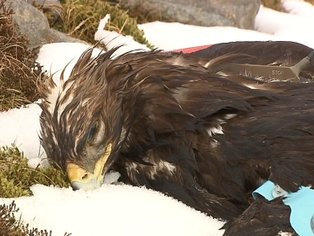
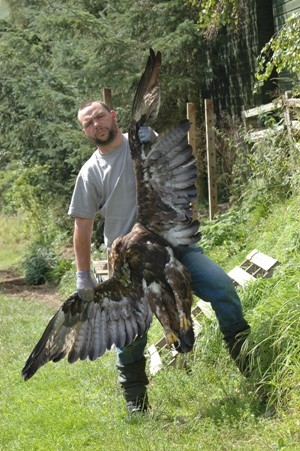
Dead red kite is suspected poisoning victim

Toxicology tests are underway on a dead red kite found on farmland in the village of Glaston, Rutland. It is suspected to have been poisoned. Two other poisoned kites were found dead in the area three years ago. In August 2008 a red kite was discovered to have been poisoned by the banned pesticide Carbofuran in a rabbit bait at Glaston. In September 2008, another kite was poisoned with Carbofuran at Seaton, Rutland (see here for details of these two incidents). The lab results from the latest dead kite have not yet been released.

Leicestershire police wildlife crime officer, Neil Hughes, is asking for locals to contact him to report any other poisoning incidents in the same area, such as cats and dogs. Contact Neil: 0116 222 2222.

Story in the Rutland Times here

Welcome to the inglorious twelfth!

Today is the inglorious 12th, the start of the four-month grouse shooting season in the uplands of northern England and Scotland. Today, and for many days to come, ridiculously rich people will dress up in clownish outfits and head for the moors in the hope of shooting dead some birds. Many will pay an estimated average of £15,000 for the experience. I wonder how many of them will enjoy the sight of a hunting hen harrier or a golden eagle quartering across the moor? Very few, infact probably none of them because scientific evidence shows that hen harriers and golden eagles have been exterminated on most grouse moors in the UK, with just a few notable exceptions. Has anyone been convicted? One person was once convicted for killing a hen harrier, and that’s it. Nobody has ever been convicted for killing a golden eagle (someone was once taken to court a few years back but the case was dropped). Even though several dead eagles and the UK’s biggest stash of the poison they died from were all found on a sporting estate last year, still nobody has ever been convicted.
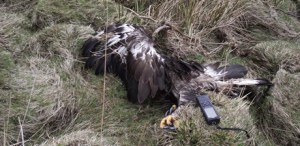
Four years ago today, this golden eagle (pictured) was found dead in Peebleshire. She was one half of the last breeding pair of golden eagles in the Borders. She had been poisoned by the banned pesticide Carbofuran and was found dead under her nest tree. Her death caused outrage and triggered the thematic inspection into the prevention, investigation and prosecution of wildlife crime in Scotland (read the resulting 2008 ‘Natural Justice’ report here). This report highlighted the problems that stand in the way of effective wildlife crime law enforcement in Scotland. Four years later, many of the same problems still exist. Nobody has been charged with the illegal killing of that female golden eagle in Peebleshire and according to a report by the Wildlife Incident Investigation Scheme, the case is now closed.

Since the year she was killed (2007), how many other protected raptors have suffered the same fate? The following have all been confirmed poisoned in Scotland over the last four years – the vast majority of them were found dead on grouse moors:

8 golden eagles, 3 sea eagles, 63 buzzards, 25 red kites and 8 peregrines.

These numbers do not account for birds that were trapped, shot, or had their heads smashed in with a shinty stick while their broken legs were pinned in an illegal spring trap. Nor do they account for the ‘missing’ birds – including over 2,000 hen harriers.

Today, the grouse-shooting industry will have filled the media with stories about how ‘great’ grouse moors are for conservation, how ‘great’ grouse shooting is for the economy, how ‘great’ grouse-shooting is for biodiversity. Fortunately, the general public are becoming wise to the propaganda.

‘Report’ now published about the ‘threat’ of reintroductions to biodiversity

Following the blog post from 19 July 2011 (here), the much-anticipated ‘report’ by the Veterinary Association for Wildlife Management (VAWM) has now been published on its website. This is the ‘report’ (note, not a peer-reviewed scientific paper) that is supposed to show us how reintroductions are “a threat to biodiversity”. The ‘report’ is exactly what one might  expect from a group who used to be called ‘Vets for Hunting’ and who claim that red kites are ‘threatening songbird species’.

In an article published in The Westmorland Gazette (here) to coincide with the ‘report’s’ release, Dr Lewis Thomas, secretary of the VAWM says of red kites: “They are large predators so they have a large appetite” (and thus presumably they threaten to wipe out every living creature in their territory). Amazing. A fascinating piece of logic, unfortunately not based on any known ecological principle. Tellingly, the ‘report’ doesn’t provide a single piece of scientific evidence to substantiate the claims about the impact of red kites on biodiversity. In fact it doesn’t even mention red kites!

If you can’t be bothered to read the ‘report’ on the VAWM website (see here), just read the comments posted underneath the article by Gazette readers (here) – and breathe a sigh of relief that morons have not yet taken over the world.

Update on last week’s police raid

Further to the blog post on 19 July 2011, the name of the Highland sporting estate that was raided last week has been reported as Farr and Kyllachy Estate, near Inverness. The police raid was in connection with alleged wildlife crime incidents that include a poisoned sea eagle and a poisoned golden eagle, believed to have been discovered in June 2010, and four dead red kites.

Allegations of wildlife crime in this area date back several decades, including the previously reported discovery of poison bait, hen harrier nest destruction, poisoned eagles, poisoned red kites and attempted trapping of goshawks and peregrines. All of these allegations can be found by anybody interested in doing an internet search, although no allegation has ever been proven in the Scottish courts.

No charges have been reported in relation to last week’s police raid. On this basis, blog commentators are reminded that anyone connected with Farr and Kyllachy Estate must be presumed innocent.

According to a 2005 report in The Times, Farr Estate is expected to receive profit of up to £11 million from revenue generated by recently erected wind turbines (see here).

Last year, The Press & Journal ran an article (here) about tick management on the estate, including an interview with the Laird, Philip Mackenzie. The article claimed that tick control had led to a 20-fold increase in the number of brace shot (red grouse) in the previous six years. It also stated the Estate was expecting 2010 to produce the best grouse bags since 1938, leading to 15 days of let driven grouse shooting, at a tidy charge of £10,000 + per day.

Last year Farr Estate donated driven and walked-up grouse shooting days to the Game and Wildlife Conservation Trust’s (GWCT) 2010 Grand Scottish Draw (see here).

Reintroductions “a threat to biodiversity”

An astonishing display of ignorance was on show in The Telegraph this week. The group calling themselves the Veterinary Association of Wildlife Management (VAWM) has claimed that the reintroduction of native species, formerly wiped out by persecution (e.g. sea eagle and red kite) are “potential man-made threats to biodiversity“. Really?  Methinks someone at the VAWM needs to read up on the Convention of Biological Diversity.

The VAWM, formerly known as Vets for Hunting (hmm, another group with a PR-induced name change – sound familiar?), also claim that the UK’s population of red kites was ‘threatening songbird species’. Ha ha ha ha ha ha ha ha ha ha ha ha ha ha ha ha! Perhaps VAWM spokesman Dr Lewis Thomas (a retired veterinary pathologist) should swap his rusty old scalpel for a shiny pair of binoculars. Ignorance is no excuse. Telegraph article here.

Interestingly, according to their facebook page, the Scottish Gamekeepers Association agrees with the VAWM’s sentiments on reintroductions. And this from a group whose members routinely rear and release millions of non-native gamebirds into our countryside every year, without any accountability for the environmental damage this may cause. Amazing.

Meanwhile, back in the real world of conservation, RSPB Scotland has secured major funding from the Heritage Lottery Fund to extend their fantastic sea eagle reintroduction project for another year (see here).

Latest SASA figures reveal widespread poisoning incidents in early 2011

The latest figures detailing illegal animal poisoning incidents in the first quarter of 2011 have just been released by Science and Advice for Scottish Agriculture (SASA) on behalf of the Scottish Government.

The figures cover the period January to March 2011, and show that criminal raptor poisoning incidents were detected in each of the three months. They include 3 buzzards, 1 golden eagle, 1 red kite and 2 peregrines.  Poisoning incidents were widespread, taking place across Scotland, including in the Borders, Strathclyde, Tayside, Grampian and the Highlands. The illegal poisons used included Carbofuran, Chloralose and Strychnine. So much for the game-shooting industry’s self-regulation. I guess 2011 will not be the year they ‘stamp out’ illegal raptor persecution.

Not for the first time, two of the five recorded incidents were apparently unpublicised in the media: 1 x buzzard poisoned with Carbofuran in the Borders in January 2011, and 1 x red kite poisoned with Chloralose in the Highland region in February 2011.

SASA poisoning figures for period Jan – Mar 2011 available here

Man arrested & bailed for kite deaths in Cumbria – guns & poisons seized

A man has been arrested and bailed over the illegal killing of red kites in Cumbria. At least three kites are known to have been illegally killed since the reintroduction project began in August 2010. Two were shot (see reports here and here) and one was poisoned (see here).

The arrest followed a police raid on a farm (currently un-named) in the Ulverston area on Tuesday, during which a number of firearms and illegally held poisons were seized.

A Cumbria Police spokesman said the man was arrested on suspicion of intentionally killing a protected wild bird and on suspicion of poisoning and firearms offences. According to the Westmorland Gazette, the man has been released without charge and bailed until July 21st.

More on this news story here, here and here

Young red kite poisoned in Cumbria

Cumbria Police are investigating the posioning of a red kite – the third kite to be killed in the region since a re-introduction project began last August.

The first dead kite from the project was shot dead in Dentdale in September 2010. The second dead kite had been killed by a shotgun wound in the Grizedale area, found under its roost tree on April 20 2011. The latest reported dead kite was discovered in January 2011 near Esthwaite Water, Hawkshead. Toxicology results have now confirmed this bird had been poisoned.

News story here

More on the Moy case

According to an article published in The Scotsman (view here), a post mortem carried out on the dead red kite discovered in the vehicle used by gamekeeper James Rolfe on Moy Estate last June, revealed it had broken legs and had died as a result of a blow to the head. Rolfe was convicted for being in possession of the dead kite. Why weren’t charges brought against anyone for the unlawful killing of this bird?

In the same article, it is reported that over a five-week period, the remains of a further two dead red kites, six illegal baited spring traps, a trapped hen harrier, and a poison bait laced with a banned agricultural pesticide (poison) were also recovered from the estate. No arrests or charges have been made in connection with these incidents.

Why not?

In an article in Birdwatch Magazine, further gruesome details are revealed about the discovery of a severed red kite leg and wing tags belonging to a red kite that was being followed by satellite tracking, all hidden in holes covered by moss. The article also reports that four golden eagle leg rings were discovered in Rolfe’s possession. No arrests or charges have been made in connection with these incidents.

Why not?

You may wish to ask the following people:

Crown Office and Procurator Fiscal Service: pn_copfs@scotland.gsi.gov.uk

Northern Constabulary Force Wildlife Crime Co-ordinator, Chief Inspector Matthew Reiss: matthew.reiss@northern.pnn.police.uk

Environment Minister for Scotland, Stewart Stevenson MSP: msp@stewartstevenson.net

Moy Estate results

Today at Inverness Sheriff Court, gamekeeper James Roderick Rolfe, 20, was convicted of being in possession of a dead red kite which was found in his vehicle during a police raid on the Moy Estate in June last year. Rolfe said he had found the kite caught in a trap set for stoats. It had not been poisoned. Rolfe was fined £1,500 for possession of the dead bird.

The images here show the dead kite in the back of his vehicle. No explanation has been given to account for the obvious injury this bird suffered to its head area. According to the Inverness Courier, Rolfe claimed the bird was already dead when he found it.

Another gamekeeper working on Moy Estate was accused of being in possession of 56 gull eggs. The court accepted his plea of not guilty.

Northern Constabulary press statement

Inverness Courier news report