
Following the news that White-tailed Eagles will be released in Exmoor National Park later this year (see here), Natural England has published a blog to outline its ‘role in assessing the licensing application, how potential risks, including concerns from the farming sector, were carefully considered, and why Exmoor has been chosen as the next release site‘.
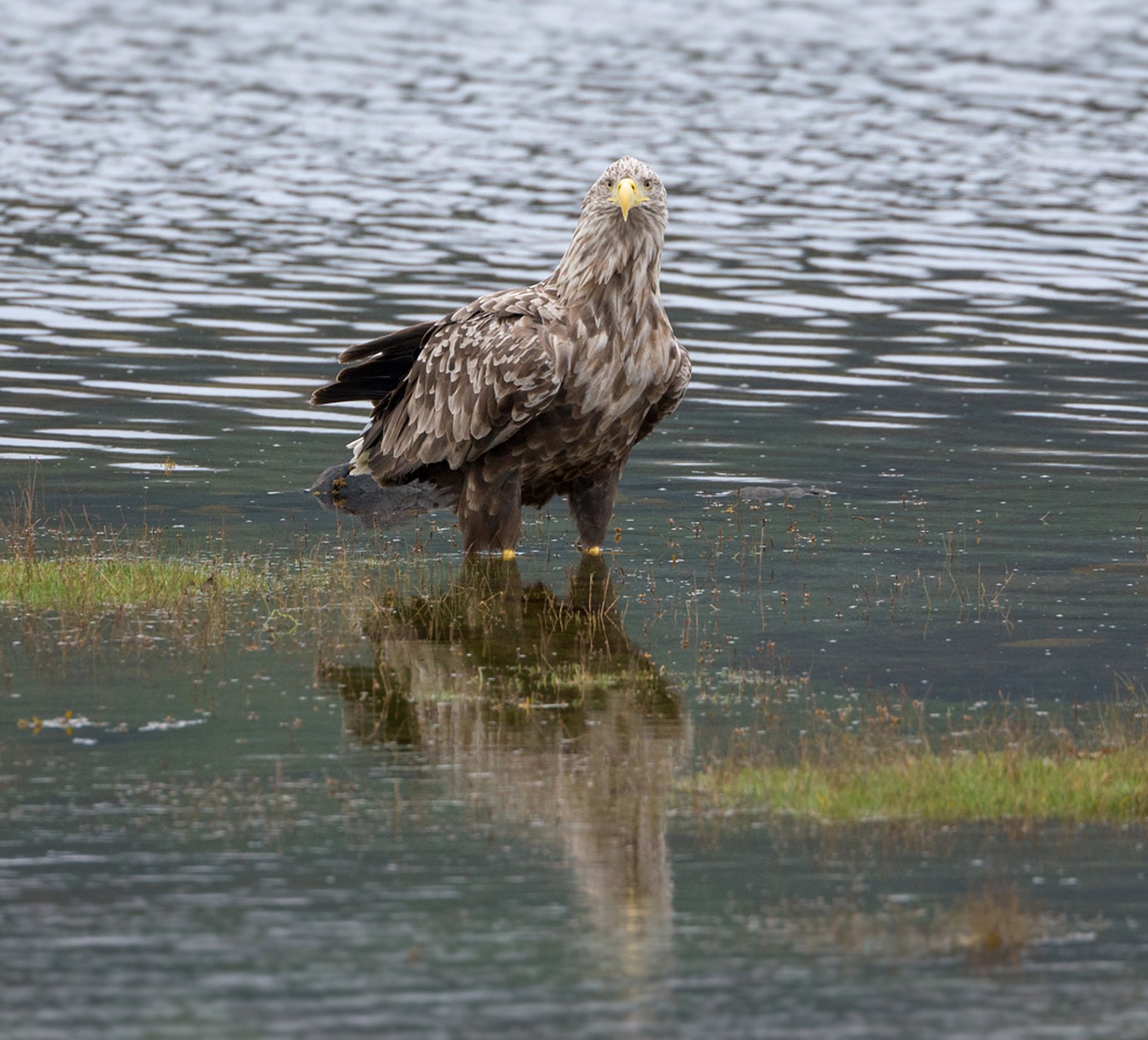
Natural England’s blog can be found on its website (here), but is reproduced below in case it ‘disappears’. I’ll add some commentary underneath it.
SUPPORTING THE RETURN OF WHITE-TAILED EAGLES TO EXMOOR
Natural England blog written by Roxanne Gardiner, Senior Officer, Natural England Wildlife Licensing Service and Olivia Beatty, Higher Officer, Wessex Area Team.
Natural England has issued a licence enabling the next phase of white-tailed eagle reintroductions in southern England, permitting the release of up to 20 birds in Exmoor National Park over three years. In this blog, Senior Officer Roxanne Gardiner and Higher Officer Olivia Beatty explain Natural England’s role in assessing the application, how potential risks, including concerns from the farming sector, were carefully considered, and why Exmoor has been chosen as the next release site.
Natural England has joined Forestry England, the Roy Dennis Wildlife Foundation and Exmoor National Park Authority in announcing the exciting next steps in reintroducing white‑tailed eagles to southern England.
Natural England has issued the licence that enables this next phase of the Roy Dennis Wildlife Foundation- and Forestry England led project to move forward. The licence permits the release of up to 20 white‑tailed eagles in Exmoor National Park over three years, and sits alongside the existing licence for the successful Isle of Wight project, which has resulted in the first breeding white tailed eagles in England for 240 years.
White‑tailed eagles are our largest native bird of prey. Once widespread throughout England’s coasts and wetlands, they were lost due to human persecution. Their return in recent years is a powerful symbol of nature recovery that has captured the public imagination; and shown how ambitious but well‑planned conservation projects can help restore nature.
As top predators and scavengers, white tailed eagles help to balance the ecology of our landscapes, regulating prey populations, recycling nutrients and driving higher biodiversity. By harassing and controlling intermediate predators like buzzards and magpies, they also help protect smaller birds and mammals from over-predation. On the Isle of Wight, there is already evidence that more lapwing chicks are fledging as a result.
The selection of Exmoor as a new release site reflects the wider shared ambitions that Natural England and Exmoor National Park Authority have long been working towards – a landscape where nature is recovering at scale. Detailed feasibility studies have been led by the Project and historical records confirm that white‑tailed eagles once bred along the Exmoor coastline.
Tracking data from birds released on the Isle of Wight shows that several have already visited the Exmoor area. Exmoor’s mix of coastal, woodland and wetland habitats provide excellent conditions for the species as it continues to re‑establish in southern England.
Natural England’s role in enabling responsible reintroductions
Natural England’s role in this project is as the statutory wildlife licensing authority. Our responsibility is to assess applications for conservation translocations carefully and transparently, ensuring they meet the high standards set out in Defra’s Reintroductions and other conservation translocations: code and guidance for England.
Staff from Natural England’s Wildlife Licensing Service led the detailed, evidence‑led assessment of the application submitted by the Project. The assessment considered the contribution of the project nationally to white‑tailed eagle recovery. We also considered:
- The likely success of the project in terms of white-tailed eagle recovery
- Experience of the project partners
- Governance and long‑term funding arrangements
- Disease and biosecurity risks
- Ecological risks and opportunities
- Socio‑economic risks and opportunities including the potential to affect farm businesses
- Monitoring and management proposals
Natural England’s Wessex Area Team played a leading role in assessing the potential impacts of the Project on protected sites and led the Habitats Regulations Assessment. This work was done in collaboration with Natural England’s Chief Scientist Directorate, bringing together local knowledge and national scientific expertise. They focused on how the released eagles are most likely to use the landscape.
Evidence shows that young birds may spend several years exploring areas across the UK and into northern Europe, but when they settle and establish breeding territories it is usually within 60km of the release site. Basing the assessment on this well‑understood behaviour, the team was able to look carefully at realistic ways the released birds might interact with nearby protected sites and key species within those sites in the years following release.
We are aware that some stakeholders have raised concerns about the project, especially around livestock predation. Our team have joined meetings with farming sector representatives and read the local consultation responses. These concerns have been fully considered by both the project and Natural England. We understand that there are genuine fears but have also reflected on evidence from six years of monitoring the 45 birds released by the Isle of Wight project, and their offspring, which shows no recorded feeding on lambs or other livestock. These birds have only been observed to take natural prey, preferring fish and coastal birds, which is in line with comparable areas in Europe.
The project management plan and licence conditions include some key measures that we are confident should mitigate the concerns that have been raised:
- There will be a project steering group that includes farming sector representatives.
- There is a commitment to long‑term monitoring of the eagles’ activities, both through GPS tracking and through activity reporting forms.
- The licence duration is for 11 years, by which time released birds will hopefully have settled and begun breeding.
- There will be a communications plan and project officer, with the aim of raising awareness, supporting monitoring, and ensuring that emerging concerns are investigated and, where appropriate, addressed.
- The project partners have shared a letter of commitment with farming sector representatives and the wider steering group, setting out that they will continue monitoring and engagement beyond the 11-year licence period.
In assessing the project, Natural England has taken a balanced and evidence‑led approach, applying the principles of the Code and Guidance in a way that supports ambition for nature recovery, while remaining proportionate, transparent and impartial, and consistent with our statutory duties. We hope this gives confidence that risks have been carefully considered and appropriately managed.
A flagship project for nature recovery
This project forms part of a wider effort to support the recovery of white‑tailed eagles across England, alongside projects and proposals in Scotland, Wales and Ireland. Natural England continues to work closely with other regulators to share learning and promote best practice for responsible species reintroductions.
We are pleased to support this next phase of a landmark conservation programme and look forward to continuing to work with the project team as releases begin this summer.
ENDS
My commentary:
Natural England’s decision to approve the licence application to release up to 20 White-tailed Eagles into Exmoor National Park over the next three years was always going to be an easy decision, to be honest.
The eagles are already there, albeit in small numbers, as can be seen in this map showing the widespread dispersal of 45 young satellite-tracked WTEs that have been released on the Isle of Wight since 2019 (map dated to January 2024, copyright Dr Tim Mackrill from the Roy Dennis Wildlife Foundation):
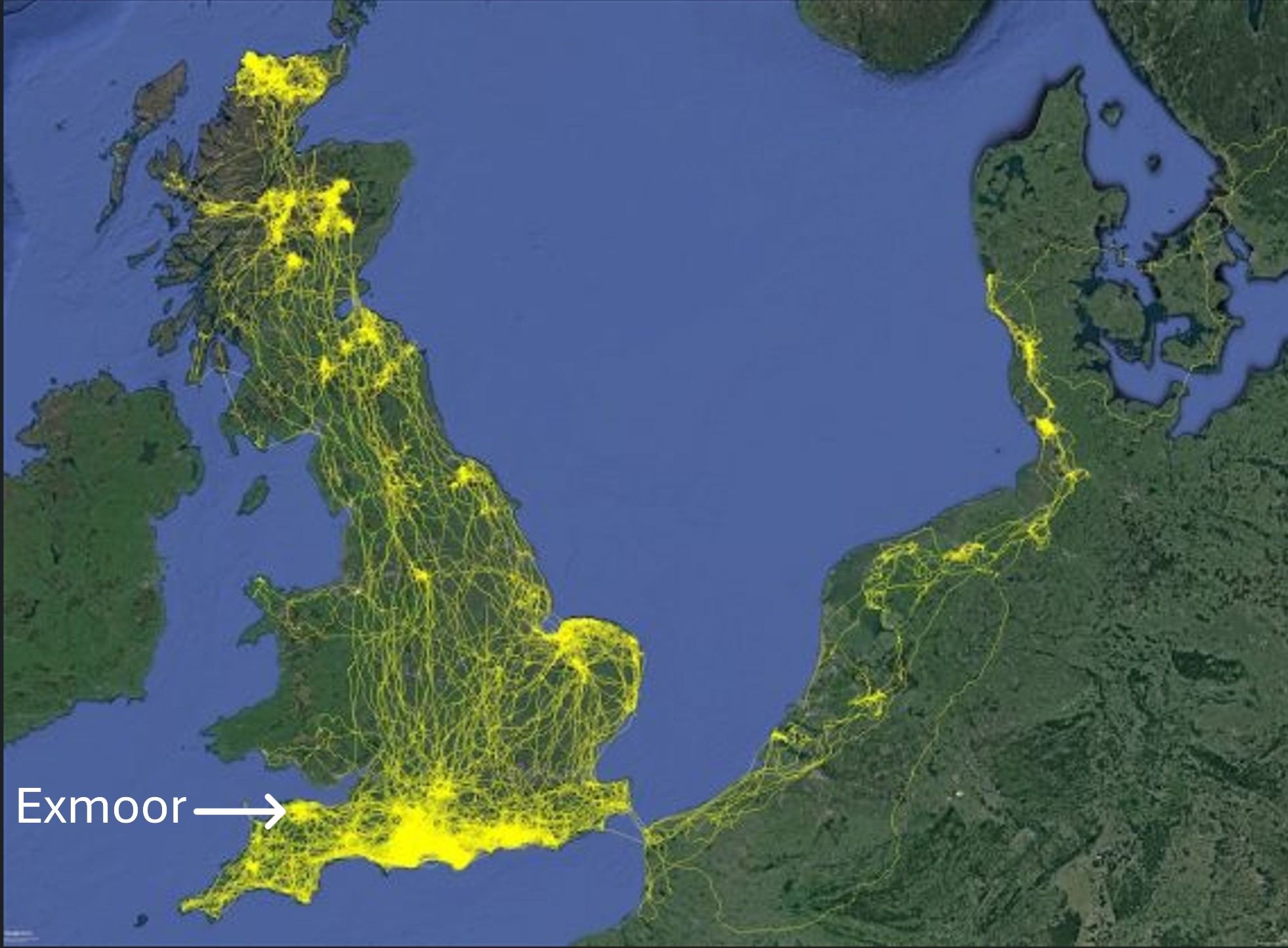
It would be quite difficult, then, for Natural England to refuse the licence application, as the releases will simply be bolstering and speeding up the spread of the eagles into the south-west, their former, historical breeding range.
And every time I read anything from Natural England, or Defra, or the Government, about the ‘careful consideration of species conservation releases and their potential impacts’ I can’t help but laugh at the hypocrisy. Over 60 million non-native gamebirds (Pheasants and Red-legged Partridges) are released in to the UK countryside every year, for shooting, and nobody bats an eyelid (unless forced to after a successful legal challenge by Wild Justice).
Anyway… Natural England acknowledges the inevitable ‘concerns’ raised about the release of 20 White-tailed Eagles (note, twenty, not 60 million!) Those concerns are from the usual suspects, as shown quite neatly in this graphic produced in a briefing note in September 2025 by The Exmoor Society, a charity that undertook an ‘evidence review’ into species reintroduction programmes in Exmoor National Park, specifically focusing on the Pine Marten and the White-tailed Eagle:
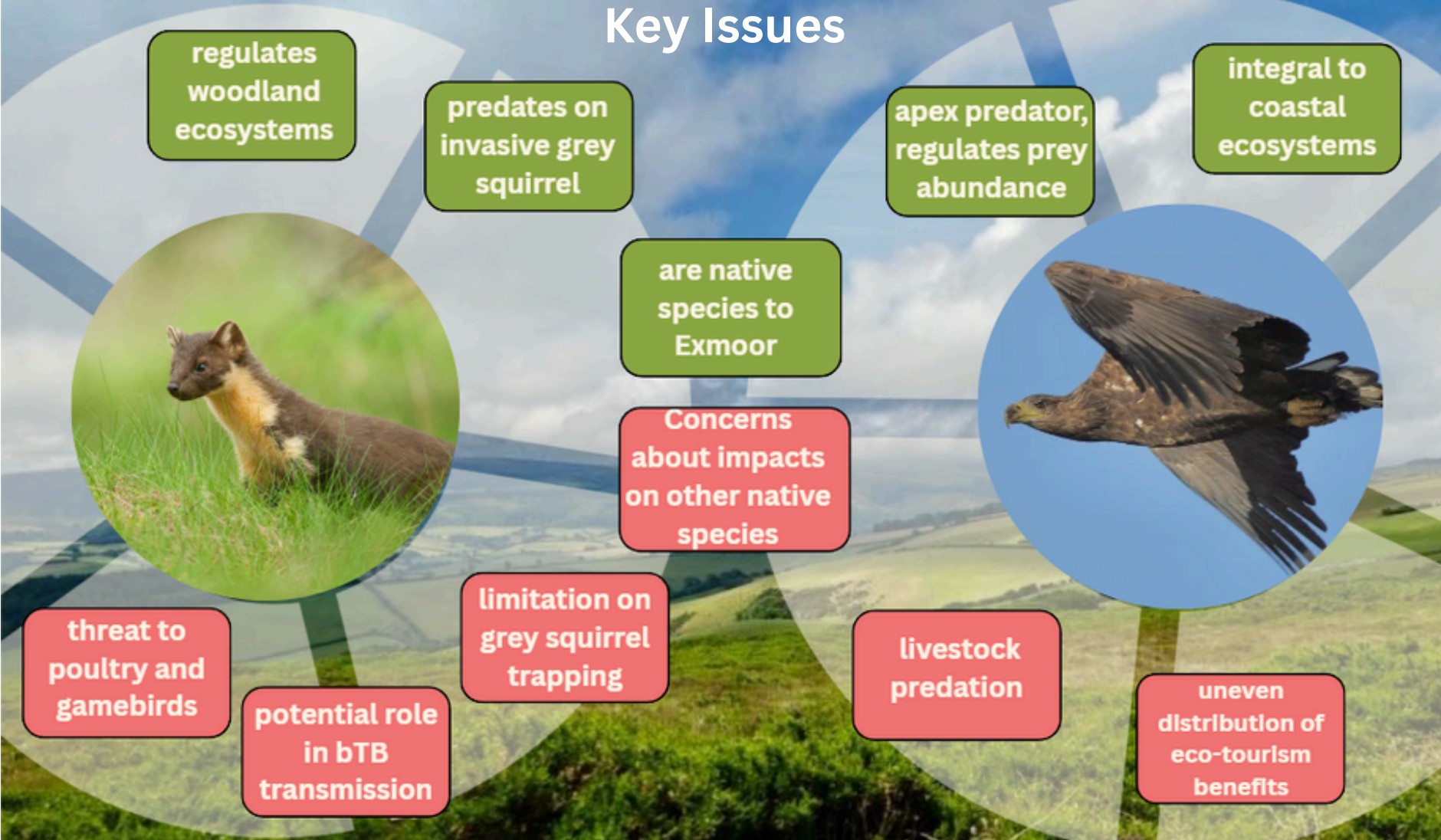
I find it hard to comprehend how ‘threats to gamebirds’ and ‘livestock predation’ should ever be taken seriously when considering the restoration of native species to what is supposed to be a National Park. Regressive doesn’t even begin to describe it.
You can read the charity’s evidence review here:
Natural England’s blog focuses on addressing the concerns of the farming sector, whose representatives are predicting some kind of lamb-aggedon, but interestingly, there’s little, actually, no mention in Natural England’s blog of the perceived ‘threat’ to (non-native) gamebirds.
Some of you may remember nine years ago when Natural England and Defra were pushing the ridiculous notion of reintroducing Hen Harriers to southern England (a tactic many of us argued was simply a distraction technique to take the focus off the widespread illegal killing of this species on grouse moors in the north).
Exmoor National Park was identified as a potentially suitable location to release Hen Harriers, but Exmoor is infested with gamebird shoots and members of the gamebird shooting industry there were dead set against the release of Hen Harriers, because:
“The fears raised were that a reintroduction would lead to increased scrutiny of their legal activities and if the project was unsuccessful the shoots would be blamed” (see here).
As a result, Exmoor National Park was quietly dropped as a potential release location.
If those Exmoor gamebird shoots were fearful of Hen Harriers being released, it’s hard to imagine they’ll be thrilled at the prospect of White-tailed Eagles…


Will donor birds be taken from Scottish nests for the Exmoor translocations, like the Isle of Wight or from another location; Norway for example? Is the Scottish population robust enough to contribute birds to two releases?
I do not know the answer to your specific question, but Defra do publish their guidelines for reintroductions and translocations of wildlife.
It is to be found on Page 44 of this, headed ‘Select an appropriate donor population’:
https://assets.publishing.service.gov.uk/media/66fd6a1430536cb927482b2d/Reintroductions_and_other_conservation_translocations_code_and_guidance_for_England_v1.2.pdf
“be sure there are enough individuals in the donor populations for them to be sampled without adverse effects”
More specific (historic) details can be found here: https://roydennis.org/white-tailed-eagle/
“Concerted efforts to restore the White-tailed Eagle to Scotland began in the middle part of the twentieth century. Early releases were undertaken in 1959 and 1968, and although they failed, the 1968 release in particular – which was undertaken by Roy Dennis on Fair Isle – was a valuable test of translocation, husbandry and release methods. A total of 75 Norwegian young were subsequently released on Rum National Nature Reserve between 1975 and 1985, and this led to the first successful breeding in 1985. The population was relatively slow to expand and so an additional 56 birds were released between 1993 and 1998 using improved techniques. By 2000 there were 22 breeding pairs and the 100th chick fledged successfully.
Since then the population in Scotland, predominantly in western parts, has expanded to more than 180 breeding pairs. Following the successes in the west, 85 juvenile White-tailed Eagles were released on the east coast between 2007 and 2012, with birds again imported from Norway. The first pair in eastern Scotland subsequently bred successfully in 2013. Meanwhile a total of 226 chicks were translocated to Ireland in two phases between 2007 and 2024. There are now at least ten breeding pairs.”
I note that the whole exercise has been characterised by learning from experience over many years about what works best.
I am not sure if the real details are published, but I can imagine that such experiments would include taking a surplus egg (where there is one) and rearing it, or taking a surplus chick (where there is one) and bringing it on, so as not to jeopardise the donor population. They may even have tried to see if they could encourage a second, natural, clutch by removing a clutch early?