Poisoned red kite found on Scottish grouse moor

Press release from Police Scotland (16th December 2020)

Appeal for information – poisoned bird of prey – Ruthven, Moy

Police Scotland has confirmed that a red kite found dead in the Ruthven area in October, had been poisoned with a banned pesticide.

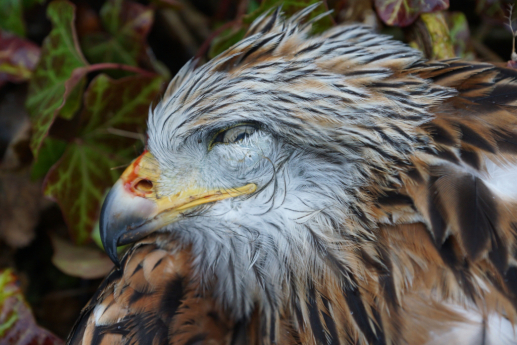
[A poisoned red kite, photo by Marc Ruddock. NB: Not the poisoned red kite in this particular incident]

Further searches were carried out yesterday (15 December) with partner agency RSPB on hill ground near Meall a’ Bhreacraibh and Ruthven, Moy, in the northern Monadliath mountains.

No further poisoned raprtors or animals were identified.

Police Constable Daniel Sutherland, Highlands and Islands Wildlife crime Liaison officer, said:

Traces of a banned pesticide have been detected in a Red kite found in the area. This incident is sadly another example of where a bird of prey has been killed through ingestion of an illegally held poison.

I strongly urge anyone within the local and wider community to come forward with details on any information about this incident.”

Following consultation with the Scottish Government Rural Payments Directorate and the Science and Advice for Scottish Agriculture (SASA), Police Scotland requests members of the public and any dog walkers to be cautious when walking in the surrounding area and the immediate vicinity. 

Anybody who has information about this incident, banned pesticide possession or misuse, or other information relating to raptor persecution please contact Police Scotland on 101 or pass on information anonymously via Crimestoppers on 0800 555 111.

ENDS

This is a very good response from Police Scotland – a press release out the day after the police search and a clear warning to the public to be cautious in this area, especially if walking with dogs. The name of the banned poison isn’t given, probably for investigative purposes, but by telling the public it’s a banned poison we know it’s one of eight highly toxic pesticides (or perhaps a combination) listed on the Possession of Pesticides (Scotland) Order 2005, which are Aldicarb, Alphachloralose, Aluminium phosphide,  Bendiocarb, Carbofuran, Mevinphos, Sodium cyanide and Strychnine.

Now, about the location. According to Andy Wightman’s excellent Who Owns Scotland website, the area of land mentioned in the police press release is part of the Moy Estate in the northern Monadhliaths. Or at least it was when Andy compiled his data – it’s possible, of course, that there have since been boundary changes.

Regular blog readers will be familiar with the Moy area. Moy Estate was raided by police ten years ago after the discovery of poisoned bait and dead raptors and illegally set traps. A gamekeeper was later convicted of possession of a red kite after its bloodied corpse was found in the back of his vehicle. It had two broken legs and a head injury. A bloodied shinty stick was also found in the back of the vehicle.

The remains of two further red kites were discovered on the moor, including a severed red kite leg and some wing tags that had previously been fitted to a kite, all found buried in holes under some moss. A jar in one of the gamekeeper’s houses contained the leg rings of four young golden eagles – nobody could account for how they had ended up inside that jar. A live hen harrier was found caught by its leg in an illegally-set spring trap. It survived after being rescued by raptor workers.

No further charges were brought against anyone for any of the offences uncovered at Moy.

In 2016 Police Scotland issued an appeal for information following the discovery of disturbed and abandoned buzzard and goshawk nests in the Moy Forest. One goshawk and four buzzard nests were abandoned in suspicious circumstances, with some evidence of illegal disturbance. These nests were being monitored by staff from Forestry Enterprise Scotland. No charges were brought.

For previous blogs on Moy see here.

I would imagine, after this latest discovery, that Ministers in the Scottish Government who recently decided to press on with the introduction of a licensing scheme for grouse shooting estates, despite cries of ‘It’s unnecessary regulation!‘ and ‘It’s all so unfair!‘ from the shooting industry, can today feel vindicated that their decision was the right one.

They now need to get on with it and get it implemented ASAP, because this latest victim is evidence that raptor persecution continues, despite all the denials routinely chuntered out by the so-called leaders in the game shooting industry.

UPDATE 17 December 2020: Poisoned red kite found dead on Scottish grouse moor – an interesting police investigation (here)

Man guilty of wildlife crime offences against red kites & a badger

Article from the South Wales Argus (13th December 2020)

Caerphilly man found guilty of hunting and killing badger

A MAN is facing a prison sentence after he was convicted after a trial of hunting and killing a badger.

Dewi James Price, 39, of Commercial Street, New Tredegar, Caerphilly, was also found guilty of offences against red kites.

He had denied the charges during a trial at Newport Magistrates’ Court.

Price was found guilty of killing a badger in the Builth Wells area of Powys on February 18, 2018.

The defendant was also convicted of taking a red kite in Gelligaer, Caerphilly, on May 19, 2019.

He was also found guilty of intentionally or recklessly disturbing a red kite while it was in, on or near a nest containing eggs or young and of intentionally or recklessly disturbing the dependent young of a red kite.

Price’s case sentence was adjourned and is due to take place at Newport Crown Court on December 23.

He was granted conditional bail.

ENDS

UPDATE 7 January 2021: Sentencing delay for man convicted of offences against badger and red kites (here)

UPDATE 13 February 2022: Badger killer and red kite chick thief avoids prison (here)

Red kite killed in barbaric illegal trap on pheasant-shooting estate – no prosecution

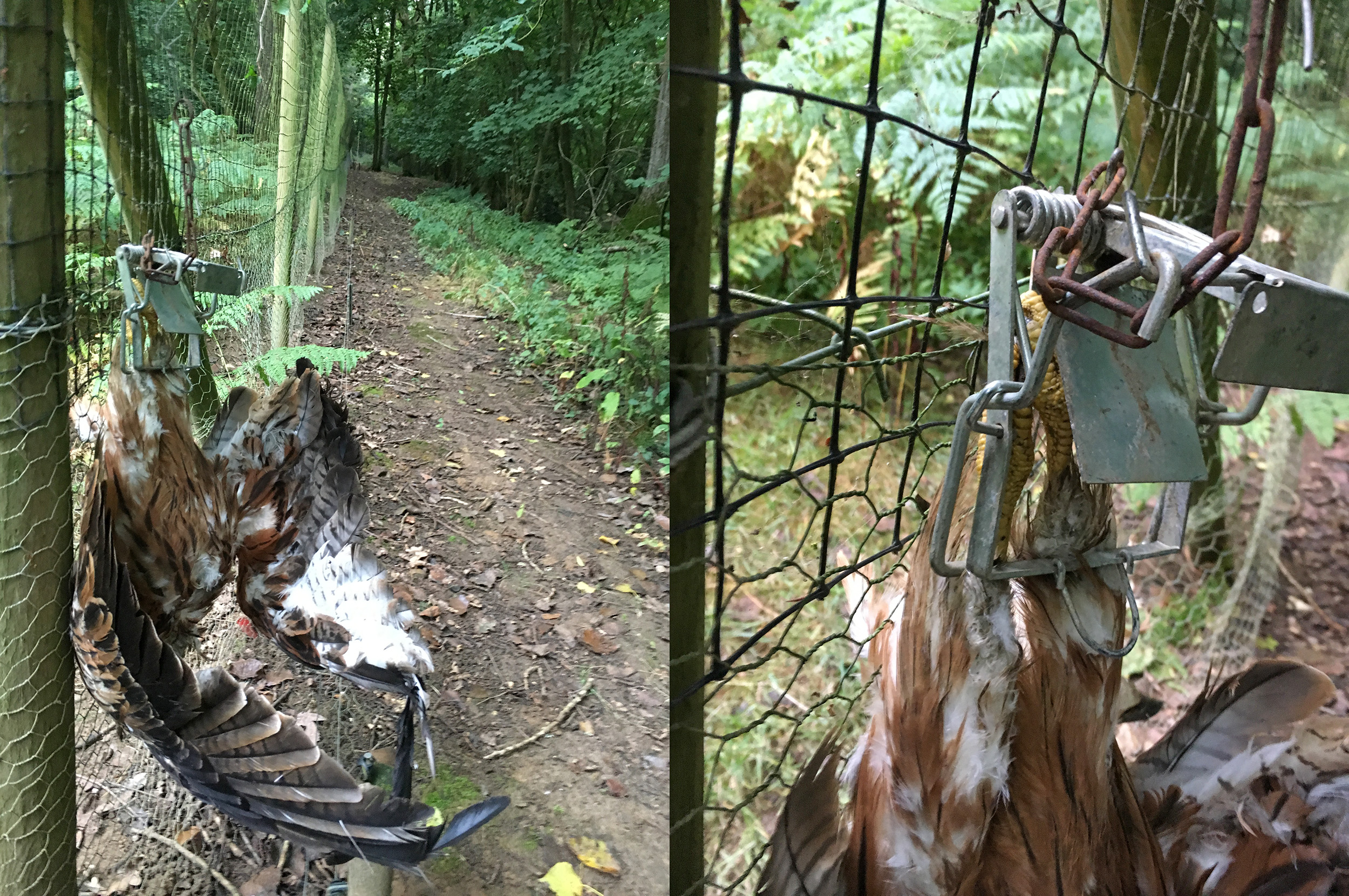
A red kite suffered a brutal and agonizing death when it was caught in a barbaric illegal trap at a pheasant-release pen on an unnamed Berkshire shooting estate in August 2020.

A member of the public found the dead kite, hanging upside down with its legs caught in a pole trap, a cruel device that has been outlawed since 1904.

[Red kite hanging dead in an illegal pole trap on a Berkshire shooting estate. Photos via RSPB].

The member of the public reported the incident to the estate (please note – if you find something like this report it to the police and the RSPB, straight away). A gamekeeper was reportedly abusive and threatening in response.

The incident was reported to the RSPB a couple of days later, who contacted Thames Valley Police. Fortunately in this instance, senior estate officials had already reported the crime to the police and had instructed the gamekeeper to retrieve the dead kite and the illegal trap.

The gamekeeper was interviewed and denied setting the trap on his pheasant pen and claimed it was ‘a set-up’.

There appears to be insufficient evidence to progress a prosecution.

For further details of this horrific crime, and the ongoing difficulty of securing sufficient evidence for a prosecution, please see the RSPB Investigations Team’s blog here.

Yet another red kite found poisoned in North Yorkshire

Yet another raptor persecution case from North Yorkshire, and yet another crime committed as part of a reported ‘surge’ of similar crimes recorded during the first period of lockdown (e.g. see here and here).

This time it’s a red kite that was found dying in April 2020 at Scampston, near Malton, to the south of the North York Moors National Park.

[Photos via Jean Thorpe]

Her corpse was sent for toxicology at the Government’s Wildlife Incident Investigation Scheme (WIIS) and the results have apparently just been released (presumably delayed due to Covid19).

She was poisoned by a mix of Brodifacoum and Bendiocarb ‘in quantities that would not be consistent with an accidental incident’, writes Jean Thorpe from Ryedale Wildlife Rehabilitation Centre.

Anybody with information about this crime please contact Police Wildlife Crime Officer Jez Walmsley at Malton Police Station (Tel: 101) and quote incident reference #12200055801.

Large police operation investigating raptor persecution near proposed release site for hen harriers

Press release from Wiltshire Police (23 September 2020)

One arrest made after operation into bird of prey persecution in Wiltshire

A teenager has been arrested today following two warrants executed in East Wiltshire.

Led by the Wiltshire Rural Crime Team but supported by local officers, officers from Hampshire Constabulary, South West Forensics, the Royal Society for the Protection of Birds (RSPB), the National Wildlife Crime Unit, Natural England and the Wiltshire Fire and Rescue Service, warrants were executed at locations in the Pewsey and Beckhampton areas.

A 19-year-old man was arrested on suspicion of raptor persecution under the Wildlife and Countryside Act.

Firearms were seized as part of ongoing enquiries, and the carcasses of a number of birds of prey, including red kites and buzzards, were located at the location in Beckhampton.

PC Marc Jackson, Wiltshire Police Rural Crime Team, said: “Following an extensive search of both locations, we have recovered the remains of a number of birds of prey, including red kites and buzzards.

The recovery of these remains presented a number of complex challenges and we are grateful for the support from other agencies.

Our enquiries continue into how these birds were killed and disposed of. If anybody has any information that they think could support our investigation, please contact us on 101.”

Inspector Liz Coles, Tactical Lead for Rural Crime in Wiltshire, said: “Today’s warrant shows that we take all aspects of rural crime seriously and we will proactively work with partners to protect wildlife and our rural communities.

“Last week saw the introduction of the new dedicated rural crime officers to the team, and this is a prime example of how they will help us moving forward.

“We continue to develop more intelligence-led policing in relation to prevention, detecting criminal activity and proactive operations“.

Wiltshire Police are part of the national initiative called Operation Owl. The initiative sets out to raise awareness of raptor persecution, encouraging the public to be vigilant for signs of this criminal activity, and to report suspicious activity to the police.

ENDS

Well now this doesn’t look good for Natural England’s ridiculous project to ‘reintroduce’ hen harriers to southern England, does it? And after all that work they’ve done trying to convince potential donor countries that raptor persecution is no longer an issue in southern England (e.g. see here and here).

[RPUK map showing proximity of Natural England’s ludicrous hen harrier reintroduction site to the area where a large police investigation in to raptor persecution is underway]

UPDATE 7th May 2022: Wiltshire gamekeeper due in court to face multiple raptor persecution charges (here)

UPDATE 12th May 2022: Wiltshire gamekeeper facing multiple charges of raptor persecution is named (here)

UPDATE 20th May 2022: Court case delayed against Wiltshire gamekeeper Archie Watson (here)

UPDATE 2nd June 2022: Gamekeeper Archie Watson convicted of raptor persecution & firearms offences on Wiltshire pheasant shoot (here)

Local resident puts up £5,000 reward to find Nidderdale poisoner

In April, during lockdown, two dogs became violently ill on a dog walk near Pateley Bridge in Nidderdale, North Yorkshire.

One of them survived but sadly the other one (Molly) did not.

[Molly, photo by Chloe Ambler]

In August, North Yorkshire Police confirmed (here) that Molly had died after ingesting what has widely become known as the ‘Nidderdale Cocktail’ – a lethal combination of four pesticides (Bendiocarb, Chloralose, Isophenphos and Carbofuran) that has been identified in a number of raptor persecution poisoning crimes in the area.

The police investigation has included conducting high profile raids at several Nidderdale addresses, accompanied by poisons experts from Natural England and persecution experts from RSPB (see here). The police have also issued a warning notice (here) for local residents to take extra care, one in a long line of warnings given Nidderdale’s notorious reputation as a red kite poisoning hotspot (see here).

[Photo by Ruth Tingay]

A local resident has now stepped forward to offer a £5,000 reward for information leading to the poisoner(s). Keith Tordoff, who owns the sweet shop in Pateley Bridge, told BBC news:

It affects tourism. It affects business. Everybody’s affected by this stain on the reputation of Nidderdale and we’ve got to get the message across to these people, this has got to stop.”

You might recognise Keith’s name. It’s not the first time he’s put up a reward for information to help catch the raptor killers and he featured in a recent Channel 4 News documentary about raptor persecution on grouse moors in North Yorkshire, where he told the presenter he’d faced a backlash for speaking out, including having eggs thrown at his windows and receiving anonymous threatening letters (here).

Molly’s owner, Chloe Ambler, wants the poisoner(s) to be held to account. She told the BBC:

“[It’s] absolutely devastating. You feel like you’ve been robbed.

I need someone to be held responsible because at the end of the day we’ve lost amazing Molly.

It’s been so awful for us and I don’t see why people should get away with that.”

Howard Jones, an investigations officer at RSPB, said:

It is absolutely dreadful and this underlines what is the completely irresponsible nature of placing poison out into the countryside.

These people are doing it and know it’s illegal but they don’t care.”

TAKE ACTION

If you’re sick to the back teeth of illegal raptor persecution on driven grouse moors, please consider participating in this quick and easy e-action to send a letter to your local Parliamentary representative (MSP/MP/MS) urging action. Launched on Hen Harrier Day by Wild Justice, RSPB and Hen Harrier Action, over 58,000 people have signed up so far.

This means that over 58,000 pre-written letters complaining about illegal raptor persecution and the environmental damage caused by intensive grouse moor management, are winging their way to politicians of all parties across the UK. If you want your local politician to receive one, Please join in HERE

Thank you

Another satellite-tagged red kite ‘vanishes’ in North Pennines AONB

RSPB press release (4 August 2020)

Another red kite vanishes in suspicious circumstances in problem area

Two red kites and one hen harrier – one of England’s rarest breeding birds – have vanished suddenly and unexpectedly in the same area of the North Pennines AONB since last October.

The birds, all of which are protected by law, were wearing satellite tags to help experts understand more about their lives after leaving the nest.

The most recent of these, a young red kite named ‘BB’, vanished in the Derwent Gorge in June 2020, triggering a police appeal for information.

BB was fitted with a satellite tag near Gateshead in June 2019 by Friends of Red Kites (FoRK) with NERF support. It has been monitored since by the RSPB.

[Red kite ‘BB’ in the centre. Photo via RSPB]

BB’s tag had been functioning reliably and as expected when it suddenly stopped on 7 June 2020. Police have been conducting enquiries including a search of the area of the bird’s last fix, between Muggleswick and Castleside, where the bird had been present for the previous month, but found no trace of the bird or the tag. BB has not been heard from since.

Two further birds have suffered similar fates. In April 2020, another red kite, KK, which hatched last summer also near Gateshead, suddenly stopped transmitting on a grouse moor near Derwent Reservoir. And in October 2019, a rare hen harrier named Ada vanished after similarly sending her last transmission from a grouse moor, east of Allendale in Northumberland, also within the AONB.

All of these birds were tagged in the summer of 2019 and were under a year old when they disappeared. It is believed the birds may have been illegally killed.

Howard Jones, RSPB Investigations Officer, said: “There is a distinct pattern emerging of satellite-tagged birds of prey vanishing without a trace on or near land managed for driven grouse shooting in this area.

“BB, KK and Ada’s disappearances are categorised as a ‘sudden stop’. These are reliable tags which continue transmitting even after a bird has died. To cut out suddenly like this strongly suggests human interference.”

Birds of prey are legally protected under the Wildlife and Countryside Act (1981) which makes it an offence to deliberately kill or injure one. Those found to have done so could be given an unlimited fine and/or a prison sentence.

The persecution of raptors including red kites is a national police wildlife crime priority. Red kites, which are mainly scavengers, went extinct in England in the early 1900s largely down to persecution and egg collecting. Reintroduction programmes in recent decades have been a huge success in the UK, yet red kites remain listed as globally-threatened by the IUCN/BirdLife International.

Harold Dobson, spokesman for the Friends of the Red Kites, said: “It is with a combination of sadness, frustration and anger that we have learned of yet another red kite disappearing under suspicious circumstances. Red kites were re-introduced in the Lower Derwent Valley between 2004-2006. They continue to fare well in the valley itself but evidence such as this strongly suggests they are being prevented from naturally expanding their range, at least in part, due to human persecution. Since 2010, seven red kites have been found poisoned or shot near the Derwent Gorge and surrounding Durham moorland. We fear that this may be the tip of the iceberg and that many more persecuted kites are never found.”

Inspector Ed Turner, from Durham Constabulary said: “It is sad that, within a matter of months, I am appealing to the public for information again regarding another red kite that has disappeared without explanation in the same area of the North Pennines. The fate of this bird is not yet clear. Until we can rule out the possibility that a crime has been committed, we will continue to take this matter very seriously.”

Chris Woodley-Stewart, Director of the North Pennines AONB Partnership, said: “I’m immensely disappointed that we’re back here again having to ask for information on missing birds of prey in this part of the AONB. We never jump to conclusions about single satellite-tagged birds going off-line – there could be several reasons for that and we always want to get to the bottom of why it’s happened, where possible – but there’s a pattern here, and this part of the North Pennines has been a problem location for ten years or so now with shot, poisoned and missing birds. Please come forward if you can help locate this bird or know what happened to it.”

ENDS


Another huge penalty for raptor poisoning offence in Spain

There have been a number of raptor poisoning cases in the news recently, including the illegal killing of a white-tailed eagle found on a grouse moor inside the Cairngorms National Park in Scotland (here), the mass poisoning of 23 buzzards in a field in Co Cork, Ireland (here), the poisoning of four peregrines on Guernsey in the Channel Islands (here), the poisoning of a family’s pet dog, believed to have consumed a poisoned bait intended for birds of prey in Nidderdale, North Yorkshire (here), the poisoning of a buzzard found dead on a grouse moor in the North York Moors National Park (here), the poisoning of a buzzard in Nidderdale, North Yorkshire (here) and the suspected poisoning of numerous raptors in Derbyshire including three peregrines, two buzzards and one kestrel, all pending toxicology results (here). More on some of those suspected cases shortly.

The connecting feature of all these incidents is that, in all probability, the poisoners will evade justice.

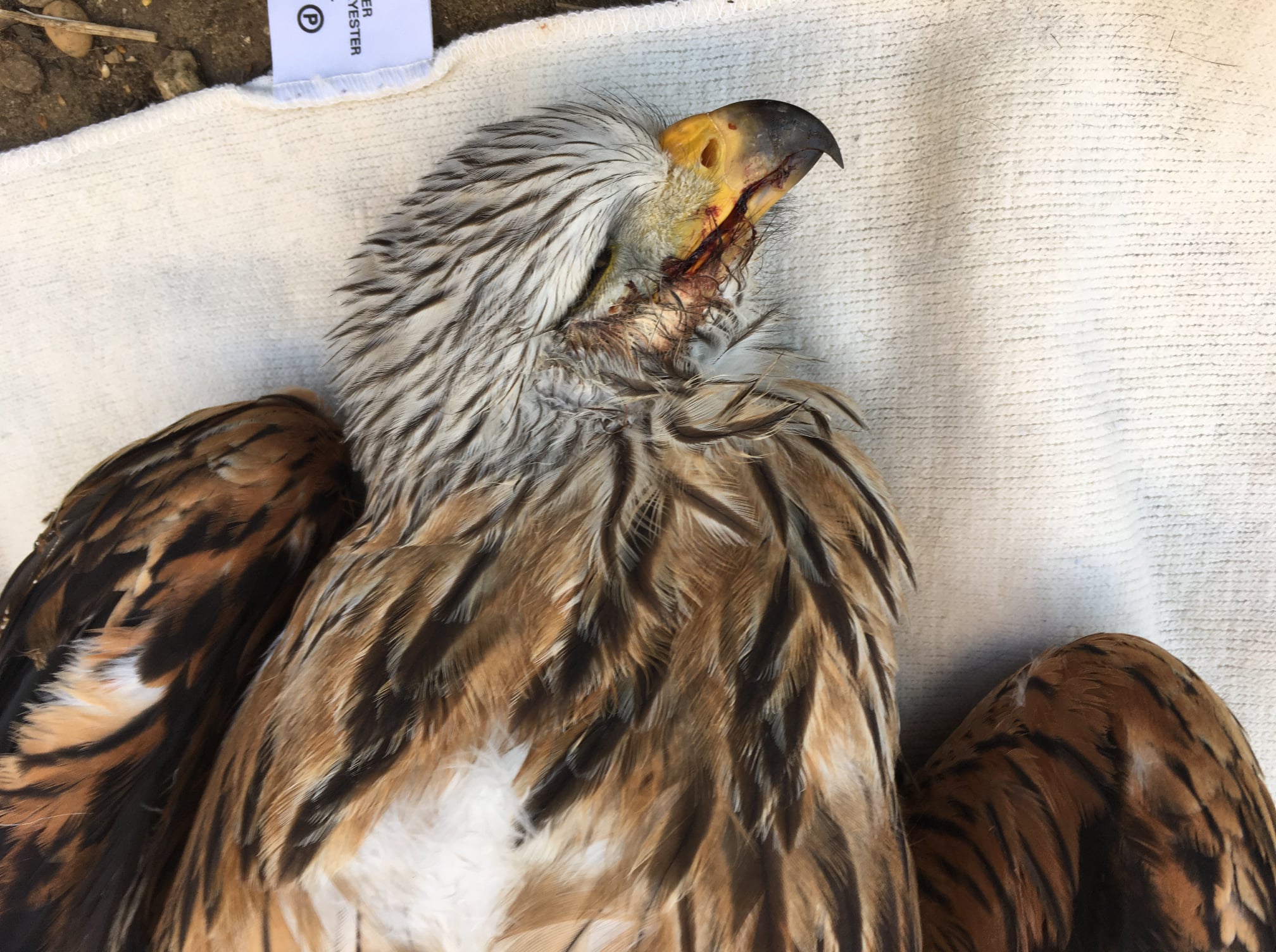
[Illegally poisoned sea eagle. Photo by Police Scotland]

It’s incredibly rare to secure a conviction for poisoning birds of prey in the UK, mainly due to the difficulty of securing sufficient evidence to link the crime to the actual individual who laid the bait. For example if the poisoned bait had been laid out on a large game shooting estate there could be numerous suspects (e.g. gamekeepers), who will all give ‘no comment’ interviews to the police, thus making it virtually impossible for the police to determine which one of them should be charged.

And even in a case where three golden eagles were found illegally poisoned on the same grouse moor, and an enormous stash of banned Carbofuran poison was found in the gamekeeper’s locked shed, reportedly to which only he had the key, he still wasn’t charged with killing those eagles, only for possession of the banned poison (see here).

There have been a few successful prosecutions for raptor poisoning over the years, but the subsequent penalties have been so utterly feeble they simply haven’t acted as a suitable deterrent for others (e.g. see here, here and here).

Meanwhile, over in Spain where tackling the illegal killing of birds of prey is taken seriously with, for example, the deployment of specialist poison detection dogs, resulting in massive fines, custodial sentences and extended hunting disqualifications for those convicted of laying poisoned baits (e.g. see here, here, here, here), another poisoner has just been sentenced this week.

According to these articles (here and here), an unnamed farmer has just been convicted of poisoning two red kites in Cabeza de Buey (Badajoz) in 2018 and has been ordered to pay a 20,000 EURO fine (the estimated value of the two red kites). He also received a two-year hunting disqualification.

Compare that response with what we’ve seen in Scotland this last week – an illegally poisoned white-tailed eagle, killed with a banned pesticide, found dead inside a National Park in an area where at least seven eagles have now been either illegally killed or have disappeared in suspicious circumstances.

There was a wholly inadequate response from a junior Environment Minister (here) followed by total silence from the Environment Cabinet Secretary and the First Minister, despite unprecedented public uproar urging action (see here and here).

Interesting, isn’t it?

Dog poisoning confirmed in Nidderdale raptor persecution hotspot

In April during lockdown, two pet dogs became ill during a walk in Pateley Bridge in Nidderdale. One of them (Molly) subsequently died and the vet suspected poisoning.

[Molly (left) and Poppy, photo via North Yorkshire Police]

Samples were submitted for toxicology, although analysis was delayed due to Covid19. Meanwhile, North Yorkshire Police issued a warning notice (here) for local residents to take extra care, especially as illegal poisoned baits had been used in the area many times before, killing birds of prey, especially red kites (here).

Just a couple of weeks ago North Yorkshire Police, along with poisons experts from Natural England and persecution experts from RSPB, conducted high profile raids at several Nidderdale addresses as they continue to investigate ongoing poisoning crimes (see here).

The toxicology results confirmed that Molly had died after ingesting what has widely become known as the ‘Nidderdale Cocktail’ – a lethal combination of four pesticides (Bendiocarb, Chloralose, Isophenphos and Carbofuran) that has been identified in a number of raptor persecution poisoning crimes.

It’s interesting to note that this particular ‘cocktail’ isn’t restricted to use in Nidderdale; it has also been used on several estates elsewhere in England and Scotland. Wouldn’t it be fascinating to see whether there was a common link between these various estates, you know, something like a shared agent or perhaps a gamekeeper who’s worked on all the estates?

On Wednesday, North Yorkshire Police issued the following press release seeking more information about the poisoning of Molly:

Police appeal for information after dog dies from suspected pesticide abuse

Properties searched as investigation into poisoning continues

North Yorkshire Police is appealing for information as part of an ongoing investigation into the poisoning of two pet dogs, believed to be as a result of pesticide abuse.

On 23 April 2020, two spaniel dogs fell seriously ill immediately after a walk, with their owner, in the countryside near Pateley Bridge. The dogs were rushed to the vets and whilst one of the two recovered, the second was so severely ill that she did not survive.

The incident was reported to the police and local area searches conducted, as a well as a warning put out to other dog owners. Samples taken from the dog which died were submitted to the Wildlife Incident Investigation Scheme (WIIS) administered by Natural England and the results showed the presence of four pesticides. The dog had a significant quantity of Bendiocarb in its system, along with smaller quantities of Chloralose, Isofenphos and Carbofuran. The tests concluded that exposure to these pesticides most likely caused this dog’s death and the severe symptoms suffered by the second dog.

The same combination of four poisons have been found to cause the deaths of two red kites and a buzzard in Nidderdale since 2016, with other cases of poisoned birds of prey in the area also involving one or more of the chemicals involved.

North Yorkshire Police Inspector, Matt Hagen, explains:

The fact we have seen this same combination of chemicals, the ‘Nidderdale cocktail’ as it is sometimes known, also cause the death of birds of prey in this same location would indicate that the poisons have been deliberately left in a place where they could be found by wildlife and unfortunately in this case, domestic pets.

Pesticide abuse of any kind will not be tolerated and we are doing everything we can to try and find those responsible.”

Following receipt of the test results and acting on local intelligence North Yorkshire Police conducted searches at a number of properties in the area with assistance from Natural England and the RSPB.  Unfortunately none of these searches resulted in any further evidence as to how these poisons reached the two dogs or who may have been responsible for this suspected pesticide abuse so officers are now appealing for information from the public.

Mark Thomas, Head of Investigations at the RSPB, said:

Nidderdale is surrounded by grouse moors and sadly we know from experience, and from the government’s own data, that there is a strong correlation between raptor persecution and driven grouse shooting. Carbofuran is one of the most commonly-abused substances in the poisoning of birds of prey. It is a highly toxic, banned substance, putting wildlife, pets and people at risk. This is not the first time harmful substances have been found left out in the open and sadly it unlikely to be the last. This reckless and irresponsible behaviour, which had led to the death of a beloved family pet, cannot be allowed to continue.”

Whilst Chloralose is licenced for use in England in a low concentration as a rodenticide, Bendiocarb, Isofenphos and Carbofuran are all banned from use in the UK. None of these chemicals should ever be used in an environment where domestic animals and/or wildlife should come into contact with them.

Anyone misusing or abusing pesticides may be committing a variety of offences. If you come across an object, often an animal carcass, which you believe may be contaminated with a pesticide or other poisons, do not touch it. Take as many photos and details as you can and report this to the police as soon as possible.

Dog owners worried by this incident should take care to keep their dogs on a lead or within sight and under control at all times when taking them for a walk. Dogs should only be walked on public rights of way or other land where the owner has permission to be.

Anyone with any information which could help the police in this investigation should call 101, quoting reference: 12200068444 or if you wish to remain anonymous call Crimestoppers on 0800 555 111.

ENDS

The RSPB also published a blog about this case, which includes comments from Molly’s owners (see here).

There’s also good coverage in the Yorkshire Post (here).

North Yorkshire police warn public of potential poisonous baits at Pateley Bridge

North Yorkshire Police are warning the public of potential poisonous baits at Pateley Bridge in Nidderdale following the suspected poisoning of two dogs in April. [August 2020: See update at foot of blog]

The following message was emailed to members of the local community last week:

This suspected poisoning incident was referred to by the Police in a recent Yorkshire Post article about raptor persecution in the area:

Nidderdale residents will be used to receiving these warnings; there have been several in recent years (e.g. see here, here, here, here, here, here, here) as illegal poisonous baits have been used routinely to kill off red kites inside this AONB and the surrounding area (e.g. see here).

Dog walkers are urged to keep their pets under close control and report anything suspicious to the police. DO NOT HANDLE A SUSPECTED POISONOUS BAIT – some of the chemicals used as poison are so dangerously toxic they have been banned from use in the UK.

UPDATE 1 August 2020: Dog poisoning confirmed in Nidderdale raptor persecution hotspot (here)