two more buzzards poisoned in Scotland

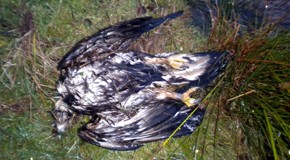
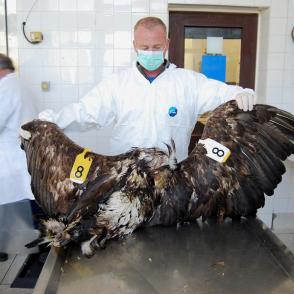
Two dead buzzards found next to a poisoned rabbit bait were poisoned by carbofuran. The buzzards and the bait were discovered in a farm field near Boat of Garten on October 15 this year, by staff from the Strathspey Estate. They called the police and the birds were sent off for toxicology tests. A spokesman from Strathspey Estate said they were shocked by the poisoning. He added, “Considering the efforts made to enhance the wildlife conservation and biodiversity on the estate, it is inconceivable that any of our staff had any part whatsoever in the laying of poisoned bait“.

Northern Constabulary and Strathspey Estate are “working closely” to find those responsible. I’m not sure how delaying the news of these deaths for 7 weeks will have helped the investigation but still, at least Northern Constabulary appear to be involved this time. Shame we can’t report the same for the two poisoned eagles found dead on Northern Constabulary’s patch back in June. Six months have now elapsed and still no news…

BBC news for the buzzard poisoning: http://www.bbc.co.uk/news/uk-scotland-highlands-islands-11958330

Strathspey Estate is owned by the Earl of Seafield, who also owns the Seafield Estate. A buzzard was found poisoned by chloralose on Seafield Estate back in 1991, but no further public records of alleged raptor persecution have appeared since then. Strathspey Estate is actively involved in projects on capercaillie and Scottish wildcat, and is also helping with the satellite-tracking of two golden eagles born on the Estate in summer 2010. The Earl of Seafield signed the SRBPA/SEBG letter to Roseanna Cunningham in May 2010, on behalf of the Seafield & Strathspey Estates, condemning the illegal poisoning of raptors in Scotland. Sandy Lewis, the Chief Executive of Seafield Estate was previously the Chair of the SEBG (Scottish Estates Business Groups), and is, according to the SEBG website, currently their regional rep for North and West Scotland. He was involved in a fascinating legal case earlier this year, involving a grouse-shooting lease in Strathspey. The case also involved land agents Mark Osborne and Nick Baikie, familiar names to readers of this blog. Here are two links to that story:

http://findarticles.com/p/news-articles/mail-on-sunday-london-england-the/mi_8003/is_2010_August_8/pocket-sportsman-grouse-court-told/ai_n54730059/

http://www.scotcourts.gov.uk/opinions/2010CSOH62.html

Scottish golden eagle poisoned in Ireland

A young golden eagle, just a few months old, has been poisoned and killed by the illegal pesticide Carbofuran in Ireland. The young bird was born in the Outer Hebrides earlier this summer, and was donated to the Irish golden eagle reintroduction project, where it was released in August 2010. It was found dead on 1st November 2010, aged 5 months old. Tests revealed it was killed by Carbofuran. Police are investigating.

This brings the total known eagle deaths resulting from illegal poisoning in the British Isles this year to TEN (4 golden eagles & 1 sea eagle in Scotland, and 3 sea eagles & 2 golden eagle in Ireland). Take note, John Scott MSP – is this what you call imaginary?

WHEN IS THIS GOING TO STOP?

Full news story here: http://www.bbc.co.uk/news/uk-northern-ireland-11937623

SGA announces new vice-chairman

The Scottish Gamekeepers’ Association has announced the appointment of a new Vice-Chairman – Peter Fraser. According to the SGA website, Peter has been employed as a stalker on the Invercauld Estate, Aberdeenshire, for 41 years and “is highly regarded throughout the industry for his knowledge and experience of the hill environment and the countryside“. He’s probably also well aware of the continuing problem of illegal raptor persecution, especially as Invercauld Estate has been reported to be at the centre of several allegations over the years. Although as only one of these allegations ever resulted in a conviction, it could be argued that the others were all scurrilously and falsely levelled at Invercauld Estate employees. We all know that Invercauld Estate is against the illegal poisoning of raptors, because they signed the SRPBA letter to say so.

Peter has made a good start to his new role as Vice-Chair, as he apparently has argued ‘that in order to move forward the industry has to abide by the rules set by government’. Great insight. All that thinking time while stalking animals across the Scottish hills for 41 years has obviously been well used.

Peter is no stranger to voicing his opinions in the media either. In a televised interview with STV, he speaks fondly of golden eagles, saying: “A beautiful bird, part of our natural heritage and must always remain so“. Unfortunately, it appears he doesn’t feel the same way about goshawks, as he calls them “ruthless killers” and says they “kill for fun“. Perhaps Peter doesn’t view goshawks as part of our natural heritage, or understand that as a predator, they kill to survive, because, er, that’s what predators do?

Never mind. Peter and his colleague, SGA Chairman Alex Hogg, will make an entertaining formidable debating team in the Scottish political arena and we look forward to hearing about their efforts to stop the continued illegal killing of raptors by people within the shooting industry.

Here is the SGA announcement of Peter’s appointment: http://www.scottishgamekeepers.co.uk/content/new-sga-vice-chairman-elected

Here is Peter’s interview on STV: http://video.stv.tv/bc/scotland-outdoors-20080530-gamekeeping-in-the-highlands/

Law to stop raptor poisoning likely to be strengthened

As many of you will know, for the past few months the Rural Affairs & Environment Committee of the Scottish Parliament has been hearing evidence on the proposed WaNE bill (Wildlife and Natural Environment (Scotland) Bill. Certain measures included in this Bill will, if accepted, help to address the on-going issue of illegal raptor persecution across Scotland.

The RAE Committee has today published its Stage 1 Report of this Bill, and they should be congratulated for their interest in, and support of, many of the suggestions made by several wildlife conservation groups to tackle raptor persecution crimes.

In a press release, Committee Convenor Maureen Watt MSP said, “We utterly condemn wildlife crime and the poisoning of iconic birds of prey such as the golden eagle and the hen harrier. The law clearly needs to be strengthened and introducing vicarious liability appears to most of us to be a step in the right direction.”

Stage 2 of the WaNE Bill is expected to take place in December.

Here is a summary of the relevant parts of the report that deal with raptor persecution:

The Committee condemns as wholly unacceptable the illegal killing of raptors which continues across Scotland. The Committee recommends that the Scottish Government instructs police forces to investigate rigorously suspected cases of raptor persecution. The Committee also recommends that the Scottish Government likewise instructs the Crown Office and Procurator Fiscals office to prosecute wildlife crime vigorously.
The Committee concludes, from all evidence taken on this issue, that detection, investigation and prosecution of this crime is not resulting in a significant reduction in cases of raptor persecution, and that this should be addressed.

The Committee welcomes the Scottish Government’s intention to bring forward an amendment at Stage 2 to introduce a vicarious liability offence in the Bill, which it considers to be a helpful step in the right direction. The Committee awaits further detail on this, which was not available before the conclusion of evidence-taking at Stage 1. The Committee recognises there could be significant challenges in securing convictions under such new provisions, but believes the strengthening of the law in this regard is a helpful addition to the range of provisions available for potential prosecution.

The Committee notes that the majority of private landowners are appalled by raptor persecution. The Committee considers that such landowners should have nothing to fear from a vicarious liability provision.

The Committee welcomes the principle of the estates initiative, a voluntary good governance scheme for private land managers currently being prepared by the SRPBA, and agrees with the Minister that the scheme should be supported and given an appropriate amount of time to become established. However, the Committee also notes that the scheme will be voluntary and will therefore lack the power to compel estates that do not wish to take part. The Committee would welcome clarification from the Minister on how she plans to support the initiative.

The Committee accepts that it would represent a challenge and a significant development of policy to introduce a fully worked up system for licensing sporting estates in the Bill at this stage. The Committee also notes that the issue would not have been subject to consultation and as a result introducing such a system would be inappropriate at this time. However, the Scottish Government may wish to consider the appropriateness of introducing an enabling power in to the Bill which would permit them to introduce a licensing scheme, only after full consultation with stakeholders and parliamentary scrutiny under the super-affirmative procedure. Should it take the power, the Scottish Government could consider formally adopting the estates initiative with appropriate modifications as a code of conduct applicable to all estates. However, any such power should only be used if the Scottish Ministers are not satisfied that the voluntary approach to good governance and any vicarious liability offence are working.

The Committee notes Sheriff Drummond’s proposal to establish a presumption of guilty intent for anyone found in possession of a regulated substance. The Committee also notes his comments on whether an employer could be proven to have knowingly caused or permitted the possession of such a substance. The Committee considers that Sheriff Drummond’s proposals, and the introduction of a vicarious liability offence, are not mutually exclusive, and invites the Scottish Government to consider the proposal.

The Committee also notes the view that there is a further gap in the armoury of potential offences, that which seeks to catch those “concerned in” the use of illegal poisons for the purpose of raptor persecution or in other activity “concerned in” the offence of bird persecution. The Committee urges the Scottish Government to consider developing further offences which cover these points to further strengthen the grounds for potential prosecution.

The Committee invites the Scottish Government to consider the merits of announcing an amnesty on illegal substances such as carbofuran.

The Committee recommends that the Scottish Government reports to Parliament annually on the number of illegal raptor killings, detailing the number of cases brought and those which were successfully prosecuted.

The full report can be read here: http://www.scottish.parliament.uk/s3/committees/rae/reports-10/rur10-08-00.htm

police investigate suspicious red kite deaths in Northumberland

Police are investigating the deaths of five red kites in the North-East of England. The deaths in the Northumberland area span a period of seven months and appear to be the results of poisoning.

Full story here: http://www.thenorthernecho.co.uk/news/8683086.Red_kite_deaths_could_be_due_to_poisoning/

gamekeeper convicted for poisoning offences on Leadhills Estate

A 20 yr old gamekeeper formerly employed on the Leadhills Estate in Lanarkshire was today convicted for laying poisoned baits, contrary to the Wildlife & Countryside Act. In April 2009, underkeeper Lewis H. Whitham was observed by a research officer from the charity OneKind (formerly called Advocates for Animals) staking out a dead rabbit, whose stomach had been split open and sprinkled with the deadly pesticide Carbofuran.

Whitham pleaded guilty at Lanark Sheriff Court and he was fined £800. This had been reduced from £1000 because of his guilty plea. The maximum penalty that can be imposed for this wildlife offence is a fine of up to £5000 and/or six months imprisonment. It is understood that Whitham is no longer employed at Leadhills and has since moved to North Yorkshire.

The Leadhills Estate has a shocking record of alleged wildlife crime incidents in recent years. See blog posts on 4 March, 6 March, 11 March and 14 March for a taster. In addition, OneKind claims that over a period of several months, numerous apparently illegal snares have been discovered on Leadhills, 3 badgers were caught in snares and 2 of these had to be put down due to their injuries, and also dead buzzards have been found in shallow graves.

If this most recent conviction isn’t justification for Roseanna Cunningham’s proposed vicarious liability ammendment to the WANE bill to be accepted, then I don’t know what is. Persistent wildlife crime exposed, yet again, on a so-called sporting estate. It’s disgusting.

Congratulations to OneKind for their dedicated research, and to the SSPCA who took the lead in securing this conviction.

For more details on the Leadhills conviction, see OneKind link here: http://www.onekind.org/onekind/blog_article/leadhills_conviction_strengthens_case_for_liability

Case details from PAW Scotland: http://www.scotland.gov.uk/Topics/Environment/Wildlife-Habitats/paw-scotland/Resources/Newsletters/Issue2/Inthecourts/LewisWhitham2010

SSPCA press release here: http://www.scottishspca.org/news/511_man-convicted-for-poisonings

Crown Office and National Wildlife Crime Unit press releases here: http://www.scotland.gov.uk/Topics/Environment/Wildlife-Habitats/paw-scotland/news/Gamekeeperfined171110

We wait with bated breath (not baited rabbit) for the SGA and SRPBA press releases.

Eagle killers getting away with it? Part 3

In our blog post on 13 October, we revealed that one golden eagle and one white-tailed eagle were found dead in the Highland region in June 2010. Laboratory testing by the government agency SASA (Science and Advice for Scottish Agriculture) revealed that both eagles had been poisoned by the illegal pesticide Carbofuran. We also noted that, four months after the dead eagles were discovered, there hadn’t been any news reports of this incident even though the SASA report stated that “The incident is part of an ongoing police investigation”. So either the police (in this case, Northern Constabulary) have decided that they don’t need to make a public appeal for information because they already know who dunnit (although now five months on, no public statements about arrests or charges have been made), or, Northern Constabulary are failing in their statutory duty to investigate wildlife crime.

On 18 October, The Guardian published an article about hen harrier persecution (see blog post 18 October). Within that article were a few lines about the poisoned golden eagle (no mention was made about the sea eagle), said to have been found on a grouse moor near Inverness in the Eastern Highlands, an area notorious as one of the worst areas for golden eagle persecution in the country.

In a press release on 3 November (see blog post 3 November), the Scottish government acknowledged the two eagle deaths and included them in their official roll-call of the 16 poisoned raptors found dead in Scotland during the first half of 2010. Of these 16 poisoned raptors, five were eagles (4 golden eagles and 1 sea eagle), making 2010 the worst year in two decades for eagle poisoning – and these figures only relate to the first six months of 2010.

Also on 3 November, Scottish Environment Minister Roseanna Cunningham, was giving evidence to the Rural Affairs and Environment Committee as they continue to deliberate over Stage 1 of the WaNE bill. Video footage from this meeting is available on Holyrood TV at: http://www.holyrood.tv/library.asp?iPid=3&section=102&title=Rural+Affairs+and+Environment+Committee

During this meeting (20.17 minutes into the video), Ms Cunningham is asked by MSP Peter Peacock (Highlands & Islands, Labour) to give her opinion on whether sufficient is being done by the police in general to investigate wildlife crime. Her response, including, “It’s a challenge……..I won’t pretend that I think the situation is perfect, it is not” is quite refreshing, given the usual sound bites that are trotted out by the various government officials that are charged with addressing the continual and widespread problem of illegal raptor persecution.

Maybe the Minister will make a quick call to Northern Constabulary’s Wildlife Crime Co-ordinator, Chief Inspector Paul Eddington, to see how he’s getting on with investigating the deaths of these two poisoned eagles?

roseanna cunningham – we salute you!

Scottish Environment Minister, Roseanna Cunningham, has today made clear her intention to address the on-going problem of illegal raptor persecution.

Speaking to the Rural Affairs and Environment Committee as they continue to discuss Stage 1 of the Wildlife and Natural Environment Bill (WaNE), she said she intends to bring in an ammendment to Stage 2 of the discussion that would create a new ‘vicarious liability’ offence that would target those who control or manage others who are involved in criminal raptor persecution.

She said:

Increased awareness and condemnation appears to be doing little to bring down the number of illegal bird poisonings in Scotland. Official figures show that 16 birds of prey were poisoned in the first six months of this year and I find this extremely disappointing.

We have robust legislation in place to tackle this sort of crime but tougher action has to be taken to deter those who think that they can get away with persecuting our wildlife.

I don’t want to unfairly target any particular group and I will be engaging with stakeholders over the coming weeks to make sure that they know what we are trying to achieve with this amendment.

We have a duty to protect our birds of prey as they are an integral part of our national identity. They also help our economy by attracting tourists from across the world and we cannot afford to have our international reputation tarnished by the few who continue to target them illegally.”

Roseanna Cunningham deserves recognition for making this move. Many conservation groups have lobbied for the introduction of vicarious liability for several years, but many of the gamekeeping and landowning groups have vehemently opposed it (hmm, I wonder why?), and especially Sheriff Drummond, who was quite entertaining when he recently presented his views against introducing it at the WaNE bill committee meeting in Holyrood.

It’s still not a certainty that the ammendment will be accepted, but at least it’s on the table.

Well done, Roseanna Cunningham.

Government press release here: http://www.scotland.gov.uk/News/Releases/2010/11/03110045

However, before we all get carried away…there are disturbing reports circulating about the failure to investigate the two poisoned eagles (one golden eagle and one sea eagle) that were found on an estate near Inverness in June (see blog report Oct 13). More on these reports shortly…

Irish government finally bans poisons used to kill raptors

This 3 yr old sea eagle was poisoned in Ireland earlier this year

New regulations came into force in the Irish Republic yesterday, finally banning the use of all poisons for pest control, apart from those used for rats and mice.

This has been a long time coming, and full credit should be given to The Golden Eagle Trust, who have long campaigned for this ban as they try to re-introduce the golden eagle, white-tailed eagle and red kite to their former ranges across the country.

Whilst the ban will not stop poisoning incidents (look at the continued number of poisoning incidents in Scotland and England where the ban has been in force for several years), it does send a clear message from the Irish government that they wish to address the issue of illegal raptor persecution. Kudos to them for taking this important step.

At least 12 re-introduced raptors have been killed by poison in Ireland this year alone, including golden eagles, sea eagles and red kites. Both the Scottish and Norwegian governments, who licence the capture of eagles in their countries for release in Ireland, have expressed grave concern at the poisonings, and failure to tackle the problem could result in the governments withdrawing their co-operation. This is quite a laughable position for the Scottish government to take, given their complete inability to effectively address raptor persecution in this country. So far, at least. They do have a chance to make significant improvements with the forthcoming WaNE bill, but the bill is still only in Stage 1 of the legislation process so there’s a long way to go yet.

A side-benefit of the new Irish legislation may be in reducing the amount of illegal poison that arrives in Scotland each year, believed to be smuggled in from Ireland where, prior to the new legislation, poison could be bought legally. Clearly it will take some time for all the poison currently in circulation in Ireland to be disposed of, but the long-term view is optimistic.

For the news story click here: http://www.independent.ie/national-news/ban-for-poison-used-to-kill-birds-of-prey-2383731.html

The Golden Eagle Trust website here: http://www.goldeneagle.ie/

eagle killers getting away with it: two more dead eagles in Scotland

The sharp-eyed amongst you will have noticed that within the latest SASA poisoning report (see below) there is a case listed that refers to a white-tailed sea eagle and a golden eagle.

Scroll down to the bottom of page 8 of the report. Incident Ref # 10123. Dated June 2010. In the Highland region, Carbofuran is reported as the cause of death for one sea eagle and one golden eagle. The incident is reported as an ongoing police investigation. Click here for details: SASA poisoning positive results 2010

Hmm, interesting. Were the deaths of these two eagles in June 2010 reported in the press? I didn’t see anything. Why wasn’t it reported? If asked, the authorities will probably say that they wanted to collect evidence without first alerting the eagle killers that the dead eagles had been discovered. That’s fair enough. But what about now, several months on? Why should these types of incident go unreported in the press? What’s so different about wildlife crime to any other type of crime that DOES get reported?  It wouldn’t be so bad if the figures for the successful prosecution of wildlife crime offenders were good. But have we seen any successful prosecutions for eagle persecution in Scotland in recent years (infact, ever)? No, we haven’t.

So, do we have yet another incident of eagle poisoning in Scotland this year, and if so, where was it and what is being done to bring the killers to justice? What’s being hidden here?

If we want to give the eagle killers a reason to continue what they’re doing, we are handing them the perfect opportunity on a plate. By having news black outs, they know they can carry on poisoning to their heart’s content because no-one will be drawing it to the public’s attention. Genius.