RSPB reports six of its satellite-tagged Hen Harriers ‘disappeared’ on or close to grouse moors in England in 2025 & another was illegally poisoned

The RSPB has today issued a press release documenting the suspicious disappearance of six of its satellite-tagged Hen Harriers in 2025, as well as one that had been illegally poisoned. All seven incidents were either on, or close to, grouse moors in England.

These seven birds are in addition to the Hen Harriers that had been satellite-tagged by Natural England and had ‘disappeared’ or were illegally killed in 2025. I’ll publish the updated combined tally list later today.
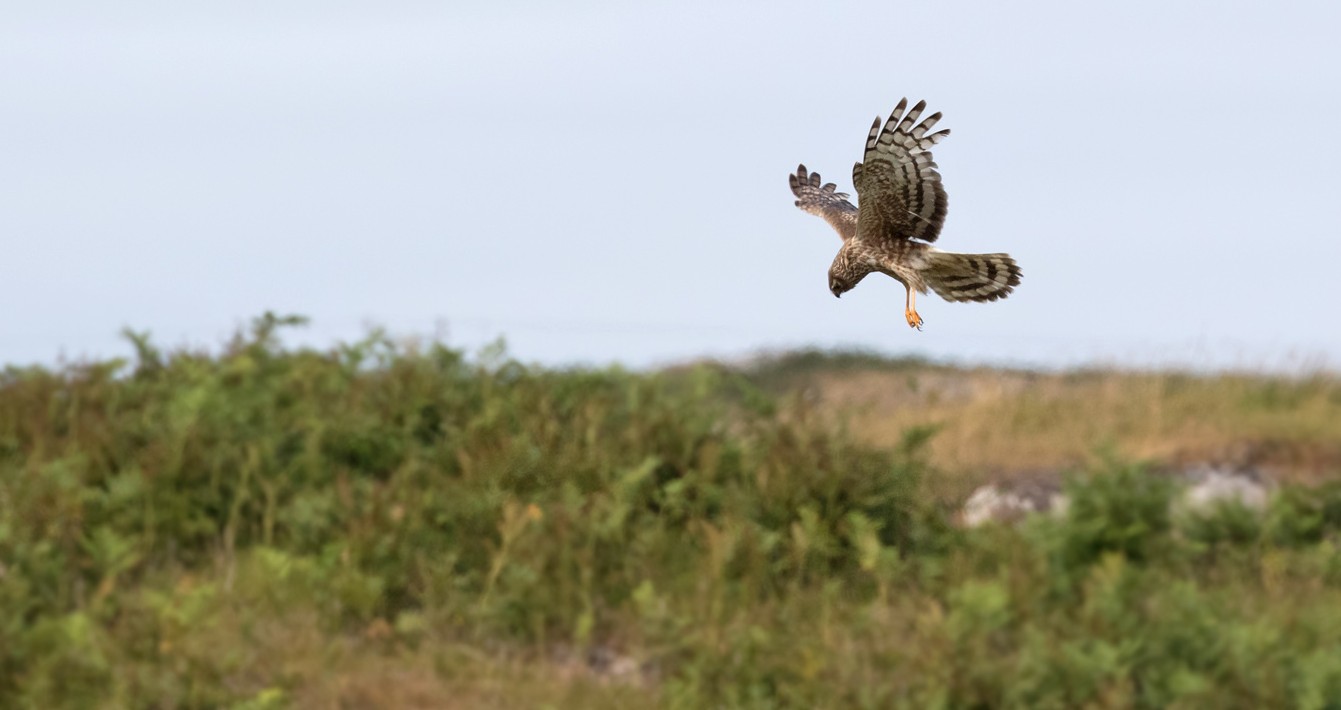
Hen Harrier (photo by Pete Walkden)

Here is the RSPB’s press release:

SIX MORE RARE HEN HARRIERS VANISH ON OR NEAR GROUSE MOORS WITH ANOTHER CONFIRMED POISONED

  • Seven RSPB satellite tagged Hen Harriers are suspected or confirmed to have been illegally killed in England on or near land managed for grouse shooting in 2025 – with three in just thirteen days.
  • Hen Harriers are a protected, Red-listed species of high conservation concern with illegal killing widely recognised as the main cause for their vulnerable status.
  • To prevent and deter these crimes and ensure the recovery of Hen Harriers in England the RSPB is urgently calling for the introduction of licensing of all gamebird shooting across the UK.

In 2025, it is suspected that a total of seven RSPB satellite-tagged Hen Harriers were illegally killed on or near grouse moors in northern England, with one Hen Harrier confirmed poisoned and six more disappearing in suspicious circumstances – all sending their final transmission on or near land managed for grouse shooting.

All incidents were quickly reported to the police and National Wildlife Crime Unit’s Hen Harrier Taskforce. Obtaining evidence of Hen Harrier killing and bringing prosecutions is extremely difficult but Police investigations continue.

To monitor Hen Harrier movements and survival, RSPB and Natural England have been tagging Hen Harrier chicks for over 15 years. These highly reliable satellite tags normally continue to transmit even when a bird dies. However, as multiple incidents have shown, many tags have suddenly and suspiciously stopped transmitting on or near grouse moors without sign of malfunction.

Evidence – including peer reviewed data, intelligence reports and forensic analysis – indicate that it is highly likely that in these circumstances the Hen Harrier’s tag has been intentionally damaged or destroyed after the bird has been illegally killed. Despite strong indication that a crime has been committed, in the absence of substantive evidence the perpetrator cannot be brought to justice.

In England, in the last 10 years (2016-2025), 72 satellite tagged Hen Harriers – monitored by the RSPB and Natural England – have suddenly and suspiciously disappeared. With 85% of these vanishing on or near land managed for grouse shooting. These incidents indicate a much wider scale of killing as only a fraction of the total Hen Harrier population is fitted with tags.

All six of the satellite tagged Hen Harriers that suddenly disappeared in 2025 sent their final transmission from hotspots – these being areas with previous bird of prey incidents in northern England, all dominated by grouse moors. Intelligence suggests that these crimes are committed in an attempt to maximise the number of grouse available to be commercially shot for profit during the grouse shooting season.

Tragically, three of the six sat-tagged Hen Harriers which disappeared in 2025 all sent their final transmissions in September – just weeks after fledging the nests and within thirteen days of each other. Recent scientific research has shown that human persecution – the main cause for Hen Harriers vulnerable status – has reduced the lifespan of this rare species, with young birds surviving on average for only four months after leaving the nest.

In addition to the six, one Hen Harrier named Ataksak, was confirmed poisoned after its body was recovered close to a grouse moor in North Yorkshire in early January 2025. Toxicological testing revealed that it had died after being exposed to a lethal pesticide mixture, known as the ‘Nidderdale Cocktail’. Since 2011 this poison has been connected to the deaths of 15 birds of prey and one dog, all in North Yorkshire.

Mark Thomas, RSPB UK Head of Investigations said: “Although the suspected persecution of six of our satellite tagged Hen Harriers in one year is extremely concerning, these birds are sadly just the latest in a long trend. Since 2010 over one hundred satellite tagged Hen Harriers are suspected to have been illegally killed in the UK, with the majority disappearing on or near land managed for grouse shooting. As satellite tagged Hen Harriers represent a small proportion of the UK’s total Hen Harrier population the true number of Hen Harriers that are being illegally killed across the uplands of the UK is likely to be significantly greater. What we’re seeing is just the tip of the iceberg“.

The RSPB has been continuously calling for the introduction of a robust licensing system for all gamebird shooting in the UK. Introduced in Scotland for grouse shooting in 2024, this proportionate, low-cost measure would only penalise those shooting estates where crimes are being committed and help ensure that this rare and vulnerable species receives the protection it so urgently needs.

James Robinson, RSPB Chief Operating Officer said: “These latest incidents paint a desperate picture for Hen Harrier recovery in England. To prevent this pattern of killing, and give this vulnerable species a realistic hope of recovery, we urgently need licensing of all gamebird shooting to be introduced in England.

“Under this proportionate legislation if a crime is suspected to have taken place, based on a civil burden of proof, the shooting estate can have their licence to shoot revoked – creating a meaningful deterrent against this type of wildlife crime. Scotland took this welcome step in 2024 when it introduced licensing for grouse shooting. We need to follow their lead and give Hen Harriers in England the safety they desperately need“.

Members of the public are urged to report any suspected incidents of bird of prey persecution by contacting the police on 101 and by submitting a report to the RSPB. This can be done via the RSPB’s online reporting form at www.rspb.org.uk/report-crimes or by calling the RSPB’s confidential Raptor Crime Hotline on 0300 999 0101. Reports via the RSPB’s reporting form and Raptor Crime Hotline can be made anonymously.

ENDS

The RSPB also provided the following additional detail as footnotes to the press release:

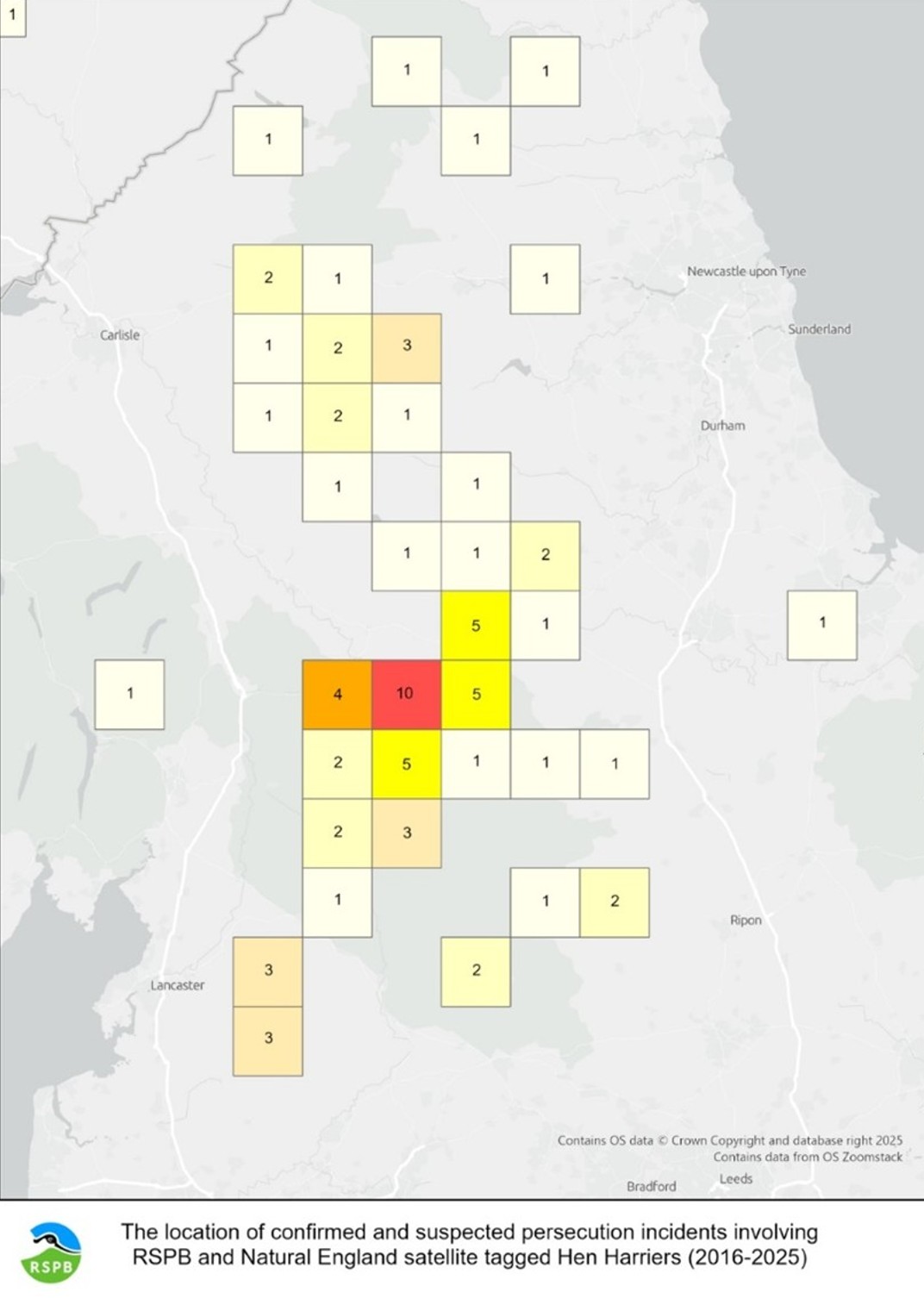
Of the 85 confirmed and suspected satellite tagged Hen Harrier persecution incidents recorded in England in the last ten years (2016-2025), 79 (93%) occurred in the area of Northern England shown in the map below.

In total, these include 35 RSPB satellite-tagged Hen Harriers and 44 Natural England satellite-tagged Hen Harriers. All were either confirmed to have been illegally killed or disappeared in suspicious circumstances.

The number in each square on the map is the total number of confirmed and suspected persecution incidents involving RSPB and Natural England satellite tagged Hen Harriers recorded in that area alone. 
The RSPB also provided details of the seven tagged Hen Harriers either missing or illegally poisoned in 2025. I blogged about a number of these individuals in 2025 although the RSPB’s new commentary provides additional context. For those individual Harriers previously reported on this blog, I’ve marked them with an asterisk and provided a link to the specific blog.

  1. *Ataksak was found poisoned close to a grouse moor in North Yorkshire – poisoned with the Nidderdale Cocktail (January 2025). The area where Ataksak’s body was found is recognised as a bird of prey persecution hotspot. In the last ten years 25 confirmed bird of prey persecution incidents have been recorded in this area, including Ataksak. These included four Hen Harriers, 13 Red Kites and five Buzzards. A satellite tagged Hen Harrier also disappeared in this area in 2024. [Previous RPUK blog on Ataksak, here].
  2. *Sita disappeared on 27 February 2025. Her tag sent its final transmission from a moor south of Reeth, in the northeastern area of the Yorkshire Dales National Park. [Previous RPUK blog on Sita, here].
  3. *Dynamo was a six-year-old RSPB satellite tagged Hen Harrier which suspiciously disappeared whilst provisioning a nest in the Forest of Bowland in Lancashire in May 2025. He was one of four breeding male Hen Harriers that disappeared in northern England over a period of eight days – two from RSPB Geltsdale Nature Reserve in Cumbria, and a further two from the Forest of Bowland in Lancashire.  All of these birds vanished whilst foraging for food away from their nest. [Previous RPUK blog on Dynamo, here].
  4. Wadrew was one of three chicks that successfully fledged from RSPB Geltsdale in the summer of 2025, raised with the assistance of RSPB staff and volunteers. When the male parent suddenly disappeared whilst foraging off the reserve (suspected to have been illegally killed) reserve staff and volunteers provided emergency supplementary food under licence. On 27 September 2025, just weeks after fledging, Wadrew disappeared whilst on a grouse moor near Birkdale, in the north-west of the Yorkshire Dales National Park. Based on incident data, this area – dominated by grouse moors – is the epicentre for Hen Harrier persecution in the UK. Since 2016, in this area four confirmed persecution incidents involving RSPB and Natural England satellite tagged Hen Harriers have taken place and 13 satellite tagged Hen Harriers have suspiciously disappeared (including Wadrew) – all suspected to have been persecuted (2016-2025).
  5. Morrigan suddenly disappeared on 30 September 2025 just three days after Wadrew’s final transmission and 17 km away, in the southern area of the North Pennines National Landscape – a notorious bird of prey persecution hotspot. In the same area in 2022, concerns were raised when irregular tag data was sent from a satellite tagged Hen Harrier named Asta. A search of the area led to the discovery of Asta’s satellite tag, found fitted to a dead Carrion Crow. The harness was intact. As a tag harness cannot be removed intact without inflicting significant harm to the bird it was clear that Asta had been illegally killed. In the last ten years 13 confirmed and suspected bird of prey persecution incidents have been recorded in this area including one confirmed incident (the sat-tagged Hen Harrier Asta) and the suspicious disappearance of 10 satellite tagged Hen Harriers, including Morrigan, between 2016 and 2025.
  6. Beatrix: Just 10 days before Wadrew and Morrigan disappeared, another young RSPB satellite tagged Hen Harrier, Beatrix, also vanished. Beatrix fledged from the Tarras Valley Nature Reserve in Scotland in the summer and dispersed south into the North Pennines, settling in an area dominated by grouse moor near Allendale. Her sat-tag sent its final transmission from this location on 17 September 2025. This area is another recognised persecution hotspot for Hen Harriers with four satellite tagged Hen Harriers confirmed to have been persecuted and six satellite tagged birds (including Beatrix) suspiciously disappearing in the area (2016-2025).
  7. *Red: In January 2025, eight months earlier, a one-year-old Scottish Hen Harrier that had also fledged from the Tarras Valley Nature Reserve, named Red, disappeared in another part of the North Pennines in County Durham. Another satellite tagged Hen Harrier, named Sia, disappeared in the same area in 2022. [Previous RPUK blog on Red, here].

The RSPB has provided a good amount of detail here, although I note that grid references have not been provided, which is disappointing.

However, the persecution hotspot map covering part of northern England is of particular interest to me. It’s striking that the RSPB has recorded ‘repeat’ incidents in certain areas, whereas Detective Inspector Mark Harrison from the National Wildlife Crime Unit (NWCU), who leads the National Hen Harrier Taskforce, is on record (several times) saying that since the Taskforce began its work in 2024, there hasn’t been a single ‘repeat’ incident in any of the Taskforce’s persecution hotspots.

This discrepancy demands more scrutiny and I’ll blog about it soon.

In the meantime, I’ll update the rolling list of missing/dead Hen Harriers since 2018…

UPDATE 21 January 2026: 147 Hen Harriers confirmed ‘missing’ or illegally killed in UK since 2018, most of them on or close to grouse moors (here).

The charity Hen Harrier Action launches Xmas fundraiser to buy satellite tags

The charity Hen Harrier Action has launched its annual Xmas fundraising appeal, this year with a target of £15K to purchase five satellite tags to be fitted to Hen Harrier chicks in 2026.

As you’ll know, over the last couple of decades, raptor satellite-tagging in the UK has shone a massive spotlight on the widespread scale of the illegal killing of a number of raptor species, especially Hen Harriers and Golden Eagles.

Scientists have been able to analyse the tag data and have demonstrated a clear and unequivocal link between illegal raptor persecution and grouse moor management (e.g. see here, here, here).

In Scotland this has led directly to a change in Government policy, with the recent introduction of a grouse moor licensing scheme, whereby licences for shooting Red Grouse can be suspended/revoked if evidence of raptor persecution (and some other wildlife crimes) is found on a grouse shooting estate.

It has also led to a change in tactics by some of those motivated to kill raptors, who are now apparently choosing to target un-tagged raptors because they want to avoid the media attention and scrutiny that follows the illegal killing or ‘disappearance’ of a tagged bird (e.g. see here).

But fitting a satellite tag doesn’t necessarily mean that that raptor won’t be targeted. There are plenty of examples of tagged birds still being targeted, either because those doing the killing are too stupid to understand what a tag’s data can reveal, or more likely, there are rarely any direct consequences for those who commit these crimes so there’s no incentive for them to stop.

To my mind, the main benefit of continuing to fit satellite tags to Hen Harriers, apart from the obvious research benefits of better understanding this species’ ecology and how it uses the landscape, is that it allows us to document the scale of the ongoing criminality (that would otherwise be hidden and thus would be easily deniable by the grouse shooting industry) and to use those data to put pressure on Governments to address the problem.

As in previous years, any tags purchased by Hen Harrier Action will be fitted by licensed experts from the RSPB who will also monitor and manage the data, and alert the police / Hen Harrier Taskforce if suspicious tag activity is detected.

It also means that Hen Harrier Action will publicise any suspicious disappearances / confirmed illegal killings, without compromising any police investigation, of course, but also without sitting on the data for months, sometimes years, as we’ve seen all too often with tags fitted by Natural England.

If you’re able to contribute to Hen Harrier Action’s Xmas fundraiser, please visit their fundraising site here.

Another Hen Harrier suspected illegally killed on a grouse moor, her satellite tag had been ‘removed’

Over the last few weeks I’ve blogged about a number of illegally-killed Hen Harriers whose deaths have been barely publicised by the authorities, but instead have been quietly entered onto a Government spreadsheet, months, and sometimes over a year later, with little effort to draw the public’s attention to this ongoing criminality.

Hen Harrier photo by Pete Walkden

There was Hen Harrier ‘Susie’ who was found dead with gunshot injuries on a grouse moor in the North Pennines, here; and Hen Harrier ‘254843’ who was found dead on moorland in the Northumberland National Park with shotgun damage to her satellite tag, here; and a Hen Harrier (ref # HSE 107/913) who was found poisoned on a grouse moor in North Yorkshire having ingested a lethal combination of toxic chemicals known as the ‘Nidderdale Cocktail’, so called due to the frequency it is used as a poisoned bait in the Nidderdale National Landscape, killing multiple birds of prey and even a pet dog, here.

Well, here’s another one.

This time its a young Hen Harrier named Margaret, who was fitted with a satellite tag (Tag ID 254844) by Natural England fieldworkers just prior to her fledging from a nest in Northumberland on 5 July 2024.

Natural England staff ‘lost contact’ with Margaret just three months later on 19 October 2024.

The first we knew about this was in Natural England’s intermittent spreadsheet update in December 2024 about the fate of the Hen Harriers that had been satellite-tagged using public funds. Margaret’s entry read as follows:

‘Lost contact 19 October 2024, Northumberland. Missing Fate Unknown, site confidential – ongoing investigation‘.

Whether that meant her tag had suddenly and inexplicably stopped transmitting, or whether the data showed an unusually long period of being static in one place, wasn’t clear.

We didn’t hear anything more until Natural England quietly updated its spreadsheet in October 2025. Margaret’s entry now reads:

‘Missing Fate Unknown. Suspected illegally killed. Tag found removed. Carcase not found. Grid ref NY878497‘.

So, a year after Natural England ‘lost contact’ with this Hen Harrier, we’re finally given a few more details.

This grid reference is in the North Pennines National Landscape (formerly called an AONB), a region that has long been identified as a Hen Harrier persecution hotspot (e.g. see the RSPB’s damning 2025 report, Hen Harriers in the Firing Line, here).

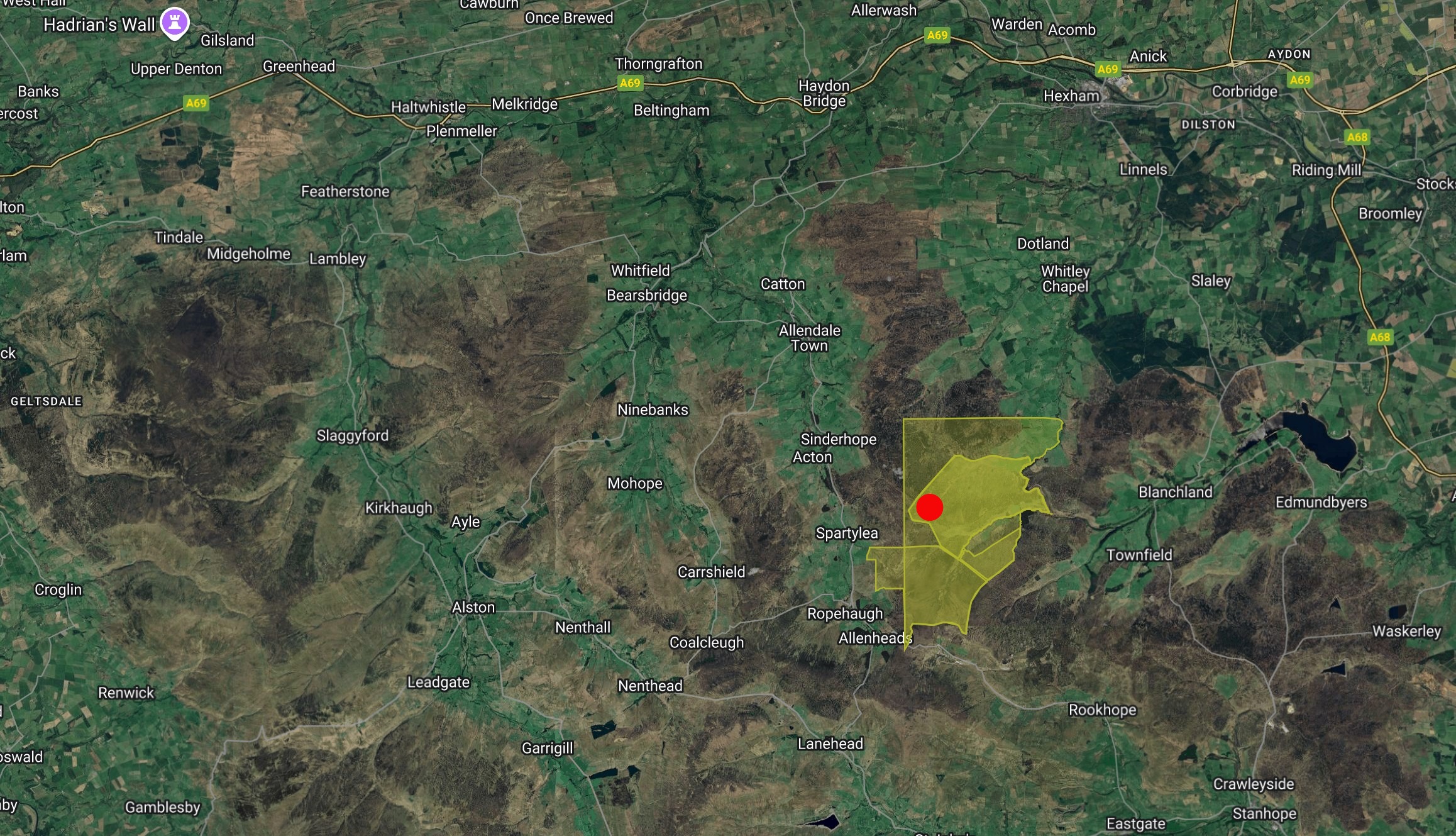
When you zoom in on this map, you’ll be unsurprised to see it is an area dominated by moorland intensively-managed for driven grouse shooting (as demonstrated by the obscene expanse of geometric strips).

According to Guy Shrubsole’s excellent website, Who Owns England?, this grid reference (approximately marked as a red dot on map below) sits on property described as part of the Allendale Settled Estates:

There’s no suggestion that anyone connected to the Allendale Estate is responsible for ‘removing’ Margaret’s satellite tag and/or killing this Hen Harrier. It’s simply a fact that her ‘removed’ satellite tag was found on a grouse moor at this location without any sign of her carcass.

I haven’t seen ANY appeal or press release from Northumbria Police about the suspected illegal killing of this Hen Harrier or the circumstances that led the police to believe her satellite tag had been ‘removed’, presumably cut, over a year ago in October 2024. Not a single word.

I haven’t seen ANY publicity from the National Wildlife Crime Unit-led Hen Harrier Taskforce. This is the specialist group set up explicitly to tackle the ongoing illegal killing of Hen Harriers in England. Not a single word.

I haven’t seen ANY publicity from the police-led national Raptor Persecution Priority Delivery Group (RPPDG), one of whose functions is apparently ‘awareness raising‘ and ‘raising the profile [of illegal raptor persecution] via media exposure‘. Not a single word.

Natural England, who used public funding to pay for the tag, public funding to pay for the fieldworkers to fit the tag to the bird, and public funding to monitor the tag’s subsequent data output, chose not to draw attention to this suspected illegal killing and instead just quietly updated its tag spreadsheet a year later, probably hoping nobody would notice.

I’ve been told by a number of sources that the decision about whether to publicise a crime lies solely with the investigating police force (in this case, Northumbria Police). I’m told that nobody else (e.g. Natural England, National Wildlife Crime Unit’s Hen Harrier Taskforce, the RPPDG) can do this until, or unless, the investigating police force agrees.

That’s understandable in the immediate period after the police have become aware of the crime. They’d want (you’d hope) to be launching an immediate investigation and wouldn’t want the suspects to be alerted because evidence could be removed/hidden before the police have turned up to do a search.

What’s utterly farcical though, is that the investigating police force can ‘sit’ on a case for months, sometimes for over a year, and do nothing, either because (a) their officers are overstretched and don’t have the resources to investigate, (b) their officers are inexperienced or even incompetent, or (c) their officers are corrupt with direct vested interests. Meanwhile, no other organisation, including a specialist police unit, is allowed to mention the suspected crime or appeal for information.

This happens again and again and again with some police forces tasked with investigating raptor persecution on private sporting estates (and some other wildlife crime offences, too, notably fox-hunting). It’s not all police forces by any means – some of them are exemplary and their wildlife crime officers routinely push the limits to try and bring offenders to justice, but some other forces simply aren’t up to the job, for any of the reasons described above.

If it is a ‘rule’ that the investigating police force has supremacy over media output, and other agencies have to sit and wait for a green light that might never come, then this needs to be challenged and changed, especially when there’s a specialist police team waiting on the sidelines ready to act but is effectively handcuffed, blindfolded and gagged. What’s the point of having a specialist team if it doesn’t have the authority to lead on an investigation?

But hang on, Natural England has ‘published’ some details about some of these incidents, albeit very quietly in a spreadsheet that most people don’t even know exists. I suspect they have a duty to do this because public funds are involved.

So why then, in those cases, can’t Natural England accompany that spreadsheet update with a blog, or a press release, or something/anything that would alert the media/public to the ongoing criminality faced by Hen Harriers?

And what’s to stop the other agencies doing likewise? Hen Harrier Margaret ‘disappeared’ and her tag was ‘removed’ over a year ago – you can’t tell me that any publicity now is going to hinder a police investigation!

And besides, I’m blogging about the case, legitimately, using information that’s in the public domain. There’s no reason whatsoever that those agencies can’t do the same.

You’ll be unsurprised to know that Margaret isn’t the last Hen Harrier I’ll be writing about that has ‘disappeared’ in suspicious circumstances in recent months.

I’m also aware that I haven’t recently updated the running ‘death list‘ of missing/dead Hen Harriers…I plan to do this soon but may not get to it quickly as there’s a lot going on right now.

Hen Harrier found poisoned on a grouse moor in North Yorkshire

I’ve blogged recently about a number of illegally-killed Hen Harriers whose deaths have not been publicised by the authorities (Hen Harrier ‘Susie’ who was found dead with gunshot injuries on a grouse moor in the North Pennines, here; and Hen Harrier ‘254843’ who was found dead on moorland in Northumberland National Park with shotgun damage to her satellite tag, here).

Here’s another one. This time found illegally poisoned on a grouse moor in North Yorkshire.

A poisoned Hen Harrier in Co Meath, Ireland, November 2019 (NB: not the poisoned HH found in North Yorkshire in January 2025). Photo by RSPB Investigations

Once again, the details of the illegal killing of this latest Hen Harrier have only become public after careful scrutiny of a national database (this one operated by the Health & Safety Executive) – an entry on a spreadsheet rather than a full-blown press release from the investigating authorities.

Here are the limited details that I’ve found:

HSE Ref number 107/913. Confirmed poisoning, North Yorkshire, January 2025. Chemicals Bendiocarb, Carbofuran, Isophenphos, Alphachloralose. Notes: ‘A dead Hen Harrier was found on a grouse moor. Residues of Bendiocarb, Carbofuran, Isophenphos and Alphachloralose were found in the samples analysed, which is an abuse of these compounds. Case closed as passed to the Police‘.

I haven’t seen ANY police appeal or press release about the illegal poisoning of this Hen Harrier or the discovery of its corpse in North Yorkshire 11 months ago in January 2025. Not a single word.

Where is the publicity from the National Wildlife Crime Unit-led Hen Harrier Taskforce? The specialist group set up explicitly to tackle the ongoing illegal killing of Hen Harriers. Not a single word.

Where is the publicity from the police-led national Raptor Persecution Priority Delivery Group (RPPDG), one of whose functions is apparently ‘awareness raising‘ and ‘raising the profile [of illegal raptor persecution] via media exposure‘? Not a single word.

Poisoning is not a commonly-used method for killing Hen Harriers because this species is not a routine carrion eater. Typically they are shot when foraging low for live prey or flying towards a roost site, or trapped on or next to their nest sites and then bludgeoned to death instead. Although there was one case of a Hen Harrier being found poisoned on a Pheasant-shoot in County Meath, Ireland in 2019 (here).

The information I’ve gleaned so far about this latest Hen Harrier poisoning just refers to ‘North Yorkshire’. It’s a huge county, with grouse moors in the Yorkshire Dales National Park, Nidderdale National Landscape (previously called an AONB), and the North York Moors National Park.

However, the eagle-eyed amongst you will have noticed the distinctive combination of chemicals used – a highly lethal mixture widely known as the ‘Nidderdale Cocktail’, so described due to the frequency of use of this nasty combination in Nidderdale, where it has killed a number of birds of prey over the years, particularly Red Kites, and also a pet dog (see here).

That might suggest a Nidderdale grouse moor as the location of the January 2025 Hen Harrier poisoning, although the Nidderdale Cocktail has also been detected in other poisoning cases as far north as Scotland, perhaps indicative of gamekeepers moving jobs, so it’s not conclusive.

This isn’t the first time that I’ve been critical of an apparent lack of action from North Yorkshire Police in relation to a national wildlife crime priority incident. Just a couple of years ago they refused to investigate the circumstances of an illegally poisoned Red Kite that had been found dead on Swinton Estate (see here).

This apparent lack of inertia is in direct contrast to how North Yorkshire Police’s Rural Crime Team used to function a few years ago, under different leadership, when it was proactive and very public about its work (e.g. see here, here, here, here etc).

I’ve submitted a number of FoIs to various agencies about this latest Hen Harrier persecution incident. I’ll report more when they respond.

UPDATE 10 March 2026: What’s happened to the police investigation in to the poisoned Hen Harrier found dead on the edge of a grouse moor in North Yorkshire? (here)

Man arrested after five Red Kites found poisoned in Essex

Statement from Essex Police posted on social media, 21 November 2025:

An Aveley man has been arrested after five red kites were found dead in a field in Orsett.

Our Rural Engagement Team is investigating because killing or harming birds of prey is a criminal offence.

PC Luke Jones says: “Red kites, along with all birds of prey, are protected under the Wildlife & Countryside Act 1981.

“Tests have shown that they were poisoned. The poisons used are deadly not only to wildlife but also to humans.

“Anyone who finds a dead bird of prey or suspects illegal activity should report the information to police via our website.

“But please take care not to touch them“.

The man has been released under investigation and our inquiries continue.

ENDS

There’s no further information available, such as when the Red Kites were found or the poison(s) used.

Red Kite. Photo by Ronnie Gilbert

New independent report reveals locations of poisoned raptors in northern England, 2015-2023 – information that has been suppressed by government

Press release from independent group, Wildlife Poisoning Research UK, 15th November 2025.

WHERE THE POISONED BODIES WERE FOUND!

Many people probably imagine that the use of poisons to kill protected wildlife is something out of the pre-Victorian era, like cock fighting and bull baiting.  However, this senseless and cruel slaughter is still happening in Britain, with many mammals and birds of prey suffering horrific and agonising deaths, even though this practice has been banned since 1911.

It is a crime which not only kills wildlife, but also kills much loved family pets and can even kill people.  This is a wildlife crime that frequently occurs on remote and private land where the chance of detection is very low and most victims are never found.  Those cases which are reported and then investigated must be considered to be a very small tip of a very large ‘iceberg’ of sickening rural felonies.

An illegally poisoned Red Kite (photo via WPRUK)

In 2017, in an attempt to combat this wildlife crime, the UK Government initiated a project to map incidents of illegal bird poisonings.  This provided information to the public and other interested parties as to where these crimes were taking place and it was intended that these maps would be updated annually to “provide an invaluable intelligence tool to help fight crimes against birds of prey” (Defra press release 2017).

It now appears that these wildlife poison crime maps have not been updated and there is very little governmental action informing the public that these crimes are still occurring and wildlife is still being deliberately poisoned.

Wildlife Poisoning Research UK (WPRUK) works to place information about the environmental impact of pesticides, biocides and other toxic chemicals into the public domain so that the general public and the media have a better understanding of this situation.  Data on cases of deliberate poisoning of birds has been obtained using Freedom of Information requests.  This has enabled WPRUK to produce maps showing where these poisoned birds have been found.  This is information which the Government, for whatever reason, has now apparently declined to put into the public domain.

WPRUK has now released a report pinpointing where the poisoned birds have been found in Northern England.  Future maps will cover other parts of the UK.

Between 2015 to 2023, the bodies of 73 legally protected birds, mostly birds of prey, were found in Northern England.  These birds had been illegally and deliberately killed using poisons; 31 birds being Schedule 1 Wildlife and Countryside Act (1981) species, which have the highest level of protection.  Due to the very small chance of poisoned birds being found, the real numbers of birds being killed by this criminal activity is likely to be far higher.  To date, no one has been convicted for killing any of these 73 birds.

There were two areas in Northern England where particularly high numbers of poisoned birds were found.  These were Nidderdale in North Yorkshire and the Glapwell area in Derbyshire.

Releasing the report, Dr Ed Blane from WPRUK said: “The fact that 114 years after this sickening practice was banned, individuals are still poisoning our wildlife is deeply disturbing.  People visit the countryside to enjoy nature and they will be truly alarmed to learn that poison is still being used to kill wildlife.”

If this continues it might severely impact on plans to re-introduce white tailed eagles to Northern England.  In the Southern England eagle project, at least 2 birds have been killed by poison.

A comment from Steve Downing Chairman Northern England Raptor Forum:

“We proudly, and rightly, identify ourselves as a nation of nature lovers.  Every year tens of thousands of tourists, both domestic and foreign, visit the historic and beautiful countryside throughout the North of England to enjoy the scenery and stunning birds of prey that it supports.  Collectively they spend £millions supporting our rural communities.  What the visitors don’t see is the underbelly of criminality in the countryside where the barbaric practice of deliberately poisoning raptors persists today, as highlighted by the bodies found in Nidderdale, North Yorkshire and around Glapwell in Derbyshire.  Thanks to Ed, a spotlight is being shone on this shocking pernicious activity raising public awareness of the danger presented by these lethal poisons, both to themselves and local birds of prey.”

Bob Elliot CEO of Wild Justice said:

“Illegal wildlife poisoning hasn’t faded into history; it’s still being carried out in the shadows with very little oversight.  These findings show that wildlife species are still being killed with impunity, and the public is being kept in the dark about the scale of it.  Without transparency, enforcement and the political will to confront those responsible, this criminal abuse of our countryside will continue unchecked.”

ENDS

The report can be read / downloaded here:

Peregrine Falcon chicks at Worcester Cathedral died from ingesting poison

Three Peregrine chicks that hatched on Worcester Cathedral all died within a few weeks, earlier this spring. Two of the dead chicks were retrieved and sent for post mortem and the results have now shown they died from ingesting poison.

The name of the poison hasn’t been published but a statement by the group who monitor the adult Peregrines at Worcester Cathedral (‘Peregrine Falcons in Worcester’) says, ‘Both birds had internal bleeding consistent with death from poison‘, which suggests the poison was probably a Second Generation Anti-coagulant Rodenticide (SGAR).

The adult breeding pair (known as ‘Peter’ and ‘Peggy’) are fine.

The BBC News website has an article on the news (here) and states that West Mercia Police had received a report but the investigation has closed due to ‘evidential difficulties’.

One of the adult Peregrines at Worcester Cathedral. (Photo from Worcester Cathedral)

A recent report written by Dr Ed Blane and published on the Wildlife Poisoning Research UK website shows that there has been a substantial increase in Peregrine exposure to SGARs, and especially to the poison Brodifacoum. The same issue is affecting Foxes and Otters.

This follows a report published last year ‘Collateral Damage‘ by Wild Justice which reported an alarming increase in SGARs exposure in Buzzards and Red Kites and was heavily critical of the Rodenticide Stewardship Scheme and how the government was ignoring the evidence.

As a result, the Health & Safety Executive, which controls the approval regime in the UK for rodenticides and decides what can and cannot be used, ran a public consultation in September 2025 to look at alternatives to SGARs.

The results of that consultation are awaited.

BBC’s Highland Cops programme features investigation into shot out Goshawk nest in Cairngorms National Park

The BBC’s Highland Cops programme has entered its third series and episode 2 features the police investigation in to an active Goshawk nest that had been shot out on a sporting estate near Kingussie, on the western side of the Cairngorms National Park.

This investigation took place in June 2024 – see here for the police’s appeal for information at the time.

Screengrab from BBC Highland Cops programme

Officers had received a report of the active Goshawk nest being found abandoned in suspicious circumstances in a forest near Loch Gynack, and the programme follows experienced wildlife crime officer PC Dan Sutherland throughout his investigation.

The commentary from Dan is excellent – he speaks calmly and with authority about the link between illegal raptor persecution and gamebird shooting estates, and how the criminals have been getting away with their crimes for so long. That’s not opinion or conjecture, it’s based on factual evidence, and I applaud him for being prepared to say it on camera, knowing full well that it will attract vicious retaliation from some within the gamebird shooting industry, including, I have no doubt, official letters to his superior officers demanding punitive action against him.

Dan visits the abandoned Goshawk nest where he finds empty shotgun cartridges at the base of the tree and a shotgun wad is found lodged in the bottom of the nest.

The nest is removed for forensic examination, along with several nearby tree branches. They’re taken to the Kincraig Wildlife Highland Park for x-rays, which reveal a large number of shotgun pellets:

As Dan says, the evidence is damning.

He then teams up with PC Gavin Ross from the National Wildlife Crime Unit (NWCU) and they set out to visit all the people who legally own shotguns in the area, to either rule them out of the enquiry or to see if they can provide assistance.

The first person they visit is a gamekeeper who lives on the estate. They knock at his house and a woman speaks to them through a crack in the door, telling them he’s not in. As the officers leave to go and visit the next person on their list, Dan gets a phone call from a solicitor who tells him that none of his clients will be talking to the police without him being present.

“It’s the nature of the beast”, says Dan.

Dan and Gavin comment to one another that the speed of the solicitor’s phone call is probably some kind of record – coming in less than ten minutes after they’d knocked on the gamekeeper’s door. Their wry smiles tell you this is a common occurrence and was not unexpected. It puts a halt to their investigation until they can organise a time to meet with the shotgun owners and their legal representative.

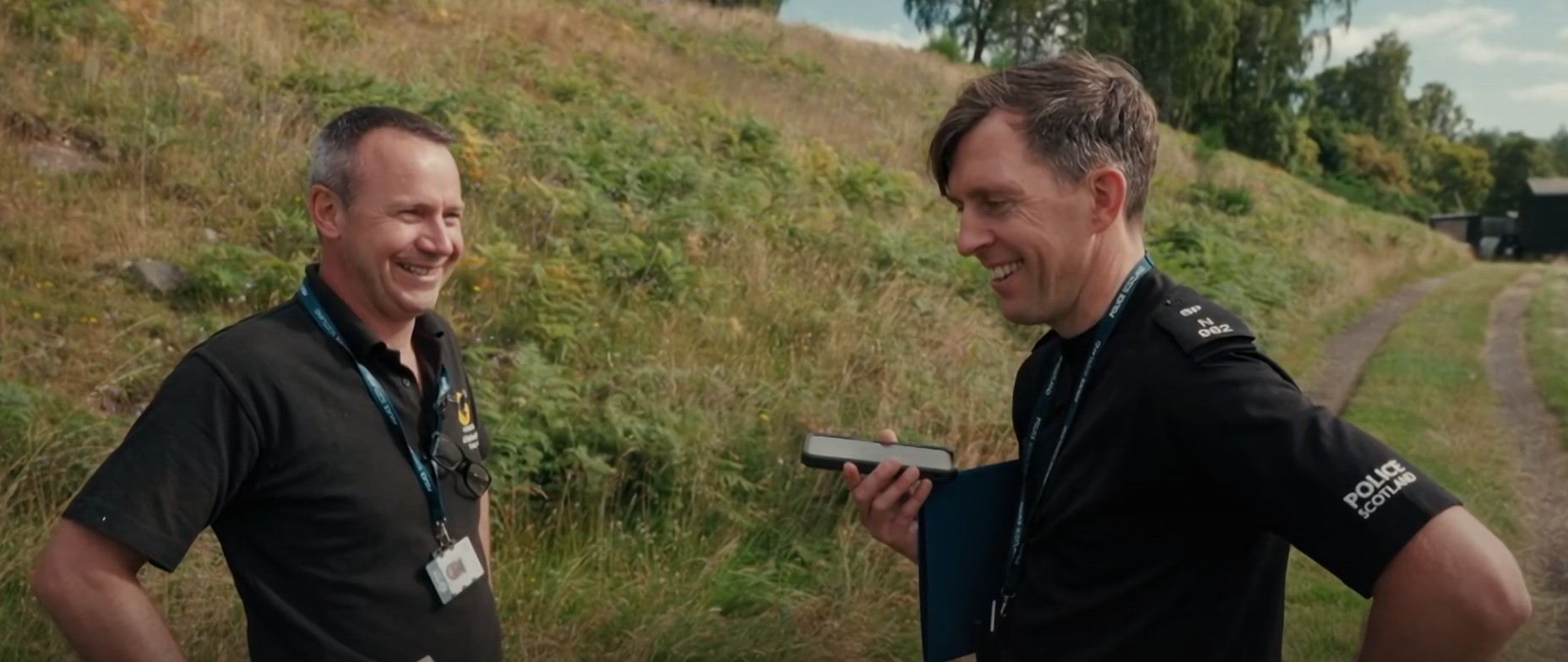
PC Gavin Ross & PC Dan Sutherland take a call from the gamekeeper’s solicitor (screengrab from BBC Highland Cops).

If someone had shot out a Goshawk nest on my land, potentially killing any adults or chicks present on the nest, and the police knocked on the door to see if I could assist, I’d be welcoming them in with open arms, breaking out the tea and posh biscuits and offering up all the assistance I could muster to help them find the culprit, especially if there was evidence that armed criminals had been active on my property. I certainly wouldn’t be calling in my attack dog solicitor to warn off the cops. Why would I?

At the end of the programme there’s an update on the case – the police did meet with the shotgun owners and their solicitor. The text on the screen says:

‘However, with no new leads the case has been closed‘.

I guess it was probably the usual ‘no comment’ interviews, then.

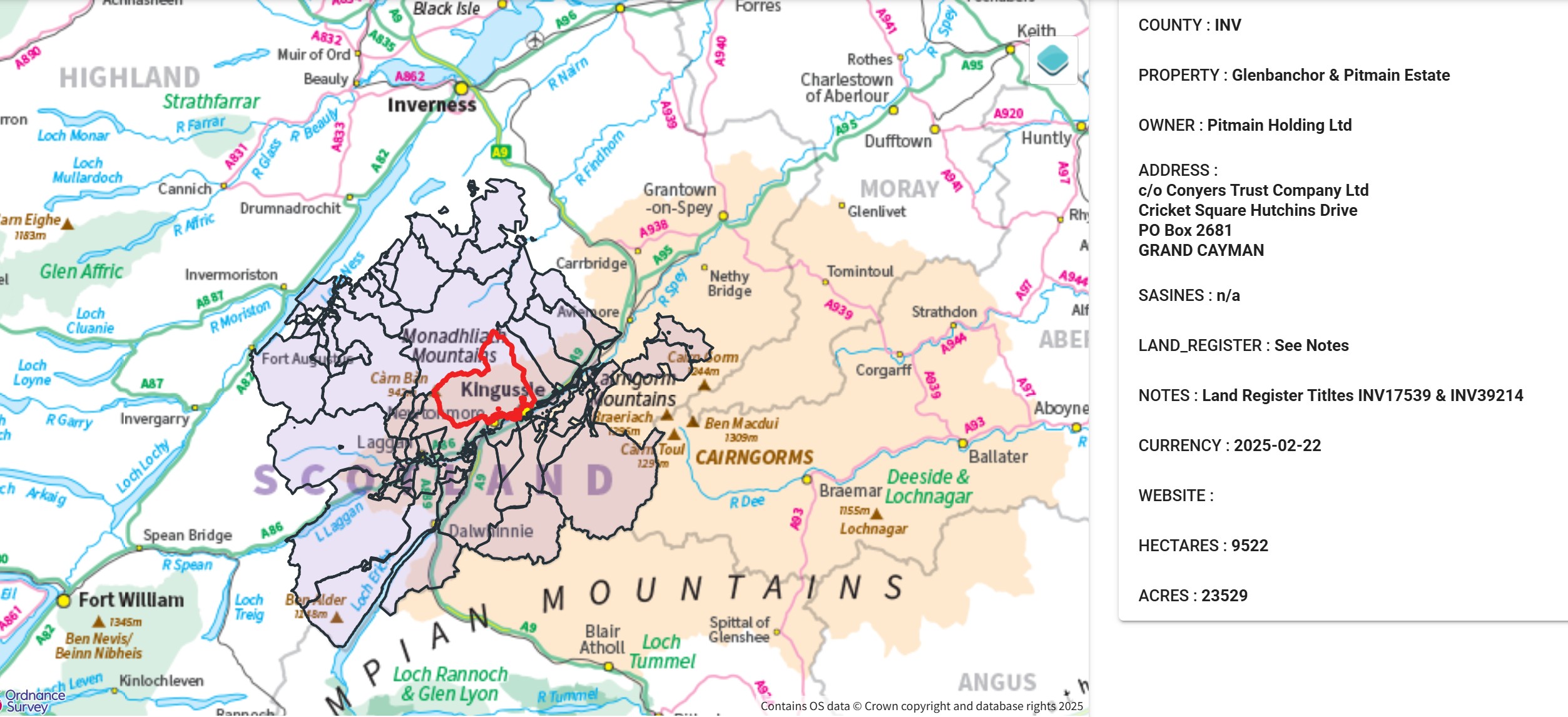
According to Andy Wightman’s excellent Who Owns Scotland website, Loch Gynack is situated on the Glenbanchor & Pitmain Estate, whose owner, Pitmain Holding Ltd, is registered in Grand Cayman:

It’s not the first time a police investigation has taken place there in relation to suspected wildlife crime. In 2019, four Greylag Geese were found poisoned at Loch Gynack – toxicology results showed they’d ingested the banned pesticide Carbofuran, so dangerous that it’s an offence to even possess this chemical in Scotland, let alone use it.

The birds had been found by estate workers who reported the incident to the police. There wasn’t any information about whether poisoned bait had been discovered and so no information about where they’d come in to contact with the Carbofuran, although given how fast-acting it is and the fact the geese were found dead together in one place, I’d think it unlikely they’d been poisoned far away.

Nobody was charged and the estate was not subject to a General Licence restriction.

Back to the Goshawk case…

The police were first notified about the abandoned Goshawk nest on 8 June 2024. This was after the enactment of the Wildlife Management & Muirburn (Scotland) Act 2024 on 30 April 2024, which introduced a licence for grouse shooting in Scotland.

I don’t know whether the Glenbanchor & Pitmain Estate applied for a grouse shooting licence in 2024. I don’t even know if they still shoot Red Grouse there (they certainly have done previously – e.g. see here and here) or whether they’ve switched to Red-legged Partridges and Pheasants as alternative quarry due to low grouse stocks, in which case they’d be exempt from needing a grouse shooting licence because the Scottish Government refused to include the shooting of RLPs and Pheasants as part of the requirement for a grouse shooting licence, despite being warned about this massive loophole.

It would be interesting to know whether (a) Pitmain Estate did apply for a grouse shooting licence in 2024, (b) if so, did NatureScot grant them a licence even though this wildlife crime investigation was ongoing, and (c) if the estate does have a five-year grouse shooting licence, will the licence be withdrawn following this incident or was the Goshawk nest beyond the area where the licence applicant indicated Red Grouse are ‘taken or shot’ (yet another loophole)?

Aside from the questions around a potential grouse shooting licence, I’ve been interested in whether NatureScot would impose a General Licence restriction following the police investigation in to the shot out Goshawk nest.

In June this year I submitted an FoI to NatureScot to ask about the status of any pending General Licence restriction decisions. My main focus was on the case concerning a Golden Eagle called ‘Merrick’ who had been shot and killed whilst she was sleeping in the Scottish Borders in October 2023.

You’ll already know that NatureScot has still not made a decision on whether to impose a General Licence restriction as a result of that crime, two years after it happened (see here).

But as well as asking about the Merrick case, I also asked how many other cases were pending.

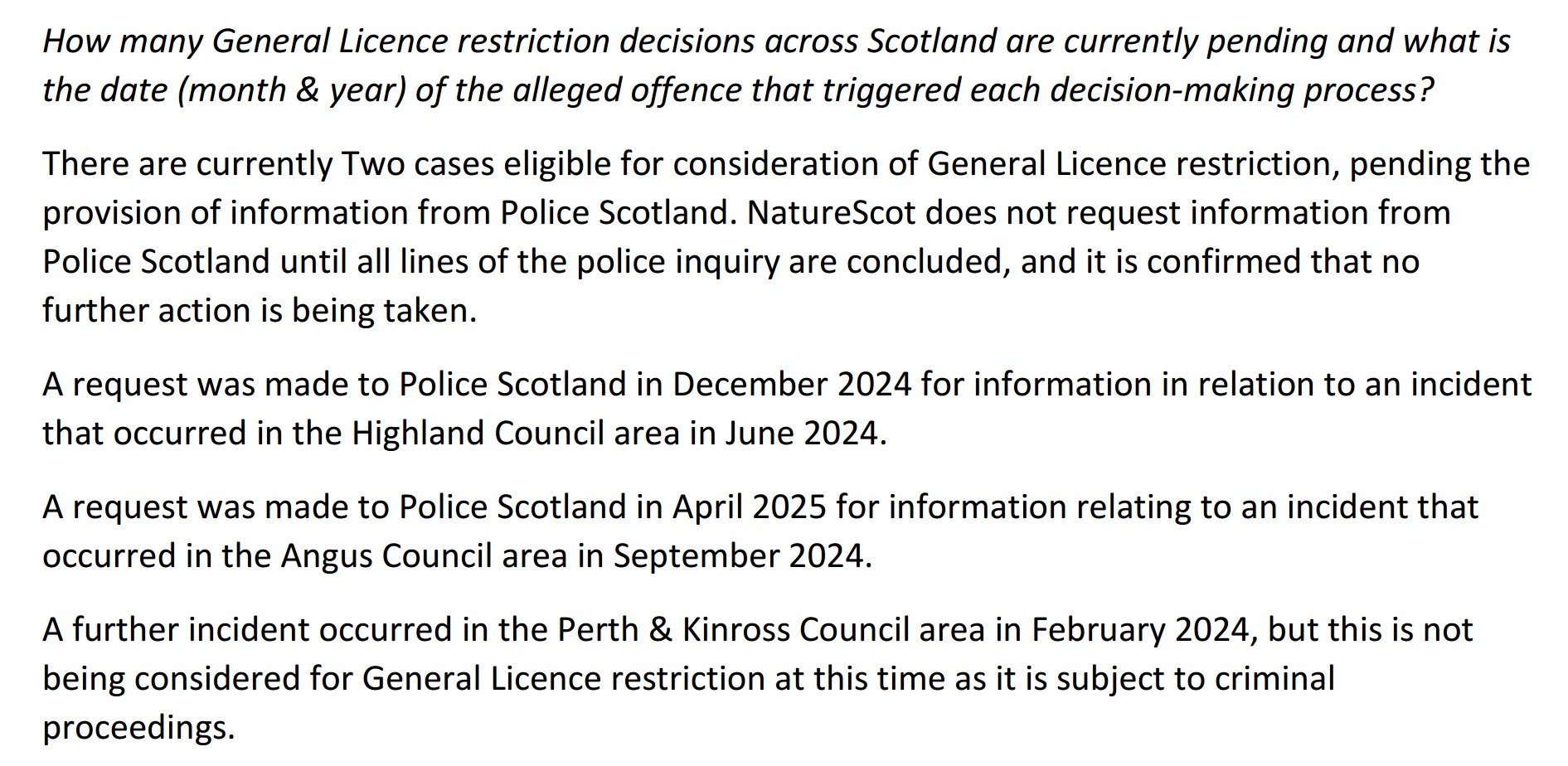
NatureScot wrote back to me in July and said this:

You can see that the case involving the shot out Goshawk nest is included on the list (‘an incident that occurred in the Highland Council area in June 2024‘).

NatureScot says it asked Police Scotland in December 2024 for the information package NS would need to begin the process of considering whether to impose a General Licence restriction.

Seven months on, in July 2025 when NatureScot responded to my FoI, Police Scotland hadn’t provided the information to NatureScot.

The Highland Cops programme demonstrates the evidential difficulties faced by the police when investigating suspected wildlife crimes, particularly those that take place on privately-owned gamebird shooting estates, and the lengths the police will go to to find out who was responsible. It was the very reason that the Scottish Parliament introduced grouse shoot licensing as part of the Wildlife Management & Muirburn (Scotland) Act 2024.

The efforts made by PC Dan Sutherland and his colleagues were exemplary in this case. But someone, somewhere, has dropped the ball in the later stages of the enforcement process by not providing an information package in a timely manner. That’s just not good enough.

The Highland Cops episode (series 3, episode 2) is available on the BBC iPlayer here. It’s well worth an hour of your time.

“Act boldly, without delay and introduce game shoot licensing” – open letter to Defra Ministers from Northern England Raptor Forum Chair

The Northern England Raptor Forum (NERF) is the representative body of voluntary raptor fieldworkers across the north of England, including in many of the raptor persecution hotspots in this region.

NERF is a well-respected organisation in conservation circles and has been at the forefront of the fight against the illegal killing of birds of prey, with its members often the first to raise the alarm to the police when suspected raptor persecution incidents have been uncovered.

NERF has also been involved in the many ‘partnership’ efforts over the last few decades that have tried, but failed, to tackle these pervasive crimes.

The group has standing, experience, and real skin in the game.

Steve Downing, NERF Chair, is a man who doesn’t mince his words. He’s written an open letter to Defra Ministers, including the newly-appointed Secretary of State for the Environment, Emma Reynolds, laying out previous Government failures to get on top of this issue and telling her that enough is enough, the time for talking is over.

It’s well worth a read – here.

If Steve’s letter resonates with you, it wouldn’t hurt for you to write to your own MP in support of NERF’s stance. There’s nothing to lose and everything to gain. Politicians won’t act if they don’t know that illegal raptor persecution is an issue of concern amongst their constituents.

If you haven’t written to your MP before, why not give it a go? If you’re not sure who your MP is, you can find out here.

‘Eyes on the Skies’ – new campaign to raise awareness of raptor persecution in the Yorkshire Dales National Park

Following the recent collapse of the Yorkshire Dales National Park Bird of Prey Partnership (due to its failure to tackle crimes against birds of prey), and the news that since 2015, 29 Hen Harriers have gone ‘missing’ in suspicious circumstances and almost 40 other raptors have been found poisoned, trapped or shot in the Yorkshire Dales National Park since 2015, including Peregrines, Hen Harriers, Red Kites and Buzzards, there’s some welcome news from a local community who has had enough and has decided to do something about it. Bravo!

Press release from Friends of the Dales:

SPEAKING OUT FOR BIRDS OF PREY

Friends of the Dales, the environmental campaigning charity, is launching a powerful new campaign − Eyes on the Skies − calling for an end to criminal killing of birds of prey in the Yorkshire Dales. The campaign kicks off with a high-profile live webinar on Tuesday 21 October at 5.30pm, featuring leading conservation expert Kate Jennings, UK Head of Site Conservation & Species Policy at the RSPB.

Kate will highlight the long history of bird crime in the Yorkshire Dales, drawing on evidence and case studies from the RSPB’s Investigations Team which works in support of the police and statutory agencies to bring criminals before the courts.

“We are delighted that Kate is joining us at the Eyes on the Skies launch event,” said Jonathan Riley, Chair of Trustees at Friends of the Dales. “She will shine a spotlight on Bird Crime in the Yorkshire Dales and the illegal and inhumane methods criminals use to trap, shoot and poison birds of prey − crimes that persist despite more than seventy years of legal protection.”

The Yorkshire Dales remains a blackspot for raptor persecution, with species such as hen harriers, short-eared owls, and red kites especially targeted. Just last week the RSPB issued a press release about the disappearance of Sita, a one-year-old female satellite-tagged Hen Harrier. The RSPB said that Sita is the 29th hen harrier “to suspiciously disappear in the national park since 2015” and that the bird “is likely to have been shot”.

“It is appalling that the hen harrier, one of the UK’s rarest birds, continues to be shot, trapped, and poisoned in our National Park, which should be a sanctuary for wildlife,” added Jonathan.

Public concern for these crimes is growing. In early 2024, more than 1,000 people responded to the first consultation on the new Management Plan for the Yorkshire Dales National Park, with ending the illegal persecution of birds of prey emerging as one of the top priorities.

David Butterworth, Chief Executive of the Authority also confirmed: “The Yorkshire Dales National Park Authority is unwavering in its commitment to raptor conservation. We will continue to collaborate with landowners, managers and organisations sharing our vision. We applaud those whose efforts have helped some species recover. But we must also confront the grim reality that criminal persecution still occurs.”

Friends of the Dales Eyes on the Skies campaign supports one of the core objectives of the new management plan for the Yorkshire Dales National Park, as well as the vital work of other organisations such as the National Wildlife Crime Unit, RSPB and Hen Harrier Action. The campaign will amplify messages around the scale and nature of these appalling crimes, educate people in how to spot and report any suspicious or illegal activity they might see and also inspire people to learn more about the birds themselves and why they are vital to a healthy, biodiverse ecosystem.

David Butterworth added: “The uplands of the Yorkshire Dales National Park should be a stronghold for a diverse range of raptor species. As apex predators, their presence signals a healthy environment. Their absence, conversely, is a warning.”

Summing up Jonathan Riley said: “Our Eyes on the Skies campaign will incorporate many more events including further webinars from insider experts, outdoor educational events and even some more creatively focussed activities. So, on behalf of the charity, I would encourage anyone who is interested in learning more to register for the free launch event on Tuesday 21 October at 5:30 pm, and sign up to our monthly email newsletter so they can be kept updated.”

Register for the Eyes on the Skies launch event and learn how to take action at: https://friendsofthedales.org.uk/events

ENDS

UPDATE 5 November 2025: Video of launch now available on Friends of the Dales YouTube channel – here.