Satellite-tagged hen harrier Fingal ‘disappears’ on Scottish grouse moor

Press release from RSPB Scotland (17 September 2020)

Another hen harrier disappears in suspicious circumstances

RSPB Scotland is calling on the Scottish Government to move quickly to introduce the licensing of grouse shooting, following the disappearance of another satellite-tagged hen harrier – the fourth to vanish on a Scottish grouse moor since the beginning of April.

Fingal, a young male hen harrier, hatched from a nest in the Scottish Borders in summer 2019, and was fitted with a lightweight satellite tag as part of the EU Hen Harrier LIFE project which has allowed scientists to track his movements.

[Hen harrier Fingal. Photo by RSPB Scotland]

He remained in this area for the first few months before spreading his wings and making a tour of northern England, stopping at sites in Lancashire, South Yorkshire and Cumbria. After returning to Scotland he settled in Dumfries and Galloway for the rest of the winter.

In mid-March 2020 Fingal moved a short distance into the southern Lowther Hills. The last location transmitted from his tag, which was funded by Lothian and Borders Raptor Study Group, came on 19 May 2020 from an area moorland managed for gamebird shooting to the east of Thornhill, Dumfries and Galloway.

Police Scotland carried out a search of the area but found no trace of Fingal or his tag. It has not transmitted since. When a satellite tagged bird dies of natural causes the tag continues to transmit allowing the body to be recovered. Independent peer-reviewed studies have shown these tags to be highly reliable, so having four fail, in very similar circumstances, all on grouse moors, strongly suggests human interference.

Fingal is the 45th known hen harrier to have disappeared in suspicious circumstances or been confirmed to have been illegally killed in the UK since 2018.

Ian Thomson, RSPB Scotland’s Head of Investigations, said: “This has become a depressingly familiar story. Yet again a satellite-tagged bird of prey has disappeared suddenly and inexplicably on a grouse moor and is presumed killed. These birds will continue to disappear until grouse shooting estates are licensed. Self-regulation by the industry has demonstrably failed, and it’s long overdue that the Scottish Government addressed this by introducing robust regulation where a right to shoot is dependent on legal management of the land.”

ENDS

44 hen harriers ‘missing’ or confirmed killed since 2018

Last month we blogged that at least 43 hen harriers were ‘missing’ in suspicious circumstances or had been confirmed killed since 2018 (see here).

Today the list is updated to 44 hen harriers, ‘missing’ or confirmed killed since 2018.

Here’s the blog we’ll publish every time this list is updated:

It’s getting to that time of year when the grouse shooting industry pumps out its patently misleading propaganda relating to hen harrier conservation in the UK. The aim is to hoodwink the public in to believing that the industry loves hen harriers and is doing all it can to protect and nurture the tiny remnant breeding population (but conveniently forgetting to mention that the breeding population is only in such dire straits because the grouse shooting industry has been ruthless in its maniacal intolerance of this supposedly protected species).

And the industry’s pursuit of the hen harrier is not simply ‘historical’ or indicative of past behaviour, as some would have us believe. It is on-going, it is current, and it is relentless.

[This male hen harrier died in 2019 after his leg was almost severed in an illegally set trap that had been placed next to his nest on a Scottish grouse moor (see here). Photo by Ruth Tingay]

To illustrate this fact, we intend to keep a running tally of all the hen harriers that we know (because most of these victims had been fitted with a satellite tag) to have either ‘disappeared’ in suspicious circumstances or have been confirmed as being illegally killed since 2018.

Why only since 2018 when we know that hen harriers have been a persecution target for years and years and years? Well, 2018 is the year that the grouse shooting industry ‘leaders’ would have us believe that the criminal persecution of hen harriers had stopped and that these birds were being welcomed back on to the UK’s grouse moors (see here).

This assertion was made shortly before the publication of a devastating new scientific paper that demonstrated that 72% of satellite-tagged Hen Harriers were confirmed or considered likely to have been illegally killed, and this was ten times more likely to occur over areas of land managed for grouse shooting relative to other land uses (see here).

We only started compiling this list of dead / missing hen harriers in June 2020 when we learned that all five of last year’s brood meddled hen harrier chicks were ‘missing’, presumed dead (see here). It has since been updated a few times as we learned about more satellite-tagged hen harriers that had vanished during lockdown in suspicious circumstances on grouse moors in the Cairnorms National Park (here) and on a notorious grouse moor in South Lanarkshire (see here).

It’s now time to update the death list again, as we’ve learned of yet another satellite-tagged hen harrier that ‘disappeared’ in suspicious circumstances, this time a bird called ‘Dryad’ who vanished from a grouse moor in the Yorkshire Dales National Park in September 2020 (see here).

That brings the gruesome tally to 44 hen harriers. (We’re still waiting to hear whether three hen harriers, satellite-tagged by Natural England this year and have since vanished (here), are being treated as suspicious disappearances by the police and if so, they will be added to this list).

Four Four.

Forty four.

In the space of two years.

Nobody has been prosecuted for any of these cases. We have every expectation that this list will be updated again in the near future.

For now, here are the 44:

February 2018: Hen harrier Saorsa ‘disappeared’ in the Angus Glens in Scotland (here). The Scottish Gamekeepers Association later published wholly inaccurate information claiming the bird had been re-sighted. The RSPB dismissed this as “completely false” (here).

5 February 2018: Hen harrier Marc ‘disappeared’ on a grouse moor in Durham (here)

9 February 2018: Hen harrier Aalin ‘disappeared’ on a grouse moor in Wales (here)

March 2018: Hen harrier Blue ‘disappeared’ in the Lake District National Park (here)

March 2018: Hen harrier Finn ‘disappeared’ near Moffat in Scotland (here)

18 April 2018: Hen harrier Lia ‘disappeared’ in Wales and her corpse was retrieved in a field in May 2018. Cause of death was unconfirmed but police treating death as suspicious (here)

8 August 2018: Hen harrier Hilma ‘disappeared’ on a grouse moor in Northumberland (here).

16 August 2018: Hen harrier Athena ‘disappeared’ on a grouse moor in Scotland (here)

26 August 2018: Hen Harrier Octavia ‘disappeared’ on a grouse moor in the Peak District National Park (here)

29 August 2018: Hen harrier Margot ‘disappeared’ on a grouse moor in Scotland (here)

29 August 2018: Hen Harrier Heulwen ‘disappeared’ on a grouse moor in Wales (here)

3 September 2018: Hen harrier Stelmaria ‘disappeared’ on a grouse moor in Scotland (here)

24 September 2018: Hen harrier Heather ‘disappeared’ on a grouse moor in Scotland (here)

2 October 2018: Hen harrier Mabel ‘disappeared’ on a grouse moor on the edge of the Yorkshire Dales National Park (here)

3 October 2018: Hen Harrier Thor ‘disappeared’ next to a grouse moor in Bowland, Lanacashire (here)

23 October 2018: Hen harrier Tom ‘disappeared’ in South Wales (here)

26 October 2018: Hen harrier Arthur ‘disappeared’ on a grouse moor in the North York Moors National Park (here)

1 November 2018: Hen harrier Barney ‘disappeared’ on Bodmin Moor (here)

10 November 2018: Hen harrier Rannoch ‘disappeared’ on a grouse moor in Scotland (here). Her corpse was found nearby in May 2019 – she’d been killed in an illegally-set spring trap (here).

14 November 2018: Hen harrier River ‘disappeared’ on a grouse moor in the Nidderdale AONB (here). Her corpse was found nearby in April 2019 – she’d been illegally shot (here).

16 January 2019: Hen harrier Vulcan ‘disappeared’ in Wiltshire close to Natural England’s proposed reintroduction site (here)

7 February 2019: Hen harrier Skylar ‘disappeared’ next to a grouse moor in South Lanarkshire (here)

22 April 2019: Hen harrier Marci ‘disappeared’ on a grouse moor in the Cairngorms National Park (here)

26 April 2019: Hen harrier Rain ‘disappeared’ on a grouse moor in Nairnshire (here)

11 May 2019: An untagged male hen harrier was caught in an illegally-set trap next to his nest on a grouse moor in South Lanarkshire. He didn’t survive (here)

7 June 2019: An untagged hen harrier was found dead on a grouse moor in Scotland. A post mortem stated the bird had died as a result of ‘penetrating trauma’ injuries and that this bird had previously been shot (here)

5 September 2019: Wildland Hen Harrier 1 ‘disappeared’ on a grouse moor nr Dalnaspidal on the edge of the Cairngorms National Park (here)

11 September 2019: Hen harrier Romario ‘disappeared’ on a grouse moor in the Cairngorms National Park (here)

14 September 2019: Hen harrier (Brood meddled in 2019, #183704) ‘disappeared’ in North Pennines (here)

23 September 2019: Hen harrier (Brood meddled in 2019, #55149) ‘disappeared’ in North Pennines (here)

24 September 2019: Wildland Hen Harrier 2 ‘disappeared’ on a grouse moor at Invercauld in the Cairngorms National Park (here)

10 October 2019: Hen harrier Ada ‘disappeared’ on a grouse moor in the North Pennines AONB (here)

12 October 2019: Hen harrier Thistle ‘disappeared’ on a grouse moor in Sutherland (here)

18 October 2019: Member of the public reports the witnessed shooting of an untagged male hen harrier on White Syke Hill in North Yorkshire (here)

November 2019: Hen harrier Mary found illegally poisoned on a pheasant shoot in Ireland (here)

January 2020: Members of the public report the witnessed shooting of a male hen harrier on Threshfield Moor in the Yorkshire Dales National Park (here)

1 April 2020: Hen harrier (Brood meddled in 2019, #183703) ‘disappeared’ in unnamed location, tag intermittent (here)

5 April 2020: Hen harrier Hoolie ‘disappeared’ on a grouse moor in the Cairngorms National Park (here)

8 April 2020: Hen harrier Marlin ‘disappeared’ on a grouse moor in the Cairngorms National Park (here)

21 May 2020: Hen harrier (Brood meddled in 2019, #183701) ‘disappeared’ on a grouse moor in Cumbria shortly after returning from wintering in France (here)

27 May 2020: Hen harrier Silver ‘disappeared’ on a grouse moor on Leadhills Estate, Scotland (here)

7 September 2020: Hen harrier Dryad ‘disappeared’ on a grouse moor in the Yorkshire Dales National Park (here)

To be continued……..

Anybody still wondering why the grouse shooting industry wants conservationists to stop fitting satellite tags?

Satellite-tagged hen harrier Dryad ‘disappears’ on grouse moor in Yorkshire Dales National Park

RSPB press release (15 Sept 2020)

Another hen harrier disappears, last reported on Yorkshire grouse moor

The RSPB is once again urging the Government to step in and support licensing of grouse shooting to address the illegal persecution of birds of prey following the suspicious disappearance of yet another satellite-tagged hen harrier.

Dryad, a female hen harrier, hatched at a nest in the Forest of Bowland this summer. She was fitted with a lightweight satellite tag so that scientists could trace her movements once she fledged. But Dryad barely had time to spread her wings before her tag, which had been transmitting normally, stopped suddenly and unexpectedly on 7 September 2020.

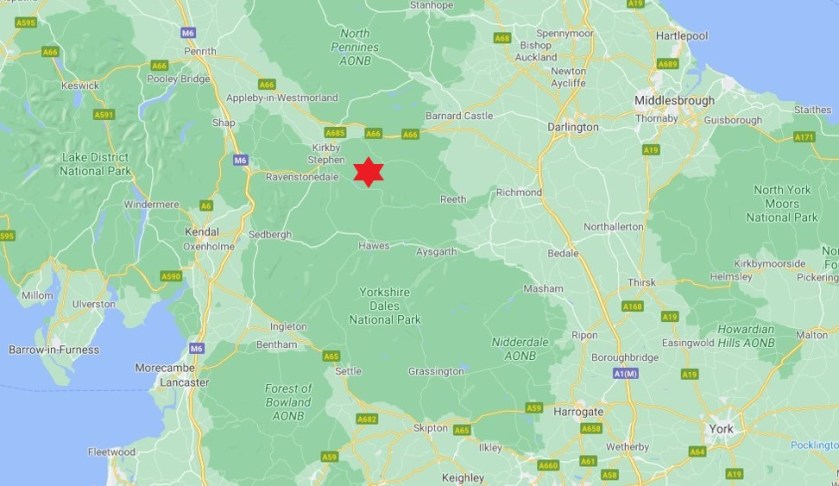
The tag’s last transmission showed the bird had been roosting on a grouse moor between Kirkby Stephen and Ravenseat in the Yorkshire Dales National Park. RSPB staff searched the area but found no trace of Dryad or her tag. Dryad has not been heard from since.

[RPUK map showing approximate location of Dryad’s last known transmission]

Hen harriers, a red-listed species, are legally protected in the UK under the Wildlife and Countryside Act 1981. Yet they remain one of the most persecuted birds of prey in the UK and continue to be illegally killed, or disappear in suspicious circumstances, particularly on or near land managed for shooting. Scientific research published in 2019, based on the UK Government’s own data, showed that 72% of satellite-tagged hen harriers in their study were killed or likely killed on British grouse moors, and that hen harriers were 10 times more likely to die or disappear over grouse moor.

The most significant threat to the English hen harrier population – which is now perilously low – is persecution by humans. 24 hen harrier nests were recorded this summer, of which 19 successfully produced chicks, yet there is enough habitat and prey to support 12 times that number.

Dryad is the 44th hen harrier known to have been illegally killed or gone missing in suspicious circumstances since 2018.

This wider area, which is dominated by driven grouse moors, has become a ‘hotspot’ for suspicious hen harrier disappearances, as revealed by satellite tagging.

In July this year a hen harrier named Harriet, tagged by Natural England, sent her last transmission near Outhgill, just over the border in Cumbria. A further two disappeared, last transmitting near Bowes, County Durham and Askrigg, North Yorkshire respectively in September 2019. And in 2016, the hen harrier Rowan was found shot in Ravenstonedale, Cumbria.

Elsewhere in North Yorkshire, in 2019 the body of another satellite tagged hen harrier known as River was found shot on the Swinton Estate, North Yorkshire.

Mark Thomas, RSPB Head of Investigations UK, said:

“Illegal killing is the number one factor stalling hen harrier conservation in the UK. Despite all the positive news around 60 juveniles fledging in England this clearly shows the fate of many of these birds once they disperse. Sadly we expect further suspicious disappearances in the next few months following the well-established pattern of previous years. If Dryad had died naturally, we would expect her tag to continue transmitting, allowing us to find and recover both body and tag. The sudden stop of satellite tags, particularly considering the history of persecution in this area, strongly points to human interference.”

Mark continues: “It is blatantly clear that current legislation is failing to protect our birds of prey and that criminality continues unchecked on grouse moors. The Government must act urgently and commit to licensing of grouse shooting with sanctions to withdraw licenses to shoot where criminal behaviours are proven to the satisfaction of the public authorities. Law-abiding estates would have nothing to fear from this approach.”

During August, over 120,000 emails were sent to local MPs by concerned members of the public urging them to take action to end bird of prey persecution, prompted by an e-action by Wild Justice, the RSPB and Hen Harrier Action.

ENDS

More on that gunman filmed with a decoy owl near hen harrier nest site on Whernside

Late on Friday afternoon the RSPB published a blog detailing an incident that was witnessed by a Natural England fieldworker at a hen harrier nest site in Cumbria during this year’s breeding season.

According to that blog (here), ‘…..a Natural England fieldworker was monitoring a hen harrier nest on moorland near Whernside, Cumbria, when he saw a man wearing camouflage carrying a firearm and a live bird of prey, believed to be an eagle owl about 300m from the hen harrier nesting area. He tethered the bird and sat a short distance away with his gun. In the circumstances there seems little doubt the intention was to draw in raptors, presumably the hen harriers, to shoot them. The use of a tethered live bird as a decoy to kill or take a wild bird is in itself illegal, but a method that seems to be increasingly used for targeting raptors. This was no doubt a highly stressful situation, we understand the fieldworker took some video footage and made himself visible. This eventually had the desired effect, and the suspect, realising he was under observation, left. It was reported to the police but due to evidential issues around establishing the identity of the suspect, it was not possible to take the matter forward to court. The RSPB would like to place on record our thanks to Cumbria Constabulary and the CPS for their determined efforts to progress this investigation. We firmly consider that this incident and the video should now be put in the public domain’.

One of the main points being made in the wider RSPB blog was that Natural England had declined to publicise this incident, even though it is understood to have taken place in an area where hen harriers were being brood meddled as part of a Government-sanctioned conservation sham, optimistically called the Hen Harrier Action Plan by those involved.

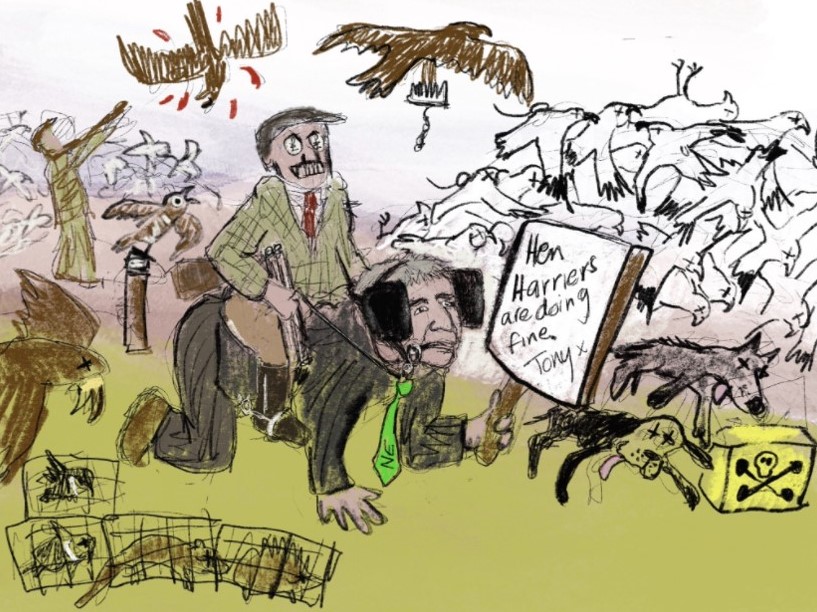
[A much more realistic portrayal of the so-called Hen Harrier Action Plan. Cartoon by Gerard Hobley]

Natural England’s refusal to voluntarily disclose detailed information about its sham hen harrier conservation project or this latest allegation of attempted persecution at a hen harrier nest site shouldn’t come as any surprise to anyone who’s been following this blog for any length of time. Natural England has developed something of a reputation for its lack of transparency and accountability, especially when it comes to meddling with hen harriers, and much of this goes back further than Tony Juniper’s reign (e.g. see here, here, here, here, here, here, here, here, here, here, here etc etc).

Since the RSPB’s blog was published on Friday afternoon, not one of the shooting organisations involved in the hen harrier brood meddling sham have published a statement on their respective websites. Remember, these are the organisations who claim to hold a ‘zero tolerance’ approach to illegal raptor persecution. You’d think they might have something to say about it, wouldn’t you? Especially given the history of raptor-killing in this area (see here).

We’ve heard, from a number of sources, an allegation that, if true, might explain Natural England’s reluctance to discuss this particular incident.

Have another look at this statement from the RSPB blog:

‘It was reported to the police but due to evidential issues around establishing the identity of the suspect, it was not possible to take the matter forward to court’

We’ve been told that the day after the Natural England fieldworker filmed the gunman with his tethered live eagle owl near the hen harrier nest, a Natural England staff member phoned the gunman and asked whether it was him who had been seen at the hen harrier site the day before.

Because Natural England is a statutory authority, its staff have to abide by the requirements of the Police & Criminal Evidence Act (PACE). This Act is primarily concerned with the behaviour of the police (or other relevant authority), the suspect’s rights and the admissibility of evidence. According to our sources, phoning a suspect and asking whether he had been present at a potential crime scene would be a breach of PACE and, even though it’s ‘just’ a technicality, this would be sufficient for a defence agent to have any potential prosecution thrown out at an early stage.

Is this what happened in this case? Did Natural England cock up a potential prosecution, albeit unintentionally? We’re unlikely to ever get a full account out of Natural England but it does raise an important issue – does Natural England have a protocol/procedure in place for how its staff should behave in these situations? And if not, it needs to get one sorted pronto because as we’re all too aware, the illegal killing of hen harriers on grouse moors is an ongoing crime wave.

UPDATE 21 September 2020: Natural England denies cocking up police investigation at Whernside hen harrier site (here)

UPDATE 20 January 2021: Confirmation that hen harrier brood meddling estate was under police investigation for suspected raptor persecution (here)

Northern England Raptor Forum statement on Hen Harrier 2020 breeding season

A couple of weeks ago Natural England published a press release (along with an interesting choice of ‘partners’ – the GWCT and Moorland Association) in which the 2020 hen harrier breeding season was pronounced ‘a wonderful result’ (see here).

It wasn’t ‘a wonderful result’ at all but Natural England and co put on a display worthy of a circus contortionist to make it appear so.

The RSPB wasn’t included in that press release – apparently they’d been asked to provide a quote but chose not to – instead the RSPB published its own statement, which reflected a much more honest evaluation of the state of the 2020 breeding season (see here).

Yesterday the Northern England Raptor Foum (NERF) published its own statement on the 2020 hen harrier breeding season and it doesn’t pull any punches. ‘The brass band can stand down‘.

You can read the full NERF statement (here) and here is an excerpt:

NERF is a member of the Raptor Persecution Priority Delivery Group [RPPDG], and as such is a consultee under Action 4 of NE’s Hen Harrier Recovery Plan. Yet when Natural England went in search of supporting comments for their press release they only published comments from the shooting industry. Perhaps Natural England would like to explain why that was the case. They may also want to explain why NERF wasn’t included in the list of organisations working in partnership for the benefit of Hen Harriers.

NERF is at the forefront of Hen Harrier nest finding and monitoring during the breeding season, ringing, satellite tagging and winter roost monitoring in partnership with the RSPB. Despite this, we weren’t approached for a comment when Natural England published their press release. If we had been asked for and provided a comment we doubt that it would have been published. Natural England should be in no doubt that without the dedication of NERF members who commit hundreds of voluntary hours to monitoring and self-fund thousands of miles to monitor Hen Harriers the species would be in a much worse state than it is currently.

Natural England has ballsed this up big time, and continues to stumble from one shambolic incident to the next, some with more serious consequences than others (e.g. see this blog (here) from Mark Avery this morning discussing how it appears Natural England has misled a Minister, either through intention or ineptitude).

More to come.

Gunman filmed at hen harrier nest site with decoy eagle owl

The RSPB Investigations Team has published a blog this afternoon detailing an incident that was witnessed by a Natural England fieldworker at a hen harrier nest site in Cumbria during the breeding season.

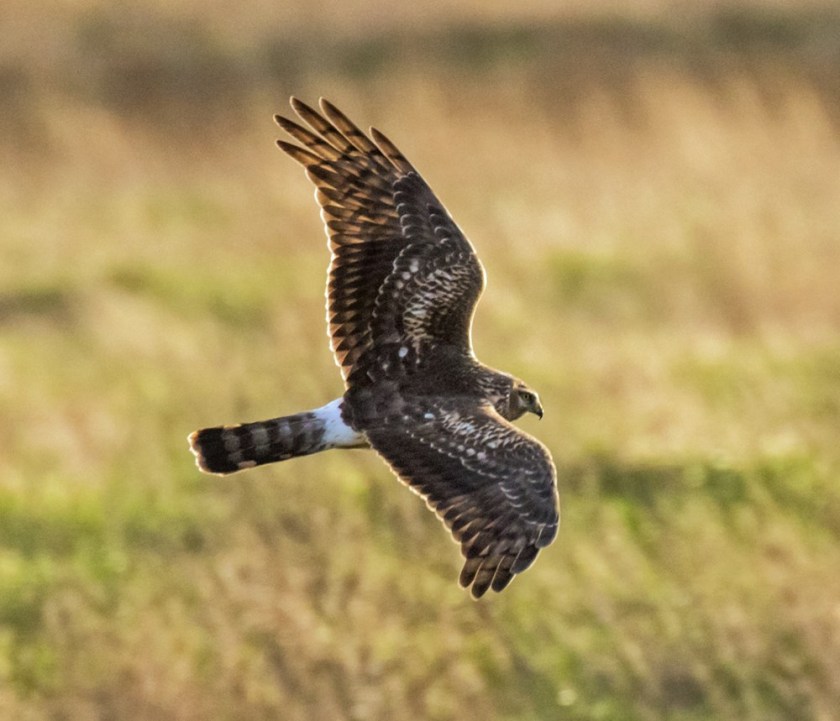
[Hen harrier, photo by Frank Burns]

The full blog can be read here but the pertinent part is reproduced as follows:

‘We understand that a Natural England fieldworker was monitoring a hen harrier nest on moorland near Whernside, Cumbria, when he saw a man wearing camouflage carrying a firearm and a live bird of prey, believed to be an eagle owl about 300m from the hen harrier nesting area. He tethered the bird and sat a short distance away with his gun. In the circumstances there seems little doubt the intention was to draw in raptors, presumably the hen harriers, to shoot them. The use of a tethered live bird as a decoy to kill or take a wild bird is in itself illegal, but a method that seems to be increasingly used for targeting raptors. This was no doubt a highly stressful situation, we understand the fieldworker took some video footage and made himself visible. This eventually had the desired effect, and the suspect, realising he was under observation, left. It was reported to the police but due to evidential issues around establishing the identity of the suspect, it was not possible to take the matter forward to court. The RSPB would like to place on record our thanks to Cumbria Constabulary and the CPS for their determined efforts to progress this investigation. We firmly consider that this incident and the video should now be put in the public domain’.

Now, putting this news out late on a Friday afternoon isn’t helpful to anyone (apart from Natural England and the criminals within the grouse shooting industry who may hope that it’ll all blow over by Monday).

It won’t.

There is a lot to say about this incident as well as about Natural England’s continuing pisspoor conduct on all things hen harrier.

We’ll be coming back to it on Monday morning.

[Cartoon by Gerard Hobley]

UPDATE 15 September 2020: More on that gunman filmed with a decoy owl near hen harrier nest site on Whernside (here)

UPDATE 20 January 2021: Confirmation that hen harrier brood meddling estate was under police investigation (here)

Does BASC know its arse from its elbow?

Does BASC (the British Association for Shooting, and, ahem, conservation) know its arse from its elbow?

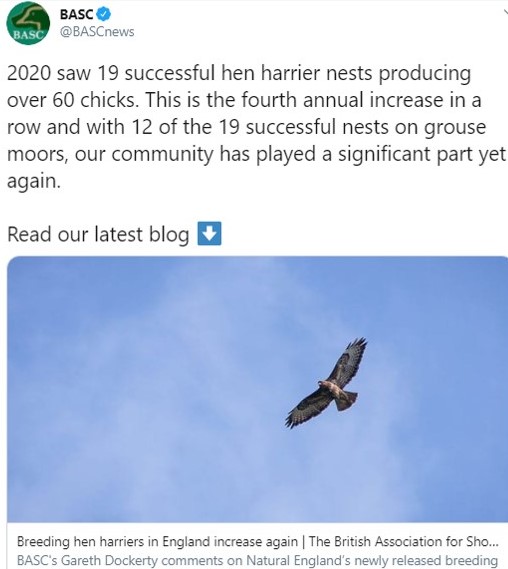
It certainly can’t tell the difference between a merlin and a lanner falcon (see here) and now it seems to be struggling to tell the difference between a buzzard and a hen harrier!

You know, if you’re going to profess to love a bird of prey, it helps your credibility if you’re first able to identify it. Otherwise it just looks like you’re pretending.

In this latest outpouring of proclaimed love from BASC for Britain’s most persecuted bird of prey, it is claimed that,

‘More grouse moors have embraced the hen harrier brood management scheme this year as confidence in the project grows‘.

Hmm. But not everything is as it seems. Standby for what we’re told is imminent breaking news that puts this alleged ’embracement’ in a totally different light…….

Four of this year’s satellite-tagged hen harriers already dead or ‘missing’

Earlier today delusional Natural England issued a press statement (along with two organisations that have zero credibility when it comes to hen harrier conservation, the Moorland Association and GWCT) proclaiming this year’s hen harrier breeding season was a ‘wonderful result’ (see here).

The RSPB published its own view, separately (here), pointing out, as if it was necessary, that illegal persecution continues to be ‘the most serious threat’ to hen harrier conservation.

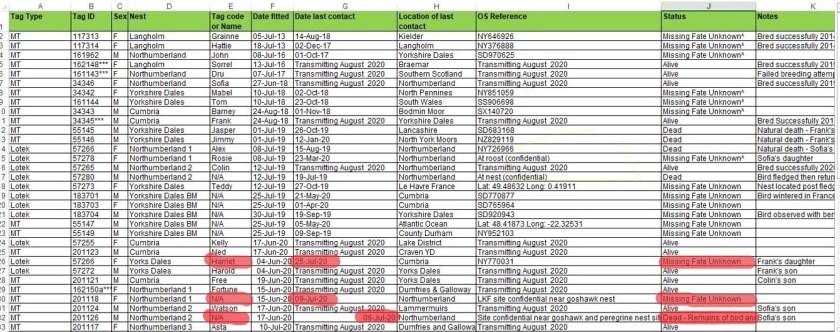
Meanwhile, Natural England, having been justifiably criticised today for publishing inaccurate and ambiguous information about hen harriers (e.g. see here) has quietly updated its spreadsheet on the number of satellite-tagged hen harriers and their fates (see here).

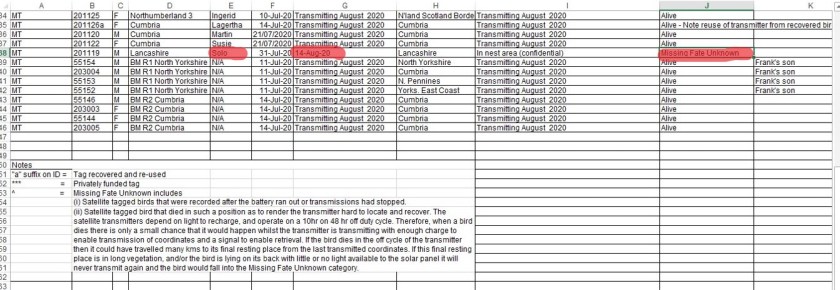
Natural England has fitted satellite tags to 23 of this year’s cohort of 60, but according to the data, four of those 23 are already either dead or ‘missing, fate unknown’.

Here are the details of the four:

Tag #57266, female, Harriet, tagged in Yorkshire Dales on 4 June 2020. Last known fix in Cumbria (actually in the Yorkshire Dales National Park, grid ref NY770031) on 25 July 2020. Listed as ‘missing fate unknown’.

Tag #201118, female, unnamed, tagged in Northumberland (site 1) on 15 June 2020. Last known fix on 9 July 2020 in Northumberland, ‘site confidential nr goshawk nest’. Listed as ‘missing fate unknown’.

Tag #201126, male, unnamed, tagged in Northumberland (site 2) on 15 June 2020. Last known fix on 6 July 2020 in Northumberland, ‘site confidential nr goshawk and peregrine nest sites’. ‘Remains of bird and tag recovered near the nest site post-fledging – most likely avian predation’.

Tag #201119, male, Solo, tagged in Lancashire on 31 July 2020. Last known fix on 14 August 2020 in Lancashire ‘in nest area (confidential)’. Listed as ‘missing, fate unknown’.

It’s not known how many of the three ‘missing, fate unknown’ hen harriers are being investigated as suspicious incidents by the police and without knowing the details or circumstances of the disappearances, it would be unwise to speculate at the moment. We’re not aware of any appeals for information in any of these three cases. We’ll be asking the respective police forces for information on each of them so that the running total of ‘43 dead or missing hen harriers in the last two years‘ can be updated if necessary.

It’s also worth pointing out that one of the ‘missing, fate unknown’ birds was fitted with a Lotek tag rather than the usual MTI tag….we’ve blogged about the apparent unreliability of this tag type previously (see here) and another blog will be published shortly with even more damning commentary on its suitability for tracking hen harriers.

Perhaps the biggest question to ask right now is why Natural England (and its ‘partners’ in the grouse shooting industry) failed to mention in this morning’s press statement the disappearances of three of this year’s cohort?

Can we trust anything Natural England tells us about hen harriers?

Multi-award-winning author Gill Lewis has neatly summarised the view of many of us with this rather telling cartoon:


‘Illegal persecution remains most serious threat to hen harriers’ – RSPB statement on 2020 breeding season

Following the news earlier today that deluded Natural England thinks the 2020 hen harrier breeding season was a ‘wonderful result’ (see here), the RSPB has now issued a statement:

‘The news that 60 hen harrier chicks have fledged in England this year is encouraging, and testament to the crucial monitoring from raptor workers. However, while 24 nests monitored is an improvement on the 7 nests in 2017, there is enough habitat and prey to support more than 12 times this year’s total. The science is clear that illegal persecution remains the most serious threat to this species  –  since 2018, 43 hen harriers are known to have been killed or “gone missing”, after fledging. The sad reality for those who passionately protect these birds is that some of this years’ fledglings risk being killed. If this painfully slow recovery is to gather pace, and these beautiful and enigmatic birds are to become as common across our landscapes as they should be, the illegal persecution must stop’.

It’s now pretty clear why the RSPB didn’t sign up to the laughably optimistic joint press statement from Natural England, GWCT and the Moorland Association.


Deluded Natural England claims 2020 hen harrier breeding season a ‘wonderful result’

Natural England has announced that a total of 19 hen harrier nests were successful in England this year.

Strangely, Natural England didn’t mention the number of hen harriers that have disappeared in suspicious circumstances this year, or those that members of the public witnessed being shot (see here).

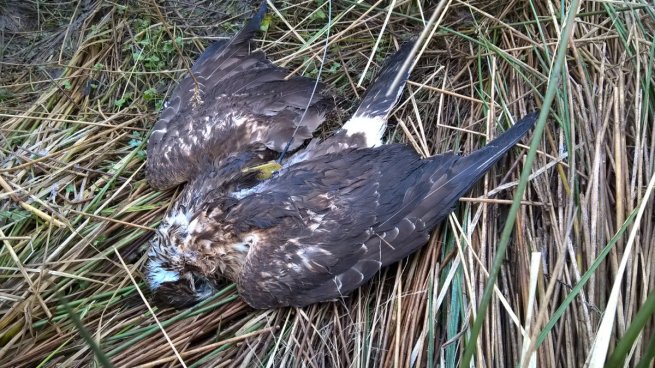
[A dead hen harrier that was caught in an illegally-set trap on a Scottish grouse moor – see here. Nobody was prosecuted for this barbaric crime. Photo by Ruth Tingay]

With a straight face, Natural England’s Chairman Tony Juniper has declared this year’s hen harrier breeding season a ‘wonderful result’ (since when has a 5% success rate been ‘wonderful’?) and, along with his good old pals from the grouse shooting industry (the very industry responsible for this species’ appalling conservation status), has issued a joint press release as follows:

A record-breaking year for hen harrier breeding

Natural England has recorded the best year for hen harrier breeding in England since Natural England’s Hen Harrier Recovery Project was established in 2002, with 60 chicks fledged from 19 nests across Northumberland, Yorkshire Dales, Cumbria and Lancashire in early summer 2020.

The success has been down to a number of factors including high numbers of voles which are a key food source, good weather, and strong partnership working between Natural England, RSPB, Forestry Commission, the Moorland Association, United Utilities, the National Trust, and others.

Hen harriers were once found across upland and lowland Britain including throughout many English counties, however after 1830 it became an exceptionally rare breeding bird in England due to raptor persecution, which was then made illegal in 1954. The hen harrier is now one of England’s rarest birds of prey.

Hen harriers are one of our most distinctive birds, with a characteristic owl-like face and stiff facial feathers that direct sound toward their ears to enable them to hunt more effectively.

Tony Juniper, Chairman of Natural England, said:

“2020 has seen the best breeding season for England’s hen harriers in years and I thank all those who’ve helped achieve this wonderful result, including landowners and managers, campaigners, conservation groups, police officers and our own Natural England staff and volunteers.

“Despite the great progress there is though no cause for complacency. Too many birds still go missing in unexplained circumstances and I urge anyone who is still engaged in the persecution of these magnificent creatures to cease at once.

“Hen harriers remain critically endangered in England and there is a long way to go before the population returns to what it should be.”

This year’s success means that 141 hen harrier chicks have fledged over the past three years alone. Natural England’s Hen Harrier Recovery Project was established in 2002 to monitor hen harriers and work towards improving their numbers in England.

Although persecution is thought to be the main factor limiting hen harrier numbers in England, other factors including the suitability of local habitats and food availability are also significant in some areas.

Natural England is involved in a number of initiatives to help ensure hen harriers recover including through Defra’s hen harrier joint action plan.

These include:

  • satellite tracking to improve understanding of the bird’s movements and behaviour;
  • supporting wildlife friendly habitat management in the uplands; and,
  • working with a range of partners to protect the current population and extend its range across England.

Dr Adam Smith of the Game & Wildlife Conservation Trust (GWCT), said:

“This is a very promising result for a pragmatic conservation project. Management options for bird of prey conservation rather than just legal enforcement is very forward thinking approach. The GWCT has studied the very real tension between harrier conservation and grouse shooting for over 30 years. Until this managed approach was adopted – at no small risk to the reputations of all involved – there was a damaging deadlock.

“If this trend can be maintained and hen harrier conservation status further improved, whilst supporting the red grouse management that best delivers our unique heather uplands, it will be a real breakthrough for practical, working conservation.”

Amanda Anderson, Director of the Moorland Association, added:

“Yet again, it has been a fantastic year for hen harriers and we have now seen significant increases in successful nests and chick numbers for three years running as part of the hen harrier Recovery Plan which includes the innovative Brood Management Scheme trial.

“Twelve of the nests reported today are on land managed for grouse shooting and this reflects a genuine commitment from moor owners and managers to work with others and help rebuild the harrier population.”

Hen harriers lay 4-6 eggs during late April–May, with incubation lasting 30 days. Hen harrier chicks then fledge in 28-32 days. Both females and males attend the young, with the males providing food which is often passed mid-air to the female in a distinctive display of ‘throw and catch’.

A high proportion of this year’s chicks have been fitted with satellite tags, which will allow Natural England to monitor the progress of the birds as they move away from their nest areas.

ENDS

What this press statement amounts to is nothing more than a cynical ploy to disguise the tragic reality of this species’ downfall at the hands of the driven grouse shooting industry.

It’s hard to know where to start with this latest piece of deliberately crafted propaganda. Isn’t it interesting though, that the only other organisations quoted are the GWCT and the Moorland Association? Where’s the RSPB quote? The Police? Forestry Commission, United Utilities, National Trust, and the ‘others’ that were mentioned as ‘partners’ by Tony Juniper (presumably he means the Northern England Raptor Forum)? Weren’t they asked? Or were they invited to comment but refused to have any part in this conservation sham?

And then there’s the actual results – 19 successful nests in the whole of England is nothing like a ‘wonderful result’. It’s bloody pitiful – just 5% of the potential English breeding population estimate of 330 pairs. The fact it’s been the ‘best breeding season since 2002’ says an awful lot about how long and how severely this species has been a victim of illegal persecution, doesn’t it?

And then there’s Tony Juniper telling us, ‘Persecution is thought to be the main factor limiting hen harrier numbers in England…’ No, Tony, it’s not thought to be the main factor, it’s known to be the main factor and has been known for many, many years. Natural England’s own data have been used to evidence this time and time and time again! [see update 14 Sept below]

It’s hardly worth dissecting the quotes from GWCT and the Moorland Association. It could be argued that these organisations have about as much credibility on hen harrier conservation as the Kremlin has on the destruction of its stockpiles of Novichok.

It is worth noting though that back in 2002, the very same year that Natural England first implemented its so-called ‘Hen Harrier Recovery Project’, that the then Chairman of the GWCT’s Scottish Committee and later Vice Chair of the national GWCT was proposing an opt-out from the European Birds Directive to enable grouse moor owners to cull hen harriers that threatened red grouse stocks for shooting (see here). Perhaps today’s quote from the GWCT, talking about ‘management options’ for birds of prey, is a more carefully-worded version of the same principle?

It’s also worth noting that in this latest press statement, both the Moorland Association and GWCT appear to be keen that the grouse shooting industry deserves recognition for this ‘record-breaking season’. Yes, the industry does deserve recognition, but only for keeping the English hen harrier population at such a critically low level for so many years.

It’s funny, isn’t it, that the industry wants credit when hen harriers are allowed to breed on a grouse moor but it refuses to accept any responsibility for the hundreds of vacant breeding territories right across the English (and Scottish) uplands, nor responsibility for the suspicious disappearance of at least 72% of satellite-tagged hen harriers that are, according to Natural England’s own data, presumed to have been illegally killed on grouse moors.

Talking about disappearing and illegally killed hen harriers is something the Natural England press statement doesn’t do. Why not? Well, because if it admitted that at least 43 hen harriers have disappeared in suspicious circumstances (or been found illegally killed) on or close to driven grouse moors in the last two years alone (see here), then it would be blindingly obvious to anyone with an ounce of common sense that the 19 successful hen harrier nests recorded in 2020 are totally irrelevant to the conservation recovery of this species if those recently-fledged young birds are subsequently shot, poisoned or trapped on grouse moors. Which, long experience has shown, is what will happen to many of them, probably before Xmas.

UPDATE 10.30hrs: ‘Illegal persecution remains most serious threat to hen harriers’ – RSPB statement on 2020 breeding season (here)

UPDATE 19.00hrs: Four of this year’s satellite-tagged hen harriers already dead or ‘missing’ (here)

UPDATE 12 September 2020: Northern England Raptor Forum statement on 2020 hen harrier breeding season (here)

UPDATE 14 September 2020: It’s been pointed out to us that we’ve wrongly attributed the quote, “Persecution is thought to be the main factor limiting hen harrier numbers in England…” to Tony Juniper. Our mistake. It is, though, still a quote attributable to Natural England, of which Tony Juniper is Chair.