
A new report has been published today detailing the recovery prospects for golden eagles in southern Scotland.
The SNH-commissioned report has been written by two undisputed experts (Alan Fielding and Paul Haworth), both of whom were involved with the impressive Golden Eagle Conservation Framework report that was published in 2008.
The report has only just been made available on SNH’s website so we’ve not had a chance to thoroughly digest its findings – although we intend to come back to it in due course.
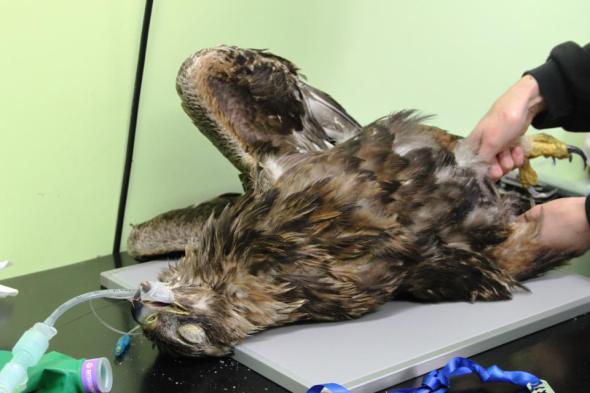
Having skimmed through it, it looks like a very detailed analysis of the various issues that could affect the recovery of this tiny population (see here for a previous blog entry on the perilous state of the golden eagle population in southern Scotland), including, of course, the effect of illegal persecution. This photo below shows the graphic effect of persecution on golden eagles in south Scotland – this one was found shot and critically injured on a driven grouse moor in 2012 – it later died from its injuries – see here.
If you haven’t read the new report (and let’s face it, not many people will), you might just base your opinion of it on what has been written in the mainstream media, which would be fine if the media reports were accurate, balanced and didn’t contain any lies.
For example, if you read the BBC report, you’d be forgiven for thinking that golden eagles in southern Scotland are only constrained by impoverished habitat and potentially by climate change, lack of prey (apparently due to a loss of gamekeepers!) and afforestation. You’d read that illegal persecution ‘may have been an historical factor’ but apparently it isn’t any more.
Hmm. Is that what the report actually says? Er, no. The report mentions persecution in several areas (Lowther Hills, Tweedsmuir Hills, Ettrick Hills and Moorfoot Hills) and suggests that it needs to be brought under control if golden eagles are to once again survive in these areas.
So if the report didn’t say that illegal persecution ‘may have been an historical factor’ but apparently isn’t any more, then who did?
 No surprises…..Doug McAdam, CEO of the landowners’ organisation, Scottish Land and Estates. We blogged about SLE’s persistent denial of raptor persecution only yesterday (see here) in relation to comments made by SLE’s Moorland Director Tim (Kim) Baynes during a radio debate. It looks like McAdam was sent the same memo – just deny, deny, deny.
This time, however, we intend to do more than just make fun of him – we’re going to complain to the BBC about publishing such nonsense and we’d encourage as many of you as possible to join in. We’ve even prepared some suggested text that you can simply cut and paste if you’re short of time or not sure what to write. Here it is:
Dear BBC,
I wish to make a complaint about the content of an online article about a new report about Golden Eagles in the south of Scotland:
http://www.bbc.co.uk/news/uk-scotland-south-scotland-28320168
In my opinion, a disproportionate amount of space in the written article is given over to comments made by Mr Doug McAdam, the chief executive of Scottish Land and Estates. This is in complete contrast to the amount of space given to the comments by Prof Des Thompson “who led the research” and Mr Ian Thomson of RSPB Scotland.
In addition I am very concerned that the comments attributed to Mr McAdam reflect a falsehood that is frequently stated by his organisation and others who have a long-term political agenda to downplay the issue of persecution of birds of prey. Mr McAdam is quoted as saying, “Where persecution may have been a historical factor, it is clear from the official government data – published alongside our partners in PAW Scotland in March – that the number of such incidents has dropped significantly in recent years.”
In fact, the figures published by the Scottish Government show the opposite to be the case. In the Scottish Government’s wildlife crime report for 2012: http://www.scotland.gov.uk/Resource/0043/00434716.pdf thirteen birds of prey are listed as being the victims of persecution.
In 2013, twenty three birds of prey were listed as victims: http://www.scotland.gov.uk/Topics/Environment/Wildlife-Habitats/paw-scotland/types-of-crime/crimes-against-birds/Poisoninghotspotmaps/2009-2013
These figures are nowhere near being indicative of “a significant” decline – in fact they are wholly contradictory of such a claim.
I urge the BBC to remove these erroneous comments from the article, given that they suggest to its readers a picture which is patently untrue.
Yours faithfully, (your name).
Here’s where to send your complaint: https://ssl.bbc.co.uk/complaints/forms/?reset=#anchor [click on ‘Make a complaint’]
Some links:
BBC news article (and accompanying video) here
SNH press release about the new golden eagle report here
RSPB Scotland press release here
Download the new report here: Fielding & Haworth 2014_Golden Eagles in south Scotland an overview
UPDATE 17.40: Interestingly, the BBC appears to have retracted some of McAdam’s quote, but not the offending part! (Many thanks to those of you have already complained – we can see from our site stats that quite a few of you have done so).
Here’s McAdam’s quote from this morning:
Douglas McAdam, chief executive of Scottish Land & Estates, said: “We have been involved with Scottish Natural Heritage and other partners in this study since its inception as we felt it was crucial to understand the real underlying reasons why Golden Eagles were struggling in certain parts of Scotland.
This thorough and detailed study makes clear that SNH believes that habitat improvements are needed to encourage more breeding golden eagle pairs in the south of the country. We fully support this conclusion and we will encourage land managers to work in partnership with SNH and other bodies to make improvements to these habitats wherever possible.
Other factors, including climate change, lack of availability of prey base for eagles – often because these areas are no longer actively managed by gamekeepers – as well as expansion of forestry and changing land use may also be inhibiting eagle presence in these areas. Where persecution may have been a historical factor, it is clear from the official government data – published alongside our partners in PAW Scotland in March – that the number of such incidents has dropped significantly in recent years. However, everyone remains resolute that where persecution exists it must be eradicated.
Golden Eagles are iconic Scottish birds, adding greatly to Scotland’s natural landscape and welcomed by estates as part of our natural heritage. This study will add greatly to our understanding of what limits the presence of these magnificent birds and should therefore help us to understand how best they can be conserved.”
And here’s what’s currently online at 17.40:
Scottish Land and Estates chief executive Douglas McAdam said: “Where persecution may have been a historical factor, it is clear from the official government data – published alongside our partners in PAW Scotland in March – that the number of such incidents has dropped significantly in recent years.
However, everyone remains resolute that where persecution exists it must be eradicated.
Golden Eagles are iconic Scottish birds, adding greatly to Scotland’s natural landscape and welcomed by estates as part of our natural heritage.
This study will add greatly to our understanding of what limits the presence of these magnificent birds and should therefore help us to understand how best they can be conserved.”
Come on BBC editors, get your act together!
 Earlier today we blogged about the latest poisoning victim to have been uncovered in Scotland….a dead buzzard that was found in Fife in April (see

 A freedom of information request has revealed some interesting correspondence between Doug McAdam, the CEO of the landowners’ organisation Scottish Land and Estates, and Paul Wheelhouse, the Scottish Environment Minister, on the subject of ‘
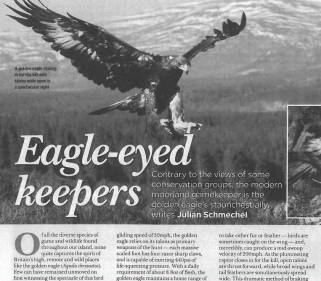 Talking of very, very stupid people….
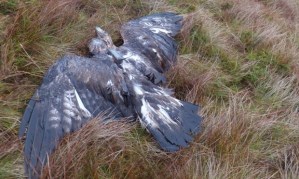 The golden eagle in Scotland does face a variety of threats or potential threats, including afforestation and the construction of wind farms. We don’t dispute that. However, the main scientific report on this issue has shown that the single biggest threat to golden eagles in Scotland is illegal persecution on driven grouse moors. That is a fact, backed up by scientific peer-reviewed evidence (see link above).
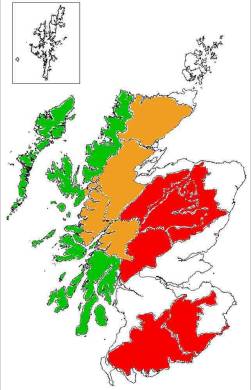 The article goes on: “It is interesting to note that eagle numbers are highest in eastern Scotland, where grouse moors are actively managed“. Er, no, they’re not. Try looking at the scientific data (see
  There’s an excellent article in the Scotsman today, written by Duncan Orr-Ewing, Head of Species and Land Management at RSPB Scotland.
