More distorted facts from Scottish Moorland Group Director Tim Baynes

We’ve all learned by now how Tim (Kim) Baynes, Director of SLE’s Scottish Moorland Group, likes to spin the facts; we only wrote about it last week (see here).

Here’s another well-spun article. We missed it when it was published in the Scottish Sporting Gazette (Summer 2016) but someone has kindly sent through. It’s classic Tim (Kim), pretending that illegal persecution is no longer an issue and also pretending that most conservationists (apart from us so-called ‘extremists’) now support the idea of some form of raptor ‘control’.

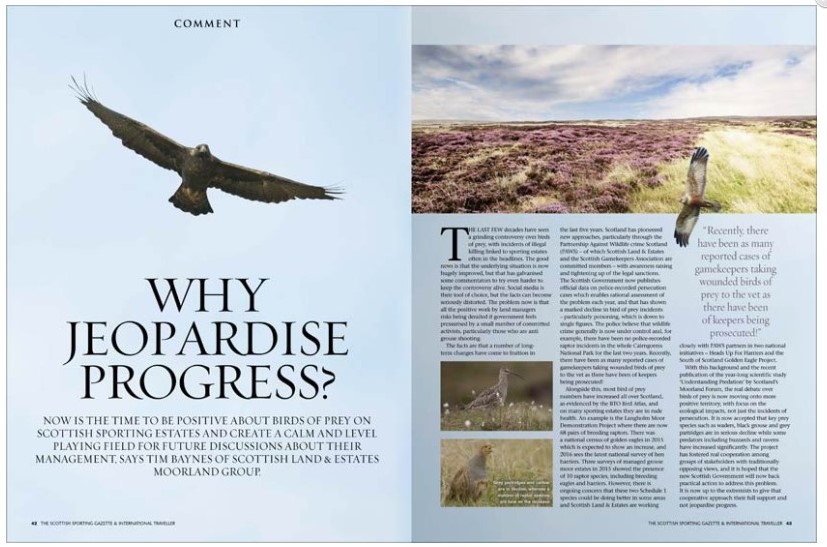
“The last few decades have seen a grinding controversy over birds of prey, with incidents of illegal killing linked to sporting estates often in the headlines. The good news is that the underlying situation is now hugely improved, but that has galvanised social commentators to try even harder to keep the controversy alive. Social media is their tool of choice, but the facts can become seriously distorted. The problem now is that all the positive work by land managers risks being derailed by a small number of committed activists, particularly those who are anti-grouse shooting.

The facts are that a number of long-term changes have come to fruition in the last five years. Scotland has pioneered new approaches, particularly through the Partnership Against Wildlife Crime (PAWS) – of which Scottish Land & Estates and the Scottish Gamekeepers’ Association are committed members – with awareness training and tightening up of legal sanctions.

The Scottish Government now publishes official data on police-recorded persecution cases which enables national assessment of the problem each year, and that has shown a marked decline in bird of prey incidents – particularly poisoning, which is down to single figures. The police believe that wildlife crime generally is now under control and, for example, there have been no police-recorded raptor incidents in the whole Cairngorms National Park for the last two years. Recently, there have been as many reported cases of gamekeepers taking wounded birds of prey to the vet as there have been keepers being prosecuted!

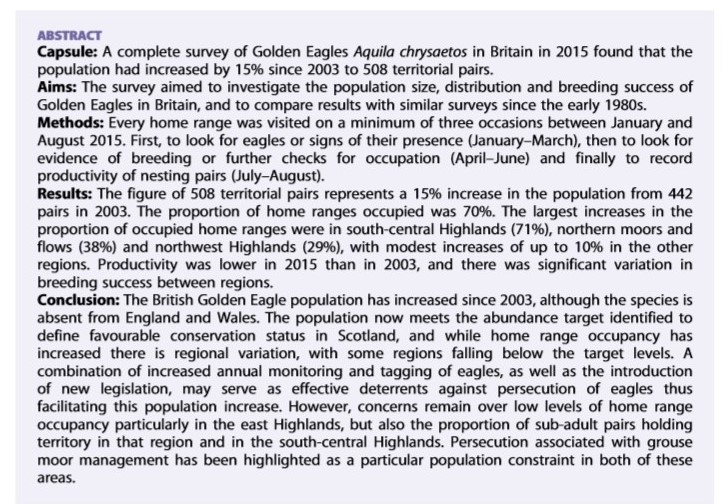
Alongside this, most bird of prey numbers have increased all over Scotland, as evidenced by the BTO Bird Atlas, and on many sporting estates they are in rude health. An example is the Langholm Moor Demonstration Project where there are now 68 pairs of breeding raptors. There was a national census of golden eagles in 2015 which is expected to show an increase, and 2016 sees the latest national survey of hen harriers.

Three surveys of managed grouse moor estates in 2015 showed the presence of 10 raptor species, including breeding eagles and harriers. However, there is ongoing concern that these two Schedule 1 species could be doing better in some areas and Scottish Land & Estates are working closely with PAWS partners in two national initiatives – Heads Up for Harriers and the South of Scotland Golden Eagle Project.

With this background and the recent publication of the year-long scientific study ‘Understanding Predation’ by Scotland’s Moorland Forum, the real debate over birds of prey is now moving onto more positive territory, with focus on the ecological impacts, not just the incidents of persecution. It is now accepted that key prey species such as waders, black grouse, and grey partridges are in serious decline while some predators including buzzards and ravens have increased significantly. The project has fostered real cooperation among groups of stakeholders with traditionally opposing views, and it is hoped that the new Scottish Government will now back practical action to address this problem. It is now up to the extremists to give that cooperative approach their full support and not jeopardise progress”.

END

We could spend all day pointing out the spin in Tim’s (Kim’s) claims, such as there being no police-recorded raptor persecution incidents in the Cairngorms National Park for two years (not quite true – see here), or that there are more reported cases of gamekeepers taking wounded raptors to the vets than there are of gamekeepers being prosecuted, implying that gamekeepers are no longer committing alleged offences (not quite true – see here), or implying that eagles and harriers were successfully breeding on three surveyed grouse moor estates in 2015 (not quite true – see here), or that most bird of prey numbers have increased all over Scotland (not quite true – see here, here, and incidentally both these scientific papers were published before Tim (Kim) wrote this tripe), or implying that all stakeholders, with traditionally opposing views, are now supportive of backing what Tim (Kim) calls ‘positive action’ against raptors (what he means is licenced ‘control’) – again, this is not true. Name one conservation NGO that doesn’t have a vested interest in game shooting who supports this idea?

One year on from Tim’s (Kim’s) world of fantasy, and our so-called ‘extremist’ claims that illegal persecution is still rife on many driven grouse moors has been validated by the findings of the recently published golden eagle satellite tag review. It is now apparent even to the Scottish Government that illegal raptor persecution continues, albeit very well hidden (apart from if the targeted raptor victim happens to be wearing a satellite tag) and on the basis of this overwhelming evidence, we are finally set to see some action.

Thank goodness the policy makers haven’t listened to Tim’s (Kim’s) distorted point of view.

UPDATE 22 June 2017: Retired Police Wildlife Crime Officer Alan Stewart has blogged about this article here

Technology challenge launched to solve problem of finding hidden or destroyed satellite tags

The Cairngorms National Park Authority has joined forces with Scottish Natural Heritage to co-sponsor a new CivTech challenge aimed at finding a creative and innovative technology-based solution to the problem of finding ‘disappearing’ satellite tagged raptors.

As you’ll be aware, satellite-tagged raptors are ‘disappearing’ in Scotland and England with increasing frequency. There was a time, in the early years of satellite tagging raptors, that illegally-killed birds would be found as their tags were still emitting signals allowing researchers to pinpoint the location of the corpse and thus evidence of the crime (e.g. poisoned golden eagle Alma whose corpse was found on Millden Estate in the Angus Glens in 2009). However, the raptor-killing criminals got wise to this and in recent years have been making more effort to destroy and hide the tag at the same time as killing the bird.

This lack of hard evidence causes problems for the wildlife crime enforcement agencies because it becomes very hard to prove that the bird has actually been killed. In a small number of cases, the satellite tag could just have malfunctioned, and we have seen evidence of this (e.g. hen harrier Highlander here), although the expected frequency of this happening is very low (the recent golden eagle satellite tag review identified tag reliability, based on studies of the same tags deployed in the US and Europe, as around 98%). Nevertheless, even with the high number of ‘disappearing’ tagged raptors in Scotland but little hard evidence of criminality, researchers have still been able to identify unusual concentrations / spatial clusters of where these birds have ‘disappeared’ in suspicious circumstances.

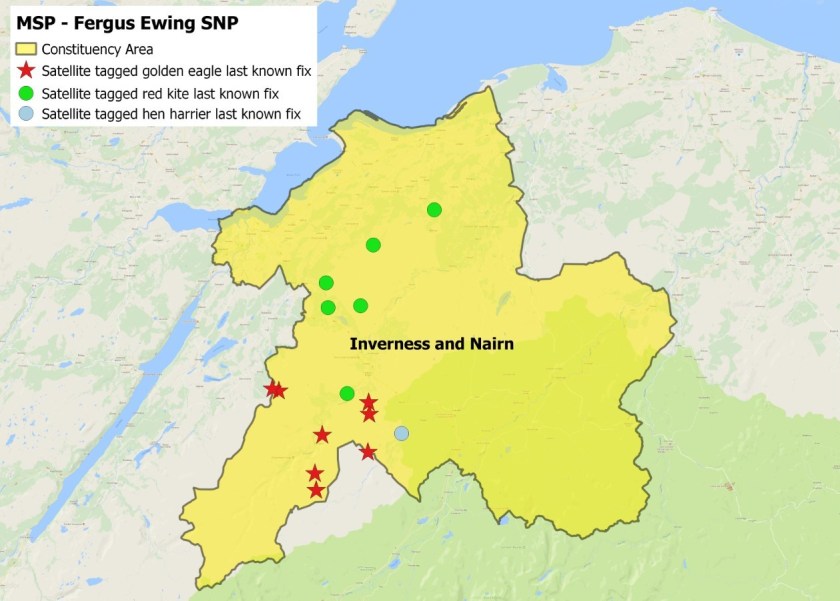
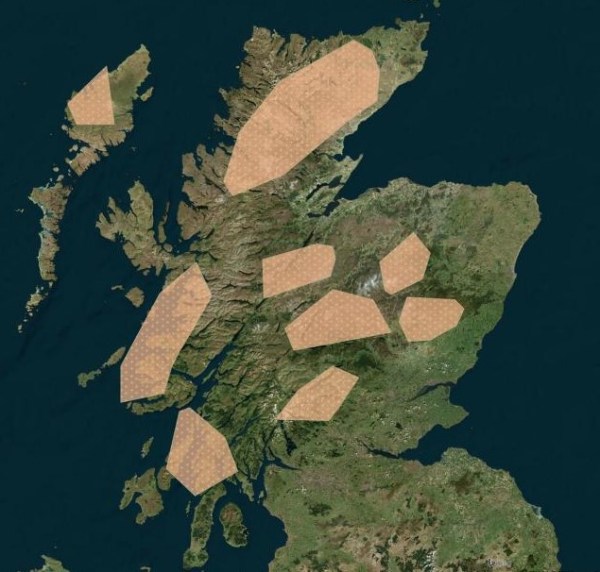
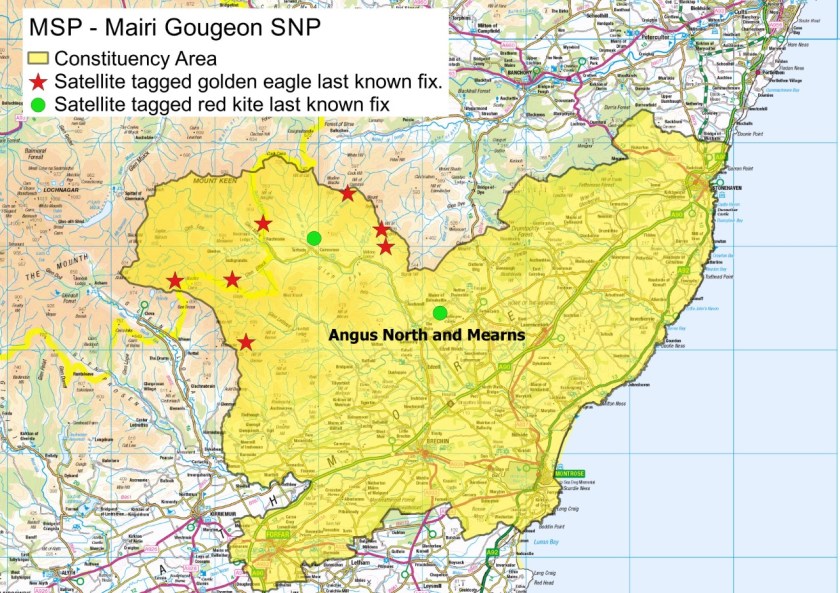
For example, here is a map showing the significant spatial clustering of ‘disappeared’ tagged golden eagles that just happen to be concentrated in several areas of driven grouse moors in and around the Cairngorms National Park, as identified in the golden eagle satellite tag review:

This identification of ‘suspicious’ persecution hotspots is excellent, and has contributed significantly to the Scottish Government finally accepting that this is an on-going problem that needs addressing, but it doesn’t provide enough information to instigate criminal proceedings against those involved. More hard evidence is required for that.

CivTech is a Scottish Government-led initiative, first piloted in 2016, which challenges creative technologists to come up with a solution to public sector problems. Some of the first challenges included improving flood forecasting and ensuring it is better used, and improving air quality in urban areas.

The joint Cairngorms National Park Authority / Scottish Natural Heritage challenge invites technologists to look at the problem of ‘disappearing’ satellite-tagged raptors and to devise a solution to find those tags, or at least provide ‘indestructible’, real-time information about the tag’s last location before it was tampered with. This probably won’t overcome the long-term problem of identifying an actual individual criminal, especially on an estate that employs multiple gamekeepers, but it might just be enough to create a deterrent. At the very least, it should provide enough information for the Scottish Government to impose civil sanctions on that estate – sanctions that are currently being discussed after Roseanna Cunningham’s announcement last month.

Opening up this challenge to the CivTech community is a very clever idea as it will reach an audience that probably knows nothing of this issue, and who may well come up with a solution that is beyond the expertise of the typical conservationist. Who knows what the technology geeks will come up with? The two instigators of the challenge (Grant Moir from CNPA and Keith Duncan from SNH) are open-minded as to what the solution might look like, e.g. a software-based solution that can be applied remotely to tags that are already deployed, or a new hardware solution that involves fitting a new gadget on to new raptors. Any new solution may be trialled in the Cairngorms National Park, a massive raptor persecution hotspot, and if successful, could be rolled out across the UK.

The closing date for applications has already passed (1 June 2017) and a ‘pitch day’ has been set for 26 July 2017.

Well done Grant and Keith. We look forward to hearing more about this later in the year.

Scottish Gamekeepers’ Association’s response to eagle satellite tag review

We’re slowly making our way through the recently published Golden Eagle Satellite Tag Review.

What an incredible piece of research! It goes far deeper than answering the simple question, ‘Is there a pattern of suspicious activity surrounding the ‘disappearance’ of many satellite tagged golden eagles?‘ (Answer: an unequivocal YES). The authors, Dr Phil Whitfield & Dr Alan Fielding, deserve much credit not only for their forensic analysis and clarity of presentation, but also for the extent of their review, demolishing long-held myths about the supposed unreliability of satellite tags, the supposed harmful effect of satellite tagging golden eagles (at an individual and population level), and the notion that wind farms are responsible for the ‘disappearance’ of many satellite-tagged golden eagles in Scotland. If you have the time to read beyond the headlines in this review, you’ll be rewarded with some really useful information that exposes the grouse shooting industry’s interminable denial about what’s been going on, some of which we discuss below.

Last Wednesday, the day the review was published, the Scottish Gamekeepers’ Association responded with this official statement:

Statement (in full, as given to media early today): SNH Report into missing tagged eagles

A Spokesman for the Scottish Gamekeepers Association said: “Losing, on average, 4 tagged eagles per year across Scotland is totally unacceptable. The illegal killing of any eagle is condemned wholeheartedly by the SGA and all law abiding gamekeepers.

Although this study assimilates 12 years of evidence and makes difficult reading, it does acknowledge recent improvements in some grouse moors areas previously associated with suspected persecution. This change has contributed to the overall betterment of the golden eagle’s conservation status, as recently reported.

That said, problems clearly still exist in some hotspot areas and, in our view, this can only be tackled by all partners having access to the same telemetry data in order to arrive at shared and targeted solutions. If this had been happening over the past decade, there is a high likelihood these problems could have been tackled satisfactorily before now.

The SGA does not believe the report adequately tackles the threat wind farms pose to raptor species as there is a significant amount of published data from other countries which show a negative correlation between bird survival and turbine strike.

However, that is not an attempt in any way to detract from the report’s findings“.

END

The SGA says the report “made difficult reading“. It’s apparent, from their official statement, that the report also made for difficult comprehension (for them). They refer to recent improvements in some grouse moor areas which led to the golden eagle’s national conservation status changing from ‘unfavourable’ (largely due to illegal persecution) to ‘favourable’, as we blogged about here. However, what the SGA has conveniently forgotten to mention is the following statement from the golden eagle satellite tag review:

We also expect that there may have been some recovery in some parts of the central and eastern Highland regions where the species’ conservation status was previously unfavourable due largely to illegal persecution. These regions, however, still yield evidence of continued illegal persecution in parts, and so we would not expect recovery to the full capability of breeding birds being evident‘.

In other words, the recent improvements in some areas do not off-set the continued illegal persecution that is, quote, “still hampering overall recovery from historic, widespread persecution“.

The SGA does acknowledge that “problems still clearly exist in some hotspot areas” but then claim that “this can only be tackled by all partners having access to the same telemetry data in order to arrive at shared and targeted solutions. If this had been happening over the past decade, there is a high likelihood these problems could have been tackled satisfactorily before now”.

Eh? Are they suggesting that before the publication of this review, they were totally unaware of where these hotspot areas were? Talk about disingenuous. They’ve been made fully aware, for many years, of where these persecution hotspots are (some intensively managed grouse moors in the Monadhliaths, eastern Cairngorms, Angus Glens and parts of north Perthshire), through their participation in the PAW Scotland Raptor Group and also from widespread media coverage every time a sat tagged raptor has ‘disappeared’ or every time a raptor has been found illegally poisoned, shot or trapped in these, and other areas. Their feigned ignorance is ludicrous.

They argue that if they’d had access to the sat tag data, the illegal killing “could have been tackled satisfactorily before now“. How? By telling gamekeepers on the ground which tagged eagles are in the area so don’t shoot those ones? It’s worth remembering how the SGA reacted when they were given access to detailed information about one tagged golden eagle, that was illegally trapped on a grouse moor in the Angus Glens, suffering two broken legs as a consequence (both almost severed, according to the Golden Eagle Sat Tag Review), and then was moved, while still alive, in the middle of the night to be dumped in a lay by on Deeside 15km away and left to suffer an excruciating and miserable death (see here). Did the SGA accept the findings of the independent expert veterinary pathologist and come down like a tonne of bricks on the estate? No, they concocted the most outlandish explanation for what might have happened to that eagle and then slagged off the RSPB for suggesting a crime might have taken place (see here). If that’s the SGA’s idea of ‘tackling the problem satisfactorily’ then it’s no wonder the illegal killing continues.

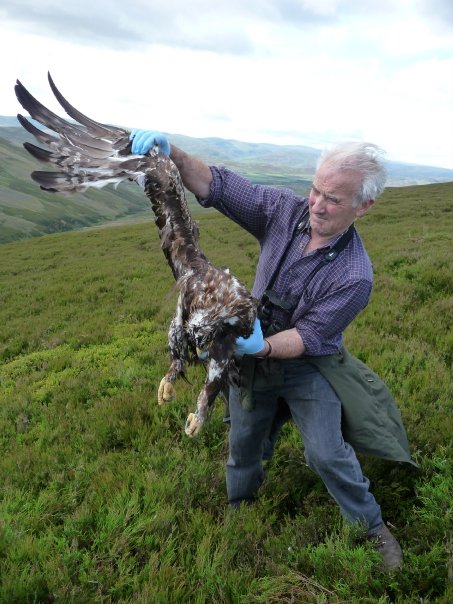
Photo of the ‘Deeside’ golden eagle (RSPB)

This sat tag review has validated the long-held concerns of conservationists that parts of the grouse shooting industry are out of control, aided and abetted by the blind-eye turning of industry representatives, and this example is just one of many that shows the industry’s inability to self-regulate and why licensing is now very much on the cards.

The SGA’s response to the satellite tag review then comes back to one of their old favourites, wind farms. Not for the first time have wind farms been cited as being a more serious threat to Scottish raptors than illegal persecution (a myth we’ve debunked at least twice, see here and here). In the SGA’s latest statement it says:

The SGA does not believe the report adequately tackles the threat wind farms pose to raptor species as there is a significant amount of published data from other countries which show a negative correlation between bird survival and turbine strike”.

Dear God. Do they not understand that the potential collision risk of a wind farm will be calculated on innumerable variables (e.g. topography, altitude, wind speed, wind farm size, turbine size, species behaviour, etc etc etc) so just because a wind farm in one country has proven disastrous for some raptor species, it doesn’t then mean that all wind farms, wherever they are sited, are going to have the same negative impact. Of course there are issues, and these are well documented, but had the SGA bothered to read the in depth chapter on wind farms in this sat tag review, they’d have realised that wind farms have been ruled out for causing the ‘disappearance’ of so many satellite-tagged golden eagles. And not ruled out on a whim, but ruled out based on almost half a million location ‘fixes’ of 112 tagged eagles.

In fact, the review has more than adequately tackled the threat of wind farms to golden eagles in Scotland, and in addition to the review’s headline that ‘Wind farms were not associated with any recorded golden eagle deaths‘ the report also includes some startling revelations. Here are some direct quotes:

  • No ‘stopped no malfunction’ last fixes [i.e. abruptly ‘disappearing’ eagles] were within 1 km of an operational wind farm [see map below]. It is difficult to envisage a situation whereby a trauma sufficient to suddenly destroy a tag would allow a bird to travel afterwards for more than 1 km.
  • Moreover, records of tagged eagles close to wind farms were rare with only 0.005% of 360,711 fixes being within 150 m of an operational turbine. This indicated that even the risk of collision with a turbine blade was miniscule. Furthermore, it would add no support to a notion that technicians visiting turbines were discovering and then ‘covering up’ victims of collision, including moving dead birds away from the wind farm before, or then, curtailing the operation of the tag.
  • Overall, there was no evidence that wind farms were a direct or indirect agent of anthropogenic influence on the sudden tag failures of many young golden eagles. The reverse was more evidentially likely – that young golden eagles appeared to avoid operational wind farms.
  • Addressing the frequently heard accusation that wind farm technicians are removing and thereby ‘covering up’ the deaths of raptors that have been struck by a turbine blade, the report says: In Scotland this possibility seems remote given that: a) on incentive, the continued operation of no wind farm in Scotland is conditional on operational monitoring feedback in planning; b) technicians are not employed directly by the developer and are contracted independently by the turbine manufacturer and according to the projected lifespan of the wind farm; c) independent checks on reporting fatalities can be conducted at several wind farms by other contractors, and at least some developers (P. Robson pers. comm.) further blind-check these in staged exercises due to additional baseline legal requirements on environmental liability reporting; and d) many dead birds of prey (including tagged birds) have been routinely recorded incidentally by technical engineers and reported through several channels (e.g. Sansom et al. 2016, Urquhart & Whitfield 2016). In other words there are several checks and balances in Scotland to circumvent the possibility that carcasses of dead birds of prey would not be reported at wind farms and not disposed of once discovered (and even when relatively few birds will have been tagged). Nevertheless, our analyses were grounded to consider such a possibility; however remote.
  • Interestingly, and by contrast, from the many data sources we have received and examined, we are not aware of dead tagged raptors having being reported by managers or employees of game bird shooting estates in Scotland.

So, after trying to muddy the water with commentary about the potential impact of wind farms, even though the review has clearly shown wind farms are not implicated in the ‘disappearance’ of over 40 satellite-tagged golden eagles, the SGA’s official response to the sat tag review concludes with the line:

However, that is not an attempt in any way to detract from the report’s findings”. 

Really? That’s exactly what it looks like to us.

Presumably, then, now the SGA has been made fully aware of where the persecution hotspots are (certain grouse moors in the Angus Glens, Monadhliaths, eastern Cairngorms and north Perthshire), not to mention the other well-known persecution hotspots that didn’t feature in this golden eagle report (e.g. certain grouse moors in the Moorfoots, Lammermuirs and Lowther Hills), we can now expect to see the SGA setting up some ‘targeted solutions’ in these areas? Can’t wait.

Scottish Government announces significant action in fight against raptor persecution

Today is an historic one in the fight against illegal raptor persecution in Scotland. This is the day that the Scottish Government has finally agreed to take bold, innovative action against a criminal sector of society that has got away with so much for so long.

This afternoon, Cabinet Secretary for the Environment, Roseanna Cunningham, has announced a package of measures to tackle wildlife crime, and specifically the illegal killing of protected birds of prey on some driven grouse moors.

This package has been triggered by the publication of the much anticipated review of golden eagle satellite tag data, which shows clear evidence of deliberate and sustained illegal raptor persecution over a number of years.

Here is a copy of the report: Analyses of the fates of satellite tracked golden eagles in Scotland

Here is a brief summary of the review’s findings:

We will be blogging about this review extensively in due course, but for now, have a look at these maps we’ve created. The first one shows the locations of the last known fixes of satellite-tagged golden eagles that have disappeared in suspicious circumstances across Scotland, and the second map zooms in on some significant clustering on several driven grouse shooting estates in and around the Cairngorms National Park (including the Monadhliaths, Angus Glens and North Perthshire).

NB: These maps are copyright of RPUK and may not be reproduced without written permission

In response to this latest evidence demonstrating the appalling scale of illegal raptor persecution, the Cabinet Secretary has announced the following measures designed to protect birds of prey, the wider Scottish environment and the reputation of those who abide by the law:

We will comment on each of these measures in due course when we’ve had time to consider the implications. As an immediate response, we very much welcome the majority of them, but we’re disappointed that the SSPCA will not be given increased investigatory powers. Nevertheless, we are delighted to see both long and short-term action, which is exactly what we asked for.

Roseanna Cunningham said:

This day has been a long time coming. Many, many people have been involved in this protracted battle for several decades and each and every one has played an important part. From the highly skilled raptor fieldworkers, to the RSPB and particularly its Investigations and behind-the-scenes advocacy teams, to the academics who have analysed and published the scientific data, to the campaigners who have brought this scandal to the attention of the wider public. It is the efforts of all of these people combined that has influenced public opinion and brought us to this watershed moment.

We would like to pay tribute to Cabinet Secretary Roseanna Cunningham. Be under no illusion about the strength and power of the dark forces that have influenced and manipulated this situation for so many decades. It takes considerable courage to go up against that and we applaud her all the more for it. Please, take the time to send her a message of thanks and let her know that you welcome and support her announcement. Emails to: CabSecECCLR@gov.scot

RESPONSES & MEDIA COVERAGE

Scottish Government statement here

RSPB Scotland press statement here

Blog from RSPB Scotland’s Head of Investigations, Ian Thomson here

Scottish Land & Estates press statement here (PS. they’re still in denial)

Scottish Gamekeepers’ Association statement here (still clinging on to the wind farm myth)

BBC News here

Cairngorms National Park Authority statement here

Herald here

Independent here

UPDATE 5 June 2017: Our analysis of the SGA’s response here

Raptor satellite tag review: the questions being addressed

As many of you will be aware, we are currently awaiting the publication of a review of raptor satellite tag data in Scotland.

This review was commissioned in August 2016 by Environment Cabinet Secretary Roseanna Cunningham, in response to the news that eight satellite-tagged golden eagles had all ‘disappeared’ in the Monadhliaths. She said she wanted to see whether the data demonstrated ‘a pattern of suspicious activity’.

The Cabinet Secretary later extended the review to not only look at golden eagle satellite tag data, but also data from tagged red kites and hen harriers. This was in response to the news of yet another satellite-tagged hen harrier (‘Elwood’) who also ‘disappeared‘ in the Monadhliaths just a few weeks after fledging.

We knew the review was being undertaken by two highly experienced and respected researchers (who each have a publication list as long as your arm) so there weren’t any concerns there, and we knew that the report was due to be submitted to SNH by the end of March 2017. Other than that, very little detail has emerged about what, exactly, the review would include.

Following a recent FoI to SNH about a related matter, we now have some information about the questions the review will address:

This information was revealed within some correspondence between Scottish Land & Estates and SNH in February this year. The name of the SLE correspondent has been redacted but it’s probably safe to assume it was (now recently departed) CEO Doug McAdam. It looks like SLE are a bit twitchy about what this review might reveal. Here’s a copy of the correspondence: Correspondence between SLE_SNH re sat tag review

So when can we expect the review to be published? We know a draft was submitted to SNH at the end of March 2017 and that it was sent to three experts for peer review. Almost a month has now passed so we would expect the peer-review process to have been completed and any proposed editorial suggestions to have been finalised. What we don’t know is whether the publication of this review will be delayed due to election purdah.

What we can be sure of is if the review has not been published by the time of the General Election on 8 June, SNH and the Scottish Government will be put under intense pressure to put it in the public domain. If they think the public will sit quietly for months, or years, awaiting publication, they are very much mistaken.

Police confirm RSPB staff did not have covered faces on estate search for missing eagle #338

For the benefit of those not on social media and who therefore may have missed this……

Further to yesterday’s blog (here) about the police search of North Glenbuchat Estate for missing golden eagle #338, Police Scotland has today stated that RSPB staff who assisted them on the search did NOT have covered faces (see twitter account of Ian Thomson, Head of RSPB Scotland Investigations, @Ian_M_Thomson).

So, the hysteria about ‘masked RSPB thugs’, ‘masked intruders’, and accusations that the RSPB is behaving like a ‘balaclava-clad paramilitary outfit’, whipped up by the likes of Bert Burnett (Scottish Gamekeepers’ Association) and other senior representatives of the game-shooting industry, was simply another failed attempt to distort the facts and create a diversion so that the focus of frequently ‘disappearing’ satellite-tagged eagles on grouse moors didn’t get the attention it merits.

We can expect more of this, in the run up to the publication of the forthcoming raptor satellite-tag review. The net is closing in on those within the game-shooting industry who continue to kill raptors, and they know it.

Photo of golden eagle #338 copyright Scottish Raptor Study Group


More on ‘missing’ golden eagle #338, North Glenbuchat Estate

On Saturday 1 April 2017, we blogged about a satellite-tagged golden eagle (#338) that the RSPB reported had ‘disappeared’ after its last sat tag signal pinged in from the North Glenbuchat Estate in the Cairngorms National Park in early March (see here).

The estate, via PR company Media House, issued a robust statement in response and posted a video clip of a young eagle, purportedly filmed on the estate on 30 March, that the estate’s head gamekeeper “firmly believed” to be golden eagle #338.

We commented at the time that the video footage was very poor quality and it was difficult to see whether the eagle in the video was even carrying a satellite tag. We also pointed out that other sat-tagged golden eagles are currently flying around Scotland so even if this eagle in the video was carrying a tag, it would have been virtually impossible for the head gamekeeper to know whether it was eagle #338 or one of the others.

Since then, various expert field ornithologists both in the UK and the USA, all of whom specialise in golden eagles, have contacted us about the video. All of them said that although the video quality was poor, the plumage characteristics of the eagle in the video were not consistent with that of a nine-month old male golden eagle, but appeared to be consistent with what they’d expect of a second year female golden eagle.

On Sunday 2 April 2017, Media House issued another press statement on behalf of North Glenbuchat Estate and published a second video, purportedly of eagle #338, filmed on the estate on Saturday 1 April 2017. The quality of this second video is even worse than the first video (you could be looking at a flying cabbage) so it’s not much use as the supplementary evidence it was clearly intended to be.

The text of this second press release via Media House is well worth a read: North Glenbuchat Estate press release_2

In it, Media House states that the RSPB staff who were involved in the police search of the estate last week (at the invitation of Police Scotland – good, partnership working) “were hooded and kept their faces covered“.

This sentence has been widely abused by the nasty brigade on social media and has been turned into phrases such as ‘Masked intruders‘, ‘Masked RSPB thugs‘ and ‘RSPB representatives conducting themselves like hunt saboteurs wearing intimidating hoods and masks‘. Doubtless spurred on by the following inflammatory commentary from Bert Burnett (Scottish Gamekeepers’ Association) on his facebook page:

So yet again, the focus of attention is dragged away from the issue at hand (the disappearance of yet another satellite-tagged raptor on a grouse moor) and moved on to the usual anti-RSPB rhetoric in an attempt to discredit anybody or anything that might point to on-going concerns about the frequency with which satellite-tagged raptors seem to ‘disappear’ in areas where intensive grouse moor management takes place.

This abuse of the RSPB is nothing new, of course, but it’s interesting that the false claims about the efficiency of satellite tags, the false claims that the RSPB does not follow PAW raptor protocols, and the attempted denigration of raptor workers and those who fit these satellite tags, has been extremely prevalent since August last year when the Cabinet Secretary announced her decision to undertake an independent review of raptor satellite tag data. The abuse will no doubt have not gone unnoticed by the Scottish Government.

But back to the missing golden eagle #338. As we’ve been writing this blog, a very interesting map has appeared on Twitter (see @Ian_M_Thomson). It’s a map showing the recent movements of three other satellite-tagged golden eagles around Glenbuchat in March – April 2017:

Clear evidence that the eagle filmed by the head gamekeeper could have been any one of these other eagles so his “firm belief” that he was filming eagle #338 may have been his genuine belief but in fact is nothing more than hopeful optimism.

Nice try, but no cigar.

Meanwhile, the satellite tag signal from golden eagle #338 remains silent.

UPDATE 5 April 2017 14.38hrs: Ian Thomson (Head of RSPB Investigations Scotland) has just tweeted the following:

@Ian_M_Thomson: ‘Regarding missing eagle #338, Police Scotland has provided clarification to @PAWScotland partners that have contacted them that @RSPBScotland staff assisting them on a search in Glenbuchat last week did NOT have covered faces. We look forward to @PAWScotland partners disseminating this information to their memberships’

UPDATE 31 May 2017: North Glenbuchat Estate identified in Government-commissioned report as one of several hotspots where satellite-tagged golden eagles have regularly ‘disappeared’ in suspicious circumstances (here).

Satellite-tagged golden eagle ‘disappears’ on North Glenbuchat Estate in Cairngorms National Park

RSPB Scotland has released the following press statement:

APPEAL FOR INFORMATION AFTER ANOTHER SATELLITE-TAGGED GOLDEN EAGLE “DISAPPEARS”

RSPB Scotland has today issued an appeal for information following the disappearance of a satellite tagged golden eagle near Strathdon in Aberdeenshire.

The young male eagle was fitted with a transmitter by a licensed raptor study group member, before it fledged from a nest in Deeside in the summer of 2016. Data received from the tag allowed conservationists to study the movements of the bird, known as “338”, as it explored north-east Scotland’s countryside.

As with most young eagles, the bird spent the first few weeks after fledging in the area around its nest, before moving further away as it matured and was more able to fend for itself, spending much of its time on the eastern side of the Cairngorms National Park.

Overnight on Sunday 5th/Monday 6th March, the tag fitted to 338 inexplicably stopped working, having being functioning perfectly up to that point. The bird’s last recorded position was in Glenbuchat just before nightfall on 5th March. No further data has been received.

Ian Thomson, RSPB Scotland’s Head of Investigations said: “As soon as we became aware of this bird’s disappearance, we notified Police Scotland, in line with PAW Scotland protocols, who concurred that the circumstances were suspicious. These tags are very reliable, and the sudden cessation of transmissions strongly suggests the bird has died. Had the bird succumbed to natural causes, we would expect to continue to receive data and to be able to locate and recover the body of the eagle with ease”.

Follow up enquiries on the North Glenbuchat Estate by police officers, assisted by RSPB staff, yielded no sign of the bird.

In 2011, a satellite-tagged golden eagle was found illegally poisoned on the same estate, with a shot short-eared owl and poisoned buzzard also discovered. Another satellite-tagged golden eagle disappeared here in September 2011, with further such tagged birds also vanishing in the same area, in February 2012 and May 2013. In April 2014, the first young white-tailed eagle to fledge from a nest in the east of Scotland in one hundred years also disappeared here.

Ian Thomson continued “The circumstances surrounding the disappearance of eagle 338 are similar to a number of previous cases currently being considered by an independent review of satellite-tagged birds of prey commissioned by the Scottish Government. If this review reveals a geographical pattern to disappearing golden eagles, we will be pressing the Scottish Government for firm action, including the introduction of a licensing system for driven grouse shooting, with sanctions for licence removal from land where there is evidence of illegal practices. In the meantime, we appeal for any information about the disappearance of this bird to contact the police”.

Ends

Eagle 338 successfully fledged from a nest in Deeside in 2016. Photo copyright Scottish Raptor Study Group.

As the RSPB Scotland statement says, eagle 338 is not the first to ‘disappear’ on the North Glenbuchat Estate.

In March 2011 a satellite-tagged eagle (#57319) was found poisoned on North Glenbuchat Estate (toxicology tests confirmed the banned poison Carbofuran had been used). A follow up police search, under warrant, recovered the remains of a short-eared owl under a rock – a post mortem confirmed it had been shot; a poisoned bait (rabbit) laced with Carbofuran; and a poisoned buzzard (Carbofuran). Nobody was prosecuted.

In September 2011 a satellite-tagged eagle (#95065, named Strathy) ‘disappeared‘ on North Glenbuchat Estate. Its tag had been functioning perfectly well before it suddenly and inexplicably stopped.

In February 2012 a satellite-tagged eagle (#57111) ‘disappeared’ on North Glenbuchat Estate. Its tag had been functioning perfectly well before it suddenly and inexplicably stopped.

In May 2013 a satellite-tagged eagle (#84133, named Angus 33) ‘disappeared‘ on North Glenbuchat Estate. Its tag had been functioning perfectly well before it suddenly and inexplicably stopped.

In April 2014 a satellite-tagged white-tailed eagle (White 1) ‘disappeared‘ on North Glenbuchat Estate. Its tag had been functioning perfectly well before it suddenly and inexplicably stopped.

That’s a lot of catastrophic tag failures all in one small area, over a six year period, isn’t it? And it’s patterns like this that the forthcoming raptor satellite tag data review will be exploring. What’s the betting that similar patterns will be seen in other areas in Scotland where the land is managed intensively for driven grouse shooting (e.g. Monadhliaths, Angus Glens)?

Interestingly, two press releases have so far been issued in response to this RSPB Scotland press release. One is from the landowners’ lobby group Scottish Land & Estates and the other one is from the North Glenbuchat Estate. It’s interesting to note that both press releases came via ‘public relations and crisis management’ experts, Media House.

The statement from Scottish Land & Estates appears to be supportive of the RSPB’s appeal for information. Read it here: Scottish Land & Estates press release North Glenbuchat eagle

The statement from North Glenbuchat Estate is very different. Read it here: North Glenbuchat Estate press release North Glenbuchat eagle

The estate’s statement includes the following claim: “The estate head gamekeeper filmed what he firmly believes to be the eagle in question yesterday afternoon” (March 30 2017) and there is an accompanying video of this eagle (here). It’s well worth a look. It’s definitely a juvenile golden eagle and it’s definitely been filmed on Glenbuchat Estate. However, it’s not known when the footage was taken and it’s extremely difficult to see whether this eagle is even carrying a satellite tag. But even if it is carrying a tag, how on earth can the keeper “firmly believe” that this is eagle 338? Surely he / the estate knows that there are plenty of satellite-tagged eagles flying around Scotland at the moment and it could be any one of those!

It all looks a little bit lame and a teensy bit desperate, but maybe that’s just us. Maybe eagle 338 is still flying around the Cairngorms National Park, along with all the other ‘missing’ satellite tagged eagles. Perhaps, having learned to use jamming technology to block the signal from their satellite tags, they’re now hanging around the Co-op car park in Grantown on Spey, using their skills to block remote-locking car keys with criminal intent so they can steal the vehicles and go joy riding around the National Park.

There are bound to be further responses to today’s news over the coming days and we’ll be reviewing those as and when they appear, but the one response we’re really keen to hear is the one from the Environment Cabinet Secretary, Roseanna Cunningham. We don’t plan to bombard her with outraged emails this time. She knows the score, she knows exactly what’s going on, and she knows that there is high expectation for her / the Scottish Government to finally address this issue with the full force it demands.

She will be considering the findings of the raptor satellite tag review over the next couple of weeks so while we wait to hear what action she intends to take, you can amuse yourselves by reading this article about the ownership of North Glenbuchat Estate, written by Andy Wightman in 2014.

(Photos by RPUK)

UPDATE 4 April 2016: More on missing golden eagle #338, North Glenbuchat Estate (here)

South Scotland Golden Eagle Project receives £1.3M lottery funding

The South Scotland Golden Eagle Project, which proposes to translocate eagles from the Highlands to boost the tiny eagle population in Dumfries & Galloway and the Borders, has been awarded over £1.3 million from the Heritage Lottery Fund (see here).

This means the project can now move forward by submitting a licence application to SNH and, if the licence is approved, the plan is to start collecting eaglets from Highland nests during the 2018 breeding season, with the intention of releasing between five and ten young eagles in southern Scotland each year until 2022.

We’ve blogged about this project before, back in 2015 when the planned translocation was first announced. We had mixed feelings about it then (see here) and we still do now.

On the one hand, the south Scotland golden eagle population is on its knees and has been for some time (see here). If nobody intervenes, the last few pairs remain extremely isolated and vulnerable and there’s every chance this sub-population will disappear. For this reason, intervention by way of releasing more birds seems like a good idea.

However, unless the cause of this sub-population’s decline has been identified and removed or sufficiently reduced, it is absolutely pointless bringing in new birds that are likely to suffer the same fate.

One of the biggest constraints on golden eagle population recovery in southern Scotland is persecution. Raptor persecution in southern Scotland has definitely not been removed, nor sufficiently reduced. It has been argued (by Scottish Land & Estates) that raptor persecution in southern Scotland ‘may have been an historical factor’ in the demise of the south Scotland eagle population, but apparently it isn’t an issue any more. Unfortunately, the evidence doesn’t support that claim. Here’s a map from the 2008 Golden Eagle Conservation Framework showing the conservation status of golden eagles in Scotland (red = unfavourable conservation status), overlaid with ten years of raptor persecution data (all species, 2005-2015) gleaned from ‘official’ persecution maps. Does it look to you like raptor persecution isn’t an issue in southern Scotland?

The 2014 SNH-commissioned report on the status of golden eagles in southern Scotland also identified several areas where persecution is an ongoing concern, including the Lowther Hills, the Lammermuirs and the Moorfoots (all driven grouse moor areas – what a surprise), and stated that persecution needed to be brought under control in those regions if golden eagles were to thrive in southern Scotland once again.

On the basis of this evidence, we would argue that translocating golden eagles to southern Scotland in the immediate future is not a wise decision. But, there is a counter argument. Young golden eagles travelling around the Highlands during their early years are just as likely to be illegally killed in the north as they are in south Scotland (e.g. see here). So, if the risk is just as great in the north, why not bring those eagles to the south, where, under the intense public attention that this project will generate, the young birds may actually have a better chance of survival because the would-be raptor killers will know they’re under close scrutiny (each eagle will be satellite-tagged). Although that’s assuming the young birds remain in southern Scotland during their formative years – we know that a young eagle that fledged from the Dumfries & Galloway nest in 2015 ‘disappeared’ on a grouse moor in the Monadhliaths just after her first birthday in 2016 (see here).

Others have commented that prey availability will pose a problem for an increasing eagle population in the south, but a recent report (here) has shown that ‘the region possesses a sufficient prey base to sustain a breeding population of golden eagles of 12-16 pairs’. Here is a photo of a young golden eagle at the one remaining productive breeding site in the Borders. Judging by the nest contents, prey availability doesn’t appear to be a problem.

Whatever the concerns may be, it looks like this project is going ahead (pending the licence application) and let’s be honest, at least the primary motivation for this scheme is NOT to appease the grouse-shooting lobby, unlike the ludicrous Hen Harrier brood meddling scheme in England, but to help improve the sustainability of this important sub-population. Our misgivings haven’t yet been allayed, but we still have fingers crossed for its success because inaction (i.e. waiting for illegal raptor persecution to stop) is no longer an option if this sub-pop is to survive.

‘Official’ 2016 raptor persecution maps are a misleading distraction

Today the Partnership for Action against Wildlife Crime (Scottish PAW Raptor group) has published the so-called ‘official’ annual raptor persecution maps showing details of recorded raptor persecution crimes for 2016.

Once again, Police Scotland has withheld information about several incidents ‘for operational reasons’ and as such these are not included on the ‘official’ map. Some details have been included in the accompanying summary data tables but even information as basic as the species affected has not been published.

Here’s the ‘official’ map purportedly showing ‘ALL’ recorded bird of prey crimes in Scotland from 2013 to 2016:

However, just as last year, some incidents are not shown and so the title of this map is totally misleading. As we’ve said before, there is no point whatsoever publishing these maps if Police Scotland is going to keep some of these crimes a secret. Seriously, what is the point?

The PAW Raptor group is headlining today’s news as a “26% drop in recorded bird of prey offences during 2016“. No doubt this supposed ‘good news’ will be used by the game-shooting industry as evidence that things are improving. On a superficial level this looks like a reasonable conclusion, but as well as the withholding of known poisoning offences, other information has also been excluded.

For example, there is no mention at all about the four satellite-tagged golden eagles that are known to have ‘disappeared’ in suspicious circumstances in 2016: three of them ‘disappeared’ on grouse moors in the Monadhliaths and one ‘disappeared’ on a grouse moor in the Angus Glens.

There is also no mention of the three satellite-tagged hen harriers that are also known to have ‘disappeared’ in suspicious circumstances in 2016: ‘Chance‘ disappeared on a South Lanarkshire grouse moor in May 2016; ‘Elwood‘ vanished on a Monadhliaths grouse moor in August 2016;  and ‘Brian‘ vanished on a grouse moor in the Cairngorms National Park in August 2016.

PAW Scotland will argue that these data have not been included because they do not represent confirmed persecution crimes. Technically, that’s fair comment, but given the frequency with which satellite-tagged raptors are ‘disappearing’ on Scottish grouse moors, they point to a much more sinister picture, as recognised by the Environment Cabinet Secretary when she ordered a review of raptor sat tag data last year. She also mentions that review in her comments about today’s supposed ‘good news’.

As far as we’re concerned, the PAW Scotland raptor persecution maps are a misleading distraction from what is actually going on in the Scottish uplands. All eyes should be on the forthcoming raptor satellite tag review for a more meaningful and revealing picture.

PAW Scotland press release here

PAW Scotland persecution maps and data here